|
시장보고서
상품코드
2115824
농업 분석 : 시장 점유율 분석, 업계 동향 및 통계, 성장 예측(2026-2031년)Agriculture Analytics - Market Share Analysis, Industry Trends & Statistics, Growth Forecasts (2026 - 2031) |
||||||
 Mordor Intelligence
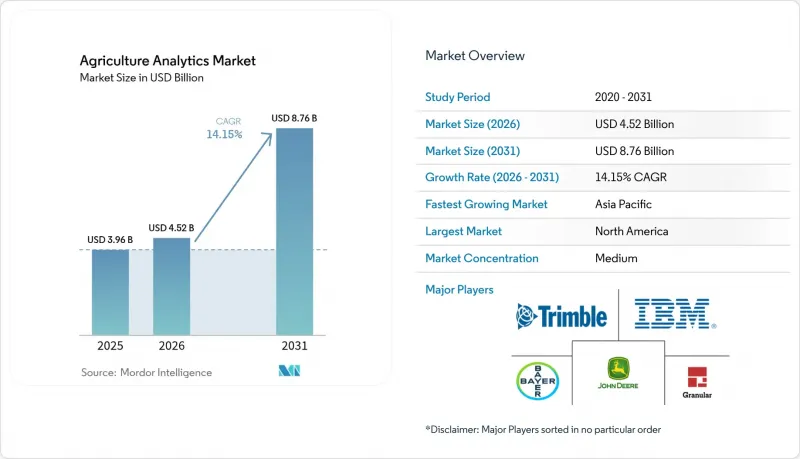
Mordor Intelligence에 의하면, 농업 분석 시장 규모는 2025년 39억 6,000만 달러로 평가되었습니다. 2026년에는 45억 2,000만 달러로 확대되어 2026년부터 2031년에 걸쳐 CAGR 14.15%로 성장을 지속하여, 2031년까지 87억 6,000만 달러에 이를 것으로 예측됩니다.
본 보고서는 구성 요소(솔루션, 서비스), 용도(농장 분석, 가축 분석 등), 도입 모델(On-Premise, 클라우드 중심 SaaS, 엣지/하이브리드),농장 규모(소규모 농장, 중규모 농장, 대규모 농장), 데이터 소스(위성·항공 이미지, UAV/드론 이미지 등), 분석 기법(기술적, 예측적(ML) 등), 지역별로 분류되어 있습니다.
세계의 농업 분석 시장 동향 및 인사이트
대규모 줄 재배 농장에서 디지털 농업의 ROI가 20%를 돌파
대규모 줄 재배 농장에서 정밀 농업의 투자 수익률(ROI)은 꾸준히 20%를 상회하고 있으며, 이는 대규모 생산자들이 분석 플랫폼 도입을 확대하는 동기가 되고 있습니다. 비용 절감은 가변율 비료 시비 및 기계 가동 일정 최적화를 통해 실현되는 반면, 수확량 증대는 밭별 종자 파종 계획을 통해 이루어지고 있습니다. JDLink가 탑재된 농업 기계의 성공 사례는 통합된 원격 측정 데이터가 실행 가능한 인사이트력을 창출하여 투입 자재 사용량을 두 자릿수 비율로 줄일 수 있음을 보여줍니다. 대규모 농장에서 입증된 수익성은 중규모 생산자들도 유사한 도구를 도입하도록 유도하여 농업 분석 시장의 확대로 이어지고 있습니다. 그러나 소규모 농가에서는 농업적 이점이 입증되었음에도 불구하고 여전히 구독료 지불에 어려움을 겪고 있습니다.
농업 소매업체가 Analytics-as-a-Service 계약을 번들로 제공
자재 공급업체들은 제품 판매에서 토양 검사, 원격 감지, 수확량 예측을 통합한 데이터 기반 서비스 번들로 사업 전환을 추진하고 있습니다. 바이엘(Bayer)과 Source.ag의 제휴는 소매업체가 AI를 온실 실험에 접목해 종자 선정을 최적화하고 있음을 보여줍니다. 번들 계약은 공급업체에 예측 가능한 수익을 가져다주고, 농가에는 종합적인 의사결정 지원을 제공함으로써 농업 분석 시장 전반에 걸친 지속적인 수요를 뒷받침하고 있습니다. 성공의 열쇠는 농업적 신뢰성, 농장용 하드웨어와의 효율적인 통합, 그리고 비용에 민감한 고객을 안심시킬 수 있는 투명한 ROI 지표입니다. 경쟁 환경에서는 범용 대시보드를 재판매하는 대신 분석 도구를 공동 개발하는 소매업체가 유리합니다.
1년간의 프리미엄 무료 체험 기간 이후 소규모 농가에서 나타나는 피로감
많은 소규모 농가들은 무료 도입 기간 동안 분석 앱을 시험 사용해 보지만, 유료화가 시작되면 이용을 중단하기 때문에 플랫폼의 지속 이용률에 부정적인 영향을 미치고 있습니다. AgUnity의 보고에 따르면, 계절적 수익이 구독 비용을 상쇄하지 못할 경우 해지율은 40% 이상의 것으로 나타났습니다. 제한된 현금 흐름, 불안정한 인터넷 연결, 디지털 문해력 격차가 이 문제를 더욱 심각하게 만들고 있습니다. 각 제공업체들은 과금 방식을 작물의 생육 주기에 맞추어 조정하는 종량제나 협동조합 모델을 시범적으로 도입하고 있습니다. 독창적인 가격 책정이 이루어지지 않는 한, 농업 분석 시장은 방대한 소규모 농가층을 놓칠 위험에 직면하게 될 것입니다.
부문별 분석
2025년, 솔루션 부문은 센서 데이터, 위성 이미지, 장비 원격 측정 데이터를 단일 대시보드에 통합한 농장 관리 제품군을 통해 농업 분석 시장의 67.60% 점유율을 차지했습니다. 최종 사용자들은 규정 준수를 간소화하고 생산성을 향상시키는 턴키 기능, 자동 보고서 작성, 원활한 업데이트를 높이 평가했습니다. 그러나 농장이 설정, 데이터 마이그레이션, 모델 조정을 전문 고문에게 위탁하는 경향이 강해짐에 따라 서비스 부문은 연평균 성장률(CAGR) 15.85%로 급성장하고 있습니다. 많은 생산자는 복잡한 분석 결과를 해석하는 데 필요한 사내 전문 지식을 갖추지 못하고 있어, 농업적 성과를 보장하는 관리형 서비스에 대한 수요가 증가하고 있습니다. 또한, 이 서비스는 농업 전문가와 데이터 사이언스자를 의사결정 주기에 포함시킴으로써 플랫폼에 대한 충성도를 높이고 고객과의 관계를 공고히 하고 있습니다. eAgronom의 컨설턴트는 250만 헥타르의 농지를 관리하며, 머신러닝을 통한 인사이트력을 활용해 작물 재배 계획을 최적화하고 있는데, 이는 생산자들이 전문가의 지도를 얼마나 중요하게 여기는지를 보여줍니다. 성과 연계형 계약이 단순 라이선스 계약을 대체함에 따라, 농업 분석 시장 내 서비스 부문의 규모는 2031년까지 꾸준히 확대될 것으로 예측됩니다. 한편, 각 벤더들은 AI를 활용한 탄소 시장 모듈을 패키지에 지속적으로 추가하며, 기업 고객을 유지하면서 수익성을 확보하려 하고 있습니다.
농업 분석 시장에서 2025년에도 농장 분석은 여전히 핵심 용도로, 시장 점유율의 46.10%를 차지했습니다. 이는 가변율 파종, 영양분 매핑, 수확량 예측의 광범위한 활용에 힘입은 것입니다. 도입이 가장 활발한 분야는 광대한 농지에서 고해상도 위성 모니터링과 정교한 모델링이 효과적인 줄 재배 농업 기업입니다. 그러나 가축의 발 끌림, 발정 주기, 사료 효율을 실시간으로 감지하는 웨어러블 단말기 및 비전 시스템이 도입됨에 따라, 가축 분석은 연평균 성장률(CAGR) 15.55%를 기록하며 가장 빠르게 성장하는 틈새 시장이 되고 있습니다. 컴퓨터 비전 프레임워크는 검사 작업의 노동을 줄이고 복지 기준을 향상시키기 때문에 이익 마진이 좁은 수직 통합형 육류 가공업체에게 매력적인 선택지가 되고 있습니다. 수산 양식업자들은 종별 추천 정확도가 94%에 달하는 IoT 지원 시스템을 도입하여 사료 공급을 자동화하고 폐기물을 줄이고 있습니다. 이러한 혁신은 기존의 밭작물을 넘어선 단백질 생산을 지원함으로써 농업 분석 시장의 범위를 넓히고 있습니다. 농업 관련 소매업체들도 수요 데이터를 활용하여 비료 재고 수준을 최적화하고 있으며, 성수기에는 매일 가격을 조정하는 가격 최적화 알고리즘에 의존하고 있습니다.
지역별 분석
북미는 2025년 농업 분석 시장의 35.90%를 차지했습니다. 이는 광범위한 광대역 네트워크 구축, 확립된 장비 텔레매틱스, 그리고 기술 업그레이드를 지원하는 금융 상품의 혜택을 받은 결과입니다. 이 지역에서는 자율 주행 농업 기계, 탄소 크레딧 검증, 가축 분석의 보급이 확대됨에 따라 2031년까지 연평균 성장률(CAGR) 13.55%로 성장할 전망입니다. 연방 및 주 정부의 지속가능성 인센티브는 데이터로 검증된 실천에 대한 지급과 연계가 점점 더 강화되면서 플랫폼에 대한 수요를 뒷받침하고 있습니다. 한편, 대규모 협동조합에서는 상호 운용 가능한 클라우드·엣지 스택의 표준화가 진행되고 있습니다.
아시아태평양은 중국의 정밀 농업에 대한 보조금과 240억 달러 규모 시장을 자랑하는 인도의 활기찬 애그테크 스타트업 생태계에 힘입어 연평균 성장률(CAGR) 15.25%로 가장 빠르게 성장하고 있는 지역입니다. 정부 기관은 소규모 농가에 자문을 제공하기 위해 원격 감지를 추진하고 있으며, 저가형 스마트폰의 급속한 보급이 이를 뒷받침하고 있습니다. 현지 혁신가들은 논, 원예용 온실, 새우 양식장에 맞추어 분석 기술을 최적화하여 광범위한 농업 분석 시장 속에서 지역 특유의 수익원을 창출하고 있습니다. 일본과 한국은 고주파수 데이터를 클라우드 파이프라인으로 전송하는 첨단 로봇 기술을 제공하고 있는 반면, 호주의 대규모 농장에서는 상용 규모로 엣지 로봇 기술의 시범 도입이 진행되고 있습니다.
유럽에서는 ‘2027년 공동농업정책’ 규정에 따라 착실히 진전되고 있으며, 스마트 규정 준수 대시보드가 의무화됨에 따라 기술 도입에 소극적인 농가조차도 디지털화를 피할 수 없게 되었습니다. 코페르니쿠스 위성 이미지를 통해 구획별 모니터링이 자동화되었으며, 국경을 초월한 추적성 솔루션이 탄소 시장 참여를 촉진하고 있습니다. 자금 조달 메커니즘은 생물 다양성 지표를 다루는 스타트업을 지원하고 있으며, 회원국들의 시범 사업은 인근 지역을 위한 모범 사례 템플릿을 제시하고 있습니다. 데이터 개인정보 보호 규제의 불일치와 구형 장비의 통합이 성장을 저해하는 한편, 다양한 규제 환경에 대응할 수 있는 모듈형 아키텍처의 도입도 촉진하고 있습니다.
기타 혜택 :
- 엑셀 형식 시장 예측(ME) 시트
- 3개월간의 애널리스트 지원
자주 묻는 질문
목차
제1장 서론
제2장 조사 방법
제3장 개요
제4장 시장 구도
제5장 시장 규모 및 성장 예측
제6장 경쟁 구도
제7장 시장 기회 및 향후의 동향
KTH 26.08.31According to Mordor Intelligence, the agriculture analytics market size is expected to grow from USD 3.96 billion in 2025 to USD 4.52 billion in 2026 and is forecast to reach USD 8.76 billion by 2031 at 14.15% CAGR over 2026-2031.
This report is Segmented by Component (Solutions and Services), Application (Farm Analytics, Livestock Analytics, and More), Deployment Model (On-Premise, Cloud-Centric SaaS, and Edge/Hybrid), Farm Size (Small Farms, Medium Farms, and Large Farms), Data Source (Satellite and Aerial Imagery, UAV/Drone Imagery, and More), Analytics Technique (Descriptive, Predictive (ML), and More), and Geography.
Global Agriculture Analytics Market Trends and Insights
Digital-farming ROI Crossing 20% on Large Row-Crop Farms
Return on investment for precision agriculture consistently exceeds 20% on expansive row-crop operations, incentivizing large growers to scale analytics platforms. Cost savings stem from variable-rate inputs and optimized machinery scheduling, while yield gains arise from site-specific seed prescriptions. The success of JDLink-equipped equipment illustrates how integrated telemetry feeds actionable insights that cut input use by double-digit percentages. Demonstrated profitability on large farms encourages medium-sized growers to adopt similar tools, widening the Agriculture analytics market. However, smallholders still struggle to cover subscription fees despite proven agronomic benefits.
Ag-Retailers Bundling Analytics-as-a-Service Contracts
Input suppliers are pivoting from product sales toward data-driven service bundles that merge soil tests, remote sensing, and yield forecasts. Bayer's alliance with Source.ag shows how retailers embed AI in greenhouse trials to refine seed selection. Bundled contracts provide predictable revenue for suppliers and holistic decision support for farmers, fueling recurring demand across the Agriculture analytics market. Success hinges on agronomic credibility, efficient integration with farm hardware, and transparent ROI metrics that reassure cost-conscious clients. Competitive dynamics favour retailers that co-develop analytics rather than resell generic dashboards.
Licence Fatigue Among Smallholders After 1-Year Freemium
Many smallholders trial analytics apps during free introductory periods, yet discontinue once fees begin, hurting platform retention rates. AgUnity reports churn exceeding 40% when seasonal revenues fail to offset subscription costs. Limited cash flow, inconsistent internet access, and digital literacy gaps compound the challenge. Providers are testing pay-per-use or cooperative models that align billing with crop cycles. Without creative pricing, the Agriculture analytics market risks missing a vast smallholder segment.
Other drivers and restraints analyzed in the detailed report include:
- Subsidy-Linked Smart Compliance Dashboards in EU CAP 2027
- Edge-AI Chips Below USD 5 for Ag-IoT Cameras
- Data-Sharing Litigation Risk in Cross-Border Food Chains
For complete list of drivers and restraints, kindly check the Table Of Contents.
Segment Analysis
Solutions captured 67.60% of the Agriculture analytics market share in 2025 through integrated farm-management suites that consolidate sensor feeds, satellite imagery, and equipment telemetry into single dashboards. End-users value turnkey functionality, automated reporting, and seamless updates that simplify compliance and boost productivity. However, the services segment is accelerating at a 15.85% CAGR as farms outsource configuration, data migration, and model tuning to specialist advisors. Many growers lack the in-house skills needed to interpret complex analytics, pushing demand for managed offerings that guarantee agronomic outcomes.Services also underpin platform stickiness by embedding agronomists and data scientists within the decision cycle, deepening customer relationships. eAgronom's consultants oversee 2.5 million hectares and use machine-learning insights to refine crop plans, illustrating the premium growers place on expert guidance. The Agriculture analytics market size for services is projected to expand steadily through 2031 as outcome-based contracts replace licence-only deals. Meanwhile, solution vendors continue to enrich packages with AI-driven carbon-market modules, hoping to preserve margins while retaining enterprise buyers.
Farm analytics remained the cornerstone application with a 46.10% share of the Agriculture analytics market in 2025, underpinned by widespread use of variable-rate seeding, nutrient mapping, and yield forecasting. Uptake is strongest on row-crop enterprises where large fields justify high-resolution satellite monitoring and advanced modeling. Yet livestock analytics is the fastest-growing niche at a 15.55% CAGR, as herds are fitted with wearables and vision systems that detect lameness, heat cycles, and feed efficiency in real time.Computer-vision frameworks cut inspection labor and raise welfare standards, making them attractive to vertically integrated meat processors facing tight margins. Aquaculture users are deploying IoT-enabled systems that register 94% accuracy in species recommendations and automate feeding to reduce waste. These innovations broaden the Agriculture analytics market by addressing protein production beyond traditional field crops. Agro-retailers also exploit demand data to refine fertilizer inventory levels, leaning on price-optimization algorithms that adjust offers daily during peak seasons.
Complete Report Scope:
- By Component
- Solutions
- Farm Management Platforms
- Yield Monitoring and Forecasting
- Supply-Chain and Traceability Suites
- Services
- Solutions
- By Application
- Farm Analytics
- Livestock Analytics
- Aquaculture Analytics
- Agro-retail and Input-pricing Analytics
- By Deployment Model
- On-premise
- Cloud-centric SaaS
- Edge/Hybrid
- By Farm Size
- Small Farms (<100 ha)
- Medium Farms (100-500 ha)
- Large Farms (>500 ha)
- By Data Source
- Satellite and Aerial Imagery
- UAV/Drone Imagery
- In-field IoT Sensors
- Machine Telemetry and CAN-bus
- Weather and Climate Feeds
- By Analytics Technique
- Descriptive
- Predictive (ML)
- Prescriptive (Optimization)
- Cognitive (AI-based)
- By Geography
- North America
- United States
- Canada
- Mexico
- South America
- Brazil
- Argentina
- Chile
- Rest of South America
- Europe
- Germany
- United Kingdom
- France
- Italy
- Spain
- Russia
- Rest of Europe
- Asia-Pacific
- China
- India
- Japan
- South Korea
- Singapore
- Malaysia
- Australia
- Rest of Asia-Pacific
- Middle East and Africa
- Middle East
- United Arab Emirates
- Saudi Arabia
- Turkey
- Rest of Middle East
- Africa
- South Africa
- Nigeria
- Rest of Africa
- Middle East
- North America
Geography Analysis
North America held 35.90% of the Agriculture analytics market in 2025, benefiting from widespread broadband coverage, established equipment telematics, and supportive financial products that underwrite technology upgrades. The region will expand at 13.55% CAGR through 2031 as autonomous machinery, carbon-credit verification, and livestock analytics deepen penetration. Federal and state sustainability incentives increasingly link payments to data-validated practices, boosting platform demand while large cooperatives standardize on interoperable cloud-edge stacks.
Asia-Pacific is the fastest-growing territory at 15.25% CAGR, driven by China's precision-agriculture grants and India's vibrant agtech start-up scene valued at USD 24 billion. Government agencies promote remote sensing for smallholder advisory, and low-cost smartphones facilitate rapid adoption. Local innovators tailor analytics to rice paddies, horticulture greenhouses, and shrimp ponds, creating region-specific revenue streams within the broader Agriculture analytics market. Japan and South Korea contribute advanced robotics that feed high-frequency data into cloud pipelines, while Australia's broadacre farms trial edge-robotics at commercial scale.
Europe advances steadily under the Common Agricultural Policy 2027 rules that mandate smart compliance dashboards, compelling even technology-averse growers to digitize. Copernicus imagery automates parcel monitoring, and cross-border traceability solutions facilitate carbon-market participation. Funding mechanisms support start-ups targeting biodiversity metrics, and member-state pilots showcase best-practice templates for neighboring regions. Data-privacy fragmentation and legacy equipment integration temper growth but also encourage modular architectures that can navigate heterogeneous regulatory landscapes.
- Trimble Inc.
- Deere & Company (John Deere Operations Center)
- Climate LLC (Bayer AG)
- IBM Corporation
- Granular, Inc. (Corteva)
- Proagrica Ltd (RELX)
- CropX Technologies
- Farmers Edge Inc.
- Agrostar (Stellapps)
- Raven Industries (CNH Industrial)
- Iteris Inc.
- AgEagle Aerial Systems Inc.
- Agrivi Ltd.
- Conservis Corporation
- PrecisionHawk, Inc.
- SAS Institute Inc.
- DataFarm Inc.
- CropIn Technology Solutions
- Taranis
- Planet Labs PBC
- Descartes Labs
- OneSoil AG
- xarvio Digital Farming Solutions (BASF)
- GeoPard Agriculture
- Agworld Pty Ltd.
- Farmbeat (Microsoft Corporation)
Additional Benefits:
- The market estimate (ME) sheet in Excel format
- 3 months of analyst support
TABLE OF CONTENTS
1 INTRODUCTION
- 1.1 Study Assumptions and Market Definition
- 1.2 Scope of the Study
2 RESEARCH METHODOLOGY
3 EXECUTIVE SUMMARY
4 MARKET LANDSCAPE
- 4.1 Market Overview
- 4.2 Market Drivers
- 4.2.1 Digital-farming ROI crossing 20% on large row-crop farms
- 4.2.2 Ag-retailers bundling analytics-as-a-service contracts
- 4.2.3 Subsidy-linked "smart compliance" dashboards in EU CAP 2027
- 4.2.4 On-farm carbon-credit monetisation platforms
- 4.2.5 Edge-AI chips dropping below USD 5/unit for ag-IoT cameras
- 4.2.6 Satellite SAR constellations hitting sub-3-day revisit time
- 4.3 Market Restraints
- 4.3.1 Licence fatigue among smallholders after 1-year freemium
- 4.3.2 Data-sharing litigation risk in cross-border food chains
- 4.3.3 Algorithm bias for specialty crops in developing nations
- 4.3.4 Sub-GHz spectrum crowding throttling sensor backhaul
- 4.4 Industry Value Chain Analysis
- 4.5 Regulatory Landscape
- 4.6 Technological Outlook
- 4.7 Industry Attractiveness - Porter's Five Forces Analysis
- 4.7.1 Threat of New Entrants
- 4.7.2 Bargaining Power of Buyers/Consumers
- 4.7.3 Bargaining Power of Suppliers
- 4.7.4 Threat of Substitute Products
- 4.7.5 Intensity of Competitive Rivalry
- 4.8 Impact of Macroeconomic Factors on the Market
5 MARKET SIZE AND GROWTH FORECASTS (VALUES)
- 5.1 By Component
- 5.1.1 Solutions
- 5.1.1.1 Farm Management Platforms
- 5.1.1.2 Yield Monitoring and Forecasting
- 5.1.1.3 Supply-Chain and Traceability Suites
- 5.1.2 Services
- 5.1.1 Solutions
- 5.2 By Application
- 5.2.1 Farm Analytics
- 5.2.2 Livestock Analytics
- 5.2.3 Aquaculture Analytics
- 5.2.4 Agro-retail and Input-pricing Analytics
- 5.3 By Deployment Model
- 5.3.1 On-premise
- 5.3.2 Cloud-centric SaaS
- 5.3.3 Edge/Hybrid
- 5.4 By Farm Size
- 5.4.1 Small Farms (<100 ha)
- 5.4.2 Medium Farms (100-500 ha)
- 5.4.3 Large Farms (>500 ha)
- 5.5 By Data Source
- 5.5.1 Satellite and Aerial Imagery
- 5.5.2 UAV/Drone Imagery
- 5.5.3 In-field IoT Sensors
- 5.5.4 Machine Telemetry and CAN-bus
- 5.5.5 Weather and Climate Feeds
- 5.6 By Analytics Technique
- 5.6.1 Descriptive
- 5.6.2 Predictive (ML)
- 5.6.3 Prescriptive (Optimization)
- 5.6.4 Cognitive (AI-based)
- 5.7 By Geography
- 5.7.1 North America
- 5.7.1.1 United States
- 5.7.1.2 Canada
- 5.7.1.3 Mexico
- 5.7.2 South America
- 5.7.2.1 Brazil
- 5.7.2.2 Argentina
- 5.7.2.3 Chile
- 5.7.2.4 Rest of South America
- 5.7.3 Europe
- 5.7.3.1 Germany
- 5.7.3.2 United Kingdom
- 5.7.3.3 France
- 5.7.3.4 Italy
- 5.7.3.5 Spain
- 5.7.3.6 Russia
- 5.7.3.7 Rest of Europe
- 5.7.4 Asia-Pacific
- 5.7.4.1 China
- 5.7.4.2 India
- 5.7.4.3 Japan
- 5.7.4.4 South Korea
- 5.7.4.5 Singapore
- 5.7.4.6 Malaysia
- 5.7.4.7 Australia
- 5.7.4.8 Rest of Asia-Pacific
- 5.7.5 Middle East and Africa
- 5.7.5.1 Middle East
- 5.7.5.1.1 United Arab Emirates
- 5.7.5.1.2 Saudi Arabia
- 5.7.5.1.3 Turkey
- 5.7.5.1.4 Rest of Middle East
- 5.7.5.2 Africa
- 5.7.5.2.1 South Africa
- 5.7.5.2.2 Nigeria
- 5.7.5.2.3 Rest of Africa
- 5.7.5.1 Middle East
- 5.7.1 North America
6 COMPETITIVE LANDSCAPE
- 6.1 Market Concentration
- 6.2 Strategic Moves
- 6.3 Market Share Analysis
- 6.4 Company Profiles (includes Global level Overview, Market level overview, Core Segments, Financials as available, Strategic Information, Market Rank/Share for key companies, Products and Services, and Recent Developments)
- 6.4.1 Trimble Inc.
- 6.4.2 Deere & Company (John Deere Operations Center)
- 6.4.3 Climate LLC (Bayer AG)
- 6.4.4 IBM Corporation
- 6.4.5 Granular, Inc. (Corteva)
- 6.4.6 Proagrica Ltd (RELX)
- 6.4.7 CropX Technologies
- 6.4.8 Farmers Edge Inc.
- 6.4.9 Agrostar (Stellapps)
- 6.4.10 Raven Industries (CNH Industrial)
- 6.4.11 Iteris Inc.
- 6.4.12 AgEagle Aerial Systems Inc.
- 6.4.13 Agrivi Ltd.
- 6.4.14 Conservis Corporation
- 6.4.15 PrecisionHawk, Inc.
- 6.4.16 SAS Institute Inc.
- 6.4.17 DataFarm Inc.
- 6.4.18 CropIn Technology Solutions
- 6.4.19 Taranis
- 6.4.20 Planet Labs PBC
- 6.4.21 Descartes Labs
- 6.4.22 OneSoil AG
- 6.4.23 xarvio Digital Farming Solutions (BASF)
- 6.4.24 GeoPard Agriculture
- 6.4.25 Agworld Pty Ltd.
- 6.4.26 Farmbeat (Microsoft Corporation)
7 MARKET OPPORTUNITIES AND FUTURE TRENDS
- 7.1 White-Space and Unmet-Need Assessment