
|
시장보고서
상품코드
2115856
장갑차 화재 진압 시스템 : 시장 점유율 분석, 업계 동향 및 통계, 성장 예측(2026-2031년)Armored Vehicle Fire Suppression Systems - Market Share Analysis, Industry Trends & Statistics, Growth Forecasts (2026 - 2031) |
||||||
 Mordor Intelligence
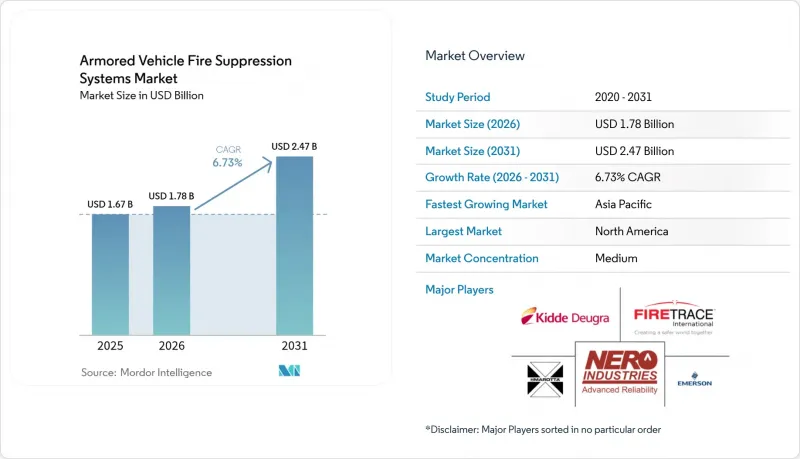
Mordor Intelligence에 의하면, 장갑차 화재 진압 시스템 시장 규모는 2025년에 16억 7,000만 달러로 평가되었습니다. 2026년 17억 8,000만 달러에서 2031년까지 24억 7,000만 달러에 이를 것으로 예상되며, 예측 기간(2026-2031년) CAGR은 6.73%를 나타낼 전망입니다.
본 보고서는 차량 유형(전투 차량, 전술 지원 차량, 기타), 시스템 유형(자동·자율형, 기타), 최종 사용자(군, 법 집행 기관), 구성 요소(감지기 및 센서, 기타), 지역(북미, 유럽, 아시아태평양, 기타)별로 분류되어 있습니다. 시장 전망은 금액(달러) 기준으로 제시되어 있습니다.
세계의 장갑차 화재 진압 시스템 시장 동향 및 인사이트
전투 플랫폼의 전동화로의 전환
리튬 이온 추진 시스템은 장갑 차체의 화재 부하 밀도를 높여 400°C에 달하는 열 폭주를 유발하며, 기존의 할론 기반 솔루션으로는 대응할 수 없는 상황을 초래하고 있습니다. 독일의 KF41 Lynx 프로그램 및 한국의 Redback-K 프로그램에 기반한 플랫폼에서는 밀폐된 배터리 케이스 내부에서도 효과를 유지할 수 있는 소화제가 지정되어 있으며, RTX사의 전투기용 열 관리 시스템을 기반으로 한 80kW 냉각 팩과 연동하여 운용됩니다. 중국의 GB 38031-2020 규격에서는 5분간의 화재 확산 지연이 의무화되어 있으며, 주요 군사 부대도 이를 따를 것으로 보입니다. 이 규격을 준수하기 위해 각 OEM 업체들은 카프톤(Kapton) 기반 단열재, 예측형 셀 격리 알고리즘, 그리고 연쇄적 고장이 시작되기 전에 배터리 베이 전체에 소화제를 주입하는 분산형 노즐 어레이를 결합하고 있습니다.
더욱 엄격해진 MIL-STD-810H 안전 요건
최신 MIL-STD-810H 시험에서는 소화 장치가 -54°C의 극지 배치, 71°C의 사막 더위, 그리고 대구경 충격에 견디면서 차량 무전기와의 전자기 호환성을 유지해야 합니다. 계약업체는 중파장 적외선(IR)과 자외선(UV) 대역을 결합한 듀얼 스펙트럼 광학 센서로 이에 대응하여, 오작동률을 0.1% 미만으로 억제하고 승무원의 작업 부담을 경감하고 있습니다. 규격 준수를 위해서는 개발 기간을 120일간 연장하는 대규모 실험 주기가 필요하기 때문에 사내에 시험실을 보유한 기업이 유리한 입장에 있습니다. 현장의 텔레메트리 데이터를 활용해 학습시킨 알고리즘을 통해 태양의 반사광과 실제 화재를 구별할 수 있게 되었으며, 먼지나 연기로 시야가 가려진 경우에도 기계가 화재를 진압할 수 있게 되었습니다.
PFAS 무함유 소화제공급망 병목 현상
미국 국방부 기준을 충족하는 불소 무함유 소화제는 단 3유형뿐이지만, 2025년 10월까지 200만 갤런을 배치해야 하기 때문에 국방부는 1년간의 연기를 불가피하게 결정했습니다. 새로운 로트별 검증에 120일이 소요되기 때문에 전술 차량의 배치는 실험실 대기 순서에 좌우되고 있습니다. 유럽 군도 유사한 과제에 직면해 있어, 소화제 사용에 편차가 발생하고 NATO의 병참적 공통성이 훼손될 위험이 있습니다.
부문별 분석
2025년, 전투 차량 부문은 전 세계 매출의 49.12%를 차지하며 그 절반에 육박했습니다. 이탈리아의 160억 유로(188억 7,000만 달러) 규모의 장갑 전투 시스템이나 독일의 레오파드 2A8 조달과 같은 대규모 프로그램에는 승무원실과 엔진실을 동시에 보호하는 완전 자동 듀얼 존 소화 장치가 탑재되어 있습니다. 스페인, 루마니아, 라트비아도 이에 발맞추어 NATO 기준에 부합하는 노벡(Novec) 계열 충전식 소화제를 지정된 트랙식 보병전투차(IFV) 구매를 추진하고 있습니다.
전술 지원 차량은 7.34%라는 가장 높은 연평균 성장률(CAGR)을 보이고 있는데, 이는 우크라이나에서의 작전 교리 변화를 반영한 것으로, 이로 인해 병참 수송대가 직접 사격에 노출되는 상황이 발생하고 있습니다. 미 육군의 M1E3 에이브러햄스 프로그램에서는 전차 회수형 및 탄약 보급형을 위한 공통 생존성 키트를 중시하고 있으며, 부품의 호환성을 확보하여 훈련 부담을 경감하고 있습니다. 전용 회수 장치나 교량 차량의 경우에도, 그 유압 장치가 특유의 발화원이 되고 노즐 위치를 개별적으로 조정해야 하기 때문에 수량은 적지만 수요는 유지되고 있습니다.
자동·자율형 장치는 2025년 매출의 66.55%를 차지했으며, 이는 즉각적인 수동 조작이 불가능한 상황에서 승무원을 보호하기 위해 150밀리초 미만의 방출을 교리로 중시하고 있음을 반영합니다. 이러한 시스템은 듀얼 스펙트럼 광학 기기와 압력 상승 센서를 결합하여 약제를 방출하기 전에 사건을 상호 검증함으로써, 비용이 많이 드는 부주의로 인한 오방출을 줄이고 있습니다.
수동형 설계는 저강도 역할이나 수명 주기 위험보다 초기 도입 가격을 우선시하는 국가에서 여전히 채택되고 있습니다. 그러나 자동 모드를 기본으로 하면서 승무원의 수동 오버라이드를 결합한 하이브리드 구성은 9.02%라는 가장 높은 연평균 성장률(CAGR)을 기록하고 있습니다. 운영자는 환기를 통해 위험이 해소되는 연료 증기 상황에서 소화 활동을 중단할 수 있는 선택권을 높이 평가하고 있으며, 이를 통해 소화제의 낭비와 가동 중단 시간을 피할 수 있습니다.
지역별 분석
북미는 2025년에도 47.25%의 점유율을 유지했습니다. 이는 약제 생산 및 개조 키트에 직접 자금을 지원하는 미국 국방부의 21억 달러 규모의 PFAS 대체 이니셔티브에 힘입은 결과입니다. 2025 회계연도 국방 예산 9,200억 달러는 지출을 안정화시키고 있어, 주요 제조업체들은 향후 5년 치 생산 물량을 계획할 수 있게 되었습니다. 캐나다의 북극권 기동성 강화 프로그램은 수륙양용선 선체 내에서 -40°C 환경에서도 유동 가능한 저온용 배합제에 대한 틈새 수요를 창출하고 있습니다. 멕시코가 미국 규격과의 상호 운용성을 확보함에 따라 북미 대륙 내 도입 기반은 더욱 확대되고 있습니다.
유럽에서는 NATO의 즉각 대응 태세 목표에 따라 조달이 가속화되고 있으며, 22개 회원국이 2025 회계연도를 목표로 국방 예산을 실질 기준으로 최소 10% 인상했습니다. 이탈리아의 링스 및 팬서 대량 발주, 독일의 레오파드 2A8 구매, 그리고 스페인의 레오파드 2E 개량은 모두 APS(능동 방어 시스템)와 연계된 제압 네트워크를 규정하고 있으며, 이를 통해 공유 공급망과 엄격한 사이버 내성 기준이 확립되고 있습니다. 26개사로 구성된 탈레스의 FMBTech 컨소시엄은 EU 자금을 활용하여 국경을 초월한 밸브 형상, 센서 펌웨어 및 약제 물류를 조정하고, 수출 라이선싱 절차를 원활하게 하고 있습니다.
아시아태평양은 8.07%라는 가장 높은 연평균 성장률(CAGR)을 기록하고 있습니다. 일본이 2025년에 사상 최대인 590억 달러의 국방 예산을 편성함에 따라, Patria사의 AMV XP 현지 생산에 자금이 조달되었으며, 이 차량은 16식 자주포나 96식 장갑병력수송차의 차체에 탑재 가능한 모듈식 제압 시스템을 특징으로 합니다. 중국은 2027년 전력 정비 목표를 향해 서방 국가들의 금수 조치를 회피하기 위해 국산 약제의 연구 개발을 추진하고 있습니다. 한편, 한국의 레드백-K에는 압력 저하를 승무원에게 실시간으로 경고하는 스마트 보틀형 텔레메트리 기능이 탑재되어 있습니다. 필리핀의 350억 달러 규모 계획부터 인도네시아의 중전차 도입에 이르기까지, 동남아시아의 현대화는 고습도가 장비의 수명에 영향을 미치는 열대 기후 지역으로 수요를 확대시키고 있습니다.
기타 혜택 :
- 엑셀 형식 시장 예측(ME) 시트
- 3개월간의 애널리스트 지원
자주 묻는 질문
목차
제1장 서론
제2장 조사 방법
제3장 개요
제4장 시장 구도
제5장 시장 규모 및 성장 예측
제6장 경쟁 구도
제7장 시장 기회 및 향후 전망
KTH 26.08.31According to Mordor Intelligence, the armored vehicle fire suppression systems market size was valued at USD 1.67 billion in 2025 and estimated to grow from USD 1.78 billion in 2026 to reach USD 2.47 billion by 2031, at a CAGR of 6.73% during the forecast period (2026-2031).
This report is Segmented by Vehicle Type (Combat Vehicles, Tactical Support Vehicles, and Other Vehicles), System Type (Automatic/Autonomous, and More), End User (Military and Law Enforcement), Component (Detectors and Sensors, and More), and Geography (North America, Europe, Asia-Pacific, and More). The Market Forecasts are Provided in Terms of Value (USD).
Global Armored Vehicle Fire Suppression Systems Market Trends and Insights
Shift-to-Electric Combat Platforms
Lithium-ion propulsion elevates fire-load density in armored hulls, creating thermal runaway scenarios that reach 400°C and defeat legacy Halon-based solutions. Platforms under Germany's KF41 Lynx and South Korea's Redback-K programs specify suppression agents that remain effective inside sealed battery casings while coordinating with 80 kW cooling packs derived from RTX's fighter-jet thermal systems. Chinese GB 38031-2020 mandates a 5-minute propagation delay, signaling that the benchmark military fleets will emulate. To comply, OEMs layer Kapton-based insulation, predictive cell-isolation algorithms, and distributed nozzle arrays that flood battery bays before cascading failure begins.
Stricter MIL-STD-810H Safety Mandates
The newest MIL-STD-810H tests require suppression hardware to endure -54°C arctic deployments, 71°C desert heat, and heavy-caliber shock while sustaining electromagnetic compatibility with vehicle radios. Contractors answer with dual-spectrum optical sensors that combine mid-wave IR and UV bands, trimming false activations below 0.1% and cutting crew workload. Compliance demands extensive lab cycles that lengthen development by 120 days, tipping the advantage to firms with in-house chambers. Algorithms trained on field telemetry now distinguish solar glint from true ignition, enabling machines to suppress fires even when vision blocks are obscured by dust or smoke.
Supply-Chain Bottlenecks for PFAS-Free Agents
Only three fluorine-free foams meet US Defense Department standards, yet 2 million gallons must be fielded before October 2025, forcing the Pentagon to seek a one-year extension. Validation of each new batch stretches 120 days, leaving tactical vehicle rollouts waiting on lab queues. European forces face identical hurdles, risking divergent agent usage that undermines NATO logistic commonality.
Other drivers and restraints analyzed in the detailed report include:
- Lightweight Non-Halon Agents (FK-5-1-12)
- Auto-Detect AI Sensor Fusion
- High Retrofit Cost for Legacy Fleets
For complete list of drivers and restraints, kindly check the Table Of Contents.
Segment Analysis
The armored vehicle fire suppression systems market size for combat vehicles amounted to nearly half of global revenue at 49.12% in 2025. Large-scale programs such as Italy's EUR 16 billion (USD 18.87 billion) Armoured Combat System and Germany's Leopard 2A8 procurement embed fully automatic, dual-zone extinguishers that simultaneously protect crew and engine bays. Spain, Romania, and Latvia have followed with tracked IFV buys that specify Novec-based flooding agents compatible with NATO standards.
Tactical support vehicles furnish the fastest 7.34% CAGR, mirroring doctrine shifts in Ukraine that expose logistics convoys to direct fire. The US Army's M1E3 Abrams program emphasizes common survivability kits for tank-retrieval and ammunition-resupply variants, ensuring part interchangeability and easing training demands. Specialized recovery rigs and bridge layers also maintain demand, albeit at modest volumes, because their hydraulic equipment creates distinct ignition sources that require bespoke nozzle positioning.
Automatic and autonomous installations captured 66.55% of 2025 revenue, reflecting doctrinal reliance on sub-150-millisecond discharge that safeguards crews when immediate manual action is impossible. These systems combine dual-spectrum optics with pressure-rise sensors to cross-validate events before releasing agent, trimming costly inadvertent discharges.
Manual designs persist in low-intensity roles or nations prioritizing initial acquisition price over lifecycle risk. Yet hybrid configurations, blending automatic default with crew override, deliver the highest 9.02% CAGR. Operators appreciate the option to halt suppression in fuel-fume scenarios where venting remedies the hazard, avoiding agent wastage and downtime.
Complete Report Scope:
- By Vehicle Type
- Combat Vehicles
- Main Battle Tanks (MBTs)
- Infantry Fighting Vehicles (IFVs)
- Armored Personnel Carriers (APCs)
- Tactical Support Vehicles
- Other Vehicles
- Combat Vehicles
- By System Type
- Automatic/Autonomous
- Manual
- Hybrid
- By End User
- Military
- Law Enforcement
- By Component
- Detectors and Sensors
- Control Units and Panels
- Cylinders and Agents
- Nozzles, Valves, and Plumbing
- By Geography
- North America
- United States
- Canada
- Mexico
- Europe
- Germany
- United Kingdom
- France
- Italy
- Russia
- Rest of Europe
- Asia-Pacific
- China
- Japan
- India
- South Korea
- Australia
- Rest of Asia-Pacific
- South America
- Brazil
- Rest of South America
- Middle East and Africa
- Middle East
- United Arab Emirates
- Saudi Arabia
- Turkey
- Rest of Middle East
- Africa
- South Africa
- Rest of Africa
- Middle East
- North America
Geography Analysis
North America retained a 47.25% share in 2025, anchored by the US Department of Defense's USD 2.1 billion PFAS-replacement initiative that directly funds agent production and retrofit kits. The FY 2025 defense budget of USD 920 billion holds spending steady, letting primes plan production lots five years out. Canada's Arctic Mobility Enhancement program adds niche demand for low-temperature formulations able to flow at -40 °C in amphibious hulls. Mexico's interoperability alignment with US standards further widens the continental installed base.
Europe accelerates procurement under NATO readiness goals, with 22 member states hiking defense budgets by at least 10% in real terms for 2025. Italy's massive Lynx and Panther orders, Germany's Leopard 2A8 buy, and Spain's Leopard 2E overhaul all specify APS-linked suppression networks, establishing shared supply chains and stringent cyber-hardening baselines. Thales' FMBTech consortium of 26 firms uses EU funding to coordinate valve geometry, sensor firmware, and agent logistics across borders, smoothing export licensing.
Asia-Pacific delivers the highest 8.07% CAGR. Japan's record USD 59 billion 2025 defense budget finances Patria AMV XP local production featuring modular suppression that drops into Type 16 mobile gun and Type 96 APC hulls. China's 2027 readiness goal pushes indigenous agent R&D to circumvent Western embargoes, while South Korea's Redback-K embeds smart-bottle telemetry that alerts crews to pressure loss in real time. Southeast Asian modernization-from the Philippines' USD 35 billion plan to Indonesia's medium-tank acquisition-extends demand to tropical climates where high humidity influences agent longevity.
- KIDDE-DEUGRA Brandschutzsysteme GmbH (RTX Corporation)
- Nero Industries Co.
- Emerson Electric Co.
- Firetrace International
- Marotta Controls, Inc.
- Explospot Systems Pty Ltd.
- Mikro-Pulssi Oy
- N2 Towers
- Fire Safe Technologies LLP
- Jomarr Products, Inc.
- FirePro Systems Ltd.
- Fireaway Inc.
Additional Benefits:
- The market estimate (ME) sheet in Excel format
- 3 months of analyst support
TABLE OF CONTENTS
1 INTRODUCTION
- 1.1 Study Assumptions and Market Definition
- 1.2 Scope of the Study
2 RESEARCH METHODOLOGY
3 EXECUTIVE SUMMARY
4 MARKET LANDSCAPE
- 4.1 Market Overview
- 4.2 Market Drivers
- 4.2.1 Shift-to-electric combat platforms
- 4.2.2 Stricter MIL-STD-810H safety mandates
- 4.2.3 Lightweight non-Halon agents
- 4.2.4 Auto-detect AI sensor fusion
- 4.2.5 Active protection system (APS) integration
- 4.2.6 Increased global defense spending and modernization programs
- 4.3 Market Restraints
- 4.3.1 Supply-chain bottlenecks for PFAS-free agents
- 4.3.2 High retrofit cost for legacy fleets
- 4.3.3 Weight-penalty vs. active armor trade-off
- 4.3.4 IP ownership concentration
- 4.4 Value Chain Analysis
- 4.5 Regulatory Landscape
- 4.6 Technological Outlook
- 4.7 Porter's Five Forces Analysis
- 4.7.1 Threat of New Entrants
- 4.7.2 Bargaining Power of Buyers
- 4.7.3 Bargaining Power of Suppliers
- 4.7.4 Threat of Substitutes
- 4.7.5 Intensity of Competitive Rivalry
5 MARKET SIZE AND GROWTH FORECASTS (VALUE)
- 5.1 By Vehicle Type
- 5.1.1 Combat Vehicles
- 5.1.1.1 Main Battle Tanks (MBTs)
- 5.1.1.2 Infantry Fighting Vehicles (IFVs)
- 5.1.1.3 Armored Personnel Carriers (APCs)
- 5.1.2 Tactical Support Vehicles
- 5.1.3 Other Vehicles
- 5.1.1 Combat Vehicles
- 5.2 By System Type
- 5.2.1 Automatic/Autonomous
- 5.2.2 Manual
- 5.2.3 Hybrid
- 5.3 By End User
- 5.3.1 Military
- 5.3.2 Law Enforcement
- 5.4 By Component
- 5.4.1 Detectors and Sensors
- 5.4.2 Control Units and Panels
- 5.4.3 Cylinders and Agents
- 5.4.4 Nozzles, Valves, and Plumbing
- 5.5 By Geography
- 5.5.1 North America
- 5.5.1.1 United States
- 5.5.1.2 Canada
- 5.5.1.3 Mexico
- 5.5.2 Europe
- 5.5.2.1 Germany
- 5.5.2.2 United Kingdom
- 5.5.2.3 France
- 5.5.2.4 Italy
- 5.5.2.5 Russia
- 5.5.2.6 Rest of Europe
- 5.5.3 Asia-Pacific
- 5.5.3.1 China
- 5.5.3.2 Japan
- 5.5.3.3 India
- 5.5.3.4 South Korea
- 5.5.3.5 Australia
- 5.5.3.6 Rest of Asia-Pacific
- 5.5.4 South America
- 5.5.4.1 Brazil
- 5.5.4.2 Rest of South America
- 5.5.5 Middle East and Africa
- 5.5.5.1 Middle East
- 5.5.5.1.1 United Arab Emirates
- 5.5.5.1.2 Saudi Arabia
- 5.5.5.1.3 Turkey
- 5.5.5.1.4 Rest of Middle East
- 5.5.5.2 Africa
- 5.5.5.2.1 South Africa
- 5.5.5.2.2 Rest of Africa
- 5.5.5.1 Middle East
- 5.5.1 North America
6 COMPETITIVE LANDSCAPE
- 6.1 Market Concentration
- 6.2 Strategic Moves
- 6.3 Market Share Analysis
- 6.4 Company Profiles (includes Global level Overview, Market level overview, Core Segments, Financials as available, Strategic Information, Market Rank/Share for key companies, Products and Services, and Recent Developments)
- 6.4.1 KIDDE-DEUGRA Brandschutzsysteme GmbH (RTX Corporation)
- 6.4.2 Nero Industries Co.
- 6.4.3 Emerson Electric Co.
- 6.4.4 Firetrace International
- 6.4.5 Marotta Controls, Inc.
- 6.4.6 Explospot Systems Pty Ltd.
- 6.4.7 Mikro-Pulssi Oy
- 6.4.8 N2 Towers
- 6.4.9 Fire Safe Technologies LLP
- 6.4.10 Jomarr Products, Inc.
- 6.4.11 FirePro Systems Ltd.
- 6.4.12 Fireaway Inc.
7 MARKET OPPORTUNITIES AND FUTURE OUTLOOK
- 7.1 White-space and Unmet-need Assessment


