|
시장보고서
상품코드
2115857
군용 트럭 : 시장 점유율 분석, 업계 동향과 통계, 성장 예측(2026-2031년)Military Truck - Market Share Analysis, Industry Trends & Statistics, Growth Forecasts (2026 - 2031) |
||||||
 Mordor Intelligence
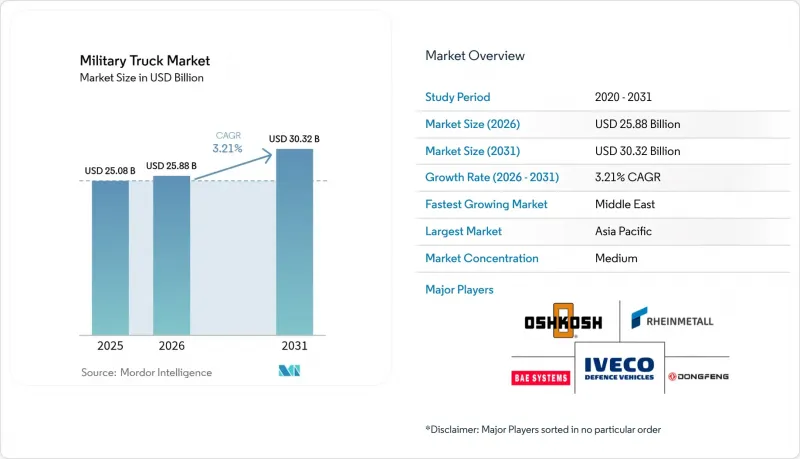
Mordor Intelligence에 따르면 군용 트럭 시장 규모는 2025년에 250억 8,000만 달러로 평가되며, 2026년 258억 8,000만 달러에서 2031년까지 303억 2,000만 달러에 달할 것으로 예측되며, 예측 기간(2026-2031년) 동안 CAGR은 3.21%가 될 전망입니다.
본 보고서는 용도별(화물 물류, 병력 수송 등), 중량 등급별(경량, 중량, 중대형), 구동 방식별(디젤 등), 최종사용자(육군, 해군/해병대 등), 구동 방식(4x4, 6x6 등), 변속기(수동 및 자동), 지역(북미, 유럽 등)별로 분류되어 있습니다. 시장 예측은 금액(달러) 기준으로 제시되어 있습니다.
세계 군용 트럭 시장의 동향 및 인사이트
방위 장비 현대화 예산 증가
군사 계획 담당자들은 오늘날의 네트워크화된 전장에 대응할 수 없게 된 수십 년 전의 차량들을 교체하고 있습니다. 사우디아라비아는 2025년도 예산을 780억 달러로 증액하고, 2030년까지 시스템의 50%를 국내 조달하겠다는 목표를 설정했습니다. 이 정책은 공장과의 제휴 및 기술 이전을 촉진하기 위한 것입니다. 아시아 전역에서도 유사한 우선순위가 나타나고 있으며, 각국 정부는 신형 트럭에 암호화 무전기, 대 IED(즉석 폭발 장치)용 배선 및 모듈식 장갑을 통합할 것을 요구하고 있습니다. 그 결과 신형 플랫폼은 대당 비용이 높아지지만, 구매자들은 적재량의 유연성과 디지털 내구성을 중시하기 때문에 이러한 비용 부담을 감수하고 있습니다.
노후된 전술용 트럭을 대체하기 위한 차량 교체
냉전 시대로 거슬러 올라가는 구형 차량은 유지비 증가와 사이버 보안상의 취약성으로 골머리를 앓고 있습니다. 2029년까지 오슈코시사에 발주요 총액 15억 4,000만 달러 상당의 미 육군 ‘중전술 차량 군(Family of Heavy Tactical Vehicles)’ 계약은 1980년대 제작된 트럭을 일소하는 체계적인 갱신을 상징합니다. 유럽 군대도 이에 발맞춰, 독일은 2025년에 라인메탈(Rheinmetall) 사가 제작한 신형 트럭 568대를 대상으로 3억 3,000만 유로(3억 8,360만 달러) 규모의 물류 계약을 체결했습니다. 구식 전자 아키텍처는 단계적인 업그레이드만으로는 더 이상 수정할 수 없기 때문에 이러한 현대화 물결은 전 세계적인 현상이 되고 있습니다.
분쟁 이후의 예산 축소와 우선순위 재조정
대규모 작전이 종료된 후, 각국 재무부는 국내 프로그램에 자금을 조달하기 위해 국방 지출을 삭감하는 경우가 많습니다. 최근 미 육군의 헬리콥터 발주 중단은 의원들이 경비 절감을 도모할 때 조달 계획이 얼마나 급격하게 바뀔 수 있는지를 보여줍니다. 군 당국은 개조를 통해 수명을 연장하고 갱신을 미룰 수 있기 때문에 트럭 프로그램은 표적이 되기 쉽습니다. 이로 인해 능력 격차가 여전히 존재함에도 불구하고, 단기적으로는 수주 건수가 감소하게 됩니다.
부문 분석
지휘통제용 쉘터 트럭은 연평균 성장률(CAGR) 6.02%로 여전히 가장 빠르게 성장하는 부문이며, 전장의 데이터를 실시간으로 처리할 수 있는 이동식 지휘부의 필요성을 반영하고 있습니다. 각 여단이 첨단 C4ISR 소프트웨어를 가동하기 위한 전용 디지털 노드를 최소 1대씩 지정하게 됨에 따라, 이러한 차량을 대상으로 하는 군용 트럭 시장의 규모는 확대될 것입니다. 대조적으로, 2025년에도 병력 수송차는 여전히 군용 트럭 시장 점유율의 39.85%라는 압도적인 비율을 차지했습니다. 이는 기술적 변화에 관계없이 모든 군대가 인원을 이동시켜야 하기 때문입니다. 물류, 연료 및 급수 탱크차 차량군은 일상적인 유지보급 작전의 기반이 되고 있기 때문에 꾸준한 갱신 곡선을 그리고 있습니다. 야전 구급차는 완만한 성장에 그치지만, 통합형 ICU 모듈과 방탄 보호 기능이 탑재되어 있어 대당 단가는 높은 편입니다. 또한, 군이 민간 재난 구호를 지원하는 상황에서는 회수 차량이나 소방차 등의 변형 모델이 다시 주목받고 있습니다.
이러한 2차적 영향은 공급망 전체로 파급되고 있습니다. 쉘터 사양의 다양성이 증가함에 따라 대용량 발전기 및 공조 장치에 대한 수요가 높아지고 있습니다. 또한 군이 플랫베드에 직접 탑재 가능한 ISO 규격 준수 컨테이너를 선호하는 경향이 있어, 모듈식 차체 공급업체들도 수요 증가를 체감하고 있습니다. 이미 오픈 아키텍처 미션 컴퓨터를 출하하고 있는 벤더는 최소한의 조정만으로 확대되는 차량군 전체에 소프트웨어를 이식할 수 있어 전략적 우위를 점하고 있습니다. 병력 수송차의 경우, 인체공학에 기반한 좌석과 폭발 충격을 완화하는 바닥이 특히 특수작전부대를 대상으로 한 제품의 차별화 요소가 되고 있습니다. 공통 섀시 위에서 수송 기능과 디지털 지휘 시스템을 통합하여 훈련 및 예비 부품 관리의 복잡성을 경감할 수 있는 기업의 경우, 경쟁사와의 격차가 더욱 벌어지고 있습니다.
총 차량 중량(GVW) 10톤 이상의 대형 트럭은 2025년 매출의 43.10%를 차지했습니다. 이는 전차 수송차나 교량 부대 등 소형화가 불가능한 전략적 수송 임무가 주도한 결과입니다. 한편, GVW 4톤 미만의 경량 부문은 도시 지역 및 특수 작전 시나리오가 계획의 전제로 주류를 이루게 됨에 따라 연평균 성장률(CAGR) 5.32%로 급속히 성장하고 있습니다. 대부분의 경우 상용차를 기반으로 하되 전복 방지 장치나 무기 거치대를 장착하여 군사 사양으로 개조된 경량 사륜구동 픽업 트럭은 C-130을 통한 공수나 헬리콥터를 이용한 슬링 수송이 가능한, 지휘관에게 비용 대비 효과가 높은 플랫폼을 제공합니다. 총 차량 중량(GVW) 4톤에서 10톤에 이르는 중형 차량은 일상적인 병참 활동에서 적재량과 기동성의 균형이 잘 잡혀 있어 여전히 핵심을 이루고 있습니다.
경량급으로의 전환은 조달 물류의 양상을 변화시키고 있습니다. 중량급 로우보이 트레일러의 발주가 줄어들면서, 그만큼의 자금을 틸트로터기 내부에 탑재할 수 있는 기동성이 뛰어난 유닛에 재배정할 수 있게 됩니다. 타이어 및 서스펜션 공급업체들은 경량화에 최적화된 런플랫 설계로 전환하고 있으며, 전방 기지에서 적층 제조를 통한 예비 부품 생산도 구조가 단순한 구동계에서는 현실적인 선택지가 되고 있습니다. 한편, 대형 부문의 각 벤더들은 가동 시간을 향상시키는 첨단 운전자 지원 시스템이나 예측 유지보수 기능을 추가하여 시장 점유율을 지키고 있으며, 험준한 지형에서는 대형 트럭 1대가 경량 차량 3대를 대체할 수도 있다고 강조하고 있습니다. 따라서 의사결정자들은 차량 구성을 포트폴리오로 간주하여, 한쪽 극단으로 완전히 치우치지 않고 각 등급을 조합하고 있습니다.
지역별 분석
아시아태평양은 중국, 인도, 한국, 호주의 지속적인 현대화를 반영하여 2025년에 매출 점유율 33.55%를 유지하며 리더십을 지켰습니다. 호주의 ‘랜드 8116’ 대형 트럭 조달이나 인도의 야전포용 트랙터 교체와 같은 최근 지출 계획에서는 전략적 산업 정책에 따라 국내 생산 라인이 우선시되고 있습니다. 이러한 탄탄한 조달 파이프라인은 현지 섀시 제조사의 설비 가동률을 확보하는 동시에, 변속기, 장갑, 텔레매틱스 분야의 기술 이전을 촉진하고 있습니다. 또한, 기후 변화에 따른 수륙 양용 임무 및 재난 대응 임무의 증가도 지역 성장에 기여하고 있으며, 전지형 대응형 물류 트럭에 대한 추가 수요를 창출하고 있습니다.
중동 지역은 2031년까지 연평균 성장률(CAGR)이 5.55%로 가장 높은 성장세를 보이고 있으며, 이는 사우디아라비아가 780억 달러를 배정하고 금세기 말까지 50%의 산업 현지화를 의무화한 데 기인합니다. 오프테이크 계약은 4×4 다목적 차량, 6×6 전술 화물 트럭, 8×8 미사일 운반차를 대상으로 하는 리야드와 유럽 주요 제조업체 간의 새로운 합작 사업을 뒷받침하고 있습니다. 한편, 아랍에미리트(UAE)와 카타르도 첨단 용접, 파워트레인 조립, 소프트웨어 통합 분야에서 국내 인력을 확대하기 위해 유사한 오프셋 조치를 추진하고 있습니다. 지속되는 지역 분쟁은 물류 체인에 부담을 주고 있으며, 위협 속에서도 물자를 수송할 수 있는 신형 차량 도입을 촉진하는 요인이 되고 있습니다.
북미는 단순한 확대라기보다는 차량의 갱신이 원동력이 되고 있는, 성숙해 있지만 여전히 규모가 큰 시장입니다. 미 육군은 FMTV A2 및 JLTV를 기반으로 한 지휘용 변형 모델을 통해 장비를 갱신하고 있으며, 사이버 공격에 대한 내성을 강화한 전자 장비와 연료 소비량을 줄이기 위한 하이브리드 프로토타입에 중점을 두고 있습니다. 캐나다도 유사한 접근 방식을 취하며, 최신 중장갑 차량을 견인할 수 있는 강화형 회수 트럭 85대를 발주하고 있습니다. 유럽의 수요도 유사한 갱신 주기를 보이고 있으며, 독일 라인메탈사와의 다년 계약 및 네덜란드의 JLTV 도입이 그 기반이 되고 있습니다. 남미와 아프리카에서는 재정 상한선 제약으로 인해 조달 속도가 둔화되고 있습니다. 그러나 브라질 육군은 국내에서 조립된 6×6 ‘과라니’ 지원 트럭을 단계적으로 계속 구매하고 있으며, 일부 아프리카 국가들은 경다목적 차량 조달을 위해 외국 군사 금융에 의존하고 있습니다.
기타 혜택:
- 엑셀 형식의 시장 예측(ME) 시트
- 3개월간의 애널리스트 지원
자주 묻는 질문
목차
제1장 소개
제2장 조사 방법
제3장 주요 요약
제4장 시장 구도
제5장 시장 규모와 성장 예측
제6장 경쟁 구도
제7장 시장 기회와 향후 전망
KSM 26.08.26According to Mordor Intelligence, the military truck market size was valued at USD 25.08 billion in 2025 and estimated to grow from USD 25.88 billion in 2026 to reach USD 30.32 billion by 2031, at a CAGR of 3.21% during the forecast period (2026-2031).
This report is Segmented by Application (Cargo Logistics, Troop Transport, and More), Weight Class (Light, Medium, and Heavy), Propulsion Type (Diesel, and More), End-User (Army, Navy/Marine Corps, and More), Drive Configuration (4x4, 6x6, and More), Transmission (Manual and Automatic), and Geography (North America, Europe, and More). The Market Forecasts are Provided in Terms of Value (USD).
Global Military Truck Market Trends and Insights
Rising Defense Equipment Modernization Budgets
Military planners are replacing decades-old fleets that no longer match today's networked battlefield. Saudi Arabia lifted its 2025 appropriation to USD 78 billion and set a 2030 goal of sourcing 50% of systems domestically, a policy that stimulates factory partnerships and knowledge transfer. Similar priorities appear across Asia, where governments insist that each new truck integrates encrypted radios, counter-IED wiring, and modular armor. Fresh platforms thus cost more per unit, yet buyers tolerate the premium because they value payload flexibility and digital resilience.
Fleet Recapitalization to Replace Ageing Tactical Trucks
Legacy vehicles that date to the Cold War suffer mounting maintenance bills and cybersecurity gaps. The US Army's Family of Heavy Tactical Vehicles order, worth USD 1.54 billion, placed with Oshkosh through 2029, illustrates structured replacement that sweeps away 1980s-era trucks. European forces followed suit; Germany signed a logistics contract for EUR 330 million (USD 383.6 million) covering 568 new Rheinmetall trucks in 2025. The recapitalization wave is global because incremental upgrades can no longer fix obsolete electrical architectures.
Post-Conflict Budget Contraction and Re-Prioritization
Following major operations, treasuries often trim defense outlays to fund domestic programs. Recent US Army helicopter cancellations show how quickly procurement plans can change when lawmakers seek savings. Truck programs become soft targets because militaries can extend service lives through rebuilds, postponing replacement. This creates a near-term dip in orders even though capability gaps persist.
Other drivers and restraints analyzed in the detailed report include:
- Surge in Demand for Multi-Role Logistics Platforms
- Modular Open-Systems Architecture Enabling Plug-and-Play Mission Kits
- High Acquisition and Life-Cycle Cost of Next-Gen Platforms
For complete list of drivers and restraints, kindly check the Table Of Contents.
Segment Analysis
Command and control shelter trucks remain the fastest-rising category at a 6.02% CAGR, reflecting the imperative for mobile headquarters that can process battlefield data in real time. The military truck market size for these vehicles will widen as each brigade specifies at least one dedicated digital node to host advanced C4ISR software. In contrast, troop transport still held the dominant 39.85% slice of the military truck market share in 2025, because every army needs to move personnel regardless of technological shifts. Logistics, fuel, and water tanker fleets follow a steady replacement curve since they underpin everyday sustainment operations. Field ambulances grow modestly yet command a high price per unit due to integrated ICU modules and ballistic protection. Recovery and fire-fighting variants receive renewed attention where military forces support civilian disaster relief.
Second-order effects cascade across the supply chain. More shelter variants create a pull for high-capacity alternators and climate-control units. Modular body suppliers also see increased demand as armies prefer ISO-compatible containers that slot onto flatbeds. Vendors that already ship open-architecture mission computers have a strategic advantage because they can port software across the expanding fleet with minimal adaptation. For troop carriers, ergonomic seating and blast-attenuating floors differentiate offerings, especially for special operations units. The competitive gap widens for companies that can integrate transport and digital command formats on a common chassis, reducing training and spares complexity.
Heavy trucks above 10 tons Gross Vehicle Weight (GVW) held 43.10% revenue in 2025, driven by strategic lift roles such as tank transporters and bridging units that cannot be downsized. Yet the light segment below 4 tons GVW is growing quickly at 5.32% CAGR as urban and special operations scenarios dominate planning assumptions. Lightweight 4X4 pickups, many based on commercial designs but militarized with rollover protection and weapon mounts, give commanders an inexpensive platform that can be air-lifted in C-130 or sling-loaded under helicopters. Medium vehicles from 4 to 10 tons GVW remain the backbone because they balance payload and mobility for day-to-day logistics.
The shift to lighter classes reshapes procurement logistics. Fewer heavy low-boys are ordered, freeing funds for agile units inside a tilt-rotor aircraft. Tire and suspension suppliers pivot to run-flat designs optimized for lower weights, while additive spares manufacturing at forward bases becomes viable for simpler drivelines. On the other hand, heavy segment vendors defend their share by adding advanced driver assistance and prognostics that boost uptime, emphasizing that one oversized truck can sometimes replace three light units in rough terrain. Decision-makers, therefore, view fleet composition as a portfolio, blending classes rather than pivoting entirely to one end of the spectrum.
Complete Report Scope:
- By Application
- Cargo Logistics
- Troop Transport
- Fuel and Water Tanker
- Command and Control Shelter
- Field Ambulance
- Recovery/Fire-fighting
- Special-purpose (Mine-clearing, Bridging, NBC)
- By Weight Class
- Light (Less than 4 tons GVW)
- Medium (4 to 10 tons GVW)
- Heavy (Greater than 10 tons GVW)
- By Propulsion Type
- Diesel
- Hybrid-Electric
- Full-Electric
- Hydrogen Fuel-cell
- By End-user
- Army
- Navy/Marine Corps
- Air Force
- Special Operations Forces
- Paramilitary and Homeland Security
- By Drive Configuration
- 4X4
- 6X6
- 8X8 and Above
- By Transmission
- Manual
- Automatic
- By Geography
- North America
- United States
- Canada
- Mexico
- South America
- Brazil
- Rest of South America
- Europe
- United Kingdom
- Germany
- France
- Rest of Europe
- Asia-Pacific
- China
- India
- Japan
- South Korea
- Rest of Asia-Pacific
- Middle East and Africa
- Middle East
- Saudi Arabia
- Israel
- Rest of Middle East
- Africa
- South Africa
- Rest of Africa
- Middle East
- North America
Geography Analysis
The Asia-Pacific region retained leadership with a 33.55% revenue share in 2025, reflecting sustained modernization across China, India, South Korea, and Australia. Recent spending programs, such as Australia's Land 8116 heavy truck acquisition and India's field artillery tractor replacement, prioritize domestic production lines, aligning with strategic industrial policies. This deep procurement pipeline ensures capacity utilization for local chassis builders and promotes technology transfer in transmissions, armor, and telematics. Regional growth also benefits from rising amphibious and disaster-response missions tied to climate events, creating supplemental demand for all-terrain logistics trucks.
The Middle East registers the fastest 5.55% CAGR through 2031 on the back of Saudi Arabia's USD 78 billion allocation that mandates 50% industrial localization by the end of this decade. Off-take agreements underpin new joint ventures between Riyadh and European primes, covering 4X4 utility vehicles, 6X6 tactical cargo trucks, and 8X8 missile carriers. Meanwhile, the United Arab Emirates and Qatar pursue similar offsets to broaden national workforces in advanced welding, powertrain assembly, and software integration. Ongoing regional conflicts continue to stress logistics chains, reinforcing the argument for fresh fleets that can move supplies under threat.
North America remains a mature but sizable buyer driven by fleet recapitalization rather than sheer expansion. The US Army resets its inventory with FMTV A2 and JLTV-based command variants, focusing on cyber-hardened electronics and hybrid prototypes to lower fuel demand. Canada mirrors this approach by contracting 85 enhanced recovery trucks capable of towing modern heavy armor. European demand tracks a similar replacement rhythm, anchored by Germany's multi-year Rheinmetall framework and the adoption of the Netherlands' JLTV. South America and Africa record slower procurement, constrained by fiscal ceilings. Yet, Brazil's army continues incremental purchases of 6X6 Guarani support trucks assembled domestically, while select African states rely on foreign military financing for light utility vehicles.
- Oshkosh Corporation
- Rheinmetall AG
- Mercedes-Benz Group AG (Daimler Truck AG)
- KNDS N.V.
- Iveco Group
- Renault Trucks Defense (Arquus SAS)
- Ashok Leyland Limited
- Tata Advanced Systems Limited
- Scania AB
- KAMAZ PTC
- AvtoKrAZ holding company
- Dongfeng Motor Group
- General Dynamics Land Systems (General Dynamics Corporation)
- AM General
- BAE Systems plc
- ND Defense LLC
- TATRA TRUCKS a.s.
Additional Benefits:
- The market estimate (ME) sheet in Excel format
- 3 months of analyst support
TABLE OF CONTENTS
1 INTRODUCTION
- 1.1 Study Assumptions and Market Definition
- 1.2 Scope of the Study
2 RESEARCH METHODOLOGY
3 EXECUTIVE SUMMARY
4 MARKET LANDSCAPE
- 4.1 Market Overview
- 4.2 Market Drivers
- 4.2.1 Rising defense-equipment modernization budgets
- 4.2.2 Fleet recapitalization to replace ageing tactical trucks
- 4.2.3 Surge in demand for multi-role logistics platforms
- 4.2.4 Modular open-systems architecture enabling plug-and-play mission kits
- 4.2.5 Hybrid-electric drivetrains that slash fuel-convoy signatures
- 4.2.6 Offset-driven local assembly lines in emerging economies
- 4.3 Market Restraints
- 4.3.1 Post-conflict budget contraction and re-prioritization
- 4.3.2 High acquisition and life-cycle cost of next-gen platforms
- 4.3.3 Supply-chain fragility for armor steel and power electronics
- 4.3.4 Carbon-footprint scrutiny limiting new diesel procurements
- 4.4 Value Chain Analysis
- 4.5 Regulatory Landscape
- 4.6 Technological Outlook
- 4.7 Porter's Five Forces Analysis
- 4.7.1 Threat of New Entrants
- 4.7.2 Bargaining Power of Buyers/Consumers
- 4.7.3 Bargaining Power of Suppliers
- 4.7.4 Threat of Substitute Products
- 4.7.5 Intensity of Competitive Rivalry
5 MARKET SIZE AND GROWTH FORECASTS (VALUE)
- 5.1 By Application
- 5.1.1 Cargo Logistics
- 5.1.2 Troop Transport
- 5.1.3 Fuel and Water Tanker
- 5.1.4 Command and Control Shelter
- 5.1.5 Field Ambulance
- 5.1.6 Recovery/Fire-fighting
- 5.1.7 Special-purpose (Mine-clearing, Bridging, NBC)
- 5.2 By Weight Class
- 5.2.1 Light (Less than 4 tons GVW)
- 5.2.2 Medium (4 to 10 tons GVW)
- 5.2.3 Heavy (Greater than 10 tons GVW)
- 5.3 By Propulsion Type
- 5.3.1 Diesel
- 5.3.2 Hybrid-Electric
- 5.3.3 Full-Electric
- 5.3.4 Hydrogen Fuel-cell
- 5.4 By End-user
- 5.4.1 Army
- 5.4.2 Navy/Marine Corps
- 5.4.3 Air Force
- 5.4.4 Special Operations Forces
- 5.4.5 Paramilitary and Homeland Security
- 5.5 By Drive Configuration
- 5.5.1 4X4
- 5.5.2 6X6
- 5.5.3 8X8 and Above
- 5.6 By Transmission
- 5.6.1 Manual
- 5.6.2 Automatic
- 5.7 By Geography
- 5.7.1 North America
- 5.7.1.1 United States
- 5.7.1.2 Canada
- 5.7.1.3 Mexico
- 5.7.2 South America
- 5.7.2.1 Brazil
- 5.7.2.2 Rest of South America
- 5.7.3 Europe
- 5.7.3.1 United Kingdom
- 5.7.3.2 Germany
- 5.7.3.3 France
- 5.7.3.4 Rest of Europe
- 5.7.4 Asia-Pacific
- 5.7.4.1 China
- 5.7.4.2 India
- 5.7.4.3 Japan
- 5.7.4.4 South Korea
- 5.7.4.5 Rest of Asia-Pacific
- 5.7.5 Middle East and Africa
- 5.7.5.1 Middle East
- 5.7.5.1.1 Saudi Arabia
- 5.7.5.1.2 Israel
- 5.7.5.1.3 Rest of Middle East
- 5.7.5.2 Africa
- 5.7.5.2.1 South Africa
- 5.7.5.2.2 Rest of Africa
- 5.7.5.1 Middle East
- 5.7.1 North America
6 COMPETITIVE LANDSCAPE
- 6.1 Market Concentration
- 6.2 Strategic Moves
- 6.3 Market Share Analysis
- 6.4 Company Profiles (includes Global level Overview, Market level overview, Core Segments, Financials as available, Strategic Information, Market Rank/Share for key companies, Products and Services, and Recent Developments)
- 6.4.1 Oshkosh Corporation
- 6.4.2 Rheinmetall AG
- 6.4.3 Mercedes-Benz Group AG (Daimler Truck AG)
- 6.4.4 KNDS N.V.
- 6.4.5 Iveco Group
- 6.4.6 Renault Trucks Defense (Arquus SAS)
- 6.4.7 Ashok Leyland Limited
- 6.4.8 Tata Advanced Systems Limited
- 6.4.9 Scania AB
- 6.4.10 KAMAZ PTC
- 6.4.11 AvtoKrAZ holding company
- 6.4.12 Dongfeng Motor Group
- 6.4.13 General Dynamics Land Systems (General Dynamics Corporation)
- 6.4.14 AM General
- 6.4.15 BAE Systems plc
- 6.4.16 ND Defense LLC
- 6.4.17 TATRA TRUCKS a.s.
7 MARKET OPPORTUNITIES AND FUTURE OUTLOOK
- 7.1 White-space and Unmet-need Assessment