

|
시장보고서
상품코드
2115866
해군 레이더 시스템 : 시장 점유율 분석, 업계 동향과 통계, 성장 예측(2026-2031년)Naval Radar Systems - Market Share Analysis, Industry Trends & Statistics, Growth Forecasts (2026 - 2031) |
||||||
 Mordor Intelligence
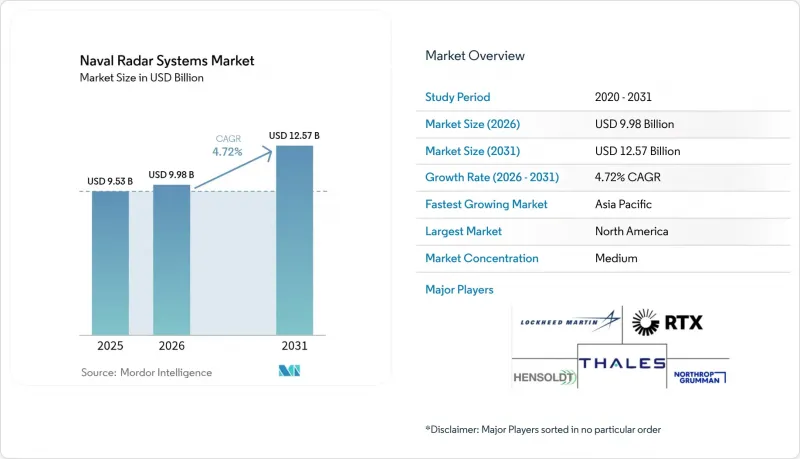
Mordor Intelligence에 따르면 해군 레이더 시스템 시장 규모는 2025년 95억 3,000만 달러에서 2026년에는 99억 8,000만 달러로 확대되고, 2026년부터 2031년까지 CAGR 4.72%를 기록하며 2031년에는 125억 7,000만 달러에 달할 것으로 예측됩니다.
본 보고서는 레이더 종류(AESA, PESA 등), 탑재 플랫폼(구축함·순양함, 프리깃함 등), 용도(감시·조기경보 등), 주파수 대역(L/S 대역, C 대역 등), 구성 부품(송신기/전력 증폭기 등), 탐지 거리(단거리, 중거리, 장거리), 지역(북미, 유럽 등)별로 분류되어 있습니다. 시장 예측은 금액(달러) 기준으로 제시되어 있습니다.
세계 해군 레이더 시스템 시장의 동향 및 인사이트
격화되는 다중 도메인 미사일 위협
홍해에서 해수면 바로 위를 비행하는 미사일과 초음속 미사일에 의한 공격이 심각한 교훈을 남겼으며, 포화 공격 시 기존 센서가 압도당했다는 점을 감안하여 함재 레이더의 요구 사항이 변화했습니다. 미국 해군은 탐지 범위를 강화하기 위해 2026년부터 5억 3,600만 달러의 예산을 투입하여 SPY-6의 개조 패키지 도입을 가속화하고 있습니다. 수면 아래 수백 미터에 잠복한 잠수함을 탐지하는, 광속에 가까운 속도의 레이더 개발을 중국이 추진하고 있어 기술 격차가 확대됨에 따라, 동맹국들은 기동성이 뛰어난 다기능 어레이의 배치를 서둘러야 하는 상황에 처해 있습니다. 그 결과, 각 공급업체들은 모드 전환 지연 없이 탄도 미사일, 극초음속 미사일, 해수면 바로 위를 비행하는 미사일을 동시에 추적할 수 있는 소프트웨어 정의 파형을 설계하고 있습니다. 이러한 복합적인 위협이 해군 레이더 시스템 시장의 꾸준한 지출 추세를 뒷받침하고 있습니다.
구형 2차원 레이더에서 AESA로의 현대화 주기
2005년 이전에 취역한 프리깃함과 구축함은 거의 노후화 단계에 달하고, 독일 헨졸트(Henzyolt)사와 IAI사에 발주요 2억 유로(2억 3,242만 달러) 규모의 F124 업그레이드 등 대규모 AESA 개조가 진행되고 있습니다. 네덜란드도 이에 발맞춰 35억 유로(40억 7,000만 달러) 규모의 대공 프리깃함 4척 계획을 추진 중이며, 운용 기간 중반이 아닌 건조 단계부터 능동 위상 배열(AESA) 시스템을 탑재하고 있습니다. 한국의 한화시스템이 개발한 프로토타입은 4,000개의 표적을 동시에 추적할 수 있어, 수출 규제에 대한 독자적인 기술적 대응을 보여주고 있습니다. 업데이트 프로그램에서는 건조선박에서의 구조 변경을 피할 수 있는 펌웨어 주도형 기능 강화가 점점 더 중요시되고 있습니다. 이러한 동향으로 인해 예측 가능한 업그레이드 수주 잔고가 확보되어, 2030년까지 해군 레이더 시스템 시장의 확장을 뒷받침하게 될 것입니다.
GaN MMIC에 대한 수출 규제
중국은 주요 갈륨 공급의 85%를 장악하고 있으며, 최근의 수출 규제로 인해 GaN 모듈을 사용하는 서방 국가들의 레이더 조달 리스크가 높아지고 있습니다. 미국의 수출 규제 목록은 40-230 GHz 대역의 장치를 추가로 제한하고 있어, 동맹국과의 공동 개발을 복잡하게 만들고 있습니다. 워싱턴과 브뤼셀은 국내 갈륨 정제소를 지원하고 있지만, 수년 단위의 일정으로 인해 의존도는 여전히 높으며, 일부 해군 레이더 시스템 시장 계약에 납기 불확실성이 발생하고 있습니다.
부문 분석
AESA 시스템은 견고한 다중 표적 추적 능력과 간섭 내성이 뛰어난 디지털 빔 포밍을 통해 2025년 해군 레이더 시스템 시장에서 40.78%라는 최대 점유율을 차지했습니다. FMCW/MIMO 레이더의 해군 레이더 시스템 시장 규모는 동시 통신 링크를 지원하는 소프트웨어 정의형 다기능성에 대한 수요에 힘입어 2031년까지 연평균 성장률(CAGR) 6.55%로 확대될 것으로 예상됩니다. 기존의 수동형 전자 스캔 어레이(PESA)는 비용 중심의 업그레이드 프로젝트에서 여전히 채택되고 있지만, 양자 기술 및 포토닉스 기술의 개념은 장기적인 연구 개발(R&D)에 대한 도전 과제로서 ‘기타’ 범주에 분류되어 있습니다.
록히드 마틴의 SPY-7은 스페인의 F-110 프리깃함 프로그램에서 지속적인 추적 능력을 입증했으며, 2026년에 납품되어 2028년에 취역할 예정입니다. 한편, 자동차 공급망에서 전환된 FMCW 솔루션은 대량 생산을 통한 비용 이점을 보여주며, 신규 공급업체의 진입 장벽을 낮추고 있습니다. 분야를 초월한 알고리즘 공유를 통해 개발 주기가 단축됨에 따라, 해군은 합리적인 가격으로 ‘플러그 앤 플레이’ 방식의 파형 라이브러리를 이용할 수 있게 되어, 함대의 센서를 장래에 걸쳐 활용할 수 있는 체제가 마련됩니다.
2025년 해군 레이더 시스템 시장 전체 규모의 38.74%를 구축함과 순양함이 차지했습니다. 이는 함대의 방공 전략이 여전히 대형 전투함을 중심으로 이루어지고 있기 때문입니다. 그러나 무인 수상정 및 AUV(자율형 수중정) 플랫폼은 연평균 성장률(CAGR) 8.12%로 가장 높은 성장률을 기록하고 있으며, 이는 저시그니처 정찰기가 필요한 분산형 치명성 전략을 반영한 것입니다.
소형화된 GaN 전력 증폭기와 컨포멀 안테나는 현재 무인 선체의 크기, 중량, 전력 소비(SWaP) 요건을 충족하며 새로운 조달 시장을 개척하고 있습니다. 잠수함의 마스트 레이더도 진화하여 노출을 최소화하면서도 잠망경 수심에서 상황 인식을 가능하게 하고 있습니다. 모듈식 ‘페이로드 베이(payload bay)’ 개념을 통해 무인 함정과 유인 함정 간에 공통 센서 코어를 상호 교환할 수 있게 되어, 통합 비용을 절감하는 동시에 플랫폼 전반에 걸친 함대 표준화를 촉진하고 있습니다.
지역별 분석
2025년에는 북미가 해군 레이더 시스템 시장 점유율의 37.21%를 차지하며 1위를 차지했습니다. 이는 미국 해군이 65척의 수상 전투함에 SPY-6를 탑재하고, 향후 항공모함에 ‘엔터프라이즈 항공 감시 레이더(Enterprise Air Surveillance Radar)’를 배치할 계획에 힘입은 결과입니다. 캐나다가 리버급 구축함에 SPY-7을 채택한 것은 국경을 초월한 산업적 시너지 효과를 가져오고 있는 반면, 멕시코의 해안 감시 시스템 단계적 업그레이드는 향후 추가 발주 여지를 남기고 있습니다. 8,000억 달러를 넘는 견실한 국방 예산 덕분에 다년간의 자금 조달 전망이 서게 되었으며, OEM 각사는 GaN 디바이스에 대해 규모에 따른 가격 책정을 확보할 수 있게 되었습니다.
아시아태평양은 가장 빠르게 성장하는 시장 클러스터이며, 중국의 잠수함 추적 레이더 시험이 이 지역의 조달 수요를 가속화하여 2031년까지 연평균 성장률(CAGR) 8.31%로 확대될 것으로 전망됩니다. 일본의 4,100만 달러 규모의 국산 장거리 레이더 계획과 3억 달러 상당의 한국 KDX-II형 구축함 개조는 자국 주도의 센서 생태계로의 전략적 전환을 뒷받침하고 있습니다. 호주의 500억 호주 달러(324억 7,000만 미 달러) 규모의 함대 확충과,필리핀의 55억 필리핀 페소(9,676만 달러) 규모의 레이더 수입 패키지는 해당 지역의 광범위한 지출 동향을 여실히 보여주고 있으며, 다른 지역의 수주 변동으로부터 공급업체를 보호하는 역할을 하고 있습니다.
나토(NATO)의 결속이 강화되는 가운데, 유럽에서는 꾸준한 성장이 나타나고 있습니다. 독일의 2억 유로(2억 3,242만 달러) 규모의 F124형 항공기 개량 계획과, 네덜란드의 35억 유로(40억 7,000만 달러) 규모의 프리깃함 건조 계획에 힘입어 수주 잔고는 안정적으로 확보되고 있습니다. 스페인은 F-110 선체에 SPY-7을 통합하는 한편, 프랑스와 이탈리아가 주도하는 ‘호라이즌’ 중기 개조(총액 15억 유로(17억 4,000만 달러))는 여러 해군에 공통된 기준을 추진하고 있습니다. 동지중해 지역의 긴장 고조로 인해 그리스는 새로운 방공 프리깃함 도입에 나섰으며, 노르웨이는 연안 센서 강화 방안을 검토하고 있습니다. 이는 재정적 측면에서 엄격한 감시가 있음에도 불구하고, 중기적으로는 견조한 성장 궤도가 유지될 것임을 시사합니다.
기타 혜택:
- 엑셀 형식의 시장 예측(ME) 시트
- 3개월간의 애널리스트 지원
자주 묻는 질문
목차
제1장 소개
제2장 조사 방법
제3장 주요 요약
제4장 시장 구도
제5장 시장 규모와 성장 예측
제6장 경쟁 구도
제7장 시장 기회와 향후 전망
KSM 26.08.26According to Mordor Intelligence, the naval radar systems market size is expected to grow from USD 9.53 billion in 2025 to USD 9.98 billion in 2026 and is forecast to reach USD 12.57 billion by 2031 at 4.72% CAGR over 2026-2031.
This report is Segmented by Radar Type (AESA, PESA, and More), Platform (Destroyers and Cruisers, Frigates, and More), Application (Surveillance and Early Warning, and More), Frequency Band (L/S Band, C Band, and More), Component (Transmitter/Power Amplifier, and More), Range (Short, Medium, and Long) and Geography (North America, Europe, and More). The Market Forecasts are Provided in Terms of Value (USD).
Global Naval Radar Systems Market Trends and Insights
Escalating Multi-Domain Missile Threats
Shipborne radar requirements changed after sea-skimming, and hypersonic missiles showcased harsh lessons in the Red Sea and overwhelming legacy sensors during saturation raids. The US Navy accelerated SPY-6 back-fit packages beginning in 2026 with a USD 536 million budget to bolster detection windows. China's push toward near-light-speed radar that reveals submarines hundreds of meters below the surface widens the technology gap and presses allies to field agile multi-function arrays. As a result, suppliers are designing software-defined waveforms that concurrently track ballistic, hypersonic, and sea-skimming profiles without mode-switch latency. These converging threats underpin a steady spending cadence inside the naval radar systems market.
Modernization Cycles of Aged 2-D Radars to AESA
Frigates and destroyers commissioned before 2005 are near obsolescence, triggering large-scale AESA retrofits such as Germany's EUR 200 million (USD 232.42 million) F124 upgrade awarded to Hensoldt and IAI. The Netherlands followed with four air-defense frigates worth EUR 3.5 billion (USD 4.07 billion), embedding active-phased-array suites at the build stage rather than mid-life. South Korea's Hanwha Systems prototype can concurrently track 4,000 targets, illustrating sovereign technology responses to export limits. Replacement programs increasingly value firmware-driven enhancements that avoid dry-dock structural changes. These dynamics lock in a predictable upgrade backlog supporting the naval radar systems market expansion through 2030.
Export-Control Limits on GaN MMICs
China controls 85% of the primary gallium supply, and recent export curbs elevate procurement risk for Western radars using GaN modules. US export listings further restrict 40-230 GHz devices, complicating co-development with allies. Washington and Brussels sponsor domestic gallium refineries, yet multi-year timelines keep dependency high, inserting delivery uncertainty into several naval radar systems market contracts.
Other drivers and restraints analyzed in the detailed report include:
- Indo-Pacific Naval Build-Up and Frigate Programs
- Mandatory Radar Cross-Section Management
- Cost Overruns Driving Radar De-Scoping
For complete list of drivers and restraints, kindly check the Table Of Contents.
Segment Analysis
AESA systems held the largest 40.78% naval radar systems market share in 2025, thanks to robust multi-target tracking and jam-resistant digital beamforming. The naval radar systems market size for FMCW/MIMO radars is projected to expand at 6.55% CAGR through 2031, propelled by demand for software-defined multifunctionality that supports concurrent communications links. Traditional passive electronically scanned arrays (PESA) linger in cost-sensitive upgrades, while quantum and photonic concepts occupy the "Others" category as long-range R&D bets.
Lockheed Martin's SPY-7 demonstrated persistent tracking for Spain's F-110 frigate program, with delivery in 2026 and commissioning in 2028. Meanwhile, FMCW solutions migrating from automotive supply chains show favorable volume economics, compressing entry barriers for new vendors. Cross-domain algorithm sharing reduces development cycles, giving navies affordable pathways to plug-and-play waveform libraries that future-proof their fleet sensors.
Destroyers and cruisers accounted for 38.74% of the overall naval radar systems market size in 2025 because fleet air-defense doctrines still center on large combatants. However, unmanned surface and AUV platforms head the growth table with an 8.12% CAGR, reflecting distributed lethality strategies that call for low-signature scouts.
Miniaturized GaN power amplifiers and conformal antennas now satisfy the size, weight, and power (SWaP) envelopes of unmanned hulls, unlocking new procurement layers. Submarine mast radars also advance, enabling periscope-depth situational awareness with minimal exposure. Modular "payload bay" concepts allow common sensor cores to slide between unmanned and manned vessels, lowering integration costs and stoking cross-platform fleet standardization.
Complete Report Scope:
- By Radar Type
- AESA
- PESA
- FMCW/MIMO
- Others
- By Platform
- Destroyers and Cruisers
- Frigates
- Corvettes and OPVs
- Aircraft Carriers and Amphibious Ships
- Submarines (mast-mounted)
- Unmanned Surface/AUV Platforms
- By Application
- Surveillance and Early Warning
- Missile Guidance/Fire Control
- Navigation and Collision-Avoidance
- Surface Search and Target Tracking
- Weather and Environmental Monitoring
- Electronic Warfare Support
- By Frequency Band
- L/S Band
- C Band
- X Band
- Ku/Ka Band
- By Component
- Transmitter/Power Amplifier
- Receiver/Down-converter
- Antenna/Array Panels
- Other Components
- By Range
- Short (Less than 50 km)
- Medium (50-200 km)
- Long (Greater than 200 km)
- Geography
- North America
- United States
- Canada
- Mexico
- Europe
- United Kingdom
- Germany
- France
- Russia
- Rest of Europe
- Asia-Pacific
- China
- India
- Japan
- South Korea
- Australia
- Taiwan
- Rest of Asia-Pacific
- South America
- Brazil
- Rest of South America
- Middle East and Africa
- Middle East
- Turkey
- Saudi Arabia
- Rest of Middle East
- Africa
- South Africa
- Rest of Africa
- Middle East
- North America
Geography Analysis
North America led with 37.21% of the naval radar systems market share in 2025, underpinned by the US Navy's plan to install SPY-6 on 65 surface combatants and to field Enterprise Air Surveillance Radar aboard future carriers. Canada's selection of SPY-7 for River-class destroyers adds cross-border industrial synergy, while Mexico's incremental coastal surveillance upgrades leave room for follow-on orders. Robust defense budgets exceeding USD 800 billion provided multiyear funding visibility, enabling OEMs to lock in scale pricing for GaN devices.
Asia-Pacific represents the fastest-growing cluster, expanding at 8.31% CAGR to 2031 as China's submarine-tracking radar tests accelerate regional procurement urgency. Japan's USD 41 million indigenous long-range radar program and South Korea's KDX-II destroyer refits, worth USD 300 million, evidence a strategic tilt toward sovereign sensor ecosystems. Australia's AUD 50 billion (USD 32.47 billion) fleet expansion and the Philippines' PHP 5.5 billion (USD 96.76 million) radar import package underscore the region's broad spending front, cushioning suppliers against order volatility elsewhere.
Europe posts steady gains as NATO cohesion intensifies. Germany's EUR 200 million (USD 232.42 million) ( F124) upgrade and the Netherlands' EUR 3.5 billion (USD 4.07 billion) frigate build ensure a rolling backlog. Spain integrates SPY-7 into F-110 hulls, while the Franco-Italian Horizon mid-life overhaul, worth EUR 1.5 billion (USD 1.74 billion), pushes common standards across multiple navies. Eastern Mediterranean tensions nudge Greece toward new air-defense frigates, and Norway eyes enhanced coastal sensors, suggesting a secure medium-term growth lane despite fiscal scrutiny.
- RTX Corporation
- Lockheed Martin Corporation
- THALES Group
- Northrop Grumman Corporation
- Leonardo S.p.A
- Saab AB
- HENSOLDT AG
- BAE Systems plc
- L3Harris Technologies, Inc.
- Terma A/S
- Israel Aerospace Industries Ltd.
- Bharat Electronics Limited
- Indra Sistemas S.A.
- Elbit Systems Ltd.
- Kongsberg Gruppen ASA
- Hanwha Systems Co., Ltd.
- Aselsan A.S.
- Mitsubishi Electric Corporation
- Rosoboronexport
- Reutech Radar Systems (Reutech Pty (Ltd.))
Additional Benefits:
- The market estimate (ME) sheet in Excel format
- 3 months of analyst support
TABLE OF CONTENTS
1 INTRODUCTION
- 1.1 Study Assumptions and Market Definition
- 1.2 Scope of the Study
2 RESEARCH METHODOLOGY
3 EXECUTIVE SUMMARY
4 MARKET LANDSCAPE
- 4.1 Market Overview
- 4.2 Market Drivers
- 4.2.1 Escalating multi-domain missile threats
- 4.2.2 Modernization cycles from 2-D to AESA
- 4.2.3 Indo-Pacific naval build-up and frigate programs
- 4.2.4 Mandatory radar cross-section management
- 4.2.5 GaN cost curve less than USD 4/W
- 4.2.6 Integration of radar-EW fusion chips
- 4.3 Market Restraints
- 4.3.1 Export-control limits on GaN MMICs
- 4.3.2 Cost overruns driving radar de-scoping
- 4.3.3 Littoral S/X-band spectrum congestion
- 4.3.4 Hull-top weight and power constraints
- 4.4 Value Chain Analysis
- 4.5 Regulatory Landscape
- 4.6 Technological Outlook
- 4.7 Porter's Five Forces Analysis
- 4.7.1 Threat of New Entrants
- 4.7.2 Bargaining Power of Buyers
- 4.7.3 Bargaining Power of Suppliers
- 4.7.4 Threat of Substitutes
- 4.7.5 Intensity of Competitive Rivalry
5 MARKET SIZE AND GROWTH FORECASTS (VALUE)
- 5.1 By Radar Type
- 5.1.1 AESA
- 5.1.2 PESA
- 5.1.3 FMCW/MIMO
- 5.1.4 Others
- 5.2 By Platform
- 5.2.1 Destroyers and Cruisers
- 5.2.2 Frigates
- 5.2.3 Corvettes and OPVs
- 5.2.4 Aircraft Carriers and Amphibious Ships
- 5.2.5 Submarines (mast-mounted)
- 5.2.6 Unmanned Surface/AUV Platforms
- 5.3 By Application
- 5.3.1 Surveillance and Early Warning
- 5.3.2 Missile Guidance/Fire Control
- 5.3.3 Navigation and Collision-Avoidance
- 5.3.4 Surface Search and Target Tracking
- 5.3.5 Weather and Environmental Monitoring
- 5.3.6 Electronic Warfare Support
- 5.4 By Frequency Band
- 5.4.1 L/S Band
- 5.4.2 C Band
- 5.4.3 X Band
- 5.4.4 Ku/Ka Band
- 5.5 By Component
- 5.5.1 Transmitter/Power Amplifier
- 5.5.2 Receiver/Down-converter
- 5.5.3 Antenna/Array Panels
- 5.5.4 Other Components
- 5.6 By Range
- 5.6.1 Short (Less than 50 km)
- 5.6.2 Medium (50-200 km)
- 5.6.3 Long (Greater than 200 km)
- 5.7 Geography
- 5.7.1 North America
- 5.7.1.1 United States
- 5.7.1.2 Canada
- 5.7.1.3 Mexico
- 5.7.2 Europe
- 5.7.2.1 United Kingdom
- 5.7.2.2 Germany
- 5.7.2.3 France
- 5.7.2.4 Russia
- 5.7.2.5 Rest of Europe
- 5.7.3 Asia-Pacific
- 5.7.3.1 China
- 5.7.3.2 India
- 5.7.3.3 Japan
- 5.7.3.4 South Korea
- 5.7.3.5 Australia
- 5.7.3.6 Taiwan
- 5.7.3.7 Rest of Asia-Pacific
- 5.7.4 South America
- 5.7.4.1 Brazil
- 5.7.4.2 Rest of South America
- 5.7.5 Middle East and Africa
- 5.7.5.1 Middle East
- 5.7.5.1.1 Turkey
- 5.7.5.1.2 Saudi Arabia
- 5.7.5.1.3 Rest of Middle East
- 5.7.5.2 Africa
- 5.7.5.2.1 South Africa
- 5.7.5.2.2 Rest of Africa
- 5.7.5.1 Middle East
- 5.7.1 North America
6 COMPETITIVE LANDSCAPE
- 6.1 Market Concentration
- 6.2 Strategic Moves
- 6.3 Market Share Analysis
- 6.4 Company Profiles (includes Global level Overview, Market level overview, Core Segments, Financials as available, Strategic Information, Market Rank/Share for key companies, Products and Services, and Recent Developments)
- 6.4.1 RTX Corporation
- 6.4.2 Lockheed Martin Corporation
- 6.4.3 THALES Group
- 6.4.4 Northrop Grumman Corporation
- 6.4.5 Leonardo S.p.A
- 6.4.6 Saab AB
- 6.4.7 HENSOLDT AG
- 6.4.8 BAE Systems plc
- 6.4.9 L3Harris Technologies, Inc.
- 6.4.10 Terma A/S
- 6.4.11 Israel Aerospace Industries Ltd.
- 6.4.12 Bharat Electronics Limited
- 6.4.13 Indra Sistemas S.A.
- 6.4.14 Elbit Systems Ltd.
- 6.4.15 Kongsberg Gruppen ASA
- 6.4.16 Hanwha Systems Co., Ltd.
- 6.4.17 Aselsan A.S.
- 6.4.18 Mitsubishi Electric Corporation
- 6.4.19 Rosoboronexport
- 6.4.20 Reutech Radar Systems (Reutech Pty (Ltd.))
7 MARKET OPPORTUNITIES AND FUTURE OUTLOOK
- 7.1 White-space and Unmet-need Assessment


