

|
시장보고서
상품코드
2115873
버스바 트렁킹 : 시장 점유율 분석, 업계 동향과 통계, 성장 예측(2026-2031년)Busbar Trunking - Market Share Analysis, Industry Trends & Statistics, Growth Forecasts (2026 - 2031) |
||||||
 Mordor Intelligence
Mordor Intelligence에 따르면 2026년 버스바 트렁킹 시장 규모는 107억 5,000만 달러로 추정되며, 2025년 99억 4,000만 달러에서 확대되어 2031년에는 158억 8,000만 달러에 달할 것으로 예측됩니다.
2026년부터 2031년까지의 연평균 성장률(CAGR)은 8.12%가 될 전망입니다.
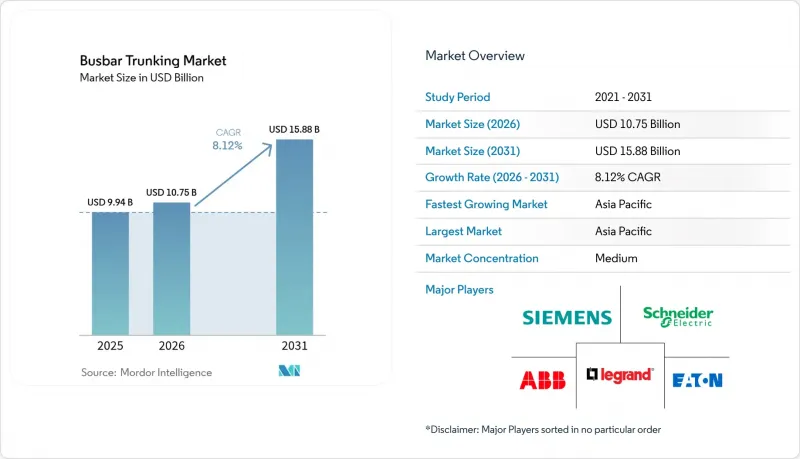
본 보고서는 도체 재료(구리, 알루미늄, 쿠퍼날/바이메탈), 절연 유형(샌드위치 절연 및 공기 절연), 정격 전력(조명, 저전압, 중전압 및 고전압), 최종사용자(산업용, 상업용, 운송용, 주거용 및 복합 용도 고층 빌딩), 지역(북미, 유럽, 아시아태평양, 남미, 중동 및 아프리카)별로 분류되어 있습니다.
세계 버스바 트렁킹 시장 동향 및 인사이트
데이터센터 및 상업용 부동산에서 신뢰성이 높고 공간 효율이 뛰어난 배전 수요
하이퍼스케일 개발 사업자가 버스바 트렁킹 시스템을 선호하는 이유는, 이 시스템이 천장 높이를 낮게 유지하면서 메가와트 규모의 전력을 공급하고, 귀중한 서버 랙 공간을 확보할 수 있기 때문입니다. 지멘스와 컴퍼스 데이터센터(Compass Data Centers)가 체결한 다년간의 기본 계약은 통합형 중전압 스키드가 설치 시간을 60% 단축하고 확장을 간소화한다는 점을 보여줍니다. 엣지 컴퓨팅 및 AI 워크로드의 증가에 따라 전력 밀도 목표치가 높아지고 있으며, 이에 대응하기 위해서는 열 부하를 관리하고 향후 정격 전력을 상향 조정할 수 있는 도체가 필요합니다. 또한 운영자는 긴 배선을 다시 할 필요 없이 시공사가 차단기를 추가할 수 있는 ‘플러그 앤 플레이’ 방식의 분기 설계를 높이 평가하고 있습니다. 분기 박스에 내장된 디지털 계량기는 예측 유지보수를 가능하게 하여 가동 시간에 관한 서비스 수준 계약(SLA) 달성에 기여합니다. 이러한 요인들이 결합되어 데이터센터 건설 사업자들은 버스바 도입의 최전선에 계속 서 있으며, 그들의 구매 패턴은 전 세계 사양 기준을 형성하고, 이후 더 광범위한 상업용 부동산 프로젝트로 파급되고 있습니다.
스마트 그리드 통합이 모듈식 시스템 수요를 견인
대량의 풍력 및 태양광발전을 통합하는 국가의 송전망 운영자는 고정식 케이블 하네스에서 양방향 에너지 흐름을 지원하는 모듈식 버스바 링크로 전환하고 있습니다. 버스바는 긴 집전 라인에서 낮은 임피던스를 실현하여 열 손실을 줄이고, 재생에너지 발전소의 전반적인 효율을 향상시킵니다. 또한, 전력 회사는 간헐적인 발전에 수반되는 단락 스트레스를 견딜 수 있는 견고한 설계를 선호합니다. 에너지 저장 시스템이 변전소나 지역 마이크로그리드에 도입됨에 따라, 기획 담당자들은 변화하는 부하 패턴에 맞춰 신속하게 재구성할 수 있는 배전 어셈블리가 필요합니다. 최신 버스바 접합부에 장착된 IoT 센서는 온도 및 전류 데이터를 실시간으로 제공하여 운영 담당자가 상태에 기반한 유지보수 일정을 실행할 수 있도록 합니다. 그 결과, 신규 건설 및 개보수 스마트 그리드 프로젝트에서 도입 실적이 꾸준히 확대되고 있습니다.
구리 및 알루미늄 가격 변동
원자재 가격의 변동 주기는 납품 6개월 전에 버스바 주문을 확정해야 하는 계약업체에게 예산 수립상의 불확실성을 초래합니다. 구리 피복 알루미늄(Cuponal)은 질량을 60% 줄이고 도체 비용을 40% 절감함으로써 이러한 격차를 메우려는 시도이지만, 실제 운용 실적이 제한적이어서 많은 설계 기술자들이 채택을 주저하고 있습니다. 공급망의 혼란으로 인해 건설 일정이 가격 정점을 지나버릴 가능성이 있으며, 그 결과 시공사들은 계약 재협상이나 프로젝트 연기를 피할 수 없게 됩니다. 동시에, 알루미늄 현물 가격의 급등으로 인해 공급업체는 추가 요금을 인상할 수밖에 없게 되었고, 가격에 민감한 인프라 입찰에서 이미 낮은 이익률을 더욱 압박하고 있습니다. 그 결과, 가격 변동이 심해지면서 대규모 조달 결정이 주저되고, 승인 절차가 장기화되며, 단기적인 성장이 둔화되고 있습니다.
부문 분석
2025년 현재, 구리는 버스바 트렁킹 시스템 시장 점유율의 72.40%를 차지하고 있으며, 이는 오랜 기간에 걸친 정착, 높은 전도성, 그리고 확고한 공급업체 기반을 반영합니다. 그러나 설계 팀이 경량화와 구조 지지 비용 절감을 더욱 중시하게 됨에 따라 알루미늄 버스바 시장은 연평균 성장률(CAGR) 8.45%로 성장하고 있습니다. 세계 공급망이 성숙해짐에 따라, 2025년부터 2031년까지 알루미늄이 버스바 트렁킹 시스템 시장 규모에서 차지하는 비중은 2배로 증가할 것으로 예상됩니다.
경량화를 통해 고소에서의 취급이 용이해져 건설 현장에서의 크레인 임대 비용을 절감할 수 있을 뿐만 아니라, 수작업으로 물건을 들어 올리는 작업이 줄어들어 안전성이 향상됩니다. 한편, 첨단 합금의 열적 특성으로 인해 동등한 구리 바보다 빠르게 열을 방출하므로, 더운 기후 하의 태양광발전소 집열 시스템에 유용합니다. 하이브리드 쿠폰바는 구리 표면의 접촉 저항과 알루미늄 심선의 경제성을 겸비하고 있지만, 극소수의 제조업체만이 보유하고 있는 전용 롤 클래드 가공 설비가 필요합니다. 지속적인 연구 개발을 통해 이종 금속 접합부와 표준 단자의 호환성이 향상될 것으로 기대되며, 기존의 구리 재고를 완전히 대체하지 않으면서도 알루미늄으로의 점진적인 전환이 촉진될 전망입니다.
샌드위치 절연 어셈블리는 2025년 매출의 67.35%를 차지했습니다. 이는 도체 플레이트를 적층함으로써 전체 단면적을 최소화하고, 공간이 제한된 천장 공간 내 배선을 간소화할 수 있기 때문입니다. 데이터센터,병원, 모듈식 오피스 타워에서의 공간 효율성에 대한 수요로 인해, 이 구성은 공기 절연 경쟁 제품보다 우위를 점하고 있습니다. 고급 부동산 시장이 컴팩트한 인프라를 높이 평가하고 있기 때문에 2031년까지 버스바 트렁킹 시스템 시장에서 샌드위치 제품의 점유율은 높은 수준을 유지할 전망입니다.
할로겐 프리 폴리머 케이싱의 최근 발전으로 뛰어난 내화 성능이 실현되어, 고층 빌딩 개발업자의 보험료가 절감되고 있습니다. 샌드위치 하우징 내에 내장된 디지털 온도 센서는 연결부의 느슨함을 조기에 경고하여, 상태 기반 유지보수를 가능하게 합니다. 공기 절연선은 시각적 점검의 용이성이 밀도보다 더 중요시되는 저층 산업 플랜트에서 여전히 선호되고 있지만, 설치 면적이 넓기 때문에 성장은 둔화되고 있습니다. 공급업체들은 비용과 화재 안전성을 최적화하기 위해 통기성 커버와 국부적인 샌드위치 섹션을 결합한 하이브리드 제품으로 대응하고 있으며, 이를 통해 컨설팅 엔지니어들의 선택 폭을 넓히고 있습니다.
지역별 분석
2025년, 아시아태평양은 버스바 트렁킹 시스템 시장을 주도하며 전 세계 매출의 47.60%를 차지했습니다. 중국, 인도, 동남아시아 전역에 걸친 야심찬 인프라 회랑 구축, 공장 확장, 스마트 시티 투자가 이 지역의 수요를 지속적으로 끌어올리고 있습니다. 또한 각국 정부가 경기 부양책을 전력망의 복원력 강화 및 전기자동차 충전 인프라 구축으로 전환함에 따라, 이 지역은 2031년까지 연평균 성장률(CAGR) 8.35%를 기록하며 가장 빠른 성장세를 보이고 있습니다. 북미는 이에 이어 버지니아주, 댈러스, 실리콘밸리에서 진행 중인 견실한 데이터센터 건설 계획에 힘입고 있습니다. 이 지역의 개발업체들은 도입 주기를 수개월에서 수주로 단축할 수 있는 맞춤형 사양의 버스웨이 스키드를 요구하고 있습니다. 유럽은 성숙한 도입 기반을 갖추고 있으나, 재생에너지 통합 및 건물의 방화 성능 향상을 요구하는 정책적 압력으로 인해 완만한 확장이 지속되고 있습니다. 노후화된 케이블 인프라의 개보수로 인해, 사무실 및 복합 용도 시설의 개보수 공사에서 레트로핏용 버스바 패키지에 대한 수요가 확대되고 있습니다. 중동 및 아프리카는 절대 수치상으로는 여전히 소규모이지만, 걸프 연안 국가들의 스마트 시티 계획이나 광업 메가 프로젝트에서 두 자릿수 성장이 예상되는 분야가 존재합니다. 라틴아메리카는 거시경제의 변동이 설비 투자를 억제하고 있어 성장세가 주춤하고 있습니다. 다만, 칠레와 브라질의 대규모 태양광발전소가 고전압 컬렉터 버스웨이에 선택적인 기회를 창출하고 있습니다. 전반적으로 버스바 트렁킹 시스템의 시장 규모 확대는 지역별로 분산되어 있으며, 아시아태평양이 가장 큰 증가분을 차지하고 있습니다.
기타 혜택:
- 엑셀 형식의 시장 예측(ME) 시트
- 3개월간의 애널리스트 지원
자주 묻는 질문
목차
제1장 소개
제2장 조사 방법
제3장 주요 요약
제4장 시장 구도
제5장 시장 규모와 성장 예측
제6장 경쟁 구도
제7장 시장 기회와 향후 전망
KSM 26.08.26According to Mordor Intelligence, busbar trunking market size in 2026 is estimated at USD 10.75 billion, growing from 2025 value of USD 9.94 billion with 2031 projections showing USD 15.88 billion, growing at 8.12% CAGR over 2026-2031.
This report is Segmented by Conductor Material (Copper, Aluminium, and Cuponal/Bi-metallic), Insulation Type (Sandwich and Air-Insulated), Power Rating (Lighting, Low-Voltage, Medium-Voltage, and High-Voltage), End-User (Industrial, Commercial, Transportation, and Residential and Mixed-Use High-Rise), Geography (North America, Europe, Asia-Pacific, South America, and Middle East and Africa).
Global Busbar Trunking Market Trends and Insights
Demand for Reliable, Space-Efficient Distribution in Data Centers and Commercial Real Estate
Hyperscale developers prefer busbar trunking systems because the assemblies deliver megawatt-scale power within reduced ceiling height, reserving valuable server rack space. A multi-year framework between Siemens and Compass Datacenters shows how integrated medium-voltage skids cut installation time by 60% and simplify expansion. Edge computing and AI workload growth increase power-density targets, which require conductors that manage thermal loads and allow future uprating. Operators also value the plug-and-play tap-off design that lets contractors add breakers without rewiring long runs. Digital meters embedded in tap-off boxes enable predictive maintenance and align with uptime service-level agreements. Together, these factors keep data-center builders at the forefront of busbar adoption, and their buying patterns shape global specification standards that later diffuse into broader commercial real-estate projects.
Smart-Grid Integration Drives Modular System Demand
National grid operators integrating large volumes of wind and solar generation are shifting from fixed cable harnesses to modular busbar links that support bidirectional energy flow. Busbars deliver lower impedance over long collector runs, which reduces thermal losses and improves overall renewable-plant efficiency. Utilities also favor the rigid design because it withstands short-circuit stresses linked to intermittent generation. As energy storage systems enter substations and community micro-grids, planners need distribution assemblies that can be re-configured quickly in line with evolving load patterns. IoT sensors fitted to modern busbar joints provide real-time temperature and current data, allowing operators to execute condition-based maintenance schedules. The result is a steadily widening installed base in greenfield and retrofit smart-grid projects.
Copper and Aluminum Price Volatility
Commodity cycles create budgeting uncertainty for contractors who may lock in busbar orders six months before delivery. Copper-clad aluminum (Cuponal) attempts to bridge the gap by lowering mass 60% and cutting conductor cost by 40%, yet many design engineers hesitate due to limited field history. Supply chain disruptions can push build schedules beyond peak price windows, causing contractors to renegotiate or defer projects. At the same time, spot spikes in aluminum force suppliers to raise surcharges that erode already thin margins in price-sensitive infrastructure tenders. Consequently, volatility deters large procurement decisions and lengthens approval cycles, trimming near-term growth.
Other drivers and restraints analyzed in the detailed report include:
- Industrial Capacity Surge Across Asia-Pacific Manufacturing Hubs
- High-Ampacity EV Fast-Charging Networks Adoption
- Cable-Based Retrofits Competing in Aged Facilities
For complete list of drivers and restraints, kindly check the Table Of Contents.
Segment Analysis
Copper captured 72.40% of the busbar trunking system market share 2025, reflecting legacy acceptance, high conductivity, and a well-established supplier base. Aluminum lines, however, are growing at an 8.45% CAGR as engineering teams place greater value on lower weight and reduced structural-support costs. Busbar trunking system market size contributions from aluminum are expected to double between 2025 and 2031 as global supply chains mature.
Weight savings translate into easier overhead handling, which lowers crane hire charges at construction sites and improves safety by reducing manual lifting. Thermal properties of advanced alloys meanwhile dissipate heat faster than comparable copper bars, which benefits solar-plant collector systems in hot climates. Hybrid Cuponal bars deliver copper-surface contact resistance with aluminum-core economics but require specialized roll-cladding equipment that only a few manufacturers possess. Continued R&D promises better compatibility between mixed-metal joints and standard terminations, supporting steady migration toward aluminum without fully displacing legacy copper inventories.
Sandwich-insulated assemblies accounted for 67.35% of 2025 revenue because their stacked conductor plates minimize overall cross-section and simplify routing through congested ceiling voids. Demand for space efficiency within data centers, hospitals, and modular office towers keeps this configuration ahead of air-insulated rivals. Busbar trunking system market size allocations to sandwich products will remain elevated through 2031 as premium real-estate values reward compact infrastructure.
Recent advances in halogen-free polymer casings achieve superior fire ratings that reduce insurance premiums for high-rise developers. Digital temperature sensors integrated inside sandwich housing deliver early warning of loose joints, enabling condition-based maintenance. Air-insulated lines still find favor in low-rise industrial plants where easy visual inspection trumps density, yet their growth lags due to a larger footprint. Suppliers respond with hybrid products that combine ventilated covers and localized sandwich sections to optimize cost and fire safety, widening the menu of choices for consulting engineers.
Complete Report Scope:
- By Conductor Material
- Copper
- Aluminium
- Cuponal/Bi-metallic
- By Insulation Type
- Sandwich (Compact)
- Air-Insulated
- By Power Rating
- Lighting (Below 125 V)
- Low-Voltage (125 V to 1 kV)
- Medium-Voltage (1 to 35 kV)
- High-Voltage (Above 35 kV)
- By End-User
- Industrial (Process, Manufacturing, Mining, Oil & Gas)
- Commercial (Offices, Retail, Datacentres, Hospitals)
- Transportation (Airports, Rail & Metro, Marine)
- Residential and Mixed-Use High-Rise
- By Geography
- North America
- United States
- Canada
- Mexico
- Europe
- Germany
- United Kingdom
- France
- Italy
- Russia
- Rest of Europe
- Asia-Pacific
- China
- India
- Japan
- South Korea
- ASEAN Countries
- Rest of Asia-Pacific
- South America
- Brazil
- Argentina
- Rest of South America
- Middle East and Africa
- Saudi Arabia
- United Arab Emirates
- South Africa
- Egypt
- Rest of Middle East and Africa
- North America
Geography Analysis
Asia-Pacific led the busbar trunking system market in 2025 with 47.60% of global revenue. Ambitious infrastructure corridors, factory expansions, and smart-city investments across China, India, and Southeast Asia continue to elevate regional demand. The region is also the fastest growing, posting an 8.35% CAGR to 2031 as national governments redirect stimulus toward grid resilience and EV charging rollouts. North America follows, buoyed by robust data-center pipelines in Virginia, Dallas, and Silicon Valley. Developers there demand custom busway skids that reduce deployment cycles from months to weeks. Europe holds a mature installed base, yet policy pressures to integrate renewable energy and improve building fire performance sustain moderate expansion. Renovation of aging cable infrastructure adds scope for retrofit busbar packages in office and mixed-use refurbishments. The Middle East and Africa remain smaller in absolute numbers but present double-digit growth pockets in Gulf smart-city programs and mining megaprojects. Latin America lags because macroeconomic volatility restrains capital expenditure, though utility-scale solar parks in Chile and Brazil create selective opportunities for high-voltage collector busways. Overall, the busbar trunking system market size gains are geographically diversified, with Asia-Pacific adding the largest incremental volume.
- ABB Ltd
- Schneider Electric SE
- Siemens AG
- Eaton Corp plc
- General Electric Co.
- Legrand SA
- Larsen & Toubro Ltd
- C&S Electric Ltd
- Pogliano Busbar S.r.l
- Anord Mardix (Emerson)
- Megabarre Group
- NAXSO S.r.l
- Mersen SA
- Rittal GmbH
- Powell Industries Inc
- Godrej & Boyce Mfg Co
- DBTS Industries
- EAE Elektrik A.S
- Furukawa Electric Co.
- Huapeng Group China
Additional Benefits:
- The market estimate (ME) sheet in Excel format
- 3 months of analyst support
TABLE OF CONTENTS
1 Introduction
- 1.1 Study Assumptions & Market Definition
- 1.2 Scope of the Study
2 Research Methodology
3 Executive Summary
4 Market Landscape
- 4.1 Market Overview
- 4.2 Market Drivers
- 4.2.1 Demand for reliable, space-efficient distribution in data-centres & commercial real-estate
- 4.2.2 Smart-grid & renewables roll-out needing modular busbar links
- 4.2.3 Industrial capacity surge across APAC manufacturing hubs
- 4.2.4 High-ampacity EV fast-charging networks adoption
- 4.2.5 Prefab micro-grid kits for disaster-resilient power restoration
- 4.2.6 Fire-retardant polymer casings lowering insurance premiums in high-rise projects
- 4.3 Market Restraints
- 4.3.1 Copper & aluminium price volatility
- 4.3.2 Cable-based retrofits competing in aged facilities
- 4.3.3 Thermal-runaway risks under harmonic-rich industrial loads
- 4.3.4 Shortage of certified installers in emerging economies
- 4.4 Supply-Chain Analysis
- 4.5 Regulatory Landscape
- 4.6 Technological Outlook (hybrid sandwich-air, Cuponal conductors, digital twins)
- 4.7 Porter's Five Forces
- 4.7.1 Bargaining Power of Suppliers
- 4.7.2 Bargaining Power of Buyers
- 4.7.3 Threat of New Entrants
- 4.7.4 Threat of Substitutes
- 4.7.5 Competitive Rivalry
5 Market Size & Growth Forecasts
- 5.1 By Conductor Material
- 5.1.1 Copper
- 5.1.2 Aluminium
- 5.1.3 Cuponal/Bi-metallic
- 5.2 By Insulation Type
- 5.2.1 Sandwich (Compact)
- 5.2.2 Air-Insulated
- 5.3 By Power Rating
- 5.3.1 Lighting (Below 125 V)
- 5.3.2 Low-Voltage (125 V to 1 kV)
- 5.3.3 Medium-Voltage (1 to 35 kV)
- 5.3.4 High-Voltage (Above 35 kV)
- 5.4 By End-User
- 5.4.1 Industrial (Process, Manufacturing, Mining, Oil & Gas)
- 5.4.2 Commercial (Offices, Retail, Datacentres, Hospitals)
- 5.4.3 Transportation (Airports, Rail & Metro, Marine)
- 5.4.4 Residential and Mixed-Use High-Rise
- 5.5 By Geography
- 5.5.1 North America
- 5.5.1.1 United States
- 5.5.1.2 Canada
- 5.5.1.3 Mexico
- 5.5.2 Europe
- 5.5.2.1 Germany
- 5.5.2.2 United Kingdom
- 5.5.2.3 France
- 5.5.2.4 Italy
- 5.5.2.5 Russia
- 5.5.2.6 Rest of Europe
- 5.5.3 Asia-Pacific
- 5.5.3.1 China
- 5.5.3.2 India
- 5.5.3.3 Japan
- 5.5.3.4 South Korea
- 5.5.3.5 ASEAN Countries
- 5.5.3.6 Rest of Asia-Pacific
- 5.5.4 South America
- 5.5.4.1 Brazil
- 5.5.4.2 Argentina
- 5.5.4.3 Rest of South America
- 5.5.5 Middle East and Africa
- 5.5.5.1 Saudi Arabia
- 5.5.5.2 United Arab Emirates
- 5.5.5.3 South Africa
- 5.5.5.4 Egypt
- 5.5.5.5 Rest of Middle East and Africa
- 5.5.1 North America
6 Competitive Landscape
- 6.1 Market Concentration
- 6.2 Strategic Moves (M&A, Partnerships, PPAs)
- 6.3 Market Share Analysis (Market Rank/Share for key companies)
- 6.4 Company Profiles (includes Global level Overview, Market level overview, Core Segments, Financials as available, Strategic Information, Products & Services, and Recent Developments)
- 6.4.1 ABB Ltd
- 6.4.2 Schneider Electric SE
- 6.4.3 Siemens AG
- 6.4.4 Eaton Corp plc
- 6.4.5 General Electric Co.
- 6.4.6 Legrand SA
- 6.4.7 Larsen & Toubro Ltd
- 6.4.8 C&S Electric Ltd
- 6.4.9 Pogliano Busbar S.r.l
- 6.4.10 Anord Mardix (Emerson)
- 6.4.11 Megabarre Group
- 6.4.12 NAXSO S.r.l
- 6.4.13 Mersen SA
- 6.4.14 Rittal GmbH
- 6.4.15 Powell Industries Inc
- 6.4.16 Godrej & Boyce Mfg Co
- 6.4.17 DBTS Industries
- 6.4.18 EAE Elektrik A.S
- 6.4.19 Furukawa Electric Co.
- 6.4.20 Huapeng Group China
7 Market Opportunities & Future Outlook
- 7.1 White-space & Unmet-Need Assessment


