
|
시장보고서
상품코드
2115880
뉴클레오티드 : 시장 점유율 분석, 업계 동향과 통계, 성장 예측(2026-2031년)Nucleotides - Market Share Analysis, Industry Trends & Statistics, Growth Forecasts (2026 - 2031) |
||||||
 Mordor Intelligence
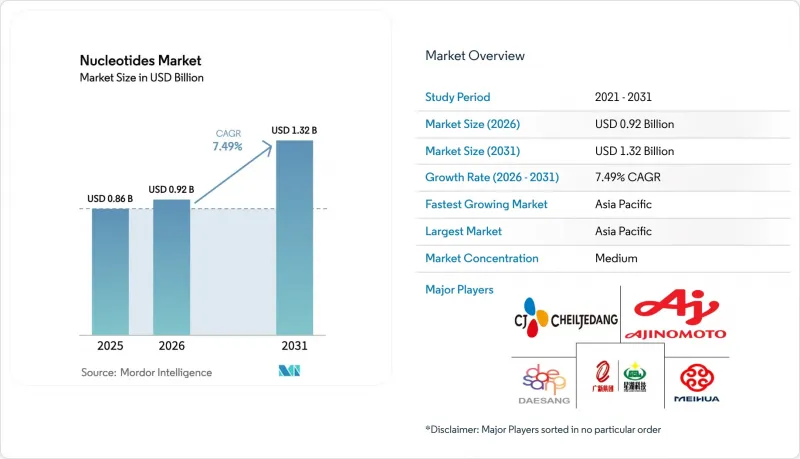
Mordor Intelligence에 따르면 뉴클레오티드 시장 규모는 2025년 8억 6,000만 달러에서 2026년에는 9억 2,000만 달러로 확대되고, 2026년부터 2031년까지 CAGR 7.49%를 기록하며 2031년에는 13억 2,000만 달러에 달할 것으로 예측됩니다.
본 보고서는 질소 함유 염기의 종류(피리미딘 및 퓨린), 뉴클레오티드의 종류(모노뉴클레오티드, 디뉴클레오티드 등), 제품 등급(식품 등급, 실험실·진단용 등급, 산업용·대량 등급), 용도(식품 및 사료 첨가제, 의약품, 신약 개발), 지역(아시아태평양, 북미 등)별로 분류되어 있습니다. 시장 전망은 금액(달러) 기준으로 제시되어 있습니다.
세계 뉴클레오티드 시장의 동향 및 인사이트
제약 및 바이오의약품 부문의 수요 확대
2024년 FDA가 Casgevy, Itvisma, RIVFLOZA 및 TRYNGOLZA를 승인함에 따라, 올리고뉴클레오티드 치료제는 틈새 시장에서 주류로 전환되었으며, 이에 따라 주요 제약사들은 고순도 뉴클레오티드에 대한 다년간의 공급 계약을 체결하게 되었습니다. 서모피셔는 2025년에 싱가포르 시설을 확장하여 연간 500kg의 생산능력을 증대하는 동시에, 안티센스 및 siRNA 프로그램을 위해 2주 리드타임을 실현했습니다. 미국 유전자·세포 치료학회(ASGCT)의 집계에 따르면, 개발 중인 RNA 기반 치료제는 1,261건에 달해 전년 대비 22% 증가했으며, 이는 시토신, 아데닌, 구아닌, 우라실 각 단량체에 대한 광범위한 수요를 여실히 보여주고 있습니다. 메신저 RNA(mRNA) 백신 제조 공장에서는 2024년에 1만 2,000톤의 뉴클레오티드가 소비될 전망이며, 현재 연속 처리 방식으로의 전환이 진행 중이어서 이로 인해 단기적인 원자재 부족 현상이 더욱 심화되고 있습니다. 따라서 CRISPR, RNAi 및 자가 증폭형 RNA(saRNA) 플랫폼의 융합으로 인해, 식품 등급 공급업체로는 대응할 수 없는 GMP 등급 원자재에 대한 구조적 수요가 확고해지고 있습니다.
기능성 유아용·의료용 영양식품에서의 채택 확대
규제 당국은 분유에 뉴클레오티드 첨가를 계속해서 권장하고 있습니다. 유럽식품안전청(EFSA)은 2024년, 100kcal당 최대 5mg까지의 사용이 안전함을 재확인했습니다. 중국 국가위생건강위원회는 2025년부터 생후 6-12개월 영아용 후속 분유에 뉴클레오티드 첨가를 의무화했으며, 이로 인해 수요는 즉시 연간 2,400톤 증가했습니다. 현재 클린 라벨 브랜드들은 발효 유래 원료를 강력히 요구하고 있으며, 유기농 기준 인증 획득에 생산능력이 따라가지 못해 2026년 초에는 리드타임이 20주로 늘어 2024년 기준의 2배가 되었습니다. 의료 영양 기업들은 유아용 조제분유의 기준보다 2-3배 높은 농도의 뉴클레오티드 블렌드를 배합하여 프리미엄 가격을 실현하고 있습니다. 규제 요건과 천연 원료를 선호하는 소비자의 기호가 교차하는 가운데, 조달 팀은 전용 클린룸 발효 설비를 갖춘 공급업체를 우선적으로 선정하여 공급업체 목록을 재검토하고 있습니다.
신공장 건설에 따른 고액의 설비 투자(CAPEX) 및 GMP 준수 비용
GMP 기준을 준수하는 뉴클레오티드 공장을 건설하려면 5,000만-2억 달러의 초기 투자에 더해 엄격한 검증 체제가 필요하며, 이로 인해 식품 등급 생산 라인에 비해 운영 비용이 15-20% 증가합니다. BioSpring사의 함부르크 거점 확장에서는 수익이 발생하기까지 18개월간의 검사 기간이 소요되어, 현금 흐름에 미치는 부정적인 영향이 두드러지게 나타났습니다. 전환 작업이나 배치 릴리스 시험으로 인해 설비가 유휴 상태가 되기 때문에 평균 가동률은 70% 전후에 그치고 있으며, 견실한 수익 확보에 필요한 85%라는 기준치를 밑돌고 있습니다. 그 결과, 소규모 CDMO는 그린필드 건설보다 파트너십을 우선시하고 있으며, 의약품 등급의 공급은 약 12개 인증 업체에 집중되어 있습니다.
부문 분석
피리미딘은 2025년 수요의 54.87%를 차지하고 있으며, 이는 mRNA 백신 및 치료제의 체외 전사 과정에서 시티딘과 우리딘이 중심적인 역할을 하고 있음을 반영합니다. 기존 mRNA 1회 투여량에는 약 1g의 피리미딘이 사용되므로, 2020년부터 2024년에 걸친 백신 생산 확대에 따라 GMP 로트에 대한 다년 계약이 확정되었습니다. 자가 증폭형 RNA(SARNA) 형식의 경우, 1회분당 필요한 뉴클레오티드 양은 감소하지만, 유전자 치료 분야의 파이프라인 확장이 공급량 둔화를 상쇄하고 있습니다. 나머지 45.13%를 차지하는 퓨린류는 특히 안티센스 올리고에서 중요하며, 포스포티오에이트로 변형된 아데노신 및 구아노신이 안정성을 높이고 있습니다. 영아용 분유에서 피리미딘과 퓨린의 55:45라는 균형 잡힌 비율은 두 계열의 수요에 안정적인 하한선을 제공하고 있습니다.
제약 공급망에서 피리미딘은 가격 면에서 프리미엄이 붙습니다. 이는 GMP 라인에서 시티딘의 탈아미노화 및 우리딘의 산화를 억제해야 하기 때문입니다. 서모피셔(Thermo Fisher)는 2025년 설비 갱신 시 이러한 제약을 해결하기 위해 시티딘 삼인산 전용 반응기를 추가했습니다. 중국의 각 발효 제조업체들은 더 높은 이익률을 확보하기 위해 우리딘의 결정화 능력을 강화하고 있지만, 유럽과 미국의 구매자들은 여전히 EMA 기준에 따라 검증된 견고한 불순물 프로파일을 가진 공급업체를 선호하고 있습니다. mRNA 백신이 종양학 및 자가면역 질환 적응증으로 다양화되는 가운데, 피리미딘의 성장세는 꺾이지 않을 것으로 보입니다.
87건의 후기 단계 의약품 후보가 승인을 향해 진행되고 있는 만큼, 올리고뉴클레오티드 시장은 2031년까지 연평균 성장률(CAGR) 8.22%로 확대될 전망입니다. 모노뉴클레오티드는 유아용 조제분유에의 첨가 의무화와 가축 용도의 확대에 힘입어 2025년 뉴클레오티드 시장 규모의 33.40%를 차지했습니다. 이중핵산은 여전히 짭짤한 스낵 식품과 관련된 풍미 조절 틈새 시장에 머물러 있지만, 다중핵산은 2025 회계연도에 NIH가 RNA 생물학에 사상 최대인 32억 달러를 지원한 혜택을 받고 있습니다.
BioSpring과 같은 맞춤형 올리고 제조업체는 2주 이내에 변형된 사슬을 납품할 수 있어, 기존의 4-6주 주기를 앞지르며 25%의 가격 프리미엄을 확보하고 있습니다. CDMO의 공급 부족은 계속되고 있으며, 미국의 여러 공급업체에서 12개월 치의 예약 대기 현상이 발생하고 있는 것으로 보아, 이로 인해 생명공학 기업들은 공급원의 다각화를 모색하고 있습니다. 공정 규모의 포스포아미다이트 합성이 여전히 주류를 이루고 있지만, 효소를 이용한 대체 방법을 통해 용매 폐기물을 줄일 가능성이 있어 투자자들은 이러한 변화를 주시하고 있습니다.
지역별 분석
아시아태평양은 2025년에 전 세계 수요의 44.71%를 차지했으며, 2031년까지 연평균 성장률(CAGR) 7.91%로 확대될 것으로 전망됩니다. 중국 한 나라만으로도 전 세계 발효 생산능력의 대부분을 차지하고 있으며, 중국의 정밀 의료 로드맵에 따른 올리고 요법 임상시험이 이를 뒷받침하고 있습니다. 한국의 CJ제일제단은 연속 발효조를 활용하여 유아용 조제분유 및 생명공학 분야 고객 모두에게 제품을 공급하고 있습니다. 인도는 진단용 시약에 주력하고 있지만, 도시 지역의 모유 수유율이 감소함에 따라 국내 유아용 조제분유 수요도 증가하고 있습니다.
북미에서는 최대 규모의 올리고뉴클레오티드 의약품 파이프라인과 프리미엄 유기농 분유 부문이 시장을 주도하고 있습니다. 서모피셔(Thermo Fisher)의 싱가포르 공장은 미국 고객에 대한 리드타임을 단축하고, 대서양 횡단 공급망의 혼란으로부터 공급망을 보호하기 위해 건설되었습니다. 캐나다의 분유 규제에서는 코덱스(국제식품규격)의 최저 기준을 20% 상회하는 뉴클레오티드 함량이 규정되어 있어, 그 결과 1인당 소비량이 높습니다. 멕시코 가금류 업계에서는 수출용 항생제 무사용 인증을 획득하기 위해 뉴클레오티드 배합 사료의 시범 도입이 진행되고 있습니다.
유럽의 수요는 리드 타임을 장기화시키는 엄격한 클린 라벨 규제가 특징입니다. EMA(유럽의약품청)의 추적성에 관한 지침은 모든 공정을 문서화할 수 있는 지역 공급업체를 우대하고 있어, 바이오스프링(BioSpring)사와 프랑스의 CDMO(위탁 개발·제조 기관)에 혜택을 주고 있습니다. 독일, 프랑스, 영국에는 올리고뉴클레오티드 의약품을 개발하는 38개 기업이 집적되어 있으며, GMP(우수 제조 관리 기준)를 준수하는 원료의 사용이 집중되고 있습니다. 유기농 배합 사료의 붐으로 인해 뉴클레오티드 공급 부족이 해소되어 현물 시장의 프리미엄 가격을 끌어올렸습니다. 남미, 중동 및 아프리카에서는 수요가 낮은 수준이지만, 브라질에서는 새우 질병으로 인한 연간 30억 달러의 손실이 뉴클레오티드 도입을 촉진하고 있으며, 사우디아라비아의 ‘비전 2030’에는 의약품 원료의 현지 조달이 포함되어 있어 새로운 생산능력 입찰로 이어질 가능성이 있습니다.
기타 혜택:
- 엑셀 형식의 시장 예측(ME) 시트
- 3개월간 애널리스트 지원
자주 묻는 질문
목차
제1장 소개
제2장 조사 방법
제3장 주요 요약
제4장 시장 구도
제5장 시장 규모와 성장 예측
제6장 경쟁 구도
제7장 시장 기회와 향후 전망
KSMAccording to Mordor Intelligence, the nucleotides market size is expected to grow from USD 0.86 billion in 2025 to USD 0.92 billion in 2026 and is forecast to reach USD 1.32 billion by 2031 at 7.49% CAGR over 2026-2031.
This report is Segmented by Nitrogenous Base Class (Pyrimidine and Purine), Nucleotide Type (Mononucleotides, Dinucleotides, and More), Product Grade (Food Grade, Lab/Diagnostic Grade, and Industrial/Bulk Grade), Application (Food and Animal Feed Additives, Pharmaceutical, and Drug Discovery), and Geography (Asia-Pacific, North America, and More). The Market Forecasts are Provided in Terms of Value (USD).
Global Nucleotides Market Trends and Insights
Growing Demand from Pharmaceutical and Biopharma Sectors
Oligonucleotide therapeutics shifted from niche to mainstream after the FDA cleared Casgevy, Itvisma, RIVFLOZA, and TRYNGOLZA in 2024, prompting originators to lock in multi-year supply contracts for high-purity nucleotides. Thermo Fisher expanded a Singapore facility in 2025, injecting 500 kg of annual capacity and offering 2-week turnaround times for antisense and siRNA programs. The American Society of Gene and Cell Therapy counted 1,261 RNA-based therapies in active pipelines, a 22% rise year-over-year, underscoring pervasive demand for cytosine, adenine, guanine, and uracil monomers. Messenger-RNA vaccine plants consumed 12,000 t of nucleotides in 2024 and are switching to continuous processing, which heightens near-term raw-material tightness. Convergence of CRISPR, RNAi, and self-amplifying RNA platforms therefore cements structural pull for GMP-grade inputs that food-grade suppliers cannot match.
Rising Adoption in Functional Infant and Medical Nutrition
Regulators continue to endorse nucleotide fortification in formula. The European Food Safety Authority reaffirmed safe use up to 5 mg/100 kcal in 2024. China's National Health Commission mandated nucleotides in follow-on formula for 6- to 12-month infants in 2025, instantly lifting demand by 2,400 t per year. Clean-label brands now insist on fermentation-derived grades; lead times stretched to 20 weeks in early 2026, double 2024 norms, as capacity struggled to certify organic standards. Medical-nutrition firms add nucleotide blends at concentrations two-to-three times infant-formula norms, capturing premium pricing. As regulatory mandates intersect with consumer preference for natural inputs, procurement teams reevaluate supplier rosters in favor of dedicated clean-room fermenters.
High CAPEX and GMP-Compliance Costs for New Plants
Building a GMP nucleotide plant demands USD 50-200 million in upfront spending plus stringent validation regimes that raise operating overhead 15-20% versus food-grade lines. BioSpring's Hamburg expansion took 18 months of inspections before revenue flow, illustrating cash-flow drag. Average utilization hovers near 70% because changeovers and batch-release testing idle equipment, below the 85% threshold needed for robust returns. As a result, smaller CDMOs favor partnerships over greenfield builds, concentrating pharmaceutical-grade supply among a dozen qualified players.
Other drivers and restraints analyzed in the detailed report include:
- Inclusion in Livestock and Aquaculture Feed to Replace Antibiotics
- Rapid Growth of Oligonucleotide-Based Gene and Cell-Therapy Pipelines
- Volatile Sugar/Corn-Based Raw-Material Prices
For complete list of drivers and restraints, kindly check the Table Of Contents.
Segment Analysis
Pyrimidines accounted for 54.87% of 2025 demand, reflecting the central role of cytidine and uridine in in-vitro transcription for mRNA vaccines and therapeutics. Each conventional mRNA dose uses roughly 1 g of pyrimidines, so vaccine ramp-ups from 2020-2024 locked in multi-year contracts for GMP lots. Self-amplifying RNA formats lower per-dose nucleotide requirements but pipeline growth in gene therapies offsets volume moderation. Purines make up the remaining 45.13% and are especially important in antisense oligos where phosphorothioate-modified adenosine and guanosine enhance stability. Balanced 55:45 pyrimidine-to-purine ratios in infant formula maintain a stable floor for both classes.
In pharmaceutical supply chains, pyrimidines enjoy pricing premiums because GMP lines must mitigate cytidine deamination and uridine oxidation. Thermo Fisher's 2025 upgrade added dedicated reactors for cytidine triphosphate to address this constraint. Chinese fermentation groups are adding uridine crystallization capacity to capture higher margins, but Western buyers still prefer suppliers with robust impurity profiles validated by EMA norms. As mRNA vaccines diversify into oncology and autoimmune indications, pyrimidine momentum is unlikely to relent.
Oligonucleotides are set to expand at 8.22% CAGR through 2031 as 87 late-stage drug candidates advance toward approval. Mononucleotides held 33.40% of the nucleotides market size in 2025, buoyed by infant-formula mandates and growing livestock applications. Dinucleotides remain a flavor-modulating niche tied to savory snacks, while polynucleotides benefit from record NIH RNA-biology funding of USD 3.2 billion for fiscal 2025.
Custom oligo houses such as BioSpring can deliver modified strands in 2 weeks, outpacing legacy four-to-six-week cycles and commanding 25% price premiums. CDMO shortages continue, evidenced by 12-month reservation queues at several U.S. providers, nudging biotech firms to dual-source supply. Process-scale phosphoramidite synthesis still dominates, but enzymatic alternatives could reduce solvent waste, a shift investors track closely.
Complete Report Scope:
- By Nitrogenous Base Class
- Pyrimidine
- Purine
- By Nucleotide Type
- Mononucleotides (NMPs)
- Dinucleotides
- Oligonucleotides
- Polynucleotides
- By Product Grade
- Food Grade
- Lab/Diagnostic Grade
- Industrial/Bulk Grade
- By Application
- Food and Animal Feed Additives
- Pharmaceutical
- Drug Discovery
- By Geography
- Asia-Pacific
- China
- Japan
- India
- South Korea
- ASEAN Countries
- Rest of Asia-Pacific
- North America
- United States
- Canada
- Mexico
- Europe
- Germany
- United Kingdom
- France
- Italy
- Rest of Europe
- South America
- Brazil
- Argentina
- Rest of South America
- Middle-East and Africa
- Saudi Arabia
- South Africa
- Rest of Middle-East and Africa
- Asia-Pacific
Geography Analysis
Asia-Pacific owned 44.71% of global demand in 2025 and is projected to expand at 7.91% CAGR to 2031. China alone houses the majority of worldwide fermentation capacity, propelled by oligo therapy trials aligned with the country's precision-medicine roadmap. South Korea's CJ CheilJedang leverages continuous fermenters to serve both formula and biotech buyers. India focuses on diagnostic reagents yet domestic infant-formula demand is climbing as urban breastfeeding rates fall.
North America is led by the largest oligonucleotide drug pipeline and premium organic-formula segments. Thermo Fisher's Singapore plant was built to shorten lead times for U.S. clients and safeguard supply chains against trans-Atlantic disruptions. Canada's formula regulations specify nucleotide levels 20% above Codex minima, resulting in high per-capita consumption. Mexico's poultry sector is piloting nucleotide feed blends to secure antibiotic-free certifications for exports.
Europe's demand is characterized by strict clean-label rules that elongate lead times. EMA traceability guidance favors regional suppliers able to document every step, benefitting BioSpring and French CDMOs. Germany, France, and the U.K. host 38 companies developing oligonucleotide drugs, concentrating GMP raw-material usage. The organic-formula boom lifted nucleotide shortages, driving spot premiums. South America and Middle-East and Africa represent lower demand, yet Brazil's USD 3 billion annual shrimp disease losses spur nucleotide adoption, and Saudi Arabia's Vision 2030 includes pharma-input localization that could open new capacity bids.
- AFINE CHEMICALS LIMITED
- Ajinomoto Co., Inc.
- Beijing Ruibo Biotechnology Co., Ltd.
- BioSpring Gesellschaft fur Biotechnologie mbH
- CJ CheilJedang Corp.
- DAESANG
- F. Hoffmann-La Roche Ltd
- Fineton Industrial Minerals Limited
- Fufeng Group
- Jena Bioscience GmbH
- LGC Biosearch Technologies
- Meihua Holdings Group Co., Ltd.
- Merck
- Meridian Bioscience, Inc.
- Promega Corporation
- STAR LAKE BIOSCIENCE
- SynCrest Inc.
- Thermo Fisher Scientific Inc.
Additional Benefits:
- The market estimate (ME) sheet in Excel format
- 3 months of analyst support
TABLE OF CONTENTS
1 Introduction
- 1.1 Study Assumptions and Market Definition
- 1.2 Scope of the Study
2 Research Methodology
3 Executive Summary
4 Market Landscape
- 4.1 Market Overview
- 4.2 Market Drivers
- 4.2.1 Growing Demand from Pharmaceutical and Biopharma Sectors
- 4.2.2 Rising Adoption in Functional Infant and Medical Nutrition
- 4.2.3 Inclusion In Livestock and Aquaculture Feed to Replace Antibiotics
- 4.2.4 Rapid Growth of Oligonucleotide-Based Gene and Cell-Therapy Pipelines
- 4.2.5 Precision Fermentation Platforms Lowering Production Cost
- 4.3 Market Restraints
- 4.3.1 High CAPEX and GMP-Compliance Costs for New Plants
- 4.3.2 Volatile Sugar/Corn Based Raw Material Prices
- 4.3.3 Fermentation-Capacity Bottlenecks for Clean-Label Infant-Formula Grade
- 4.4 Value Chain Analysis
- 4.5 Porter's Five Forces
- 4.5.1 Bargaining Power of Suppliers
- 4.5.2 Bargaining Power of Buyers
- 4.5.3 Threat of New Entrants
- 4.5.4 Threat of Substitutes
- 4.5.5 Degree of Competition
5 Market Size and Growth Forecasts (Value)
- 5.1 By Nitrogenous Base Class
- 5.1.1 Pyrimidine
- 5.1.2 Purine
- 5.2 By Nucleotide Type
- 5.2.1 Mononucleotides (NMPs)
- 5.2.2 Dinucleotides
- 5.2.3 Oligonucleotides
- 5.2.4 Polynucleotides
- 5.3 By Product Grade
- 5.3.1 Food Grade
- 5.3.2 Lab/Diagnostic Grade
- 5.3.3 Industrial/Bulk Grade
- 5.4 By Application
- 5.4.1 Food and Animal Feed Additives
- 5.4.2 Pharmaceutical
- 5.4.3 Drug Discovery
- 5.5 By Geography
- 5.5.1 Asia-Pacific
- 5.5.1.1 China
- 5.5.1.2 Japan
- 5.5.1.3 India
- 5.5.1.4 South Korea
- 5.5.1.5 ASEAN Countries
- 5.5.1.6 Rest of Asia-Pacific
- 5.5.2 North America
- 5.5.2.1 United States
- 5.5.2.2 Canada
- 5.5.2.3 Mexico
- 5.5.3 Europe
- 5.5.3.1 Germany
- 5.5.3.2 United Kingdom
- 5.5.3.3 France
- 5.5.3.4 Italy
- 5.5.3.5 Rest of Europe
- 5.5.4 South America
- 5.5.4.1 Brazil
- 5.5.4.2 Argentina
- 5.5.4.3 Rest of South America
- 5.5.5 Middle-East and Africa
- 5.5.5.1 Saudi Arabia
- 5.5.5.2 South Africa
- 5.5.5.3 Rest of Middle-East and Africa
- 5.5.1 Asia-Pacific
6 Competitive Landscape
- 6.1 Market Concentration
- 6.2 Strategic Moves
- 6.3 Market Share (%)/Ranking Analysis
- 6.4 Company Profiles (includes Global level Overview, Market level overview, Core Segments, Financials as available, Strategic Information, Products and Services, and Recent Developments)
- 6.4.1 AFINE CHEMICALS LIMITED
- 6.4.2 Ajinomoto Co., Inc.
- 6.4.3 Beijing Ruibo Biotechnology Co., Ltd.
- 6.4.4 BioSpring Gesellschaft fur Biotechnologie mbH
- 6.4.5 CJ CheilJedang Corp.
- 6.4.6 DAESANG
- 6.4.7 F. Hoffmann-La Roche Ltd
- 6.4.8 Fineton Industrial Minerals Limited
- 6.4.9 Fufeng Group
- 6.4.10 Jena Bioscience GmbH
- 6.4.11 LGC Biosearch Technologies
- 6.4.12 Meihua Holdings Group Co., Ltd.
- 6.4.13 Merck
- 6.4.14 Meridian Bioscience, Inc.
- 6.4.15 Promega Corporation
- 6.4.16 STAR LAKE BIOSCIENCE
- 6.4.17 SynCrest Inc.
- 6.4.18 Thermo Fisher Scientific Inc.
7 Market Opportunities and Future Outlook
- 7.1 White-space and Unmet-need Assessment