|
시장보고서
상품코드
2115888
에어 스타터 : 시장 점유율 분석, 산업 동향 및 통계 데이터, 성장 예측(2026-2031년)Air Starter - Market Share Analysis, Industry Trends & Statistics, Growth Forecasts (2026 - 2031) |
||||||
 Mordor Intelligence
Mordor Intelligence에 의하면, 에어 스타터 시장 규모는 2025년에 4억 1,618만 달러로 평가되었습니다. 2026년 4억 3,569만 달러에서 2031년까지 5억 4,783만 달러에 이를 것으로 예상되며, 예측 기간(2026-2031년) CAGR은 4.69%를 나타낼 전망입니다.
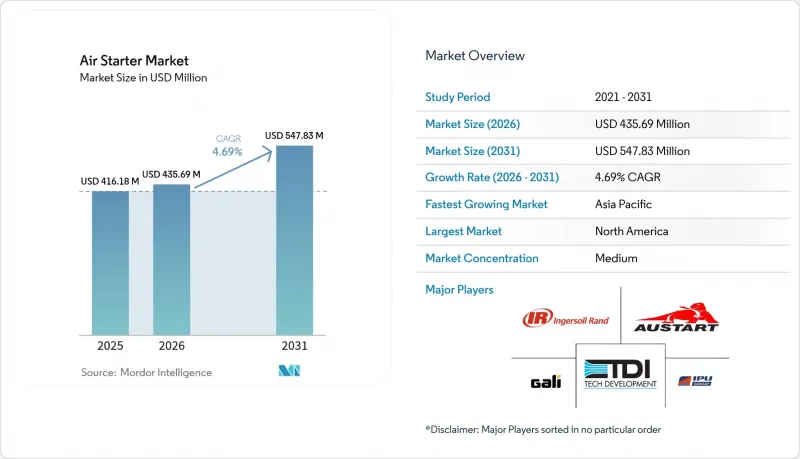
본 보고서는 스타터의 유형(베인식 에어 스타터, 터빈식 에어 스타터, 감속기 장착형 에어 스타터), 엔진 출력(100 HP 이하, 100-300 HP, 300 HP 이상), 최종 사용자(석유 및 가스,발전, 광업, 선박, 항공, 운송) 및 지역(북미, 유럽, 아시아태평양, 남미 등)별로 분류되어 있습니다. 시장 규모 및 전망은 금액(미 달러) 기준으로 제시되어 있습니다.
세계의 에어 스타터 시장 동향 및 인사이트
위험 구역에서 전동식 스타터를 공압식 스타터로 교체하는 추세가 확산되고 있습니다.
산업 사업자들은 클래스 I, 디비전 1 구역에서의 발화 위험을 줄이기 위해 ATEX 및 IECEx 인증을 획득한 공기식 솔루션의 표준화를 추진하고 있습니다. 보험사들은 인증을 받지 않은 전동 유닛의 문제를 점점 더 지적하고 있으며, 이로 인해 정유시설, 곡물 사일로, 화학 플랜트 전반에 걸쳐 개조 주기가 가속화되고 있습니다. 안전을 중시하는 이러한 전환 과정에서 특히 예기치 않은 가동 중단이 막대한 벌금으로 이어지는 업스트림 부문의 시추 및 가스 압축 분야에서는 초기 비용보다 운영의 연속성이 우선시되고 있습니다. 이러한 수요는 가동 중단 시간을 최소화하고, 점점 더 엄격해지는 지역별 안전 감사에 대응할 수 있는 턴키 방식의 개조 키트에 의해 뒷받침되고 있습니다.
ATEX 인증 터빈 스타터가 필요한 LNG 운반선 선단 확대
세계 LNG 수송 분야의 수주 잔고는 방폭형 터빈 스타터에 대한 지속적인 수주를 뒷받침하고 있습니다. 이는 가연성 환경에서의 듀얼 연료 추진 및 화물 취급에 필수적인 요소입니다. 덴마크, 한국, 중국의 조선소들은 설계 단계부터 이러한 시스템을 통합하고 있는 반면, 선주들은 합성 LNG 및 바이오 LNG 운항에 대비해 선단의 미래 경쟁력을 확보하기 위해 예산을 증액하고 있습니다(마스크사는 연간 선박 설비 투자액을 100억-110억 달러로 인상했습니다). 부유식 생산·저장·하역 설비(FPSO)도 이러한 추세를 따르고 있으며, 해상에서의 유지보수를 최소화하기 위해 콤팩트하고 내식성이 뛰어난 설계가 중시되고 있습니다.
전동 구동식 플럭 펌프로의 전환을 통해 시동 및 정지 반복 주기가 해소되고 있습니다.
북미의 셰일 사업자들은 전력망 또는 가스 터빈 발전을 통한 전기식 프래킹 설비로 전환을 추진하고 있으며, 이를 통해 기존 에어 스타터 사용을 촉진하던 빈번한 엔진 재시동이 억제되고 있습니다. 프로페트로(Petro)사와 엑슨모빌(ExxonMobil)사의 3년 계약은 이러한 전환을 상징하는 것으로, 이 회사의 선단의 65%는 이미 듀얼 연료 또는 전기식 유닛이 차지하고 있습니다. 펌프의 연속 운전은 스타터 수요 패턴을 변화시키고 있으며, 공급업체들은 기존의 디젤 용도를 넘어 다각화를 모색할 수밖에 없는 상황입니다.
부문별 분석
2025년에는 베인식 스타터가 에어 스타터 시장에서 53.45%의 점유율을 차지하며 시장을 휩쓸었습니다. 이는 현장에서의 오랜 신뢰성과 간편한 유지보수 절차를 반영한 결과입니다. 석유 및 가스 사업자들은 공구 및 전력 공급이 제한될 가능성이 있는 외딴 지역에서 이러한 특성을 높이 평가했습니다. 터빈 모델은 급속한 회전 수 상승이 필요한 선박 및 항공우주 장비에 채택되고 있습니다. 하이브리드 방식 및 감속기 장착 설계는 연평균 성장률(CAGR) 6.58%로 빠르게 확대되고 있으며, 공압 구동과 기계식 감속을 결합함으로써 자율 주행 기계 및 수소 대응 터빈을 위한 토크 밀도를 향상시키고 있습니다. 적층 가공(3D 프린팅)를 통해 가혹한 사용 조건 하의 터빈 기종에서 내열성을 높인 경량 초합금 로터를 구현할 수 있게 되었으며, 하이브리드 방식은 광범위한 에어 스타터 시장에서 미래의 성장 동력으로서의 입지를 확립해 가고 있습니다.
현재 진행 중인 연구 개발에서는 씰 성능 향상, 건식 윤활 코팅, 그리고 금속 적층 조형 공정을 통해 실현 가능한 더욱 엄격한 공차에 중점을 두고 있습니다. 이러한 혁신은 유지보수 주기 연장을 목표로 하고 있으며, 이는 무인 광산 및 무인 해양 시설에 있어 중요한 판매 포인트입니다. 또한, 선진 표준화 기구들은 ATEX와 지역 규격 간의 상호 인정을 원활하게 하기 위해 인증 체계를 업데이트하고 있으며, 이를 통해 하이브리드 제품에 신규로 진입하는 기업들의 형식 승인 비용이 절감될 가능성이 있습니다.
지역별 분석
2025년에는 북미가 시장을 주도하며 매출의 39.45%를 차지했습니다. 이는 셰일가스, 멕시코만 연안 자산, 그리고 견조한 석유화학 플랜트 업그레이드 프로젝트에 힘입은 결과입니다. 혹독한 겨울과 사막의 더위는 장비를 극한까지 시험하며, 광범위한 온도 범위에서 공압 시스템의 내구성이 입증되었습니다. 이 지역의 애프터마켓 환경은 성숙되어 있으며, 재제조 및 인증 예비 부품에 대한 신속한 대응이 가능하기 때문에 확립된 브랜드에 대한 충성도가 높아지고 있습니다.
아시아태평양은 성장의 견인차 역할을 하고 있으며, 2031년까지 연평균 성장률(CAGR)은 6.72%로 예측됩니다. 중국의 산업 거점과 인도의 송전망 확장이 수요를 견인하는 한편, 한국과 중국의 조선소에서는 수출용 터빈 스타터가 장착된 LNG 운반선이 잇달아 건조되고 있습니다. 일본과 호주에서 증가하고 있는 수소(H2) 시범 프로젝트로 인해, 혼합 연료에 적합한 고토크 설계에 대한 수주가 더욱 다양해지고 있습니다. 현지 부품 공급업체들은 리드 타임 단축을 위해 움직이기 시작했지만, ATEX 준수 요건으로 인해 고액 계약 수주에서는 여전히 유럽 및 미국 기업들이 우위를 점하고 있습니다.
유럽에서는 기존 산업이 엄격한 근로자 안전 지침을 준수해 나가는 가운데, 전망은 균형을 유지하고 있습니다. 독일과 북유럽 국가들의 수소 클러스터는 인증을 받은 고토크 시스템에 대한 전문적인 수요의 거점이 되고 있습니다. 중동에서는 브라운필드 가스 인프라에 대한 투자가 활용되고 있으며, 아프리카의 구리·금 광맥 지대는 광업을 중심으로 한 판매를 견인하고 있습니다. 이 모든 요소는 안정적인 프로젝트 흐름을 창출하여, 전 세계 에어 스타터 시장에서 지역별 서비스 거점의 활기를 유지하는 요인이 되고 있습니다.
기타 혜택 :
- 엑셀 형식 시장 예측(ME) 시트
- 3개월간의 애널리스트 지원
자주 묻는 질문
목차
제1장 서론
제2장 분석 방법
제3장 개요
제4장 시장 구도
제5장 시장 규모 및 성장 예측
제6장 경쟁 구도
제7장 시장 기회 및 향후 전망
KTH 26.08.31According to Mordor Intelligence, the air starter market size was valued at USD 416.18 million in 2025 and estimated to grow from USD 435.69 million in 2026 to reach USD 547.83 million by 2031, at a CAGR of 4.69% during the forecast period (2026-2031).
This report is Segmented by Starter Type (Vane Air Starter, Turbine Air Starter, and Gear-Reduced Air Starter), Engine Capacity (Up To 100 HP, 100 To 300 HP, and Above 300 HP), End-User (Oil and Gas, Power Generation, Mining, Marine, Aviation, and Transportation), and Geography (North America, Europe, Asia-Pacific, South America, and More). The Market Sizes and Forecasts are Provided in Terms of Value (USD).
Global Air Starter Market Trends and Insights
Rising replacement of electric starters with pneumatic starters in hazardous zones
Industrial operators are standardizing ATEX- and IECEx-certified pneumatic solutions to mitigate ignition risks in Class I, Division 1 areas. Insurers are increasingly flagging non-certified electric units, which accelerates retrofit cycles across refineries, grain silos, and chemical plants. The safety-driven transition prioritizes operational continuity over upfront cost, especially in upstream drilling and gas compressio,n where unscheduled outages carry hefty penalties. Resulting demand is buoyed by turnkey retrofit kits that minimize downtime and align with tightening regional safety audits.
Growth of LNG carrier fleet requiring ATEX-rated turbine starters
Global LNG shipping backlogs support persistent orders for explosion-proof turbine starters, a must for dual-fuel propulsion and cargo handling in volatile atmospheres. Danish, Korean, and Chinese yards embed these systems at the design stage, while owners increase budgets-Maersk raised its annual vessel capex to USD 10-11 billion-to future-proof their fleets for synthetic and bio-LNG operations. Floating production, storage, and offloading units echo this trend, emphasizing compact, corrosion-resistant designs to minimize offshore maintenance.
Shift toward electric-drive frac pumps eliminating start-stop duty cycles
North American shale operators are transitioning to grid-powered or gas-turbine-generated electric frac spreads, which curbs the frequent engine restarts that historically drove air starter use. ProPetro's three-year ExxonMobil deal exemplifies the shift, with dual-fuel or electric units already accounting for 65% of its fleet. Continuous pump operation reshapes starter demand patterns, forcing suppliers to diversify beyond legacy diesel applications.
Other drivers and restraints analyzed in the detailed report include:
- IOCs' brownfield life-extension programs boosting retrofit demand
- Recovery in mining equipment capex post-2024 commodity super-cycle
- OEM consolidation reducing multi-vendor starter specifications
For complete list of drivers and restraints, kindly check the Table Of Contents.
Segment Analysis
Vane starters dominated the air starter market with a 53.45% share in 2025, reflecting a long track record of field reliability and straightforward servicing protocols. Oil and gas operators value these traits for remote sites where tooling and power may be constrained. Turbine models serve marine and aerospace equipment needing rapid spin-up. Hybrid gear-reduced designs are accelerating at a 6.58% CAGR, combining pneumatic drive with mechanical reduction to boost torque density for autonomous machinery and hydrogen-ready turbines. Additive manufacturing is now unlocking lightweight superalloy rotors that enhance thermal tolerance in extreme-duty turbine variants, positioning hybrids as a future growth driver in the broader air starter market.
Ongoing R&D focuses on sealing improvements, dry-lube coatings, and tighter tolerances achievable through metal additive processes. These innovations aim to widen maintenance intervals, a key selling point for unmanned mines or unmanned offshore installations. Progressive standards bodies are also updating certification schemes to streamline cross-acceptance between ATEX and regional codes, potentially lowering homologation costs for hybrid entrants.
Complete Report Scope:
- By Starter Type
- Vane Air Starter
- Turbine Air Starter
- Gear-Reduced (Hybrid) Air Starter
- By Horsepower Rating
- Up to 100 HP
- 100 to 300 HP
- Above 300 HP
- By End-User Industry
- Oil and Gas
- Power Generation
- Mining
- Marine (LNG, FPSO, Naval)
- Aviation
- Transportation (Heavy-Duty Trucks, Rail)
- By Geography
- North America
- United States
- Canada
- Mexico
- Europe
- Germany
- United Kingdom
- France
- Italy
- NORDIC Countries
- Russia
- Rest of Europe
- Asia-Pacific
- China
- India
- Japan
- South Korea
- ASEAN Countries
- Rest of Asia-Pacific
- South America
- Brazil
- Argentina
- Rest of South America
- Middle East and Africa
- Saudi Arabia
- United Arab Emirates
- South Africa
- Egypt
- Rest of Middle East and Africa
- North America
Geography Analysis
North America led the way in 2025, accounting for 39.45% of revenue, driven by shale gas, offshore Gulf assets, and a robust pipeline of petrochemical upgrades. Harsh winters and desert heat test equipment to extremes, validating pneumatic resilience over a wide temperature range. The region's aftermarket ecosystem is mature, offering rapid turnaround on rebuilds and certified spares, which reinforces loyalty to established brands.
The Asia-Pacific region is the growth pacesetter, with a 6.72% CAGR projected to 2031. China's industrial hubs and India's grid expansion fuel demand, while Korean and Chinese shipyards pack LNG carriers with turbine starters destined for export routes. Rising H2 pilot projects in Japan and Australia further diversify orders toward high-torque designs suited for blended fuels. Local component suppliers are stepping up to shorten lead times, although ATEX compliance still favors European and U.S. firms in securing premium contracts.
Europe maintains a balanced outlook as legacy industries adapt to meet stringent worker safety directives. Hydrogen clusters in Germany and the Nordics create pockets of specialized demand for certified high-torque systems. The Middle East leverages brownfield gas infrastructure spending, and Africa's copper and gold corridors drive mining-centric sales, both contributing to a steady flow of projects that keep regional service depots active within the global air starter market.
- Ingersoll Rand plc
- Tech Development Inc. (TDI)
- Gali International
- Austart (Air Starter Sales & Service)
- IPU Group
- KH Equipment Pty Ltd
- Air Starter Components (ASC)
- Multi Torque Industries
- Maradyne Corporation
- The Rowland Company
- Hilliard Corporation
- Atlas Copco (Air Power div.)
- Caterpillar Inc. (Starting Motors)
- Chicago Pneumatic
- Cummins Inc. (Starter Solutions)
- Powerstart Pty Ltd
- Turbine Kinetics Inc.
- DAB Industries
- Sullair LLC
- Parker Hannifin (Starter Systems)
Additional Benefits:
- The market estimate (ME) sheet in Excel format
- 3 months of analyst support
TABLE OF CONTENTS
1 Introduction
- 1.1 Study Assumptions & Market Definition
- 1.2 Scope of the Study
2 Research Methodology
3 Executive Summary
4 Market Landscape
- 4.1 Market Overview
- 4.2 Market Drivers
- 4.2.1 Rising replacement of electric starters with pneumatic starters in hazardous (Class I, Div 1) zones
- 4.2.2 Growth of LNG carrier fleet requiring ATEX-rated turbine starters
- 4.2.3 IOCs' brown-field life-extension programs boosting demand for retrofit vane starters
- 4.2.4 Recovery in capex for underground hard-rock mining equipment post-2024 commodity super-cycle
- 4.2.5 Surging interest in hydrogen-ready gas turbines that mandate high-torque air starters
- 4.2.6 Emergence of autonomous haul trucks needing ultra-low-maintenance air start systems
- 4.3 Market Restraints
- 4.3.1 Shift toward electric-drive frac pumps eliminating start-stop duty cycles
- 4.3.2 OEM consolidation reducing multi-vendor starter specifications
- 4.3.3 Persistent air leakage losses in legacy compressor skids raising TCO
- 4.3.4 Scarcity of dry-lube vane materials inflating BOM costs
- 4.4 Supply-Chain Analysis
- 4.5 Regulatory Landscape (ATEX, IECEx, UL)
- 4.6 Technological Outlook (3-D printed turbine blades, IoT-enabled start count logs)
- 4.7 Porter's Five Forces
- 4.7.1 Bargaining Power of Suppliers
- 4.7.2 Bargaining Power of Buyers
- 4.7.3 Threat of New Entrants
- 4.7.4 Threat of Substitutes
- 4.7.5 Intensity of Rivalry
5 Market Size & Growth Forecasts
- 5.1 By Starter Type
- 5.1.1 Vane Air Starter
- 5.1.2 Turbine Air Starter
- 5.1.3 Gear-Reduced (Hybrid) Air Starter
- 5.2 By Horsepower Rating
- 5.2.1 Up to 100 HP
- 5.2.2 100 to 300 HP
- 5.2.3 Above 300 HP
- 5.3 By End-User Industry
- 5.3.1 Oil and Gas
- 5.3.2 Power Generation
- 5.3.3 Mining
- 5.3.4 Marine (LNG, FPSO, Naval)
- 5.3.5 Aviation
- 5.3.6 Transportation (Heavy-Duty Trucks, Rail)
- 5.4 By Geography
- 5.4.1 North America
- 5.4.1.1 United States
- 5.4.1.2 Canada
- 5.4.1.3 Mexico
- 5.4.2 Europe
- 5.4.2.1 Germany
- 5.4.2.2 United Kingdom
- 5.4.2.3 France
- 5.4.2.4 Italy
- 5.4.2.5 NORDIC Countries
- 5.4.2.6 Russia
- 5.4.2.7 Rest of Europe
- 5.4.3 Asia-Pacific
- 5.4.3.1 China
- 5.4.3.2 India
- 5.4.3.3 Japan
- 5.4.3.4 South Korea
- 5.4.3.5 ASEAN Countries
- 5.4.3.6 Rest of Asia-Pacific
- 5.4.4 South America
- 5.4.4.1 Brazil
- 5.4.4.2 Argentina
- 5.4.4.3 Rest of South America
- 5.4.5 Middle East and Africa
- 5.4.5.1 Saudi Arabia
- 5.4.5.2 United Arab Emirates
- 5.4.5.3 South Africa
- 5.4.5.4 Egypt
- 5.4.5.5 Rest of Middle East and Africa
- 5.4.1 North America
6 Competitive Landscape
- 6.1 Market Concentration
- 6.2 Strategic Moves (M&A, Partnerships, PPAs)
- 6.3 Market Share Analysis (Market Rank/Share for key companies)
- 6.4 Company Profiles (includes Global level Overview, Market level overview, Core Segments, Financials as available, Strategic Information, Products & Services, and Recent Developments)
- 6.4.1 Ingersoll Rand plc
- 6.4.2 Tech Development Inc. (TDI)
- 6.4.3 Gali International
- 6.4.4 Austart (Air Starter Sales & Service)
- 6.4.5 IPU Group
- 6.4.6 KH Equipment Pty Ltd
- 6.4.7 Air Starter Components (ASC)
- 6.4.8 Multi Torque Industries
- 6.4.9 Maradyne Corporation
- 6.4.10 The Rowland Company
- 6.4.11 Hilliard Corporation
- 6.4.12 Atlas Copco (Air Power div.)
- 6.4.13 Caterpillar Inc. (Starting Motors)
- 6.4.14 Chicago Pneumatic
- 6.4.15 Cummins Inc. (Starter Solutions)
- 6.4.16 Powerstart Pty Ltd
- 6.4.17 Turbine Kinetics Inc.
- 6.4.18 DAB Industries
- 6.4.19 Sullair LLC
- 6.4.20 Parker Hannifin (Starter Systems)
7 Market Opportunities & Future Outlook
- 7.1 White-space & Unmet-Need Assessment