|
시장보고서
상품코드
2115889
부스터 컴프레서 : 시장 점유율 분석, 업계 동향과 통계, 성장 예측(2026-2031년)Booster Compressor - Market Share Analysis, Industry Trends & Statistics, Growth Forecasts (2026 - 2031) |
||||||
 Mordor Intelligence
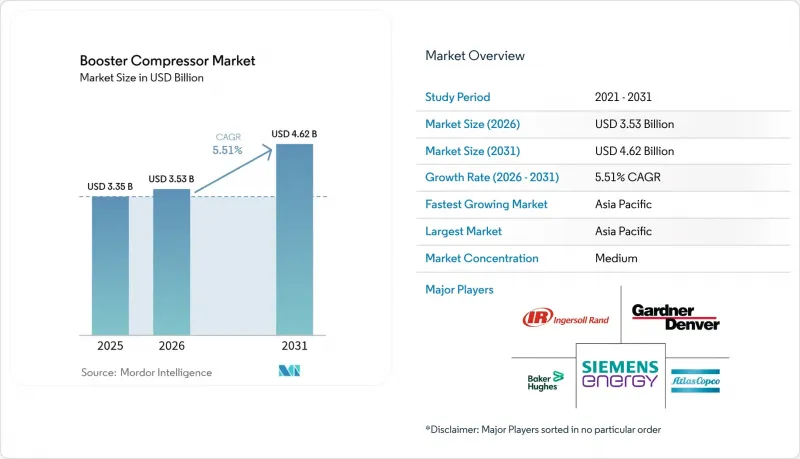
Mordor Intelligence에 따르면 부스터 컴프레서 시장 규모는 2025년에 33억 5,000만 달러로 평가되며, 2026년 35억 3,000만 달러에서 2031년까지 46억 2,000만 달러에 달할 것으로 예측되며, 예측 기간(2026-2031년) 동안 CAGR은 5.51%가 될 전망입니다.
본 보고서는 냉각 방식(공랭식 및 수랭식), 압축 단수(단단, 2단, 3단 이상), 윤활 방식(유윤활식 및 오일 프리식), 압력 범위(21-40바, 41-100바, 101-350바, 350바 이상), 최종사용자(석유·가스, 제조, 식품·음료 등), 및 지역(북미, 유럽, 아시아태평양, 남미 등)
세계 부스터 컴프레서 시장의 동향 및 인사이트
천연가스 파이프라인 압력 향상 프로그램의 증가
주요 송가스 사업자들은 더 높은 처리 용량 목표와 더 엄격한 배출 규제를 충족하기 위해 노후화된 파이프라인의 현대화를 추진하고 있습니다. 2024년부터 2025년까지, 연방 에너지 규제 위원회(FERC)는 새로운 루프 설치와 13개 스테이션의 업그레이드를 통해 130만 Dth/d의 증설을 실현한 ‘사우스 시스템 확장 4(South System Expansion 4)’ 프로젝트를 포함한 확장 계획을 승인했습니다. 미시간주의 컨슈머스 에너지(Consumers Energy)와 와이오밍주의 노스웨스트 파이프라인(Northwest Pipeline)이 진행하는 유사한 현대화 프로젝트에서는 NOx 배출량을 93%, 메탄 배출량을 89% 감축하는 첨단 부스터가 채택되었습니다. 운전 압력을 향상시키기 위해서는 부하 변동에도 유량 효율을 유지할 수 있는 다단 왕복식 또는 일체형 기어식 원심식 설계가 필요합니다. 이러한 자본 집약적인 프로젝트에서 사업자는 단일 창구를 통한 책임 체계를 선호하기 때문에 장비와 턴키 방식의 설치 및 원격 모니터링을 패키지로 제공할 수 있는 공급업체가 수주를 확보하고 있습니다.
고압 압축 공기에 대한 산업 수요
레이저 절단, PET 병 블로우 성형, 반도체 세정 등의 정밀 제조 분야에서는 기존의 7-13 bar 범위가 아닌, 현재 30-40 bar의 기본 압력이 지정되고 있습니다. 미국 에너지부의 2025년 효율 규제에 따라 각 OEM 업체는 최소 엔트로피 성능 향상을 의무화하고 있으며, 이에 따라 공장에서는 구형 설비를 조기에 폐기하는 움직임이 확산되고 있습니다. 인도의 아시아태평양 생산 연계형 인센티브 제도와 ‘Making Indonesia 4.0’ 로드맵에 따라, 오일 프리 고압 공기를 동력원으로 하는 자동화 라인 도입 대수가 증가하고 있습니다. 가변 속도 드라이브는 부분 부하 시 효율을 최대 35% 향상시켜, 중규모 주문 생산 공장에 3단식 패키지 도입을 경제적으로 만듭니다. 그 결과, 부스터 컴프레서 시장에서는 압력 안정성, 에너지 소비 및 공기 청정도의 균형이 잡힌 장비로의 구조적인 전환이 진행되고 있습니다.
높은 초기 투자비 및 유지 관리비
정격 압력이 350바를 초과하는 다단식 부스터는 표준 플랜트용 공기 유닛보다 3배의 비용이 들 수 있으며, 특수 합금, 정밀 부품, 방폭 인클로저가 필요합니다. 라이프사이클 조사에 따르면, 총 소유 비용의 15-25%를 유지보수 비용이 차지하고 있으며, 이러한 부담이 소규모 가공 업체의 업그레이드를 저해하고 있습니다. 전 세계 HVACR(냉난방·공조·냉동) 업계에서는 북미 지역만 해도 8만 명의 기술자 부족이 보고되고 있어, 인건비 급등과 가동 중단 기간의 장기화를 초래하고 있습니다. 이에 대해 각 제조사는 베이커 휴즈의 ‘통합 압축기 라인’에서 볼 수 있듯이, 자기 베어링을 채택하여 오일 회로를 불필요하게 만들고, 10년마다 한 번씩 점검하면 되는 설계로 대응하고 있습니다. 그럼에도 불구하고, 자금 사정이 넉넉하지 않은 신흥 경제국의 구매자들에게는 그 높은 가격에 놀라 도입이 더딘 실정입니다.
부문 분석
수랭식 부스터는 매출 성장률이 가장 높았으나, 부스터 컴프레서 시장 규모 면에서는 여전히 공랭식 모델이 주류를 차지하고 있습니다. 수랭식 인터쿨링은 3단 구성의 트레인 전체에서 열을 보다 효과적으로 방출하여, 350바의 수소 공급 용도에서 모터의 kW를 최대 8%까지 절감합니다. 수요가 가장 높은 분야는 식품 등급 및 고부하 석유화학 플랜트로, 연속 운전이 도입 비용의 높음을 정당화하는 분야입니다. 각 OEM 업체들은 배기열을 재활용하여 건물의 온수 공급 시스템에 전력을 공급하고, 시설 전체의 효율을 향상시키는 열회수 키트를 권장하고 있습니다. 대조적으로, 건설 현장, 컨테이너형 시추 장비, 그리고 물 부족 규제에 직면한 지역에서는 공랭식 유닛이 여전히 선호되고 있습니다. 견고한 설계, 최소한의 보조 장비, 그리고 간편한 유지보수 덕분에 부스터 컴프레서 시장의 기반을 이루는 임대 장비에서 공랭식 유닛은 계속해서 핵심적인 역할을 수행하고 있습니다.
2세대 수랭식 설계에서는 수질 변동으로 인한 스케일 부착을 방지하기 위해 스테인리스 스틸 튜브 번들과 완전 용접 플레이트가 채택되었습니다. 수소 충전소를 운영하는 사업자들은 공랭식에서 수랭식으로 전환한 결과, 토출 온도가 15°C 낮아지고 밸브 수명이 30% 연장되었다고 보고하고 있습니다. 초기 투자 비용은 높지만, 플랜트 관리자는 전기 요금 절감과 예정 외 가동 중단 감소를 통해 투자를 회수하고 있습니다. 그 결과, 예측 기간 동안 수랭식 시스템의 시장 점유율은 공랭식 시스템의 우위를 꾸준히 잠식해 나갈 것으로 예상됩니다.
단단식 부스터는 컴팩트한 설치 면적과 적은 부품 수 덕분에 최대 100 bar의 압력 범위 내 부스터 컴프레서 시장에서 50.35%의 점유율을 유지하고 있습니다. 그러나 수소, 레이저 절단, PET 생산 라인이 350 bar의 요구 사항으로 전환됨에 따라 3단 이상의 패키지 채택이 가장 빠르게 진행되고 있습니다. 다단 압축은 압력비를 각 실린더에 분산시켜 토출 온도와 밸브에 가해지는 부하를 줄여주며, 그 결과 점검 주기를 연장합니다. 아시아태평양의 음료 공장에 대한 에너지 감사에 따르면, 3단식 장비는 개조된 2단식 세트에 비해 단위 출력당 전력 소비를 12% 절감하는 것으로 나타났습니다.
능동형 전자 제어 인터쿨러 및 가변 클리어런스 포켓과 같은 기술적 진보로 인해 다단식의 효율은 더욱 향상되고 있습니다. 고압용 OEM 제조업체는 API 618의 임계값 이하로 진동 수준을 유지하면서 1,500rpm에서 오일 프리 운전이 가능한 자기 베어링식 크랭크케이스를 채택하고 있습니다. 엔지니어링, 조달, 건설(EPC) 기업들은 턴키 방식의 수소 충전소에서 사양 준수를 간소화할 수 있기 때문에 이러한 통합 솔루션을 선호합니다. 한편, 2단식 유닛은 플랜트용 공기를 40-100 bar 서비스로 업그레이드하는 경우나, 완전한 3단식 성능을 위한 예산이나 필요성이 부족한 사용자를 대상으로 중간 틈새 시장을 차지하고 있습니다.
지역별 분석
아시아태평양은 부스터 컴프레서 수요에서 여전히 핵심적인 위치를 차지하고 있습니다. 중국, 인도, 아세안(ASEAN) 국가들은 2025년 매출의 약 39.45%를 차지하고 있으며, 각국의 제조 로드맵에 따라 새로운 전자부품 공장 및 자동차 공장 건설이 잇따르면서 이 점유율은 소폭 더 상승할 것으로 예상됩니다. 중국의 저부가가치 제품 수출 비중은 감소했으나, 고부가가치 제품 생산에 있어서는 여전히 GDP 단위당 압축 공기 사용량이 많은 편입니다. 인도의 세제 혜택 제도에 따라 휴대전화, 태양전지 모듈,특수 화학제품 제조업체에 대해 세제상의 우대 조치가 시행되고 있으며, 이들 모두 오일 프리 고압 공기 시스템이 필요합니다. 동남아시아의 그린필드 공장에서는 기존의 2단식 기계를 건너뛰고, 처음부터 디지털 컨트롤러가 탑재된 3단식 패키지를 주문하는 사례가 많아 기술의 보급을 가속화하고 있습니다.
북미는 셰일가스 인프라 업그레이드로 인해 2위를 차지하고 있습니다. 2025년 1월 시행될 미국 에너지부의 새로운 압축기 기준에 따라 조기 교체가 진행되고 있으며, FERC(연방 에너지 규제 위원회)가 승인한 파이프라인 연장 공사에는 메탄 누출 감지 기능을 갖춘 최신식 부스터가 요구되고 있습니다. 캘리포니아주와 텍사스주의 모듈식 수소 충전소도 규모는 작지만 수요가 급속히 증가하고 있습니다. 유럽에서는 특히 독일, 프랑스, 북유럽 국가들을 중심으로 자동차, 식품, 그린 수소 프로젝트가 교차하는 지역에서 꾸준한 교체 수요가 나타나고 있습니다. ‘대체 연료 인프라 규정’에 따라 2030년까지 주요 회랑을 따라 200km마다 공공 수소 충전소를 설치하도록 의무화하는 EU의 정책은 초고압 장비 수주를 직접적으로 촉진하고 있습니다.
남미, 중동 및 아프리카는 장기적인 성장의 개척지를 형성하고 있습니다. 브라질의 프레스솔트층 개발과 사우디아라비아의 비석유 산업 진출이 핵심 프로젝트로 자리 잡고 있지만, 정치적·물류적 리스크로 인해 단기적인 공급량은 제한되고 있습니다. 그럼에도 불구하고, 서비스 품질과 자금 조달 패키지에 주력하는 공급업체는 이들 지역이 산업 기반을 다각화해 나가는 과정에서 큰 시장 점유율을 확보할 가능성이 있습니다.
기타 혜택:
- 엑셀 형식의 시장 예측(ME) 시트
- 3개월간의 애널리스트 지원
자주 묻는 질문
목차
제1장 소개
제2장 조사 방법
제3장 주요 요약
제4장 시장 구도
제5장 시장 규모와 성장 예측
제6장 경쟁 구도
제7장 시장 기회와 향후 전망
KSM 26.08.26According to Mordor Intelligence, the booster compressor market size was valued at USD 3.35 billion in 2025 and estimated to grow from USD 3.53 billion in 2026 to reach USD 4.62 billion by 2031, at a CAGR of 5.51% during the forecast period (2026-2031).
This report is Segmented by Cooling Type (Air-Cooled and Water-Cooled), Compression Stage (Single-Stage, Two-Stage, and Three-Stage and Above), Lubrication Type (Oil-Lubricated and Oil-Free), Pressure Range (21 To 40 Bar, 41 To 100 Bar, 101 To 350 Bar, and Above 350 Bar), End User (Oil and Gas, Manufacturing, Food and Beverage, and More), and Geography (North America, Europe, Asia-Pacific, South America, and More)
Global Booster Compressor Market Trends and Insights
Rising Natural Gas Pipeline Pressure Upgrade Programs
Major transmission operators are modernizing aging lines to meet higher throughput targets and tighter emission limits. In 2024-2025, the Federal Energy Regulatory Commission cleared expansions, including the South System Expansion 4 project, which added 1.3 million Dth/d via new loops and 13 station upgrades. Similar replacements by Consumers Energy in Michigan and Northwest Pipeline in Wyoming feature advanced boosters that reduce NOx emissions by 93% and methane emissions by 89%. Higher operating pressures require multi-stage reciprocating or integrally geared centrifugal designs that can maintain flow efficiency across varying load profiles. Vendors that can bundle equipment with turnkey installation and remote monitoring win orders because operators prefer single-point accountability for these capital-intensive projects.
Industrial Demand for High-Pressure Compressed Air
Precision manufacturing segments-such as laser cutting, PET bottle blowing, and semiconductor cleaning-now specify base pressures of 30-40 bar, rather than the legacy 7-13 bar range. The U.S. Department of Energy's 2025 efficiency rule compels OEMs to raise minimum isentropic performance, pushing factories to retire legacy plants early. Asia-Pacific's production-linked incentive schemes in India, along with the "Making Indonesia 4.0" roadmap, are increasing the installed base of automated lines that operate on oil-free, high-pressure air. Variable-speed drives improve part-load efficiency by up to 35%, making three-stage packages economical for mid-sized job shops. As a result, the booster compressor market is experiencing a structural shift toward equipment that balances pressure stability, energy consumption, and air purity.
High Capital & Maintenance Expenditure
Multi-stage boosters rated above 350 bar can cost three times a standard plant air unit and require specialized alloys, precision components, and explosion-proof enclosures. Lifecycle studies indicate that service accounts for 15-25% of total ownership cost, a burden that deters smaller processors from upgrading. The global HVACR sector reports 80,000 open technician positions in North America, inflating labor rates and lengthening downtime. Manufacturers respond with ten-year service-interval designs that utilize magnetic bearings, eliminating the need for oil circuits, as seen in Baker Hughes' Integrated Compressor Line. Even so, sticker shock slows adoption for cash-constrained buyers in emerging economies.
Other drivers and restraints analyzed in the detailed report include:
- Expansion of EOR & Well-Head Compression in Oil & Gas
- Energy-Efficiency Mandates for Compressed-Air Systems
- Volatile Upstream CAPEX Cycles
For complete list of drivers and restraints, kindly check the Table Of Contents.
Segment Analysis
Water-cooled boosters delivered the fastest revenue growth, although air-cooled models still dominated the booster compressor market size. Water-based intercooling dissipates heat more effectively across three-stage trains, trimming motor kW by up to 8% in 350-bar hydrogen service. Demand is strongest in food-grade and high-duty petrochemical plants where continuous operation justifies higher installation costs. OEMs tout heat-recovery kits that repurpose rejected thermal energy to power building hot-water systems, thereby improving overall facility efficiency. In contrast, air-cooled units remain the preferred choice for construction sites, containerized rigs, and regions facing water scarcity regulations. Their rugged design, minimal auxiliary hardware, and simpler maintenance keep them central to rental fleets that underpin the booster compressor market.
Second-generation water-cooled designs now feature stainless-steel tube bundles and fully welded plates to resist scaling in variable water quality. Operators running hydrogen stations report discharge-temperature reductions of 15°C and valve life extensions of 30% after switching from air to water cooling. While capital outlay is higher, plant managers recoup their investment through lower electricity bills and reduced unscheduled shutdowns. Consequently, water-cooled share is expected to chip steadily at the dominance of air-cooled systems over the forecast period.
Single-stage boosters maintain a 50.35% share of the booster compressor market for pressures up to 100 bar due to their compact footprint and low part count. However, as hydrogen, laser-cutting, and PET lines migrate toward 350 bar requirements, three-stage and above packages log the fastest uptake. Multi-stage compression spreads pressure ratio across cylinders, cutting discharge temperature and valve stress, which in turn extends overhaul intervals. Energy audits in Asia-Pacific's beverage plants show that three-stage machines save 12% in specific power compared to retrofitted two-stage sets.
Technological advances, such as active electronically controlled intercoolers and variable clearance pockets, further enhance multi-stage efficiency. High-pressure OEMs integrate magnetic-bearing crankcases that enable oil-free operation at 1,500 rpm, while maintaining vibration levels below API 618 thresholds. Engineering, procurement, and construction firms favor such integrated solutions because they simplify compliance with specifications in turnkey hydrogen stations. In parallel, two-stage units occupy a mid-range niche for users upgrading from plant air to 40-100 bar service yet lacking the budget or need for full three-stage performance.
Complete Report Scope:
- By Cooling Type
- Air-Cooled
- Water-Cooled
- By Compression Stage
- Single-Stage
- Two-Stage
- Three-Stage and Above
- By Lubrication Type
- Oil-Lubricated
- Oil-Free
- By Pressure Range
- 21 to 40 bar
- 41 to 100 bar
- 101 to 350 bar
- Above 350 bar
- By End User
- Oil and Gas
- Chemicals and Petrochemicals
- Power Generation
- Manufacturing
- Food and Beverage
- Other Process Industries
- By Geography
- North America
- United States
- Canada
- Mexico
- Europe
- Germany
- United Kingdom
- France
- Italy
- NORDIC Countries
- Russia
- Rest of Europe
- Asia-Pacific
- China
- India
- Japan
- South Korea
- ASEAN Countries
- Rest of Asia-Pacific
- South America
- Brazil
- Argentina
- Rest of South America
- Middle East and Africa
- Saudi Arabia
- United Arab Emirates
- South Africa
- Egypt
- Rest of Middle East and Africa
- North America
Geography Analysis
Asia-Pacific remains the cornerstone of booster compressor demand. China, India, and ASEAN account for nearly 39.45% of 2025 sales, a share expected to edge up as new electronics fabs and vehicle plants break ground under national manufacturing roadmaps. Although China's export share in low-value goods slipped, its higher value-added output still uses more compressed air per unit of GDP. India's incentive scheme channels tax benefits to producers of mobile phones, solar modules, and specialty chemicals, each of which requires oil-free, high-pressure air systems. Southeast Asia's greenfield plants often bypass legacy two-stage machines and order three-stage packages with digital controllers from the outset, accelerating the diffusion of technology.
North America ranks second, thanks to upgrades in shale gas infrastructure. The U.S. Department of Energy's new compressor standards, effective January 2025, are prompting early replacements, while FERC-approved pipeline extensions require modern boosters equipped with methane leak detection. Modular hydrogen stations in California and Texas add a small but fast-growing volume. Europe shows steady replacement demand, particularly in Germany, France, and the Nordics, where automotive, food, and green hydrogen projects converge. The EU policy, which requires public hydrogen stations every 200 km along core corridors by 2030 under the Alternative Fuels Infrastructure Regulation, directly lifts ultra-high-pressure orders.
South America and the Middle East & Africa form the long-term frontier. Brazil's pre-salt developments and Saudi Arabia's push into non-oil industries provide anchor projects; however, political and logistical risks temper near-term volumes. Nonetheless, vendors focused on service quality and financing packages can win outsized shares as these regions diversify their industrial bases.
- Atlas Copco AB
- Ingersoll Rand PLC
- Baker Hughes Company
- General Electric Company
- Siemens Energy AG
- Gardner Denver Inc.
- Kaeser Kompressoren SE
- Bauer Kompressoren GmbH
- Quincy Compressor LLC
- Sullair LLC (Hitachi)
- Elgi Equipments Ltd
- Ariel Corporation
- Kobelco Compressors
- Doosan Portable Power
- BOGE Kompressoren
- IDEX Corporation
- Aircomp Enterprises
- Fusheng Group
- Hanwha Power Systems
- IHI Rotating Machinery
Additional Benefits:
- The market estimate (ME) sheet in Excel format
- 3 months of analyst support
TABLE OF CONTENTS
1 Introduction
- 1.1 Study Assumptions & Market Definition
- 1.2 Scope of the Study
2 Research Methodology
3 Executive Summary
4 Market Landscape
- 4.1 Market Overview
- 4.2 Market Drivers
- 4.2.1 Rising natural-gas pipeline pressure upgrade programs
- 4.2.2 Industrial demand for high-pressure compressed air
- 4.2.3 Expansion of EOR & well-head compression in oil & gas
- 4.2.4 Energy-efficiency mandates for compressed-air systems
- 4.2.5 Hydrogen refueling stations requiring 450-bar boosters
- 4.2.6 "Compressed-air-as-a-service" rental platforms
- 4.3 Market Restraints
- 4.3.1 High capital & maintenance expenditure
- 4.3.2 Volatile upstream CAPEX cycles
- 4.3.3 Shortage of certified high-pressure technicians
- 4.3.4 Price erosion from VSD centrifugal alternatives
- 4.4 Supply-Chain Analysis
- 4.5 Regulatory Landscape
- 4.6 Technological Outlook
- 4.7 Porter's Five Forces
- 4.7.1 Bargaining Power of Suppliers
- 4.7.2 Bargaining Power of Buyers
- 4.7.3 Threat of New Entrants
- 4.7.4 Threat of Substitutes
- 4.7.5 Intensity of Rivalry
5 Market Size & Growth Forecasts
- 5.1 By Cooling Type
- 5.1.1 Air-Cooled
- 5.1.2 Water-Cooled
- 5.2 By Compression Stage
- 5.2.1 Single-Stage
- 5.2.2 Two-Stage
- 5.2.3 Three-Stage and Above
- 5.3 By Lubrication Type
- 5.3.1 Oil-Lubricated
- 5.3.2 Oil-Free
- 5.4 By Pressure Range
- 5.4.1 21 to 40 bar
- 5.4.2 41 to 100 bar
- 5.4.3 101 to 350 bar
- 5.4.4 Above 350 bar
- 5.5 By End User
- 5.5.1 Oil and Gas
- 5.5.2 Chemicals and Petrochemicals
- 5.5.3 Power Generation
- 5.5.4 Manufacturing
- 5.5.5 Food and Beverage
- 5.5.6 Other Process Industries
- 5.6 By Geography
- 5.6.1 North America
- 5.6.1.1 United States
- 5.6.1.2 Canada
- 5.6.1.3 Mexico
- 5.6.2 Europe
- 5.6.2.1 Germany
- 5.6.2.2 United Kingdom
- 5.6.2.3 France
- 5.6.2.4 Italy
- 5.6.2.5 NORDIC Countries
- 5.6.2.6 Russia
- 5.6.2.7 Rest of Europe
- 5.6.3 Asia-Pacific
- 5.6.3.1 China
- 5.6.3.2 India
- 5.6.3.3 Japan
- 5.6.3.4 South Korea
- 5.6.3.5 ASEAN Countries
- 5.6.3.6 Rest of Asia-Pacific
- 5.6.4 South America
- 5.6.4.1 Brazil
- 5.6.4.2 Argentina
- 5.6.4.3 Rest of South America
- 5.6.5 Middle East and Africa
- 5.6.5.1 Saudi Arabia
- 5.6.5.2 United Arab Emirates
- 5.6.5.3 South Africa
- 5.6.5.4 Egypt
- 5.6.5.5 Rest of Middle East and Africa
- 5.6.1 North America
6 Competitive Landscape
- 6.1 Market Concentration
- 6.2 Strategic Moves (M&A, Partnerships, PPAs)
- 6.3 Market Share Analysis (Market Rank/Share for key companies)
- 6.4 Company Profiles (includes Global level Overview, Market level overview, Core Segments, Financials as available, Strategic Information, Products & Services, and Recent Developments)
- 6.4.1 Atlas Copco AB
- 6.4.2 Ingersoll Rand PLC
- 6.4.3 Baker Hughes Company
- 6.4.4 General Electric Company
- 6.4.5 Siemens Energy AG
- 6.4.6 Gardner Denver Inc.
- 6.4.7 Kaeser Kompressoren SE
- 6.4.8 Bauer Kompressoren GmbH
- 6.4.9 Quincy Compressor LLC
- 6.4.10 Sullair LLC (Hitachi)
- 6.4.11 Elgi Equipments Ltd
- 6.4.12 Ariel Corporation
- 6.4.13 Kobelco Compressors
- 6.4.14 Doosan Portable Power
- 6.4.15 BOGE Kompressoren
- 6.4.16 IDEX Corporation
- 6.4.17 Aircomp Enterprises
- 6.4.18 Fusheng Group
- 6.4.19 Hanwha Power Systems
- 6.4.20 IHI Rotating Machinery
7 Market Opportunities & Future Outlook
- 7.1 White-Space & Unmet-Need Assessment