

|
시장보고서
상품코드
2115916
ASEAN의 윤활유 : 시장 점유율 분석, 산업 동향 및 통계 데이터, 성장 예측(2026-2031년)ASEAN Lubricants - Market Share Analysis, Industry Trends & Statistics, Growth Forecasts (2026 - 2031) |
||||||
 Mordor Intelligence
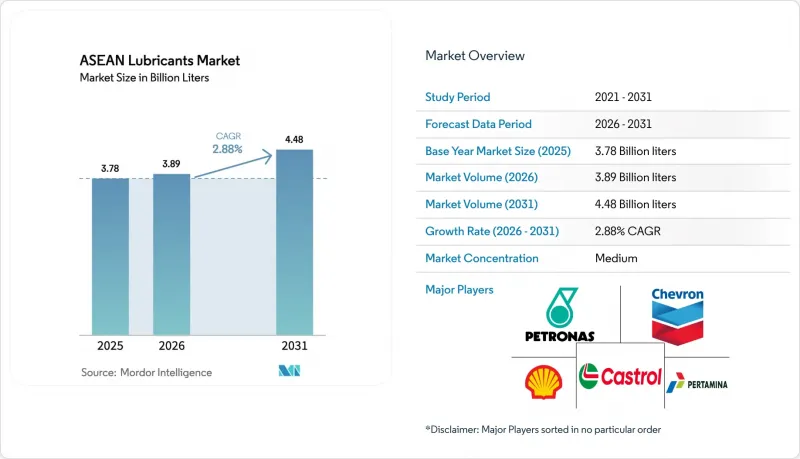
Mordor Intelligence에 의하면, ASEAN의 윤활유 시장 규모는 2025년에 37억 8,000만 리터로 평가되었습니다. 2026년에 38억 9,000만 리터에 달하고, 2031년까지 44억 8,000만 리터에 이를 것으로 예측되며, 2026년부터 2031년에 걸쳐 CAGR 2.88%로 성장할 전망입니다.
본 보고서는 제품 유형(자동차용 엔진 오일, 산업용 엔진 오일, 그리스, 금속 가공유, 터빈 오일 등), 최종 사용자 산업(자동차, 선박, 항공우주 등), 기유 유형(광유계 윤활유 등), 지역(인도네시아, 태국, 베트남,필리핀, 말레이시아, 싱가포르)별로 분류되어 있습니다. 시장 전망은 판매량(리터) 기준으로 제시되어 있습니다.
ASEAN의 윤활유 시장 동향 및 인사이트
차량 보유 대수와 화물 수송량 증가
상용차 및 승용차 보유 대수는 계속 증가하고 있지만, 인도네시아와 베트남에서는 이륜차가 주류를 이루고 있어 수요는 승용차용 윤활유보다 교환 주기가 짧은 소용량 오일로 이동하고 있습니다. 필리핀의 자동차 제조업체들은 2025년에 48만 대를 조립했으며, 말레이시아는 2024년에 73만 8,000대, 2025년에는 75만 대를 생산했습니다. 2024년에 2,220억 달러에 달하는 외국인 직접 투자(FDI) 유입에 따른 화물 운송량 증가는 트럭 및 건설 기계의 가동 빈도를 높이고 있습니다. 전단 안정성과 세정 성분을 강화한 이륜차용 및 상용차용 오일을 전문적으로 개발하는 공급업체들은 교환 빈도 증가로 인한 혜택을 누리고 있습니다. ‘PETRONAS Sprinta’와 ‘Mobil Super Moto’ 시리즈는 이미 이러한 추세를 활용하고 있으며, 단위당 소비량이 감소하는 상황에서도 ASEAN의 윤활유 시장이 자동차 분야에서 판매량 우위를 계속 유지하는 이유를 뒷받침하고 있습니다.
급속한 산업화와 제조업의 확대
중국에서 베트남, 인도네시아, 태국으로 전자기기, 반도체, 재생에너지 관련 부품 공장이 이전됨에 따라 금속 가공유, 작동유, 터빈유의 소비량이 증가하고 있습니다. 국제에너지기구(IEA)는 새로운 반도체 제조 공장과 데이터센터가 가동을 시작함에 따라 2030년까지 해당 지역의 산업용 석유 사용량이 하루 640만 배럴에 달할 것으로 예측했습니다. 특수 첨가제 수요는 범용 등급보다 빠르게 증가하고 있으며, 페트로나스 케미칼스가 첨가제의 이익률은 하락하고 있음에도 불구하고 2024년 초 엔지니어링 유체 매출이 증가했다고 보고한 것이 그 한 예입니다. 이러한 다각화로 인해 ASEAN의 윤활유 시장은 승용차의 경기 사이클에 대한 의존도가 낮아지고, 자본재 투자에 대한 의존도가 높아지고 있습니다.
최신형 엔진의 오일 교환 주기 연장
ACEA C5 및 API SP를 준수하는 합성 멀티그레이드 오일은 서비스 주기를 2만km까지 연장하여 차량 1대당 연간 수요를 절반으로 줄입니다. 리키 몰리(Riki Moly)사의 지침 및 토탈에너지(TotalEnergies)사의 ‘쿼츠 EV-드라이브(Quartz EV-Drive)’에 대한 OEM 검증 결과에 따르면, 10만 km를 초과해도 점도 안정성이 유지되는 것으로 나타났습니다. 이에 반해, 블렌더 각사는 30%의 가격 프리미엄을 붙여 합성 오일의 업셀링을 도모하고 있지만, 비용에 민감한 시장에서는 정비사 교육 및 판매 거점에서의 프로모션에 투자할 필요가 있습니다.
부문별 분석
2025년, 자동차용 엔진 오일은 판매량 점유율의 33.12%를 차지했으나, 산업용 엔진 오일은 2031년까지 연평균 성장률(CAGR) 2.96%를 나타낼 것으로 예측되며, 이는 전체 제품 유형 중 가장 높은 성장률입니다. 이는 아세안(ASEAN) 지역의 제조업 확대와 발전 분야 투자가 현재 승용차 보유 대수 증가와 어깨를 나란히 하는 주요 수요 요인이 되고 있음을 반영합니다. 변속기 오일, 기어 오일, 브레이크 오일은 전반적으로 자동차 드라이브트레인 분야에 사용됩니다. 이 분야에서는 중국의 듀얼 클러치 변속기(DCT) 및 일본의 무단 변속기(CVT)로의 전환이 아세안 국가들의 OEM 사양에 파급되고 있어, 전단 안정성과 마찰 조절제가 강화된 ATF(자동 변속기 오일)의 배합이 요구되고 있습니다. 금속 가공용 유체는 클린룸 제조 과정에서 이점을 얻고 있으며, 생분해성 에멀젼이 폐기 비용 절감에 기여하고 있습니다. ASEAN의 윤활유 시장에서 터빈 오일 시장 규모는 재생에너지 도입률 상승을 상쇄하는 가스 화력 피크 발전소의 확장에 따라 확대될 전망입니다. 공정 오일은 타이어 및 의약품 생산과 연계된 안정적인 틈새 시장으로 자리 잡고 있으며, 식품 등급의 화이트 오일은 프리미엄 가격을 유지하고 있습니다.
그리스 분야에서는 새로운 흐름이 나타나고 있습니다. 쉘의 인도네시아 신공장은 자동차용 베어링, 산업기계, 선박용 갑판 설비를 위한 리튬계 및 칼슘설포네이트계 그리스의 생산 능력을 1,200만 리터 확대할 예정입니다. 카스트롤의 전기차용 그리스는 전기적 적합성과 구름 저항 감소를 목적으로 설계되었으며, 이 설계는 2024년 말레이시아에서 기록된 1만 3,478대의 전기차 판매를 뒷받침하고 있습니다. 에스테르계 기유를 사용한 바이오 그리스는 이미 해양 분야의 생분해성 요건을 충족하고 있으며, 전체 윤활유 시장에서 가장 빠른 성장세를 보이고 있습니다.
기타 혜택 :
- 엑셀 형식 시장 예측(ME) 시트
- 3개월간의 애널리스트 지원
자주 묻는 질문
목차
제1장 서론
제2장 분석 방법
제3장 개요
제4장 시장 구도
제5장 시장 규모 및 성장률 예측
제6장 경쟁 구도
제7장 시장 기회 및 향후 전망
KTH 26.08.31According to Mordor Intelligence, the ASEAN lubricants market size is projected to be 3.78 Billion liters in 2025, 3.89 Billion liters in 2026, and reach 4.48 Billion liters by 2031, growing at a CAGR of 2.88% from 2026 to 2031.
This report is Segmented by Product Type (Automotive Engine Oil, Industrial Engine Oil, Greases, Metalworking Fluids, Turbine Oil, and More), End-User Industry (Automotive, Marine, Aerospace, and More), Base Stock Type (Mineral Oil-Based Lubricants, and More), and Geography (Indonesia, Thailand, Vietnam, Philippines, Malaysia, and Singapore). The Market Forecasts are Provided in Terms of Volume (liters).
ASEAN Lubricants Market Trends and Insights
Growing Vehicle Parc and Freight Movement
Commercial and passenger fleets continue to swell, yet two-wheeler dominance in Indonesia and Vietnam shifts demand toward small-sump volumes that turn over faster than car lubricants. Philippines automakers plan to assemble 480 000 units in 2025 while Malaysia produced 738 000 units in 2024 and targets 750 000 in 2025. Freight growth tied to USD 222 billion in 2024 FDI inflows increases duty cycles for trucks and construction machinery. Suppliers that tailor two-wheeler and commercial-vehicle oils with enhanced shear stability and detergent chemistry benefit from higher replacement frequency. PETRONAS Sprinta and Mobil Super Moto lines already exploit this dynamic, reinforcing why the ASEAN lubricants market will keep an automotive volume edge even as per-unit consumption falls.
Rapid Industrialisation and Manufacturing Expansion
Relocation of electronics, semiconductor, and renewable component plants from China into Vietnam, Indonesia, and Thailand is lifting consumption of metalworking fluids, hydraulic oils, and turbine oils. The International Energy Agency sees regional oil use in industry rising to 6.4 million bpd by 2030 as new fabs and data centers go live. Specialty additive demand is advancing faster than commodity grades, as shown by PETRONAS Chemicals which cited higher engineered-fluid sales in early 2024 despite weaker additive margins. This diversification makes the ASEAN lubricants market less tied to passenger-car cycles and more dependent on capital-equipment investments.
Longer Drain Intervals in Modern Engines
Synthetic multigrades that meet ACEA C5 and API SP extend service intervals to 20 000 km, halving annual per-vehicle demand. Liqui Moly guidance and OEM validation of TotalEnergies Quartz EV-Drive show viscosity stability beyond 100,000 km. Blenders respond by upselling synthetics at a 30% price premium yet must invest in mechanic training and point-of-sale promotion in cost-sensitive markets.
Other drivers and restraints analyzed in the detailed report include:
- Shift Towards High-Performance Synthetic Lubricants
- Digitalised Distribution and Predictive-Lubrication Services
- Base-Oil Price Volatility
For complete list of drivers and restraints, kindly check the Table Of Contents.
Segment Analysis
Automotive engine oil held 33.12% volume share in 2025, yet industrial engine oil is forecast to grow at 2.96% CAGR through 2031, the fastest rate among all product types, reflecting ASEAN's manufacturing buildout and power-generation investments that now rival passenger-vehicle parc expansion as the primary demand vector. Transmission fluids, gear oils, and brake fluids collectively serve the automotive drivetrain segment, where the shift to dual-clutch transmissions (DCT) in China and continuously variable transmissions (CVT) in Japan is spilling into ASEAN OEM specifications, requiring ATF formulations with enhanced shear stability and friction modifiers. Metalworking fluids benefit from clean-room manufacturing where bio-stable emulsions cut disposal costs. The ASEAN lubricants market size for turbine oils is poised to expand alongside gas-fired peaking plants that balance rising renewable penetration. Process oils remain a stable niche tied to tire and pharmaceutical output where food-grade white oils command premium pricing.
A dedicated grease wave is unfolding. Shell's new Indonesian plant adds 12 million liters of capacity for lithium and calcium sulfonate greases that serve automotive bearings, industrial machinery, and marine deck equipment. Castrol's electric-vehicle greases are engineered for electrical compatibility and reduced rolling resistance, a design that supports the 13,478 EV sales logged in Malaysia during 2024. Bio-based greases using ester base stocks already meet maritime biodegradability mandates and deliver the fastest gains within the broader lubricant basket.
Complete Report Scope:
- By Product Type
- Automotive Engine Oil
- Industrial Engine Oil
- Transmission Fluids
- Gear Oil
- Brake Fluids
- Hydraulic Fluids
- Greases
- Process Oil (Including Rubber Process Oil and White Oil)
- Metalworking Fluids
- Turbine Oil
- Transformer Oil
- Other Product Types
- By End-user Industry
- Automotive
- Passenger Vehicles
- Commercial Vehicles
- Two-Wheelers
- Marine
- Aerospace
- Heavy Equipment
- Construction
- Mining
- Agriculture
- Industrial
- Power Generation
- Metallurgy and Metalworking
- Textiles
- Oil and Gas
- Other End-Use Industries
- Automotive
- By Base Stock Type
- Mineral Oil-Based Lubricants
- Synthetic Lubricants
- Semi-Synthetic Lubricants
- Bio-Based Lubricants
- By Geography
- Indonesia
- Malaysia
- Philippines
- Singapore
- Thailand
- Vietnam
List of Companies Covered in this Report:
- Caltex
- Castrol Limited
- Exxon Mobil Corporation
- FUCHS
- Idemitsu Kosan Co., Ltd.
- Petroliam Nasional Berhad (PETRONAS)
- PT Pertamina (Persero)
- PTT Lubricants
- Shell plc
- TotalEnergies
- Valvoline Global Operations
- SK Enmove
- ENEOS Corporation
- Sinopec Lubricant (Singapore) Pte Ltd,
- Repsol
- Gulf Oil International
- Motul SA
- LUKOIL
- Gazpromneft Lubricants
Additional Benefits:
- The market estimate (ME) sheet in Excel format
- 3 months of analyst support
TABLE OF CONTENTS
1 Introduction
- 1.1 Study Assumptions & Market Definition
- 1.2 Scope of the Study
2 Research Methodology
3 Executive Summary
4 Market Landscape
- 4.1 Market Overview
- 4.2 Market Drivers
- 4.2.1 Growing vehicle parc and freight movement
- 4.2.2 Rapid industrialisation and manufacturing expansion
- 4.2.3 Shift towards high-performance synthetic lubricants
- 4.2.4 Digitalised distribution and predictive-lubrication services
- 4.2.5 Rise of ASEAN marine-bunkering hubs
- 4.3 Market Restraints
- 4.3.1 Longer drain intervals in modern engines
- 4.3.2 Base-oil price volatility
- 4.3.3 Accelerated EV adoption in key ASEAN states
- 4.4 Value Chain Analysis
- 4.5 Regulatory Framework
- 4.6 End-User Trends
- 4.6.1 Automotive Industry
- 4.6.2 Manufacturing Industry
- 4.6.3 Power Generation Industry
- 4.7 Porter's Five Forces
- 4.7.1 Bargaining Power of Suppliers
- 4.7.2 Bargaining Power of Buyers
- 4.7.3 Threat of New Entrants
- 4.7.4 Threat of Substitutes
- 4.7.5 Degree of Competition
5 Market Size and Growth Forecasts (Volume)
- 5.1 By Product Type
- 5.1.1 Automotive Engine Oil
- 5.1.2 Industrial Engine Oil
- 5.1.3 Transmission Fluids
- 5.1.4 Gear Oil
- 5.1.5 Brake Fluids
- 5.1.6 Hydraulic Fluids
- 5.1.7 Greases
- 5.1.8 Process Oil (Including Rubber Process Oil and White Oil)
- 5.1.9 Metalworking Fluids
- 5.1.10 Turbine Oil
- 5.1.11 Transformer Oil
- 5.1.12 Other Product Types
- 5.2 By End-user Industry
- 5.2.1 Automotive
- 5.2.1.1 Passenger Vehicles
- 5.2.1.2 Commercial Vehicles
- 5.2.1.3 Two-Wheelers
- 5.2.2 Marine
- 5.2.3 Aerospace
- 5.2.4 Heavy Equipment
- 5.2.4.1 Construction
- 5.2.4.2 Mining
- 5.2.4.3 Agriculture
- 5.2.5 Industrial
- 5.2.5.1 Power Generation
- 5.2.5.2 Metallurgy and Metalworking
- 5.2.5.3 Textiles
- 5.2.5.4 Oil and Gas
- 5.2.5.5 Other End-Use Industries
- 5.2.1 Automotive
- 5.3 By Base Stock Type
- 5.3.1 Mineral Oil-Based Lubricants
- 5.3.2 Synthetic Lubricants
- 5.3.3 Semi-Synthetic Lubricants
- 5.3.4 Bio-Based Lubricants
- 5.4 By Geography
- 5.4.1 Indonesia
- 5.4.2 Malaysia
- 5.4.3 Philippines
- 5.4.4 Singapore
- 5.4.5 Thailand
- 5.4.6 Vietnam
6 Competitive Landscape
- 6.1 Market Concentration
- 6.2 Strategic Moves
- 6.3 Market Share**(%)/Ranking Analysis
- 6.4 Company Profiles (includes Global level Overview, Market level overview, Core Segments, Financials as available, Strategic Information, Products & Services, Recent Developments)
- 6.4.1 Caltex
- 6.4.2 Castrol Limited
- 6.4.3 Exxon Mobil Corporation
- 6.4.4 FUCHS
- 6.4.5 Idemitsu Kosan Co., Ltd.
- 6.4.6 Petroliam Nasional Berhad (PETRONAS)
- 6.4.7 PT Pertamina (Persero)
- 6.4.8 PTT Lubricants
- 6.4.9 Shell plc
- 6.4.10 TotalEnergies
- 6.4.11 Valvoline Global Operations
- 6.4.12 SK Enmove
- 6.4.13 ENEOS Corporation
- 6.4.14 Sinopec Lubricant (Singapore) Pte Ltd,
- 6.4.15 Repsol
- 6.4.16 Gulf Oil International
- 6.4.17 Motul SA
- 6.4.18 LUKOIL
- 6.4.19 Gazpromneft Lubricants
7 Market Opportunities & Future Outlook
- 7.1 White-space and Unmet-Need Assessment


