

|
시장보고서
상품코드
2115919
아메리카의 폴리프로필렌 필름 : 시장 점유율 분석, 산업 동향 및 통계 데이터, 성장 예측(2026-2031년)Americas Polypropylene (PP) Films - Market Share Analysis, Industry Trends & Statistics, Growth Forecasts (2026 - 2031) |
||||||
 Mordor Intelligence
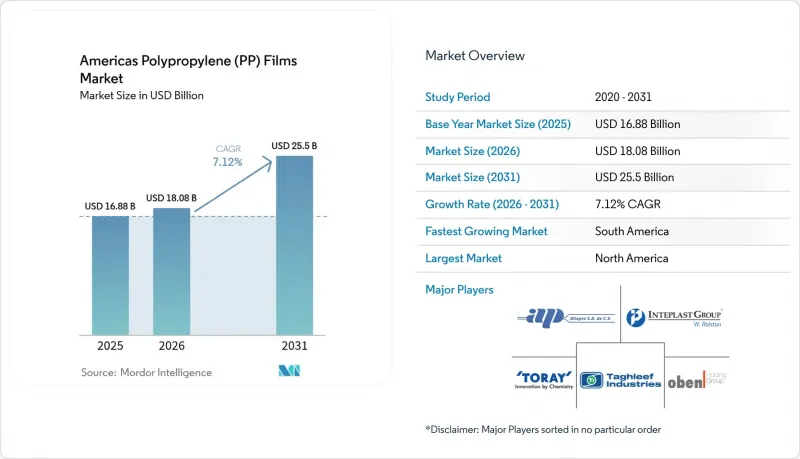
Mordor Intelligence에 의하면, 아메리카의 폴리프로필렌 필름 시장 규모는 2025년 168억 8,000만 달러로 평가되었습니다. 2026년에는 180억 8,000만 달러로 확대되어 2026년부터 2031년에 걸쳐 CAGR 7.12%로 성장을 지속하여, 2031년에는 255억 달러에 이를 것으로 예측됩니다.
본 보고서는 유형(BOPP, CPP, SPP 등), 두께(20마이크론 미만, 20-40마이크론, 40마이크론 이상), 최종 사용자 산업(식품, 음료, 의약품 및 의료, 산업 등),용도(포장, 라벨·테이프, 라미네이트, 그래픽·오버레이 등), 지역별로 분류되어 있습니다. 시장 전망은 금액(달러) 기준으로 제시되어 있습니다.
남미 및 북미의 폴리프로필렌 필름 시장 동향 및 인사이트
단일 소재 연포장 솔루션으로의 급속한 전환
각 브랜드 소유 기업들은 재활용 설계 목표를 달성하고, 확대 생산자 책임(EPR)에 따른 비용을 회피하기 위해 다층 라미네이트를 단일 폴리머 형태로 통합하고 있습니다. Coveris와 Borealis는 2024년, 폴리에틸렌 타이 층을 제거하면서도 낙하 시험 기준을 충족하는 단일 폴리프로필렌 소재의 반려동물사료 파우치를 상용화했습니다. Boruge사와 Ziegwerk사는 재활용 흐름의 순도를 유지하면서도 15mm당 2N을 초과하는 박리 강도를 실현하는 호환 가능한 잉크 및 접착제 시스템을 출시했습니다. 프라운호퍼 연구소의 조사에 따르면, 라미네이트 소재는 3회의 기계적 사이클 후에도 인장 강도의 85%를 유지하는 반면, 폴리에틸렌 테레프탈레이트(PET) 블렌드의 경우 60%에 그칩니다. 2024년에 시행될 캘리포니아주 규정에 따르면, 2032년까지 일회용 포장재에 25%의 소비 후 재활용 소재를 포함해야 할 의무가 부과됨에 따라 이러한 단일 구조 소재의 채택이 가속화되고 있습니다. 이러한 발전들이 맞물리면서, 북미와 남미의 폴리프로필렌 필름 시장은 폐쇄형 포장 프로그램에 최적의 플랫폼이 되고 있습니다.
전자상거래에 따른 신선식품 배송 네트워크의 확대
밀키트 및 온라인 식료품 서비스는 가볍고 내천공성이 뛰어난 파우치를 선호하는 콜드체인 허브를 확대되고 있습니다. 금속 코팅 캐스트 폴리프로필렌은 1 g m-2day-1 미만의 방습성을 발휘하여 냉장 크로스독에서의 결로 제어에 필수적입니다. 플렉서블 포장은 운송 중량을 40% 줄이고 적재 효율을 25% 향상시켜 인구 밀집 도시의 배송 비용을 절감합니다. UFlex사는 2025년 하반기 멕시코에서 연간 1만 8,000톤 규모의 생산 라인을 가동하여, 미국의 풀필먼트 센터에 단기 납기 맞춤형 인쇄 제품을 공급하고 있습니다. 단일 소재의 웹에 라미네이팅 처리된 재밀봉 가능한 지퍼와 주입구는 재활용성을 저해하지 않으면서 소비자의 편의성을 높이고 있습니다. 식품 구독 서비스의 보급이 확대됨에 따라 이러한 기능성이 북미 및 남미의 폴리프로필렌 필름 시장에서 평방미터 단위 수요 증가를 견인하고 있습니다.
셰일가스 동향에 연동되는 프로파일렌 원료 가격 변동
헨리 허브(Henry Hub)의 현물 가격은 2024년에 1MMBtu당 2.27달러까지 하락했으나, 멕시코만 연안 지역에서 예기치 못한 가동 중단이 발생했을 때는 15% 급등하여 프로파일렌의 지표 가격을 끌어올렸고, 고정 가격으로 필름 계약을 체결한 가공업체들을 곤경에 빠뜨렸습니다. INEOS사는 2024년 초, 압축기 고장으로 인해 불가항력을 선언했으며, 2025년 1월에는 겨울형 폭설 ‘엔조’의 영향으로 스팀 크래커가 일시적으로 가동을 중단했습니다. 미국 화학제품 수출에 의존하는 라틴아메리카의 압출 성형 업체들은 수입 프리미엄을 지불해야 했으며, 이로 인해 스프레드가 축소되었습니다. 수지는 완제품 필름 비용의 55-65%를 차지하기 때문에 가격 변동은 자본 집약적인 배리어 코팅의 업그레이드를 저해하고, 단기적으로는 북미 및 남미의 폴리프로필렌 필름 시장 성장을 둔화시킬 가능성이 있습니다.
부문별 분석
이축 연신 등급은 2025년 판매량의 64.78%를 차지하며, 스낵, 라벨, 테이프 용도에 적합한 높은 인장 강도와 광택을 갖추고 있어 미주 지역의 폴리프로필렌 필름 시장을 지탱했습니다. 제조업체들은 용융 시트를 기계 방향 및 횡방향 모두로 연신하여 탄성률을 3GPa 이상으로 높이고, 내천공성을 손상시키지 않으면서 15미크론까지 박막화를 실현하고 있습니다. 각 변환 업체는 로스팅 커피용 산소 투과율 목표(1 cc m-2day-1 미만)를 달성하기 위해 이산화규소를 코팅하고 있으며, 이를 통해 폴리에틸렌 테레프탈레이트(PET) 구조를 대체하고 있습니다. 의약품용 블리스터 포장 라인이 추출물 규제를 준수하기 위해 폴리염화비닐(PVC)에서 전환되고, 무균 파우치에 더 강력한 밀봉 강도가 요구됨에 따라 캐스트 폴리프로필렌(CPP)은 연평균 성장률(CAGR) 8.18%를 나타낼 것으로 예측됩니다. 브라질의 각 변환 업체들은 2024년에 메르코수르(Mercosur) 회원국의 제약 제조업체를 대상으로 와이드 캐스트 라인을 발주하고 있으며, 이는 북미 및 남미의 폴리프로필렌 필름 시장에서 CPP의 전략적 중요성이 높아지고 있음을 보여줍니다.
멕시코, 아르헨티나, 미국에서의 생산 능력 급속한 확대로 인해 수년간 지속되어 온 CPP 공급 부족은 완화되고 있지만, 라벨, 오버랩, 투명 스낵 포장 분야에서는 여전히 BOPP가 대규모 생산의 주류를 이루고 있습니다. 2024년 Vitopel사의 메탈라이즈드 BOPP 생산 능력이 확대됨에 따라, 습기에 민감한 커피 봉지의 리드 타임이 단축되었습니다. 한편, 북미의 각 컨버터 기업들은 브랜드의 지속가능성 목표를 달성하기 위해 재생재 함유율 30%인 BOPP에 대한 적합성 인증을 진행했습니다. 커패시터용 필름이나 홀로그래픽 오버레이와 같은 틈새 시장용 등급은 엄격한 두께 공차와 유전 순도 덕분에 높은 수익률을 누리고 있지만, 이를 모두 합쳐도 북미 및 남미의 폴리프로필렌 필름 시장 점유율은 2% 미만에 그치고 있습니다.
20마이크론 미만의 필름은 고강성 이축 연신 공정을 통해 브랜드 소유자가 내천자성을 유지하면서 수지 사용량을 줄일 수 있기 때문에 연평균 성장률(CAGR) 9.05%로 성장을 지속하고 있습니다. 배리어 코팅이 적용된 12마이크론 웹은 40마이크론의 비코팅 필름과 동등한 산소 차단 성능을 발휘하며, 40%의 소재 절감을 실현하고 있습니다. 20-40미크론 두께 대는 2025년에 52.05%의 점유율을 차지했으며, 의약품 블리스터 열성형, 내구성이 높은 산업용 포장재, 그리고 밀봉의 무결성을 확보하기 위해 두께가 필요한 FFS(Form-Fill-Seal) 파우치에 주로 사용됩니다. 많은 블리스터 생산 라인은 25마이크론 웹에 맞추어 조정되어 있어, 더 얇은 두께에 대응하기 위한 개조에는 새로운 히터 플레이트와 냉각 랙이 필요하지만, 컨버터들은 종종 그 도입을 미루고 있습니다.
40미크론 이상에서는 폴리프로필렌이 강성이 필요한 냉동용 봉투 분야에서는 연신 폴리에틸렌과, 투명한 레토르트용 뚜껑 분야에서는 폴리에틸렌 테레프탈레이트와 경쟁하고 있습니다. 이 분야의 성장은 둔화되고 있지만, 건설용 랩이나 합성지 라벨의 경우 무게보다 인열 저항성이나 내습성이 더 중요시되기 때문에 북미와 남미의 두꺼운 폴리프로필렌 필름 시장 규모는 견조한 추세를 보이고 있습니다. 커피나 스낵 과자 포장이 15마이크론 코팅 웹으로 전환될 전망인 만큼, 중후형 필름 생산에 지속적인 압박을 가하게 될 것이며, 생산자들은 초박형 텐터 프레임이나 고출력 권취 시스템에 대한 투자를 서둘러야할 것입니다.
기타 혜택 :
- 엑셀 형식 시장 예측(ME) 시트
- 3개월간의 애널리스트 지원
자주 묻는 질문
목차
제1장 서론
제2장 분석 방법
제3장 개요
제4장 시장 구도
제5장 시장 규모 및 성장률 예측
제6장 경쟁 구도
제7장 시장 기회 및 향후 전망
KTH 26.08.31According to Mordor Intelligence, the Americas polypropylene films market size is expected to grow from USD 16.88 billion in 2025 to USD 18.08 billion in 2026 and is forecast to reach USD 25.5 billion by 2031 at 7.12% CAGR over 2026-2031.
This report is Segmented by Type (BOPP, CPP, SPP, and More), Thickness (Below 20 Microns, 20-40 Microns, Above 40 Microns), End-User Industry (Food, Beverage, Pharmaceuticals and Medical, Industrial, and More), Application (Packaging, Labelling and Tapes, Laminations, Graphics and Overlays, and More), and Geography. The Market Forecasts are Provided in Terms of Value (USD).
Americas Polypropylene (PP) Films Market Trends and Insights
Rapid Shift Toward Mono-Material Flexible Packaging Solutions
Brand owners are collapsing multilayer laminates into single-polymer formats to meet design-for-recycling targets and avoid extended producer responsibility fees. Coveris and Borealis commercialized a mono-polypropylene pet-food pouch in 2024 that eliminates polyethylene tie layers and still passes drop-test protocols. Borouge and Siegwerk have released a compatible ink-adhesive system that delivers peel strengths of above 2 N per 15 mm while preserving the purity of the recycling stream. Fraunhofer research shows that laminates retain 85% of their tensile strength after three mechanical cycles, compared to 60% for polyethylene terephthalate blends. California regulations, effective in 2024, require 25% post-consumer content in single-use packaging by 2032, accelerating the adoption of these mono-structures. Together, these advances make the Americas polypropylene films market a preferred platform for closed-loop packaging programs.
Expansion of E-commerce Fresh Food Delivery Networks
Meal-kit and online grocery services are scaling cold-chain hubs that favor lightweight, puncture-resistant pouches. Metallized cast polypropylene delivers moisture barriers below 1 g m-2 day-1, crucial for condensation control in refrigerated cross-docks. Flexible packs reduce shipping weight by 40% and cube utilization by 25%, trimming courier costs in dense cities. UFlex brought an 18,000 tpa line online in Mexico in H2 FY 2025 to supply U.S. fulfillment centers with rapid-turnaround custom prints. Reclosable zippers and fitment spouts laminated onto mono-material webs add consumer convenience without compromising recyclability. As subscription grocery penetration climbs, that functionality propels incremental square-meter demand in the Americas polypropylene films market.
Volatile Propylene Feedstock Prices Linked to Shale Gas Dynamics
Henry Hub spot prices fell to USD 2.27 per MMBtu in 2024 but spiked 15% during unplanned Gulf Coast outages, sending propylene references higher and squeezing converters locked into fixed-price film contracts. INEOS declared force majeure in early 2024 after a compressor failure, while Winter Storm Enzo temporarily idled steam crackers in January 2025. Latin American extruders reliant on U.S. chemical exports paid import premiums that compressed spreads. Because resin accounts for 55-65% of finished-film cost, volatility discourages capital-intensive barrier-coating upgrades and can slow the Americas polypropylene films market in the short term.
Other drivers and restraints analyzed in the detailed report include:
- Increased Demand for High-Barrier Films in Sustainable Packaging
- Replacement of PVC and PET with Polypropylene Films in Pharmaceutical Blister Packs
- Stringent Single-Use Plastic Regulations in Major U.S. States
For complete list of drivers and restraints, kindly check the Table Of Contents.
Segment Analysis
Biaxially oriented grades retained 64.78% of 2025 volume, anchoring the Americas polypropylene films market with strong tensile strength and high gloss that suit snack, label, and tape applications. Producers stretch molten sheet in both machine and transverse directions, boosting modulus above 3 GPa and enabling 15 micron downgauging without puncture compromise. Converters overlay silicon-oxide to meet sub-1 cc m-2 day-1 oxygen targets for roasted coffee, displacing polyethylene terephthalate structures. Cast polypropylene is projected to grow at an 8.18% CAGR as pharmaceutical blister lines transition from polyvinyl chloride to comply with extractables rules and as aseptic pouches demand stronger seal integrity. Brazilian converters ordered wide-cast lines in 2024 to serve Mercosur drug makers, underscoring CPP's rising strategic weight in the Americas polypropylene films market.
Rapid output additions in Mexico, Argentina, and the United States ease historic CPP shortfalls, yet BOPP remains the scale workhorse for labels, overwraps, and transparent snacks. Vitopel's metallized BOPP capacity jump in 2024 lowered lead times for moisture-sensitive coffee bags, while North American converters qualified 30% recycled-content BOPP to meet brand sustainability targets. Niche oriented grades, such as capacitor films and holographic overlays, enjoy premium margins thanks to tight thickness tolerance and dielectric purity, but they combined represent less than 2% of Americas polypropylene films market share.
Films under 20 microns post a 9.05% CAGR because high-stiffness biaxial orientation enables brand owners to reduce resin mass while maintaining puncture resistance. Barrier-coated 12-micron webs deliver the same oxygen protection as 40-micron uncoated films, unlocking 40% material savings. The 20-40 micron slot held 52.05% share in 2025, favored for pharmaceutical blister thermoforming, heavy-duty industrial wraps, and form-fill-seal pouches that need caliper for seal integrity. Many blister lines are calibrated for 25-micron webs, and retrofitting for thinner gauges requires new heater plates and cooling racks that converters often defer.
Above 40 microns, polypropylene competes with oriented polyethylene for stiff freezer bags and with polyethylene terephthalate for transparent retort lids. Growth here is muted, yet the Americas polypropylene films market size for thick gauges holds steady because construction wraps and synthetic paper labels value tear and moisture resistance over weight. The anticipated migration of coffee and snack packs to 15-micron coated webs will continue to put pressure on mid-gauge output, prompting producers to invest in ultra-thin tenter frames and high-output winding systems.
Complete Report Scope:
- By Type
- Biaxially Oriented Polypropylene (BOPP) Films
- Cast Polypropylene (CPP) Films
- Shrink Polypropylene (SPP) Films
- Other Types
- By Thickness
- Below 20 Microns
- 20 - 40 Microns
- Above 40 Microns
- By End-User Industry
- Food
- Beverage
- Pharmaceuticals and Medical
- Industrial
- Personal Care and Cosmetics
- Other End-User Industries
- By Application
- Packaging
- Labelling and Tapes
- Laminations
- Graphics and Overlays
- Other Applications
- By Geography
- North America
- United States
- Canada
- Mexico
- South America
- Brazil
- Argentina
- Chile
- Rest of South America
- North America
List of Companies Covered in this Report:
- Taghleef Industries LLC
- Toray Plastics (America), Inc.
- Jindal Films Americas LLC
- Oben Holding Group S.A.
- Cosmo Films Ltd.
- Inteplast Group Corporation
- Amcor plc
- CCL Industries Inc. (Innovia Films)
- Uflex Limited
- Sigma Plastics Group
- Vitopel Group
- Profol Inc.
- Treofan Americas
- Altopro S.A. de C.V.
- Copol International Ltd.
- Poligal S.A.
- Cheever Specialty Paper and Film
- Polibak Plastic Film Industry Inc.
Additional Benefits:
- The market estimate (ME) sheet in Excel format
- 3 months of analyst support
TABLE OF CONTENTS
1 INTRODUCTION
- 1.1 Study Assumptions and Market Definition
- 1.2 Scope of the Study
2 RESEARCH METHODOLOGY
3 EXECUTIVE SUMMARY
4 MARKET LANDSCAPE
- 4.1 Market Overview
- 4.2 Market Drivers
- 4.2.1 Rapid Shift Toward Mono-Material Flexible Packaging Solutions
- 4.2.2 Expansion of E-commerce Fresh Food Delivery Networks
- 4.2.3 Increased Demand for High-Barrier Films in Sustainable Packaging
- 4.2.4 Replacement of PVC and PET with Polypropylene Films in Pharmaceutical Blister Packs
- 4.2.5 Investment in Advanced Biaxially Oriented Lines by Latin American Converters
- 4.2.6 Rising Adoption of Recyclable Transparent Wraps by Quick-Service Restaurants
- 4.3 Market Restraints
- 4.3.1 Volatile Propylene Feedstock Prices Linked to Shale Gas Dynamics
- 4.3.2 Stringent Single-Use Plastic Regulations in Major U.S. States
- 4.3.3 Supply Chain Disruptions from Regional Plant Outages
- 4.3.4 Competition from Emerging Bio-Based and Biodegradable Film Alternatives
- 4.4 Industry Value Chain Analysis
- 4.5 Regulatory Landscape
- 4.6 Impact of Macroeconomic Factors on the Market
- 4.7 Technological Outlook
- 4.8 Porter's Five Forces Analysis
- 4.8.1 Bargaining Power of Suppliers
- 4.8.2 Bargaining Power of Buyers
- 4.8.3 Threat of New Entrants
- 4.8.4 Threat of Substitute Products
- 4.8.5 Intensity of Competitive Rivalry
- 4.9 Investment Analysis
5 MARKET SIZE AND GROWTH FORECASTS (VALUE)
- 5.1 By Type
- 5.1.1 Biaxially Oriented Polypropylene (BOPP) Films
- 5.1.2 Cast Polypropylene (CPP) Films
- 5.1.3 Shrink Polypropylene (SPP) Films
- 5.1.4 Other Types
- 5.2 By Thickness
- 5.2.1 Below 20 Microns
- 5.2.2 20 - 40 Microns
- 5.2.3 Above 40 Microns
- 5.3 By End-User Industry
- 5.3.1 Food
- 5.3.2 Beverage
- 5.3.3 Pharmaceuticals and Medical
- 5.3.4 Industrial
- 5.3.5 Personal Care and Cosmetics
- 5.3.6 Other End-User Industries
- 5.4 By Application
- 5.4.1 Packaging
- 5.4.2 Labelling and Tapes
- 5.4.3 Laminations
- 5.4.4 Graphics and Overlays
- 5.4.5 Other Applications
- 5.5 By Geography
- 5.5.1 North America
- 5.5.1.1 United States
- 5.5.1.2 Canada
- 5.5.1.3 Mexico
- 5.5.2 South America
- 5.5.2.1 Brazil
- 5.5.2.2 Argentina
- 5.5.2.3 Chile
- 5.5.2.4 Rest of South America
- 5.5.1 North America
6 COMPETITIVE LANDSCAPE
- 6.1 Market Concentration
- 6.2 Strategic Moves
- 6.3 Market Share Analysis
- 6.4 Company Profiles (includes Global level Overview, Market level overview, Core Segments, Financials as available, Strategic Information, Market Rank/Share for key companies, Products and Services, and Recent Developments)
- 6.4.1 Taghleef Industries LLC
- 6.4.2 Toray Plastics (America), Inc.
- 6.4.3 Jindal Films Americas LLC
- 6.4.4 Oben Holding Group S.A.
- 6.4.5 Cosmo Films Ltd.
- 6.4.6 Inteplast Group Corporation
- 6.4.7 Amcor plc
- 6.4.8 CCL Industries Inc. (Innovia Films)
- 6.4.9 Uflex Limited
- 6.4.10 Sigma Plastics Group
- 6.4.11 Vitopel Group
- 6.4.12 Profol Inc.
- 6.4.13 Treofan Americas
- 6.4.14 Altopro S.A. de C.V.
- 6.4.15 Copol International Ltd.
- 6.4.16 Poligal S.A.
- 6.4.17 Cheever Specialty Paper and Film
- 6.4.18 Polibak Plastic Film Industry Inc.
7 MARKET OPPORTUNITIES AND FUTURE OUTLOOK
- 7.1 White-space and Unmet-Need Assessment


