|
시장보고서
상품코드
2115929
수의 정형외과 : 시장 점유율 분석, 업계 동향과 통계, 성장 예측(2026-2031년)Veterinary Orthopedics - Market Share Analysis, Industry Trends & Statistics, Growth Forecasts (2026 - 2031) |
||||||
 Mordor Intelligence
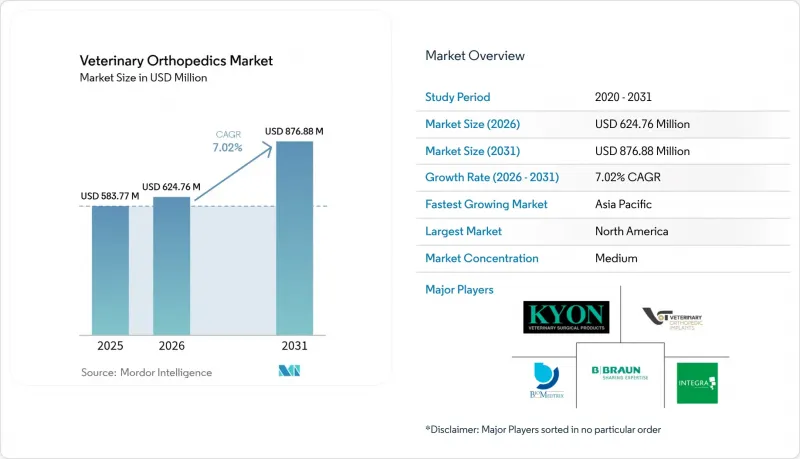
Mordor Intelligence에 따르면 수의 정형외과 시장 규모는 2025년에 5억 8,377만 달러로 평가되며, 2026년 6억 2,476만 달러에서 2031년까지 8억 7,688만 달러에 달할 것으로 예측되며, 예측 기간(2026-2031년) 동안 CAGR은 7.02%가 될 전망입니다.
본 보고서는 제품 유형(임플란트[플레이트 및 나사 등], 기구, 소모품), 동물 종(개, 고양이, 기타), 용도(관절 치환술, 외상 고정술, 기타), 최종사용자(동물병원 및 의뢰 센터, 전문 정형외과 클리닉, 기타), 및 지역(북미, 유럽, 아시아태평양, 기타)별로 분류되어 있습니다.
세계 수의 정형외과 시장의 동향 및 인사이트
반려동물 사육 마릿수 증가 및 수의의료 종사자 확대
세계 반려동물 사육 마릿수는 꾸준히 증가하고 있으며, 미국에서만 2030년까지 2,790억 달러의 지출이 예상됩니다. 밀레니얼 세대와 Z세대는 반려동물을 가족의 일원으로 대하는 경향이 강해지고 있어, 과거에는 엘리트 경주마에게만 제공되던 수술 옵션에 대한 수요가 높아지고 있습니다. 중국과 인도에서 새로 인가된 수의학 대학들이 공급 능력을 강화하고 있지만, 졸업생의 분포는 도시 지역에 편중되어 있어 지방 진료소에서는 인력 부족이 지속되고 있습니다. 미국 수의과대학 협회(AAVMC)의 예측에 따르면, 2032년까지 7만 92명의 수의사가 필요할 것으로 예상되는 반면, 졸업 예정자는 5만 2,926명에 그쳐 24%의 부족이 발생할 것으로 전망됩니다. 이러한 불균형으로 인해 진료소 통합이 진행되고 있으며, 복잡한 정형외과 증례를 전문 진료 센터로 의뢰하는 원격 상담의 이용이 확대되고 있습니다.
정부의 동물 복지 지원 및 보험 확대
정부의 보조금 및 반려동물 보험의 보급으로 인해 수술에 드는 본인 부담금이 경감되어 수술 건수가 증가하고 있습니다. 스칸디나비아 국가들에서는 보험 가입률이 80%를 초과하고 있으며, 투명성이 높은 요금 체계가 확립되어 보험금 지급이 원활해지고 있습니다. 미국의 ‘농촌 지역 수의사 인재 확보법’에서는 인력 부족 지역에서 근무하는 임상 수의사에 대한 대출금 면제가 제안되고 있으며, 이 모델은 현재 호주와 일본의 규제 당국에서 검토되고 있습니다. 제품 측면에서는 중형·대형 견종에 맞춰 설계된 해부학적 형태를 반영한 3.5 LCP 원위 대퇴골 플레이트가, 목표가 명확한 자금 지원이 의료기기 개발을 어떻게 가속화하는지를 보여주고 있습니다.
임플란트, 수술 및 수술 후 관리의 높은 비용
미국에서 TPLO 수술 비용은 4,900-6,500달러 범위이며, 복잡한 증례의 경우 1만 달러를 초과하기도 하여, 가격에 민감한 반려인들은 약 3,500달러에 받을 수 있는 멕시코의 국경 간 의료 서비스에 눈을 돌리고 있습니다. 유럽에서는 기본적인 재건 수술 비용의 중앙값이 스웨덴의 72유로에서 덴마크의 230유로까지 폭이 넓으며, 이는 보험 환급 모델의 차이를 반영합니다. 병원 체인은 독립 클리닉보다 높은 요금을 청구하는 경우가 많아, 이로 인해 의료 접근성 격차가 확대되고 있습니다. 수술 후 재활, 물리치료, 그리고 재수술 가능성도 경제적 부담을 가중시켜, 조기 개입의 가장 큰 장벽으로서 비용 문제를 더욱 심각하게 만들고 있습니다.
부문 분석
2025년, 임플란트는 수의 정형외과 시장의 59.12%를 차지했으며, 이 하위 부문은 2031년까지 연평균 성장률(CAGR) 7.78%로 성장할 전망입니다. 수술 시간을 단축하고 골유합률을 높이는 잠금식 압축 기술 덕분에 플레이트와 나사가 주류를 이루고 있습니다. 핀, 와이어, 네일은 수술 후 골유합이 필요 없는 SPIDER법 등의 외고정법에 힘입어 급성장하고 있는 카테고리입니다. 임플란트 분야의 수의 정형외과 시장 규모는 예측 기간 동안 1억 4,750만 달러 증가할 것으로 예상되며, 이는 인간 외상 치료 기기에서 이루어진 병행 기술 혁신을 반영한 것입니다.
기구의 시장 점유율은 작지만 견조한 추세를 보이고 있는데, 이는 소개 병원이 관절경 수술실을 정비하고 CT 유도 드릴 지그를 도입하고 있기 때문입니다. 소모품은 여전히 가격 탄력성이 높으며, 자체 브랜드의 흡수성 봉합사와 생체 시멘트가 대규모 동물병원 그룹의 처방 목록에 채택되기 시작하고 있습니다. 디지털 융합의 물결이 다가오고 있습니다. 존슨앤드존슨은 자사의 로봇 관절 치환술 플랫폼의 수의학용 버전을 시연하며, 드릴 궤적 및 절단 블록의 자동화가 머지않았음을 시사했습니다. 이러한 시스템은 독자적인 기구에 의존함으로써 임플란트 판매 촉진을 뒷받침합니다.
대형 견종에서 고관절 이형성증 및 십자 인대 손상의 높은 발생률에 힘입어, 2025년 매출의 47.10%를 개가 차지했습니다. 토이 견종의 레그-칼베-페르테스병과 작업견의 장요근 파열에 관한 견종별 연구가, 가동 범위를 유지하는 임플란트의 개량을 촉진하고 있습니다. 고양이의 경우 통증 징후가 미묘하여 진단이 간과되기 쉬웠으나, 반려인들이 정밀 영상 진단 및 맞춤형 초소형 나사를 수용하게 됨에 따라 현재는 연평균 성장률(CAGR) 8.05%를 기록하고 있습니다. 고양이 임플란트 관련 수의 정형외과 시장 규모는 2026년 6,807만 달러에서 2031년까지 1억 25만 달러로 확대될 것으로 예측됩니다.
말의 스포츠 의학은 여전히 프리미엄 틈새 시장을 유지하고 있습니다. 경주마의 성과 지표를 추적함으로써 미세 골절을 조기에 발견할 수 있게 되었으며, 관절경 하에서 골편 제거나 잠금 플레이트 고정술에 대한 수요가 증가하고 있습니다. 이국적인 동물은 규모는 작지만 주목할 만한 새로운 분야입니다. 앵무새용 3D 프린팅 부리 의치나 거북이용 경첩이 달린 등껍질 임플란트는 기존의 반려동물을 넘어선 외과적 적용 범위의 확대를 보여주고 있습니다.
지역별 분석
북미는 2025년 매출의 47.80%를 차지하며, 350만 마리의 보험 가입 반려동물과 공인 외과 의사들의 긴밀한 네트워크의 혜택을 받고 있습니다. 평균적인 동물병원에서는 2대의 디지털 X선 촬영 장비를 도입하고, 적어도 1곳의 첨단 영상 진단 센터와 의뢰 제휴를 맺고 있어, 진단부터 임플란트 이식에 이르기까지 원활한 흐름이 구축되어 있습니다. 존슨앤드존슨은 DePuy Synthes의 제품 라인업을 활용하여 TPLO 시스템을 공급하고 있으며, 지금까지 50만 건 이상의 개 수술 실적을 기록하고 있으며, 불만율은 0.006%에 그치고 있습니다. 시장은 성숙기에 접어들었으나, 반려인들이 1세대 임플란트를 교체하거나 반대쪽 십자인대 질환을 치료함에 따라 수술 건수는 증가하고 있습니다.
유럽에서는 견조하지만 지역별로 편차가 있는 성장이 나타나고 있습니다. 스칸디나비아 국가들은 반려인의 본인 부담금 상한선을 설정하고, 요금 투명 공개를 의무화하는 환급 모델을 통해 가격 편차를 줄이고 기준을 확립하고 있습니다. 독일에서는 선택적 관절경 수술의 대기 기간이 14주에 달해, 수요가 전문의의 대응 능력을 초과하고 있음을 보여줍니다. 남유럽은 보험 가입률이 낮아 뒤처지고 있지만, 스페인과 이탈리아의 말 사육 목장에서는 혈통마의 가치를 유지하기 위해 관절경을 이용한 이물질 제거 수술에 막대한 투자를 하고 있습니다.
아시아태평양은 연평균 성장률(CAGR) 9.62%로 가장 빠르게 성장하고 있는 지역입니다. 중국의 반려동물 병원 수는 2024년에 11% 증가했으며, 시설당 반려동물 진료 건수는 6,862건(미국은 5,485건)에 달하여 잠재적인 수술 건수가 많음을 시사하고 있습니다. 호주는 1인당 개 사육률이 세계 최고를 기록하고 있으며, 호주의 대학에서는 현재 연간 1,200명의 수의학부 졸업생을 배출하고 있고, 그 중 다수가 소동물 정형외과 분야로 진출하고 있습니다. 일본의 의약품·의료기기 심사 체계는 첨단 임플란트의 승인을 신속히 처리하여 세계 제조사의 시장 진입을 원활하게 하고 있습니다. 중동 및 아프리카는 여전히 발전 단계에 있지만, 미래가 기대되고 있습니다. 걸프 국가들에서는 경주용 종마 중 티타늄제 록 플레이트가 필요한 말을 위한 재활 센터가 설립되었습니다. 케냐에서는 2024년에 케냐 최초의 정형외과 전문 소개 클리닉이 개설되었으며, 이미 TPLO 수술에 관한 인턴 연수가 진행되고 있어 치료 기준의 보급이 진전되고 있음을 엿볼 수 있습니다. 남미의 동향은 제각각입니다. 브라질에는 55개의 인증 수의과대학이 있지만, 환율 변동으로 인해 고가의 임플란트 수입이 차질을 빚고 있습니다. 그럼에도 불구하고, 현지 주조 공장에서는 비용 절감을 위해 ISO-13485를 준수하는 스테인리스강 플레이트 가공을 시작하고 있습니다.
기타 혜택:
- 엑셀 형식의 시장 예측(ME) 시트
- 3개월간 애널리스트의 지원
자주 묻는 질문
목차
제1장 소개
제2장 조사 방법
제3장 주요 요약
제4장 시장 구도
제5장 시장 규모와 성장 예측
제6장 경쟁 구도
제7장 시장 기회와 향후 전망
KSMAccording to Mordor Intelligence, the veterinary orthopedics market size was valued at USD 583.77 million in 2025 and estimated to grow from USD 624.76 million in 2026 to reach USD 876.88 million by 2031, at a CAGR of 7.02% during the forecast period (2026-2031).
This report is Segmented by Product Type (Implants [Plates and Screws, and More], Instruments, Consumables), by Animal Type (Canine, Feline, and More), by Application (Joint Replacement, Trauma Fixation, and More), by End User (Veterinary Hospitals and Referral Centers, Specialty Orthopedic Clinics, and More), and by Geography (North America, Europe, Asia-Pacific, and More).
Global Veterinary Orthopedics Market Trends and Insights
Rising Pet Ownership & Expanding Veterinary Workforce
Global pet ownership continues to climb, with U.S. expenditures alone projected to hit USD 279 billion by 2030. Millennials and Gen Z increasingly treat pets as family, prompting demand for surgical options once reserved for elite equine athletes. Newly chartered veterinary colleges in China and India add capacity, yet graduate distribution skews toward urban hubs, leaving rural practices understaffed. The American Association of Veterinary Medical Colleges forecasts a 24% shortfall-70,092 veterinarians needed versus 52,926 expected graduates by 2032. This imbalance fuels practice consolidation and wider use of teleconsults that route complex orthopedic cases to referral centers.
National Animal-Welfare Funding & Insurance Expansion
Government subsidies and pet insurance uptake reduce out-of-pocket costs for surgery, stimulating procedure volumes. Scandinavian markets exceed 80% insurance penetration, creating transparent fee schedules that streamline reimbursement. The U.S. Rural Veterinary Workforce Act proposes loan forgiveness for clinicians serving shortage areas, a model now studied by regulators in Australia and Japan. On the product side, anatomically contoured 3.5 LCP distal femoral plates tailored to medium and large breeds illustrate how targeted funding can fast-track device development.
High Cost of Implants, Surgery & After-Care
TPLO procedures range from USD 4,900-6,500 in the United States, with complex cases topping USD 10,000, steering price-sensitive owners toward cross-border care in Mexico at roughly USD 3,500. In Europe, median costs swing from €72 in Sweden to €230 in Denmark for basic repairs, reflecting divergent reimbursement models. Chain hospitals often levy higher fees than independent clinics, widening access gaps. Post-operative rehab, physiotherapy and potential revision surgeries add to the financial burden, amplifying cost as the leading barrier to early intervention.
Other drivers and restraints analyzed in the detailed report include:
- Surge in Obesity-Linked Orthopedic Disorders
- Advances in 3-D Printed & Patient-Specific Implants
- Shortage of Board-Certified Veterinary Surgeons
For complete list of drivers and restraints, kindly check the Table Of Contents.
Segment Analysis
Implants delivered 59.12% of the veterinary orthopedics market in 2025, and the sub-segment is on track for an 7.78% CAGR through 2031. Plates and screws dominate, thanks to locking compression technology that cuts surgical time and boosts union rates. Pins, wires and nails are the breakout category, supported by external fixation methods like the SPIDER technique that remove the need for postoperative coaptation. The veterinary orthopedics market size for implants is set to grow by USD 147.5 million over the forecast window, mirroring parallel innovations in human trauma hardware.
Instruments hold a smaller but resilient share as referral hospitals outfit arthroscopy suites and integrate CT-guided drill jigs. Consumables remain price-elastic; private-label absorbable suture and biologic cements now enter formularies of large clinic groups. Digital convergence looms: Johnson & Johnson demonstrated a veterinary adaptation of its robotic arthroplasty platform, signaling impending automation of drill trajectories and cut blocks. Such systems reinforce implant pull-through by relying on proprietary instrumentation.
Canine patients generated 47.10% of 2025 revenue, supported by high incidence of hip dysplasia and cruciate injuries in large breeds. Breed-specific studies on Legg-Calve-Perthes in toy breeds and iliopsoas strain in working dogs drive implant refinements that preserve range of motion. Feline cases, often under-diagnosed due to subtle pain signs, now show 8.05% CAGR as owners accept advanced imaging and custom narrow-diameter screws. The veterinary orthopedics market size for feline implants is forecast to climb from USD 68.07 million in 2026 to USD 100.25 million by 2031.
Equine sports medicine retains a premium niche: performance-metric tracking in racehorses leads to early detection of micro-fractures, fueling demand for arthroscopic chip removal and locking plate fixation. Exotic species represent a small but visible frontier; 3-D printed beak prostheses for parrots and hinged shell implants for turtles illustrate the expansion of surgical reach beyond traditional companions.
Complete Report Scope:
- By Product Type
- Implants
- Plates and Screws
- Pins, Wires and Nails
- External Fixators
- Instruments
- Consumables
- Implants
- By Animal Type
- Canine
- Feline
- Equine
- Others
- By Application
- Joint Replacement
- Trauma Fixation
- Arthroscopy
- Others
- By End User
- Veterinary Hospitals and Referral Centers
- Specialty Orthopedic Clinics
- Academic and Research Institutes
- By Geography
- North America
- United States
- Canada
- Mexico
- Europe
- Germany
- United Kingdom
- France
- Italy
- Spain
- Rest of Europe
- Asia-Pacific
- China
- Japan
- India
- Australia
- South Korea
- Rest of Asia-Pacific
- Middle East and Africa
- GCC
- South Africa
- Rest of Middle East and Africa
- South America
- Brazil
- Argentina
- Rest of South America
- North America
Geography Analysis
North America commanded 47.80% of 2025 revenue, benefiting from 3.5 million insured pets and dense networks of board-certified surgeons. The average practice deploys two digital radiography units and maintains referral ties with at least one advanced imaging center, creating seamless pathways from diagnosis to implant placement. Johnson & Johnson leverages its DePuy Synthes catalog to supply TPLO systems that have logged over 500,000 canine procedures with a complaint rate of 0.006%. Despite market maturity, procedure frequency rises as owners replace first-generation implants or address contralateral cruciate disease.
Europe exhibits robust but heterogeneous growth. Scandinavian nations set the benchmark with reimbursement models that cap owner co-pays and mandate transparent fee disclosures, compressing price dispersion. Germany reports a 14-week waiting period for elective arthroscopy, signaling demand outstripping specialist capacity. Southern Europe lags due to lower insurance uptake, yet equine studs in Spain and Italy invest heavily in arthroscopic chip removal to preserve bloodstock value.
Asia-Pacific is the fastest-growing region at 9.62% CAGR. China's companion animal hospital count rose 11% in 2024, each clinic serving 6,862 pets versus 5,485 in the United States, pointing to latent surgery volumes. Australia records the world's highest per-capita dog ownership, and its universities now produce 1,200 veterinary graduates annually, many entering small-animal orthopedics. Japan's drug-device review framework expedites advanced implant approvals, smoothing entry for global manufacturers. The Middle East and Africa remain nascent but promising. Gulf states establish equine rehabilitation centers that require titanium locking plates for performance stallions. Kenya's first referral orthopedic clinic opened in 2024 and already trains interns on TPLO procedures, underscoring the diffusion of standards. South America's trajectory is mixed: Brazil hosts 55 accredited veterinary schools yet suffers currency volatility that hinders import of high-value implants. Still, local foundries begin machining stainless-steel plates under ISO-13485 to cut costs.
- Johnson & Johnson
- Veterinary Orthopedic Implants
- BioMedtrix
- KYON
- B. Braun
- Movora
- Integra LifeSciences
- GerMedUSA
- Cencora, Inc.
- Orthomed UK
- IMEX Veterinary, Inc.
- Intrauma
- Kahuvet Veterinary Equipment Ltd.
- Animal Ortho Care
- Rita Leibinger
Additional Benefits:
- The market estimate (ME) sheet in Excel format
- 3 months of analyst support
TABLE OF CONTENTS
1 Introduction
- 1.1 Study Assumptions & Market Definition
- 1.2 Scope of the Study
2 Research Methodology
3 Executive Summary
4 Market Landscape
- 4.1 Market Overview
- 4.2 Market Drivers
- 4.2.1 Rising pet ownership & expanding veterinary workforce
- 4.2.2 National animal-welfare funding & insurance expansion
- 4.2.3 Surge in obesity-linked orthopedic disorders
- 4.2.4 Advances in 3-D printed & patient-specific implants
- 4.2.5 Growing adoption of minimally-invasive arthroscopy
- 4.2.6 Equine sports medicine demand in emerging economies
- 4.3 Market Restraints
- 4.3.1 High cost of implants, surgery & after-care
- 4.3.2 Shortage of board-certified veterinary surgeons
- 4.3.3 Limited reimbursement outside North America & EU
- 4.3.4 Regulatory lag for novel biomaterials & devices
- 4.4 Value / Supply-Chain Analysis
- 4.5 Regulatory Landscape
- 4.6 Technological Outlook
- 4.7 Porter's Five Forces Analysis
- 4.7.1 Threat of New Entrants
- 4.7.2 Bargaining Power of Buyers
- 4.7.3 Bargaining Power of Suppliers
- 4.7.4 Threat of Substitutes
- 4.7.5 Competitive Rivalry
5 Market Size & Growth Forecasts (Value)
- 5.1 By Product Type
- 5.1.1 Implants
- 5.1.1.1 Plates and Screws
- 5.1.1.2 Pins, Wires and Nails
- 5.1.1.3 External Fixators
- 5.1.2 Instruments
- 5.1.3 Consumables
- 5.1.1 Implants
- 5.2 By Animal Type
- 5.2.1 Canine
- 5.2.2 Feline
- 5.2.3 Equine
- 5.2.4 Others
- 5.3 By Application
- 5.3.1 Joint Replacement
- 5.3.2 Trauma Fixation
- 5.3.3 Arthroscopy
- 5.3.4 Others
- 5.4 By End User
- 5.4.1 Veterinary Hospitals and Referral Centers
- 5.4.2 Specialty Orthopedic Clinics
- 5.4.3 Academic and Research Institutes
- 5.5 By Geography
- 5.5.1 North America
- 5.5.1.1 United States
- 5.5.1.2 Canada
- 5.5.1.3 Mexico
- 5.5.2 Europe
- 5.5.2.1 Germany
- 5.5.2.2 United Kingdom
- 5.5.2.3 France
- 5.5.2.4 Italy
- 5.5.2.5 Spain
- 5.5.2.6 Rest of Europe
- 5.5.3 Asia-Pacific
- 5.5.3.1 China
- 5.5.3.2 Japan
- 5.5.3.3 India
- 5.5.3.4 Australia
- 5.5.3.5 South Korea
- 5.5.3.6 Rest of Asia-Pacific
- 5.5.4 Middle East and Africa
- 5.5.4.1 GCC
- 5.5.4.2 South Africa
- 5.5.4.3 Rest of Middle East and Africa
- 5.5.5 South America
- 5.5.5.1 Brazil
- 5.5.5.2 Argentina
- 5.5.5.3 Rest of South America
- 5.5.1 North America
6 Competitive Landscape
- 6.1 Market Concentration
- 6.2 Market Share Analysis
- 6.3 Company Profiles (includes Global level Overview, Market level overview, Core Segments, Financials as available, Strategic Information, Market Rank/Share for key companies, Products & Services, and Recent Developments)
- 6.3.1 DePuy Synthes (Johnson & Johnson)
- 6.3.2 Veterinary Orthopedic Implants
- 6.3.3 BioMedtrix
- 6.3.4 KYON
- 6.3.5 B. Braun SE
- 6.3.6 Movora
- 6.3.7 Integra LifeSciences
- 6.3.8 GerMedUSA
- 6.3.9 Cencora, Inc.
- 6.3.10 Orthomed UK
- 6.3.11 IMEX Veterinary, Inc.
- 6.3.12 Intrauma
- 6.3.13 Kahuvet Veterinary Equipment Ltd.
- 6.3.14 Animal Ortho Care
- 6.3.15 Rita Leibinger
7 Market Opportunities & Future Outlook
- 7.1 White-space & Unmet-Need Assessment