|
시장보고서
상품코드
2116009
생체재료 상처 드레싱 : 시장 점유율 분석, 업계 동향과 통계, 성장 예측(2026-2031년)Biomaterial Wound Dressing - Market Share Analysis, Industry Trends & Statistics, Growth Forecasts (2026 - 2031) |
||||||
 Mordor Intelligence
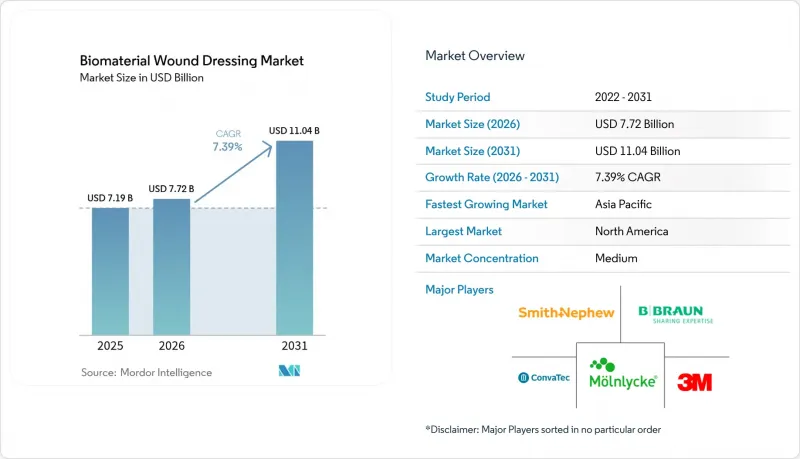
Mordor Intelligence에 따르면 생체재료 상처 드레싱 시장 규모는 2025년 71억 9,000만 달러에서 2026년에는 77억 2,000만 달러로 확대되고, 2026년부터 2031년까지 CAGR 7.39%를 기록하며 2031년에는 110억 4,000만 달러에 달할 것으로 예측됩니다.
본 보고서는 제품별(하이드로콜로이드, 알긴산 드레싱, 피부 대체재, 기타), 용도별(상처, 화상, 궤양, 기타), 지역별(북미, 유럽, 아시아태평양, 중동 및 아프리카, 남미)로 분류되어 있습니다. 본 보고서에서는 상기 각 부문의 시장 규모(단위: 백만 달러)를 제시하고 있습니다.
세계 생체재료 상처 드레싱 시장의 동향 및 인사이트
증거 기반의 첨단 드레싱에 대한 규제 당국의 추진
규제 당국은 재료 분류에 따른 면제에서 성능 기반 기준으로 전환하고 있습니다. 항균 드레싱을 클래스 II 및 III로 재분류하겠다는 FDA의 제안에 따라, 기업들은 더 많은 임상 데이터를 제출해야 하며, 안전성 검증이 불충분한 범용 제품들은 시장에서 퇴출될 것입니다. 유럽 규제 당국은 기존의 위험 평가에 환경 지표를 추가하고 있으며, 설계 팀은 안전성과 지속가능성 두 가지 기준을 모두 충족하는 생분해성 폴리머의 채택을 우선시하도록 권장받고 있습니다. 사내에 ISO 10993 준수 시험소를 보유한 의료기기 신청자는 제3자 기관의 심사를 기다리는 데 따른 지연으로 인해 시장 출시 속도의 경쟁력이 저하되는 일이 없어졌기 때문에 승인 주기가 단축되는 혜택을 누리고 있습니다.
증가하는 당뇨병 및 고령 만성 궤양 환자 수
세계 당뇨병 유병률은 2030년까지 성인 6억 4,300만 명에 달할 것으로 예측되며, 그 중 약 3분의 1은 일생 중 어느 시점에서 당뇨병성 족부궤양을 겪게 될 것입니다. 임상시험에 따르면, 콜라겐 드레싱은 만성 궤양의 상처 면적을 평균 54.5% 축소시키는 반면, 기존의 거즈는 38.8%에 그치고 있어, 이에 따라 감염률 및 재입원률을 낮추는 솔루션에 대한 보험사의 관심이 높아지고 있습니다. 인구 고령화에 따라 면역 기능 저하와 상피화 지연이 진행되는 가운데, 염증을 억제하고 혈관 신생을 촉진하는 생체활성 스캐폴드에 대한 수요는 앞으로도 견조하게 이어질 전망입니다.
단편화된 알긴산 공급망
알긴산의 대부분은 한정된 계절에 수확되는 갈조류에서 유래하며, 드레싱 제조업체는 원자재 가격 변동 및 재고 부족의 위험에 노출되어 있습니다. 연구에 따르면, 화학적 추출법 대신 효소 기반 추출법을 채택하면 양식 다시마에서도 천연 다시마와 동등한 품질을 얻을 수 있는 것으로 나타났지만, 그 도입은 아직 초기 단계에 있습니다. 600개 이상의 제품 카테고리에서 알긴산이 수요되고 있는 만큼, 해조류 양식장 인수나 안정적 공급 계약 체결과 같은 수직 통합이 공급 충격에 대한 헤지 수단으로 부상하고 있습니다.
부문 분석
알긴산계 드레싱은 겔 형성 섬유가 삼출액을 가두면서 미세하게 습윤한 치유 환경을 유지하기 때문에 2025년에는 생체 재료 상처 피복재 시장의 31.12%를 차지했습니다. 그러나 같은 해, 키토산 패드는 전장에서의 실증 실적과 강력한 항균 성능에 힘입어 7.70%라는 가장 높은 연평균 성장률(CAGR)을 기록했습니다. 콜라겐 드레싱은 세포외 기질을 모방하는 특성으로 인해 만성 상처 치료 프로토콜에서 계속해서 채택되고 있습니다. 한편, 복합 드레싱은 고흡수성 층이나 항균성 나노입자를 추가함으로써 적응증의 폭을 넓히고 있습니다.
예측 기간 동안 알지네이트계 드레싱의 기존 제조사들은 알지네이트의 흡수성과 키토산의 응혈 유도 작용을 결합한 독자적인 배합으로 전환을 추진하며, 시장 점유율 하락을 막으려 하고 있습니다. 피부 대체 시트는 조직 공학의 복잡성으로 인해 고가대를 유지하고 있으며, 강철에 필적하는 인장 강도를 지닌 거미줄을 활용한 프로토타입은 현재 전임상시험 단계에 있습니다. 전반적으로, 생체 재료를 이용한 상처 피복재 시장은 1회 교체 기간 내에 흡수, 지혈, 항균 효과를 통합한 다기능 시트로의 전환이 진행될 것으로 예상됩니다.
천연 고분자는 임상의들이 그 생체적합성과 생분해성을 신뢰하고 있으며, 정부가 지속가능한 공급망을 중시하고 있기 때문에 생체 재료를 활용한 상처 피복재 시장 규모의 54.88%를 차지하고 있습니다. 한편, 키토산 등의 천연 사슬과 인장 강도 및 프로그램 가능한 방출 동역학을 제공하는 일렉트로스피닝 법에 의한 합성 소재를 결합한 복합 소재는 연평균 성장률(CAGR) 7.93%로 예상되는 성장을 주도하고 있습니다. 세계보건기구(WHO)가 미세 플라스틱 잔류물을 문제로 지적하고 있어 순수 합성 소재에 대한 선택에는 여전히 경계심이 있지만, 완전한 바이오 유래 합성 소재는 파일럿 라인에서 개발이 진행되고 있습니다.
실제로 차세대 복합 시트의 경우, 식물 유래 셀룰로오스 나노결정과 생체흡수성 폴리에스테르를 결합함으로써 기계적 내구성과 환경 친화적인 폐기물 처리의 균형을 맞출 가능성이 있습니다. 무용제 제조 공정을 확립한 의료기기 제조업체는 규제 감사와 저탄소 공개 요건 완화라는 혜택을 받을 가능성이 높으며, 이는 지불자가 조달 평가 기준에 점점 더 많이 반영하고 있는 요소들입니다. 따라서 복합 소재 공급업체는 더 친환경적이고 내구성이 뛰어나며 풍부한 데이터를 갖춘 상처 피복재를 요구하는 생체 소재 상처 피복재 시장에서 협상력을 높일 수 있을 것입니다.
지역별 분석
북미는 견고한 환급 제도, 밀집된 외상 센터, 그리고 센서 내장형 시트의 조기 도입으로 인해 생체 소재를 이용한 상처 피복재 시장의 45.02%를 차지하고 있습니다. 클래스 II 및 III 신청에 관한 FDA의 명확한 지침은 예측 가능한 파이프라인을 유지하고 있으며, 충족되지 않은 당뇨병성 족부궤양 요구를 목표로 하는 신생 기업에 대한 벤처 캐피탈 투자를 뒷받침하고 있습니다. 산학 협력을 통해 아이디어에서 임상시험에 이르는 주기가 더욱 단축됨에 따라, 이 지역은 차세대 스캐폴드 개발의 요람이 되고 있습니다.
유럽은 성숙한 지역인 동시에 환경 의식이 높은 지역이기도 하며, 의료기기 규정(MDR) 준수를 통해 제품의 안전성과 수명주기 전반에 걸친 지속가능성이 밀접하게 연결되어 있습니다. 생분해성 기질이나 회수·재활용 프로그램을 갖춘 공급업체는 각국의 국민건강보험 서비스로부터 조달상의 우대 조치를 받고 있습니다. 스웨덴에서 첨단 상처 피복재에 대한 수요가 증가하는 것은, 임상 데이터를 통해 간호 시간 단축이 입증될 경우 지급 기관이 고기능 복합 소재에 대한 보험 급여를 적극적으로 검토하고 있음을 보여줍니다.
아시아태평양은 도시화와 생활습관병의 증가에 따라 만성 상처 사례 수가 증가하고 있어 8.58%라는 가장 높은 연평균 성장률(CAGR)을 기록하고 있습니다. 중국에서는 외래 진료소, 원격의료, 표준화된 프로토콜을 연계하는 병원 외 상처 관리 네트워크가 구축되어 있어, 스마트 드레싱의 잠재적 시장 규모가 확대되고 있습니다. 일본에서는 PMDA(의약품·의료기기종합기구)의 명확하지만 복잡한 의료기기 명명 규칙으로 인해 중소기업의 시장 진입이 지연되고 있지만, 승인 절차를 완료한 기업은 의사들로부터 강한 신뢰를 얻고 있습니다. 인도에서는 규제 변동으로 인해 국내 생산이 부진하지만, 수입 증가로는 막대한 수요의 극히 일부만 충족할 수 있어 비용 대비 효과가 높은 천연 고분자 기반 솔루션의 길이 열리고 있습니다.
기타 혜택:
- 엑셀 형식의 시장 예측(ME) 시트
- 3개월간의 애널리스트 지원
자주 묻는 질문
목차
제1장 소개
제2장 조사 방법
제3장 주요 요약
제4장 시장 구도
제5장 시장 규모와 성장 예측
제6장 경쟁 구도
제7장 시장 기회와 향후 전망
KSM 26.08.26According to Mordor Intelligence, the biomaterial wound dressing market size is expected to grow from USD 7.19 billion in 2025 to USD 7.72 billion in 2026 and is forecast to reach USD 11.04 billion by 2031 at 7.39% CAGR over 2026-2031.
This report is Segmented by Product (Hydrocolloids, Alginate Dressing, Skin Substitutes, Others), Application (Wounds, Burns, Ulcers, and Others), and Geography (North America, Europe, Asia-Pacific, Middle East and Africa, and South America). The Report Offers the Value (in USD Million) for the Above Segments.
Global Biomaterial Wound Dressing Market Trends and Insights
Regulatory push for evidence-based advanced dressings
Regulators are shifting from material-class exemptions to performance-based benchmarks. The FDA's proposal to reclassify antimicrobial dressings into Class II and III status will compel companies to submit more clinical data, filtering out commodity products that lack safety validation. European rule makers are layering environmental metrics over traditional risk assessments, spurring design teams to favor biodegradable polymers that meet both safety and sustainability tests. Device sponsors with in-house ISO 10993 labs now enjoy shorter approval cycles because third-party queuing delays no longer erode their speed-to-market advantage.
Rising diabetic & geriatric chronic-wound pool
Global diabetes prevalence is expected to reach 643 million adults by 2030, and roughly one-third will face diabetic foot ulcers at some point in their lives. Clinical trials demonstrate that collagen dressings deliver 54.5% mean wound-area reduction in chronic ulcers compared with 38.8% for conventional gauze, tightening payer focus on solutions that cut infection rates and readmissions. As population aging intensifies immune compromise and slows re-epithelialization, demand for bioactive scaffolds that curb inflammation and stimulate angiogenesis will remain durable.
Fragmented raw alginate supply chain
Most alginate comes from brown seaweed harvested in a narrow seasonal window, exposing dressings makers to raw-material price swings and stock-out risks. Studies show cultivated kelp can match wild-harvest quality when enzyme-based extraction replaces chemical methods, but adoption is still nascent . With alginate demanded by over 600 product categories, vertical integration-either by acquiring seaweed farms or securing offtake contracts-is emerging as a hedge against supply shocks.
Other drivers and restraints analyzed in the detailed report include:
- Surge in outpatient surgery & home-based care
- Reimbursement expansion for bioactive dressings
- Breakthroughs in electro-spun nanofiber scaffolds
- Military adoption of chitosan hemostatic pads
- Stringent biocompatibility validation timelines
For complete list of drivers and restraints, kindly check the Table Of Contents.
Segment Analysis
Alginate dressings captured 31.12% of the biomaterial wound dressing market in 2025 because their gel-forming fibers lock in exudate while maintaining a micro-moist healing climate. Yet the same year saw chitosan pads deliver the fastest 7.70% CAGR trajectory, bolstered by battlefield proof and strong antimicrobial credentials. Collagen dressings continue to win chronic-wound protocols owing to their extracellular-matrix mimicry, whereas composite dressings add super-absorbent layers or antimicrobial nanoparticles to broaden indications.
Over the forecast horizon, alginate incumbents are moving into proprietary blends that combine alginate's absorptivity with chitosan's clot-triggering chains, counteracting share erosion. Skin-substitute sheets command premium pricing thanks to tissue-engineering complexity, and spider-silk prototypes with tensile strength rivaling steel are now in pre-clinical programs. Collectively, the biomaterial wound dressing market will likely see a migration toward multi-mechanism sheets that consolidate absorption, hemostasis, and antibacterial effects within a single change interval.
Natural polymers account for 54.88% of the biomaterial wound dressing market size because clinicians trust their biocompatibility and biodegradability, and governments favor sustainable supply chains. Composite materials, however, lead projected growth at 7.93% CAGR as they unite natural chains like chitosan with electro-spun synthetics that add tensile strength and programmable release kinetics. Pure synthetic options are still viewed warily when microplastic residues are flagged by environmental health agencies, but fully bio-based synthetics are progressing through pilot lines.
In practice, the next wave of composite sheets may integrate plant-derived cellulose nanocrystals with bio-resorbable polyesters to balance mechanical endurance and eco-friendly disposal. Device sponsors that master solvent-free manufacturing will likely benefit from easing regulatory audits and lower carbon disclosures, attributes that payers increasingly embed into procurement scorecards. As such, composite material vendors will gain bargaining power across a biomaterial wound dressing market eager for greener, tougher, and data-rich dressings.
Complete Report Scope:
- By Product Type
- Hydrocolloids
- Alginate Dressings
- Collagen Dressings
- Chitosan Dressings
- Skin Substitutes
- Composite / Combination Dressings
- Other Products
- By Material Source
- Natural Biomaterials
- Synthetic Biomaterials
- Composite Biomaterials
- By Mode of Mechanism
- Moisture-Retentive
- Antimicrobial
- Haemostatic
- Bioactive / Intelligent
- By Application
- Wounds
- Burns
- Ulcers
- Surgical Incisions
- Traumatic Injuries
- Other Applications
- By End-User
- Hospitals
- Home Healthcare
- Others
- By Geography
- North America
- United States
- Canada
- Mexico
- Europe
- Germany
- United Kingdom
- France
- Italy
- Spain
- Rest of Europe
- Asia-Pacific
- China
- Japan
- India
- Australia
- South Korea
- Rest of Asia-Pacific
- Middle East & Africa
- GCC
- South Africa
- Rest of Middle East & Africa
- South America
- Brazil
- Argentina
- Rest of South America
- North America
Geography Analysis
North America holds 45.02% of the biomaterial wound dressing market owing to robust reimbursement pathways, dense trauma centers, and early adoption of sensor-embedded sheets. FDA clarity on Class II and III filings sustains a predictable pipeline, encouraging venture capital for start-ups that target unmet diabetic foot ulcer needs. Academic-industry collaborations further shorten ideation-to-trial cycles, making the region a crucible for next-generation scaffolds.
Europe represents a mature but environmentally mindful region where Medical Device Regulation (MDR) compliance now intertwines product safety with life-cycle sustainability. Suppliers with biodegradable substrates and take-back recycling programs are earning procurement points from national health services. Sweden's appetite for advanced dressings illustrates payer readiness to reimburse premium composites when clinical dossiers show reduced nursing hours.
Asia-Pacific posts the highest 8.58% CAGR as urbanization and lifestyle diseases swell chronic-wound caseloads. China is forming extramural wound-care networks that coordinate outpatient clinics, telehealth, and standardized protocols-expanding the addressable base for intelligent dressings. Japan's clear but intricate device nomenclature under PMDA slows entry for smaller firms yet rewards those that complete the pathway with strong physician trust. India's regulatory flux keeps domestic output subdued, but rising imports meet only a fraction of its vast need, opening doors for cost-effective natural polymer solutions.
- 3M
- Smiths Group
- Convatec
- Molnlycke Health Care
- Johnson & Johnson
- Medtronic
- B. Braun
- Hollister
- Coloplast
- Organogenesis
- Integra LifeSciences
- MiMedx Group
- Hartmann Group
- Cardinal Health
- Lohmann & Rauscher
- Urgo Medical
- KCI / Acelity (3M)
- Avita Medical
- Axio Biosolutions
- Winner Medical
Additional Benefits:
- The market estimate (ME) sheet in Excel format
- 3 months of analyst support
TABLE OF CONTENTS
1 Introduction
- 1.1 Study Assumptions & Market Definition
- 1.2 Scope of the Study
2 Research Methodology
3 Executive Summary
4 Market Landscape
- 4.1 Market Overview
- 4.2 Market Drivers
- 4.2.1 Regulatory push for evidence-based advanced dressings
- 4.2.2 Rising diabetic & geriatric chronic-wound pool
- 4.2.3 Surge in outpatient surgery & home-based care
- 4.2.4 Reimbursement expansion for bioactive dressings
- 4.2.5 Breakthroughs in electro-spun nanofiber scaffolds
- 4.2.6 Military adoption of chitosan haemostatic pads
- 4.3 Market Restraints
- 4.3.1 Fragmented raw alginate supply chain
- 4.3.2 Stringent biocompatibility validation timelines
- 4.3.3 Recycling-disposal concerns for silver-laden dressings
- 4.3.4 Price sensitivity in low- & middle-income settings
- 4.4 Value / Supply-Chain Analysis
- 4.5 Regulatory Landscape
- 4.6 Technological Outlook
- 4.7 Porter's Five Forces Analysis
- 4.7.1 Threat of New Entrants
- 4.7.2 Bargaining Power of Buyers
- 4.7.3 Bargaining Power of Suppliers
- 4.7.4 Threat of Substitutes
- 4.7.5 Intensity of Competitive Rivalry
5 Market Size & Growth Forecasts (Value)
- 5.1 By Product Type
- 5.1.1 Hydrocolloids
- 5.1.2 Alginate Dressings
- 5.1.3 Collagen Dressings
- 5.1.4 Chitosan Dressings
- 5.1.5 Skin Substitutes
- 5.1.6 Composite / Combination Dressings
- 5.1.7 Other Products
- 5.2 By Material Source
- 5.2.1 Natural Biomaterials
- 5.2.2 Synthetic Biomaterials
- 5.2.3 Composite Biomaterials
- 5.3 By Mode of Mechanism
- 5.3.1 Moisture-Retentive
- 5.3.2 Antimicrobial
- 5.3.3 Haemostatic
- 5.3.4 Bioactive / Intelligent
- 5.4 By Application
- 5.4.1 Wounds
- 5.4.2 Burns
- 5.4.3 Ulcers
- 5.4.4 Surgical Incisions
- 5.4.5 Traumatic Injuries
- 5.4.6 Other Applications
- 5.5 By End-User
- 5.5.1 Hospitals
- 5.5.2 Home Healthcare
- 5.5.3 Others
- 5.6 By Geography
- 5.6.1 North America
- 5.6.1.1 United States
- 5.6.1.2 Canada
- 5.6.1.3 Mexico
- 5.6.2 Europe
- 5.6.2.1 Germany
- 5.6.2.2 United Kingdom
- 5.6.2.3 France
- 5.6.2.4 Italy
- 5.6.2.5 Spain
- 5.6.2.6 Rest of Europe
- 5.6.3 Asia-Pacific
- 5.6.3.1 China
- 5.6.3.2 Japan
- 5.6.3.3 India
- 5.6.3.4 Australia
- 5.6.3.5 South Korea
- 5.6.3.6 Rest of Asia-Pacific
- 5.6.4 Middle East & Africa
- 5.6.4.1 GCC
- 5.6.4.2 South Africa
- 5.6.4.3 Rest of Middle East & Africa
- 5.6.5 South America
- 5.6.5.1 Brazil
- 5.6.5.2 Argentina
- 5.6.5.3 Rest of South America
- 5.6.1 North America
6 Competitive Landscape
- 6.1 Market Concentration
- 6.2 Market Share Analysis
- 6.3 Company Profiles (includes Global level Overview, Market level overview, Core Segments, Financials as available, Strategic Information, Market Rank/Share for key companies, Products & Services, and Recent Developments)
- 6.3.1 3M
- 6.3.2 Smith & Nephew PLC
- 6.3.3 ConvaTec Group PLC
- 6.3.4 Molnlycke Health Care AB
- 6.3.5 Johnson & Johnson (Ethicon)
- 6.3.6 Medtronic PLC
- 6.3.7 B. Braun Melsungen AG
- 6.3.8 Hollister Incorporated
- 6.3.9 Coloplast A/S
- 6.3.10 Organogenesis Holdings Inc.
- 6.3.11 Integra LifeSciences
- 6.3.12 MiMedx Group
- 6.3.13 Paul Hartmann AG
- 6.3.14 Cardinal Health Inc.
- 6.3.15 Lohmann & Rauscher
- 6.3.16 Urgo Medical
- 6.3.17 KCI / Acelity (3M)
- 6.3.18 Avita Medical
- 6.3.19 Axio Biosolutions
- 6.3.20 Winner Medical
7 Market Opportunities & Future Outlook
- 7.1 White-space & Unmet-Need Assessment