

|
시장보고서
상품코드
2116010
금속 표면 처리 약품 : 시장 점유율 분석, 업계 동향과 통계, 성장 예측(2026-2031년)Metal Finishing Chemical - Market Share Analysis, Industry Trends & Statistics, Growth Forecasts (2026 - 2031) |
||||||
 Mordor Intelligence
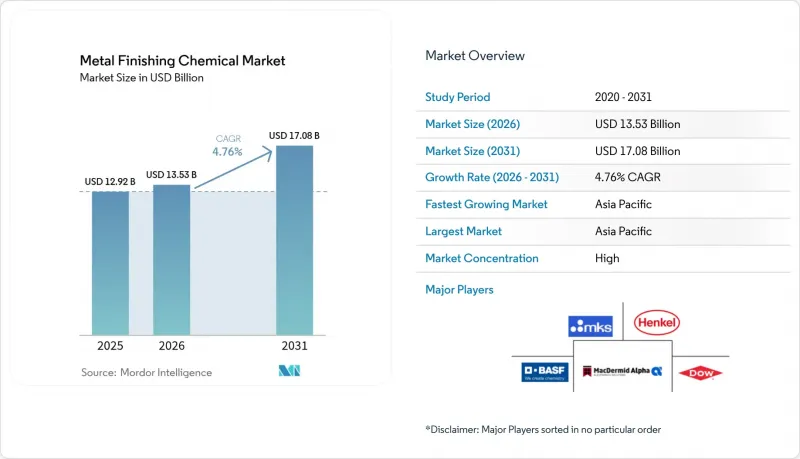
Mordor Intelligence에 따르면 2026년 금속 표면 처리 약품 시장 규모는 135억 3,000만 달러로 추정되며, 2025년 129억 2,000만 달러에서 확대되어 2031년에는 170억 8,000만 달러에 달할 것으로 예측됩니다.
2026년부터 2031년까지 연평균 성장률(CAGR) 4.76%로 성장할 것으로 전망됩니다.
본 보고서에서는 업계를 화학약품의 종류(도금용 약품, 독자 개발 약품, 세정용 약품, 컨버전 코팅용 약품), 소재(알루미늄, 구리, 아연 등), 공정(양극 산화 처리, 탄화 처리, 전기도금 등), 최종사용자 산업(자동차, 산업용, 전자 등), 및 지역(아시아태평양, 북미, 유럽 등)별로 분류하고 있습니다.
세계 금속 표면 처리 약품 시장의 동향과 인사이트
전기자동차(EV)의 경량화가 진행됨에 따라, 더욱 고성능의 도금 약품이 요구되고 있습니다
전기자동차(EV) 플랫폼은 알루미늄 및 혼합 금속 구조에 의존하고 있어, 재활용 합금과의 밀착이 가능한 내식성 변환 코팅이 요구되고 있습니다. 혼다가 캐나다에 건설 중인 150억 달러 규모의 전기자동차 복합 시설과 BMW의 멕시코 배터리 생산 확대는 해당 지역의 화학약품 수요를 끌어올릴 생산 체계 재편을 여실히 보여주고 있습니다. 특수 양극 산화 시스템은 경량화 목표를 충족하면서도 재활용 알루미늄 표면의 코팅 무결성을 유지합니다. 한편, ARRK 그룹의 탄소섬유 기어박스 쉘 등 복합재 하우징이 일부 금속 부품을 대체하고 있지만, 금속과 복합재의 접합부에서는 갈바닉 부식의 위험을 줄이기 위해 여전히 틈새 시장용 도금 약제가 필요합니다. 2030년까지 이어질 지속적인 모델 갱신 주기는 고품질 도금 제제의 지속적인 채택을 뒷받침하고 있으며, 금속 표면 처리용 화학 약품 시장은 판매량과 이익률의 꾸준한 확대가 예상됩니다.
초박막 증착 정밀도가 요구되는 전자기기의 소형화
반도체 노드의 미세화로 인해 상호연결 피치가 10µm 미만으로 줄어들면서, 전해 도금욕에는 웨이퍼 전체에 걸쳐 100 nm 미만의 균일성이 요구되고 있습니다. 수평형 웨이퍼 레벨 시스템은 실리콘 관통 비아(TSV)의 충전 정밀도를 향상시키고, 펄스 도금은 보이드 발생을 억제합니다. 일부 층에서는 일렉트로마이그레이션 내성을 높이기 위해 구리 대신 코발트가 사용되고 있으며, 이로 인해 도금액의 화학적 균형을 안정화시키는 새로운 첨가제가 요구되고 있습니다. AI 탑재 센서가 기계 학습 모델에 데이터를 제공함으로써 두께 편차를 실시간으로 예측하여 불량품 및 시약 사용량을 줄이고 있습니다. 팹의 설비 투자는 노드 전환과 연동되어 있기 때문에 리소그래피 기술이 전환될 때마다 고순도 첨가제 및 실시간 제어 패키지에 대한 새로운 수요가 금속 표면 처리 약품 시장에 발생하고 있습니다.
e-모빌리티 분야의 고성능 플라스틱 급속한 보급
엔지니어들은 알루미늄으로 만든 브래킷과 하우징을 탄소섬유 및 유리섬유 복합 소재로 대체함으로써 도금 후 공정을 거치지 않고도 무게를 30% 줄이고 있습니다. 플라스틱은 성형 시 장식적인 질감을 부여할 수 있기 때문에 화학 에칭이나 무전해 도금의 필요성이 사라집니다. 코베스트로(Covestro)사의 저탄소 폴리카보네이트는 VOC를 줄이고 열충격 기준을 충족하여 비금속 소재의 채택을 촉진하고 있습니다. 플라스틱의 보급이 확대됨에 따라, 외장 트림 및 보닛 하부 브래킷과 관련된 금속 표면 처리 약품 시장의 잠재적 점유율은 축소되어 기존 화학약품 시장에 압박을 가하고 있습니다.
부문 분석
2025년, 도금용 화학약품은 금속 표면 처리 약품 시장에서 38.72%의 점유율을 차지했습니다. 이는 자동차 트림, 반도체 범프, 항공우주용 패스너의 전착 처리에서 도금용 화학약품이 필수적인 역할을 하고 있기 때문입니다. 세정용 화학약품은 점유율이 작지만, 반도체 팹에서는 구리 다마스커스 공정 전에 입자가 없는 기판이 필수적이기 때문에 연평균 성장률(CAGR) 5.93%로 가장 빠르게 성장하고 있습니다. 바이오 유래 계면활성제를 채택한 탈지제는 엄격한 저항률 기준을 충족하며, 과산화수소 혼합물이 용제형 세정제를 대체하여 온실가스 배출량을 줄이고 있습니다. 독자적인 배합은 현재 틈새 합금 시스템을 위해 침전물의 광택과 인장 응력을 미세 조정하는 다층 첨가제 패키지를 구성하고 있습니다. 크롬 프리 변환 피막 솔루션은 인증 프로그램의 완료에 따라 항공우주 분야에서 시장 점유율을 확대하고 있으며, 기존의 6가 크롬 제품에서 발생하는 수익을 보다 안전한 대체품으로 전환하고 있습니다.
알루미늄 표면 처리 제품은 전기자동차(EV) 배터리 트레이 생산 및 건축용 클래딩 수요에 힘입어 2025년에는 금속 표면 처리 약품 시장의 30.86%를 차지했습니다. 다단계 양극 산화욕은 염료 흡수에 적합한 기공 구조를 만들어내어 장식 옵션을 확대하고 있습니다. 그러나 전해조 플레이트 및 배터리용 집전체의 보급에 따라 니켈욕이 연평균 성장률(CAGR) 6.09%로 가장 빠르게 성장하고 있습니다. 고pH 황산염계 시스템은 수소 발생 효율에 필수적인 내부 응력이 낮은 두꺼운 니켈 피막을 형성할 수 있습니다. 인쇄회로기판 제조 분야의 구리 도금은 견조한 추세를 보이는 반면, 항공우주용 하드웨어 분야에서는 아연·니켈 합금이 카드뮴을 대체하고 있습니다.
지역별 분석
2025년에는 아시아태평양이 매출 점유율의 53.08%를 차지하며 주도적인 위치를 차지하고 있으며, 이 지역의 금속 표면 처리 약품 시장 규모는 연평균 6.78%의 성장률을 보이고 있습니다. 중국의 전기자동차(EV) 생산 확대, 인도의 특수 화학제품 시장 확대, 그리고 한국의 반도체 파운드리 투자가 판매량 증가를 주도하고 있습니다. 반도체 공급망의 현지화를 위한 정부의 인센티브가 고순도 도금 수요를 자극하고 있으며, 이는 지역 공급업체들에게 규모의 우위를 가져다주고 있습니다.
북미는 ‘인프라 투자 및 고용법(IIJA)’에 따른 자금 지원과 생산의 국내 복귀(리쇼어링)의 혜택을 받고 있습니다. 미국의 주조 금속 수요는 2032년까지 375억 달러에 달할 것으로 예측되며, 이는 다운스트림 표면 처리 수요를 뒷받침하고 있습니다. 캐나다의 전기자동차(EV) 프로젝트와 멕시코의 수탁 제조 거점으로 인해 국경을 넘는 화학약품 유통량이 증가하고 있습니다. 운송 경로의 단축과 현지 기술 지원으로 공급업체와의 관계가 강화되어, 금속 표면 처리용 화학약품 시장의 이익률이 향상되고 있습니다.
유럽에서는 PFAS를 금지하고 6가 크롬의 허용 기준을 강화하는 REACH 규정 개정이 시급히 추진되고 있습니다. 규정 준수는 비용 증가를 초래하는 한편, 혁신도 촉진하고 있습니다. 듀폰사의 크롬 프리 에칭제나 암모니아 프리 플라스틱 메탈라이제이션 라인이 주목을 받는 한편, 독일의 Tier 1 제조업체는 지르코네이트 실러 시스템의 시범 운영을 진행하고 있습니다. 동유럽은 비용이 높은 서유럽의 공장에서 이전해 오는 생산능력을 흡수하며, 표면 처리용 화학제품의 소비 기반을 확대하고 있습니다. 규제 당국이 지속가능한 화학 기술을 높이 평가하는 가운데, 고품질 제품이 금속 표면 처리 약품 시장 전반에서 점유율을 확보하고 있습니다.
기타 혜택:
- 엑셀 형식의 시장 예측(ME) 시트
- 3개월간의 애널리스트 지원
자주 묻는 질문
목차
제1장 소개
제2장 조사 방법
제3장 주요 요약
제4장 시장 구도
제5장 시장 규모와 성장 예측(달러)
제6장 경쟁 구도
제7장 시장 기회와 향후 전망
KSM 26.08.26According to Mordor Intelligence, metal finishing chemical market size in 2026 is estimated at USD 13.53 billion, growing from 2025 value of USD 12.92 billion with 2031 projections showing USD 17.08 billion, growing at 4.76% CAGR over 2026-2031.
This report Segments the Industry by Chemical Type (Plating Chemicals, Proprietary Chemicals, Cleaning Chemicals, and Conversion Coating Chemicals), Materials (Aluminum, Copper, Zinc, and More), Process (Anodizing, Carbonizing, Electroplating, and More), End-User Industry (Automotive, Industrial, Electronics, and More), and Geography (Asia-Pacific, North America, Europe, and More).
Global Metal Finishing Chemical Market Trends and Insights
EV Lightweighting Shifts Needing Higher-Performance Plating Chemistries
Electric-vehicle platforms rely on aluminum and mixed-metal architectures that demand corrosion-resistant conversion coats capable of bonding to recycled alloys. Honda's USD 15 billion Canadian EV complex and BMW's battery expansion in Mexico illustrate production realignment that lifts regional chemical demand. Specialized anodizing systems maintain coating integrity on secondary aluminum while complying with weight-reduction goals. At the same time, composite housings such as ARRK Group's carbon-fiber gearbox shells displace some metal parts, yet hybrid metal-composite interfaces still require niche plating chemistries to mitigate galvanic risk. Continuous model refresh cycles through 2030 support sustained uptake of premium plating formulations, positioning the metal finishing chemical market for steady volume and margin expansion.
Electronics Miniaturization Requiring Ultra-Thin Deposit Accuracy
Shrinking semiconductor nodes have moved interconnect pitches below 10 µm, pushing electroplating baths to deliver sub-100 nm uniformity across wafers. Horizontal wafer-level systems improve through-silicon-via filling, while pulse plating cuts void formation. Cobalt replaces copper in some layers for better electromigration resistance, demanding new additives that stabilize bath chemistry. AI-enabled sensors feed machine-learning models to predict thickness deviations in real time, cutting scrap and reagent use. Fab capital outlays track node migrations, so each lithography transition injects new demand into the metal finishing chemical market for high-purity additives and real-time control packages.
Rapid Adoption of High-Performance Plastics in E-Mobility
Engineers substitute carbon-fiber and glass-fiber composites for aluminum brackets and housings, trimming 30% weight without post-plating steps. Plastics can integrate decorative texture during molding, erasing the need for chemical etches or electroless plating. Covestro's low-carbon polycarbonate cuts VOCs and meets thermal-shock standards, reinforcing non-metal adoption. As plastic penetration widens, the addressable portion of the metal finishing chemical market tied to exterior trim and under-hood brackets contracts, pressuring legacy chemistries.
Other drivers and restraints analyzed in the detailed report include:
- Aerospace OEM PFAS-Free Mandates Accelerate Conversion-Coat Demand
- Reshoring of Metal Parts Boosts Localized Chemical Demand
- 3D-Printed Net-Shape Metals Lower Post-Finish Chemical Volumes
For complete list of drivers and restraints, kindly check the Table Of Contents.
Segment Analysis
Plating chemicals held a 38.72% share of the metal finishing chemical market in 2025, driven by their indispensable role in electrodeposition for automotive trim, semiconductor bumps, and aerospace fasteners. Cleaning chemicals, although smaller, are the fastest-growing at 5.93% CAGR because chip fabs mandate particle-free substrates before copper damascene steps. Degreasers employing bio-based surfactants meet stringent resistivity thresholds, and hydrogen peroxide blends replace solvent cleaners to cut greenhouse-gas footprints. Proprietary blends now comprise multilayer additive packages that fine-tune deposit brightness and tensile stress for niche alloy systems. Chrome-free conversion-coat solutions capture aerospace share as qualification programs conclude, redirecting revenue from legacy hexavalent products into safer alternatives.
Aluminum finishing products commanded 30.86% of the metal finishing chemical market in 2025, buoyed by EV battery-tray production and architectural cladding demand. Multi-stage anodizing baths yield pore structures suited for dye uptake, expanding decorative options. Yet nickel baths are advancing fastest at 6.09% CAGR as electrolyzer plates and battery current collectors proliferate. High-pH sulfamate systems allow thick nickel deposits with low internal stress, critical for hydrogen-evolution efficiency. Copper plating remains steady in printed-circuit fabrication, while zinc-nickel alloys displace cadmium in aerospace hardware.
Complete Report Scope:
- By Chemical Type
- Plating Chemicals
- Proprietary Chemicals
- Cleaning Chemicals
- Conversion-Coating Chemicals
- By Materials
- Aluminum
- Copper
- Zinc
- Nickel
- Chromium
- Other Materials
- By Process
- Anodizing
- Carbonizing
- Electroplating
- Polishing
- Plating
- Thermal or Plasma Spray Coating
- Other Process (Laser, Magnetic-Abrasive, etc.)
- By End-user Industry
- Automotive
- Industrial
- Electronics
- Aerospace and Defense
- Construction
- Other End-User Industries (Energy, etc.)
- By Geography
- Asia-Pacifc
- China
- India
- Japan
- South Korea
- Rest of Asia-Pacific
- North America
- United States
- Canada
- Mexico
- Europe
- Germany
- United Kingdom
- France
- Italy
- Rest of Europe
- South America
- Brazil
- Argentina
- Rest of South America
- Middle-East and Africa
- Saudi Arabia
- South Africa
- Rest of Middle-East and Africa
- Asia-Pacifc
Geography Analysis
Asia-Pacific dominated with 53.08% revenue share in 2025, and the metal finishing chemical market size here is rising 6.78% annually. China's EV build-out, India's specialty chemical expansion, and South Korea's chip-foundry investments fuel volume gains. Government incentives for localized semiconductor supply chains spur high-purity plating demand, giving regional suppliers scale advantages.
North America benefits from the Infrastructure Investment and Jobs Act funding and reshoring. U.S. cast-metal demand is projected at USD 37.5 billion by 2032, supporting downstream finishing needs. Canada's EV projects and Mexico's contract manufacturing hubs multiply cross-border chemical flows. Shorter transport routes and on-site technical support strengthen supplier relationships, raising margins within the metal finishing chemical market.
Europe faces strict REACH revisions that ban PFAS and tighten chromium VI allowances. Compliance pressures add cost but also stimulate innovation. DuPont's chrome-free etchants and ammonia-free plastic metallization lines gain traction, while German tier-ones pilot zirconate sealer systems. Eastern Europe captures capacity migrating from higher-cost Western plants, enlarging its finish-chemical consumption base. As regulators reward sustainable chemistries, premium offerings secure share across the metal finishing chemical market.
- Asterion LLC
- BASF
- Dow
- Elementis PLC
- Henkel AG & Co. KGaA
- Honeywell International Inc.
- JCU INTERNATIONAL, INC
- Kemia Pte Ltd
- MacDermid Alpha Electronics Solutions
- McGean-Rohco Inc.
- MKS Inc.
- Nihon Parkerizing Co.
- NOF Corporation
- Quaker Chemical Corporation
- Transene Company, Inc.
Additional Benefits:
- The market estimate (ME) sheet in Excel format
- 3 months of analyst support
TABLE OF CONTENTS
1 Introduction
- 1.1 Study Assumptions and Market Definition
- 1.2 Scope of the Study
2 Research Methodology
3 Executive Summary
4 Market Landscape
- 4.1 Market Overview
- 4.2 Market Drivers
- 4.2.1 EV Lightweighting Shifts Needing Higher-Performance Plating Chemistries
- 4.2.2 Electronics Miniaturization Requiring Ultra-Thin Deposit Accuracy
- 4.2.3 Aerospace OEM PFAS-Free Mandates Accelerate Conversion-Coat Demand
- 4.2.4 Reshoring of Metal Parts Boosts Localized Chemical Demand
- 4.2.5 Green Hydrogen Electrolyzer Build-Out Needs Specialty Nickel Baths
- 4.3 Market Restraints
- 4.3.1 Rapid Adoption of High-Performance Plastics in E-Mobility
- 4.3.2 3-D-Printed Net-Shape Metals Lower Post-Finish Chemical Volumes
- 4.3.3 Tight PFAS and Cr VI Bans Raise Reformulation Compliance Costs
- 4.4 Value Chain Analysis
- 4.5 Porter's Five Forces
- 4.5.1 Threat of New Entrants
- 4.5.2 Bargaining Power of Buyers
- 4.5.3 Bargaining Power of Suppliers
- 4.5.4 Threat of Substitutes
- 4.5.5 Degree of Competition
5 Market Size and Growth Forecasts (USD)
- 5.1 By Chemical Type
- 5.1.1 Plating Chemicals
- 5.1.2 Proprietary Chemicals
- 5.1.3 Cleaning Chemicals
- 5.1.4 Conversion-Coating Chemicals
- 5.2 By Materials
- 5.2.1 Aluminum
- 5.2.2 Copper
- 5.2.3 Zinc
- 5.2.4 Nickel
- 5.2.5 Chromium
- 5.2.6 Other Materials
- 5.3 By Process
- 5.3.1 Anodizing
- 5.3.2 Carbonizing
- 5.3.3 Electroplating
- 5.3.4 Polishing
- 5.3.5 Plating
- 5.3.6 Thermal or Plasma Spray Coating
- 5.3.7 Other Process (Laser, Magnetic-Abrasive, etc.)
- 5.4 By End-user Industry
- 5.4.1 Automotive
- 5.4.2 Industrial
- 5.4.3 Electronics
- 5.4.4 Aerospace and Defense
- 5.4.5 Construction
- 5.4.6 Other End-User Industries (Energy, etc.)
- 5.5 By Geography
- 5.5.1 Asia-Pacifc
- 5.5.1.1 China
- 5.5.1.2 India
- 5.5.1.3 Japan
- 5.5.1.4 South Korea
- 5.5.1.5 Rest of Asia-Pacific
- 5.5.2 North America
- 5.5.2.1 United States
- 5.5.2.2 Canada
- 5.5.2.3 Mexico
- 5.5.3 Europe
- 5.5.3.1 Germany
- 5.5.3.2 United Kingdom
- 5.5.3.3 France
- 5.5.3.4 Italy
- 5.5.3.5 Rest of Europe
- 5.5.4 South America
- 5.5.4.1 Brazil
- 5.5.4.2 Argentina
- 5.5.4.3 Rest of South America
- 5.5.5 Middle-East and Africa
- 5.5.5.1 Saudi Arabia
- 5.5.5.2 South Africa
- 5.5.5.3 Rest of Middle-East and Africa
- 5.5.1 Asia-Pacifc
6 Competitive Landscape
- 6.1 Market Concentration
- 6.2 Strategic Moves
- 6.3 Market Share(%)/Ranking Analysis
- 6.4 Company Profiles {(includes Global level Overview, Market level overview, Core Segments, Financials as available, Strategic Information, Market Rank/Share for key companies, Products and Services, and Recent Developments)}
- 6.4.1 Asterion LLC
- 6.4.2 BASF
- 6.4.3 Dow
- 6.4.4 Elementis PLC
- 6.4.5 Henkel AG & Co. KGaA
- 6.4.6 Honeywell International Inc.
- 6.4.7 JCU INTERNATIONAL, INC
- 6.4.8 Kemia Pte Ltd
- 6.4.9 MacDermid Alpha Electronics Solutions
- 6.4.10 McGean-Rohco Inc.
- 6.4.11 MKS Inc.
- 6.4.12 Nihon Parkerizing Co.
- 6.4.13 NOF Corporation
- 6.4.14 Quaker Chemical Corporation
- 6.4.15 Transene Company, Inc.
7 Market Opportunities and Future Outlook
- 7.1 White-space and Unmet-need Assessment


