

|
시장보고서
상품코드
2116028
웹 필터링 : 시장 점유율 분석, 업계 동향과 통계, 성장 예측(2026-2031년)Web Filtering - Market Share Analysis, Industry Trends & Statistics, Growth Forecasts (2026 - 2031) |
||||||
 Mordor Intelligence
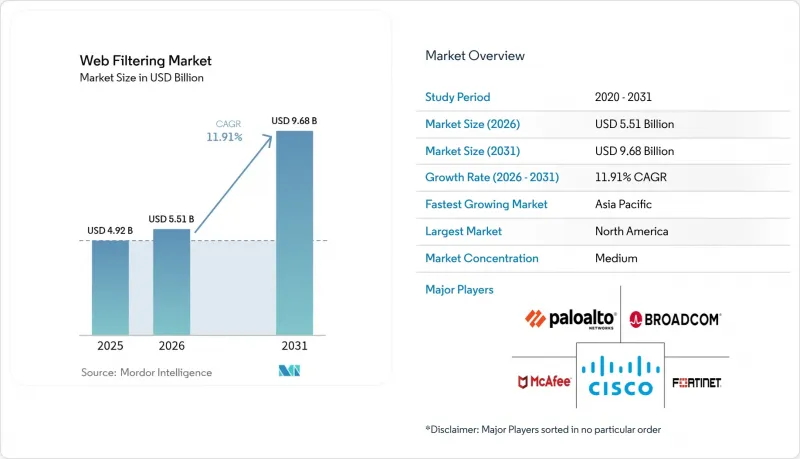
Mordor Intelligence에 따르면 2026년 웹 필터링 시장 규모는 55억 1,000만 달러로 추정되며, 2025년 49억 2,000만 달러에서 확대되어 2031년에는 96억 8,000만 달러에 달할 것으로 예측됩니다.
2026년부터 2031년까지의 연평균 성장률(CAGR)은 11.91%가 될 것으로 전망됩니다.
본 보고서는 구성요소(솔루션 및 서비스), 도입 형태(온프레미스 및 클라우드), 필터링 유형(DNS 필터링, 키워드 필터링, URL 필터링, 파일 유형 및 기타 필터링), 조직 규모(대기업 및 중소기업(SME)), 산업별(BFSI, IT·통신,정부, 교육, 기타 산업), 그리고 지역별로 분류되어 있습니다.
세계 웹 필터링 시장 동향 및 인사이트
엄격한 정부 규제 및 규정 준수 압력
세계 각국 정부는 제로 트러스트 및 암호화 DNS 요건을 법률에 반영하고 있으며, 규정 준수는 웹 필터링 시장에서 양보할 수 없는 투자 촉진요인으로 작용하고 있습니다. 인도네시아에서는 현재 미성년자에게 서비스를 제공하는 사업자에게 규칙 17/2025에 따라 콘텐츠 제어 도입이 의무화되어 있으며, 도입을 신속히 진행할 수 있는 기성 정책 템플릿에 대한 수요가 증가하고 있습니다. 미국에서는 K-12(유치원부터 고등학교까지) 학교들이 ‘아동 인터넷 보호법(CIPA)’에 따른 자금 지원에 계속 의존하고 있기 때문에 교육 분야를 위한 필터링 솔루션에 대한 안정적인 조달 수요가 유지되고 있습니다. 인도의 DPDPA(데이터 보호법)와 같은 데이터 보호 규정이 규정 준수 요건을 더욱 복잡하게 만들어, 구매자들이 감사를 간소화하는 통합 플랫폼으로 전환하도록 유도하고 있습니다. 규정 위반 시 수백만 달러 규모의 벌금이 부과되기 때문에 예산 담당자들은 재량적인 IT 프로젝트보다는 검증된 필터링 공급업체에 성장 예산을 할당하는 경향이 강해지고 있습니다.
BYOD 및 하이브리드 근무의 급속한 확산
사무실 근무와 원격 근무의 지속적인 융합으로 인해, 기기에 구애받지 않는 정책 적용은 웹 필터링 시장의 핵심 기능이 되었습니다. Zscaler는 현재 하루에 5,000억 건 이상의 트랜잭션을 검사하고 있으며, 이는 직원이 어디서든 연결할 때 필요한 정책 적용의 규모가 얼마나 큰지를 여실히 보여줍니다. 클라우드 호스팅형 SWG는 지사, 자택, 공공 Wi-Fi 스팟에서 정책의 일관성을 유지하는 동시에 트래픽을 종단 간(end-to-end)으로 암호화합니다. 암호화된 DNS에 관한 미국 연방 정부의 지침은 프라이버시를 존중하면서도 가시성을 유지해야 하는 운영상의 난제를 부각시키고 있습니다. 그 결과, 기업들은 경계 어플라이언스를 엣지 노드로 대체하고, 신원, 기기 상태, 위협 텔레메트리 데이터를 모든 판단에 반영하고 있습니다.
복잡한 정책 조정에 따른 사이버 보안 인력 부족
고급 필터링 엔진에는 머신 러닝 임계값, 애플리케이션 제어, 섀도 IT 탐지 등 수백 가지의 설정 항목이 존재하지만, 이를 적절히 조정할 수 있는 노하우를 갖춘 보안 팀은 극히 드뭅니다. 신흥국에서는 대학의 사이버 보안 교육 과정이 뒤처져 있어 인력 부족이 더욱 심각합니다. 그 결과, 많은 구매자가 24시간 365일 정책 최적화를 매니지드 서비스 제공업체에 의존하고 있으며, 이는 총소유비용(TCO)을 상승시키고 라이선스 수익의 직접적인 성장을 둔화시키고 있습니다. 이에 대응해 벤더 측은 도입 기간을 단축하는 마법사 방식의 콘솔이나 AI가 추천하는 정책 기준을 제공하며 대응하고 있습니다. 플랫폼이 ID 및 행동 분석에 기반한 상황 인식 기능을 추가함에 따라 기술 격차는 더욱 확대될 가능성이 있습니다.
부문 분석
서비스 부문은 2026년부터 2031년까지 연평균 성장률(CAGR) 13.62%를 기록하며 소프트웨어 부문을 앞질렀습니다. 다만, 2025년 시점에서는 솔루션이 여전히 매출의 62.75%를 차지했습니다. 웹 필터링 시장에서는 AI 정책 엔진 설정, ID 피드 통합, 위협 헌팅 플레이북 실행을 수행하는 전문 서비스에 대한 수요가 증가하고 있습니다. Zscaler와 같은 벤더는 운영 부담을 줄여주는 매니지드 서비스를 통해 8,600개 이상의 고객사를 지원하고 있습니다. 복잡성이 심화되고 사이버 보안 인력 부족이 맞물리면서, 서비스는 전략적인 수익의 주축으로서 확고한 입지를 다지고 있습니다.
대기업들이 클라우드 게이트웨이에 대한 다년 계약을 선불로 체결함에 따라, 해당 솔루션은 계속해서 웹 필터링 시장의 상당 부분을 지탱하고 있습니다. 종량제 요금제로 인해 소프트웨어와 서비스의 경계가 모호해지고 있지만, 라이선스의 가치는 여전히 중요합니다. Menlo Security의 클라우드 네이티브 제품인 ‘Secure Enterprise Browser’는 RBI(자원 기반 식별)와 제로 트러스트 제어를 SaaS 비즈니스 모델을 모방한 사용자 단위 요금 체계에 통합하고 있습니다. 그 결과, 핵심 라이선스 수익을 잠식하지 않으면서 서비스 수익이 확대되어 총 잠재 시장 규모(TAPO)가 견조하게 유지되고 있습니다.
2025년에도 온프레미스형 어플라이언스는 웹 필터링 시장 규모의 68.90%를 차지하고 있으며, 이는 규제가 엄격한 업계의 기존 설비 투자 주기를 반영합니다. 그러나 클라우드 배포는 연평균 성장률(CAGR) 13.98%를 기록하며 가장 빠르게 성장하는 부문입니다. 웹 필터링 시장은 기업들이 트래픽 급증 시 탄력적으로 확장 가능한 세계 PoP(Point of Presence) 네트워크를 우선시하고, 지점에 설치된 어플라이언스를 단계적으로 축소하고 있는 데서 혜택을 보고 있습니다. Cloudflare는 2025년 1분기 매출이 27% 증가한 4억 7,910만 달러를 기록했습니다. 이는 1억 건의 보안 계약이 기여한 결과이기도 합니다.
PoP 밀도가 높아지고, 벤더들이 세션을 최적의 경로로 유도하는 스마트 라우팅 알고리즘을 도입함에 따라 지연 시간에 대한 오해는 점차 사라지고 있습니다. 온프레미스 정책 엔진과 클라우드에서 얻는 인텔리전스를 결합한 하이브리드 모델은 신중한 구매자들에게 전환의 가교 역할을 합니다. 정부 기관에서는 최신 검사 계층이 필요한 암호화 DNS 의무화를 배경으로, 샌드박스화된 워크로드에서 클라우드 게이트웨이의 시범 운영이 진행되고 있습니다.
지역별 분석
북미는 성숙한 규제 요건, 제로 트러스트 도입, 주요 벤더의 기존 입지 덕분에 2025년 전 세계 매출의 36.95%를 차지했습니다. 미국의 지출 상한선에 따른 예산 혼란으로 연방 정부와의 계약이 일시적으로 지연되었으나, 대통령령 제14144호에 따라 암호화 DNS 도입 일정이 법적으로 정해지면서 그 시급성이 재인식되었습니다. 지방 자치 단체의 학군에서는 소셜 미디어 필터링 도입 기한을 맞추기 위해 조달을 가속화하고 있으며, 이에 따른 지출 규모가 확대되고 있습니다.
유럽은 이에 이어 2위를 차지하고 있으며, GDPR, 2023년 온라인 안전법 및 각국의 다양한 개인정보 보호법에 따라 서비스 제공업체들은 고도화된 검사 및 데이터 유출 방지 대책 도입을 강요받고 있습니다. Ofcom의 집행 프로그램에 따라 기업은 불법 콘텐츠에 대한 위험 평가를 제출해야 하며, 이로 인해 SWG(소셜 웹 거버넌스) 솔루션에 대한 최소 기준 역량이 높아지고 있습니다. 디지털 주권에 대한 요구가 높아지는 가운데, EU 내에 호스팅된 PoP(Point of Presence) 및 현지 위협 인텔리전스 피드에 대한 관심이 높아지고 있습니다.
아시아태평양은 인도의 DPDPA, 인도네시아의 아동 보호 규정, 그리고 디지털 네이티브 기업들의 급속한 클라우드 인프라 확충에 힘입어 연평균 성장률(CAGR) 12.74%로 가장 빠르게 성장하고 있는 지역입니다. 일본과 한국에서는 규정 준수 적용 범위를 앱 스토어까지 확대하는 스마트폰 보안 법안이 마련되어 장기적인 수요를 공고히 하고 있습니다. 성숙도 차이는 교육, 현지 언어 지원, 규제 관련 지침을 종합적으로 제공하는 채널 파트너에게 비즈니스 기회를 창출하고 있습니다.
기타 혜택:
- 엑셀 형식의 시장 예측(ME) 시트
- 3개월간의 애널리스트 지원
자주 묻는 질문
목차
제1장 소개
제2장 조사 방법
제3장 주요 요약
제4장 시장 구도
제5장 시장 규모와 성장 예측
제6장 경쟁 구도
제7장 시장 기회와 향후 전망
KSM 26.08.26According to Mordor Intelligence, web filtering market size in 2026 is estimated at USD 5.51 billion, growing from 2025 value of USD 4.92 billion with 2031 projections showing USD 9.68 billion, growing at 11.91% CAGR over 2026-2031.
This report is Segmented by Component (Solution and Services), Deployment Mode (On-Premises and Cloud), Filtering Type (DNS Filtering, Keyword Filtering, URL Filtering, and File-Type and Other Filtering), Organization Size (Large Enterprises and Small and Medium Enterprises (SMEs)), Industry Vertical (BFSI, IT and Telecom, Government, Education, and Other Industry Verticals), and Geography.
Global Web Filtering Market Trends and Insights
Strict Government Regulations and Compliance Pressure
Governments worldwide are embedding zero-trust and encrypted DNS requirements into law, making compliance a non-negotiable investment driver for the web filtering market. Indonesia now compels operators serving minors to deploy content controls under Regulation 17/2025, pushing demand for pre-packaged policy templates that speed onboarding. In the United States, K-12 schools remain tethered to Children's Internet Protection Act (CIPA) funding, sustaining steady procurement in education-focused filtering. Data-protection rules such as India's DPDPA compound the compliance stack, nudging buyers toward consolidated platforms that simplify audits. Because penalties for non-compliance stretch into multimillion-dollar fines, budget holders increasingly allocate growth dollars to proven filtering vendors rather than discretionary IT projects.
Surge in BYOD and Hybrid Work Adoption
The permanent blend of office and remote work makes device-agnostic enforcement a baseline capability for the web filtering market. Zscaler now inspects more than half a trillion daily transactions, underscoring the scale of policy application required when workers connect from anywhere. Cloud-hosted SWGs maintain policy uniformity in branch offices, homes, and public Wi-Fi locations-all while encrypting traffic end-to-end. U.S. federal guidance on encrypted DNS highlights the operational puzzle: retain visibility while respecting privacy. Consequently, enterprises replace perimeter appliances with edge nodes that pull identity, device posture, and threat telemetry into every verdict.
Cyber-Skills Deficit for Complex Policy Tuning
Advanced filtering engines expose hundreds of toggles for machine-learning thresholds, app controls, and shadow-IT discovery, yet few security teams possess the know-how to calibrate them. Talent shortages are starker in emerging economies, where universities lag behind in cybersecurity curricula. Consequently, many buyers lean on managed service providers for 24x7 policy optimization, inflating total cost of ownership and dampening direct license growth. Vendors counter by shipping wizard-driven consoles and AI-recommended policy baselines that shorten ramp-up times. Skills gaps could widen as platforms add context-aware features reliant on identity and behavioral analytics.
Other drivers and restraints analyzed in the detailed report include:
- Escalating Sophistication of Web-Borne Malware
- SASE Convergence Accelerating SWG Refresh Cycles
- Encrypted DNS (DoH) Circumventing Filters
For complete list of drivers and restraints, kindly check the Table Of Contents.
Segment Analysis
Services generated a 13.62% CAGR from 2026-2031, outstripping software even though solutions still captured 62.75% revenue in 2025. The web filtering market records mounting demand for professional services that configure AI policy engines, integrate identity feeds, and run threat-hunting playbooks. Vendors like Zscaler support over 8,600 customers with managed offerings that absorb operational burdens. Growing complexity, coupled with the cyber-skills gap, cements services as a strategic revenue pillar.
Solutions continue to underwrite the bulk of the web filtering market because large enterprises pre-pay multiyear subscriptions for cloud gateways. Consumption-based billing now blurs lines between software and service, yet license value remains material. Menlo Security's cloud-native Secure Enterprise Browser packages RBI and zero-trust controls into per-seat fees that mimic SaaS economics. Consequently, services revenues expand without cannibalizing core license flows, keeping total addressable opportunity robust.
On-prem appliances still held 68.90% of web filtering market size in 2025, reflecting historical capex cycles inside heavily regulated verticals. However, cloud deployment is the fastest-growing segment at 13.98% CAGR. The web filtering market benefits from enterprises peeling back branch boxes in favor of global point-of-presence (PoP) networks that scale elastically during traffic spikes. Cloudflare posted 27% top-line growth to USD 479.1 million in Q1 2025, partly on the back of nine-figure security contracts.
Latency myths are fading as PoP density climbs and vendors introduce smart-routing algorithms that steer sessions along optimal paths. Hybrid models-on-prem policy engines paired with cloud-fed intelligence-bridge migration for cautious buyers. Government agencies trial cloud gateways in sandboxed workloads, spurred by encrypted DNS mandates that demand modern inspection layers.
Complete Report Scope:
- By Component
- Solution
- Services
- By Deployment Mode
- On-premises
- Cloud
- By Filtering Type
- DNS Filtering
- Keyword Filtering
- URL Filtering
- File-type and Other Filtering
- By Organisation Size
- Large Enterprises
- Small and Medium Enterprises (SMEs)
- By Industry Vertical
- BFSI
- IT and Telecom
- Government
- Education
- Other Industry Verticals
- By Geography
- North America
- United States
- Canada
- Mexico
- Europe
- Germany
- United Kingdom
- France
- Italy
- Spain
- Russia
- Rest of Europe
- Asia-Pacific
- China
- Japan
- India
- South Korea
- Australia and New Zealand
- Rest of Asia-Pacific
- South America
- Brazil
- Argentina
- Rest of South America
- Middle East and Africa
- Middle East
- Saudi Arabia
- United Arab Emirates
- Turkey
- Rest of Middle East
- Africa
- South Africa
- Nigeria
- Rest of Africa
- Middle East
- North America
Geography Analysis
North America retained 36.95% of global revenue in 2025 owing to mature regulatory mandates, zero-trust adoption, and incumbency of leading vendors. Budget turbulence from U.S. spending caps briefly delayed federal deals, yet Executive Order 14144 has reset urgency by codifying encrypted DNS timelines. Municipal school districts accelerate procurement to meet social-media filtering deadlines, expanding addressable spend.
Europe ranks next as GDPR, the Online Safety Act 2023, and diverse national privacy laws force service providers to deploy sophisticated inspection and data-loss prevention controls. Ofcom's enforcement program obliges firms to submit illegal-content risk assessments, raising minimum baseline capability for SWG offerings. Digital-sovereignty demands drive interest in EU-hosted PoPs and local threat-intel feeds.
Asia-Pacific is the fastest-growing territory with 12.74% CAGR, propelled by India's DPDPA, Indonesia's child-protection regulation, and rapid cloud build-outs among digitally native businesses. Japan and South Korea craft smartphone security bills that will widen compliance scope to app stores, fortifying long-term demand. Fragmented maturity levels create openings for channel partners that bundle training, local language support, and regulatory guidance.
- Cisco Systems Inc.
- Broadcom (Symantec)
- Palo Alto Networks
- Fortinet Inc.
- Zscaler Inc.
- McAfee LLC
- Trend Micro Inc.
- Barracuda Networks
- Forcepoint LLC
- AO Kaspersky Lab
- Trustwave Holdings
- Sophos Ltd.
- Netskope Inc.
- Skyhigh Security
- Cloudflare Inc.
- iboss Inc.
- Sangfor Technologies
- Proofpoint Inc.
- Check Point Software
- Akamai Technologies
- Secureworks
- Webroot (OpenText)
- Cyren Ltd.
Additional Benefits:
- The market estimate (ME) sheet in Excel format
- 3 months of analyst support
TABLE OF CONTENTS
1 INTRODUCTION
- 1.1 Study Assumptions and Market Definition
- 1.2 Scope of the Study
2 RESEARCH METHODOLOGY
3 EXECUTIVE SUMMARY
4 MARKET LANDSCAPE
- 4.1 Market Overview
- 4.2 Market Drivers
- 4.2.1 Strict government regulations and compliance pressure
- 4.2.2 Surge in BYOD and hybrid work adoption
- 4.2.3 Escalating sophistication of web-borne malware
- 4.2.4 SASE convergence accelerating SWG refresh cycles
- 4.2.5 AI-driven real-time content classification
- 4.2.6 Remote Browser Isolation as zero-trust enabler
- 4.3 Market Restraints
- 4.3.1 Cyber-skills deficit for complex policy tuning
- 4.3.2 Performance-latency concerns in cloud SWG
- 4.3.3 Encrypted DNS (DoH) circumventing filters
- 4.3.4 Vendor consolidation boosting price power
- 4.4 Value Chain Analysis
- 4.5 Regulatory Landscape
- 4.6 Technological Outlook
- 4.7 Porter's Five Forces Analysis
- 4.7.1 Bargaining Power of Suppliers
- 4.7.2 Bargaining Power of Buyers
- 4.7.3 Threat of New Entrants
- 4.7.4 Threat of Substitutes
- 4.7.5 Intensity of Competitive Rivalry
- 4.8 Pricing Analysis
- 4.9 Assessment of the Impact of Macroeconomic Trends on the Market
5 MARKET SIZE AND GROWTH FORECASTS (VALUE)
- 5.1 By Component
- 5.1.1 Solution
- 5.1.2 Services
- 5.2 By Deployment Mode
- 5.2.1 On-premises
- 5.2.2 Cloud
- 5.3 By Filtering Type
- 5.3.1 DNS Filtering
- 5.3.2 Keyword Filtering
- 5.3.3 URL Filtering
- 5.3.4 File-type and Other Filtering
- 5.4 By Organisation Size
- 5.4.1 Large Enterprises
- 5.4.2 Small and Medium Enterprises (SMEs)
- 5.5 By Industry Vertical
- 5.5.1 BFSI
- 5.5.2 IT and Telecom
- 5.5.3 Government
- 5.5.4 Education
- 5.5.5 Other Industry Verticals
- 5.6 By Geography
- 5.6.1 North America
- 5.6.1.1 United States
- 5.6.1.2 Canada
- 5.6.1.3 Mexico
- 5.6.2 Europe
- 5.6.2.1 Germany
- 5.6.2.2 United Kingdom
- 5.6.2.3 France
- 5.6.2.4 Italy
- 5.6.2.5 Spain
- 5.6.2.6 Russia
- 5.6.2.7 Rest of Europe
- 5.6.3 Asia-Pacific
- 5.6.3.1 China
- 5.6.3.2 Japan
- 5.6.3.3 India
- 5.6.3.4 South Korea
- 5.6.3.5 Australia and New Zealand
- 5.6.3.6 Rest of Asia-Pacific
- 5.6.4 South America
- 5.6.4.1 Brazil
- 5.6.4.2 Argentina
- 5.6.4.3 Rest of South America
- 5.6.5 Middle East and Africa
- 5.6.5.1 Middle East
- 5.6.5.1.1 Saudi Arabia
- 5.6.5.1.2 United Arab Emirates
- 5.6.5.1.3 Turkey
- 5.6.5.1.4 Rest of Middle East
- 5.6.5.2 Africa
- 5.6.5.2.1 South Africa
- 5.6.5.2.2 Nigeria
- 5.6.5.2.3 Rest of Africa
- 5.6.5.1 Middle East
- 5.6.1 North America
6 COMPETITIVE LANDSCAPE
- 6.1 Market Concentration
- 6.2 Strategic Moves
- 6.3 Market Share Analysis
- 6.4 Company Profiles (includes Global level Overview, Market level overview, Core Segments, Financials as available, Strategic Information, Market Rank/Share for key companies, Products and Services, Recent Developments)
- 6.4.1 Cisco Systems Inc.
- 6.4.2 Broadcom (Symantec)
- 6.4.3 Palo Alto Networks
- 6.4.4 Fortinet Inc.
- 6.4.5 Zscaler Inc.
- 6.4.6 McAfee LLC
- 6.4.7 Trend Micro Inc.
- 6.4.8 Barracuda Networks
- 6.4.9 Forcepoint LLC
- 6.4.10 AO Kaspersky Lab
- 6.4.11 Trustwave Holdings
- 6.4.12 Sophos Ltd.
- 6.4.13 Netskope Inc.
- 6.4.14 Skyhigh Security
- 6.4.15 Cloudflare Inc.
- 6.4.16 iboss Inc.
- 6.4.17 Sangfor Technologies
- 6.4.18 Proofpoint Inc.
- 6.4.19 Check Point Software
- 6.4.20 Akamai Technologies
- 6.4.21 Secureworks
- 6.4.22 Webroot (OpenText)
- 6.4.23 Cyren Ltd.
7 MARKET OPPORTUNITIES AND FUTURE OUTLOOK
- 7.1 White-space and Unmet-need Assessment


