

|
시장보고서
상품코드
2116037
모션 센서 : 시장 점유율 분석, 업계 동향 및 통계, 성장 예측(2026-2031년)Motion Sensor - Market Share Analysis, Industry Trends & Statistics, Growth Forecasts (2026 - 2031) |
||||||
 Mordor Intelligence
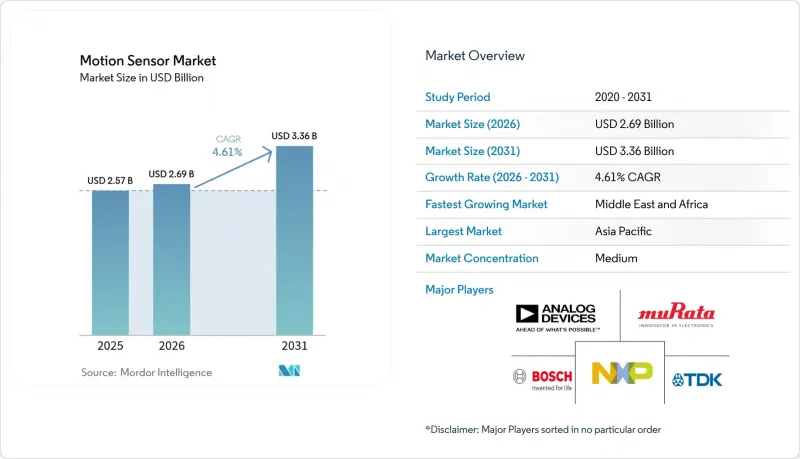
Mordor Intelligence에 의하면, 모션 센서 시장 규모는 2025년 25억 7,000만 달러로 평가되었습니다. 2026년에는 26억 9,000만 달러로 확대되어 2026년부터 2031년에 걸쳐 CAGR 4.61%로 성장을 지속하여, 2031년에는 33억 6,000만 달러에 이를 것으로 예측됩니다.
본 보고서는 기술별(초음파, 마이크로파, 적외선 등), 기능 수준별(완전 자동, 반자동),내장형 센서 유형별(가속도계, 자이로스코프, 자력계 등), 용도별(소비자용 전자기기, 자동차 및 운송, 헬스케어 및 의료기기, 조명 제어 등), 지역별로 분류되어 있습니다. 시장 예측은 금액(미화) 기준으로 제시되어 있습니다.
세계의 모션 센서 시장 동향 및 인사이트
자동차 및 모바일 기기에서의 MEMS 보급
규제 당국은 첨단 운전자 지원 기능에 관한 장기적인 로드맵을 수립하고 있으며, 기능이 추가될 때마다 더 많은 관성 센싱이 필요하게 됩니다. 미국 도로교통안전국(NHTSA)이 2024년에 사각지대 감지, 차선 유지, 보행자 자동 제동 기능에 대한 차량 평가 기준을 수립함에 따라, 신형 모델이 출시될 때마다 모션 센싱 기능의 탑재가 더욱 확대될 것이 확실해졌습니다. 한편, 스마트폰 제조업체들은 증강현실(AR) 인터페이스와 제스처 제어를 구현하기 위해 여러 개의 MEMS 센서를 탑재하고 있으며, 이로 인해 수요 주기가 겹치게 되어 공급업체들은 특정 부문 수요 둔화 영향을 완화할 수 있습니다. 수직 통합형 칩 제조업체는 핵심 센서 요소를 재설계할 필요 없이, 자동차용과 모바일용 생산 라인 간에 파운드리 생산 능력을 유연하게 배분할 수 있기 때문에 가장 큰 혜택을 보고 있습니다. 차량용 컴퓨팅 아키텍처의 통합으로 인해 향후 10년 후반에는 총 출하 대수가 억제될 가능성이 있지만, 기기당 복잡성이 높아짐에 따라 출하 대수 감소는 상쇄될 전망입니다.
모션 지원 게임 및 AR/VR의 급증
몰입형 게임 플랫폼에는 1밀리초 미만의 추적 정밀도가 요구됩니다. 2025년 조사에 따르면, 음향 주입 공격으로 인해 주요 헤드셋의 관성 측정 장치가 오작동하여 가상 컨텐츠가 왜곡되거나 멀미를 유발할 가능성이 있습니다. 이러한 취약성으로 인해 중복 센서 어레이와 안전한 융합 알고리즘에 대한 수요가 증가하면서 부품표(BOM)의 총 가치가 상승하고 있습니다. 풍부한 햅틱 기능을 갖춘 콘솔용 액세서리로 대표되는 컨트롤러 공급업체들은 이미 가속도계, 자이로스코프, 정전용량식 터치 센서를 조합하여 현실감을 높이고 있습니다. 혼합 현실(MR)의 도입이 기업 교육 및 현장 유지보수 분야로 확대됨에 따라, 모션 센서 시장은 소비자 소비 주기의 영향을 덜 받는 다양한 고객 기반을 확보하고 있습니다.
고급 MEMS 대체 기술의 높은 비용
포토닉 및 양자 규모의 모션 센서는 정확도를 10배 향상시킬 잠재력을 가지고 있지만, 대량 도입에는 아직 비용 면에서 몇 가지 장벽이 남아 있습니다. 패키징의 복잡성과 공통된 시험 기준의 부재로 인해 단가가 상승하고 있어, 범용 스마트 조명이나 저가 가전제품 라인에의 채택을 방해하고 있습니다. 연구 그룹은 정확도를 유지하면서 생산 시 조정 공정을 10초 미만으로 단축하는 머신러닝 기반의 보정 기법을 추구하고 있습니다. 그러나 본격적인 상용화를 위해서는 여러 센서 제품군에 걸쳐 설비 투자를 상각할 수 있는 공유 제조 인프라가 필수적입니다.
부문별 분석
수동형 적외선 장치는 저비용이며 조명 자동화 분야에서 입증된 신뢰성을 갖추고 있어, 2025년 모션 센서 시장 규모의 35.10%를 차지했습니다. 레이더 기반 단층 촬영 시스템의 채택은 연평균 성장률(CAGR) 5.42%로 확대되고 있습니다. 이는 밀리파 칩이 첨단 자동차 안전 기능에 필요한 물질 투과성과 물체 분류의 이점을 제공하기 때문입니다.
저예산 보안 설비의 경우 적외선 제품의 출하 대수가 여전히 높은 수준을 유지하고 있지만, 고급 주택용 키트에서는 레이더와 PIR을 융합한 멀티 테크놀로지 노드가 등장하고 있습니다. 또한, 연구소에서는 MEMS 자이로스코프를 위한 세분화된 열 보정 개선이 진행되고 있으며, 온도 변동에 따른 드리프트를 줄임으로써 하이엔드 로봇 공학에서의 사용 범위를 확대되고 있습니다. 초기 시험 단계에 있는 포토닉 간섭 센서는 패키징상의 장벽이 해소된다면, 궁극적으로 레이더와 적외선 모두에 혁신을 가져올 가능성이 있습니다.
2025년에는 완전 자동 시스템이 55.70%의 점유율을 차지했습니다. 이는 사람의 조작 없이 조명, 공조 또는 운전 지원을 최적화하는 ‘설치 후 방치해도 되는’ 유형의 기기에 대한 구매자들의 선호 경향을 반영한 것입니다. 이 부문의 연평균 성장률(CAGR)은 4.95%로, 자체 학습 알고리즘을 통해 시운전 노력을 줄여주는 스마트 빌딩 개조 공사의 확대에 힘입고 있습니다.
수동 오버라이드가 필요한 산업용 라인에서는 반자동 설계가 여전히 주류를 이루고 있지만, AI를 활용한 자동 보정이 점차 도입됨에 따라 설정 시간은 단축되고 있습니다. 현재 센서에 내장된 엣지 추론 엔진 덕분에 지연 시간이 수백 밀리초에서 한 자릿수 밀리초로 단축되어, 공장 현장의 협동 로봇에 대한 더 엄격한 안전 기준을 충족하고 있습니다.
지역별 분석
2025년, 아시아태평양은 모션 센서 시장 매출의 36.95%를 차지했습니다. 이는 중국, 일본, 한국의 긴밀한 전자 부품 공급망에 힘입은 결과입니다. 현지 반도체 제조 공장은 벌크 CMOS 및 웨이퍼 레벨 칩 스케일 패키징을 전문으로 하고 있으며, 이를 통해 이 지역의 OEM 기업들은 단기간에 다수의 센서가 탑재된 새로운 모바일 기기를 시장에 출시할 수 있게 되었습니다. 일본과 한국에서 첨단 운전자 보조 시스템(ADAS)에 대한 규제적 추진은 기초적인 수요를 더욱 강화하고 있습니다.
북미와 유럽은 대량 생산 거점이라기보다는 여전히 기술의 선도자 역할을 수행하고 있습니다. 미국 ‘신차 평가 프로그램(NCAP)’의 개정에 따라 자동차 제조업체는 사각지대 감지, 차선 유지, 보행자용 제동 기능을 탑재해야 할 의무가 부과되었으며, 이로 인해 관성 센서 콤보 및 레이더 서브시스템에 대한 수요가 향후 수년간 증가할 것으로 확실시되고 있습니다. 유럽의 ‘일반 안전 규정 II(GSR II)’도 2024년 중반 이후 판매되는 신차 모델에 대해 유사한 요건을 부과하고 있어, 성숙한 두 시장 수요를 일치시키고 있습니다.
중동 및 아프리카는 현재로서는 시장 점유율 기여도가 미미하지만, 걸프 국가들의 스마트 시티 예산에서 지능형 조명, 보안, 교통 모니터링 인프라가 우선시됨에 따라 2031년까지 연평균 5.04% 성장할 것으로 예측됩니다. 가혹한 사막 기후에 적합한 광범위 대응 모션 센서는 대규모 주변 경비 시설 및 고속 교통 프로젝트에서 보급이 확대되고 있습니다. 현지 조립 파트너십은 수입 관세 회피 및 지역 내 현지 조달 규정 준수에 도움이 되고 있습니다.
기타 혜택 :
- 엑셀 형식 시장 예측(ME) 시트
- 3개월간의 애널리스트 지원
자주 묻는 질문
목차
제1장 서론
제2장 조사 방법
제3장 개요
제4장 시장 구도
제5장 시장 규모 및 성장 예측
제6장 경쟁 구도
제7장 시장 기회 및 향후 전망
KTH 26.08.31According to Mordor Intelligence, the motion sensor market size is expected to grow from USD 2.57 billion in 2025 to USD 2.69 billion in 2026 and is forecast to reach USD 3.36 billion by 2031 at 4.61% CAGR over 2026-2031.
This report is Segmented by Technology (Ultrasonic, Microwave, Infrared, and More), Functionality Level (Fully Automatic, and Semi-Automatic), Embedded Sensor Type (Accelerometer, Gyroscope, Magnetometer, and More), Application (Consumer Electronics, Automotive and Transportation, Healthcare and Medical Devices, Lighting Control and More), and Geography. The Market Forecasts are Provided in Terms of Value (USD).
Global Motion Sensor Market Trends and Insights
MEMS Penetration in Automotive and Mobile Devices
Regulators have locked in long-range roadmaps for advanced driver assistance functions, and each incremental feature requires added inertial sensing. The National Highway Traffic Safety Administration's 2024 decision to rate vehicles on blind-spot, lane-keeping, and pedestrian automatic braking incentives ensures that each new model refresh carries more motion sensing content.Smartphone vendors meanwhile embed multiple micro-electro-mechanical sensors to power augmented reality interfaces and gesture controls, creating overlapping demand cycles that cushion suppliers from sector-specific slowdowns. Vertically integrated chipmakers benefit most because they can shift foundry capacity between automotive and mobile runs without redesigning core sensor elements. Centralized vehicle compute architectures may temper total unit volumes later in the decade, yet higher per-device complexity should offset any volume erosion.
Surge in Motion-Enabled Gaming and AR/VR
Immersive gaming platforms need sub-millisecond tracking accuracy; a 2025 study showed that acoustic injection attacks can mislead inertial measurement units in leading headsets, distorting virtual content and inducing motion sickness These vulnerabilities spur demand for redundant sensor arrays and secure fusion algorithms that raise overall bill-of-materials value. Controller vendors, exemplified by haptic-rich console accessories, already combine accelerometers, gyroscopes, and capacitive touch to improve realism. As mixed-reality adoption spreads to enterprise training and field maintenance, the motion sensor market gains a diversified customer base that is less tied to consumer spending cycles.
High Cost of Advanced MEMS Alternatives
Photonic and quantum-scale motion sensors promise ten-fold precision gains but remain several cost curves away from high-volume deployment. Packaging complexity and lack of common test standards inflate per-unit pricing, deterring adoption in commodity smart-lighting and budget appliance lines. Research groups are pursuing machine-learning-based calibration schemes that reduce production tuning steps to under 10 seconds while maintaining accuracy. Widespread commercialization, however, depends on shared manufacturing infrastructure that can amortize capital outlays across multiple sensor families.
Other drivers and restraints analyzed in the detailed report include:
- Smart-Home and Building-Automation Rollout
- Edge-AI Ultra-Low-Power Sensor Innovations
- Semiconductor Supply-Chain Bottlenecks
For complete list of drivers and restraints, kindly check the Table Of Contents.
Segment Analysis
Passive infrared devices held 35.10% share of the motion sensor market size in 2025 due to low cost and proven reliability in lighting automation. Adoption of radar-based tomographic systems is growing at a 5.42% CAGR because millimeter-wave chips offer material penetration and object-classification advantages needed for advanced automotive safety.
Infrared shipments remain high for budget security installations, but multi-technology nodes that blend radar with PIR are emerging in premium residential kits. Laboratories are also refining segmented thermal calibration for MEMS gyroscopes, trimming drift across temperature swings and thereby widening usable ranges for high-end robotics. Photonic interference sensors under early trial could eventually disrupt both radar and infrared if packaging barriers fall.
Fully automatic systems commanded 55.70% share in 2025, reflecting buyer preference for "install-and-forget" devices that optimize lighting, HVAC, or driver assistance without human input. The segment's 4.95% CAGR rests on expanding smart-building retrofits where self-learning algorithms reduce commissioning labor.
Semi-automatic designs endure in industrial lines requiring manual overrides, yet the gradual rollout of AI-enabled auto-calibration trims their configuration time. Edge inference engines now embedded in sensors shrink latency from hundreds of milliseconds to single-digit milliseconds, meeting stricter safety thresholds for collaborative robots on factory floors.
Complete Report Scope:
- By Technology
- Ultrasonic
- Microwave
- Infrared (PIR)
- Dual/Hybrid
- Radar/Tomographic
- By Functionality Level
- Fully Automatic
- Semi-Automatic
- By Embedded Sensor Type
- Accelerometer
- Gyroscope
- Magnetometer
- Combo/IMU (6-axis, 9-axis)
- Pressure/Barometric
- By Application
- Consumer Electronics
- Automotive and Transportation
- Healthcare and Medical Devices
- Security and Surveillance
- Lighting Controls
- Smart Home and Building Automation
- Industrial and Robotics
- Gaming and Entertainment
- Other Applications
- By Geography
- North America
- United States
- Canada
- Mexico
- South America
- Brazil
- Argentina
- Rest of South America
- Europe
- Germany
- France
- United Kingdom
- Italy
- Spain
- Russia
- Rest of Europe
- Asia-Pacific
- China
- Japan
- South Korea
- India
- South East Asia
- Rest of Asia-Pacific
- Middle East and Africa
- GCC
- Turkey
- South Africa
- Rest of Middle East and Africa
- North America
Geography Analysis
Asia-Pacific generated 36.95% of motion sensor market revenue in 2025, enabled by dense electronics supply chains in China, Japan, and South Korea. Local fabs specialize in bulk CMOS and wafer-level chip-scale packaging, allowing regional OEMs to launch new sensor-rich mobile devices on compressed timelines. Regulatory pushes for advanced driver assistance systems in Japan and South Korea further reinforce baseline demand.
North America and Europe remain technology pace-setters rather than high-volume production centers. The U.S. New Car Assessment Program revisions obligate automakers to integrate blind-spot detection, lane-keeping, and pedestrian braking, guaranteeing a multi-year uplift for inertial combos and radar subsystems. Europe's General Safety Regulation II places similar requirements on new car models sold from mid-2024 onward, synchronizing demand across both mature markets.
The Middle East & Africa, though only a modest share contributor today, is projected to grow at 5.04% annually to 2031 as Gulf smart-city budgets prioritize intelligent lighting, security, and traffic-monitoring infrastructure. Broad-spectrum motion sensors suited to harsh desert climates gain traction in large-scale perimeter security installations and rapid-transit projects. Local assembly partnerships help circumvent import tariffs and align with regional content rules.
- Analog Devices Inc.
- NXP Semiconductors N.V.
- STMicroelectronics N.V.
- TE Connectivity Ltd.
- Panasonic Corp.
- Murata Manufacturing Co. Ltd.
- Honeywell International Inc.
- Bosch Sensortec GmbH
- TDK (InvenSense) Corp.
- KEMET Corp.
- Infineon Technologies AG
- Texas Instruments Inc.
- Sony Group Corp. (IMX sensors)
- Qualcomm Technologies Inc.
- Sensirion AG
- Alps Alpine Co. Ltd.
- MEMSIC Inc.
- Asahi Kasei Microdevices (AKM)
- ON Semiconductor Corp.
- Epson Toyo Yuden
Additional Benefits:
- The market estimate (ME) sheet in Excel format
- 3 months of analyst support
TABLE OF CONTENTS
1 INTRODUCTION
- 1.1 Study Assumptions and Market Definition
- 1.2 Scope of the Study
2 RESEARCH METHODOLOGY
3 EXECUTIVE SUMMARY
4 MARKET LANDSCAPE
- 4.1 Market Overview
- 4.2 Market Drivers
- 4.2.1 MEMS penetration in automotive and mobile devices
- 4.2.2 Surge in motion-enabled gaming and AR/VR
- 4.2.3 Smart-home and building-automation rollout
- 4.2.4 Wearable and IoT sensor fusion demand
- 4.2.5 Edge-AI ultra-low-power sensor innovations
- 4.2.6 ADAS-mandate-led demand for inertial combos
- 4.3 Market Restraints
- 4.3.1 High cost of advanced MEMS alternatives
- 4.3.2 Semiconductor supply-chain bottlenecks
- 4.3.3 Privacy backlash against ubiquitous sensing
- 4.3.4 Calibration drift in multi-axis combo IMUs
- 4.4 Industry Ecosystem Analysis
- 4.5 Technological Outlook
- 4.6 Porter's Five Forces Analysis
- 4.6.1 Threat of New Entrants
- 4.6.2 Bargaining Power of Buyers
- 4.6.3 Bargaining Power of Suppliers
- 4.6.4 Threat of Substitutes
- 4.6.5 Competitive Rivalry
5 MARKET SIZE AND GROWTH FORECASTS (VALUES)
- 5.1 By Technology
- 5.1.1 Ultrasonic
- 5.1.2 Microwave
- 5.1.3 Infrared (PIR)
- 5.1.4 Dual/Hybrid
- 5.1.5 Radar/Tomographic
- 5.2 By Functionality Level
- 5.2.1 Fully Automatic
- 5.2.2 Semi-Automatic
- 5.3 By Embedded Sensor Type
- 5.3.1 Accelerometer
- 5.3.2 Gyroscope
- 5.3.3 Magnetometer
- 5.3.4 Combo/IMU (6-axis, 9-axis)
- 5.3.5 Pressure/Barometric
- 5.4 By Application
- 5.4.1 Consumer Electronics
- 5.4.2 Automotive and Transportation
- 5.4.3 Healthcare and Medical Devices
- 5.4.4 Security and Surveillance
- 5.4.5 Lighting Controls
- 5.4.6 Smart Home and Building Automation
- 5.4.7 Industrial and Robotics
- 5.4.8 Gaming and Entertainment
- 5.4.9 Other Applications
- 5.5 By Geography
- 5.5.1 North America
- 5.5.1.1 United States
- 5.5.1.2 Canada
- 5.5.1.3 Mexico
- 5.5.2 South America
- 5.5.2.1 Brazil
- 5.5.2.2 Argentina
- 5.5.2.3 Rest of South America
- 5.5.3 Europe
- 5.5.3.1 Germany
- 5.5.3.2 France
- 5.5.3.3 United Kingdom
- 5.5.3.4 Italy
- 5.5.3.5 Spain
- 5.5.3.6 Russia
- 5.5.3.7 Rest of Europe
- 5.5.4 Asia-Pacific
- 5.5.4.1 China
- 5.5.4.2 Japan
- 5.5.4.3 South Korea
- 5.5.4.4 India
- 5.5.4.5 South East Asia
- 5.5.4.6 Rest of Asia-Pacific
- 5.5.5 Middle East and Africa
- 5.5.5.1 GCC
- 5.5.5.2 Turkey
- 5.5.5.3 South Africa
- 5.5.5.4 Rest of Middle East and Africa
- 5.5.1 North America
6 COMPETITIVE LANDSCAPE
- 6.1 Market Concentration
- 6.2 Strategic Moves
- 6.3 Market Share Analysis
- 6.4 Company Profiles (includes Global level Overview, Market level overview, Core Segments, Financials as available, Strategic Information, Market Rank/Share for key companies, Products and Services, and Recent Developments)
- 6.4.1 Analog Devices Inc.
- 6.4.2 NXP Semiconductors N.V.
- 6.4.3 STMicroelectronics N.V.
- 6.4.4 TE Connectivity Ltd.
- 6.4.5 Panasonic Corp.
- 6.4.6 Murata Manufacturing Co. Ltd.
- 6.4.7 Honeywell International Inc.
- 6.4.8 Bosch Sensortec GmbH
- 6.4.9 TDK (InvenSense) Corp.
- 6.4.10 KEMET Corp.
- 6.4.11 Infineon Technologies AG
- 6.4.12 Texas Instruments Inc.
- 6.4.13 Sony Group Corp. (IMX sensors)
- 6.4.14 Qualcomm Technologies Inc.
- 6.4.15 Sensirion AG
- 6.4.16 Alps Alpine Co. Ltd.
- 6.4.17 MEMSIC Inc.
- 6.4.18 Asahi Kasei Microdevices (AKM)
- 6.4.19 ON Semiconductor Corp.
- 6.4.20 Epson Toyo Yuden
7 MARKET OPPORTUNITIES AND FUTURE OUTLOOK
- 7.1 White-space and Unmet-need Assessment


