

|
시장보고서
상품코드
2116038
고등교육 학습 시스템 : 시장 점유율 분석, 업계 동향과 통계, 성장 예측(2026-2031년)Higher Education Learning Systems - Market Share Analysis, Industry Trends & Statistics, Growth Forecasts (2026 - 2031) |
||||||
 Mordor Intelligence
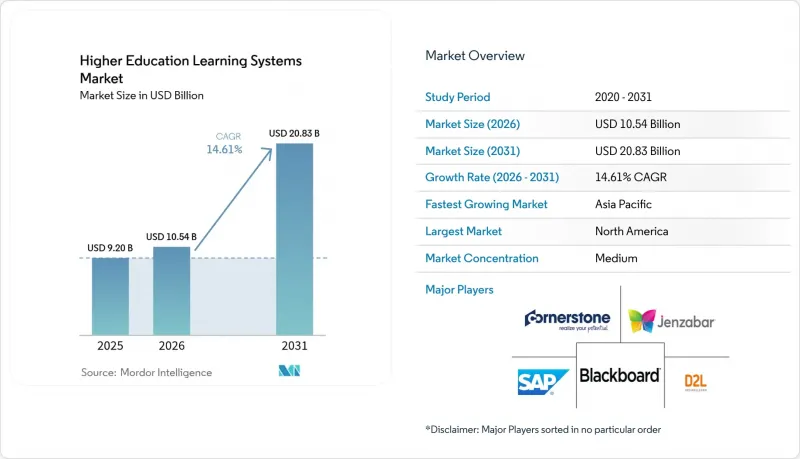
Mordor Intelligence에 따르면 고등교육 학습 시스템 시장 규모는 2025년에 92억 달러로 평가되며, 2026년에는 105억 4,000만 달러에 달하고, 예측 기간(2026-2031년) 동안 CAGR 14.61%로 성장하여, 2031년까지 208억 3,000만 달러에 달할 것으로 추정됩니다.
본 보고서는 유형(소프트웨어 및 서비스), 도입 모델(클라우드 및 온프레미스), 교육 기관 유형(주립 대학, 사립 대학, 커뮤니티 칼리지), 학습 형태(강사 주도형, 자기 주도형, 하이브리드/블렌디드형), 및 지역(아메리카, 유럽, 아시아태평양, 기타)별로 분류되어 있습니다. 시장 전망은 금액(달러) 기준으로 제시되어 있습니다.
세계 고등교육 학습 시스템 시장의 동향 및 인사이트
고등교육 기관에서의 ‘클라우드 퍼스트’ 전략 확대
대학에서는 자본 지출을 줄이고 가동 시간을 늘리며 기능 출시 주기를 단축하는 유연한 SaaS 환경을 우선시하기 위해 온프레미스 데이터센터를 폐지하는 움직임이 진행되고 있습니다. Internet2의 NET+ 조사에 따르면, 회원 기관의 78%가 2024년 중반까지 적어도 하나의 주요 학술 시스템을 클라우드로 이전했으며, 이는 2022년의 54%에서 증가한 수치입니다. 호주의 NCRIS 기금은 클라우드 전환의 주요 단계 달성을 위해 7억 5,000만 호주 달러(4억 8,800만 달러)를 지원하며, 이는 해당 부문 전반의 도입 가속화를 뒷받침하고 있습니다. 또한 클라우드 플랫폼은 온프레미스 환경에서는 대응하기 어려운 협업 서비스 및 AI 서비스와의 통합을 효율화합니다. 규정 준수 요구도 이러한 추세를 강화하고 있으며, 고등교육 기관 고객을 확보하려는 벤더들에게 ISO/IEC 27001 인증은 사실상 필수 요건이 되어 가고 있습니다. 이러한 요인들이 결합되어 단기적으로는 고등교육용 학습 시스템 시장의 연평균 성장률(CAGR)에 3퍼센트 포인트 이상의 기여를 하고 있습니다.
AI를 활용한 적응형 학습 도구의 보급
AI를 활용한 개인화는 시범 단계를 넘어 본 운영 환경으로 확대되어 수료율 향상에 기여하고 있습니다. 텔아비브 대학의 TAUDT 시스템은 자연어로 생성된 학습 계획을 통해 2024년에 STEM 분야 1학년 학생들의 중도 탈락률을 12% 감소시켰습니다. 피어슨의 AI 튜터는 같은 해 120만 건의 적응형 평가를 실시하여 보충 수학 과목의 합격률을 15% 끌어올렸습니다. 2025년 초, 캘리포니아 대학교는 위험에 처한 학생을 식별하기 위한 예측형 조기 경보 시스템을 전교적으로 도입하여 AI의 적용 범위를 28만 5,000명의 학습자로 확대했습니다. 이러한 성공 사례를 계기로 플랫폼 공급업체들은 기계 학습 API를 기본적으로 통합하기 시작했으며, 중기적으로는 연평균 성장률(CAGR)을 약 3퍼센트 포인트 끌어올리는 동시에 알고리즘의 투명성과 IEEE를 준수하는 윤리에 대한 논의도 활발해지고 있습니다.
사이버 보안 및 데이터 개인정보 보호 규정 준수 비용의 급증
FERPA 및 GDPR 감사가 강화됨에 따라, 2024년 교육 기관 1곳당 보안 지출의 중앙값은 120만 달러에 달하여 2022년 대비 23% 증가했습니다. 유럽의 대학들은 2023년에 GDPR에 근거한 12억 유로의 벌금에 직면하여 긴급한 예산 재분배를 단행해야 했습니다. 캘리포니아 대학교는 2024년 정보 유출 사고를 계기로 랜섬웨어 복구 및 모니터링에 1,400만 달러를 투자했습니다. 이러한 비용은 혁신에 투입될 자금을 압박하며, 단기적으로는 성장률을 2퍼센트 포인트 이상 끌어내리는 요인이 되고 있습니다.
부문별 분석
컨설팅, 통합, 교육, 관리형 지원을 포함한 서비스 매출은 2031년까지 연평균 성장률(CAGR) 15.94%로 증가할 것으로 예상되며, 2025년 지출의 68.74%를 차지했던 소프트웨어 분야를 넘어설 전망입니다. 각 기관은 플랫폼 도입을 ‘변혁 관리 프로세스’로 인식하는 경향이 강해지고 있으며, 레거시 콘텐츠 마이그레이션, 싱글 사인온(SSO) 설정, 맞춤형 분석 레이어 구축을 위해 통합 전문업체를 활용하고 있습니다. 액센츄어의 고등교육 부문은 FERPA 및 GDPR 규제 요건을 준수하는 클라우드 마이그레이션 로드맵에 대한 수요에 힘입어 2024년에 19%의 성장을 기록했습니다. 서비스 제공업체들이 학생 유지율 향상 및 비용 절감 효과를 정량화하고, 기술을 단순한 조달 체크리스트가 아닌 성과를 창출하는 원동력으로 자리매김함에 따라 고등교육 학습 시스템 시장은 그 혜택을 누리고 있습니다.
지속적인 관리형 서비스 계약은 인력이 제한된 캠퍼스 IT 팀의 부담을 덜어주고, 규정 준수를 위한 패치가 예정대로 적용되도록 보장합니다. AI를 활용한 개별 지도, 표절 탐지 또는 접근성 개선을 전문으로 하는 틈새 기업들은 고등교육 학습 시스템 업계를 특징짓는 개방형 API를 활용하여 수익화를 도모하고 있습니다. 예측 기간 동안 각 교육 기관은 졸업률, 학점 취득 속도, 취업률과 같은 증거 기반의 ROI 지표를 중시하며, 보다 심층적인 컨설팅 계약을 촉진할 것입니다. 그 결과, 2031년까지 서비스 부문이 고등교육 학습 시스템 시장에서 점점 더 큰 점유율을 차지할 것으로 전망됩니다.
2025년 기준, 클라우드 도입은 고등교육 학습 시스템 시장의 72.36%를 차지하고 있으며, 신규 조달에서 SaaS가 표준으로 자리 잡음에 따라 2031년까지 연평균 성장률(CAGR) 15.89%로 성장할 것으로 예상됩니다. 에든버러 대학은 2025년에 3년에 걸친 AWS로의 전환을 완료하여 연간 180만 파운드(230만 달러)의 비용 절감을 실현하는 동시에, 피크 시간대의 부하에 대한 확장성을 원활하게 했습니다. FedRAMP, ISO/IEC 27001 및 이와 유사한 인증은 현재 최소한의 진입 요건이 되었으며, 기밀성이 높은 학생 데이터를 오프프레미스로 저장하는 것에 대한 신뢰를 높이고 있습니다. 멀티테넌트 설계 덕분에 공급업체는 캠퍼스 가동 중단 시간 없이 기능 업데이트를 배포할 수 있어, 고등교육 학습 시스템 시장 전체의 혁신 주기가 단축되고 있습니다.
데이터 보관 장소에 관한 법규로 인해 로컬 스토리지가 의무화되어 있거나, 구형 조사용 컴퓨팅 클러스터가 캠퍼스 내에 남아 있는 경우 등에는 여전히 하이브리드 모델이 채택되고 있습니다. 그렇지만 신중한 기관이라 할지라도 버스트 워크로드를 관리하기 위해 동영상 트랜스코딩 등 계산 부하가 높은 작업을 퍼블릭 클라우드로 오프로드하고 있습니다. 유지보수 기간 단축, 예측 가능한 구독 가격, 패치 적용 자동화 덕분에 클라우드의 보급 추세가 확고해졌으며, 고등교육 학습 시스템 시장에서 클라우드의 점유율은 꾸준히 확대되고 있습니다.
지역별 분석
북미는 2025년, 대규모 주립 대학 시스템, 사립 대학의 기금 지출, 그리고 견조한 IT 예산에 힘입어 전 세계 매출의 39.72%를 차지했습니다. 플랫폼 보급이 성숙 단계에 접어들면서 지역의 연평균 성장률(CAGR)은 완만하지만, 지속적인 리프레시 주기와 분석 기능의 업그레이드로 인해 꾸준한 성장이 유지되고 있습니다. 또한, FERPA(교육 기록 개인정보 보호법)의 엄격한 준수 의무와 빈번하게 발생하는 랜섬웨어 공격 역시 사이버 보안에 대한 지속적인 지출을 촉진하여 새로운 서비스 기회를 창출하고 있습니다.
아시아태평양은 중국과 인도가 국가 차원의 디지털화 계획을 추진하고 있는 만큼, 2031년까지 연평균 성장률(CAGR) 16.94%로 성장을 주도할 것으로 예측됩니다. 중국 교육부는 200개 대학을 현대화하기 위해 150억 위안(21억 달러)을 배정했으며, 2027년까지 클라우드 도입률 80%를 목표로 하고 있습니다. 인도의 ‘국가 교육 정책’은 2035년까지 총 취학률 50% 달성을 목표로 하고 있어, 온라인 교육 수용 능력을 대폭 확대해야 합니다. 동남아시아 국가 정부들도 이러한 모델을 참고하여 멀티테넌트 아키텍처를 활용해 다국어 사용자와 변동하는 대역폭 환경에 대응하고 있습니다.
유럽에서는 에라스무스(Erasmus)형 학생 교류와 벤더 심사 기준을 높이는 엄격한 GDPR 요건의 뒷받침을 받아 꾸준한 성장을 유지하고 있습니다. 영국 학생청(Office for Students)이 시행하는 9,200만 파운드 규모의 지원 프로그램은 자금 지원을 분석에 기반한 학생 유지율 향상과 연계하여 플랫폼 업그레이드를 촉진하고 있습니다. 남미에서는 진척도에 편차가 나타나고 있습니다. 브라질의 공립 대학은 LMS 플랫폼을 신속하게 도입하고 있는 반면, 소규모 경제권에서는 통신 환경 정비에 어려움을 겪고 있습니다. 중동에서는 사우디아라비아의 13억 달러 규모 ‘비전 2030’ 에드테크 계획이 주도하며, 경제 다각화를 도모하기 위해 스마트 캠퍼스 구축을 우선시하고 있습니다. 아프리카는 여전히 개발도상국 단계이지만, 원격 교육이 지방의 접근성 문제를 해결해 감에 따라 두 자릿수 성장을 기록하는 지역도 곳곳에서 나타나고 있습니다.
기타 혜택:
- 엑셀 형식의 시장 예측(ME) 시트
- 3개월간의 애널리스트 지원
자주 묻는 질문
목차
제1장 소개
제2장 조사 방법
제3장 주요 요약
제4장 시장 구도
제5장 시장 규모와 성장 예측
제6장 경쟁 구도
제7장 시장 기회와 향후 전망
KSM 26.08.26According to Mordor Intelligence, the higher education learning systems market size was valued at USD 9.20 billion in 2025 and estimated to grow from USD 10.54 billion in 2026 to reach USD 20.83 billion by 2031, at a CAGR of 14.61% during the forecast period (2026-2031).
This report is Segmented by Type (Software, and Services), Deployment Model (Cloud, and On-Premises), Institution Type (State Universities, Private Colleges, and Community Colleges), Learning Mode (Instructor-Led, Self-Paced, and Hybrid/Blended), and Geography (North America, South America, Europe, Asia Pacific, and More). The Market Forecasts are Provided in Terms of Value (USD).
Global Higher Education Learning Systems Market Trends and Insights
Increasing Cloud-First Strategies Among Higher-Ed Institutions
Universities are dismantling on-premises data centers in favor of elastic SaaS environments that compress capital outlays, expand uptime, and shorten feature-release cycles. Internet2's NET+ survey revealed that 78% of member institutions had transitioned at least one core academic system to the cloud by mid-2024, up from 54% in 2022. Australia's NCRIS fund tied AUD 750 million (USD 488 million) to cloud migration milestones, catalyzing accelerated adoption across the sector. Cloud platforms also streamline integrations with collaboration and AI services that on-premises stacks struggle to support. Compliance drivers reinforce momentum as ISO/IEC 27001 certification gains de facto status for vendors courting higher education clients. Collectively, these factors contribute more than three percentage points to the higher education learning systems market CAGR during the short term.
Proliferation of AI-Powered Adaptive Learning Tools
AI-driven personalization has moved beyond pilots, scaling across production environments to raise completion metrics. Tel Aviv University's TAUDT system lowered first-year STEM attrition by 12% in 2024 through natural-language-generated study plans. Pearson's AI tutor delivered 1.2 million adaptive assessments the same year, lifting remedial-math pass rates by 15%. In early 2025, the University of California deployed predictive early-warning systems system-wide to flag at-risk students, broadening AI reach to 285,000 learners. These successes spur platform vendors to embed machine-learning APIs natively, driving nearly three percentage points of incremental CAGR over the medium term while elevating conversations around algorithmic transparency and IEEE-aligned ethics.
Escalating Cybersecurity and Data-Privacy Compliance Costs
The median security spend per institution reached USD 1.2 million in 2024, a 23% increase from 2022, as FERPA and GDPR audits intensified. European universities faced EUR 1.2 billion in GDPR fines during 2023, driving emergency budget reallocations. The University of California invested USD 14 million in ransomware remediation and monitoring following the 2024 breach. These costs siphon funds from innovation and subtract more than two percentage points from growth during the near term.
Other drivers and restraints analyzed in the detailed report include:
- Government Digital-Campus Stimulus Packages
- Campus-Wide Demand for Learning Analytics Dashboards
- Skills Gap in EdTech Systems Administration
For complete list of drivers and restraints, kindly check the Table Of Contents.
Segment Analysis
Services revenue, including consulting, integration, training, and managed support, is projected to rise at a 15.94% CAGR through 2031, outstripping software, even though the latter captured 68.74% of 2025 spending. Institutions increasingly view platform rollouts as change-management journeys, engaging integrators to migrate legacy content, configure single sign-on, and build custom analytics layers. Accenture's higher-education practice grew 19% in 2024, driven by demand for cloud-migration roadmaps that align with FERPA and GDPR guardrails. The higher education learning systems market benefits as service providers quantify retention lifts and cost savings, repositioning technology as an outcome driver rather than a procurement checklist.
Ongoing managed-service contracts reduce strain on lean campus IT teams and ensure regulatory patches are applied on schedule. Niche firms specializing in AI-powered tutoring, plagiarism detection, or accessibility remediation monetize open APIs that characterize the higher education learning systems industry. Over the forecast period, institutions will emphasize evidence-based ROI metrics, such as graduation rates, credit completion velocity, and employability, encouraging deeper advisory engagements. As a result, services are set to command a growing slice of the higher education learning systems market by 2031.
Cloud deployments owned 72.36% of the higher education learning systems market in 2025 and are poised for a 15.89% CAGR through 2031 as SaaS becomes the default for new procurements. The University of Edinburgh completed a three-year migration to AWS in 2025, saving GBP 1.8 million (USD 2.3 million) annually while easing peak-load scaling. FedRAMP, ISO/IEC 27001, and similar attestations are now the minimum entry requirements, boosting confidence in the off-premises storage of sensitive student data. Multi-tenant designs allow vendors to push feature updates without campus downtime, shortening innovation cycles across the higher education learning systems market.
Hybrid models persist where data-residency statutes require local storage or where legacy research compute clusters remain on-site. Nonetheless, even cautious institutions offload compute-intensive tasks, such as video transcoding, to public clouds to manage burst workloads. Reduced maintenance windows, predictable subscription pricing, and automated patching cement cloud's trajectory, ensuring its share of the higher education learning systems market size widens steadily.
Complete Report Scope:
- By Type
- Software
- Services
- By Deployment Model
- Cloud
- On-Premises
- By Institution Type
- State Universities
- Private Colleges
- Community Colleges
- By Learning Mode
- Instructor-Led
- Self-Paced
- Hybrid/Blended
- By Geography
- North America
- United States
- Canada
- Mexico
- South America
- Brazil
- Argentina
- Rest of South America
- Europe
- Germany
- United Kingdom
- France
- Italy
- Spain
- Russia
- Rest of Europe
- Asia Pacific
- China
- Japan
- India
- South Korea
- Australia
- Rest of Asia Pacific
- Middle East and Africa
- Middle East
- Saudi Arabia
- United Arab Emirates
- Turkey
- Rest of Middle East
- Africa
- South Africa
- Nigeria
- Egypt
- Rest of Africa
- Middle East
- North America
Geography Analysis
North America generated 39.72% of global revenue in 2025, fueled by large state systems, private endowment spending, and robust IT budgets. Mature platform penetration moderates regional CAGR, yet ongoing refresh cycles and analytics upgrades sustain steady expansion. Stringent FERPA compliance obligations and frequent ransomware incidents also drive sustained cybersecurity spending, adding incremental service opportunities.
The Asia Pacific is forecast to lead growth at a 16.94% CAGR through 2031, as China and India deploy national digitization blueprints. China's Ministry of Education has earmarked CNY 15 billion (USD 2.1 billion) to modernize 200 universities, aiming for 80% cloud adoption by 2027. India's National Education Policy aims for a 50% gross enrollment rate by 2035, necessitating a massive expansion of online capacity. Southeast Asian governments emulate these models, leveraging multi-tenant architectures to support multilingual users and variable bandwidth conditions.
Europe maintains steady growth underpinned by Erasmus-style student mobility and strict GDPR mandates that elevate vendor vetting. The U.K. Office for Students' GBP 92 million grant program links funding to analytics-driven retention improvements, stimulating platform upgrades. South America shows uneven progress; Brazil's public universities adopt LMS platforms quickly, whereas smaller economies struggle with connectivity. The Middle East, led by Saudi Arabia's USD 1.3 billion Vision 2030 EdTech plan, prioritizes smart campus rollouts to diversify its economies. Africa remains nascent, yet it records pockets of double-digit growth as distance learning addresses rural access.
- Anthology Inc.
- Blackboard Inc.
- Cornerstone OnDemand Inc.
- Desire2Learn Corporation
- Ellucian Company L.P.
- Epignosis LLC
- IBM Corporation
- iSpring Solutions Inc.
- Instructure Holdings Inc.
- Jenzabar Inc.
- McGraw Hill LLC
- Moodle Pty Ltd.
- Oracle Corporation
- Pearson PLC
- SAP SE
- SumTotal Systems LLC
- The rSmart Group Inc.
- Unifyed LLC
- Workday Inc.
- Civitas Learning Inc.
Additional Benefits:
- The market estimate (ME) sheet in Excel format
- 3 months of analyst support
TABLE OF CONTENTS
1 INTRODUCTION
- 1.1 Study Assumptions and Market Definition
- 1.2 Scope of the Study
2 RESEARCH METHODOLOGY
3 EXECUTIVE SUMMARY
4 MARKET LANDSCAPE
- 4.1 Market Overview
- 4.2 Market Drivers
- 4.2.1 Increasing Cloud-First Strategies Among Higher-Ed Institutions
- 4.2.2 Proliferation of AI-Powered Adaptive Learning Tools
- 4.2.3 Government Digital-Campus Stimulus Packages
- 4.2.4 Rapid International Student Mobility Driving Multi-Tenant Architectures
- 4.2.5 Campus-Wide Demand for Learning Analytics Dashboards
- 4.2.6 Sustainability Mandates Pushing Paperless Workflows
- 4.3 Market Restraints
- 4.3.1 Escalating Cybersecurity and Data-Privacy Compliance Costs
- 4.3.2 Skills Gap in EdTech Systems Administration
- 4.3.3 Budget Freezes at Community Colleges
- 4.3.4 Vendor Lock-In Concerns Over Proprietary Ecosystems
- 4.4 Industry Value Chain Analysis
- 4.5 Regulatory Landscape
- 4.6 Technological Outlook
- 4.7 Impact of Macroeconomic Factors
- 4.8 Porter's Five Forces Analysis
- 4.8.1 Bargaining Power of Suppliers
- 4.8.2 Bargaining Power of Buyers
- 4.8.3 Threat of New Entrants
- 4.8.4 Threat of Substitute Products
- 4.8.5 Intensity of Competitive Rivalry
- 4.9 Higher Education Learning Systems Landscape
5 MARKET SIZE AND GROWTH FORECASTS
- 5.1 By Type
- 5.1.1 Software
- 5.1.2 Services
- 5.2 By Deployment Model
- 5.2.1 Cloud
- 5.2.2 On-Premises
- 5.3 By Institution Type
- 5.3.1 State Universities
- 5.3.2 Private Colleges
- 5.3.3 Community Colleges
- 5.4 By Learning Mode
- 5.4.1 Instructor-Led
- 5.4.2 Self-Paced
- 5.4.3 Hybrid/Blended
- 5.5 By Geography
- 5.5.1 North America
- 5.5.1.1 United States
- 5.5.1.2 Canada
- 5.5.1.3 Mexico
- 5.5.2 South America
- 5.5.2.1 Brazil
- 5.5.2.2 Argentina
- 5.5.2.3 Rest of South America
- 5.5.3 Europe
- 5.5.3.1 Germany
- 5.5.3.2 United Kingdom
- 5.5.3.3 France
- 5.5.3.4 Italy
- 5.5.3.5 Spain
- 5.5.3.6 Russia
- 5.5.3.7 Rest of Europe
- 5.5.4 Asia Pacific
- 5.5.4.1 China
- 5.5.4.2 Japan
- 5.5.4.3 India
- 5.5.4.4 South Korea
- 5.5.4.5 Australia
- 5.5.4.6 Rest of Asia Pacific
- 5.5.5 Middle East and Africa
- 5.5.5.1 Middle East
- 5.5.5.1.1 Saudi Arabia
- 5.5.5.1.2 United Arab Emirates
- 5.5.5.1.3 Turkey
- 5.5.5.1.4 Rest of Middle East
- 5.5.5.2 Africa
- 5.5.5.2.1 South Africa
- 5.5.5.2.2 Nigeria
- 5.5.5.2.3 Egypt
- 5.5.5.2.4 Rest of Africa
- 5.5.5.1 Middle East
- 5.5.1 North America
6 COMPETITIVE LANDSCAPE
- 6.1 Market Concentration
- 6.2 Strategic Moves
- 6.3 Market Share Analysis
- 6.4 Company Profiles (includes Global level Overview, Market level overview, Core Segments, Financials as available, Strategic Information, Market Rank/Share for key companies, Products and Services, and Recent Developments)
- 6.4.1 Anthology Inc.
- 6.4.2 Blackboard Inc.
- 6.4.3 Cornerstone OnDemand Inc.
- 6.4.4 Desire2Learn Corporation
- 6.4.5 Ellucian Company L.P.
- 6.4.6 Epignosis LLC
- 6.4.7 IBM Corporation
- 6.4.8 iSpring Solutions Inc.
- 6.4.9 Instructure Holdings Inc.
- 6.4.10 Jenzabar Inc.
- 6.4.11 McGraw Hill LLC
- 6.4.12 Moodle Pty Ltd.
- 6.4.13 Oracle Corporation
- 6.4.14 Pearson PLC
- 6.4.15 SAP SE
- 6.4.16 SumTotal Systems LLC
- 6.4.17 The rSmart Group Inc.
- 6.4.18 Unifyed LLC
- 6.4.19 Workday Inc.
- 6.4.20 Civitas Learning Inc.
7 MARKET OPPORTUNITIES AND FUTURE OUTLOOK
- 7.1 White-Space and Unmet-Need Assessment


