|
시장보고서
상품코드
2116041
유전체 바이오마커 : 시장 점유율 분석, 업계 동향과 통계, 성장 예측(2026-2031년)Genomic Biomarkers - Market Share Analysis, Industry Trends & Statistics, Growth Forecasts (2026 - 2031) |
||||||
 Mordor Intelligence
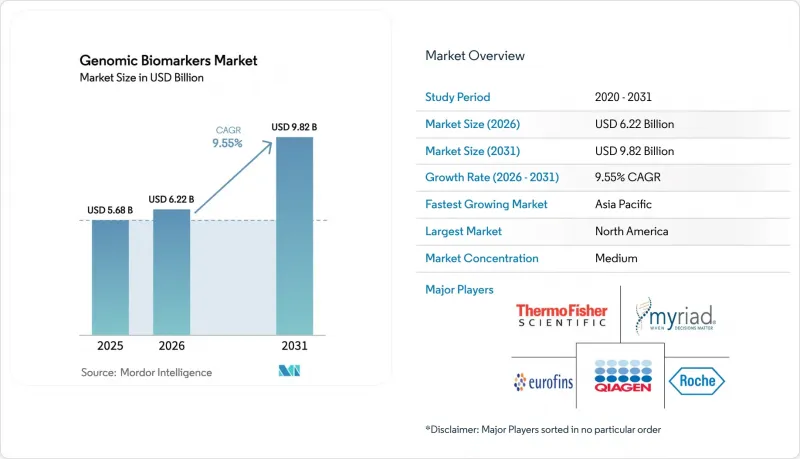
Mordor Intelligence에 따르면 유전체 바이오마커 시장 규모는 2025년에 56억 8,000만 달러, 2026년에 62억 2,000만 달러에 달하고, 2031년까지 98억 2,000만 달러에 달할 것으로 예측되며, 2026년부터 2031년까지 CAGR 9.55%로 성장할 것으로 전망됩니다.
본 보고서는 적응증(암, 심혈관질환, 신경 질환 등), 최종사용자(진단 검사 기관, 병원, 제약·바이오기술 기업, 기타), 기술 플랫폼(차세대 염기서열 분석, PCR, 마이크로어레이, 기타), 바이오마커 유형(예측적, 예후적) 및 지역별로 분류되어 있습니다. 시장 전망은 금액(달러) 기준으로 제시되어 있습니다.
세계 유전체 바이오마커 시장의 동향 및 인사이트
만성 질환 및 생활습관병 유병률 증가
암, 심혈관질환, 대사증후군은 전반적으로 조기 발견 및 맞춤형 치료 계획에 대한 수요를 주도하고 있습니다. 2024년에는 비감염성 질환이 전 세계 사망자의 74%를 차지했으며, 그중 암으로 인한 사망자 수는 1,000만 명에 육박했습니다. 미국 암 학회는 2026년에 미국에서 200만 명 이상의 신규 암 진단이 있을 것으로 예측하고 있으며, 이는 종양 프로파일링 및 체액 생검을 통한 모니터링에 대한 지속적인 수요를 뒷받침합니다. 현재 다유전자 위험 점수를 통해 발병 수십 년 전에 관상동맥 질환 위험이 높은 무증상 성인을 식별할 수 있게 되어, 예방적 스타틴 요법이나 생활 습관 개선이 가능해졌습니다. 이러한 도구의 이용 확대에 따라, 유전체 바이오마커 시장은 전문적인 종양학 영역을 넘어 일차 진료 및 공중보건 분야로 확대되고 있습니다. 스크리닝이 확산됨에 따라 일회성 진단 대신 정기적인 감시 검사가 주류를 이루게 되어, 서비스 제공업체의 장기적인 수익 전망이 밝아지고 있습니다.
NGS, 멀티오믹스, AI 바이오인포매틱스 분야의 획기적인 발전
시퀀싱 처리량은 2020년 이후 18개월마다 두 배로 증가하고 있으며, 일루미나의 NovaSeq X Plus는 현재 1회 실행당 16 Tb의 데이터를 전체 유전체 시퀀싱 비용 200달러 미만으로 제공하고 있습니다. 옥스포드 나노포어(Oxford Nanopore)의 적응형 샘플링 기술을 통해 급성기 의료 현장에서 결과 보고까지 걸리는 시간을 12시간 미만으로 단축하고 있습니다. 다양한 코호트를 통해 학습된 딥러닝 파이프라인은 병원성 변이 식별에서 94%의 민감도와 98%의 특이도를 달성하여, 기존 소프트웨어보다 11퍼센트 포인트 높은 수치를 보여주고 있습니다. 2025년, FDA는 PD-L1 단독 요법과 비교하여 무악화 생존 기간을 23% 개선한 최초의 멀티오믹스 검사를 승인하며, 통합 바이오마커에 대한 규제 당국의 지지를 보여주었습니다. 이러한 발전들이 결합되어 분석 시간이 단축되고 정확도가 향상되며 임상적으로 활용 가능한 신호가 밝혀짐에 따라, 유전체 바이오마커 시장이 확대되고 있습니다.
높은 검사 비용과 제3자 보험 지급의 불확실성
종합적인 유전체 프로파일링 가격은 여전히 3,000-5,800달러 범위이며, 이는 보험에 가입되지 않은 환자나 저·중소득 국가의 공공 의료 제도에서 이용을 제한하고 있습니다. Grail사의 949달러짜리 다중 암 조기 발견 검사는 메디케어 적용 대상이 아니기 때문에 해당 검사는 대상 미국 성인의 2% 미만이 이용할 수 있는 경영진용 웰니스 패키지로만 판매되고 있습니다. 민간 보험사는 지속적인 체액 생검 모니터링에 대한 사전 승인 신청의 약 18%를 기각하고 있어, 환자들은 장기간에 걸친 이의 제기나 본인 부담금을 감수해야만 합니다. 신흥 시장에서는 보험 환급 제도가 정비되어 있지 않아 도입이 주요 암 센터로 한정되어 있으며, 도시와 농촌 간의 격차가 확대되고 있습니다. 분기별 미세 잔류 병변 검사는 5년 동안 2만 달러 이상의 비용이 들 수 있으며, 이를 부담하는 지불자는 거의 없습니다.
부문별 분석
종양학 분야는 2025년 매출의 45.55%를 차지했습니다. 이는 EGFR, KRAS 및 HER2 상태를 표적 치료 선택과 연계하는 진료 지침에서 의무화한 유전체 프로파일링에 힘입은 결과입니다. 최소 잔류 병변(MRD)에 대한 지속적인 체액 생검은 수술 후 경과 관찰 기간 동안 암 환자 1인당 수익을 확대합니다. 심혈관 분야의 적용은 기반은 작지만, 리스크 점수가 연례 건강검진에 도입됨에 따라 연평균 성장률(CAGR) 13.85%라는 가장 빠른 성장세를 보이고 있습니다.
신경계, 신장, 자가면역 질환에 대한 적응증이 사업의 다각화에 기여하고 있습니다. 약리 유전체 패널은 우울증 관리에 있어 6주간의 시행착오 주기를 단축하고, 다발성 낭성 신장의 조기 유전체 식별을 통해 ACE 억제제 치료가 시작되어 신기능 저하를 지연시킵니다. 이러한 사용 사례가 성숙해짐에 따라, 비종양성 질환을 위한 유전체 바이오마커 시장 규모는 시장 규모 실적을 상회하는 속도로 확대될 전망이지만, 2031년까지 종양학이 여전히 총 수요의 절반을 차지할 것으로 예상됩니다.
진단 검사 기관은 CLIA 및 CAP 인증 자격과 검사 건당 비용을 30% 절감하는 규모의 경제를 활용하여 2025년 매출의 38.53%를 차지했습니다. 병원, 특히 대학 부속 병원에서는 급성 백혈병을 대상으로 신속 검사를 실시하여 72시간 이내의 진단 결정 기간을 충족하고 있습니다.
제약 및 생명공학 기업은 2024년 FDA의 종양학 의약품 승인 중 68%가 바이오마커에 의한 계층화된 피험자 등록을 필요로 했기 때문에 연평균 성장률(CAGR) 12.75%로 가장 빠르게 성장하는 채널이 되었습니다. CRO(의약품 개발 수탁 기관)는 재택형 임상시험 모델로 검사 범위를 확대하고 있으며, 지역 의료기관에서는 실세계 데이터(REW) 수집을 목적으로 검사 결과를 전자건강기록(EHR)에 직접 통합하고 있습니다. 이러한 동향은 여러 의료 현장에서의 검사 건수 증가를 촉진하며, 유전체 바이오마커 시장의 추가적인 확대로 이어지고 있습니다.
지역별 분석
북미는 2025년 매출의 38.55%를 차지하고 있으며, 그 기반이 되는 것은 3,500개가 넘는 CLIA 인증 분자 검사실과 ‘All of Us’ 포털을 통한 유전체 데이터의 조기 대중화입니다. 대규모 유전자 패널에 대한 공적 보험 적용과 활발한 민간 투자가 이 지역의 주도적 지위를 뒷받침하고 있습니다. 캐나다의 주립 암 프로그램에서는 현재 대부분의 전이성 사례에 대해 종합적인 프로파일링에 대한 보험 적용이 이루어지고 있어, 국내 검사 건수를 끌어올리고 있습니다.
유럽도 계속해서 큰 기여를 하고 있으며, 독일에서는 5억 유로 규모의 ‘국가 유전체 전략’의 일환으로 모든 연방주에 시퀀싱 센터가 설치되어 있습니다. NHS 유전체 의료 서비스에서는 연간 약 10만 건의 유전체 분석을 실시하고 있으며, 희귀질환의 진단 기간을 1년 미만으로 단축하고 있습니다. IVDR(체외진단용 의료기기 규정)과 관련된 지연이 있는 프랑스, 이탈리아, 스페인에서는 BRCA 및 유전성 암 검사의 보급률이 지속적으로 확대되고 있습니다.
아시아태평양은 중국의 ‘정밀 의료 이니셔티브’가 50곳의 시퀀싱 허브를 구축하고, 약리유전학을 국가 의약품 목록에 포함시킴에 따라 2031년까지 연평균 성장률(CAGR) 11.72%라는 가장 빠른 성장세를 기록할 것으로 예측됩니다. 인도는 2030년까지 100만 개의 유전체 분석을 목표로 하고 있는 반면, 일본은 2028년까지 500만 명의 국민을 대상으로 연례 건강검진 시 다유전자 점수 검사 비용을 보험 적용 대상으로 하고 있습니다. 호주와 한국도 국가 유전체 전략 및 집단 시퀀싱 이니셔티브를 통해 더욱 탄력을 받고 있습니다. 아랍에미리트(UAE), 사우디아라비아, 남아프리카공화국, 브라질에서 전개되고 있는 신생 프로그램들은 규모는 작지만 전 세계적인 확산의 조짐을 보이고 있으며, 이를 통해 개발도상 지역 전체에서 유전체 바이오마커 시장의 규모가 확대되고 있습니다.
기타 혜택:
- 엑셀 형식의 시장 예측(ME) 시트
- 3개월간의 애널리스트 지원
자주 묻는 질문
목차
제1장 소개
제2장 조사 방법
제3장 주요 요약
제4장 시장 구도
제5장 시장 규모와 성장 예측
제6장 경쟁 구도
제7장 시장 기회와 향후 전망
KSM 26.08.26According to Mordor Intelligence, the genomic biomarkers market size is projected to be USD 5.68 billion in 2025, USD 6.22 billion in 2026, and reach USD 9.82 billion by 2031, growing at a CAGR of 9.55% from 2026 to 2031.
This report is Segmented by Indication (Cancer, Cardiovascular Disorders, Neurological Disorders, and More), End User (Diagnostic Laboratories, Hospitals, Pharmaceutical & Biotechnology Companies, Others), Technology Platform (Next-Generation Sequencing, PCR, Microarray, Others), Biomarker Type (Predictive, Prognostic), and Geography. Market Forecasts are Provided in Terms of Value (USD).
Global Genomic Biomarkers Market Trends and Insights
Rising Prevalence of Chronic and Lifestyle Diseases
Cancer, cardiovascular disorders, and metabolic syndromes collectively drive demand for earlier detection and individualized treatment planning. Noncommunicable diseases caused 74% of global deaths in 2024, with cancer responsible for nearly 10 million fatalities. The American Cancer Society projects more than 2 million new U.S. cancer diagnoses in 2026, reinforcing sustained need for tumor profiling and liquid biopsy monitoring. Polygenic risk scores now flag asymptomatic adults at elevated risk of coronary artery disease decades before onset, enabling preventive statin therapy and lifestyle modification. Widening use of such tools extends the genomic biomarkers market beyond specialty oncology into primary care and population health. As screening broadens, recurring surveillance tests replace one-off diagnostics, strengthening long-term revenue visibility for service providers.
Breakthroughs in NGS, Multi-Omics and AI Bioinformatics
Sequencing throughput has doubled every 18 months since 2020, and Illumina's NovaSeq X Plus now delivers 16 Tb per run at sub-USD 200 whole genome cost. Oxford Nanopore adaptive sampling reduces turnaround to under 12 hours in acute settings. Deep learning pipelines trained on diverse cohorts achieve 94% sensitivity and 98% specificity for pathogenic variant calls, 11 percentage points above legacy software. In 2025, the FDA cleared the first multi-omic assay that improved progression-free survival by 23% versus PD-L1 alone, signaling regulatory support for integrative biomarkers. Collectively, these advances compress analysis time, boost accuracy, and unlock clinically actionable signals that expand the genomic biomarkers market.
High Test Cost and Uncertain Third-Party Reimbursement
Comprehensive genomic profiling remains priced between USD 3,000 and USD 5,800, limiting access for uninsured patients and for public systems in low- and middle-income countries. Grail's USD 949 multi-cancer early detection test lacks Medicare coverage, confining sales to executive wellness packages that touch fewer than 2% of eligible U.S. adults. Private insurers deny roughly 18% of prior authorizations for serial liquid biopsy monitoring, pushing patients toward lengthy appeals or out-of-pocket payment. In emerging markets, absent reimbursement narrows adoption to major cancer centers, widening urban-rural inequities. Quarterly minimal residual disease tests can cost more than USD 20,000 over five years, a burden few payers will shoulder.
Other drivers and restraints analyzed in the detailed report include:
- Mainstreaming of Precision-Medicine Reimbursement Models
- National Population Genomic-Screening Programs
- Stringent and Fragmented Regulatory Approval Pathways
For complete list of drivers and restraints, kindly check the Table Of Contents.
Segment Analysis
Oncology generated 45.55% of 2025 revenue, underpinned by guideline-mandated genomic profiling that links EGFR, KRAS, and HER2 status to targeted therapy selection. Serial minimal residual disease liquid biopsies extend revenue per oncology patient over post-surgery surveillance windows. Cardiovascular applications, though starting from a smaller base, show the fastest momentum with a 13.85% CAGR as risk scores enter annual wellness visits.
Neurologic, renal, and autoimmune indications add diversification. Pharmacogenomic panels shorten the six-week trial-and-error cycle in depression management, while early genomic identification of polycystic kidney disease triggers ACE inhibitor therapy that delays renal decline. As these use cases mature, the genomic biomarkers market size for non-oncology diseases will outpace historical averages, although oncology should still anchor half of total demand through 2031.
Diagnostic laboratories held 38.53% of 2025 revenue, leveraging CLIA and CAP credentials and economies of scale that lower per-test costs by 30%. Hospitals, particularly academic centers, run rapid-turnaround assays for acute leukemia, meeting sub-72-hour decision windows.
Pharma and biotech represent the fastest-growing channel at 12.75% CAGR as 68% of 2024 FDA oncology drug approvals required biomarker-stratified enrollment. CROs extend testing to home-based clinical trial models, and community practices integrate result feeds directly into EHRs for real-world evidence capture. These dynamics fortify volume growth across multiple care settings, further broadening the genomic biomarkers market.
Complete Report Scope:
- By Indication
- Cancer
- Cardiovascular Disorders
- Neurological Disorders
- Renal Disorders
- Auto-Immune & Inflammatory Diseases
- Others
- By End User
- Diagnostic Laboratories
- Hospitals
- Pharmaceutical & Biotechnology Companies
- Others
- By Technology Platform
- Next-Generation Sequencing
- PCR
- Microarray
- Others
- By Biomarker Type
- Predictive Biomarker
- Prognostic Biomarker
- By Geography
- North America
- United States
- Canada
- Mexico
- Europe
- Germany
- United Kingdom
- France
- Italy
- Spain
- Rest of Europe
- Asia-Pacific
- China
- India
- Japan
- Australia
- South Korea
- Rest of Asia-Pacific
- Middle East and Africa
- GCC
- South Africa
- Rest of Middle East and Africa
- South America
- Brazil
- Argentina
- Rest of South America
- North America
Geography Analysis
North America accounted for 38.55% of 2025 revenue, anchored by more than 3,500 CLIA-certified molecular labs and early consumer normalization of genomic data through the All of Us portal. Public reimbursement for large gene panels and prolific private investment sustain the region's leadership. Canada's provincial cancer programs now reimburse comprehensive profiling for most metastatic cases, boosting national volumes.
Europe remains a substantial contributor, with Germany's EUR 500 million National Genome Strategy earmarking sequencing centers in all federal states. The NHS Genomic Medicine Service completes roughly 100,000 genomes annually, trimming rare-disease diagnostic time to under one year. Despite IVDR-related delays, France, Italy, and Spain continue to expand BRCA and hereditary cancer testing penetration.
Asia-Pacific is projected to post the fastest growth at 11.72% CAGR through 2031 as China's Precision Medicine Initiative deploys 50 sequencing hubs and integrates pharmacogenomics into the national formulary. India targets 1 million genomes by 2030, while Japan reimburses polygenic scores in annual health checks for 5 million citizens by 2028. Australia and South Korea add further momentum with national genome frameworks and population sequencing initiatives. Emerging programs in the UAE, Saudi Arabia, South Africa, and Brazil grow from a smaller base yet signal widespread global adoption, collectively enlarging genomic biomarkers market size across developing regions.
- 23andMe Holding Co.
- Adaptive Biotechnologies Corp.
- Agilent Technologies
- Almac Group Ltd.
- BGI Genomics Co. Ltd.
- Bio-Rad Laboratories
- Cancer Genetics
- Caris Life Sciences Inc.
- Element Biosciences Inc.
- Eurofins
- Exact Sciences Corp.
- Roche
- Foundation Medicine Inc.
- Grail LLC
- Guardant Health
- Illumina
- Invitae
- Myriad Genetics
- Natera
- NeoGenomics Laboratories
- Oxford Nanopore Technologies
- Pacific Bioscience
- QIAGEN
- Tempus Labs Inc.
- Thermo Fisher Scientific
Additional Benefits:
- The market estimate (ME) sheet in Excel format
- 3 months of analyst support
TABLE OF CONTENTS
1 Introduction
- 1.1 Study Assumptions & Market Definition
- 1.2 Scope of the Study
2 Research Methodology
3 Executive Summary
4 Market Landscape
- 4.1 Market Overview
- 4.2 Market Drivers
- 4.2.1 Rising prevalence of chronic & lifestyle diseases
- 4.2.2 Breakthroughs in NGS, multi-omics & AI bio-informatics
- 4.2.3 Mainstreaming of precision-medicine reimbursement models
- 4.2.4 National population genomic-screening programmes
- 4.2.5 Employer-sponsored genetic-benefit plans in self-insured firms
- 4.2.6 Federated cloud learning accelerating rare-disease biomarker discovery
- 4.3 Market Restraints
- 4.3.1 High test cost & uncertain third-party reimbursement
- 4.3.2 Stringent & fragmented regulatory approval pathways
- 4.3.3 Algorithmic bias in polygenic-risk scores for non-European populations
- 4.3.4 Scarcity of validated digital-plus-genomic composite biomarkers
- 4.4 Supply-Chain Analysis
- 4.5 Regulatory Landscape
- 4.6 Technological Outlook
- 4.7 Porter's Five Forces
- 4.7.1 Threat of New Entrants
- 4.7.2 Bargaining Power of Buyers
- 4.7.3 Bargaining Power of Suppliers
- 4.7.4 Threat of Substitutes
- 4.7.5 Competitive Rivalry
5 Market Size & Growth Forecasts (Value, USD)
- 5.1 By Indication
- 5.1.1 Cancer
- 5.1.2 Cardiovascular Disorders
- 5.1.3 Neurological Disorders
- 5.1.4 Renal Disorders
- 5.1.5 Auto-Immune & Inflammatory Diseases
- 5.1.6 Others
- 5.2 By End User
- 5.2.1 Diagnostic Laboratories
- 5.2.2 Hospitals
- 5.2.3 Pharmaceutical & Biotechnology Companies
- 5.2.4 Others
- 5.3 By Technology Platform
- 5.3.1 Next-Generation Sequencing
- 5.3.2 PCR
- 5.3.3 Microarray
- 5.3.4 Others
- 5.4 By Biomarker Type
- 5.4.1 Predictive Biomarker
- 5.4.2 Prognostic Biomarker
- 5.5 By Geography
- 5.5.1 North America
- 5.5.1.1 United States
- 5.5.1.2 Canada
- 5.5.1.3 Mexico
- 5.5.2 Europe
- 5.5.2.1 Germany
- 5.5.2.2 United Kingdom
- 5.5.2.3 France
- 5.5.2.4 Italy
- 5.5.2.5 Spain
- 5.5.2.6 Rest of Europe
- 5.5.3 Asia-Pacific
- 5.5.3.1 China
- 5.5.3.2 India
- 5.5.3.3 Japan
- 5.5.3.4 Australia
- 5.5.3.5 South Korea
- 5.5.3.6 Rest of Asia-Pacific
- 5.5.4 Middle East and Africa
- 5.5.4.1 GCC
- 5.5.4.2 South Africa
- 5.5.4.3 Rest of Middle East and Africa
- 5.5.5 South America
- 5.5.5.1 Brazil
- 5.5.5.2 Argentina
- 5.5.5.3 Rest of South America
- 5.5.1 North America
6 Competitive Landscape
- 6.1 Market Concentration
- 6.2 Market Share Analysis
- 6.3 Company Profiles (includes Global level Overview, Market level overview, Core Segments, Financials as available, Strategic Information, Market Rank/Share for key companies, Products & Services, and Recent Developments)
- 6.3.1 23andMe Holding Co.
- 6.3.2 Adaptive Biotechnologies Corp.
- 6.3.3 Agilent Technologies Inc.
- 6.3.4 Almac Group Ltd.
- 6.3.5 BGI Genomics Co. Ltd.
- 6.3.6 Bio-Rad Laboratories Inc.
- 6.3.7 Cancer Genetics Inc.
- 6.3.8 Caris Life Sciences Inc.
- 6.3.9 Element Biosciences Inc.
- 6.3.10 Eurofins Scientific SE
- 6.3.11 Exact Sciences Corp.
- 6.3.12 F. Hoffmann-La Roche AG
- 6.3.13 Foundation Medicine Inc.
- 6.3.14 Grail LLC
- 6.3.15 Guardant Health Inc.
- 6.3.16 Illumina Inc.
- 6.3.17 Invitae Corp.
- 6.3.18 Myriad Genetics Inc.
- 6.3.19 Natera Inc.
- 6.3.20 NeoGenomics Laboratories
- 6.3.21 Oxford Nanopore Technologies Ltd.
- 6.3.22 Pacific Biosciences of California Inc.
- 6.3.23 QIAGEN N.V.
- 6.3.24 Tempus Labs Inc.
- 6.3.25 Thermo Fisher Scientific Inc.
7 Market Opportunities & Future Outlook
- 7.1 White-space & Unmet-need Assessment