

|
시장보고서
상품코드
2116043
디지털 농업 : 시장 점유율 분석, 업계 동향과 통계, 성장 예측(2026-2031년)Digital Agriculture - Market Share Analysis, Industry Trends & Statistics, Growth Forecasts (2026 - 2031) |
||||||
 Mordor Intelligence
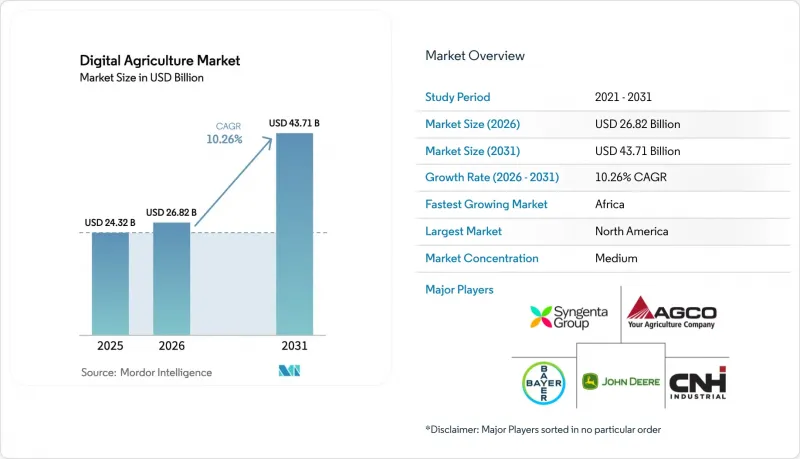
Mordor Intelligence에 따르면 디지털 농업 시장 규모는 2025년에 243억 2,000만 달러에 달하고, 2026년에는 268억 2,000만 달러에 달할 것으로 추정됩니다.
또한, 예측 기간 동안 연평균 성장률(CAGR) 10.26%로 성장하여 2031년까지 437억 1,000만 달러에 달할 것으로 전망됩니다.
본 보고서는 기술별(가이드 시스템, 원격 감지 및 이미지 처리 등), 구성요소별(하드웨어, 소프트웨어, 서비스), 용도별(작물 모니터링, 수확량 매핑 및 예측 등), 농장 규모별(소규모 농장 등), 지역별(북미, 유럽, 아시아태평양 등)로 분류되어 있습니다. 시장 전망은 금액(달러) 기준으로 제시되어 있습니다.
세계 디지털 농업 시장의 동향 및 인사이트
정밀한 투입 자재 최적화 및 수확량 향상
디지털 농업 시장의 생산자들은 도구가 농장의 경제성을 눈에 띄게 개선할 경우, 가장 신속하게 해당 도구를 도입하는 경향이 있습니다. 가변 시비나 카메라 기반 살포와 같은 기술은 생산자로 하여금 불확실한 수익을 감수하도록 강요하지 않으면서 낭비를 최소화할 수 있기 때문에 매우 중요합니다. Deere사에 따르면, 자사의 ‘See and Spray’ 시스템은 2024년 밭 시험에서 제초제 사용량을 최대 59%까지 줄여, 농가에게 디지털 기술을 채택할 명확한 비용 절감 인센티브가 되었습니다. FAO(유엔 식량농업기구)가 2020년부터 2024년까지 비료 및 작물 보호 비용의 급격한 증가를 보고한 바와 같이, 이익률에 대한 압박은 막대하며, 투입 자재의 정밀한 사용이 점점 더 중요해지고 있습니다. 또한, 디어(Deere)사는 3대의 고랑 내 카메라를 사용하여 실시간 깊이 데이터와 자동화된 다운포스 최적화 기능을 제공하는 ‘FurrowVision’ 시스템에 대해 1에이커당 최대 20부셸의 수확량 향상 가능성이 있다고 강조했습니다. 이는 기술 투자를 비용 관리 및 작물 수확량 향상과 직접적으로 연결하기 때문에 정밀한 투입 자재 관리가 디지털 농업 시장에서 주요 추진력으로 자리 잡고 있는 이유를 여실히 보여줍니다.
센서, 드론, 가이던스 시스템의 비용 감소
하드웨어 비용의 하락으로 인해, 과거 정밀 농업 도구를 막대한 자본 투자로 여겼던 농장들조차 디지털 농업 시장에 진입하기가 쉬워지고 있습니다. DJI Agriculture의 보고서에 따르면, 2025년 말까지 전 세계 100개국 이상에서 60만 대 이상의 드론이 도입되어 60만 명 이상의 훈련을 받은 운영자가 이를 운용할 것으로 예상됩니다. 2025년, 브라질은 시야 외 비행에 대한 특별 조치를 도입하여 한 명의 조종사가 하루에 200헥타르를 커버할 수 있게함으로써 투자 회수 기간을 18개월 미만으로 단축했습니다. 스마트폰 공급망의 발전으로 인해, 이전에는 5,000달러였던 열화상 카메라의 비용이 800달러까지 낮아져, 작물 생육 기간 중 개입을 위한 스트레스 감지가 더욱 용이해졌습니다. 국제민간 항공기구(ICAO)에 의한 규제 조화로 인해, 현재는 면허를 보유한 운영자가 유럽 전역에서 입찰에 참여할 수 있게 되어 국경을 초월한 서비스 모델의 전개가 촉진되고 있습니다. 이러한 비용 절감과 규제 측면의 개선이 맞물려, 이전에는 수작업으로 살포에 의존하던 소규모 농가에게도 드론은 현실적인 선택지가 되었습니다. 또한, 도입 범위가 확대됨에 따라 더 풍부한 이미지 데이터세트가 생성되어, 기계 학습에 기반한 수확량 예측의 정확도가 향상되고 있습니다.
소규모 농장의 높은 초기 투자 비용과 불확실한 투자 회수
자본 집약성은 여전히 디지털 농업 시장의 성장에 큰 제약요인으로 작용하고 있습니다. 특히 광활한 농지에 고정비를 분산시킬 수 없는 소규모 농장의 경우 더욱 그렇습니다. 전체 기술 스택을 도입하려면 하드웨어, 구독, 데이터 서비스 및 교육에 대한 동시 투자가 필요한 경우가 많아, 장기적인 이점이 예상됨에도 불구하고 초기 도입 결정은 더욱 어려워지고 있습니다. 이 문제는 생산자가 공식적인 자금 조달 수단에 대한 접근이 제한적이거나 연간 가용 자금이 부족한 경우 더욱 두드러집니다. 세네갈, 코트디부아르, 베냉의 생산자 3,660명을 대상으로 한 서아프리카 조사에 따르면, 응답자의 60%는 기본적인 휴대전화만 소유하고 있었고, 20%는 휴대전화를 전혀 가지고 있지 않은 것으로 나타났습니다. 이는 해당 지역의 디지털 인프라가 제한적임을 여실히 보여줍니다. 저비용 자문 모델이라 할지라도 스마트폰 보급이 광범위하게 이루어졌다고 전제할 수 없기 때문에 이러한 조사 결과는 매우 중요합니다. 게다가 농산물 가격 변동이나 악천후로 인해 농가의 수입이 영향을 받을 경우, 정기적인 소프트웨어 구독 비용은 가장 먼저 삭감되는 대상이 되는 경우가 많습니다. 소규모 농가에서 디지털 농업의 도입을 가속화하기 위해서는 공급업체가 서비스, 집단 이용, 장비 공유, 또는 성과 기반 과금 체계를 중시하는 가격 책정 모델을 개발해야 합니다.
부문 분석
가이드 시스템은 2025년 매출의 29.4%를 차지하며 디지털 농업 시장에서 여전히 가장 큰 기술 부문으로 자리매김했습니다. 이러한 우위는 줄 재배, 특산 작물, 대규모 곡물 재배 분야에서 널리 채택되고 있음을 반영하며, 이러한 분야에서는 조향 정밀도가 선택적 추가 기능이 아닌 기본 기능이 되고 있습니다. 또한, 가이던스 시스템은 사후 장착 키트를 통해 생산자가 기계 전체 라인을 교체하지 않고도 구형 차량을 개조할 수 있기 때문에 견조한 성장세를 유지하고 있습니다. ‘인공지능(AI) 및 고급 분석’은 가장 빠르게 성장하는 기술 부문이며, 농업 플랫폼이 생성형 AI, 컴퓨터 비전, 예측 의사결정 도구를 추가함에 따라 이 카테고리의 디지털 농업 시장은 2031년까지 연평균 성장률(CAGR) 11.3%로 확대될 것으로 예측됩니다.
‘사물인터넷(IoT) 및 연결형 센서’ 분야는 저비용 센서 기술과 밭 데이터를 관개, 비료 시비, 작물 재배 조치로 전환할 수 있는 플랫폼의 결합을 통해 성장하고 있습니다. CropX에 따르면, 자사가 제공하는 V4 센서를 도입하고 생산자가 회사의 관개 권장 사항을 엄격히 준수한 경우, 노던 플레인스 지역에서 1에이커당 20-30부셸의 수확량 증가를 달성했다고 합니다. ‘블록체인 및 추적성’ 분야는 여전히 규모는 작지만, 탄소 MRV(측정·보고·검증), 원산지 증명, 공급망 보고에 대한 수요로 인해 수출 및 저탄소 작물 유통 채널에서 그 상업적 역할이 더욱 명확해지고 있습니다. ‘로보틱스 및 자동화’ 분야는 Deere, AGCO, Kubota 등 각사가 자율주행 기술을 실증 단계에서 본격적인 도입으로 추진함에 따라, 2026년에는 보다 상업적인 단계로 전환되고 있습니다. 이는 디지털 농업 시장이 단일 정밀 농업 도구에서 연결된 실행 시스템으로 전환되고 있음을 의미합니다.
2025년 구성요소별 매출에서 하드웨어가 차지하는 비중은 43.2%였습니다. 이는 디지털 농업 시장 전체에서 안내 수신기, 안테나, 센서, 드론, 디스플레이 및 커넥티드 농업 기계의 도입 대수를 반영한 것입니다. 소프트웨어의 가치를 실현하기 위해서는 농장에서 물리적 데이터 수집, 위치 파악, 제어 단계가 필요하기 때문에 하드웨어는 여전히 도입의 기반을 이루고 있습니다. 반면, 소프트웨어는 가장 빠르게 성장하는 분야이며, 각 벤더사가 수익원을 구독, 데이터 서비스 및 지속적인 농업 워크플로로 전환함에 따라 2031년까지 연평균 성장률(CAGR) 9.8%로 확대될 것으로 예측됩니다. Deere, AGCO, Syngenta, BASF는 각각 ‘Operations Center Advanced License’, ‘PTx FarmEngage’, ‘Cropwise Open Platform’, ‘xarvio FIELD MANAGER’를 통해 이러한 방향성을 추진하고 있으며, 이는 디지털 농업 업계가 지속적인 소프트웨어 가치로 꾸준히 전환되고 있음을 보여줍니다.
서비스는 여전히 세 번째 축을 이루며, 농업학적 지원, 도입, 구현, 데이터 통합, 성과 기반 자문 등이 포함됩니다. BASF가 2025년 일본에서 시작한 ‘xarvio HEALTHY FIELDS’는 수확량 보증 및 서비스 계층을 소프트웨어에 통합함으로써 생산자를 대상으로 더욱 차별화된 제안을 창출할 수 있음을 입증했습니다. 데이터의 품질과 API 접근성이 하드웨어 소유와 마찬가지로 구매 결정에 영향을 미치게 되었기 때문에 개방형 통합의 중요성이 높아지고 있습니다. CNH의 ‘FieldOps’ 생태계와 DTN의 광범위한 농업 인텔리전스 전개는 커넥티드 서비스가 왜 중요한지를 보여주고 있으며, 이러한 추세에 따라 디지털 농업 시장 전체에서 소프트웨어와 서비스의 점유율은 앞으로도 계속 상승할 것입니다.
지역별 분석
2025년, 북미는 디지털 농업 시장 점유율의 37.8%를 차지했습니다. 이는 대규모 농지, 높은 기계화율, 그리고 미국 농무부(USDA)의 ‘기후 스마트 상품 프로그램(Climate Smart Commodity Program)’에 의한 지속적인 자금 지원에 힘입은 결과입니다. 환경보호청(EPA)의 제초제 규제는 정밀 살포 기술의 도입을 가속화하고 있는 반면, 식품의약국(FDA)의 가축 추적성 규정은 기록 관리 소프트웨어에 대한 수요를 끌어올리고 있습니다. 캐나다에서는 프레리 지대의 곡물 생산 시스템에서 유사한 진전이 나타나고 있는 반면, 멕시코는 2026년까지 80%의 보급률을 달성하는 것을 목표로 농촌 지역의 광대역 격차 해소에 힘쓰고 있습니다. 확립된 판매점 네트워크와 자금 조달 채널이 차세대 자율주행 트랙터의 급속한 보급을 뒷받침하고 있습니다. 또한, 사이버 보안에 대한 인식이 높아짐에 따라 미국 국립표준기술연구소(NIST)가 제창하는 모범 사례의 도입이 가속화되고 있습니다.
아프리카는 디지털 농업 시장에서 연평균 성장률(CAGR) 10.9%라는 가장 높은 성장률을 달성할 것으로 예측됩니다. 이러한 성장은 모바일 기반 서비스, 농가의 디지털 등록, 스마트 관개 및 제어 환경 프로그램에 기인하며, 이를 통해 시장의 각 부문이 기존의 하드웨어 의존형 도입 방식을 피할 수 있게 되었습니다. 남미는 2031년까지 연평균 성장률(CAGR) 10.0%로 성장할 것으로 예상되며, 브라질은 광범위한 상업 농업 기반과 증가하는 기술 투자를 바탕으로 이 지역의 견인차 역할을 하고 있습니다. 아르헨티나와 브라질은 대규모 줄 작물 생산을 원동력으로 삼아, 안내 시스템, 위성 모니터링, 자율 농장 작업, 드론을 활용한 농업 기술에 대한 견고한 기반을 함께 제공하고 있습니다.
유럽에서는 더 높은 성장률이 예상되며, 보조금 수령 자격 및 지속가능성에 관한 규제로 인해 디지털 기록과 농업 관행 간의 연관성이 점점 더 강화되고 있어, 디지털 농업 시장에서 여전히 규정 준수를 중시하는 지역으로 남아 있습니다. 프랑스와 독일은 농업용 로봇의 연계에 주력하고 있으며, 자율형 농업 기계 및 디지털 제어 시스템으로의 지역적 전환을 뒷받침하고 있습니다. 대조적으로, 러시아에서는 제재, 수입 제한, 기술 접근의 불안정성으로 인해 농장의 디지털화 속도가 계속해서 저해되고 있어 성장은 비교적 완만할 것으로 예상됩니다. 2030년까지 농약 사용량을 50% 감축하는 것을 목표로 하는 ‘팜 투 포크(Farm to Fork)’ 전략에 따라, 화학제품 사용을 최적화하기 위한 구독형 분석 서비스에 대한 수요가 증가하고 있습니다. 농가에게 원격 측정 데이터에 대한 소유권을 인정하는 데이터 거버넌스법에 따라, 개방형 교환 프레임워크를 지원하는 플랫폼 설계가 진행되고 있습니다. 또한, 각 제조사는 유럽연합(EU)의 ‘인공지능법’을 준수하기 위해 엣지 AI 모듈의 현지화를 추진하고 있으며, 이를 통해 인증 소요 기간을 단축하고 있습니다.
기타 혜택:
- 엑셀 형식의 시장 전망(ME) 시트
- 3개월간의 애널리스트 지원
자주 묻는 질문
목차
제1장 소개
제2장 조사 방법
제3장 주요 요약
제4장 시장 구도
제5장 시장 규모와 성장 예측
제6장 경쟁 구도
제7장 시장 기회와 향후 전망
KSM 26.08.26According to Mordor Intelligence, the digital agriculture market size stood at USD 24.32 billion in 2025 and is estimated to reach USD 26.82 billion in 2026, growing at a 10.26% CAGR during the forecast period to reach USD 43.71 billion by 2031.
This report is Segmented by Technology (Guidance Systems, Remote Sensing and Imaging, and More), by Component (Hardware, Software, and Services), by Application (Crop Monitoring, Yield Mapping and Forecasting, and More), by Farm Size (Small-Scale Farms, and More), and by Geography (North America, Europe, Asia-Pacific, and More). The Market Forecasts are Provided in Terms of Value (USD).
Global Digital Agriculture Market Trends and Insights
Precision Input Optimization and Yield Uplift
Growers in the digital agriculture market tend to adopt tools most rapidly when these tools visibly improve field economics. Technologies like variable-rate application and camera-based spraying are significant because they minimize waste without requiring growers to accept uncertain returns. According to Deere, its See and Spray system reduced herbicide use by up to 59% during 2024 field trials, providing farmers with a clear cost-saving incentive to adopt digital technologies. The pressure on margins has been substantial, as the FAO reported a sharp increase in fertilizer and crop protection costs between 2020 and 2024, making precise input usage increasingly critical. Deere also highlighted that its FurrowVision system, which uses three in-furrow cameras to deliver real-time depth data and automated DownForce optimization, has the potential to improve yields by up to 20 bushels per acre. This underscores why precision input control remains a key driver in the digital agriculture market, as it directly connects technology investments to both cost management and crop yield improvements.
Falling Sensor, Drone, and Guidance-System Costs
Lower hardware costs are widening access to the digital agriculture market for farms that once viewed precision tools as a high-capital purchase. DJI Agriculture reported that by the end of 2025, it had more than 600,000 drones deployed globally across more than 100 countries, supported by more than 600,000 trained operators. In 2025, Brazil introduced beyond-visual-line-of-sight waivers, enabling a single operator to cover 200 hectares per day and reduce payback periods to less than 18 months. The cost of thermal cameras, previously USD 5,000, dropped to USD 800 due to advancements in smartphone supply chains, making stress detection more accessible for mid-season interventions. The International Civil Aviation Organization's harmonization efforts now permit licensed operators to bid across the European region, facilitating cross-border service models. These lower costs, combined with regulatory improvements, have made drones a viable option for small-scale farmers who previously relied on manual spraying. Additionally, broader deployment generates richer image datasets, enhancing machine-learning-based yield forecasts.
High Upfront Investment and Uncertain Payback for Smaller Farms
Capital intensity remains a significant constraint on the growth of the digital agriculture market, particularly for smaller farms that cannot distribute fixed costs across extensive acreage. Implementing full technology stacks often involves simultaneous investments in hardware, subscriptions, data services, and training, making the initial adoption decision more challenging despite potential long-term benefits. This issue is more pronounced in cases where growers have limited access to formal financing or operate with tight annual cash reserves. A study in West Africa, involving 3,660 producers across Senegal, Cote d'Ivoire, and Benin, found that 60% of respondents owned only basic phones, while 20% had no phone at all. This highlights the limited digital infrastructure in such regions. These findings are critical, as even low-cost advisory models cannot assume widespread smartphone availability. Additionally, recurring software subscription costs are often among the first to be reduced when farm income is impacted by fluctuating commodity prices or adverse weather conditions. To accelerate the adoption of digital agriculture among smallholders, vendors must develop pricing models that emphasize services, group access, shared equipment, or outcome-based billing structures.
Other drivers and restraints analyzed in the detailed report include:
- Farm Labor Shortages Accelerating Automation
- Climate-Smart Farming Incentives and Compliance Demand
- Cybersecurity Exposure Across Connected Machinery and Farm Data Platforms
For complete list of drivers and restraints, kindly check the Table Of Contents.
Segment Analysis
Guidance Systems remained the largest technology segment in the digital agriculture market, accounting for 29.4% of revenue in 2025. Their lead reflects broad adoption across row crops, specialty crops, and large-grain operations, where steering accuracy has become a baseline capability rather than an optional add-on. Guidance also stays resilient because retrofit kits let growers improve older fleets without replacing whole machinery lines. Artificial Intelligence and Advanced Analytics is the fastest-growing technology segment, and the digital agriculture market for this category is projected to expand at a 11.3% CAGR through 2031 as agronomy platforms add generative AI, computer vision, and predictive decision-making tools.
The Internet of Things and Connected Sensors segment is expanding as lower-cost sensing is paired with platforms that can turn field data into irrigation, nutrient, and crop actions. CropX said deployments of its V4 sensors delivered 20-30 bushel-per-acre yield improvements in the Northern Plains when growers closely followed its irrigation recommendations. Blockchain and Traceability is still smaller, but demand from carbon MRV, provenance, and supply chain reporting is giving it a clearer commercial role in export and low-carbon crop channels. Robotics and Automation is moving into a more commercial phase in 2026 as Deere, AGCO, and Kubota push autonomy from demonstration into active deployment, which means the digital agriculture market is shifting from stand-alone precision tools toward connected execution systems
Hardware accounted for 43.2% of component revenue in 2025, reflecting the installed base of guidance receivers, antennas, sensors, drones, displays, and connected machinery across the digital agriculture market. Hardware still anchors deployments because farms need physical collection, positioning, and control layers before software value can be realized. At the same time, Software is the fastest-growing component and is projected to expand at 9.8% CAGR through 2031 as vendors move revenue toward subscriptions, data services, and recurring agronomy workflows. Deere, AGCO, Syngenta, and BASF are all advancing this direction through Operations Center Advanced License, PTx FarmEngage, Cropwise Open Platform, and xarvio FIELD MANAGER, indicating that the digital agriculture industry is steadily moving toward recurring software value.
Services remain the third component pillar and include agronomic support, deployment, implementation, data integration, and outcome-based advisory. BASF's xarvio HEALTHY FIELDS launch in Japan during 2025 demonstrated how yield guarantees and service layers can sit atop software to create a more differentiated offer for growers. Open integration is becoming more important because data quality and API access now influence buying decisions as much as hardware ownership does. CNH's FieldOps ecosystem and DTN's broad farm intelligence footprint show why connected services matter, and that trend should keep lifting software and service share across the digital agriculture market
Complete Report Scope:
- By Technology
- Guidance Systems
- Remote Sensing and Imaging
- Variable Rate Technology
- Artificial Intelligence and Advanced Analytics
- Internet of Things and Connected Sensors
- Blockchain and Traceability
- Robotics and Automation
- By Component
- Hardware
- Software
- Services
- By Application
- Crop Monitoring
- Yield Mapping and Forecasting
- Soil Monitoring and Soil Health Analytics
- Weather Tracking and Forecasting
- Precision Spraying and Input Optimization
- Drone Analytics
- Livestock Health Tracking
- By Farm Size
- Small-Scale Farms (Less Than 100 ha)
- Medium-Scale Farms (100 - 500 ha)
- Large-Scale Farms (More Than 500 ha)
- By Geography
- North America
- United States
- Canada
- Mexico
- Rest of North America
- Europe
- Germany
- United Kingdom
- France
- Italy
- Spain
- Russia
- Rest of Europe
- Asia-Pacific
- China
- India
- Japan
- Australia
- South Korea
- Rest of Asia-Pacific
- South America
- Brazil
- Argentina
- Rest of South America
- Middle East
- Saudi Arabia
- United Arab Emirates
- Turkey
- Rest of Middle East
- Africa
- South Africa
- Egypt
- Rest of Africa
- North America
Geography Analysis
North America accounted for 37.8% of the digital agriculture market share in 2025, driven by large farm sizes, high mechanization rates, and sustained funding from the United States Department of Agriculture's Climate-Smart Commodity Program. Restrictions on herbicides by the Environmental Protection Agency are accelerating the adoption of precision spraying technologies, while the Food and Drug Administration's livestock traceability rule is boosting demand for record-keeping software. In Canada, similar advancements are observed in prairie grain systems, while Mexico is working to close rural broadband gaps, aiming for 80% coverage by 2026. Established dealer networks and financing channels are facilitating the rapid adoption of next-generation autonomous tractors. Additionally, heightened cybersecurity awareness is promoting faster implementation of the National Institute of Standards and Technology best practices.
Africa is anticipated to achieve the highest growth rate in the digital agriculture market, with a CAGR of 10.9%. This growth is attributed to mobile-led services, digital farmer registration, smart irrigation, and controlled-environment programs, enabling segments of the market to bypass traditional, hardware-intensive adoption methods. South America is projected to grow at a CAGR of 10.0% through 2031, with Brazil serving as the regional anchor due to its extensive commercial farming base and increasing technology investments. Argentina and Brazil together provide a strong foundation for guidance systems, satellite monitoring, autonomous fieldwork, and drone-supported agronomy, driven by their large-scale row-crop production.
Europe is anticipated to experience a higher growth rate and remains the most compliance-driven region in the digital agriculture market, as subsidy eligibility and sustainability regulations increasingly link digital records to farming practices. France and Germany are focusing on agricultural robotics collaboration, supporting a regional shift toward autonomous machinery and digital control systems. In contrast, Russia is anticipated to see more subdued growth due to sanctions, import restrictions, and inconsistent access to technology, which continue to hinder the pace of farm digitalization. The Farm to Fork strategy, targeting a 50% reduction in pesticide use by 2030, is increasing demand for subscription-based analytics to optimize chemical use . Data governance laws granting farmers ownership of telemetry data are shaping platform designs to support open exchange frameworks. Furthermore, manufacturers are localizing edge artificial intelligence modules to align with the European Union Artificial Intelligence Act, thereby shortening certification timelines.
- Deere & Company
- CNH Industrial N.V.
- Bayer AG
- AGCO Corporation
- Syngenta Group
- International Business Machines Corporation
- Microsoft Corporation
- Hexagon AB
- KUBOTA Corporation
- Topcon Corporation
- SZ DJI Technology Co., Ltd.
- Planet Labs PBC
- Farmers Edge Inc.
- AeroVironment Inc.
- Traction Ag
Additional Benefits:
- The market estimate (ME) sheet in Excel format
- 3 months of analyst support
TABLE OF CONTENTS
1 Introduction
- 1.1 Study Assumptions and Market Definition
- 1.2 Scope of the Study
2 Research Methodology
3 Executive Summary
4 Market Landscape
- 4.1 Market Overview
- 4.2 Market Drivers
- 4.2.1 Precision Input Optimization and Yield Uplift
- 4.2.2 Falling Sensor, Drone, and Guidance-System Costs
- 4.2.3 Farm Labor Shortages Accelerating Automation
- 4.2.4 Climate-Smart Farming Incentives and Compliance Demand
- 4.2.5 Carbon MRV and Scope 3 Data Monetization
- 4.2.6 Embedded Finance and Digital Public Infrastructure for
Farmers
- 4.3 Market Restraints
- 4.3.1 High Upfront Investment and Uncertain Payback for Smaller Farms
- 4.3.2 Rural Connectivity Gaps and Limited Digital Skills
- 4.3.3 Interoperability Friction and Vendor Lock-In
- 4.3.4 Cybersecurity Exposure Across Connected Machinery and Farm Data Platforms
- 4.4 Regulatory Landscape
- 4.5 Technological Outlook
- 4.6 Porter's Five Forces Analysis
- 4.6.1 Bargaining Power of Buyers
- 4.6.2 Bargaining Power of Suppliers
- 4.6.3 Threat of Substitutes
- 4.6.4 Threat of New Entrants
- 4.6.5 Intensity of Competitive Rivalry
5 Market Size and Growth Forecasts (Value)
- 5.1 By Technology
- 5.1.1 Guidance Systems
- 5.1.2 Remote Sensing and Imaging
- 5.1.3 Variable Rate Technology
- 5.1.4 Artificial Intelligence and Advanced Analytics
- 5.1.5 Internet of Things and Connected Sensors
- 5.1.6 Blockchain and Traceability
- 5.1.7 Robotics and Automation
- 5.2 By Component
- 5.2.1 Hardware
- 5.2.2 Software
- 5.2.3 Services
- 5.3 By Application
- 5.3.1 Crop Monitoring
- 5.3.2 Yield Mapping and Forecasting
- 5.3.3 Soil Monitoring and Soil Health Analytics
- 5.3.4 Weather Tracking and Forecasting
- 5.3.5 Precision Spraying and Input Optimization
- 5.3.6 Drone Analytics
- 5.3.7 Livestock Health Tracking
- 5.4 By Farm Size
- 5.4.1 Small-Scale Farms (Less Than 100 ha)
- 5.4.2 Medium-Scale Farms (100 - 500 ha)
- 5.4.3 Large-Scale Farms (More Than 500 ha)
- 5.5 By Geography
- 5.5.1 North America
- 5.5.1.1 United States
- 5.5.1.2 Canada
- 5.5.1.3 Mexico
- 5.5.1.4 Rest of North America
- 5.5.2 Europe
- 5.5.2.1 Germany
- 5.5.2.2 United Kingdom
- 5.5.2.3 France
- 5.5.2.4 Italy
- 5.5.2.5 Spain
- 5.5.2.6 Russia
- 5.5.2.7 Rest of Europe
- 5.5.3 Asia-Pacific
- 5.5.3.1 China
- 5.5.3.2 India
- 5.5.3.3 Japan
- 5.5.3.4 Australia
- 5.5.3.5 South Korea
- 5.5.3.6 Rest of Asia-Pacific
- 5.5.4 South America
- 5.5.4.1 Brazil
- 5.5.4.2 Argentina
- 5.5.4.3 Rest of South America
- 5.5.5 Middle East
- 5.5.5.1 Saudi Arabia
- 5.5.5.2 United Arab Emirates
- 5.5.5.3 Turkey
- 5.5.5.4 Rest of Middle East
- 5.5.6 Africa
- 5.5.6.1 South Africa
- 5.5.6.2 Egypt
- 5.5.6.3 Rest of Africa
- 5.5.1 North America
6 Competitive Landscape
- 6.1 Market Concentration
- 6.2 Strategic Moves
- 6.3 Market Share Analysis
- 6.4 Company Profiles (Includes Global-level Overview, Market-level Overview, Core Segments, Financials as Available, Strategic Information, Market Rank/Share for Key Companies, Products and Services, and Recent Developments)
- 6.4.1 Deere & Company
- 6.4.2 CNH Industrial N.V.
- 6.4.3 Bayer AG
- 6.4.4 AGCO Corporation
- 6.4.5 Syngenta Group
- 6.4.6 International Business Machines Corporation
- 6.4.7 Microsoft Corporation
- 6.4.8 Hexagon AB
- 6.4.9 KUBOTA Corporation
- 6.4.10 Topcon Corporation
- 6.4.11 SZ DJI Technology Co., Ltd.
- 6.4.12 Planet Labs PBC
- 6.4.13 Farmers Edge Inc.
- 6.4.14 AeroVironment Inc.
- 6.4.15 Traction Ag


