

|
시장보고서
상품코드
2116048
스마트 홈 헬스케어 : 시장 점유율 분석, 업계 동향과 통계, 성장 예측(2026-2031년)Smart Home Healthcare - Market Share Analysis, Industry Trends & Statistics, Growth Forecasts (2026 - 2031) |
||||||
 Mordor Intelligence
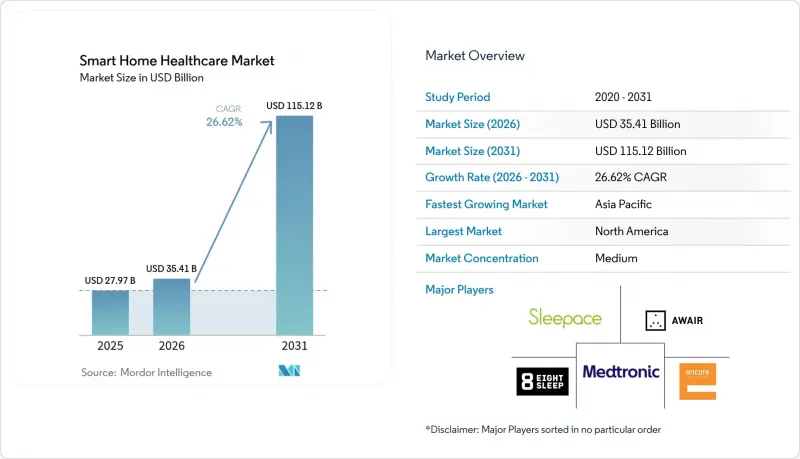
Mordor Intelligence에 따르면 스마트 홈 헬스케어 시장 규모는 2025년에 279억 7,000만 달러로 평가되며, 2026년 354억 1,000만 달러에서 2031년까지 1,151억 2,000만 달러에 달할 것으로 예측되며, 예측 기간(2026-2031년) 동안 CAGR은 26.62%가 될 전망입니다.
본 보고서는 제품별(의료기기 경보 시스템, 스마트 혈당 모니터링 시스템, 스마트 낙상 센서 등), 기술별(무선, 유선 등), 최종사용자별(고령자, 만성 질환 환자, 임산부 및 산모 등), 용도별(안전·보안 모니터링, 건강 상태 모니터링 등), 그리고 지역별로 분류되어 있습니다.
세계 스마트 홈 헬스케어 시장의 동향 및 인사이트
고령화와 만성 질환의 부담
2030년까지 미국 거주자 5명 중 1명이 65세 이상이 될 것이며, 이 연령대의 85%는 이미 적어도 한 가지 만성 질환을 앓고 있는 상태이므로 의료 수요는 기존 시설의 수용 능력을 초과할 것으로 예상됩니다. 일본에서는 이미 국민의 29%가 65세 이상이며, 가정 내 디지털 치료법 도입을 위한 제약 업계와 기술 업계 간의 협력이 촉진되고 있습니다. 2033년까지 13만 9,000명의 의사 부족이 예상됨에 따라, 스마트 기기는 단순한 라이프스타일 향상을 넘어 의료 접근성을 확보하기 위한 필수품이 되고 있습니다. 싱가포르의 ‘실버 인포콤 이니셔티브(Silver Infocomm Initiative)’와 같은 프로그램은 기술에 정통한 젊은이와 고령자를 연결해 주고 있으며, 사회적 지원이 기술 도입의 가정임을 입증하고 있습니다. 인구 동향이 점점 더 어려워지는 가운데, 구조적인 수요로 인해 스마트 홈 헬스케어 시장은 일반적인 기술 주기를 훨씬 뛰어넘는 상승세를 계속 유지할 것입니다.
재택 간호 기기에서의 IoT와 AI 통합 가속화
데크콤(Dekcom)사가 2024년 하반기 출시 예정인 생성형 AI를 활용한 혈당 플랫폼은, 기계 학습이 바이오센서 데이터를 맥락에 맞춰 해석하여 맞춤형 인사이트를 도출하는 구조를 보여줍니다. 삼성전자의 비침습적 혈당 측정 관련 특허에는 FDA가 지적한 정확도 문제를 해결하는 예측 알고리즘이 포함되어 있어, AI가 더 이상 단순히 데이터를 보고하는 데 그치지 않고 하드웨어의 한계를 해결하는 단계에 접어들었음을 보여줍니다. 향후 도입될 6G 네트워크는 대규모 센서 어레이에 거의 즉각적인 대역폭을 제공하여, 임상의에게 재택 환경에서도 끊김 없는 가시성을 제공합니다. 모듈식 IoT 간호 플랫폼은 이미 표준화된 API를 통해 기존 전자의무기록 시스템에 연결되어 있어, 상호 운용성의 장벽이 점차 완화되고 있음을 시사합니다. 새로운 기기가 추가될 때마다 공유 데이터 풀이 풍부해지고 그 가치가 비약적으로 높아짐에 따라, 여러 치료 경로에서 이 플랫폼의 급속한 확산이 촉진되고 있습니다.
데이터 개인정보 보호 및 사이버 보안에 대한 우려
FDA의 2024년판 지침 초안에서는 연결형 기기의 신청 건마다 사이버 보안 관리 계획과 소프트웨어 부품 명세서(BOM)의 제출을 의무화하고 있어, 이로 인해 개발 주기가 장기화되고 규정 준수 관련 예산이 증가하고 있습니다. HIPAA 적용 대상이 아닌 소비자용 웨어러블 기기 역시 기밀성이 높은 건강 데이터를 수집하고 있어, 사용자는 규제상의 회색 지대에 노출된 상태로 남아 있습니다. HIPAA의 보호 규정과 GDPR의 데이터 최소화 요건은 종종 상반된 방향을 제시하여 AI 모델 훈련을 복잡하게 만듭니다. 엣지 처리나 종단 간 암호화는 위험을 완화하지만, 계산 처리의 오버헤드와 비용을 증가시킵니다. 새로운 IoT 엔드포인트가 추가될 때마다 새로운 공격 경로가 생겨나고, 지속적인 보안 패치 적용이 필요하기 때문에 총 소유 비용이 증가하여 스마트홈 의료 업계에서의 도입을 저해하는 요인이 되고 있습니다.
부문 분석
2025년 기준, 스마트 혈당 모니터링 시스템은 스마트 홈 헬스케어 시장의 23.60%를 차지하고 있으며, 연속 혈당 모니터링(CGM)은 연평균 성장률(CAGR) 27.52%로 확대될 전망입니다. 이는 당뇨병 관리가 커넥티드 케어의 진입점임을 여실히 보여줍니다. Dexcom사의 2024년 4분기 매출은 전년 동기 대비 8% 증가한 11억 1,400만 달러를 기록하며, 수요의 지속성을 입증하고 있습니다. 스마트 심박수 모니터와 혈압 측정 기기는 원격의료의 확산에 힘입어 성장하고 있습니다. 한편, 웨어러블 수면 트래커는 일반 소비자의 웰니스 분야에서 임상 프로토콜로 활용 범위를 넓혀가고 있습니다. 낙상 센서는 예측 알고리즘을 활용해 오경보를 줄이고 있지만, 정확도 측면의 과제가 보급을 저해하고 있습니다. 의료기기 알림 허브는 지휘 본부 역할을 하며, 여러 센서를 연동해 일관성 있는 의료진용 대시보드를 구축합니다. 스마트 흡입기는 AI를 통한 지도를 통해 복약 순응도를 촉진하고, 로봇식 약품 디스펜서는 다제 병용으로 인한 복잡성을 해소합니다. 제품의 융합은 미래의 제품이 개별 기기가 아닌, 통합된 플랫폼 하에서 다중 매개변수 센서를 통합하는 방향으로 나아갈 것임을 시사합니다.
혈당 모니터링 분야의 스마트 홈 헬스케어 시장 규모는 틈새 시장을 훨씬 뛰어넘어 막대한 연구개발 예산을 뒷받침하고 있습니다. 그러나 경쟁 우위는 원시 데이터를 실용적인 인사이트로 변환하는 소프트웨어 알고리즘으로 점차 이동하고 있습니다. 삼성의 특허 출원에 따르면, FDA의 정확도 기준을 충족하기 위해 비침습적 광학식 혈당 측정법과 컨텍스트 데이터 계층을 결합한 기법이 제시되어 있습니다. 신뢰성이 향상됨에 따라 CGM 플랫폼은 더 광범위한 만성 질환 관리 생태계의 기반이 되어, 공급업체들이 심장, 호흡기, 수면 관련 모듈을 교차 판매할 수 있도록 뒷받침할 것입니다. 기기 사용 현황과 임상 결과 간의 지속적인 피드백 루프는 보험사의 광범위한 보험 적용에 대한 정당성을 강화하여 관련 제품 라인 전체의 성장세를 더욱 가속화할 것입니다.
무선 솔루션은 2025년에 스마트 홈 헬스케어 시장의 60.25%를 차지했으며, 1밀리초 미만의 지연 시간을 약속하는 5G의 보급과 초기 단계의 6G 시범 프로젝트에 힘입어 연평균 성장률(CAGR) 27.85%로 확대되고 있습니다. 단거리 통신에서는 Wi-Fi 6과 Bluetooth Low Energy가 주류를 이루는 반면, NB-IoT는 지방에 거주하는 환자들에게 통신 범위를 확대하고 있습니다. Zigbee와 Thread는 저전력 소비와 자가 복구 기능이 필요한 고밀도 가정 내 메시 네트워크를 지원합니다. 유선 연결은 높은 대역폭이 필요한 영상 진단 노드에서 여전히 사용되고 있지만, 무선 통신의 암호화 및 신뢰성이 향상됨에 따라 감소 추세를 보이고 있습니다.
2030년까지 무선 백본에 의존하는 스마트 홈 헬스케어 시장 규모는 유선 채널을 크게 웃돌 것으로 예상됩니다. 이는 사용자들의 ‘케이블에 얽매이지 않는’ 이동성에 대한 수요를 반영한 것입니다. 하이브리드 라우터는 임상 사건 발생 시 서비스 품질을 유지하기 위해 셀룰러, Wi-Fi, 이더넷 간에 트래픽을 자동으로 전환합니다. LoRa와 같은 LPWAN 프로토콜은 배터리가 필요 없는 상처 센서에 최적이며, 치유 데이터를 비정기적으로 전송함으로써 유지보수를 최소화합니다. 6G가 성숙해짐에 따라 가구당 수천 개의 센서 스트림을 동시에 전송할 수 있게 되어, 증상이 나타나기 전에 임상 상태의 악화를 예측하는 ‘앰비언트 인텔리전스’의 길이 열리게 됩니다.
지역별 분석
북미는 확립된 광대역 환경, 유리한 보험 환급 제도, 그리고 IoT의 조기 도입 덕분에 2025년 스마트 홈 헬스케어 시장 매출의 41.35%를 차지했습니다. FDA가 사이버 보안을 핵심 안전 규정에 포함시키고, 메디케어가 지속적인 원격 모니터링을 보험 환급 대상으로 지정함에 따라 정부 정책에 힘입어 그 기세가 더욱 높아지고 있습니다. 의료 서비스 제공자 네트워크는 스마트홈 데이터를 임상 대시보드에 통합하고 있으며, 이를 통해 임상의는 다수의 환자 집단을 거의 실시간으로 파악할 수 있습니다.
아시아태평양은 더 가파른 보급 곡선을 보이고 있으며, 2031년까지 연평균 성장률(CAGR) 28.36%로 성장할 것으로 예측됩니다. 일본의 고령화 사회를 배경으로 제약 기업과 기술 기업의 제휴가 진행되어 거실에서의 모니터링이 가능해졌습니다. 중국은 AI 의사결정 엔진에 데이터를 공급하는 국가 규모의 건강 데이터 레이크에 투자하고 있으며, 이를 통해 제품 승인을 가속화하고 있습니다. 한국은 AI를 활용한 응급 시스템 및 디지털 케어 인프라 구축에 8억 3,000만 달러를 배정했습니다. 인도는 보험 지원을 받는 원격의료 솔루션을 중시하고 있으며, 전용 하드웨어 대신 대부분 저가형 스마트폰을 활용함으로써 농촌 지역으로의 서비스 제공 범위를 확대하고 있습니다.
유럽에서는 GDPR의 엄격한 개인정보 보호 체계 하에서 꾸준한 성장이 나타나고 있습니다. 각국의 자금 지원 프로그램을 통해 전자건강기록의 표준화가 진행되고 있으나, 국경을 넘는 규제의 복잡성으로 인해 다국적 기업의 사업 확장이 지연되고 있습니다. 스칸디나비아 국가들에서는 치매 관리를 위한 음성 비서를 활용한 모니터링이 시범 도입되고 있는 반면, 프랑스에서는 CGM(지속 혈당 측정) 기기에 대한 보험 적용이 선례가 되어 기초 인슐린 사용자의 접근성이 확대되고 있습니다.
중동 및 아프리카에서는 아직 발전 단계에 있지만, 모바일 헬스 플랫폼이 의료 인력 부족을 극복할 수 있는 분야에서 미래성이 기대되고 있습니다. 각국 정부는 가정용 기기와 연동되는 지역 원격의료 키오스크 설치를 위해 민관 협력을 모색하고 있습니다. 라틴아메리카도 비슷한 길을 걷고 있으며, 연결 환경의 변동에 대응할 수 있는 저대역폭 프로토콜을 활용하고 있습니다. 모든 지역에서 센서의 접근성뿐만 아니라 정책의 일관성, 광대역 보급률, 디지털 문해력 향상 노력 등이 도입 속도를 좌우하는 중요한 요소로 작용하고 있습니다.
기타 혜택:
- 엑셀 형식의 시장 예측(ME) 시트
- 3개월간의 애널리스트 지원
자주 묻는 질문
목차
제1장 소개
제2장 조사 방법
제3장 주요 요약
제4장 시장 구도
제5장 시장 규모와 성장 예측
제6장 경쟁 구도
제7장 시장 기회와 향후 전망
KSM 26.08.26According to Mordor Intelligence, the smart home healthcare market size was valued at USD 27.97 billion in 2025 and estimated to grow from USD 35.41 billion in 2026 to reach USD 115.12 billion by 2031, at a CAGR of 26.62% during the forecast period (2026-2031).
This report is Segmented by Product (Medical Device Alert Systems, Smart Glucose Monitoring Systems, Smart Fall Sensors, and More), Technology (Wireless, Wired, and More), End User (Elderly, Chronic-Disease Patients, Pregnant Women and New Mothers, and More), Application (Safety and Security Monitoring, Health-Status Monitoring, and More), and Geography.
Global Smart Home Healthcare Market Trends and Insights
Aging Population and Chronic Disease Burden
One in five United States residents will be over 65 by 2030, and 85% of that cohort already lives with at least one chronic condition, pushing healthcare demand beyond existing facility capacity. Japan already sees 29% of its citizens above 65, spurring pharmaceutical-technology collaborations that bring digital therapeutics into homes. Physician shortfalls projected at 139,000 by 2033 make smart devices an access necessity rather than a lifestyle upgrade. Programs such as Singapore's Silver Infocomm Initiative pair tech-savvy youth with seniors, proving social support is a precondition for technology uptake. As demographics tighten, structural demand will keep the smart home healthcare market on an upward curve well past standard technology cycles.
Accelerating IoT and AI Integration in Home-Care Devices
Dexcom's late-2024 launch of a generative-AI glucose platform demonstrates how machine learning contextualizes biosensor data into personalized insights. Samsung's non-invasive glucose patents integrate predictive algorithms that address accuracy concerns flagged by the FDA, indicating AI now solves hardware limits rather than merely reporting data. Upcoming 6G networks promise near-instant bandwidth for large sensor arrays, giving clinicians seamless in-home visibility. Modular IoT nursing platforms already plug into existing electronic medical records through standardized APIs, suggesting that interoperability hurdles are easing. As each new device enriches shared data pools, value grows exponentially, reinforcing rapid adoption across multiple care pathways.
Data-Privacy and Cybersecurity Concerns
The FDA's 2024 draft guidance now requires cybersecurity management plans and software bills of materials for every connected device submission, lengthening development cycles and raising compliance budgets. Consumer wearables that sit outside HIPAA still collect sensitive health data, leaving users exposed in grey regulatory zones. HIPAA's safeguard rules and GDPR's data-minimization mandates often pull in opposite directions, complicating AI model training. Edge-processing and end-to-end encryption mitigate risks yet increase computing overhead and cost. Each new IoT endpoint is another attack vector, requiring continuous security patching that inflates total cost of ownership, tempering adoption in the smart home healthcare industry.
Other drivers and restraints analyzed in the detailed report include:
- Shift to Value-Based Reimbursement and Telehealth Coverage Expansion
- Cost Advantage Over Facility-Based Care
- Device-Integration and Interoperability Gaps
For complete list of drivers and restraints, kindly check the Table Of Contents.
Segment Analysis
Smart Glucose Monitoring Systems held 23.60% of the smart home healthcare market in 2025, and Continuous Glucose Monitoring is set to climb at 27.52% CAGR, underscoring diabetes management as the entry point for connected care. Dexcom's USD 1.114 billion Q4 2024 revenue, up 8% year on year, validates sustained demand. Smart cardiac monitors and blood-pressure devices ride telehealth adoption, while wearable sleep trackers spill over from consumer wellness into clinical protocols. Fall sensors deploy predictive algorithms to cut false alarms, though accuracy challenges hold back mass uptake. Medical device alert hubs act as command centers, linking multiple sensors for cohesive clinician dashboards. Smart inhalers align medication adherence with AI coaching, and robotic pill dispensers solve polypharmacy complexity. Product convergence signals that future offerings will package multi-parameter sensors under unified platforms rather than discrete gadgets.
The smart home healthcare market size for glucose monitoring dwarfs niche categories and supports heavy R&D budgets. Yet, competitive advantage is shifting toward software algorithms that translate raw data into actionable insights. Patent filings from Samsung show non-invasive optical glucose methods combined with contextual data layers to meet FDA accuracy thresholds. As reliability rises, CGM platforms will anchor broader chronic-care ecosystems, helping vendors cross-sell cardiac, respiratory, and sleep modules. Continuous feedback loops between device usage and clinical outcomes strengthen payer justification for wider reimbursement, reinforcing momentum across adjacent product lines.
Wireless solutions commanded 60.25% of the smart home healthcare market share in 2025 and are advancing at 27.85% CAGR, pushed by 5G rollouts and early 6G pilots promising sub-millisecond latency. Wi-Fi 6 and Bluetooth Low Energy dominate short-range transmissions, while NB-IoT extends coverage to rural patients. Zigbee and Thread serve dense in-home mesh networks that need low power and self-healing signals. Wired connections persist in high-bandwidth imaging nodes but trend downward as encryption and reliability improve over airwaves.
By 2030 the smart home healthcare market size tied to wireless backbones will exceed wired channels by a broad margin, reflecting user demand for untethered mobility. Hybrid routers automatically shift traffic among cellular, Wi-Fi, and Ethernet to preserve quality of service during clinical events. LPWAN protocols such as LoRa prove ideal for battery-free wound sensors that broadcast occasional healing data, keeping maintenance minimal. As 6G matures, simultaneous transmission of thousands of sensor streams per household becomes feasible, opening doors to ambient intelligence that predicts clinical deterioration before symptoms appear.
Complete Report Scope:
- By Product
- Medical Device Alert Systems
- Smart Glucose Monitoring Systems
- Continuous Glucose Monitoring (CGM)
- Smart Cardiac Monitoring Devices
- Smart Blood-Pressure Monitors
- Wearable Sleep and Vital-Sign Trackers
- Smart Inhalers and Respiratory Monitors
- Smart Fall Sensors
- Medication-Dispensing Robots
- Others
- By Technology
- Wireless
- Wi-Fi
- Bluetooth
- Zigbee / Thread
- Cellular / NB-IoT
- Wired
- Hybrid Networks
- Wireless
- By End User
- Elderly (65 + Independent Living)
- Chronic-Disease Patients
- Disabled / Mobility-Impaired Individuals
- Post-Acute and Rehabilitation Patients
- Pregnant Women and New Mothers
- General Wellness Users
- By Application
- Safety and Security Monitoring
- Health-Status Monitoring
- Fall Prevention and Detection
- Nutrition / Diet Tracking
- Memory Aids
- Remote Patient Management
- Rehabilitation and Chronic-Care Management
- Others
- By Geography
- North America
- United States
- Canada
- Mexico
- South America
- Brazil
- Argentina
- Rest of South America
- Europe
- Germany
- United Kingdom
- France
- Italy
- Spain
- Rest of Europe
- Asia Pacific
- China
- Japan
- India
- South Korea
- Rest of Asia Pacific
- Middle East and Africa
- Middle East
- United Arab Emirates
- Saudi Arabia
- Turkey
- Rest of Middle East
- Africa
- South Africa
- Nigeria
- Kenya
- Rest of Africa
- Middle East
- North America
Geography Analysis
North America generated 41.35% of 2025 revenue for the smart home healthcare market, thanks to established broadband, favorable reimbursement, and early IoT adoption. Government policy keeps momentum high as the FDA weaves cybersecurity into core safety rules and Medicare reimburses continuous remote monitoring. Provider networks integrate smart home data into clinical dashboards, giving clinicians near-real-time visibility across large patient cohorts.
Asia Pacific is on a steeper adoption curve and is projected to grow at 28.36% CAGR through 2031. Japan's aging society propels pharmaceutical-technology alliances that bring monitoring to living rooms. China invests in national health-data lakes that feed AI decision engines, accelerating product approvals. South Korea earmarked USD 830 million to build AI-driven emergency systems and digital-care infrastructure. India emphasizes insurance-backed telehealth solutions that extend reach in rural districts, often using low-cost smartphones rather than dedicated hardware.
Europe posts steady growth under GDPR's stringent privacy guardrails. National funding programs accelerate electronic medical-record harmonization, yet cross-border regulatory complexity slows multinational rollouts. Scandinavia pilots voice-assistant monitoring for dementia care, while France sets reimbursement precedent for CGM devices, expanding access for basal-insulin users.
The Middle East and Africa remain nascent but show promise where mobile health platforms overcome clinician shortages. Governments explore public-private partnerships to install community telehealth kiosks that interface with in-home devices. Latin America follows a similar path, leaning on low-bandwidth protocols that fit variable connectivity. Across all regions, policy alignment, broadband density, and digital-literacy programs determine adoption speed more than sensor availability alone.
- Medtronic
- Philips Healthcare
- GE HealthCare
- Honeywell
- Abbott Laboratories
- Dexcom
- Omron Healthcare
- Resideo Technologies
- Bosch Healthcare Solutions
- Essence SmartCare
- Sleepace
- Awair Inc.
- Eight Sleep
- Encore Healthcare
- Withings
- Tunstall Healthcare
- Garmin Ltd.
- Apple (Health and Home)
- Google (Fitbit)
- Amazon (Alexa Together)
- Xiaomi
- iHealth Labs
Additional Benefits:
- The market estimate (ME) sheet in Excel format
- 3 months of analyst support
TABLE OF CONTENTS
1 INTRODUCTION
- 1.1 Study Assumptions and Market Definition
- 1.2 Scope of the Study
2 RESEARCH METHODOLOGY
3 EXECUTIVE SUMMARY
4 MARKET LANDSCAPE
- 4.1 Market Overview
- 4.2 Market Drivers
- 4.2.1 Aging population and chronic disease burden
- 4.2.2 Accelerating IoT and AI integration in home?care devices
- 4.2.3 Shift to value-based reimbursement and telehealth coverage expansion
- 4.2.4 Cost advantage over facility-based care
- 4.2.5 Voice-assistant-enabled passive monitoring
- 4.2.6 Insurer wellness-IoT incentive programs
- 4.3 Market Restraints
- 4.3.1 Data-privacy and cybersecurity concerns
- 4.3.2 Device-integration and interoperability gaps
- 4.3.3 Care-giver digital-literacy barriers
- 4.3.4 Battery-life / maintenance burden for 24-7 sensors
- 4.4 Value Chain Analysis
- 4.5 Regulatory Landscape
- 4.6 Technological Outlook
- 4.7 Porter's Five Forces Analysis
- 4.7.1 Bargaining Power of Suppliers
- 4.7.2 Bargaining Power of Buyers
- 4.7.3 Threat of New Entrants
- 4.7.4 Threat of Substitutes
- 4.7.5 Competitive Rivalry
5 MARKET SIZE AND GROWTH FORECASTS (VALUE)
- 5.1 By Product
- 5.1.1 Medical Device Alert Systems
- 5.1.2 Smart Glucose Monitoring Systems
- 5.1.3 Continuous Glucose Monitoring (CGM)
- 5.1.4 Smart Cardiac Monitoring Devices
- 5.1.5 Smart Blood-Pressure Monitors
- 5.1.6 Wearable Sleep and Vital-Sign Trackers
- 5.1.7 Smart Inhalers and Respiratory Monitors
- 5.1.8 Smart Fall Sensors
- 5.1.9 Medication-Dispensing Robots
- 5.1.10 Others
- 5.2 By Technology
- 5.2.1 Wireless
- 5.2.1.1 Wi-Fi
- 5.2.1.2 Bluetooth
- 5.2.1.3 Zigbee / Thread
- 5.2.1.4 Cellular / NB-IoT
- 5.2.2 Wired
- 5.2.3 Hybrid Networks
- 5.2.1 Wireless
- 5.3 By End User
- 5.3.1 Elderly (65 + Independent Living)
- 5.3.2 Chronic-Disease Patients
- 5.3.3 Disabled / Mobility-Impaired Individuals
- 5.3.4 Post-Acute and Rehabilitation Patients
- 5.3.5 Pregnant Women and New Mothers
- 5.3.6 General Wellness Users
- 5.4 By Application
- 5.4.1 Safety and Security Monitoring
- 5.4.2 Health-Status Monitoring
- 5.4.3 Fall Prevention and Detection
- 5.4.4 Nutrition / Diet Tracking
- 5.4.5 Memory Aids
- 5.4.6 Remote Patient Management
- 5.4.7 Rehabilitation and Chronic-Care Management
- 5.4.8 Others
- 5.5 By Geography
- 5.5.1 North America
- 5.5.1.1 United States
- 5.5.1.2 Canada
- 5.5.1.3 Mexico
- 5.5.2 South America
- 5.5.2.1 Brazil
- 5.5.2.2 Argentina
- 5.5.2.3 Rest of South America
- 5.5.3 Europe
- 5.5.3.1 Germany
- 5.5.3.2 United Kingdom
- 5.5.3.3 France
- 5.5.3.4 Italy
- 5.5.3.5 Spain
- 5.5.3.6 Rest of Europe
- 5.5.4 Asia Pacific
- 5.5.4.1 China
- 5.5.4.2 Japan
- 5.5.4.3 India
- 5.5.4.4 South Korea
- 5.5.4.5 Rest of Asia Pacific
- 5.5.5 Middle East and Africa
- 5.5.5.1 Middle East
- 5.5.5.1.1 United Arab Emirates
- 5.5.5.1.2 Saudi Arabia
- 5.5.5.1.3 Turkey
- 5.5.5.1.4 Rest of Middle East
- 5.5.5.2 Africa
- 5.5.5.2.1 South Africa
- 5.5.5.2.2 Nigeria
- 5.5.5.2.3 Kenya
- 5.5.5.2.4 Rest of Africa
- 5.5.5.1 Middle East
- 5.5.1 North America
6 COMPETITIVE LANDSCAPE
- 6.1 Market Concentration
- 6.2 Strategic Moves
- 6.3 Market Share Analysis
- 6.4 Company Profiles {(includes Global level Overview, Market level overview, Core Segments, Financials as available, Strategic Information, Market Rank/Share for key companies, Products and Services, and Recent Developments)}
- 6.4.1 Medtronic
- 6.4.2 Philips Healthcare
- 6.4.3 GE HealthCare
- 6.4.4 Honeywell
- 6.4.5 Abbott Laboratories
- 6.4.6 Dexcom
- 6.4.7 Omron Healthcare
- 6.4.8 Resideo Technologies
- 6.4.9 Bosch Healthcare Solutions
- 6.4.10 Essence SmartCare
- 6.4.11 Sleepace
- 6.4.12 Awair Inc.
- 6.4.13 Eight Sleep
- 6.4.14 Encore Healthcare
- 6.4.15 Withings
- 6.4.16 Tunstall Healthcare
- 6.4.17 Garmin Ltd.
- 6.4.18 Apple (Health and Home)
- 6.4.19 Google (Fitbit)
- 6.4.20 Amazon (Alexa Together)
- 6.4.21 Xiaomi
- 6.4.22 iHealth Labs
7 MARKET OPPORTUNITIES AND FUTURE OUTLOOK
- 7.1 White-space and Unmet-need Assessment


