

|
시장보고서
상품코드
2116061
면역혈액학 : 시장 점유율 분석, 업계 동향과 통계, 성장 예측(2026-2031년)Immunohematology - Market Share Analysis, Industry Trends & Statistics, Growth Forecasts (2026 - 2031) |
||||||
 Mordor Intelligence
Mordor Intelligence에 따르면 면역혈액학 시장 규모는 2025년 24억 9,000만 달러에서 2026년에는 26억 4,000만 달러로 확대되고, 2026년부터 2031년까지 CAGR 5.88%를 기록하며 2031년까지 35억 1,000만 달러에 달할 것으로 예측됩니다.
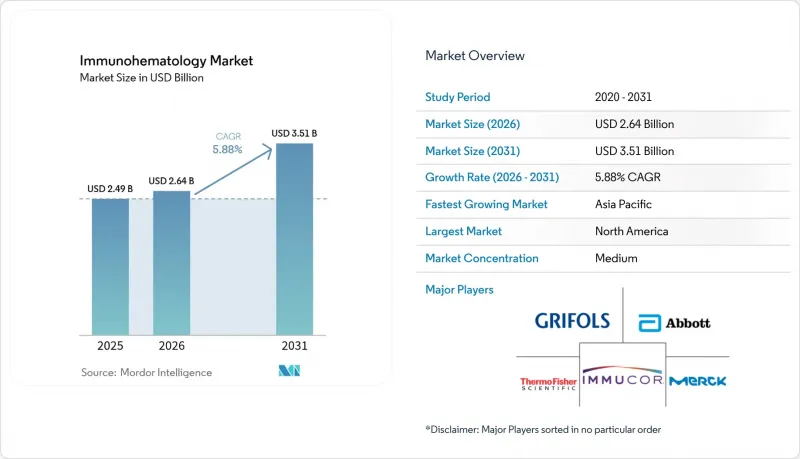
본 보고서는 제품별(면역혈액학 분석기[반자동 및 완전 자동] 및 면역혈액학 시약[적혈구 시약, 항혈청 시약 등]), 용도(혈액형 판정, 항체 스크리닝 등), 최종사용자(병원, 진단 검사실 등), 및 지역(북미, 유럽 등)별로 분류되어 있습니다. 시장 예측은 금액(달러) 기준으로 제시되어 있습니다.
세계 면역혈액학 시장의 동향 및 인사이트
고령화에 따른 외과 수술 건수 증가
고령층의 증가에 따라, 치밀한 혈액 적합성 검사가 필요한 심혈관 및 정형외과 수술 건수와 복잡성이 증가하고 있습니다. 병원에서는 고령 환자의 입원 기간 장기화와 수혈 수요 증가를 예상하고 있으며, 이는 시약 소비량의 지속적인 증가를 촉진하는 동시에 정확도를 저하시키지 않으면서 증가하는 검사량을 처리할 수 있는 완전 자동 분석 장치에 대한 투자를 뒷받침하고 있습니다. 최소침습 수술은 수술 중 출혈량을 줄이는 한편, 역설적으로 1건당 면역혈액학 업무 부담을 증가시키고 있습니다. 이는 외과의사가 유해 사건을 최소화하기 위해 더 엄격한 적합성 여유를 요구하기 때문입니다. 대규모 의료 기관에서는 이러한 업무량을 원활하게 처리하고, 긴급성이 높은 고령 환자 사례에 대해 일관된 검사 결과 보고 시간을 확보하기 위해 AI가 탑재된 분석 장치의 도입을 확대하기 시작했습니다.
외상 및 헤모글로빈 질환 발생률의 증가
응급실에서는 신속한 교차적합 검사나 대량 수혈 프로토콜이 필요한, 더 복잡한 외상 사례를 치료할 기회가 늘고 있습니다. 동시에, 겸상적혈구증과 같은 헤모글로빈 질환의 경우, 안전한 만성 수혈 지원을 위해 특수한 항체 선별 검사가 필수적입니다. 유니버시티 호스피털스(University Hospitals)는 2025년에 혈액은행의 검체 수가 7% 증가하고 검사 건수가 1만 2,000건 증가할 것이라고 보고하며, 신속하고 신뢰할 수 있는 면역혈액학 워크플로우에 대한 수요가 높아지고 있음을 부각시키고 있습니다. 전혈 프로그램 및 현장 진단(POCT)의 도입이 확대됨에 따라, 특히 그동안 수혈 서비스가 부족했던 지방 지역에서 몇 분 만에 정확한 혈청학적 또는 유전자형 검사 결과를 제공할 수 있는 휴대용 분석 기기에 대한 수요가 증가하고 있습니다.
자동 분석기의 높은 도입 및 유지 비용
완전 자동화 플랫폼의 가격은 종종 50만 달러를 초과하며, 서비스 계약으로 인해 연간 10-15%의 추가 비용이 발생하기 때문에 지역 병원이나 독립 검사실의 예산을 압박하고 있습니다. 이러한 지출을 정당화하기 어려운 의료 기관은 장비 교체를 미루거나 검사를 외부에 위탁하게 되는데, 이로 인해 검사 소요 시간이 길어지고 환자에게 위험이 높아질 가능성이 있습니다. 이러한 재정적 장벽으로 인해 조달 방향은 공유 서비스 모델이나 시약 임대 계약 쪽으로 기울고 있습니다. 이러한 모델에서는 공급업체가 하드웨어와 시약 구매 의무를 세트로 제공함으로써, 초기 투자와 장기적인 소모품 비용 간의 균형을 맞추려고 하고 있습니다.
부문 분석
2025년 매출액 중 면역혈액학용 시약이 56.68%를 차지하고 있어, 면역혈액학 시장의 모든 검사 절차에서 소모품이 핵심적인 역할을 하고 있음을 뒷받침하고 있습니다. 분석 장비는 일회성 설비 투자이긴 하지만, 병원이 증가하는 검사량을 관리하기 위해 자동화가 필요하기 때문에 연평균 성장률(CAGR) 11.05%로 성장하고 있습니다. 면역혈액학 시장에서 시약의 시장 규모는 앞으로도 하드웨어에 대한 지출을 계속 상회할 전망이지만, 자동화된 검사 1회당 여러 개의 시약 바이알이 소모되기 때문에 분석 장치의 보급률과 직접적인 관련이 있습니다. 적혈구용 시약은 일상적인 ABO/Rh형 판정의 기반이 되는 한편, 항혈청 패널에서는 위양성 판정을 최소화하기 위해 단일클론 항체의 특이성에 점점 더 의존하고 있습니다. 로슈가 2025년에 고감도 림프종 검사법에 대해 FDA 승인을 획득한 것은, 첨단 검출 시스템과 결합된 시약의 혁신이 추진되고 있음을 여실히 보여줍니다.
검사 건수가 많은 시설에서는 바코드 추적, 리플렉스 검사, LIS 연동 기능을 통합한 완전 자동 분석기로의 전환이 진행되고 있습니다. 한편, 고액의 유지보수 계약을 체결하지 않고도 수동 피펫팅을 줄이고자 하는 소규모 검사실에서는 반자동 장비가 여전히 중요한 역할을 하고 있습니다. 시약 렌탈 방식을 제공하는 업체는 분석기 설치와 소모품 구매 보증을 세트로 제공하며, 이를 통해 설비 투자를 운영비로 전환함으로써 자원이 제한된 환경에서의 도입을 원활하게 하고 있습니다.
지역별 분석
북미는 선진적인 의료 인프라, FDA의 엄격한 감독, 그리고 AI 탑재 분석 장치의 높은 보급률 덕분에 2025년에는 매출 점유율 35.50%로 1위를 차지했습니다. 이 지역 내 지출의 대부분은 미국이 차지하고 있지만, 캐나다도 캐나다 혈액 서비스(Canadian Blood Services)의 현대화 프로그램을 통해 기여하고 있습니다. 감염병 위험에 관한 FDA의 2025년 지침 초안은 이 지역이 세계 수혈 기준에 미치는 영향력을 여실히 보여주고 있습니다.
아시아태평양은 면역혈액학 시장에서 가장 빠르게 성장하는 시장으로, 2031년까지 연평균 성장률(CAGR)은 9.40%로 예측됩니다. 중국과 인도에서는 병원 네트워크와 혈액은행의 수용 능력을 확대하고 있는 반면, 일본과 한국에서는 최첨단 자동화 시스템이 도입되고 있습니다. 지역 내 자원 격차로 인해 도입 현황에 차이가 나타나고 있습니다. 도시 지역의 3차 의료기관에서는 AI 분석 장비가 주류를 이루는 반면, 지방 병원에서는 반자동 시스템에 의존하고 있습니다. 전문 인력 부족으로 인해 인적 개입을 최소화할 수 있는 ‘워크어웨이형’ 기기에 대한 수요가 증가하고 있습니다.
유럽은 여전히 성숙한 시장으로, 엄격한 유럽의약품청(EMA) 및 각국의 규제, 종합적인 혈액 감시 네트워크, 그리고 병원 통합이 특징입니다. 독일, 영국, 프랑스에서는 첨단 검사 정보 시스템이 도입되어 있으며, 분자 면역혈액학 프로젝트가 정기적으로 시범적으로 실시되고 있습니다. 남유럽 및 동유럽 국가에서는 현대화가 진행되고 있어, 중급 분석 장비 및 시약 임대 계약에 대한 성장 기회가 되고 있습니다.
중동에서는 양극화가 나타나고 있습니다. 걸프협력회의(GCC) 회원국들은 최첨단 혈액 센터에 투자하고 있는 반면, 많은 북아프리카 및 사하라 이남 아프리카 국가들은 여전히 인프라 부족으로 어려움을 겪고 있습니다. 국제 원조 프로젝트와 민관 파트너십을 통해 기본 시약의 접근성이 확대되고 있으며, 분석 장비의 단계적 도입을 위한 기반이 마련되고 있습니다.
기타 혜택:
- 엑셀 형식의 시장 예측(ME) 시트
- 3개월간의 애널리스트 지원
자주 묻는 질문
목차
제1장 소개
제2장 조사 방법
제3장 주요 요약
제4장 시장 구도
제5장 시장 규모와 성장 예측
제6장 경쟁 구도
제7장 시장 기회와 향후 전망
KSM 26.08.26According to Mordor Intelligence, the immunohematology market size is expected to grow from USD 2.49 billion in 2025 to USD 2.64 billion in 2026 and is forecast to reach USD 3.51 billion by 2031 at 5.88% CAGR over 2026-2031.
This report is Segmented by Product (Immunohematology Analyzers [Semi-Automated and Fully Automated] and Immunohematology Reagents [Red-Cell Reagents, Antisera Reagents and More]), Application (Blood Grouping, Antibody Screening and More), End User (Hospitals, Diagnostic Laboratories and More), and Geography (North America, Europe and More). The Market Forecasts are Provided in Terms of Value (USD).
Global Immunohematology Market Trends and Insights
Aging-related growth in surgical procedures
An expanding elderly cohort is raising the number and complexity of cardiovascular and orthopedic operations that rely on meticulous blood-compatibility checks. Hospitals anticipate longer inpatient stays and heavier transfusion needs from older patients, driving sustained reagent consumption and prompting investment in fully automated analyzers that can clear rising test volumes without compromising accuracy. Minimally invasive surgery, although reducing intra-operative blood loss, paradoxically increases per-case immunohematology workloads because surgeons demand tighter compatibility margins to minimize adverse events. Larger facilities have begun scaling AI-enabled analyzers to handle these workloads smoothly, ensuring consistent turnaround times for high-acuity geriatric cases.
Rising trauma & hemoglobinopathies incidence
Emergency departments are treating more complex trauma cases that require rapid cross-matching and massive transfusion protocols. Simultaneously, hemoglobinopathies such as sickle-cell disease necessitate specialized antibody screens for safe chronic transfusion support. University Hospitals reported a 7% rise in blood-bank samples and 12,000 additional tests in 2025, underscoring the growing need for fast, reliable immunohematology workflows. Field adoption of whole-blood programs and point-of-care testing is intensifying demand for portable analyzers capable of delivering accurate serologic or genotypic results in minutes, especially in rural areas that previously lacked transfusion services.
High capital & maintenance cost of automated analyzers
Fully automated platforms often exceed USD 500,000, with service contracts adding another 10-15% annually, stretching budgets of community hospitals and independent labs. Facilities struggling to justify such expenditure either delay upgrades or outsource testing, which can increase turnaround time and patient risk. Financial hurdles are steering procurement toward shared-service models and reagent-rental agreements where vendors bundle hardware with reagent commitments, attempting to balance initial outlay and long-term consumable spend.
Other drivers and restraints analyzed in the detailed report include:
- Mandated universal antibody screening in transfusion services
- AI-enabled fully automated analyzers cutting TAT
- Short shelf-life of certain rare-cell reagents
For complete list of drivers and restraints, kindly check the Table Of Contents.
Segment Analysis
Immunohematology reagents accounted for 56.68% of 2025 revenue, confirming the consumable core of every test procedure in the immunohematology market. Analyzers, though only a one-time capital purchase, are growing at an 11.05% CAGR because hospitals need automation to manage rising volumes. The immunohematology market size for reagents will continue to overshadow hardware spending yet is directly linked to analyzer penetration, since each automated test consumes multiple reagent vials. Red-cell reagents underpin routine ABO/Rh typing, while antisera panels increasingly rely on monoclonal specificity to minimize false-positive flags. Roche's 2025 FDA clearance for a highly sensitive lymphoma assay underscores the push for reagent innovation that pairs with sophisticated detection systems.
Laboratories in high-volume settings migrate toward fully automated analyzers that integrate barcode tracking, reflex testing, and LIS interfacing. Semi-automated instruments retain relevance in smaller labs looking to reduce manual pipetting without incurring premium maintenance contracts. Vendors offering reagent-rental structures bundle analyzer placement with guaranteed consumable purchases, shifting capital expenditure toward operating expenditure and smoothing adoption in resource-constrained environments.
Complete Report Scope:
- By Product
- Immunohematology Analyzers
- Semi-Automated
- Fully Automated
- Immunohematology Reagents
- Red-Cell Reagents
- Antisera Reagents
- Enhancement & Control Solutions
- Immunohematology Analyzers
- By Application
- Blood Grouping (ABO/Rh)
- Antibody Screening & Identification
- Cross-Matching
- Prenatal & Neonatal Testing
- By End User
- Hospitals
- Diagnostic Laboratories
- Blood Banks & Transfusion Centers
- Research & Academic Institutes
- Geography
- North America
- United States
- Canada
- Mexico
- Europe
- Germany
- United Kingdom
- France
- Italy
- Spain
- Rest of Europe
- Asia-Pacific
- China
- Japan
- India
- South Korea
- Australia
- Rest of Asia-Pacific
- Middle East and Africa
- GCC
- South Africa
- Rest of Middle East and Africa
- South America
- Brazil
- Argentina
- Rest of South America
- North America
Geography Analysis
North America led with 35.50% revenue share in 2025 due to sophisticated healthcare infrastructure, stringent FDA oversight, and high adoption of AI-enabled analyzers. The United States accounts for the bulk of regional spending, while Canada contributes through Canadian Blood Services modernization programs. The FDA's 2025 draft guidances on communicable-disease risk underscore the region's influence on global transfusion standards.
Asia-Pacific is the immunohematology market's fastest-growing arena, projected at 9.40% CAGR through 2031. China and India are scaling hospital networks and blood-bank capacity, while Japan and South Korea deploy cutting-edge automation. Resource differentials across the region create stratified adoption: urban tertiary centers champion AI analyzers, whereas district hospitals rely on semi-automated systems. Workforce shortages in specialized roles propel demand for walk-away instruments that require minimal human intervention.
Europe remains a mature market characterized by rigorous EMA and national regulations, comprehensive hemovigilance networks, and hospital consolidation. Germany, the United Kingdom, and France field advanced laboratory information systems and routinely pilot molecular immunohematology projects. Southern and Eastern European nations are modernizing, offering growth pockets for mid-range analyzers and reagent rental contracts.
The Middle East displays bifurcation: Gulf Cooperation Council states invest in state-of-the-art blood centers, while many North African and sub-Saharan nations still grapple with infrastructure shortfalls. International aid projects and public-private partnerships are expanding basic reagent availability, setting the stage for gradual analyzer deployment.
- Abbott Laboratories
- Beckton Dickinson
- Becton Dickinson & Co.
- Bio-Rad Laboratories
- Cardinal Health
- Roche
- Grifols
- Immucor
- Merck
- Ortho Clinical Diagnostics
- Siemens Healthineers
- Thermo Fisher Scientific
- bioMerieux
- DiaSorin
- Quotient Limited
- Fresenius
- BAG-Diagnostics GmbH
- Inno-Train Diagnostik
- Tulip Diagnostics
- HemoCue AB (Radiometer)
Additional Benefits:
- The market estimate (ME) sheet in Excel format
- 3 months of analyst support
TABLE OF CONTENTS
1 Introduction
- 1.1 Study Assumptions & Market Definition
- 1.2 Scope of the Study
2 Research Methodology
3 Executive Summary
4 Market Landscape
- 4.1 Market Overview
- 4.2 Market Drivers
- 4.2.1 Aging-Related Growth In Surgical Procedures
- 4.2.2 Rising Trauma & Hemoglobinopathies Incidence
- 4.2.3 Mandated Universal Antibody Screening In Transfusion Services
- 4.2.4 AI-Enabled Fully-Automated Analyzers Cutting TAT
- 4.2.5 Transition From Polyclonal To Monoclonal Reagent Formulations
- 4.2.6 Demand For Molecular Immunohematology (Genotyping)
- 4.3 Market Restraints
- 4.3.1 High Capital & Maintenance Cost Of Automated Analyzers
- 4.3.2 Short Shelf-Life Of Certain Rare-Cell Reagents
- 4.3.3 Scarcity Of Certified Immunohematologists In Lmics
- 4.3.4 Reimbursement Gaps For Advanced Antibody Panels
- 4.4 Porter's Five Forces
- 4.4.1 Threat of New Entrants
- 4.4.2 Bargaining Power of Buyers
- 4.4.3 Bargaining Power of Suppliers
- 4.4.4 Threat of Substitutes
- 4.4.5 Competitive Rivalry
5 Market Size & Growth Forecasts (Value, USD)
- 5.1 By Product
- 5.1.1 Immunohematology Analyzers
- 5.1.1.1 Semi-Automated
- 5.1.1.2 Fully Automated
- 5.1.2 Immunohematology Reagents
- 5.1.2.1 Red-Cell Reagents
- 5.1.2.2 Antisera Reagents
- 5.1.2.3 Enhancement & Control Solutions
- 5.1.1 Immunohematology Analyzers
- 5.2 By Application
- 5.2.1 Blood Grouping (ABO/Rh)
- 5.2.2 Antibody Screening & Identification
- 5.2.3 Cross-Matching
- 5.2.4 Prenatal & Neonatal Testing
- 5.3 By End User
- 5.3.1 Hospitals
- 5.3.2 Diagnostic Laboratories
- 5.3.3 Blood Banks & Transfusion Centers
- 5.3.4 Research & Academic Institutes
- 5.4 Geography
- 5.4.1 North America
- 5.4.1.1 United States
- 5.4.1.2 Canada
- 5.4.1.3 Mexico
- 5.4.2 Europe
- 5.4.2.1 Germany
- 5.4.2.2 United Kingdom
- 5.4.2.3 France
- 5.4.2.4 Italy
- 5.4.2.5 Spain
- 5.4.2.6 Rest of Europe
- 5.4.3 Asia-Pacific
- 5.4.3.1 China
- 5.4.3.2 Japan
- 5.4.3.3 India
- 5.4.3.4 South Korea
- 5.4.3.5 Australia
- 5.4.3.6 Rest of Asia-Pacific
- 5.4.4 Middle East and Africa
- 5.4.4.1 GCC
- 5.4.4.2 South Africa
- 5.4.4.3 Rest of Middle East and Africa
- 5.4.5 South America
- 5.4.5.1 Brazil
- 5.4.5.2 Argentina
- 5.4.5.3 Rest of South America
- 5.4.1 North America
6 Competitive Landscape
- 6.1 Market Concentration
- 6.2 Market Share Analysis
- 6.3 Company Profiles (includes Global level Overview, Market level overview, Core Segments, Financials as available, Strategic Information, Market Rank/Share for key companies, Products & Services, and Recent Developments)
- 6.3.1 Abbott Laboratories
- 6.3.2 Beckman Coulter Inc. (Danaher)
- 6.3.3 Becton Dickinson & Co.
- 6.3.4 Bio-Rad Laboratories
- 6.3.5 Cardinal Health
- 6.3.6 F. Hoffmann-La Roche
- 6.3.7 Grifols S.A.
- 6.3.8 Immucor Inc.
- 6.3.9 Merck KGaA
- 6.3.10 Ortho Clinical Diagnostics
- 6.3.11 Siemens Healthineers
- 6.3.12 Thermo Fisher Scientific
- 6.3.13 bioMerieux SA
- 6.3.14 DiaSorin S.p.A.
- 6.3.15 Quotient Limited
- 6.3.16 Fresenius Kabi
- 6.3.17 BAG-Diagnostics GmbH
- 6.3.18 Inno-Train Diagnostik
- 6.3.19 Tulip Diagnostics
- 6.3.20 HemoCue AB (Radiometer)
7 Market Opportunities & Future Outlook
- 7.1 White-space & Unmet-Need Assessment


