

|
시장보고서
상품코드
2116064
혈액 종양 검사 : 시장 점유율 분석, 업계 동향 및 통계, 성장 예측(2026-2031년)Global Hemato Oncology Testing - Market Share Analysis, Industry Trends & Statistics, Growth Forecasts (2026 - 2031) |
||||||
 Mordor Intelligence
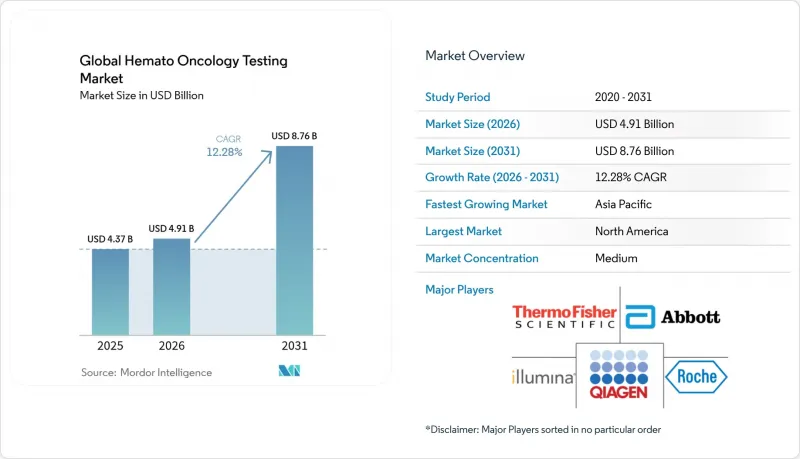
Mordor Intelligence에 의하면, 2026년 혈액 종양 검사 시장 규모는 49억 1,000만 달러로 추정되고 2025년 43억 7,000만 달러에서 확대해, 2031년에는 87억 6,000만 달러에 이를 것으로 예측됩니다.
2026-2031년 동안의 연평균 성장률(CAGR)은 12.28%가 될 것으로 전망됩니다.
본 보고서에서는 제품 및 서비스별(분석 키트 및 시약, 서비스), 암 유형별(백혈병, 림프종, 다발성 골수종, 기타),기술별(중합효소 연쇄반응(PCR), 면역조직화학(IHC), 차세대 염기서열 분석(NGS), 기타 기술), 최종 사용자별(병원, 학술·연구 기관, 기타 최종 사용자), 지역별로 분류하고 있습니다.
세계의 혈액 종양 검사 시장 동향 및 인사이트
혈액암 발병률 증가
세계 질병 부담에 관한 연구에 따르면, 인구 고령화와 진단 프로그램의 개선으로 인해 사례 발견률이 향상됨에 따라 다발성 골수종, 급성 골수성 백혈병, 다양한 림프계 종양의 유병률이 상승하고 있습니다. 그 결과, 의료 시스템은 희귀 유전자형이나 복잡한 구조적 변이를 규명할 수 있는 고해상도 분자 검사에 대한 지속적인 수요에 직면해 있습니다. 3세대 시퀀싱은 이미 지중해빈혈 선별 검사에서 기존 방식을 능가하는 성능을 보여주고 있으며, 이를 통해 더 조기적인 유전 상담 및 산전 의사결정이 가능해졌습니다. 환자 수가 증가함에 따라, 종합적인 유전체 패널을 도입한 검사 기관은 보다 신속하고 정확한 분류를 제공하여 치료법 선택 및 경과 관찰을 지원할 수 있습니다. 따라서 혈액 종양 검사 시장은 수요, 기술 가용성, 임상의의 수용이라는 선순환의 혜택을 받고 있습니다.
맞춤형 치료에 대한 수요 증가
동반 진단이 분자 검사 결과를 표적 치료제, 면역 요법, 세포 기반 중재와 연계함에 따라 정밀 종양학은 치료 경로를 혁신하고 있습니다. 2024년 8월, FDA는 일루미나(Illumina)사의 ‘TruSight Oncology Comprehensive’ 분석법을 승인했습니다. 이는 500개 이상의 유전자를 포괄하는 최초의 범암(pan-cancer) 검사로서, 규제 당국이 광범위한 검사 패널의 승인을 긍정적으로 검토하고 있음을 보여줍니다. 비용 대비 효과 연구에 따르면, 초기 단계의 NGS 프로파일링을 통해 효과가 없는 치료를 배제하고 최적의 치료에 도달하는 시간을 단축함으로써 총 비용을 절감할 수 있음이 추가로 입증되었습니다. 보험사들이 실세계 증거(RWE)를 점점 더 많이 도입함에 따라, 분자 검사는 선택적 검사에서 표준 치료로 전환되고 있으며, 이는 혈액 종양 검사 시장의 잠재 고객 기반을 확대되고 있습니다.
불리한 보험 지급 상황
CMS 데이터에 따르면, 2020년 보험 적용 조정 후 메디케어에서 검사용 NGS 청구에 대한 불승인률은 16.8%에서 27.4%로 상승했으며, 독립 검사 기관이 특히 큰 영향을 받고 있습니다. 민간 보험사들도 Z 코드 등 사전 승인 장벽을 설정하고 있어, 이로 인해 청구 주기가 길어지고 업무 처리 부담이 증가하고 있습니다. 검사 기관은 임상의와의 관계를 유지하기 위해 환급되지 않는 검사 비용을 보전하는 경우가 많으며, 이는 이익률을 압박하고 있습니다. 이러한 동향으로 인해 단기적인 현금 흐름이 억제되고, 비용에 민감한 환경에서 검사 도입이 둔화되고 있어 혈액 종양 검사 시장의 성장을 저해하는 요인이 되고 있습니다.
부문별 분석
2025년에는 서비스가 매출의 67.85%를 차지하며 혈액 종양 검사 시장에서 가장 큰 부문이 되었습니다. 병원 네트워크, 지역 클리닉, 제약 기업 후원사는 검체 물류, 핵산 추출, 시퀀싱, 생물정보학, 변이체 큐레이션에 이르는 종단간 워크플로우에 대해 전문 서비스 제공업체에 의존하고 있습니다. 이 부문의 높은 점유율은 분자진단 실험실의 높은 자본 집약도와 사내 전문 지식의 부족을 반영합니다. 금액 기준으로 볼 때, 이러한 주도적인 위상은 2025년 혈액 종양 검사 시장 규모 중 29억 7,000만 달러에 해당합니다. 검사실이 인력 부족 문제를 해결하고, 검사 결과 도출 시간 지연으로 인한 불이익을 줄이기 위해 처리 능력을 초과하는 검사량을 외부에 위탁하고 있기 때문에 시장 전망은 계속해서 견조합니다.
어세이 키트 및 시약은 규모는 작지만, 2031년까지 연평균 성장률(CAGR)이 12.79%로 제품 분류 중 가장 높은 성장률을 보이고 있습니다. 성장의 핵심은 멀티플렉스 PCR 패널, 싱글 튜브 방식의 라이브러리 준비법, 현장 도입을 지원하는 동결건조 시약입니다. QIAGEN 등의 기업은 추출과 분석 설정을 통합한 ‘샘플에서 결과까지’ 플랫폼을 발표하고 있으며, 이를 통해 일관성이 향상되고 조작 오류가 감소합니다. 이러한 개선으로 소규모 검사실에서도 분자 검사 메뉴를 도입하기 쉬워져, 혈액 종양 검사 시장의 검사량이 증가하고 있습니다.
2025년, 림프종 검사는 혈액 종양 검사 시장 점유율의 40.37%를 차지했습니다. 이는 호지킨 림프종과 비호지킨 림프종의 다양한 병태를 반영한 것으로, 각각에서 면역표현형 분석, 유전자 재조합 분석, 돌연변이 패널 검사가 요구되고 있습니다. 항체-약물 복합체(ADC) 및 CAR-T 치료법과의 하류 연계로 인해, 종합적인 검사는 임상상 필수 요건으로 더욱 자리 잡고 있습니다. 그 결과, 2025년 혈액 종양 검사 시장 규모 중 림프종이 17억 6,000만 달러를 차지했습니다.
백혈병 검사는 규모는 작지만, MRD(미세 잔류 병변) 모니터링이 표준 치료로 자리 잡으면서 연평균 성장률(CAGR) 13.28%로 성장하고 있습니다. clonoSEQ 등 FDA 승인을 받은 검사법을 통해 잔류 클론의 정량적 추적이 가능해져, 치료 조정 및 이식 계획의 지침이 되고 있습니다. 뉴클레오솜 DNA의 단편화를 모니터링하는 체액 생검 접근법은 재발의 조기 발견을 가능하게 할 것으로 기대됩니다. 보험사들이 정기적인 모니터링의 예후 예측 가치를 인식함에 따라, 백혈병 검사 건수 증가는 혈액 종양 검사 시장 전체의 수익을 크게 끌어올릴 것으로 보입니다.
지역별 분석
2025년에는 성숙한 보상 제도와 기술의 조기 도입으로 인해 검사 이용률이 높은 수준을 유지함에 따라, 북미가 매출 점유율의 41.80%를 차지하며 시장을 주도했습니다. 메디케어의 급여 거부가 증가하고 있음에도 불구하고, 미국에서는 시장 출시 기간을 단축하는 클래스 II MRD 의료기기를 포함하여 새로운 검사법의 승인이 계속해서 신속하게 이루어지고 있습니다. BioReference Health의 자산 인수를 대표로 하는 검사 기관의 통합은 규모의 경제를 가져와 이익률을 유지하고 있습니다. 캐나다 각 주의 의료 제도에서는 통합된 유전체 프로그램이 도입되고 있으며, 멕시코의 민간 부문에서는 의료 관광용 액체 생검 서비스 확대가 진행되고 있습니다. 이러한 동향들이 맞물려 혈액 종양 검사 시장 중에서도 포화 상태에 있는 부문에서 한 자릿수 중반대의 성장을 뒷받침하고 있습니다.
아시아태평양은 가장 역동적인 지역으로, 2031년 연평균 성장률(CAGR)은 13.9%로 예측됩니다. 중국, 일본, 인도의 정부 정책에 따라 검사실 현대화를 위한 자금 지원과 표준 치료로서의 분자 패널 검사에 대한 보조금이 지급되고 있습니다. 시스멕스는 2025년도 1분기에 해당 지역의 혈액학 분야 매출이 119.2% 증가한 것을 기록했으며, 이는 고급 분석 기기에 대한 수출 수요가 높음을 뒷받침하고 있습니다. 규제 체계는 체외진단용 의약품(IVD)의 조화를 통해 점차 통합되고 있으며, 이는 승인 기간 단축과 현지 생산 활성화로 이어지고 있습니다. 분산형 현장 진단(PoC) PCR 플랫폼을 채택한 동남아시아 국가들은 기존 인프라를 뛰어넘는 형태로 발전하고 있으며, 새로운 검사 건수를 기록함으로써 지역 전체의 혈액 종양 검사 시장을 주도하고 있습니다.
유럽에서는 공적 보험자가 비용 대비 효과를 신중하게 검토하고 있어 균형 잡힌 성장을 유지하고 있습니다. EU 전역에 걸친 노력으로 데이터 상호 운용성이 촉진되어, 국경을 넘는 임상 검사 및 참조 검사 기관과의 연계가 용이해지고 있습니다. 독일과 프랑스에서는 NGS 패널의 보험 적용 범위가 확대되고 있으며, 영국의 ‘유전체 의학 서비스(Genomic Medicine Service)’에서는 혈액학 적응증이 지속적으로 추가되고 있습니다. 동유럽 각국의 보건부는 지역 병원과 중앙 전문 기관을 연결하는 원격 병리 진단 시범 사업에 자금을 지원하고 있으며, 이로 인해 1인당 검사율이 완만하게 상승하고 있습니다. 한편, 걸프협력회의(GCC) 회원국들은 미국과 EU에서 승인된 검사 키트를 도입하는 최첨단 종양 센터에 대한 투자를 추진하고 있으며, 남아프리카공화국은 사하라 이남 아프리카의 참조 허브로서의 위상을 확립해 가고 있습니다. 이러한 동향들이 맞물려 광범위한 지리적 다양성이 유지되고 있으며, 이는 혈액 종양 검사 시장의 전 세계적인 확장을 뒷받침하고 있습니다.
기타 혜택
- 엑셀 형식 시장 예측(ME) 시트
- 3개월간의 애널리스트 지원
자주 묻는 질문
목차
제1장 서론
제2장 조사 방법
제3장 개요
제4장 시장 구도
제5장 시장 규모 및 성장 예측
제6장 경쟁 구도
제7장 시장 기회 및 향후 전망
KTH 26.08.31According to Mordor Intelligence, hemato oncology testing market size in 2026 is estimated at USD 4.91 billion, growing from 2025 value of USD 4.37 billion with 2031 projections showing USD 8.76 billion, growing at 12.28% CAGR over 2026-2031.
This report Segments the Industry Into by Product & Services (Assay Kits and Reagents, Services), by Cancer Type (Leukemia, Lymphoma, Multiple Myeloma, Others), by Technology (Polymerase Chain Reaction (PCR), Immunohistochemistry (IHC), Next-Generation Sequencing (NGS), Other Technology), by End User (Hospitals, Academic & Research Institutes, Other End-Users), and Geography.
Global Hemato Oncology Testing Market Trends and Insights
Increasing Incidence of Hematologic Cancers
Global burden studies show that multiple myeloma, acute myeloid leukemia, and diverse lymphoid neoplasms are climbing in prevalence as populations age and diagnostic programs improve case detection. Healthcare systems consequently face sustained demand for high-resolution molecular testing capable of revealing rare genotypes and complex structural variations. Third-generation sequencing already outperforms conventional methods in thalassemia screening, enabling earlier genetic counselling and prenatal decision making . With rising patient volumes, laboratories that deploy comprehensive genomic panels can provide faster, more precise classification, supporting treatment selection and monitoring. The hemato oncology testing market therefore benefits from a virtuous cycle of need, technology availability, and clinician acceptance.
Growing Demand for Personalized Therapy
Precision oncology is reshaping treatment pathways as companion diagnostics link molecular findings to targeted drugs, immunotherapies, and cell-based interventions. The FDA's August 2024 approval of Illumina's TruSight Oncology Comprehensive assay, the first pancancer test with claims covering more than 500 genes, underscores regulator readiness to endorse broad panels. Cost-effectiveness studies further indicate that upfront NGS profiling reduces overall spend by eliminating ineffective treatments and shortening time to optimal therapy. As payers increasingly integrate real-world evidence, molecular testing transitions from optional work-up to standard of care, enlarging the addressable base for the hemato oncology testing market.
Unfavorable Reimbursement Scenario
CMS data reveal Medicare denial rates for laboratory NGS claims climbed from 16.8% to 27.4% after 2020 coverage adjustments, with independent labs disproportionately affected. Commercial insurers have added precertification hurdles such as Z-codes, lengthening claim cycles and introducing administrative overhead. Laboratories often subsidise unreimbursed tests to maintain clinician relationships, pressuring margins. These dynamics moderate near-term cash inflows and temper adoption in cost-sensitive settings, placing a drag on the hemato oncology testing market.
Other drivers and restraints analyzed in the detailed report include:
- Advancements in Molecular Diagnostic Technologies
- Rising Adoption of Non-Invasive Liquid Biopsy
- Shortage of Skilled Molecular Pathologists
For complete list of drivers and restraints, kindly check the Table Of Contents.
Segment Analysis
Services contributed 67.85% revenue in 2025, making them the single largest slice of the hemato oncology testing market. Hospital networks, community clinics, and pharma sponsors rely on specialised service providers for end-to-end workflows that span sample logistics, nucleic-acid extraction, sequencing, bioinformatics, and variant curation. The segment's high share reflects the capital intensity of molecular laboratories and the scarcity of in-house expertise. In value terms, this leadership translates into USD 2.97 billion of the 2025 hemato oncology testing market size. Market outlook remains strong as laboratories outsource overflow volumes to combat staff shortages and reduce turnaround-time penalties.
Assay kits and reagents, although smaller, exhibit a 12.79% CAGR through 2031, the fastest within the product grid. Growth centres on multiplex PCR panels, single-tube library prep chemistries, and lyophilised reagents that support field deployment. Firms such as QIAGEN announced sample-to-result platforms that integrate extraction and assay setup, enhancing consistency and lowering operator error. These improvements encourage smaller laboratories to launch molecular menus, adding incremental volume to the hemato oncology testing market.
Lymphoma testing held 40.37% of the hemato oncology testing market share in 2025, reflecting the diverse spectrum of Hodgkin and non-Hodgkin entities that each demand immunophenotyping, gene rearrangement studies, and mutational panels. The downstream linkage to antibody-drug conjugates and CAR-T therapies further entrenches comprehensive testing as a clinical imperative. Consequently, lymphoma accounted for USD 1.76 billion of the 2025 hemato oncology testing market size.
Leukemia testing, while smaller, grows at 13.28% CAGR as MRD surveillance becomes standard of care. FDA-cleared assays such as clonoSEQ enable quantitative tracking of residual clones, guiding therapy adjustment and transplant planning. Liquid biopsy approaches that monitor nucleosomal DNA fragmentation promise earlier relapse detection. As payers recognise the prognostic value of serial monitoring, volume growth in leukemia tests will meaningfully lift overall revenue for the hemato oncology testing market.
Complete Report Scope:
- By Product & Services
- Assay Kits & Reagents
- PCR assay kits
- NGS panels & library prep kits
- IHC/Flow-cytometry reagents
- Services
- Assay Kits & Reagents
- By Cancer Type
- Leukemia
- Lymphoma
- Multiple Myeloma
- Other Hematologic Malignancies
- By Technology
- Polymerase Chain Reaction (PCR)
- Next-Generation Sequencing (NGS)
- Immunohistochemistry (IHC)
- Flow Cytometry
- Other Technologies
- By End User
- Hospitals
- Reference & Specialty Laboratories
- Other End-Users
- By Geography
- North America
- United States
- Canada
- Mexico
- Europe
- Germany
- United Kingdom
- France
- Italy
- Spain
- Rest of Europe
- Asia-Pacific
- China
- Japan
- India
- Australia
- South Korea
- Rest of Asia-Pacific
- Middle East & Africa
- GCC
- South Africa
- Rest of Middle East & Africa
- South America
- Brazil
- Argentina
- Rest of South America
- North America
Geography Analysis
North America led with 41.80% revenue share in 2025 as mature reimbursement structures and early technology adoption sustained high test utilisation. Despite rising Medicare denials, the United States continues to approve new assays rapidly, including Class II MRD devices that shorten time-to-market. Laboratory consolidation, exemplified by BioReference Health asset acquisitions, yields economies of scale that protect margins. Canada's provincial health systems are introducing centralised genomic programmes, and Mexico's private sector is scaling liquid biopsy services for medical tourism. Together, these dynamics support mid-single-digit growth in an otherwise saturated segment of the hemato oncology testing market.
Asia-Pacific is the most dynamic region, posting a 13.9% CAGR forecast to 2031. Government initiatives in China, Japan, and India fund laboratory modernisation and subsidise molecular panels as standard care. Sysmex recorded a 119.2% increase in regional hematology revenue during the first quarter of fiscal 2025, underscoring export demand for advanced analysers. Regulatory frameworks are converging toward IVD harmonisation, trimming approval times and stimulating local production. Southeast Asian countries employing decentralised point-of-care PCR platforms are leapfrogging legacy infrastructure, registering new test volumes that lift the hemato oncology testing market across the region.
Europe maintains balanced growth as public payers weigh cost-effectiveness carefully. Pan-EU initiatives encourage data interoperability, facilitating cross-border clinical trials and reference-lab collaborations. Germany and France are enlarging reimbursement codes for NGS panels, and the United Kingdom's Genomic Medicine Service continues to add haematology indications. Eastern European health ministries fund tele-pathology pilots that connect local hospitals with central expertise, modestly raising per-capita test rates. Meanwhile, the Gulf Cooperation Council states invest in high-end oncology centres that import US- and EU-cleared assays, and South Africa positions itself as a sub-Saharan reference hub. Collectively, these trends sustain broad geographical diversity and underpin the global expansion of the hemato oncology testing market.
- Roche
- Abbott Laboratories
- Thermo Fisher Scientific
- QIAGEN
- Illumina
- Bio-Rad Laboratories
- Guardant Health
- Adaptive Biotechnologies
- Invitae Corp. / ArcherDX
- Cepheid (Danaher)
- EntroGen Inc.
- NeoGenomics Inc.
- Sysmex Corp.
- Beckman Coulter (Danaher)
- Siemens Healthineers
- Beckton Dickinson
- Labcorp Oncology
- Precipio Inc.
- Biotype GmbH
- Invivoscribe Inc.
Additional Benefits:
- The market estimate (ME) sheet in Excel format
- 3 months of analyst support
TABLE OF CONTENTS
1 Introduction
- 1.1 Study Assumptions & Market Definition
- 1.2 Scope of the Study
2 Research Methodology
3 Executive Summary
4 Market Landscape
- 4.1 Market Overview
- 4.2 Market Drivers
- 4.2.1 Increasing incidence of hematologic cancers
- 4.2.2 Growing demand for personalized therapy
- 4.2.3 Advancements in molecular diagnostic technologies
- 4.2.4 Rising adoption of non-invasive liquid biopsy
- 4.2.5 AI-driven decision support in heme-oncology labs
- 4.2.6 Decentralized PoC molecular platforms in emerging markets
- 4.3 Market Restraints
- 4.3.1 Unfavorable reimbursement scenario
- 4.3.2 High cost of next-generation sequencing tests
- 4.3.3 Shortage of skilled molecular pathologists
- 4.3.4 Genomic-data interoperability & cybersecurity gaps
- 4.4 Value / Supply-Chain Analysis
- 4.5 Regulatory Landscape
- 4.6 Technological Outlook
- 4.7 Porter's Five Forces Analysis
- 4.7.1 Threat of New Entrants
- 4.7.2 Bargaining Power of Buyers
- 4.7.3 Bargaining Power of Suppliers
- 4.7.4 Threat of Substitutes
- 4.7.5 Competitive Rivalry
5 Market Size & Growth Forecasts (Value)
- 5.1 By Product & Services
- 5.1.1 Assay Kits & Reagents
- 5.1.1.1 PCR assay kits
- 5.1.1.2 NGS panels & library prep kits
- 5.1.1.3 IHC/Flow-cytometry reagents
- 5.1.2 Services
- 5.1.1 Assay Kits & Reagents
- 5.2 By Cancer Type
- 5.2.1 Leukemia
- 5.2.2 Lymphoma
- 5.2.3 Multiple Myeloma
- 5.2.4 Other Hematologic Malignancies
- 5.3 By Technology
- 5.3.1 Polymerase Chain Reaction (PCR)
- 5.3.2 Next-Generation Sequencing (NGS)
- 5.3.3 Immunohistochemistry (IHC)
- 5.3.4 Flow Cytometry
- 5.3.5 Other Technologies
- 5.4 By End User
- 5.4.1 Hospitals
- 5.4.2 Reference & Specialty Laboratories
- 5.4.3 Other End-Users
- 5.5 By Geography
- 5.5.1 North America
- 5.5.1.1 United States
- 5.5.1.2 Canada
- 5.5.1.3 Mexico
- 5.5.2 Europe
- 5.5.2.1 Germany
- 5.5.2.2 United Kingdom
- 5.5.2.3 France
- 5.5.2.4 Italy
- 5.5.2.5 Spain
- 5.5.2.6 Rest of Europe
- 5.5.3 Asia-Pacific
- 5.5.3.1 China
- 5.5.3.2 Japan
- 5.5.3.3 India
- 5.5.3.4 Australia
- 5.5.3.5 South Korea
- 5.5.3.6 Rest of Asia-Pacific
- 5.5.4 Middle East & Africa
- 5.5.4.1 GCC
- 5.5.4.2 South Africa
- 5.5.4.3 Rest of Middle East & Africa
- 5.5.5 South America
- 5.5.5.1 Brazil
- 5.5.5.2 Argentina
- 5.5.5.3 Rest of South America
- 5.5.1 North America
6 Competitive Landscape
- 6.1 Market Concentration
- 6.2 Market Share Analysis
- 6.3 Company Profiles (includes Global level Overview, Market level overview, Core Segments, Financials as available, Strategic Information, Market Rank/Share for key companies, Products & Services, and Recent Developments)
- 6.3.1 F. Hoffmann-La Roche Ltd
- 6.3.2 Abbott Laboratories
- 6.3.3 Thermo Fisher Scientific Inc.
- 6.3.4 QIAGEN
- 6.3.5 Illumina Inc.
- 6.3.6 Bio-Rad Laboratories Inc.
- 6.3.7 Guardant Health
- 6.3.8 Adaptive Biotechnologies
- 6.3.9 Invitae Corp. / ArcherDX
- 6.3.10 Cepheid (Danaher)
- 6.3.11 EntroGen Inc.
- 6.3.12 NeoGenomics Inc.
- 6.3.13 Sysmex Corp.
- 6.3.14 Beckman Coulter (Danaher)
- 6.3.15 Siemens Healthineers
- 6.3.16 Becton, Dickinson and Company
- 6.3.17 Labcorp Oncology
- 6.3.18 Precipio Inc.
- 6.3.19 Biotype GmbH
- 6.3.20 Invivoscribe Inc.
7 Market Opportunities & Future Outlook
- 7.1 White-Space & Unmet-Need Assessment


