|
시장보고서
상품코드
2116065
조혈모세포 이식 : 시장 점유율 분석, 업계 동향과 통계, 성장 예측(2026-2031년)Hematopoietic Stem Cell Transplantation - Market Share Analysis, Industry Trends & Statistics, Growth Forecasts (2026 - 2031) |
||||||
 Mordor Intelligence
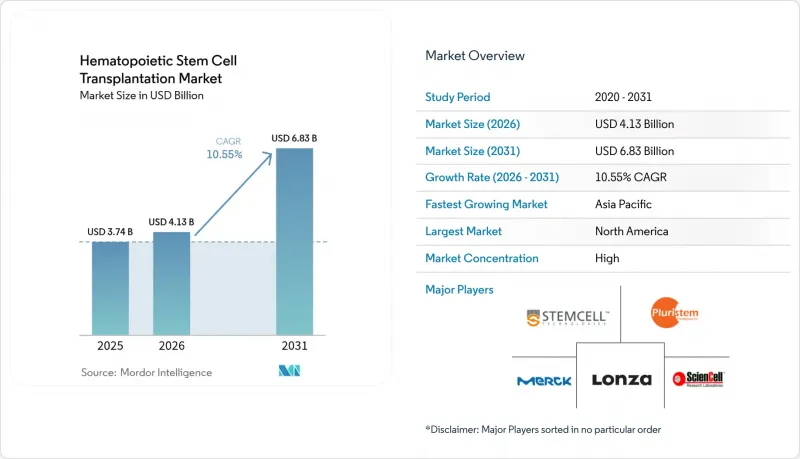
Mordor Intelligence에 따르면 조혈모세포 이식 시장 규모는 2025년에 37억 4,000만 달러로 평가되며, 2026년 41억 3,000만 달러에서 2031년까지 68억 3,000만 달러에 달할 것으로 예측되며, 예측 기간(2026-2031년) 동안 CAGR은 10.55%가 될 전망입니다.
본 보고서에서는 시장을 이식 유형(자가 이식 등), 줄기세포 채취원(말초혈액 줄기세포 이식 등), 적응증(백혈병 등), 최종사용자(이식·세포 치료 센터 등), 및 지역(북미, 유럽, 아시아태평양 등)별로 분류하고 있습니다. 시장 예측은 금액(달러) 기준으로 제시되어 있습니다.
세계 조혈모세포 이식 시장의 동향 및 인사이트
세계 혈액 악성 종양 발병률 증가
2024년, 전 세계 암 신규 발병 건수는 2,000만 건에 달하며, 그중 백혈병이 이식 수술의 34.65%를 차지하고 있어 조혈모세포 이식 시장에 대한 꾸준한 수요가 뒷받침되고 있습니다. 조기 발견 프로토콜의 확립과 2024년 메디케어가 골수이형성증후군의 적용 범위를 확대함에 따라, 미국 내 치료 접근 장벽은 낮아졌습니다. 유럽과 북미에서는 고령화로 인해 적격 환자 수가 많이 유지되고 있으며, 신흥 시장에서도 진단 인프라의 개선에 따라 유사한 경향이 나타나고 있습니다. 질환의 초기 단계에서 선별 검사를 실시함으로써 전처치에 대한 내성 범위가 확대되어 더 많은 이식이 가능해졌습니다. 질환 발생률이 지속적으로 증가하고 있다는 점을 고려할 때, 이러한 촉진요인은 2030년 이후에도 그 기세를 유지할 것으로 예상됩니다.
전처치 요법의 발전
2025년 1월, 트레오설판을 주성분으로 하는 ‘그라파펙스(Grafapex)’가 승인됨에 따라, 부설판 프로토콜에 비해 전체 생존율이 향상된 저강도 전처치가 가능해졌으며, 조혈모세포 이식의 대상이 허약한 환자나 고령 환자까지 확대되었습니다. 현재 정밀한 약리유전체 검사를 통해 투여량의 개인화가 진행되어 장기 독성이 경감되고 있습니다. AI를 활용한 치료법 선택으로 인해 치료 관련 사망률은 더욱 낮아지고 있습니다. 현재 진행 중인 임상시험에서는 악성 세포를 표적으로 삼으면서도 건강한 조직을 보존하는 항체약물접합체(ADC)를 이용한 전처치가 평가되고 있습니다. 이러한 혁신 기술이 결합되어 이식 후보자의 범위가 넓어지고, 입원 기간 단축으로 이어지고 있습니다.
HSCT의 높은 수술 비용과 이식 후 장기 관리
1건당 총 의료비는 종종 40만 달러를 초과하여, 보험사와 환자 양측 모두에게 부담을 주고 있습니다. 제안된 메디케어 지급 개혁안에서는 환급을 측정 가능한 치료 성과와 연계하도록 되어 있으나, 아직까지 통일된 시행 단계에는 이르지 못하고 있습니다. 만성 이식편대숙주병(GVHD)은 입원 비용을 50% 증가시키며, 2024년 영국의 평균 입원 비용은 1만 8,567파운드에 달할 것으로 예상됩니다. 새롭게 등장하고 있는 가치 기반 계약은 이식 센터 중 극히 일부만을 대상으로 하고 있어 광범위한 도입이 지연되고 있습니다. 따라서 예산이 제한된 의료 시스템에서는 경제적 부담이 도입의 걸림돌이 될 가능성이 높다고 볼 수 있습니다.
부문 분석
2025년 기준으로 동종 이식은 조혈모세포 이식 시장의 57.84%를 차지하며, 2031년까지 연평균 성장률(CAGR) 11.05%를 기록할 것으로 예측됩니다. 이는 기증자 유래 이식편에 대한 의존도가 앞으로도 지속될 것임을 시사합니다. Orca-T는 표준 치료와 비교하여 3상 임상시험에서 우수한 생존율 및 재발률 결과를 보여주었으며, 선택적 이식편 설계를 통해 이식편 대 숙주 질환을 감소시킬 수 있음을 입증함으로써 채택이 더욱 확대되고 있습니다. 이 부문은 등록 환자 수 증가, HLA 타이핑 정확도 향상, 이식 후 시클로포스파미드 투여와 같은 예방 요법의 혁신으로 인한 혜택을 받고 있습니다.
또한, 하플로이덴티컬 이식 프로토콜에서도 두드러진 성장세를 보이고 있으며, 친족 간의 부분적 일치로 인해 기증자 풀이 확대되고 검색 시간이 단축되고 있습니다. 존스 홉킨스 대학의 연구에 따르면, 저강도 하프로-동일성 골수 이식을 이용한 겸상 적혈구증의 경우 전체 생존율 95%, 치유율 88%가 보고되었습니다. 이러한 결과는 자가 이식 접근법이 CAR-T 치료로 인한 대체 위험에 직면해 있음에도 불구하고, 동종 이식의 경쟁 우위를 뒷받침하는 것입니다. 따라서 조혈모세포 이식 시장은 계속해서 동종 이식의 혁신에 힘입어 성장하고 있으며, 프로세스의 자동화 및 표적화된 전처치를 통해 수익성 향상이 기대됩니다.
말초혈액 이식은 신속한 생착과 기증자에게 주는 편의성으로 인해 2025년 조혈모세포 이식 시장에서 80.62%의 점유율을 유지했습니다. 그러나 성장세는 제대혈 이식으로 이동하고 있으며, 연평균 성장률(CAGR)은 12.15%로 확대되고 있습니다. 2024년 오미시르지(Omisirge)의 승인으로 표준 제대혈 유닛에서 호중구 회복까지의 기간 중앙값이 22일에서 12일로 단축되어, 확장 이식의 상업적 실현 가능성이 입증되었습니다.
중국에서는 99%의 생존율을 자랑하는 900건의 지중해빈혈 이식을 포함해 4만 건에 가까운 치료용 제대혈 수혈이 시행되고 있으며, 이는 대규모 제대혈 은행이 조혈모세포 이식 시장을 어떻게 견인할 수 있는지를 보여주고 있습니다. 현재, 하플로타이핑과 제대혈의 결합을 통해 부분적 형제 이식과 제대혈 유닛을 융합함으로써, 성인의 세포 투여량 제한 문제를 해결하고 있습니다. 골수 채취는 더 강력한 이식편 대 백혈병 효과가 필요한 적응증에서 여전히 중요하지만, 그 점유율은 계속 감소하고 있습니다. UM171과 같은 차세대 증식 플랫폼은 체중이 많은 환자에서 제대혈 사용의 위험을 더욱 낮출 가능성이 있습니다.
지역별 분석
북미는 유리한 환급 제도, 밀집된 이식 센터 네트워크, 그리고 지속적인 임상시험 활동 덕분에 2025년에 조혈모세포 이식 시장의 41.35%를 차지했습니다. 메디케어가 이식 비용 지급을 진단 관련 그룹(DRG) 개정안에 부합하도록 조정함에 따라 의료 제공자의 자금 사정이 개선되었고, 이로 인해 이식 건수가 증가했습니다. 또한 다발성 골수종의 유병률이 높기 때문에 이 지역은 전 세계 자가 이식의 상당 부분을 차지하고 있습니다.
유럽은 표준화된 EBMT 지침과 국경을 초월한 기증자 조정에 힘입어 북미에 근소한 차이로 뒤를 잇고 있습니다. 독일과 이탈리아에서 트레오설판 전처치 도입은 규제 일관성이 기술 보급을 얼마나 가속화할 수 있는지를 보여줍니다. 그러나 일부 시장에서는 예산 상한선이 엄격하여 북미에 비해 시술 건수의 증가세가 둔화되고 있습니다.
아시아태평양은 연평균 성장률(CAGR) 14.85%라는 눈부신 성장을 보이며, 시술 밀도의 격차를 빠르게 좁혀가고 있습니다. 중국의 국가위생건강위원회는 이식 인프라에 대한 공공 자금을 확충한 반면, 인도에서는 장기적인 경과 관찰을 포함한 일괄 지급 제도의 시범 도입이 이루어졌습니다. 아랍에미리트(UAE)에서는 2020년 규제 개정에 따라 제대혈 검사 시설이 2곳에서 8곳으로 증가했으며, 이는 정책 전환이 처리 능력 확대를 어떻게 가속화할 수 있는지를 보여줍니다. 남미 및 중동 및 아프리카는 여전히 발전 단계에 있지만, 보험 적용 범위 확대에 따라 두 자릿수 성장이 예상됩니다. 이러한 지역적 동향을 종합해 보면, 조혈모세포 이식 시장을 목표로 하는 기업들에게 지리적 다양성이 전략적으로 중요하다는 점이 부각됩니다.
기타 혜택:
- 엑셀 형식의 시장 예측(ME) 시트
- 3개월간의 애널리스트 지원
자주 묻는 질문
목차
제1장 소개
제2장 조사 방법
제3장 주요 요약
제4장 시장 구도
제5장 시장 규모와 성장 예측
제6장 경쟁 구도
제7장 시장 기회와 향후 전망
KSM 26.08.26According to Mordor Intelligence, the hematopoietic stem cell transplantation market size was valued at USD 3.74 billion in 2025 and estimated to grow from USD 4.13 billion in 2026 to reach USD 6.83 billion by 2031, at a CAGR of 10.55% during the forecast period (2026-2031).
This report Segments the Industry Into by Transplant Type (Autologous Transplant, and More), Stem Cell Source (Peripheral Blood Stem Cell Transplant, and More), Indication (Leukemia, and More), End User (Transplant & Cellular-Therapy Centers, and More), and Geography (North America, Europe, Asia-Pacific, and More). The Market Forecasts are Provided in Terms of Value (USD).
Global Hematopoietic Stem Cell Transplantation Market Trends and Insights
Rising Global Incidence of Hematologic Malignancies
Cancer incidence reached 20 million new cases worldwide in 2024, and leukemias generate 34.65% of transplant procedures, reinforcing steady demand for the Hematopoietic stem cells transplantation market. Earlier detection protocols and Medicare's 2024 coverage expansion for myelodysplastic syndromes have lowered access barriers in the United States. An aging population in Europe and North America sustains a large eligible pool, and emerging markets are following suit as diagnostic infrastructures improve. Screening at earlier disease stages supports better conditioning-tolerance windows, enabling more transplants. Given the constant rise in disease incidence, this driver is expected to keep momentum beyond 2030.
Advancements in Conditioning Regimens
The January 2025 approval of treosulfan-based Grafapex enabled reduced-intensity conditioning with improved overall survival versus busulfan protocols, broadening the Hematopoietic stem cells transplantation market to frail or elderly patients. Precision pharmacogenomic testing now personalizes dosing and reduces organ toxicity. AI-directed regimen selection further lowers treatment-related mortality. Ongoing clinical programs are evaluating antibody-drug conjugate conditioning that targets malignant cells while sparing healthy tissue. Collectively, these innovations enlarge the candidate pool and cut inpatient lengths of stay.
High Cost of HSCT Procedures and Long-Term Post-Transplant Care
Total episode spending often exceeds USD 400,000, straining both payers and patients. Proposed Medicare payment reforms now tie reimbursement to measurable outcomes, but uniform implementation remains elusive. Chronic graft-versus-host disease adds 50% to hospitalization expenses, with mean inpatient costs in the United Kingdom hitting GBP 18,567 in 2024. Emerging value-based contracts cover only a fraction of transplant centers, slowing widespread adoption. Financial toxicity is therefore likely to limit adoption in health systems with constrained budgets.
Other drivers and restraints analyzed in the detailed report include:
- Increased Investment in Regenerative Medicine and Cell Therapy R&D
- Expansion of International Donor Registries and HLA-Typing Technologies
- Limited Availability of Matched Donors
For complete list of drivers and restraints, kindly check the Table Of Contents.
Segment Analysis
Allogeneic procedures captured 57.84% of the Hematopoietic stem cells transplantation market in 2025 and are tracking an 11.05% CAGR to 2031, signaling enduring reliance on donor-sourced grafts. Orca-T posted superior Phase 3 survival and relapse outcomes versus standard care and showcases how selective graft engineering can cut graft-versus-host disease, further enlarging adoption. The segment benefits from registry growth, improved HLA-typing accuracy, and prophylaxis innovations like post-transplant cyclophosphamide.
Momentum is also evident in haploidentical protocols, where partial matches from relatives expand donor pools and reduce search times. A Johns Hopkins study documented 95% overall survival and 88% cure rates in sickle-cell disease using reduced-intensity, haploidentical bone-marrow transplantation. These outcomes reinforce the competitive edge of allogeneic grafts even as autologous approaches face substitution risk from CAR-T therapies. The Hematopoietic stem cells transplantation market therefore remains anchored by allogeneic innovation, with process automation and targeted conditioning poised to enhance margin profiles.
Peripheral-blood procedures retained 80.62% share of the Hematopoietic stem cells transplantation market in 2025 due to rapid engraftment and donor convenience. Growth, however, is tilting toward cord-blood transplants, which are advancing at a 12.15% CAGR. The 2024 Omisirge approval shortened median neutrophil recovery to 12 days from 22 days for standard cord units, proving commercial viability for expanded grafts.
China has performed nearly 40,000 therapeutic cord-blood infusions, including 900 thalassemia transplants with 99% survival, illustrating how large-scale cord banking can propel the Hematopoietic stem cells transplantation market. Haplo-cord combinations now merge partial sibling grafts with cord units to solve cell-dose limitations in adults. Bone-marrow harvests remain relevant for indications requiring heightened graft-versus-leukemia effects, although their share continues to decline. Next-generation expansion platforms such as UM171 may further de-risk cord-blood usage in heavier patients.
Complete Report Scope:
- By Transplant Type
- Autologous Transplant
- Allogeneic Transplant
- By Stem Cell Source
- Peripheral Blood Stem Cell Transplant
- Bone Marrow Transplant
- Cord Blood Transplant
- By Indication
- Leukemia
- Lymphoproliferative Disorders
- Multiple Myeloma & Plasma-Cell Dyscrasias
- Non-Malignant Blood Disorders
- By End User
- Transplant & Cellular-Therapy Centers
- Academic and Research Institutes
- Multi-Specialty Hospitals & Clinics
- By Geography
- North America
- United States
- Canada
- Mexico
- Europe
- Germany
- United Kingdom
- France
- Italy
- Spain
- Rest of Europe
- Asia-Pacific
- China
- Japan
- India
- Australia
- South Korea
- Rest of Asia-Pacific
- Middle East & Africa
- GCC
- South Africa
- Rest of Middle East & Africa
- South America
- Brazil
- Argentina
- Rest of South America
- North America
Geography Analysis
North America controlled 41.35% of the Hematopoietic stem cells transplantation market in 2025 thanks to favorable reimbursement mechanisms, a dense transplant-center network, and continuous trial activity. Medicare's alignment of transplant payments with Diagnosis-Related Group revisions has improved provider liquidity, encouraging volume growth. The region also accounts for a sizable portion of global autologous transplants because of multiple myeloma prevalence.
Europe follows closely, backed by standardized EBMT guidelines and cross-border donor coordination. Adoption of treosulfan conditioning in Germany and Italy demonstrates how regulatory convergence accelerates technology diffusion. However, tighter budget caps in certain markets slow procedure growth compared with North America.
Asia-Pacific stands out with a 14.85% CAGR and is quickly narrowing the procedural-density gap. China's National Health Commission has increased public funding for transplant infrastructure, while India introduced bundled-payment pilots that include long-term follow-up. New cord-blood labs in the United Arab Emirates rose from 2 to 8 after regulatory changes in 2020, showing how policy shifts can fast-track capacity. South America and the Middle East & Africa remain nascent but are positioned for double-digit growth as insurance coverage widens. Combined, these regional dynamics underscore the strategic importance of geographical diversity for companies targeting the Hematopoietic stem cells transplantation market.
- Talaris Therapeutics
- Thermo Fisher Scientific
- Stem Cell Technologies
- Pluristem Therapeutics
- Merck
- Lonza Group
- Sartorius CellGenix
- ScienCell Research Laboratories
- ThermoGenesis Holdings
- Novartis
- Bristol-Myers Squibb
- Gilead Sciences
- Sanofi
- Takeda Pharmaceuticals
- GAMIDA Cell
- Bluebird bio
- Miltenyi Biotec
- Fujifilm Cellular Dynamics
- Cryoport Systems
Additional Benefits:
- The market estimate (ME) sheet in Excel format
- 3 months of analyst support
TABLE OF CONTENTS
1 Introduction
- 1.1 Study Assumptions & Market Definition
- 1.2 Scope of the Study
2 Research Methodology
3 Executive Summary
4 Market Landscape
- 4.1 Market Overview
- 4.2 Market Drivers
- 4.2.1 Rising Global Incidence of Hematologic Malignancies
- 4.2.2 Advancements in Conditioning Regimens
- 4.2.3 Increased Investment in Regenerative Medicine and Cell Therapy R&D
- 4.2.4 Expansion of International Donor Registries and HLA-Typing Technologies
- 4.2.5 Emergence of CAR-T Bridging Strategies
- 4.2.6 Integration of AI and Machine Learning in Donor-Recipient Matching
- 4.3 Market Restraints
- 4.3.1 High cost of HSCT Procedures and Long-Term Post-Transplant Care
- 4.3.2 Limited Availability of Matched Donors
- 4.3.3 Growing Adoption of CAR-T and Other Cell Therapies
- 4.3.4 Manufacturing and Regulatory Bottlenecks in GMP-Compliant Cell Therapy Facilities
- 4.4 Regulatory Landscape
- 4.5 Porter's Five Forces Analysis
- 4.5.1 Threat of New Entrants
- 4.5.2 Bargaining Power of Buyers
- 4.5.3 Bargaining Power of Suppliers
- 4.5.4 Threat of Substitute Products
- 4.5.5 Intensity of Competitive Rivalry
5 Market Size & Growth Forecasts (Value in USD)
- 5.1 By Transplant Type
- 5.1.1 Autologous Transplant
- 5.1.2 Allogeneic Transplant
- 5.2 By Stem Cell Source
- 5.2.1 Peripheral Blood Stem Cell Transplant
- 5.2.2 Bone Marrow Transplant
- 5.2.3 Cord Blood Transplant
- 5.3 By Indication
- 5.3.1 Leukemia
- 5.3.2 Lymphoproliferative Disorders
- 5.3.3 Multiple Myeloma & Plasma-Cell Dyscrasias
- 5.3.4 Non-Malignant Blood Disorders
- 5.4 By End User
- 5.4.1 Transplant & Cellular-Therapy Centers
- 5.4.2 Academic and Research Institutes
- 5.4.3 Multi-Specialty Hospitals & Clinics
- 5.5 By Geography
- 5.5.1 North America
- 5.5.1.1 United States
- 5.5.1.2 Canada
- 5.5.1.3 Mexico
- 5.5.2 Europe
- 5.5.2.1 Germany
- 5.5.2.2 United Kingdom
- 5.5.2.3 France
- 5.5.2.4 Italy
- 5.5.2.5 Spain
- 5.5.2.6 Rest of Europe
- 5.5.3 Asia-Pacific
- 5.5.3.1 China
- 5.5.3.2 Japan
- 5.5.3.3 India
- 5.5.3.4 Australia
- 5.5.3.5 South Korea
- 5.5.3.6 Rest of Asia-Pacific
- 5.5.4 Middle East & Africa
- 5.5.4.1 GCC
- 5.5.4.2 South Africa
- 5.5.4.3 Rest of Middle East & Africa
- 5.5.5 South America
- 5.5.5.1 Brazil
- 5.5.5.2 Argentina
- 5.5.5.3 Rest of South America
- 5.5.1 North America
6 Competitive Landscape
- 6.1 Market Concentration
- 6.2 Market Share Analysis
- 6.3 Company Profiles (includes Global level Overview, Market level overview, Core Segments, Financials as available, Strategic Information, Market Rank/Share for key companies, Products & Services, and Recent Developments)
- 6.3.1 Talaris Therapeutics
- 6.3.2 Thermo Fisher Scientific
- 6.3.3 STEMCELL Technologies
- 6.3.4 Pluristem Therapeutics
- 6.3.5 Merck KGaA
- 6.3.6 Lonza Group
- 6.3.7 Sartorius CellGenix
- 6.3.8 ScienCell Research Laboratories
- 6.3.9 ThermoGenesis Holdings
- 6.3.10 Novartis AG
- 6.3.11 Bristol Myers Squibb
- 6.3.12 Gilead Sciences
- 6.3.13 Sanofi S.A.
- 6.3.14 Takeda
- 6.3.15 GAMIDA Cell
- 6.3.16 Bluebird bio
- 6.3.17 Miltenyi Biotec
- 6.3.18 Fujifilm Cellular Dynamics
- 6.3.19 Cryoport Systems
7 Market Opportunities & Future Outlook
- 7.1 White-Space & Unmet-Need Assessment