|
시장보고서
상품코드
2116066
화상 연고 : 시장 점유율 분석, 업계 동향 및 통계, 성장 예측(2026-2031년)Burn Ointment - Market Share Analysis, Industry Trends & Statistics, Growth Forecasts (2026 - 2031) |
||||||
 Mordor Intelligence
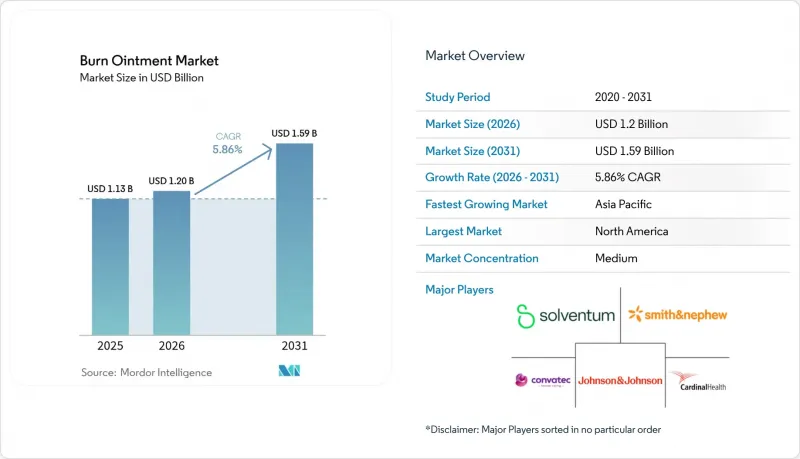
Mordor Intelligence에 의하면, 화상 연고 시장 규모는 2025년 11억 3,000만 달러로 평가되었습니다. 2026년에는 12억 달러로 확대되어 2026-2031년에 걸쳐 CAGR 5.86%로 성장을 지속하여, 2031년까지 15억 9,000만 달러에 이를 것으로 예측됩니다.
본 보고서는 제품 유형(외용 항생제, 은계 연고, 요오드계 연고, 기타), 화상 깊이(1도(경증) 화상, 기타), 최종 사용자(병원·화상 치료 센터, 기타), 유통 채널(병원 약국, 온라인 약국, 기타),지역(북미, 유럽, 아시아태평양, 기타)별로 분류되어 있습니다. 시장 전망은 금액(달러) 기준으로 제시되어 있습니다.
세계의 화상 연고 시장 동향 및 인사이트
저·중소득 국가에서의 화상 발생률 증가
저·중소득 국가에서는 병원의 불과 3분의 1만이 전용 화상 병동을 운영하고 있으며, 화재로 인한 사망률은 여전히 높은 수준을 유지하고 있습니다. 도시화에 따라 가정 내 연료로 인한 위험이 높아지고, 공장 확대로 인해 신속한 국소 치료가 필요한 산업 재해가 증가하고 있습니다. 인도의 의료비 지출은 2025년에 12.59% 증가했으며, 이에 따라 주립 병원은 농촌 지역 지원 프로그램을 위해 다목적 항균 젤을 비축할 수 있게 되었습니다. 현재 각국 정부는 지역 진료소에 배포되는 외상 치료 키트에 화상 연고 조달을 포함시키고 있습니다. 이러한 구조적 수요로 인해 다국적 기업으로부터 핵심 기술을 라이선스 받아 합리적인 가격의 제품을 공급하는 제조업체들의 기본 생산량이 증가하고 있습니다. 응급실에서는 환자의 체류 기간이 단축되고 있는 것으로 보고되고 있으며, 저비용 제제가 응급처치와 이송 치료 사이의 가교 역할을 수행하고 있어, 이것이 화상 연고 시장의 성장을 뒷받침하고 있습니다.
환자의 인식 제고 및 첨단 치료에 대한 접근성 확대
원격 의료 포털 사이트에서는 환자에게 표재성 화상과 부분층 화상을 구별하는 방법, 그리고 부상 후 몇 시간 이내에 약용 크림을 스스로 도포하기 시작하는 방법을 안내하고 있습니다. 미국의 보험사는 4주간의 보존적 치료가 효과를 보이지 않은 경우에만 피부 대체 이식편 비용을 보상하고 있으며, 이러한 방침은 간접적으로 더 고기능성 제제를 이용한 조기 국소 치료를 촉진하고 있습니다. 화상 생존자 단체가 주도하는 소셜 미디어 캠페인에서는 은이나 서방형 나노겔을 통한 치유 기간 단축이 강조되고 있으며, 이는 제품의 유효성에 대한 소비자의 인식을 형성하고 있습니다. 현재 유럽의 외래 클리닉에서는 입원 치료 대신 디지털 기반의 경과 관찰이 계획되어 있으며, 이를 통해 간접비가 절감되는 동시에 가치 기반 의료 모델에서 화상 연고 산업의 역할이 확고해지고 있습니다.
항생제 내성 및 국소적 부작용
세계 65개 병원을 대상으로 한 조사에 따르면, 화상 환자의 32.4%가 부상 후 1주일 이내에 전신 항생제를 투여받고 있으며, 이는 녹농균 및 아시네토박터 속 균의 내성 증가를 조장하고 있습니다. 임상의들은 재상피화를 지연시키는 접촉성 피부염의 위험이 있으므로, 항생제의 장기간 국소 사용에 신중한 태도를 취하고 있습니다. 르완다에서는 소아의 다제내성 슈도모나스증 사례가 보고되어, 국경을 넘는 병원체의 확산에 대한 우려가 높아졌습니다. 이에 각 병원에서는 소독제 유형을 순환하여 사용하거나 콜드 플라즈마 요법을 도입하는 등 대응하고 있으며, 기존 연고에 대한 의존도를 낮추고 있습니다. 이러한 제약으로 인해 사용량이 억제되고 있으며, 내성이라는 과제를 대체 제제가 극복할 때까지는 화상 연고 시장의 성장에 한계가 있을 것으로 보입니다.
부문별 분석
2025년에는 임상 현장에서의 친숙도와 낮은 단가를 배경으로, 외용 항생제가 매출의 37.95%를 차지하며 화상 연고 시장을 주도했습니다. 그러나 병원이 생물막 형성에 대항하는 광범위 항균 효과를 중시하는 프로토콜로 전환함에 따라, 은 함유 크림은 2031년까지 연평균 성장률(CAGR) 8.13%를 나타낼 것으로 전망됩니다. 요오드 제제는 산화 살균 메커니즘 덕분에 깊은 부위의 화상이나 오염된 화상에 대해 여전히 중요성을 유지하고 있지만, 착색 및 세포 독성에 대한 우려로 인해 성장률은 둔화되고 있습니다. 2025년에 개발된 카본 도트 전달 시스템은 유효 성분의 방출을 3일 동안 지속시켜 간호 시간을 단축하고 환자의 편안함을 향상시킵니다.
경쟁사와의 차별화는 유효 성분 그 자체가 아니라 특허 취득이 가능한 전달 매트릭스에 달려 있습니다. 각사는 삼출액과 접촉하면 팽윤하는 하이드로콜로이드 층에 은 이온을 봉입하여, 48-72시간에 걸쳐 금속을 방출시키면서 습윤도를 조절하고 있습니다. 은과 리도카인을 결합한 복합 제제는 감염 관리와 진통을 동시에 수행해야 하는 응급구조사 등의 요구를 충족시킵니다. 규제 강화에 따라 클래스 III 은 겔에는 미생물 내성 추이에 관한 데이터 기재가 의무화되었으며, 보다 충실한 시판 후 조사 프로그램의 실시가 요구되고 있습니다. 고급 제품이 승인됨에 따라 판매량은 기존 크림에 미치지 못하지만, 프리미엄 가격 책정으로 인해 매출액은 현저한 증가세를 보이고 있습니다. 유효성, 복약 순응도, 비용 간의 상호작용이 화상 연고 시장의 장기적인 경쟁 구도를 형성해 나갈 것으로 예측됩니다.
표재성 1도 화상은 여전히 흔하며, 가정 내에서 발생 빈도가 높기 때문에 2025년 매출의 46.05%를 차지했습니다. 반면, 산업 폭발, 화학물질 유출, 군사 행동으로 인한 복합 외상에는 고부가가치의 국소 치료가 요구되므로, 3도 화상은 연평균 성장률(CAGR) 7.41%를 나타낼 것으로 예측됩니다. 이러한 전층 화상에는 수분 관리, 항균 작용, 재생 지원이 요구되며, 성장 인자 모방 물질을 배합한 생체 활성 겔이 적합한 치료 옵션이 됩니다.
현재의 치료 방침에서는 감염을 억제하고 이식편 준비를 앞당기기 위해, 3일 이내에 창면 소독을 실시한 후 서방형 연고를 도포하는 것이 중요시되고 있습니다. 엑소좀 유사 소포를 연구 중인 제제 개발자들은 비후성 흉터로 이어지는 섬유아세포의 과도한 자극을 유발하지 않으면서 콜라겐 침착을 촉진하는 것을 목표로 하고 있습니다. 병원에서는 상처의 깊이를 측정하고 투여량을 결정하기 위해 첨단 영상 기술을 도입하고 있으며, 이를 통해 고가 제품의 비용 대비 효과가 향상되고 있습니다. 그 결과, 3도 화상 연고 시장 규모는 가격이 두 자릿수 수준임에도 불구하고 출하량을 상회하고 있습니다. 국방 기관이 전장 프로토콜을 개선함에 따라, 군사 용도로 개발된 3도 화상 치료 솔루션이 민간 외상 센터에도 점차 도입되어 수익 기반이 확대될 가능성이 있습니다.
지역별 분석
북미는 37.55%의 점유율을 차지하며 여전히 최대 지역 시장으로 자리 잡고 있습니다. 이는 첨단 외상 치료 시스템, 광범위한 보험 적용 범위, 고품질 화상 연고 프로토콜을 뒷받침하는 지속적인 군사 연구개발(R&D) 자금에 힘입은 결과입니다. 미국의 조달 경로에서는 전장에서의 효능이 입증된 후, 최첨단 은계 제품이 계속해서 민간 병원에 공급되고 있습니다. 캐나다의 단일 지불자 모델에서는 비용 대비 효과가 높은 제네릭 의약품을 우선하는 전국적인 입찰이 이루어지고 있지만, 그럼에도 불구하고 생체 활성 젤을 도입하는 소아 화상 치료 부문에는 예산이 배정되고 있습니다. 멕시코의 민간 병원에서는 의료 관광의 확대에 따라 미국산 제제를 수입하고 있으며, 이로 인해 지역 내 유통 범위가 확대되고 있습니다.
아시아태평양은 가장 빠르게 성장하는 지역이며, 의료 현대화 프로그램을 통해 화상 치료 센터에 대한 자본 예산이 확보됨에 따라 2031년 연평균 성장률(CAGR)은 8.68%를 나타낼 것으로 전망됩니다. 2024년에 도입된 인도의 주 보험 제도는 고위험 환자에 대한 외용 은 제제의 비용을 상환하여 기초적인 수요를 뒷받침하고 있습니다. 중국의 각 성 정부는 지역 나노겔 스타트업을 육성하는 상처 관리 혁신 허브에 공동 투자하고 있으며, 이러한 스타트업들은 국내 전자상거래 플랫폼을 활용하여 급속한 사업 확장을 꾀하고 있습니다. 동남아시아 국가들은 산업 단지 화재와 가정 내 조리 사고로 어려움을 겪고 있으며, 비용과 성능의 균형이 잡힌 중저가 항균 크림을 수입하고 있습니다. 일본에서는 상피화 촉진 효과를 평가하는 성과 연계형 환급 제도가 도입되어, 병원들은 서방형 플랫폼 도입을 추진하고 있습니다. 프랑스에서는 국립 공중보건기관의 지침에 따라 응급실 필수 비축품에 은계 겔이 추가되었습니다. 동유럽 시장에서는 EU 구조기금을 활용하여 외상 치료 시설의 개보수가 진행되고 있으며, 일반적인 항생제 크림에 대한 수요가 서서히 증가하고 있습니다.
중동 및 아프리카는 여전히 시장 침투율이 낮지만, 장래성이 기대되고 있습니다. 걸프 국가에서는 가스 폭발로 인한 화상이 빈번히 발생하는 외국인 노동자가 밀집한 건설 현장을 위해, 첨단 생물학적 겔이 조달되고 있습니다. 북아프리카 국가들에서는 비정부기구(NGO)와 협력하여 공립 클리닉에서 기본적인 항균 연고를 배포함으로써 응급 처치 대응 시간을 단축하고 있습니다. 사하라 이남 시장에서는 일회용 소포장이 비축된 지역 화상 치료 시설로 환자를 안내하는 모바일 헬스 앱이 도입되어, 인프라 제약에도 불구하고 치료 접근성이 확대되고 있습니다. 남미에서는 적당한 수준의 보급이 관찰되고 있으며, 브라질은 지역별 피부 은행에 투자하고 있어, 이것이 감염 예방용 연고에 대한 장기적인 수요의 기반이 될 것으로 보입니다. 이러한 지역별 특성이 결합되어 화상 연고 시장은 전 세계적으로 꾸준한 성장을 이어가고 있습니다.
기타 혜택
- 엑셀 형식 시장 예측(ME) 시트
- 3개월간의 애널리스트 지원
자주 묻는 질문
목차
제1장 서론
제2장 조사 방법
제3장 개요
제4장 시장 구도
제5장 시장 규모 및 성장 예측
제6장 경쟁 구도
제7장 시장 기회 및 향후 전망
KTH 26.08.31According to Mordor Intelligence, the burn ointment market size is expected to grow from USD 1.13 billion in 2025 to USD 1.2 billion in 2026 and is forecast to reach USD 1.59 billion by 2031 at 5.86% CAGR over 2026-2031.
This report is Segmented by Product Type (Topical Antibiotics, Silver-Based Ointments, Iodine-Based Ointments and More), Depth of Burn (First-Degree (Minor) Burns, and More), End User (Hospitals & Burn Centers and More), Distribution Channel (Hospital Pharmacies, Online Pharmacies, and More), and Geography (North America, Europe, Asia-Pacific, and More). The Market Forecasts are Provided in Terms of Value (USD).
Global Burn Ointment Market Trends and Insights
Rising Incidence of Burn Injuries in LMICs
Fire-related mortality remains high in low- and middle-income countries where only a third of hospitals run dedicated burn wards. Urbanization raises household fuel hazards, and factory expansion heightens industrial accidents that demand rapid topical intervention. India's health-care outlay rose 12.59% in 2025, enabling state hospitals to stock multipurpose antimicrobial gels for rural outreach programs. Governments now bundle burn ointment procurement with trauma-care kits distributed to community clinics. This structural demand lifts baseline volumes for manufacturers that supply value-priced packs while licensing core technology from multinational partners. As emergency departments report shorter patient stays, low-cost formulations become a stop-gap between first aid and referral care, which fuels the burn ointment market.
Growing Patient Awareness & Access to Advanced Treatment
Telehealth portals teach patients to distinguish between superficial and partial-thickness burns and to begin self-application of medicated creams within hours of injury. Payers in the United States reimburse skin-substitute grafts only after 4 weeks of failed conservative therapy, a policy that indirectly stimulates early topical care using higher-end formulations. Social-media campaigns led by burn-survivor foundations spotlight faster healing times linked to silver and sustained-release nanogels, shaping consumer perception of product efficacy. Europe's outpatient clinics now schedule digital follow-ups rather than inpatient stays, cutting overhead costs and cementing the role of the burn ointment industry in value-based care models.
Antibiotic Resistance & Local Side-Effects
A global study across 65 hospitals found that 32.4% of burn patients received systemic antibiotics within a week of injury, fueling resistance in Pseudomonas and Acinetobacter strains. Clinicians are cautious about prolonged topical antibiotic use because of contact dermatitis risks that delay re-epithelialization. In Rwanda, a pediatric case of pan-drug-resistant Pseudomonas raised alarm over cross-border pathogen spread. Hospitals respond by rotating antiseptic classes and integrating cold-plasma therapy, reducing dependence on conventional ointments. These limitations dampen usage volumes and place a ceiling on the burn ointment market until alternative formulations overcome resistance hurdles.
Other drivers and restraints analyzed in the detailed report include:
- Rapid Adoption of Silver-Based Antimicrobial Ointments
- Military Field-Use Procurement for Combat Burns
- High Cost of Advanced Silver/Biologic Therapies
For complete list of drivers and restraints, kindly check the Table Of Contents.
Segment Analysis
Topical antibiotics dominated revenue with a 37.95% burn ointment market share in 2025, underpinned by clinical familiarity and low unit cost. Silver creams, however, are set to chart an 8.13% CAGR to 2031 as hospitals shift protocols toward broad-spectrum coverage that counters biofilm formation. Iodine products retain relevance for deep or contaminated burns because of their oxidative kill mechanism but record slower growth on account of staining and cytotoxicity concerns. Carbon-dot carrier systems developed in 2025 extend active release over three days, which reduces nursing time and improves patient comfort.
Competitive differentiation hinges on patentable delivery matrices rather than the active ingredient itself. Firms embed silver ions within hydrocolloid layers that swell on contact with exudate, controlling moisture while releasing metal over 48-72 hours. Combo formulations that marry silver with lidocaine cater to emergency responders needing infection management and analgesia in one step. Regulatory upgrades mean Class III silver gels must now include data on microbial resistance trajectories, prompting richer post-market surveillance programs. As advanced products gain approvals, premium pricing contributes outsize dollar growth even if volume gains trail traditional creams. The interplay of efficacy, compliance, and cost will shape the long-term competitive fabric of the burn ointment market.
Superficial first-degree burns remained common, capturing 46.05% of 2025 sales value because of their high frequency in domestic settings. Yet third-degree burns are projected to register a 7.41% CAGR as complex trauma from industrial blasts, chemical spills, and military actions requires high-value topical care. These full-thickness injuries demand moisture control, antimicrobial coverage, and regenerative support, making them suitable candidates for bioactive gels laced with growth factor mimetics.
Treatment pathways now emphasize debridement within three days followed by sustained-release ointment application to curtail infection and speed graft readiness. Formulators researching exosome-like vesicles seek to trigger collagen deposition without fibroblast overstimulation that leads to hypertrophic scarring. Hospitals deploy advanced imaging to map wound depth and guide dosage amounts, improving cost efficiency for premium products. The burn ointment market size for third-degree applications thus outpaces unit shipments because of double-digit price points. As defense agencies refine battlefield protocols, third-degree burn solutions built for military use may trickle into civilian trauma centers, broadening the revenue base.
Complete Report Scope:
- By Product Type
- Topical Antibiotics
- Silver-based Ointments
- Iodine-based Ointments
- Combination / Others
- By Depth of Burn
- First-degree (Minor) Burns
- Second-degree (Partial Thickness) Burns
- Third-degree (Full Thickness) Burns
- By End User
- Hospitals & Burn Centers
- Ambulatory Surgical Centers
- Home Healthcare Settings
- By Distribution Channel
- Hospital Pharmacies
- Retail Pharmacies & Drug Stores
- Online Pharmacies
- Geography
- North America
- United States
- Canada
- Mexico
- Europe
- Germany
- United Kingdom
- France
- Italy
- Spain
- Rest of Europe
- Asia-Pacific
- China
- Japan
- India
- South Korea
- Australia
- Rest of Asia-Pacific
- Middle East and Africa
- GCC
- South Africa
- Rest of Middle East and Africa
- South America
- Brazil
- Argentina
- Rest of South America
- North America
Geography Analysis
North America, with its 37.55% share, remains the largest regional contributor, leveraging advanced trauma systems, broad insurance coverage, and sustained military R&D funding that validates premium burn ointment protocols. United States procurement channels continue to funnel cutting-edge silver-based products into civilian hospitals after demonstrating efficacy on the battlefield. Canada's single-payer model negotiates national tenders that favor cost-effective generics yet still allocates budget for pediatric burn units deploying bioactive gels. Mexico's private hospitals import U.S. formulations as medical tourism grows, thereby widening the regional distribution footprint.
Asia-Pacific is the fastest-growing cluster, registering an 8.68% CAGR through 2031 as healthcare modernization programs unlock capital budgets for burn centers. India's state insurance schemes introduced in 2024 reimburse topical silver for high-risk patients, boosting baseline demand. China's provincial governments co-fund wound-care innovation hubs that incubate local nanogel start-ups, which tap domestic e-commerce platforms for rapid scale. Southeast Asian economies, grappling with industrial corridor fires and domestic cooking accidents, import mid-tier antimicrobial creams that balance cost and performance. Japan introduces performance-based reimbursement that rewards faster epithelialization, pushing hospitals toward sustained-release platforms. France adds silver-based gels to mandatory emergency-room stocks following guidance from its national public health agency. Eastern European markets lean on EU structural funds to renovate trauma facilities, creating incremental demand for staple antibiotic creams.
The Middle East and Africa remain underpenetrated yet promising. Gulf nations procure advanced biologic gels for expatriate-dense construction zones where burns from gas explosions are prevalent. North African countries collaborate with non-governmental organizations to distribute basic antimicrobial ointments at public clinics, improving first-aid response times. Sub-Saharan markets adopt mobile-health apps that direct patients to community burn units stocked with single-use sachets, enhancing treatment reach despite infrastructure constraints. South America sees moderate uptake, with Brazil investing in regional skin banks that will underpin longer-term demand for infection-control ointments. Collectively, these geographic nuances ensure that the burn ointment market continues its steady global climb.
- Solventum Corporation
- Smiths Group
- Johnson & Johnson
- Convatec
- Cardinal Health
- GlaxoSmithKline
- Pfizer
- Cipla
- Sun Pharmaceuticals Industries
- Perrigo Company
- Mankind Pharma
- DeRoyal Industries
- Molnlycke Health Care
- Leo Pharma
- Medline Industries
- B. Braun
- Acelity (KCI)
- Integra LifeSciences
- Morepen
- Trio Lifescience Pvt. Ltd.
Additional Benefits:
- The market estimate (ME) sheet in Excel format
- 3 months of analyst support
TABLE OF CONTENTS
1 Introduction
- 1.1 Study Assumptions & Market Definition
- 1.2 Scope of the Study
2 Research Methodology
3 Executive Summary
4 Market Landscape
- 4.1 Market Overview
- 4.2 Market Drivers
- 4.2.1 Rising Incidence Of Burn Injuries In LMICs
- 4.2.2 Growing Patient Awareness & Access To Advanced Treatment
- 4.2.3 Rapid Adoption Of Silver-Based Antimicrobial Ointments
- 4.2.4 Military Field-Use Procurement For Combat Burns
- 4.2.5 Lithium-Battery & Vaping Explosions Increasing Outpatient Burns
- 4.2.6 Nanotechnology-Enabled Sustained-Release Formulations
- 4.3 Market Restraints
- 4.3.1 Antibiotic Resistance & Local Side-Effects
- 4.3.2 High Cost Of Advanced Silver/Biologic Therapies
- 4.3.3 Regulatory Re-Classification Of Topical Antimicrobials
- 4.3.4 Silver Supply-Chain Price Volatility
- 4.4 Porter's Five Forces
- 4.4.1 Threat of New Entrants
- 4.4.2 Bargaining Power of Buyers
- 4.4.3 Bargaining Power of Suppliers
- 4.4.4 Threat of Substitutes
- 4.4.5 Competitive Rivalry
5 Market Size & Growth Forecasts (Value, USD)
- 5.1 By Product Type
- 5.1.1 Topical Antibiotics
- 5.1.2 Silver-based Ointments
- 5.1.3 Iodine-based Ointments
- 5.1.4 Combination / Others
- 5.2 By Depth of Burn
- 5.2.1 First-degree (Minor) Burns
- 5.2.2 Second-degree (Partial Thickness) Burns
- 5.2.3 Third-degree (Full Thickness) Burns
- 5.3 By End User
- 5.3.1 Hospitals & Burn Centers
- 5.3.2 Ambulatory Surgical Centers
- 5.3.3 Home Healthcare Settings
- 5.4 By Distribution Channel
- 5.4.1 Hospital Pharmacies
- 5.4.2 Retail Pharmacies & Drug Stores
- 5.4.3 Online Pharmacies
- 5.5 Geography
- 5.5.1 North America
- 5.5.1.1 United States
- 5.5.1.2 Canada
- 5.5.1.3 Mexico
- 5.5.2 Europe
- 5.5.2.1 Germany
- 5.5.2.2 United Kingdom
- 5.5.2.3 France
- 5.5.2.4 Italy
- 5.5.2.5 Spain
- 5.5.2.6 Rest of Europe
- 5.5.3 Asia-Pacific
- 5.5.3.1 China
- 5.5.3.2 Japan
- 5.5.3.3 India
- 5.5.3.4 South Korea
- 5.5.3.5 Australia
- 5.5.3.6 Rest of Asia-Pacific
- 5.5.4 Middle East and Africa
- 5.5.4.1 GCC
- 5.5.4.2 South Africa
- 5.5.4.3 Rest of Middle East and Africa
- 5.5.5 South America
- 5.5.5.1 Brazil
- 5.5.5.2 Argentina
- 5.5.5.3 Rest of South America
- 5.5.1 North America
6 Competitive Landscape
- 6.1 Market Concentration
- 6.2 Market Share Analysis
- 6.3 Company Profiles (includes Global level Overview, Market level overview, Core Segments, Financials as available, Strategic Information, Market Rank/Share for key companies, Products & Services, and Recent Developments)
- 6.3.1 Solventum Corporation
- 6.3.2 Smith & Nephew PLC
- 6.3.3 Johnson & Johnson
- 6.3.4 ConvaTec Group PLC
- 6.3.5 Cardinal Health Inc.
- 6.3.6 GlaxoSmithKline PLC
- 6.3.7 Pfizer Inc.
- 6.3.8 Cipla Ltd.
- 6.3.9 Sun Pharmaceutical Industries Ltd.
- 6.3.10 Perrigo Company PLC
- 6.3.11 Mankind Pharma
- 6.3.12 DeRoyal Industries Inc.
- 6.3.13 Molnlycke Health Care AB
- 6.3.14 LEO Pharma A/S
- 6.3.15 Medline Industries LP
- 6.3.16 B. Braun Melsungen AG
- 6.3.17 Acelity (KCI)
- 6.3.18 Integra LifeSciences
- 6.3.19 Dr. Morepen
- 6.3.20 Trio Lifescience Pvt. Ltd.
7 Market Opportunities & Future Outlook
- 7.1 White-space & Unmet-need Assessment