|
시장보고서
상품코드
2116069
인터루킨 억제제 : 시장 점유율 분석, 업계 동향 및 통계, 성장 예측(2026-2031년)Global Interleukin Inhibitors - Market Share Analysis, Industry Trends & Statistics, Growth Forecasts (2026 - 2031) |
||||||
 Mordor Intelligence
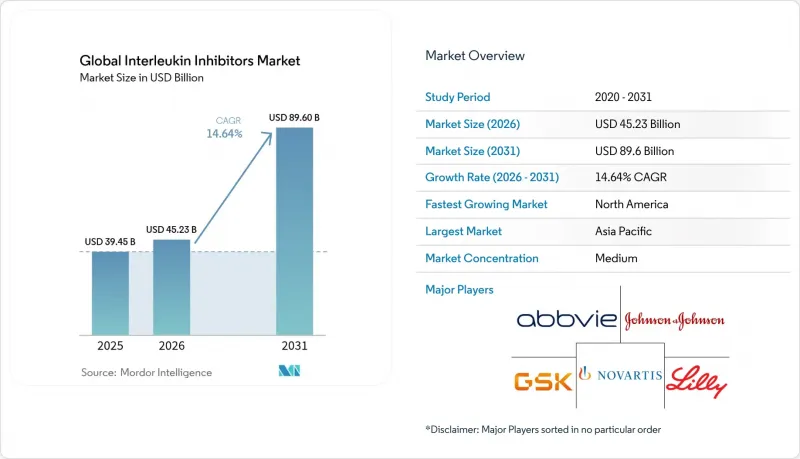
Mordor Intelligence에 의하면, 2026년 인터루킨 억제제 시장 규모는 452억 3,000만 달러로 추정되고 2025년 394억 5,000만 달러에서 확대해, 2031년에는 896억 달러에 이를 것으로 예측됩니다.
2026-2031년 동안의 연평균 성장률(CAGR)은 14.64%가 될 것으로 전망됩니다.
본 보고서는 약물 유형별(IL-1 억제제, IL-6 억제제, 기타), 용도별(건선·건선성 관절염, 기타), 투여 경로별(피하, 정맥 내), 최종 사용자별(병원, 전문 클리닉, 기타),지역별(북미, 유럽, 아시아태평양, 기타)로 분류되어 있습니다. 시장 예측은 입수 가능한 정보를 바탕으로 금액(달러)으로 제시되어 있습니다.
세계의 인터루킨 억제제 시장 동향 및 인사이트
자가면역 질환 및 자가염증성 질환 유병률 증가
세계 자가면역 질환의 발생률은 상승하고 있으며, 특히 그레이브스병 등의 질환 증가가 가장 두드러집니다. 북미와 유럽의 높은 유병률이 수요를 집중시키고, 프리미엄 가격 책정력을 뒷받침하고 있습니다. 다중 질환 병용으로 인해 치료 경로가 복잡해지고 있으므로, 광범위하게 작용하는 면역억제제보다 특이성이 높은 생물학적 제제가 선호되고 있습니다. 류마티스과 및 피부과 클리닉에서는 진료 지침의 변화를 반영하여 인터루킨 억제제의 1차 선택적 사용이 증가하고 있는 것으로 보고되고 있습니다. 따라서 지속적인 역학적 압력이 인터루킨 억제제 시장의 장기적인 수익 기반을 뒷받침하고 있습니다.
차세대 IL-17/IL-23 바이오의약품에 대한 FDA 및 EMA의 승인 가속화
2024년부터 2025년 초에 걸쳐 규제 당국은 화농성 한선염 치료제인 비메키주맙과 최초의 경구용 IL-23 수용체 억제제인 이코트로킨라 등 몇 가지 획기적인 의약품을 승인했습니다. 신속 심사 절차는 시판까지의 기간을 단축시켜 출시 시점의 프리미엄 가격 책정을 뒷받침하고 있습니다. 2024년 EMA가 4개의 우스테키누맙 바이오시밀러를 승인한 것은 이 계열의 안전성에 대한 신뢰를 보여주는 동시에 가격 경쟁을 심화시키고 있습니다. 전반적으로, 승인 절차의 신속화로 인해 편의성이나 유효성의 우월성이 입증될 경우, 의사들이 동일한 치료군 내에서 약물을 전환하려는 의지가 높아져 인터루킨 억제제 시장 전체의 성장을 뒷받침하고 있습니다.
높은 도입 비용과 저분자 DMARD와의 비교
생물학적 제제에 의한 연간 치료비는 1만 4,000달러에서 9만 1,609달러에 달하며, 기존 질환 수정 항류마티스제(DMARD)를 훨씬 상회합니다. 저소득 시장에서의 본인 부담금 상한선은 여전히 고액이어서 보급을 저해하고 있습니다. 지불 기관은 실제 임상 환경에서의 비용 대비 효과에 대한 증거를 요구하고 있으며, 제약사는 입원 방지 등 명확한 평가 지표를 동반한 직접 비교를 통해 우월성을 입증하는 데이터를 제시해야만 합니다. 따라서 높은 가격이 비용에 민감한 지역에서 인터루킨 억제제 시장의 잠재적 수요를 억제하고 있습니다.
부문별 분석
IL-17 억제제는 일반 건선, 건선성 관절염, 강직성 척추염에서 지속되는 효능에 힘입어 2025년 매출의 37.32%를 차지했습니다. 선도적인 위치를 차지하고 있지만, 비메키주맙이 화농성 땀샘염과 축성 척추관절염으로 적응증을 확대함에 따라 경쟁의 폭은 더욱 넓어지고 있습니다. IL-23 억제제는 경구용 약물인 이코트로킨라가 편의성과 질환 수정 가능성을 모두 갖추고 있어 15.32%라는 가장 높은 연평균 성장률(CAGR)을 보이고 있습니다. 토실리주맙은 COVID-19 및 거대세포동맥염으로의 적응증 확대를 통해 IL-6 억제제로서의 중요성을 유지하고 있습니다. 틈새 시장인 IL-1 억제제는 희귀 자가염증성 증후군을 대상으로 하는 반면, 이중 표적 요법은 대상 환자층을 확대하는 정밀의료의 동향을 반영하고 있습니다. 전반적으로, 각 약물의 서로 다른 작용기전이 약물 분류별로 인터루킨 억제제 시장 규모에 다양성을 부여하여, 단일 분류에 의존하는 위험을 완화하고 있습니다.
비경구형에서 경구형 저분자 IL-23 길항제로의 전환 또한 자가 주사를 원하지 않는 적격 환자층을 확대시키고 있습니다. 파이프라인의 혁신에는 주사 횟수를 줄이면서 더 광범위한 억제를 목표로 하는 여러 다중 사이토카인 억제제가 포함되어 있습니다. 그 결과, 치료군의 진화에 따라 인터루킨 억제제 시장은 2031년까지 확립된 치료법과 신흥 치료법이 균형 있게 공존하는 상태를 유지하게 될 것입니다.
건선은 2025년 시장 규모의 45.74%를 차지했으며, 전신 스테로이드나 광선 요법에 대한 뚜렷한 우위를 바탕으로 그 입지가 강화되고 있습니다. 경구용 이코트로킨라의 경우, PASI 90 달성률 등 높은 피부 증상 개선율이 49.6%를 넘어, 1차 치료제로서의 생물학적 제제 도입에 대한 기대가 다시 높아지고 있습니다. 한편, 강직성 척추염은 MRI 진단 기술의 향상으로 인해 축성 척추관절염에 대한 인식이 확산되면서 연평균 성장률(CAGR) 15.74%로 성장을 지속하고 있습니다. 류마티스 관절염은 여전히 규모가 큰 시장이지만, 성숙기에 접어든 TNF 억제제와 JAK 억제제가 가격 면에서 치열한 경쟁을 벌이고 있어 성장 속도는 완만합니다. 염증성 장 질환은 TREMFYA의 크론병 적응증 확대에 따라 발전하고 있으며, 기타 자가염증성 질환에 대해서는 AI를 통해 발견된 인터루킨 경로의 규명이 기여할 것으로 보입니다. 이러한 다양한 동향으로 인해 인터루킨 억제제 시장은 면역매개성 질환 전반에 걸쳐 다양성을 유지하고 있습니다.
바이오마커에 기반한 치료 알고리즘을 채택함으로써 시장 내 입지가 더욱 최적화될 것입니다. 피부과 및 류마티스 전문의들은 사이토카인 프로파일을 바탕으로 환자를 선별하는 경우가 늘어나고 있으며, 피부 증상이 주된 질환에는 IL-23 억제제를, 축성 증상에는 IL-17 억제제를 각각 적용하고 있습니다. 이러한 정밀한 매칭을 통해 치료 성과가 향상되고, 최적화된 분자를 가진 인터루킨 억제제 시장 점유율이 강화됩니다.
지역별 분석
북미는 종합적인 보험 적용 범위와 새로운 치료법을 조기에 도입하는 의료진의 문화 덕분에 2025년 매출의 41.78%를 차지했습니다. 바이오시밀러의 진입으로 가격 수준은 하락하겠지만, 접근성은 확대되어 매출 변동은 균형을 이룰 것으로 예측됩니다. 유럽은 이에 이어, 판매 수량에 따른 할인을 협상하는 확립된 국가 조달 체계를 통해 이 약물군의 지속가능성이 촉진되고 있습니다. 아시아태평양은 중국의 현지 생산, 인도의 부상하는 민간 보험 상품, 일본의 적응증 목록 확대에 힘입어 16.42%라는 가장 높은 연평균 성장률(CAGR)을 기록하고 있습니다. 질병에 대한 인식 제고와 진료 지침의 통합에 따라 환자 치료 과정에서 생물학적 제제의 투여 시작 시기가 앞당겨지고 있어, 아시아태평양의 인터루킨 억제제 시장에서의 판매량 확대가 가속화되고 있습니다.
라틴아메리카의 보급 상황은 제각각입니다. 브라질은 ‘통합 보건 시스템’을 통해 도입을 주도하고 있는 반면, 다른 국가들은 조달 예산의 제약에 직면해 있습니다. 중동 및 아프리카에서는 소규모 기반에서 두 자릿수의 수량 성장을 보이고 있으며, GCC(걸프협력회의)의 환급 위원회가 건선 및 류마티스 관절염용 바이오의약품을 점진적으로 채택하고 있습니다. 입찰에서 낙찰 사례가 늘어남에 따라 지역 내 인지도가 높아지고, 의사의 이해 증진으로 이어지고 있습니다. 전반적으로, 지역적 다양성이 거시경제적 충격을 완화하여 전 세계 인터루킨 억제제 시장의 성장 곡선을 유지하고 있습니다.
기타 혜택
- 엑셀 형식 시장 예측(ME) 시트
- 3개월간의 애널리스트 지원
자주 묻는 질문
목차
제1장 서론
제2장 조사 방법
제3장 개요
제4장 시장 구도
제5장 시장 규모 및 성장 예측
제6장 경쟁 구도
제7장 시장 기회 및 향후 전망
KTH 26.08.31According to Mordor Intelligence, the interleukin inhibitors market size in 2026 is estimated at USD 45.23 billion, growing from 2025 value of USD 39.45 billion with 2031 projections showing USD 89.6 billion, growing at 14.64% CAGR over 2026-2031.
This report is Segmented by Drug Type (IL-1 Inhibitors, IL-6 Inhibitors, and More), Application (Psoriasis & Psoriatic Arthritis, and More), Route of Administration (Subcutaneous, Intravenous), End-User (Hospitals, Specialty Clinics, and More), and Geography (North America, Europe, Asia-Pacific, and More). The Market Forecasts are Provided in Terms of Value (USD), Based On Availability.
Global Interleukin Inhibitors Market Trends and Insights
Escalating Prevalence of Autoimmune & Autoinflammatory Diseases
Global autoimmune incidence has climbed, with conditions such as Graves' disease accelerating most sharply . Higher prevalence in North America and Europe concentrates demand and drives premium pricing power. Multi-morbid presentations create complex treatment pathways that favor high-specificity biologics over broad immunosuppressants. Rheumatology and dermatology clinics report growing first-line use of interleukin inhibitors, reflecting guideline evolution. Sustained epidemiologic pressure therefore preserves the long-run revenue base of the interleukin inhibitors market.
Accelerated FDA & EMA Approvals for Next-Gen IL-17/IL-23 Biologics
Between 2024 and early 2025, regulators cleared several breakthrough assets, including bimekizumab for hidradenitis suppurativa and icotrokinra as the first oral IL-23 receptor inhibitor . Expedited review pathways shorten launch cycles and support premium introductory pricing. EMA endorsement of four ustekinumab biosimilars in 2024 demonstrates parallel confidence in class safety while intensifying price competition. Collectively, faster approvals lift physician willingness to switch within the same therapeutic class when superior convenience or efficacy is shown, boosting overall interleukin inhibitors market growth.
High Acquisition Cost Versus Small-Molecule DMARDs
Annual biologic therapy costs run from USD 14,000 to USD 91,609, far exceeding older disease-modifying antirheumatic drugs. Out-of-pocket ceilings in low-income markets remain prohibitive, restricting uptake. Payers demand real-world cost-offset evidence, forcing manufacturers to deliver head-to-head superiority data with hard endpoints such as hospitalization avoidance. The pricing premium therefore suppresses full-potential demand for the interleukin inhibitors market in cost-sensitive geographies.
Other drivers and restraints analyzed in the detailed report include:
- Shift Toward Convenient Self-Injectable Formulations
- Expanding Reimbursement in Emerging Asian Markets
- Looming Biosimilar Competition Post-2026
For complete list of drivers and restraints, kindly check the Table Of Contents.
Segment Analysis
IL-17 inhibitors anchored 37.32% of 2025 revenue, underpinned by durable efficacy in plaque psoriasis, psoriatic arthritis, and ankylosing spondylitis. Despite leadership, competitive breadth has intensified as bimekizumab expanded into hidradenitis suppurativa and axial spondyloarthritis. IL-23 inhibitors exhibit the fastest 15.32% CAGR because oral icotrokinra combines convenience with disease-modifying potential. Tocilizumab sustains IL-6 inhibitor relevance through COVID-19 and giant cell arteritis expansions. Niche IL-1 inhibitors cater to rare autoinflammatory syndromes, while dual-target regimens reflect a precision trend that widens addressable patient cohorts. Collectively, differentiated mechanisms diversify the interleukin inhibitors market size across drug classes, buffering against single-class risk.
The shift from parenteral to oral small-molecule IL-23 antagonists also enlarges eligible patient pools unwilling to self-inject. Pipeline innovation contains multiple multi-cytokine inhibitors aiming for broader suppression with fewer injections. Consequently, therapeutic class evolution ensures the interleukin inhibitors market retains a balanced assortment of established and emerging modalities through 2031.
Psoriasis delivered 45.74% of 2025 value, reinforced by clear superiority over systemic steroids and phototherapy. High skin-clearance rates such as PASI 90 attainment exceed 49.6% on oral icotrokinra, renewing enthusiasm for first-line biologic adoption. Meanwhile, ankylosing spondylitis shows 15.74% CAGR as improved MRI diagnostics broaden axial spondyloarthritis recognition. Rheumatoid arthritis remains a sizeable but slower-growth cohort because mature TNF inhibitors and JAKs compete aggressively on price. Inflammatory bowel disease advances on TREMFYA's Crohn's disease label expansion, while miscellaneous autoinflammatory conditions will benefit from AI-discovered interleukin pathways. These mixed dynamics keep the interleukin inhibitors market diversified across immune-mediated disorders.
Employing biomarker-guided treatment algorithms further optimizes positioning. Dermatologists and rheumatologists increasingly triage patients by cytokine profile, matching IL-23 blockers to skin-dominant disease and IL-17 blockers to axial manifestations. Precision matching enhances therapeutic outcomes and reinforces the interleukin inhibitors market share for optimized molecules.
Complete Report Scope:
- By Drug Type
- IL-1 Inhibitors
- IL-6 Inhibitors
- IL-17 Inhibitors
- IL-23 Inhibitors
- Multi-target / Others
- By Application
- Psoriasis & Psoriatic Arthritis
- Rheumatoid Arthritis
- Inflammatory Bowel Disease (Crohn's & UC)
- Ankylosing Spondylitis
- Other Auto-Inflammatory Disorders
- By Route of Administration
- Subcutaneous
- Intravenous
- By End-user
- Hospitals
- Specialty Clinics
- Home-care / Self-administration Programs
- By Geography
- North America
- United States
- Canada
- Mexico
- Europe
- Germany
- United Kingdom
- France
- Italy
- Spain
- Rest of Europe
- Asia-Pacific
- China
- India
- Japan
- South Korea
- Australia
- Rest of Asia-Pacific
- South America
- Brazil
- Argentina
- Rest of South America
- Middle East and Africa
- GCC
- South Africa
- Rest of Middle East and Africa
- North America
Geography Analysis
North America generated 41.78% of 2025 revenue due to comprehensive insurance coverage and an early-adopter clinician culture. Biosimilar entry is expected to soften price points but widen access, balancing revenue shifts. Europe follows with entrenched national tender frameworks that negotiate volume-linked discounts, promoting class sustainability. Asia-Pacific posts the highest 16.42% CAGR, driven by China's local production, India's emerging private insurance products, and Japan's expanding indications list. Growing disease recognition and guideline alignment push biologic initiation earlier in patient journeys, accelerating volume capture in the Asia-Pacific interleukin inhibitors market.
Latin American uptake is uneven; Brazil leads adoption through its Unified Health System, while other countries face procurement budget limits. Middle East & Africa show double-digit unit growth off a small base, with GCC reimbursement committees gradually incorporating biologics for psoriasis and rheumatoid arthritis. As tender wins propagate, regional visibility increases, supporting physician familiarity. Overall, geography diversity cushions macro-economic shocks and sustains the interleukin inhibitors market growth curve worldwide.
- Novartis
- Eli Lilly and Company
- Abbvie
- Johnson & Johnson
- Roche
- Amgen
- Sanofi
- Regeneron Pharmaceuticals
- AstraZeneca
- Bristol-Myers Squibb
- UCB
- Boehringer Ingelheim
- Sun Pharmaceuticals Industries
- Biogen
- Celltrion Healthcare
- Samsung Bioepis
- Fresenius
- XBiotech Inc.
- Innovent Biologics
- Akeso Inc.
Additional Benefits:
- The market estimate (ME) sheet in Excel format
- 3 months of analyst support
TABLE OF CONTENTS
1 Introduction
- 1.1 Study Assumptions & Market Definition
- 1.2 Scope of the Study
2 Research Methodology
3 Executive Summary
4 Market Landscape
- 4.1 Market Overview
- 4.2 Market Drivers
- 4.2.1 Escalating prevalence of autoimmune & autoinflammatory diseases
- 4.2.2 Accelerated FDA & EMA approvals for next-gen IL-17/IL-23 biologics
- 4.2.3 Shift toward convenient self-injectable formulations
- 4.2.4 Expanding reimbursement in emerging Asian markets
- 4.2.5 AI-enabled target discovery for novel interleukin pathways (under-the-radar)
- 4.2.6 Clinical success of IL inhibitors in severe COVID-19 cytokine storm (under-the-radar)
- 4.3 Market Restraints
- 4.3.1 High acquisition cost versus small-molecule DMARDs
- 4.3.2 Looming biosimilar competition post-2026
- 4.3.3 Adverse infection-risk profile & black-box warnings
- 4.3.4 Payer preference shifting to step-therapy prior authorizations (under-the-radar)
- 4.4 Value / Supply-Chain Analysis
- 4.5 Regulatory Landscape
- 4.6 Technological Outlook
- 4.7 Porter's Five Forces
- 4.7.1 Threat of New Entrants
- 4.7.2 Bargaining Power of Suppliers
- 4.7.3 Bargaining Power of Buyers
- 4.7.4 Threat of Substitutes
- 4.7.5 Competitive Rivalry
5 Market Size & Growth Forecasts (Value)
- 5.1 By Drug Type
- 5.1.1 IL-1 Inhibitors
- 5.1.2 IL-6 Inhibitors
- 5.1.3 IL-17 Inhibitors
- 5.1.4 IL-23 Inhibitors
- 5.1.5 Multi-target / Others
- 5.2 By Application
- 5.2.1 Psoriasis & Psoriatic Arthritis
- 5.2.2 Rheumatoid Arthritis
- 5.2.3 Inflammatory Bowel Disease (Crohn's & UC)
- 5.2.4 Ankylosing Spondylitis
- 5.2.5 Other Auto-Inflammatory Disorders
- 5.3 By Route of Administration
- 5.3.1 Subcutaneous
- 5.3.2 Intravenous
- 5.4 By End-user
- 5.4.1 Hospitals
- 5.4.2 Specialty Clinics
- 5.4.3 Home-care / Self-administration Programs
- 5.5 By Geography
- 5.5.1 North America
- 5.5.1.1 United States
- 5.5.1.2 Canada
- 5.5.1.3 Mexico
- 5.5.2 Europe
- 5.5.2.1 Germany
- 5.5.2.2 United Kingdom
- 5.5.2.3 France
- 5.5.2.4 Italy
- 5.5.2.5 Spain
- 5.5.2.6 Rest of Europe
- 5.5.3 Asia-Pacific
- 5.5.3.1 China
- 5.5.3.2 India
- 5.5.3.3 Japan
- 5.5.3.4 South Korea
- 5.5.3.5 Australia
- 5.5.3.6 Rest of Asia-Pacific
- 5.5.4 South America
- 5.5.4.1 Brazil
- 5.5.4.2 Argentina
- 5.5.4.3 Rest of South America
- 5.5.5 Middle East and Africa
- 5.5.5.1 GCC
- 5.5.5.2 South Africa
- 5.5.5.3 Rest of Middle East and Africa
- 5.5.1 North America
6 Competitive Landscape
- 6.1 Market Concentration
- 6.2 Market Share Analysis
- 6.3 Company Profiles {(includes Global level Overview, Market level overview, Core Segments, Financials as available, Strategic Information, Market Rank/Share for key companies, Products & Services, and Recent Developments)}
- 6.3.1 Novartis AG
- 6.3.2 Eli Lilly & Co.
- 6.3.3 AbbVie Inc.
- 6.3.4 Johnson & Johnson (Janssen)
- 6.3.5 F. Hoffmann-La Roche AG
- 6.3.6 Amgen Inc.
- 6.3.7 Sanofi S.A.
- 6.3.8 Regeneron Pharmaceuticals
- 6.3.9 AstraZeneca plc
- 6.3.10 Bristol Myers Squibb
- 6.3.11 UCB S.A.
- 6.3.12 Boehringer Ingelheim
- 6.3.13 Sun Pharma
- 6.3.14 Biogen Inc.
- 6.3.15 Celltrion Healthcare
- 6.3.16 Samsung Bioepis
- 6.3.17 Fresenius Kabi
- 6.3.18 XBiotech Inc.
- 6.3.19 Innovent Biologics
- 6.3.20 Akeso Inc.
7 Market Opportunities & Future Outlook
- 7.1 White-space & Unmet-need Assessment