

|
시장보고서
상품코드
2116111
북미의 UPVC 창호 : 시장 점유율 분석, 업계 동향 및 통계, 성장 예측(2026-2031년)North America UPVC Doors And Windows - Market Share Analysis, Industry Trends & Statistics, Growth Forecasts (2026 - 2031) |
||||||
 Mordor Intelligence
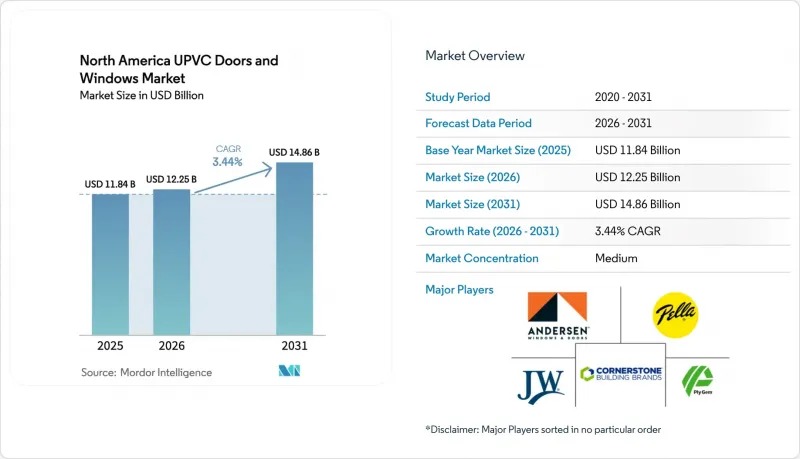
Mordor Intelligence에 의하면, 북미의 UPVC 창호 시장 규모는 2025년 118억 4,000만 달러로 평가되었습니다. 2026년에는 122억 5,000만 달러로 확대되어 2026-2031년에 걸쳐 CAGR 3.44%로 성장을 지속하여, 2031년까지 148억 6,000만 달러에 이를 것으로 예측됩니다.
본 보고서는 제품 유형(UPVC 문, UPVC 창호), 최종 사용자(주거, 상업, 산업·공공시설), 설치 형태(신축, 개보수·교체), 유통 채널(직접 판매(제조업체), 유통업체·딜러 네트워크, 온라인 소매), 지역(미국, 캐나다, 멕시코)별로 분류되어 있습니다. 시장 전망은 달러 기준 금액으로 제시되어 있습니다.
북미의 UPVC 창호 시장 동향 및 인사이트
엄격한 에너지 효율 규제 및 인센티브
이 지역 전체에서 에너지 효율 기준은 계속해서 강화되고 있으며, ENERGY STAR 버전 7.0에 따라 U-값의 하향이 요구되고, 고성능 개구부 자재에 대한 SHGC(일사열 획득률) 요건도 상향 조정되고 있습니다. 이로 인해 북부 지역에서는 많은 고급 주택용 제품 라인이 사실상 3중 유리 사양으로 전환되고 있습니다. 연방 정부의 지원은 각 관할 구역이 보다 효율적인 모델 코드로의 전환을 촉진하는 프로그램 및 보조금을 통해 지역 내 도입을 뒷받침하고 있습니다. 이에 따라 건설업체와 리모델링 업체는 2024년판 IECC(국제 에너지 보존 코드)의 규정 기준을 충족하거나, 성능 기준에 따라 크레딧을 획득할 수 있는 저U값 창문을 채택하도록 권장받고 있습니다. DOE(미국 에너지부)의 지침과‘Energy Saver’ 프레임워크에서는 저방사(Low-E) 유리 및 첨단 유리가 냉난방 부하를 어떻게 줄이는지 설명하고 있으며, 이러한 절약 효과는 창문·문 개보수 시 투자 수익률(ROI)을 향상시키는 인센티브 프로그램 및 주택 소유자용 세액 공제와 연계되어 있습니다. NFRC(전미 창호 협의회)가 2023년에 발표한 U값 및 SHGC 측정 절차에 대한 기술적 업데이트는 제품 검사 결과와 실제 환경에서의 라벨 값 간의 연관성을 강화하여, 보증 관련 분쟁을 줄이는 데 기여할 뿐만 아니라 각 건축 기준 관할 구역에서의 규정 준수를 지원하고 있습니다. 캘리포니아주의 ‘타이틀 24 제6부’ 2025년 개정으로 인해, 해당 주는 더욱 엄격한 건축 외피 기준 및 열펌프 기준으로 전환되고 있으며, 이에 따라창문과 문에 대한 성능 기준이 상향 조정되는 경우가 많아졌으며, 그 영향은 전국의 제품 포트폴리오 전반에 걸친 제품 개발 및 재고 전략까지 파급되고 있습니다.
리모델링 주도형 수요 급증
주택의 노후화와 에너지 비용에 대한 민감도로 인해, 측정 가능한 쾌적성과 에너지 비용 절감 효과를 가져오는 외피 개선이 우선시되는 가운데, 교체 수요의 기세는 북미의 UPVC 창호 시장에서 결정적인 성장 동력으로 자리 잡고 있습니다. 건축 기준 개정과 이용 가능한 세액 공제 덕분에 주택 소유자는 기준에 부합하는 제품을 쉽게 선택하고, 표준화된 양식을 통해 세제상의 우대 조치를 신청함으로써, 그렇지 않았다면 지연되었을 여러 개구부를 대상으로 한 개보수 프로젝트를 추진할 수 있게 되었습니다. 유틸리티 프로그램과 지역 주도형 이니셔티브를 통해 누적 가능한 리베이트가 추가되어 투자 회수 기간이 더욱 단축되고 있습니다. 이로 인해 금리 상승기나 신축 주택 공급이 부족한 상황에서도 교체 공사 수요는 견조하게 유지되고 있습니다. 전국 협회와 평가 기관은 U값과 일사열 획득률(SHGC)의 평가 기준을 표준화하여, 브랜드를 초월한 창호 사양 결정 및 비교가 간소화되었고, 교체 결정 과정에서의 판매 절차상의 마찰이 완화되었습니다. 각 제조업체는 실내 쪽에서 보다 신속하고 청결하게 교체 작업을 수행할 수 있는 설치 시스템을 도입했습니다. 이를 통해 공사로 인한 생활의 지장이나 공수가 줄어들고, 작업반당 처리 능력이 향상되어 숙련된 시공자 부족으로 인한 병목 현상 완화에도 기여하고 있습니다.
단열 알루미늄과의 경쟁
단열 칸막이가 있는 알루미늄은 더욱 엄격한 건축 기준의 임계값을 충족하기 위해 U값 및 조립 기술을 지속적으로 개선하고 있으며, 이로 인해 특정 상업시설이나 고급 주택의 사양에서 UPVC의 단열상 우위가 줄어들고 있습니다. 2024년판 IECC 및 ASHRAE 90.1이 적용되는 한랭 기후대에서는 열단열, 웜 엣지 스페이서, 삼중 유리를 통합한 알루미늄 시스템이 규정 기준을 충족하는 성능 수준을 달성할 수 있습니다. 또한, 건축가들은 더 날렵한 시선 라인과 큰 개구부에 대응할 수 있는 스팬 능력을 선호하는 경향이 있습니다. 건축 기준의 도입 동향에 따라 고정식 및 개폐식 개구부의 최소 기준이 상향 조정되었으며, 이러한 기준값은 상업용 사례에서 미적·구조적 요건을 충족하면서 알루미늄 제품이 기준을 충족할 수 있는 길을 열어주고 있습니다. 해안 지역에서는 알루미늄 제품용으로 내식성 마감 처리 및 내충격 사양의 제품을 널리 구할 수 있습니다. 이러한 제품들은 건축 기준 준수와 더불어, 프로젝트 설계에서 높이와 폭이 넓은 개구부가 요구되는 경우 UPVC를 대체할 수 있는 신뢰할 수 있는 대안이 됩니다. 설치 비용이 높아지는 경우에도, 엄격한 건축 기준의 제약 하에서 수명 주기 고려, 파사드 디자인, 프로젝트 예산이 조화를 이룬다면, 알루미늄의 내구성과 형태적 특성은 해당 사양을 채택할 타당한 이유가 됩니다.
부문별 분석
UPVC 창호는 2025년 북미의 UPVC 창호 시장 점유율의 65.83%를 차지했으며, 2031년까지 연평균 성장률(CAGR) 4.13%를 나타낼 것으로 예측됩니다. ENERGY STAR 기준의 엄격화와 IECC 개정에 따라 주택 및 소규모 상업시설의 개구부(창문·문)에 요구되는 성능 수준이 높아지고 있습니다. 실제로 기후대에 관계없이 건물의 외피 U값 및 일사열 획득률(SHGC) 목표 달성에 창문이 기여하기 때문에 창문 사양은 항상 최우선 과제로 자리 잡고 있습니다. ENERGY STAR의 ‘Most Efficient’ 기준을 충족하는 제품, 더 엄격한 건축 기준을 준수하는 제품은 주택 소유자나 건설업자에게 리베이트 및 세액 공제 신청 절차를 간소화할 수 있다는 이점이 있습니다. 전미창호평가협의회(NFRC)의 업데이트된 절차에 따른 라벨 표시와 성능 검증을 통해 건축기준법에 따른 검사가 더욱 효율화되고, 납품 시 U값과 SHGC에 대한 기대치가 통일되므로, 재시공 발생이나 보증 청구가 감소합니다. 소유주나 시설 관리자에게 있어 수명 주기 전반에 걸친 종합 평가는 단열 성능과 설치 비용, 유지보수의 용이성을 고려한 것이며, 이것이 북미의 UPVC 창호 및 창문 시장에서 주택과 소규모 상업 프로젝트의 일반적인 개구부 전반에 걸쳐 UPVC 채택을 촉진하고 있습니다.
UPVC 창호는 해안 주에서 내충격 성능을 갖춘 출입구에 대한 건축 기준 및 보험 요건이 여전히 중요하며, 단열 UPVC 창호 시스템이 매력적인 R값을 달성하면서도 교체 공사 시에도 합리적인 설치 비용을 유지할 수 있기 때문에 성장세를 유지하고 있습니다. 2026년에 관할 구역별 에너지 기준이 더 높은 외피 기준치로 전환됨에 따라, 각 제조업체는 채광이 요구되는 하프라이트 및 풀라이트 도어 설계에서 U값 목표를 달성하기 위해 코어 소재 및 유리 옵션 개선에 주력하고 있습니다. NFRC의 체계는 구매자가 문과 창문의 성능을 통일된 기준으로 비교할 수 있게 해주며, 이러한 투명성 덕분에 성능 수준별로 분류된 UPVC 제품의 보급이 촉진되고 있습니다. 주요 브랜드가 도입한 설치용 도구와 노크다운 프레임 옵션 덕분에 설치 시간이 단축되었고, 이로 인해 작업팀당 처리 능력이 향상되어 시간적 제약이 있는 리모델링 프로젝트의 총 소유 비용이 절감되고 있습니다. 예측 기간 동안, 열교 방지, 하드웨어 통합, 스마트 기능에 초점을 맞춘 제품 개발을 통해 북미의 UPVC 창호 시장에서 창문과 문 모두 진화하는 건축 기준과 사용자 경험에 대한 기대에 지속적으로 부응하고 있습니다.
주택 부문은 정착된 교체 주기와 주택 전체 개조를 촉진하는 세액 공제의 혜택을 받아 2025년에는 58.14%의 점유율을 차지하며, 수량 기준으로 여전히 가장 큰 부문을 형성goT습니다. 한편, 상업 부문은 ASHRAE 90.1을 준수하는 사양과 성능 중심의 건축 기준에 따라 연평균 성장률(CAGR) 3.92%로 가장 빠르게 성장하고 있습니다. 성능 기준에 따른 적합성 에너지 모델링과 끊임없이 변화하는 지자체 기준에 따라, 상업시설 소유주는 건물 전체의 부하를 줄이기 위한 외피 개선을 검토하도록 권장받고 있으며, 이로 인해 사양은 더 고성능의 개구부 구성으로 전환될 가능성이 있습니다. 유틸리티자의 프로그램과 공공 부문의 조달 기준은 명확한 성능 문서, 환경적 투명성, 내구성을 갖춘 제품의 선정을 장려하고 있으며, 이는 경쟁력 있는 가격으로 인증 기준을 충족하는 UPVC 제품과 부합합니다. 기관 투자자 구매자들은 수명 주기 및 보증 지원을 중시하는 경향이 강하며, 이 부문에서는 제품의 성능과 규정 준수를 보장하기 위해 제조업체 직영 설치 및 서비스 프로그램이 확대되고 있습니다. 주택 시장에서는 각 가구가 세금 공제를 활용하고 있어 견조한 성장세가 지속되고 있으며, 시공업체들은 청구 절차를 간소화하기 위해 인증 제조업체 식별 번호(QMID)와 같은 표준화된 문서에 의존하고 있습니다.
상업 부문 구매자에게도 여러 관할 구역에 걸쳐 있는 포트폴리오 전체에 걸친 건축 기준의 일관성과 라벨 표시의 신뢰성은 큰 이점이 됩니다. 이를 통해 북미의 UPVC 문 및 창호 시장에서 대규모 개보수 프로그램을 전개할 때의 규정 준수 위험을 줄일 수 있습니다. 기관 시설이나 경공업용 건물의 경우, 예산과 유지보수의 현실성을 고려할 때, 빈번하게 사용되는 환경에서도 신뢰할 수 있는 단열 성능과 비용 관리를 실현하는 재료가 선호됩니다. 이러한 점에서 UPVC는 비구조용 표준 크기의 개구부에 적합합니다. 사무실에서 주거용으로의 용도 변경이나 적응형 재이용의 경우, 적절한 유리 및 스페이서 기술과 결합함으로써 UPVC의 단열·차음 특성은 건축 기준 및 쾌적성 목표를 충족시키기에 충분한 경우가 많습니다. 이용 가능한 공공 인센티브는 건물 전체의 에너지 계획의 일환으로, 외피 개조를 통해 건축 기준을 충족하거나 성능을 향상시킨 실적을 프로젝트에서 입증할 수 있는 경우, 추가적인 뒷받침이 됩니다. 이러한 수요 추세는 북미의 UPVC 창호 시장에서 주택이 여전히 큰 점유율을 차지하고 있음에도 불구하고, 상업용 시장의 성장이 주택 시장을 소폭 앞지를 가능성이 있는 이유를 뒷받침합니다.
기타 혜택
- 엑셀 형식 시장 예측(ME) 시트
- 3개월간의 애널리스트 지원
자주 묻는 질문
목차
제1장 서론
제2장 조사 방법
제3장 개요
제4장 시장 구도
제5장 시장 규모 및 성장 예측
제6장 경쟁 구도
제7장 시장 기회 및 향후 전망
KTH 26.08.31According to Mordor Intelligence, the North America UPVC doors and windows market size is expected to grow from USD 11.84 billion in 2025 to USD 12.25 billion in 2026 and is forecast to reach USD 14.86 billion by 2031 at 3.44% CAGR over 2026-2031.
This report is Segmented by Product Type (uPVC Doors, UPVC Windows), End User (Residential, Commercial, Industrial & Institutional), Installation (New Construction, Renovation & Replacement), Distribution Channel (Direct Sales Manufacturers, Distributor Dealer Network, Retail & Online), and Geography (United States, Canada, Mexico). The Market Forecasts are Provided in Terms of Value USD.
North America UPVC Doors And Windows Market Trends and Insights
Stringent Energy-Efficiency Regulations & Incentives
Energy-efficiency criteria continue to tighten across the region, with ENERGY STAR Version 7.0 pushing U-factors lower and raising SHGC expectations for high-performance fenestration, which effectively steers many premium residential lines toward triple-pane options in northern zones. Federal support bolsters local adoption through programs and grants that help jurisdictions move to more efficient model codes, which in turn nudge builders and remodelers toward low U-factor windows that meet the prescriptive path or earn credits under performance paths within the 2024 IECC. DOE guidance and the Energy Saver framework document how low-e and advanced glazing reduce heating and cooling loads, and those savings tie into incentive programs and homeowner tax credits that improve ROI on fenestration upgrades. NFRC's 2023 technical updates to U-factor and SHGC procedures strengthen the linkage between product testing and real-world label values, which helps mitigate warranty disputes and supports compliance across code jurisdictions. California's Title 24 Part 6 2025 update moves the state toward tighter envelope baselines and heat pump norms, and it often raises the performance bar for windows and doors in ways that cascade into product development and stocking strategies across national portfolios.
Renovation-Led Demand Surge
Replacement momentum remains a defining growth axis for the North America uPVC doors and windows market as aging housing and energy-bill sensitivity prioritize envelope improvements that deliver measurable comfort and utility-bill outcomes. Code updates and available credits make it easier for homeowners to pick compliant products, claim tax benefits through standardized forms, and move forward with multi-opening projects that would otherwise be delayed. Utility programs and local initiatives add stackable rebates that further compress the payback period, keeping replacement activity resilient during phases of higher interest rates and constrained new-home supply. National associations and rating councils have standardized rating protocols for U-factor and Solar Heat Gain Coefficient (SHGC), which simplifies specifying and comparing windows and doors across brands, and this reduces friction in the sales process for replacement decisions. Manufacturers have introduced installation systems that allow faster, cleaner replacements from the interior, which lowers project disruption and labour hours, raising throughput per crew and helping alleviate skilled installer bottlenecks.
Competition from Thermally Broken Aluminum
Thermally broken aluminum continues to improve U-factors and assembly techniques to meet stricter code thresholds, which narrows uPVC's thermal advantage in certain commercial and high-end residential specifications. In cold climate zones under 2024 IECC and ASHRAE 90.1, aluminum systems that integrate thermal breaks, warm-edge spacers, and triple glazing can achieve performance levels that satisfy prescriptive paths, and architects often prefer the slimmer sightlines and span capacity for larger openings. Code adoption trends elevate minimums for fixed and operable fenestration, and these thresholds open pathways for aluminum products to qualify while maintaining aesthetic and structural preferences in commercial use cases. In coastal markets, corrosion-resistant finishes and impact-rated configurations are widely available for aluminum, which, when combined with code compliance, present credible alternatives to uPVC where project design requires tall or wide spans. Even with higher installed costs, aluminum's durability and form factor can justify specifications where lifecycle considerations, facade design, and project budgets align under strict code constraints.
Other drivers and restraints analyzed in the detailed report include:
- Material Cost-Advantage vs. Wood & Aluminum
- Smart-Sensor-Ready Profile Adoption
- Skilled Installer Shortage
For complete list of drivers and restraints, kindly check the Table Of Contents.
Segment Analysis
uPVC windows captured 65.83% of the 2025 North America uPVC doors and windows market share, and are set to grow at a 4.13% CAGR through 2031. Intensifying ENERGY STAR criteria and IECC updates elevate the required performance for residential and light commercial fenestration, which in practice keeps window specifications front and centre due to their contribution to envelope U-factors and Solar Heat Gain Coefficient (SHGC) targets across climate zones. Products that meet ENERGY STAR Most Efficient thresholds or comply with stretch codes gain an advantage by simplifying rebate and tax credit documentation for homeowners and builders. Labelling and performance verification through the National Fenestration Rating Council's updated procedures further streamlines code inspections and aligns expectations for delivered U-factor and SHGC, which reduces rework and warranty claims. For owners and facility managers, the lifecycle equation pairs thermal performance with installed cost and maintenance profile, which supports the use of uPVC across a wide span of typical openings in residential and smaller commercial projects in the North America uPVC doors and windows market.
uPVC doors maintain growth parity because code and insurance requirements for impact-rated entries remain prominent in coastal states, and because insulated uPVC door systems can reach attractive R-values while keeping installed costs accessible for replacement projects. As jurisdictional energy standards move toward higher envelope baselines in 2026, manufacturers have focused on improved cores and glazing options to meet U-factor targets for half-light and full-light door designs where daylighting is desired. The NFRC framework helps buyers compare door and window performance on a uniform basis, and this transparency supports broader adoption of performance-tiered uPVC offerings. Installation tools and knockdown frame options introduced by leading brands shorten install times, which raises throughput per crew and lowers total cost of ownership for time-sensitive remodelling projects. Over the forecast period, product development targeting thermal bridging, hardware integration, and smart-ready features keeps both windows and doors aligned with evolving code and user-experience expectations across the North America uPVC doors and windows market.
The residential segment remained the largest by volume with 58.14% share in 2025, benefiting from an entrenched replacement cycle and tax credits that promote whole-home upgrades, while the commercial segment is the fastest growing with a 3.92% CAGR on specifications tied to ASHRAE 90.1 and performance-led code paths. Energy modelling for performance-based compliance and evolving municipal standards push commercial owners to evaluate envelope improvements that reduce whole-building loads, which can tilt specifications toward higher-performing fenestration configurations. Utility programs and public-sector procurement standards encourage the selection of products with clear performance documentation, environmental transparency, and durability, which aligns with uPVC offerings that meet certified thresholds at competitive cost. Institutional buyers often weigh lifecycle and warranty support heavily, an area where manufacturer-direct installation and service programs have grown to ensure product performance and compliance alignment. Residential momentum remains resilient as households leverage tax credits, while installers rely on standardized documentation like Qualified Manufacturer Identification Numbers to simplify claims.
Commercial buyers also benefit from code consistency and labelling assurance across multi-jurisdiction portfolios, which reduces compliance risk when deploying retrofit programs at scale in the North America uPVC doors and windows market. For institutional facilities and light industrial buildings, budgets and maintenance practicalities favour materials that deliver reliable thermal performance and cost control under frequent use, which positions uPVC for non-structural, standard-size openings. In office-to-residential conversions and adaptive reuse, uPVC's thermal and acoustic characteristics are often sufficient when paired with appropriate glazing and spacer technologies to meet code and comfort goals. Public incentives, where available, add further support when projects can document code or performance gains for envelope upgrades as part of whole-building energy plans. This demand profile underscores why commercial growth can edge ahead of residential, even as residential retains the larger share in the North America uPVC doors and windows market.
Complete Report Scope:
- By Product Type
- uPVC Doors
- Sliding Doors
- Casement Doors
- Tilt & Turn Doors
- French Doors
- Others
- uPVC Windows
- Sliding Windows
- Casement Windows
- Tilt & Turn Windows
- Others (Picture / Fixed Windows,Awning Windows)
- uPVC Doors
- By End User
- Residential
- Commercial
- Industrial & Institutional
- By Installation
- New Construction
- Renovation & Replacement
- By Distribution Channel
- Direct Sales (Manufacturers)
- Distributor / Dealer Network
- Retail & Online
- By Country
- United States
- Canada
- Mexico
List of Companies Covered in this Report:
- Andersen Corporation
- Pella Corporation
- JELD-WEN Holding Inc.
- Cornerstone Building Brands (MI Windows)
- Ply Gem
- Marvin Windows & Doors
- Milgard Manufacturing
- Harvey Building Products
- Atrium Windows & Doors
- Viwinco
- Simonton Windows & Doors
- Soft-Lite LLC
- YKK AP America
- Crystal Window & Door Systems
- REHAU
- VEKA AG
- Deceuninck NV
- Profine Group (Kommerling)
- Aluplast GmbH
- Eurocell plc
Additional Benefits:
- The market estimate (ME) sheet in Excel format
- 3 months of analyst support
TABLE OF CONTENTS
1 Introduction
- 1.1 Study Assumptions & Market Definition
- 1.2 Scope of the Study
2 Research Methodology
3 Executive Summary
4 Market Landscape
- 4.1 Market Overview
- 4.2 Market Drivers
- 4.2.1 Stringent energy-efficiency regulations & incentives
- 4.2.2 Renovation-led demand surge
- 4.2.3 Material cost-advantage vs. wood & aluminum
- 4.2.4 Insurance-driven uptake of hurricane-rated uPVC
- 4.2.5 Recycled-content extrusion capacity expansion
- 4.2.6 Smart-sensor-ready profile adoption
- 4.3 Market Restraints
- 4.3.1 PVC resin price volatility
- 4.3.2 Competition from thermally-broken aluminum
- 4.3.3 ESG limits on virgin PVC
- 4.3.4 Skilled installer shortage
- 4.4 Industry Value Chain Analysis
- 4.5 Regulatory Landscape
- 4.6 Porter's Five Forces Analysis
- 4.6.1 Bargaining Power of Suppliers
- 4.6.2 Bargaining Power of Buyers
- 4.6.3 Threat of New Entrants
- 4.6.4 Threat of Substitutes
- 4.6.5 Competitive Rivalry
- 4.7 Insights into the Latest Trends and Innovations in the Market
- 4.8 Insights into Recent Developments (New Product Launches, Strategic Initiatives, Investments, Partnerships, JVs, Expansion, M&As, etc.) in the Market
5 Market Size & Growth Forecasts
- 5.1 By Product Type
- 5.1.1 uPVC Doors
- 5.1.1.1 Sliding Doors
- 5.1.1.2 Casement Doors
- 5.1.1.3 Tilt & Turn Doors
- 5.1.1.4 French Doors
- 5.1.1.5 Others
- 5.1.2 uPVC Windows
- 5.1.2.1 Sliding Windows
- 5.1.2.2 Casement Windows
- 5.1.2.3 Tilt & Turn Windows
- 5.1.2.4 Others (Picture / Fixed Windows,Awning Windows)
- 5.1.1 uPVC Doors
- 5.2 By End User
- 5.2.1 Residential
- 5.2.2 Commercial
- 5.2.3 Industrial & Institutional
- 5.3 By Installation
- 5.3.1 New Construction
- 5.3.2 Renovation & Replacement
- 5.4 By Distribution Channel
- 5.4.1 Direct Sales (Manufacturers)
- 5.4.2 Distributor / Dealer Network
- 5.4.3 Retail & Online
- 5.5 By Country
- 5.5.1 United States
- 5.5.2 Canada
- 5.5.3 Mexico
6 Competitive Landscape
- 6.1 Market Concentration
- 6.2 Strategic Moves
- 6.3 Market Share Analysis
- 6.4 Company Profiles {(includes Global level Overview, Market level overview, Core Segments, Financials as available, Strategic Information, Market Rank/Share for key companies, Products & Services, and Recent Developments)}
- 6.4.1 Andersen Corporation
- 6.4.2 Pella Corporation
- 6.4.3 JELD-WEN Holding Inc.
- 6.4.4 Cornerstone Building Brands (MI Windows)
- 6.4.5 Ply Gem
- 6.4.6 Marvin Windows & Doors
- 6.4.7 Milgard Manufacturing
- 6.4.8 Harvey Building Products
- 6.4.9 Atrium Windows & Doors
- 6.4.10 Viwinco
- 6.4.11 Simonton Windows & Doors
- 6.4.12 Soft-Lite LLC
- 6.4.13 YKK AP America
- 6.4.14 Crystal Window & Door Systems
- 6.4.15 REHAU
- 6.4.16 VEKA AG
- 6.4.17 Deceuninck NV
- 6.4.18 Profine Group (Kommerling)
- 6.4.19 Aluplast GmbH
- 6.4.20 Eurocell plc
7 Market Opportunities & Future Outlook
- 7.1 Closed-Loop Recycling & Reprocessed uPVC Feedstock
- 7.2 Smart-Ready Retrofit Systems


