

|
시장보고서
상품코드
2116126
일회용 의료용품 시장 : 점유율 분석, 업계 동향과 통계, 성장 예측(2026-2031년)Disposable Medical Supplies - Market Share Analysis, Industry Trends & Statistics, Growth Forecasts (2026 - 2031) |
||||||
 Mordor Intelligence
Mordor Intelligence에 의하면, 일회용 의료용품 시장 규모는 2025년에 6,000억 달러로 평가되었고 2026년 6,800억 달러에서 2031년까지 1조 2,800억 달러에 이를 것으로 예측되며, 예측 기간(2026-2031년) CAGR은 13.52%를 나타낼 전망입니다.
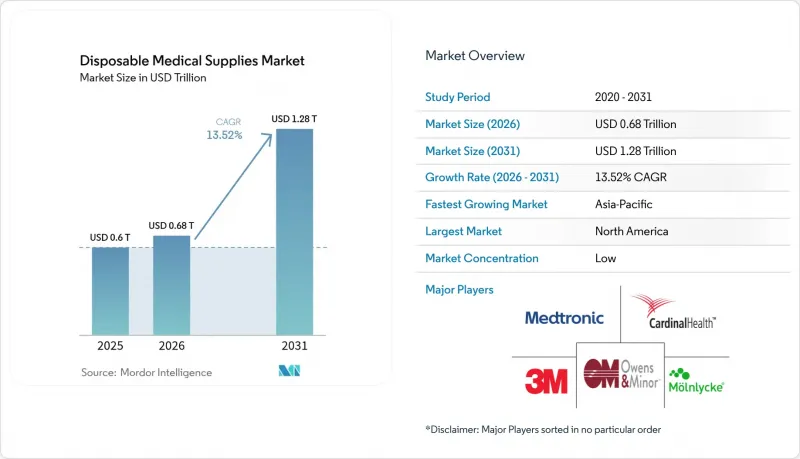
본 보고서는 제품 유형(장갑, 드레이프, 가운, 마스크, 호흡용 보호구, 바늘, 주사기, 시술 키트, 트레이 등), 최종 사용자(병원 및 진료소, 당일 수술센터, 재택치료 시설 등), 지역(북미, 유럽,아시아태평양, 중동 및 아프리카, 남미)별로 분류되어 있습니다. 시장 예측은 금액(달러) 기준으로 제시되어 있습니다.
전 세계 일회용 의료용품 시장 동향 및 인사이트
감염 관리 기준의 강화
의료 기관들은 교차 오염을 억제하기 위해 일회용 의료 용품을 우선적으로 사용하는 팬데믹 이후의 프로토콜을 정착시키고 있습니다. 조인트 커미션(Joint Commission)은 프로세스 점검의 70%를 줄이는 한편, 표면 청소 기준을 강화하여 병원들이 재사용 가능한 물품을 일회용 동등 제품으로 대체하도록 장려했습니다. 이러한 변화는 현재 일회용 가운, 드레이프, 진단 용품이 일상적으로 사용되는 일반 병동으로까지 확산되고 있습니다. 예산 담당자들은 단위당 지출 증가를 정당화할 때, 멸균으로 인한 가동 중단 시간 및 소송 비용의 회피를 고려하고 있습니다. 환자 만족도와 연계된 규정 준수 평가는 일회용 의료용품 시장 전체에서 일회용 제품에 대한 수요를 더욱 뒷받침하고 있습니다.
외래수술센터(ASC)의 급속한 확대
외래수술센터(ASC)는 정형외과 및 순환기과 수술 분야에서 보험사의 지지를 지속적으로 확대되고 있습니다. 최소한의 인력 배치와 신속한 수술 순환을 실현하기 위해서는 재처리로 인한 지연을 없애는 사전 멸균 키트가 필수적입니다. ASC에는 일반적으로 병원 내 멸균 장비가 없기 때문에 일회용 키트는 수술실의 순환 속도를 높이고 간접비를 최소화합니다. 외래 진료를 장려하는 보험 환급 제도 변경으로 진료 건수가 증가함에 따라, 드레이프, 카테터, 일회용 기구를 포함한 전용 팩에 대한 수요가 확대되고 있습니다. OECD 국가 전반에 걸쳐 ASC 거점이 확대됨에 따라 일회용 의료용품 시장은 지속적인 호재를 누리고 있습니다.
매립세 및 EPR법에 따른 폐기 비용 급등
EU의 ‘포장 및 포장 폐기물 규정’은 2030년까지 재활용 가능성을 의무화하고, 2026년 8월부터는 폐기 비용 부담을 생산자에게 전가하도록 하고 있습니다. 의료 분야에서는 이미 연간 약 600만 톤의 폐기물이 발생하고 있지만, 그중 플라스틱 재활용률은 1% 미만에 그치고 있습니다. 기존 PVC 장갑 제조업체들은 이익률을 압박하는 세금 인상에 직면해 있습니다. 의료 서비스 제공업체들은 구매 결정 시 폐기물 처리 비용을 고려하게 되었으며, 비용에 민감한 의료용 일회용품 시장 부문에서 지속가능성이 부족한 일회용 제품의 채택을 억제하고 있습니다.
부문 분석
CAGR은 연평균 성장률(Compound Annual Growth Rate)을 의미합니다. 시술 키트와 트레이 또한 외래수술센터(ASC)의 성장에 힘입어 혜택을 보고 있습니다. 이는 사전 포장(pre-pack)을 통해 수술실 회전율이 효율화되기 때문입니다. 드레이프와 가운도 이와 같은 효율화 추세를 타고 있지만, 마스크와 호흡용 보호구의 경우 팬데믹 당시의 정점보다는 진정된 양상을 보이고 있으나, 산업 안전 기준을 고려할 때 여전히 견조한 수요가 예상됩니다. 바늘과 주사기는 만성 질환 치료에 따른 주사가 재택으로 전환됨에 따라 안정적인 성장세를 보이고 있습니다. 카테터 제조업체들은 PTFE 공급 제약에 직면해 있으며, 이에 따라 생산 능력에 대한 투자와 대체 소재 개발이 진행되고 있습니다.
혁신적인 기업들은 나노섬유로 만든 상처 피복재와 전자 차트에 데이터를 전송하는 연결형 일회용 센서 개발을 추진하며 이 카테고리의 폭을 넓히고 있습니다. 에보닉(Evonik)사의 ‘RESOMER’ 폴리머 플랫폼은 재료 과학이 성능과 지속가능성이라는 두 가지 목표를 어떻게 충족시키고 있는지를 보여줍니다. 점점 더 많은 병원이 조달을 폐기물 공개와 연계함에 따라, 바이오 제품의 진열 공간은 확대되고 있습니다. 그 결과, 생분해성 장갑의 의료용 일회용품 시장 규모는 2031년까지 현저한 점유율 확대를 기록할 것으로 예측됩니다.
지역별 분석
북미는 엄격한 감염 관리 감독과 현지 생산에 대한 새로운 자본 투자 덕분에 2025년 일회용 의료용품 시장에서 37.05%의 점유율을 유지했습니다. 2026년까지 특정 중국산 장갑에 대한 관세가 100%로 인상됨에 따라, 킴벌리 클라크(Kimberly-Clark)와 같은 기업들은 오하이오주 및 사우스캐롤라이나주의 공장에 20억 달러를 투자하여 900명 이상의 숙련된 일자리를 창출하고 있습니다. 공동 조달 기구(GPO)는 사양을 표준화함으로써 제품 회전율을 가속화하고, 네트워크 전체에 걸쳐 안정적인 판매량을 확보하고 있습니다.
유럽에서는 지속 가능한 의료 조달을 위한 노력이 계속해서 진행되고 있습니다. 2030년까지 재활용 가능한 포장을 의무화하는 EPR(사용 후 제품 책임) 법에 따라, 바이오폴리머로 만든 일회용 제품 라인에 대한 관심이 높아지고 있습니다. 독일과 북유럽 국가의 병원에서는 연간 폐기물 지표를 공표하고 있으며, 폐기 처리 비용을 절감할 수 있는 공급업체가 입찰에서 우위를 점하고 있습니다. 유럽 대륙의 인구 증가율은 완만하지만, 고령화로 인해 의료 시술 건수가 유지되어 일회용 의료용품 시장의 지속적인 수요가 뒷받침될 전망입니다.
아시아태평양은 2031년까지 연평균 성장률(CAGR) 7.62%를 나타낼 것으로 예측되며, 이는 모든 지역 중 가장 높은 성장률입니다. 도시화와 의료 예산 증가로 인해 중국, 인도, 인도네시아, 베트남에서는 병상 수가 확대되고 있습니다. 무역 마찰로 인해 일부 수출 주문이 중국에서 다른 국가로 이동하고 있는 가운데, 말레이시아와 태국의 지역 제조업체들은 미국 내 수요를 보충하기 위해 장갑 주문을 확보하고 있습니다. 한편, 인도의 신생 민간 병원에서는 서유럽의 감염 관리 기준이 채택되어 환자 1인당 일회용 의료용품의 평균 소비량이 증가하고 있습니다.
중동 및 아프리카 및 남미에서는 각국 정부가 병원 인프라에 투자하여 의료 관련 감염을 줄이려 하고 있어, 수요 증가세는 완만하지만 증가 추세를 보이고 있습니다. 다자간 자금 지원 프로그램에는 국제 인증 기준을 충족하기 위해 일회용 키트 사용을 의무화하는 조항이 포함되는 경우가 많습니다. 이러한 개발도상 지역은 전반적으로 의료용 일회용품 시장에서 사업을 전개하는 공급업체에게 판매량 증가와 수익원 다각화에 기여하고 있습니다.
기타 혜택:
- 엑셀 형식 시장 예측(ME) 시트
- 3개월간의 애널리스트 지원
자주 묻는 질문
목차
제1장 서론
제2장 조사 방법
제3장 주요 요약
제4장 시장 구도
제5장 시장 규모와 성장 예측
제6장 경쟁 구도
제7장 시장 기회와 향후 전망
JHS 26.08.28According to Mordor Intelligence, the disposable medical supplies market size was valued at USD 0.60 trillion in 2025 and estimated to grow from USD 0.68 trillion in 2026 to reach USD 1.28 trillion by 2031, at a CAGR of 13.52% during the forecast period (2026-2031).
This report is Segmented by Product Type (Gloves, Drapes, Gowns, Masks, Respirators, Needles, Syringes, Procedure Kits, and Trays, and More), End User (Hospitals and Clinics, Ambulatory Surgery Centers, Home-Healthcare Settings, and More), and Geography (North America, Europe, Asia Pacific, Middle East and Africa, South America). The Market Forecasts are Provided in Terms of Value (USD).
Global Disposable Medical Supplies Market Trends and Insights
Tightening Infection-Control Norms
Healthcare organizations have locked in post-pandemic protocols that prioritize disposable supplies to curb cross-contamination. The Joint Commission cut 70% of process checks but tightened surface-cleaning outcomes, driving hospitals to replace reusable items with single-use equivalents.The shift now extends to general wards where disposable gowns, drapes, and diagnostics are routine. Budget holders factor avoidance of sterilization downtime and litigation costs when justifying higher per-unit spending. Compliance scores tied to patient satisfaction further anchor demand for disposables across the disposable medical supplies market.
Rapid ASC Expansion
Ambulatory surgery centers continue to gain payer support for orthopedics and cardiology procedures. Lean staffing and rapid case turnover require pre-sterile kits that eliminate reprocessing delays. ASCs typically lack in-house sterilizers, so disposable kits speed room turnover and minimize overhead. Reimbursement shifts that incentivize outpatient care strengthen volume, boosting specialized packs containing drapes, catheters, and single-use instruments. The disposable medical supplies market gains a lasting tailwind as ASC footprints widen across OECD nations.
Landfill Taxes & EPR Laws Escalating Disposal Costs
The EU Packaging and Packaging Waste Regulation mandates recyclability by 2030 and shifts disposal fees to producers from August 2026. Healthcare already generates nearly 6 million tons of waste annually, of which fewer than 1% of plastics are recycled.Manufacturers of traditional PVC gloves face rising levies that erode margins. Providers add waste charges into purchasing decisions, tempering the adoption of non-sustainable disposables in cost-sensitive segments of the disposable medical supplies market.
Other drivers and restraints analyzed in the detailed report include:
- Home-based Chronic-Care Boom
- Growth of Point-Of-Care Diagnostics
- Price Compression from Bulk GPO Tenders in North America
For complete list of drivers and restraints, kindly check the Table Of Contents.
Segment Analysis
The gloves segment generated 28.85% of the disposable medical supplies market revenue in 2025 and remains central to everyday clinical routines. Usage frequency rose sharply after COVID-19, and elevated volumes have normalized at higher baselines. Biodegradable gloves are scaling quickly, registering an 11.52% CAGR that outpaces all other sub-categories. Their momentum reflects imminent EPR fees on traditional nitrile and latex waste. Procedure kits and trays also benefit from ambulatory surgery center growth, as pre-pack builds streamline room turnover. Drapes and gowns ride the same efficiency trend, whereas masks and respirators, though moderating from pandemic peaks, still post healthy demand given occupational safety standards. Needles and syringes post stable gains, tied to chronic-care injections migrating into homes. Catheter makers face PTFE supply constraints, prompting capacity investments and alternative materials development.
Innovators are advancing nanofiber wound dressings and connected single-use sensors that report data to electronic records, broadening the category. Evonik's RESOMER polymer platform illustrates how material science responds to dual performance and sustainability targets. As more hospitals link purchasing to waste disclosure, bio-based lines gain shelf space. Consequently, the disposable medical supplies market size for biodegradable gloves is projected to log visible share gains by 2031.
Complete Report Scope:
- By Product Type
- Gloves
- Drapes & Gowns
- Masks & Respirators
- Needles & Syringes
- Procedure Kits & Trays
- Catheters
- Wound Dressings
- Diagnostic & Sampling Disposables
- Other Types
- By End User
- Hospitals & Clinics
- Ambulatory Surgery Centers
- Home-Healthcare Settings
- Diagnostic Laboratories
- Other End Users
- By Geography
- North America
- United States
- Canada
- Mexico
- Europe
- Germany
- United Kingdom
- France
- Italy
- Spain
- Rest of Europe
- Asia Pacific
- China
- Japan
- India
- South Korea
- Australia
- Rest of Asia Pacific
- Middle East & Africa
- GCC
- South Africa
- Rest of Middle East & Africa
- South America
- Brazil
- Argentina
- Rest of South America
- North America
Geography Analysis
North America retained a 37.05% share of the disposable medical supplies market in 2025, thanks to strict infection-control oversight and fresh capital investments in local manufacturing. Tariffs that climb to 100% on certain Chinese gloves by 2026 spur companies such as Kimberly-Clark to pump USD 2 billion into Ohio and South Carolina plants, creating more than 900 skilled roles. Group Purchasing Organizations standardize specifications, accelerating product turnover and ensuring steady volume across the network.
Europe remains committed to sustainable healthcare procurement. EPR legislation that compels recyclable packaging by 2030 has amplified interest in bio-polymer disposable lines. Hospitals in Germany and the Nordics publish annual waste metrics, and suppliers able to lower disposal fees gain bidding advantages. While the continent's population growth is muted, aging demographics sustain procedural volumes and drive continuous demand within the disposable medical supplies market.
Asia Pacific is expected to chart a 7.62% CAGR up to 2031, the fastest among all regions. Urbanization and rising healthcare funding expand bed capacity across China, India, Indonesia, and Vietnam. Although trade tensions redirect some export orders away from China, regional manufacturers in Malaysia and Thailand seize glove contracts to backfill U.S. demand. Meanwhile, emerging private hospitals in India adopt Western infection-control norms, boosting average per-patient disposable consumption.
Middle East and Africa, along with South America, contribute modest but rising demand as governments invest in hospital infrastructure and seek to reduce healthcare-acquired infections. Multilateral funding programs often include clauses for single-use kits to meet global accreditation benchmarks. Collectively, these developing territories add incremental volume and diversify revenue streams for suppliers active in the disposable medical supplies market.
- Cardinal Health
- Medtronic
- 3M
- Owens & Minor
- Molnlycke Health Care
- Medline Industries
- Semperit
- Ansell
- Nipro
- Mckesson
- Top Glove
- Beckton Dickinson
- Baxter
- B. Braun
- Halyard Health
- Kimberly-Clark Worldwide
- Terumo
- Smiths Group
- Coloplast
- Hartalega Holdings
Additional Benefits:
- The market estimate (ME) sheet in Excel format
- 3 months of analyst support
TABLE OF CONTENTS
1 Introduction
- 1.1 Study Assumptions & Market Definition
- 1.2 Scope of the Study
2 Research Methodology
3 Executive Summary
4 Market Landscape
- 4.1 Market Overview
- 4.2 Market Drivers
- 4.2.1 Tightening Infection-Control Norms In Post-COVID Healthcare Systems
- 4.2.2 Rapid ASC (Ambulatory Surgery Center) Expansion In OECD Countries
- 4.2.3 Home-Based Chronic-Care Boom Driving Single-Use Kits
- 4.2.4 Growth Of Point-Of-Care Diagnostics Using Disposable Sensors
- 4.2.5 Biodegradable Bio-Polymer Breakthroughs Lowering Eco-Concerns
- 4.2.6 Reshoring Of Med-Tech Manufacturing In US & EU Boosting Demand For Sterile Packaging
- 4.3 Market Restraints
- 4.3.1 Land-Fill Taxes & EPR Laws Escalating Disposal Costs
- 4.3.2 Price Compression From Bulk GPO Tenders In North America
- 4.3.3 Sterilization Capacity Bottlenecks Delaying Product Launches
- 4.3.4 Volatility In Nitrile & Latex Prices Impacting Margins
- 4.4 Supply Chain Analysis
- 4.5 Regulatory Landscape
- 4.6 Technological Outlook
- 4.7 Porter's Five Forces Analysis
- 4.7.1 Bargaining Power of Buyers/Consumers
- 4.7.2 Bargaining Power of Suppliers
- 4.7.3 Threat of New Entrants
- 4.7.4 Threat of Substitute Products
- 4.7.5 Intensity of Competitive Rivalry
5 Market Size & Growth Forecasts (Value)
- 5.1 By Product Type
- 5.1.1 Gloves
- 5.1.2 Drapes & Gowns
- 5.1.3 Masks & Respirators
- 5.1.4 Needles & Syringes
- 5.1.5 Procedure Kits & Trays
- 5.1.6 Catheters
- 5.1.7 Wound Dressings
- 5.1.8 Diagnostic & Sampling Disposables
- 5.1.9 Other Types
- 5.2 By End User
- 5.2.1 Hospitals & Clinics
- 5.2.2 Ambulatory Surgery Centers
- 5.2.3 Home-Healthcare Settings
- 5.2.4 Diagnostic Laboratories
- 5.2.5 Other End Users
- 5.3 By Geography
- 5.3.1 North America
- 5.3.1.1 United States
- 5.3.1.2 Canada
- 5.3.1.3 Mexico
- 5.3.2 Europe
- 5.3.2.1 Germany
- 5.3.2.2 United Kingdom
- 5.3.2.3 France
- 5.3.2.4 Italy
- 5.3.2.5 Spain
- 5.3.2.6 Rest of Europe
- 5.3.3 Asia Pacific
- 5.3.3.1 China
- 5.3.3.2 Japan
- 5.3.3.3 India
- 5.3.3.4 South Korea
- 5.3.3.5 Australia
- 5.3.3.6 Rest of Asia Pacific
- 5.3.4 Middle East & Africa
- 5.3.4.1 GCC
- 5.3.4.2 South Africa
- 5.3.4.3 Rest of Middle East & Africa
- 5.3.5 South America
- 5.3.5.1 Brazil
- 5.3.5.2 Argentina
- 5.3.5.3 Rest of South America
- 5.3.1 North America
6 Competitive Landscape
- 6.1 Market Concentration
- 6.2 Market Share Analysis
- 6.3 Company Profiles (includes Global level Overview, Market level overview, Core Segments, Financials as available, Strategic Information, Market Rank/Share for key companies, Products & Services, and Recent Developments)
- 6.3.1 Cardinal Health
- 6.3.2 Medtronic
- 6.3.3 3M
- 6.3.4 Owens & Minor
- 6.3.5 Molnlycke Health Care
- 6.3.6 Medline Industries
- 6.3.7 Semperit
- 6.3.8 Ansell
- 6.3.9 Nipro
- 6.3.10 McKesson
- 6.3.11 Top Glove
- 6.3.12 Becton Dickinson
- 6.3.13 Baxter International
- 6.3.14 B. Braun Melsungen
- 6.3.15 Halyard Health
- 6.3.16 Kimberly-Clark
- 6.3.17 Terumo Corporation
- 6.3.18 Smiths Medical
- 6.3.19 Coloplast
- 6.3.20 Hartalega Holdings
7 Market Opportunities & Future Outlook
- 7.1 White-space & Unmet-Need Assessment


