

|
시장보고서
상품코드
2116143
동물용 임신 검사 키트 : 시장 점유율 분석, 업계 동향 및 통계, 성장 예측(2026-2031년)Animal Pregnancy Test Kit - Market Share Analysis, Industry Trends & Statistics, Growth Forecasts (2026 - 2031) |
||||||
 Mordor Intelligence
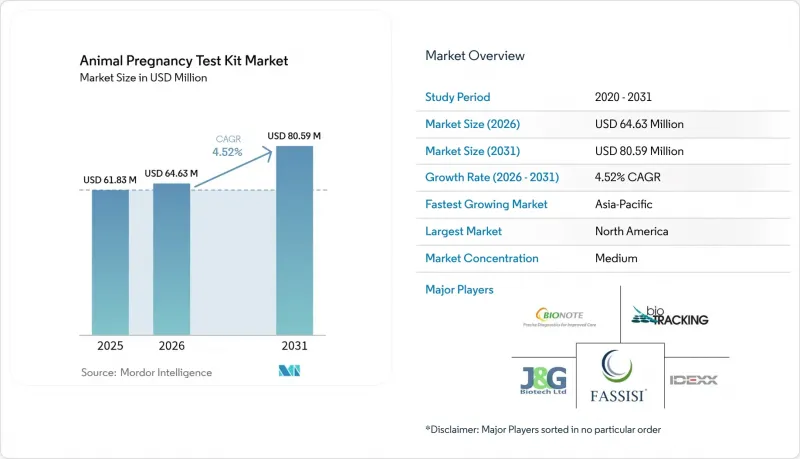
Mordor Intelligence에 의하면, 동물용 임신 검사 키트 시장 규모는 2025년 6,183만 달러로 평가되었습니다. 2026년에는 6,463만 달러로 확대되어 2026-2031년에 걸쳐 CAGR 4.52%로 성장을 지속하여, 2031년에는 8,059만 달러에 이를 것으로 예측됩니다.
본 보고서는 제품 유형(임신 검사 카세트 키트, 임신 검사 스트립/딥스틱 키트, ELISA 기반 키트), 동물 유형(반려동물, 가축), 검체 유형(혈청/혈장/전혈, 우유, 소변), 유통 채널(동물병원·동물 클리닉, 기타),지역(북미, 유럽, 기타)별로 분류되어 있습니다. 시장 예측은 금액(달러) 기준으로 제시되어 있습니다.
세계의 동물용 임신 검사 키트 시장 동향 및 인사이트
전 세계 반려동물 보유율 상승과 반려동물의 ‘인간화’
반려동물은 실용적인 역할에서 가족의 일원으로서의 지위로 전환되었으며, 반려인들은 가정용 임신 검사 키트를 포함하여 인간과 동등한 진단법을 요구하기 시작했습니다. 팬데믹 이후 반려동물 입양 증가로 인해 개와 고양이의 총 마릿수가 늘어나면서, 정기적인 건강 관리 일정에 원활하게 통합할 수 있는 예방용 키트에 대한 지속적인 수요가 발생하고 있습니다. Bellylabs와 같은 소비자 직접 판매 브랜드는 높은 재주문률을 보고하고 있으며, 이는 강력한 재구매 경향을 시사합니다. 디지털 소매에 익숙한 젊은 반려인들은 즉각적인 결과 확인을 선호하기 때문에 제조업체들은 결과를 더 명확하게 해석할 수 있도록 모바일 기기에서의 판독 기능을 탑재하도록 촉구받고 있습니다. 보험 계약에서 생식 검사 비용이 보상되는 사례가 증가함에 따라, 구매 빈도가 더욱 정착되고 있습니다. 조기 발견을 통해 응급 제왕절개 비용도 절감되므로, 정기적인 선별 검사의 경제적 이점이 더욱 커지고 있습니다.
젖소·육우 생산자의 군 단위 번식 경제성 향상
생산자들은 사료 마진의 압박과 우유 가격 변동에 직면해 있어, 임신 확인은 비용 절감을 위한 필수 요건이 되고 있습니다. 보급 조사에 따르면, 임신하지 않은 소를 조기에 도태함으로써 한 군당 연간 수천 달러를 절약할 수 있는 것으로 나타났습니다. 그러나 미국의 육우 생산 농장 중 체계적인 검사 프로토콜을 도입한 곳은 불과 3분의 1에 그치고 있어, 잠재적 수요가 높다는 점이 부각되고 있습니다. 군 관리 소프트웨어가 검사 결과를 자동으로 반영하여 교배 알림을 발령하는 환경에서는 도입이 가속화되고 있습니다. 성별 선별 정액 프로그램에서는 고부가가치 배아를 재사용하기 위해 신속한 확인이 필요하며, 이로 인해 검사 키트의 활용도가 향상됩니다. 가축 금융 기관은 대출을 실행할 때 번식 효율에 대한 증거를 점점 더 중요시하고 있으며, 이는 간접적으로 상업 농장 전반에 걸쳐 검사 키트 사용을 촉진하고 있습니다.
소규모 농업 종사자용 고급 키트의 높은 가격
ELISA 키트의 가격은 기본적인 래터럴 플로우 방식 검사 스트립의 최대 5배에 달하며, 1회 검사당 15-50달러로, 일일 평균 유제품 수익이 여전히 적은 소규모 농장에게는 상당한 지출이 됩니다. 긴 번식 시즌 동안 반복적인 검사가 필요해지면 경제적 부담은 더욱 커집니다. 휴대용 초음파 진단 장비는 초기 투자 비용이 2,000달러를 넘고, 여기에 교육 비용까지 추가되기 때문에 더 큰 장벽이 되고 있습니다. 보조금 지원이 없다면 소규모 농업 종사자들의 도입은 제한적일 수밖에 없으며, 전 세계 가축의 대부분을 보유한 신흥국에서의 판매량 증가가 억제될 것입니다.
부문별 분석
제품 유형별 동물용 임신 검사 키트 시장 규모를 살펴보면, 2025년 시점에서 임신 검사 카세트 키트가 매출 점유율 40.35%를 유지했으나, ELISA 키트는 연평균 성장률(CAGR) 6.28%로 가장 빠르게 성장할 것으로 예측됩니다. 축산 사업자들은 카세트 형태가 견고하고 비용 대비 효과가 높으며, 무리 단위로 경제성을 가져다주기 때문에 종종 이를 채택하고 있습니다. 반면, 말 번식업자나 반려동물 병원은 횡류 스트립에서는 얻을 수 없는 정확한 임신 단계 판정을 가능하게 하는 ELISA의 정량적 측정 결과를 얻기 위해 더 높은 가격을 지불하고 있습니다. 하이브리드 마이크로플루이딕스 카트리지는 신속한 유로와 ELISA의 포획 화학 기술을 융합하여, 분석 능력을 저해하지 않으면서 검사 시간을 15분 이하로 단축하고 있습니다. 규제 당국의 모니터링이 강화되는 가운데, 전문 구매자들은 새로운 경쟁 차별화 요소가 되고 있는 전자 감사 추적을 제공하는 형태를 선호하는 경향이 있습니다.
낙농장에서는 카세트식 키트가 여전히 널리 보급되어 있지만, 보험사가 검사 비용을 보상하는 지역에서는 ELISA의 보급이 진행되고 있으며, 가격보다 정확도를 중시하는 구매 경향이 나타나고 있습니다. 동물용 임신 검사 키트 시장에서는 각 제조업체가 스트립/딥스틱 제품을 비용과 신뢰성의 균형을 추구하는 종합 진료 클리닉용 미드티어 제품으로 재포지셔닝하고 있습니다. 나노 소재를 응용한 센서가 검증의 최종 단계에 접어들면서 기존 형태는 향후 대체될 위험에 직면해 있지만, 범용 제품에 중점을 두는 가축 부문의 가격 탄력성으로 인해 카세트 방식은 2031년까지 기준 판매량을 유지할 것으로 전망됩니다.
2025년, 가축용 임신 검사 키트 시장 점유율의 68.62%를 가축이 차지했으며, 이는 주로 전 세계 소 사육 두수의 규모가 크기 때문입니다. 한편, 반려동물용 검사는 연평균 성장률(CAGR) 5.18%로 성장을 지속하고 있으며, 이는 반려인이 인간의 산전 관리 절차를 모방하는 경향을 반영한 것입니다. 소의 경우, 임신 확인을 사료 배분 및 유전자 선발과 연계하는 확립된 절차가 정착되어 있어, 검사 키트는 예측 가능한 투입 비용으로 자리 잡고 있습니다. 돼지 사육 농가에서는 현재 전혈을 이용한 신속 검사를 자동 분만 관리 시스템에 통합하여 새끼 돼지 생산 계획의 정확도를 높이고 있습니다.
반려동물 부문에서는 개의 타액이나 소변을 채취하는 카세트형 키트 등 소비자 직접 판매 형태가 수의사의 개입을 최소화하면서 판매량 증가를 주도하고 있으며, 이는 인간의 가정용 임신 검사 키트와 유사한 추세입니다. 고양이 검사는 기존에는 수의학 검사실에 한정되어 있었으나, 진료실에서 선별 검사가 가능하게 해주는 새로운 프로게스테론 측정법이 등장함에 따라 혜택을 보고 있습니다. 이러한 변화를 배경으로, 동물용 임신 검사 키트 산업은 축산 분야의 바이오이코노미와 반려동물 관리에서 개성을 중시하는 소비 성향 모두에 동시에 대응하는 다양화된 제품 포트폴리오로의 전환을 추진하고 있습니다.
지역별 분석
북미는 선진적인 수의학 인프라, 보험의 보급, 엄격한 번식 관리 기준에 힘입어 2025년 매출의 36.22%를 차지했습니다. 미국은 AI를 활용한 참조 실험실 도입을 선도하고 있으며, 몇 시간 이내에 임신 여부를 보고함으로써 당일 내 재교배 결정을 가능하게 하고 있습니다. 캐나다는 임신 검사 비용을 상환해 주는 유제품 공급 관리 인센티브의 혜택을 받고 있는 반면, 멕시코의 수출 지향형 쇠고기 부문에서는 추적성 요건을 충족하기 위해 검사 키트가 채택되고 있습니다.
아시아태평양은 연평균 성장률(CAGR) 6.05%를 기록하며 세계에서 가장 빠른 성장률을 보이고 있습니다. 이는 중국과 인도에서 확대되고 있는 상업용 낙농 농장들이 분만 간격을 단축하기 위해 저비용 카세트형 키트를 채택하고 있기 때문입니다. 도쿄, 서울, 상하이의 도시 지역에서 반려동물 사육이 특히 소변 검사 키트를 중심으로 한 소비자 직접 판매를 견인하고 있습니다. 태국과 베트남의 수의사회는 제조업체와 제휴하여 연수 비용을 지원함으로써 수의사 간 인식 격차를 줄이고 있습니다. 농촌 지역의 소규모 농업 종사자 커뮤니티에서는 여전히 가격에 대한 민감도가 두드러지지만, 협동조합을 통한 일괄 구매 제도로 인해 비용 측면의 장벽이 완화되기 시작하고 있습니다.
유럽은 성숙한 시장이면서도 혁신이 중심이 되는 영역입니다. 프랑스와 독일의 낙농 생산자들은 착유 로봇 시스템에 젖소의 임신 검사를 통합하여, 군 단위에서 일관된 데이터 흐름을 확보하고 있습니다. 유럽식품안전청(EFSA)이 검증한 진단 성능 기준의 추진은 확립된 임상 데이터 파일을 보유한 ELISA 공급업체에 혜택을 주고 있습니다. 동유럽 시장에서는 EU의 농촌 개발 기금이 생식 효율 향상 프로젝트를 지원하고 있어 급속한 추격 성장이 관찰되고 있습니다. 이러한 경향은 전반적으로 동물용 임신 검사 키트 시장이 지역별로 다양한 양상을 띠고 있음을 뒷받침하며, 각국의 규제 태도와 경제 구조가 도입 속도를 좌우하고 있습니다.
기타 혜택
- 엑셀 형식 시장 예측(ME) 시트
- 3개월간의 애널리스트 지원
자주 묻는 질문
목차
제1장 서론
제2장 조사 방법
제3장 개요
제4장 시장 구도
제5장 시장 규모 및 성장 예측
제6장 경쟁 구도
제7장 시장 기회 및 향후 전망
KTH 26.08.31According to Mordor Intelligence, the animal pregnancy test kit market size is expected to grow from USD 61.83 million in 2025 to USD 64.63 million in 2026 and is forecast to reach USD 80.59 million by 2031 at 4.52% CAGR over 2026-2031.
This report is Segmented by Product Type (Pregnancy Test Cassette Kits, Pregnancy Test Strip/Dipstick Kits, ELISA-Based Kits), Animal Type (Companion Animals, Livestock), Sample Type (Serum/Plasma/Whole Blood, Milk, Urine), Distribution Channel (Veterinary Hospitals and Clinics, and More), and Geography (North America, Europe, and More). The Market Forecasts are Provided in Terms of Value (USD).
Global Animal Pregnancy Test Kit Market Trends and Insights
Rising global pet ownership and "humanisation" of companion animals
Companion animals shifted from utility roles to family status, prompting owners to request human-grade diagnostics, including at-home pregnancy tests. Post-pandemic pet adoptions boosted total dog and cat populations, creating sustained demand for preventive kits that slot seamlessly into routine wellness schedules. Direct-to-consumer brands such as Bellylabs report high reorder rates, suggesting strong repeat-usage behaviour. Younger owners, comfortable with digital retail, prefer instant results, encouraging manufacturers to integrate mobile read-outs for clearer interpretation. Insurance policies increasingly reimburse reproductive testing, further normalising purchase frequency. Early detection also cuts emergency caesarean costs, reinforcing the economic case for regular screening.
Increasing herd-fertility economics for dairy and beef producers
Producers face tight feed margins and milk-price volatility, turning pregnancy confirmation into a cost-avoidance imperative. Extension studies show early culling of open cows can save thousands of USD per herd annually. Yet only one-third of U.S. beef operations deploy structured testing protocols, highlighting latent demand. Adoption accelerates where herd-management software automatically imports test results and triggers breeding alerts. Sexed-semen programs rely on quick confirmation to recycle high-value embryos, multiplying kit utilisation. Livestock bankers increasingly look for evidence of reproductive efficiency when extending credit, indirectly reinforcing kit usage across commercial operations.
High price point of advanced kits for smallholders
ELISA kits can cost up to five times more than basic lateral-flow strips, ranging from USD 15-50 per test, a significant outlay for small farms where average daily milk margins remain thin. The economics worsen when repeat testing is needed across long breeding seasons. Portable ultrasound systems present an even steeper hurdle, with initial investment exceeding USD 2,000 and further training costs. Without subsidised access, uptake among smallholders stays muted, limiting volume growth in emerging economies that house the bulk of global livestock.
Other drivers and restraints analyzed in the detailed report include:
- Advances in rapid lateral-flow and ELISA diagnostic formats
- Growing veterinary healthcare spend and insurance penetration
- Sub-optimal sensitivity / specificity causing false results
For complete list of drivers and restraints, kindly check the Table Of Contents.
Segment Analysis
The animal pregnancy test kit market size allocated to product types shows pregnancy test cassette kits retained 40.35% revenue share in 2025, but ELISA kits are projected to advance fastest at 6.28% CAGR. Livestock operators often reach for cassette formats because they are rugged, cost-efficient and offer herd-level economies. Conversely, equine breeders and companion-animal clinics pay premiums for ELISA's quantitative read-outs that support precise gestation staging, a capability lateral-flow strips lack. Hybrid microfluidic cartridges now blend rapid flow paths with ELISA capture chemistry, trimming assay time to under 15 minutes without sacrificing analytical power. As regulatory scrutiny strengthens, professional buyers favour formats that provide electronic audit trails, an emerging competitive differentiator.
While cassette kits remain ubiquitous on dairy farms, ELISA penetration rises wherever insurers reimburse test costs, tilting purchasing toward accuracy over price. The animal pregnancy test kit market sees manufacturers reposition strip-/dipstick products as mid-tier options that cater to mixed-practice clinics needing balanced cost and reliability. With nanomaterial-enhanced sensors entering late-stage validation, incumbent formats face future substitution risk, yet price elasticity in commodity-focused livestock segments suggests cassettes will defend baseline volumes through 2031.
Livestock held 68.62% of animal pregnancy test kit market share in 2025, largely due to the sheer scale of global cattle inventories. Companion-animal testing, however, clocks a 5.18% CAGR, reflecting owners' readiness to emulate human prenatal care protocols. Bovine testing enjoys entrenched protocols that tie pregnancy confirmation to feed rationing and genetic selection, making kits a predictable input expense. Swine producers now integrate whole-blood rapid assays into automated farrowing-management systems, enhancing litter planning accuracy.
In household pets, direct-to-consumer formats such as canine saliva and urine cassettes drive incremental volume with minimal veterinary intervention, mirroring human home pregnancy testing. Feline testing, historically limited to veterinary labs, benefits from newer progesterone chemistries that allow chair-side screening. These shifts anchor the animal pregnancy test kit industry's move toward diversified portfolios that cater simultaneously to farm bio-economics and boutique pet-care preferences.
Complete Report Scope:
- By Product Type
- Pregnancy Test Cassette Kits
- Pregnancy Test Strip/Dipstick Kits
- ELISA-based Kits
- By Animal Type
- Companion Animals
- Dogs
- Cats
- Other Companion Animals
- Livestock
- Bovine
- Equine
- Swine
- Small Ruminants
- Companion Animals
- By Sample Type
- Serum / Plasma / Whole Blood
- Milk
- Urine
- By Distribution Channel
- Veterinary Hospitals and Clinics
- Retail Stores
- E-commerce
- By Geography
- North America
- United States
- Canada
- Mexico
- Europe
- Germany
- United Kingdom
- France
- Italy
- Spain
- Rest of Europe
- Asia-Pacific
- China
- Japan
- India
- Australia
- South Korea
- Rest of Asia-Pacific
- Rest of the World
- North America
Geography Analysis
North America generated 36.22% of 2025 revenue, propelled by advanced veterinary infrastructure, insurance uptake and strict reproductive management norms. The United States spearheads adoption of AI-supported reference labs that report pregnancy status within hours, allowing same-day rebreeding decisions. Canada benefits from dairy supply-management incentives that reimburse pregnancy testing, while Mexico's export-oriented beef sector adopts kits to meet traceability mandates.
Asia-Pacific records a 6.05% CAGR, the fastest worldwide, as expanding commercial dairies in China and India turn to low-cost cassette kits to boost calving intervals. Urban pet ownership in Tokyo, Seoul and Shanghai fuels direct-to-consumer sales, especially urine-based formats. Veterinary associations in Thailand and Vietnam partner with manufacturers to subsidise training, narrowing the practitioner awareness gap. Price sensitivity remains pronounced in rural smallholder communities, yet cooperative bulk-buying schemes begin to dilute cost barriers.
Europe represents a mature but innovation-centric terrain. Dairy producers in France and Germany integrate milk pregnancy assays into robotic milking systems, securing consistent herd-level data streams. The European Food Safety Authority's push for validated diagnostic performance standards benefits ELISA suppliers with established clinical dossiers. Eastern European markets witness rapid catch-up growth as EU rural-development funds back reproductive efficiency projects. Collectively, these patterns affirm the animal pregnancy test kit market's regional mosaic, where domestic regulatory stance and economic structure dictate adoption velocity.
- IDEXX
- Neogen
- BioNote Inc.
- BioTracking
- Zoetis
- Fassisi
- Randox Laboratories
- Heska
- Teco Diagnostics
- Bellylabs Oy
- Bioeasy Biotechnology
- J & G Biotech Ltd
- Agdia Inc.
- Corteva Agriscience (Geneseek)
- Arbor Assays
- ScintiVet
Additional Benefits:
- The market estimate (ME) sheet in Excel format
- 3 months of analyst support
TABLE OF CONTENTS
1 Introduction
- 1.1 Study Assumptions & Market Definition
- 1.2 Scope of the Study
2 Research Methodology
3 Executive Summary
4 Market Landscape
- 4.1 Market Overview
- 4.2 Market Drivers
- 4.2.1 Rising Global Pet Ownership and "Humanisation" of Companion Animals
- 4.2.2 Increasing Herd-Fertility Economics for Dairy & Beef Producers
- 4.2.3 Advances in Rapid Lateral-Flow & ELISA Diagnostic Formats
- 4.2.4 Growing Veterinary Healthcare Spend & Insurance Penetration
- 4.2.5 Nanomaterial-Enabled Ultra-Early Biosensor Kits
- 4.2.6 Tele-Veterinary Platforms Bundling At-Home Pregnancy Testing
- 4.3 Market Restraints
- 4.3.1 High Price Point of Advanced Kits for Smallholders
- 4.3.2 Sub-Optimal Sensitivity / Specificity Causing False Results
- 4.3.3 Low Practitioner Awareness in Emerging Markets
- 4.3.4 Regulatory Grey-Zones for DTC Animal Diagnostics
- 4.4 Value / Supply-Chain Analysis
- 4.5 Regulatory Landscape
- 4.6 Technological Outlook
- 4.7 Porter's Five Forces Analysis
- 4.7.1 Threat of New Entrants
- 4.7.2 Bargaining Power of Buyers/Consumers
- 4.7.3 Bargaining Power of Suppliers
- 4.7.4 Threat of Substitute Products
- 4.7.5 Intensity of Competitive Rivalry
5 Market Size & Growth Forecasts (Value)
- 5.1 By Product Type
- 5.1.1 Pregnancy Test Cassette Kits
- 5.1.2 Pregnancy Test Strip/Dipstick Kits
- 5.1.3 ELISA-based Kits
- 5.2 By Animal Type
- 5.2.1 Companion Animals
- 5.2.1.1 Dogs
- 5.2.1.2 Cats
- 5.2.1.3 Other Companion Animals
- 5.2.2 Livestock
- 5.2.2.1 Bovine
- 5.2.2.2 Equine
- 5.2.2.3 Swine
- 5.2.2.4 Small Ruminants
- 5.2.1 Companion Animals
- 5.3 By Sample Type
- 5.3.1 Serum / Plasma / Whole Blood
- 5.3.2 Milk
- 5.3.3 Urine
- 5.4 By Distribution Channel
- 5.4.1 Veterinary Hospitals and Clinics
- 5.4.2 Retail Stores
- 5.4.3 E-commerce
- 5.5 By Geography
- 5.5.1 North America
- 5.5.1.1 United States
- 5.5.1.2 Canada
- 5.5.1.3 Mexico
- 5.5.2 Europe
- 5.5.2.1 Germany
- 5.5.2.2 United Kingdom
- 5.5.2.3 France
- 5.5.2.4 Italy
- 5.5.2.5 Spain
- 5.5.2.6 Rest of Europe
- 5.5.3 Asia-Pacific
- 5.5.3.1 China
- 5.5.3.2 Japan
- 5.5.3.3 India
- 5.5.3.4 Australia
- 5.5.3.5 South Korea
- 5.5.3.6 Rest of Asia-Pacific
- 5.5.4 Rest of the World
- 5.5.1 North America
6 Competitive Landscape
- 6.1 Market Concentration
- 6.2 Market Share Analysis
- 6.3 Company Profiles (includes Global level Overview, Market level overview, Core Segments, Financials as available, Strategic Information, Market Rank/Share for key companies, Products & Services, and Recent Developments)
- 6.3.1 IDEXX Laboratories
- 6.3.2 Neogen Corporation
- 6.3.3 BioNote Inc.
- 6.3.4 BioTracking
- 6.3.5 Zoetis Inc.
- 6.3.6 Fassisi GmbH
- 6.3.7 Randox Laboratories Ltd
- 6.3.8 Heska Corporation
- 6.3.9 Teco Diagnostics
- 6.3.10 Bellylabs Oy
- 6.3.11 Bioeasy Biotechnology
- 6.3.12 J & G Biotech Ltd
- 6.3.13 Agdia Inc.
- 6.3.14 Corteva Agriscience (Geneseek)
- 6.3.15 Arbor Assays
- 6.3.16 ScintiVet
7 Market Opportunities & Future Outlook
- 7.1 White-space & Unmet-Need Assessment


