

|
시장보고서
상품코드
2116145
PCR 분자진단 시장 : 점유율 분석, 업계 동향과 통계, 성장 예측(2026-2031년)PCR Molecular Diagnostics - Market Share Analysis, Industry Trends & Statistics, Growth Forecasts (2026 - 2031) |
||||||
 Mordor Intelligence
Mordor Intelligence에 의하면, PCR 분자진단 시장 규모는 2025년에 97억 4,000만 달러로 평가되었고 2026년 102억 6,000만 달러에서 2031년까지 133억 1,000만 달러에 이를 것으로 예측되며, 예측 기간(2026-2031년) CAGR은 5.36%를 나타낼 전망입니다.
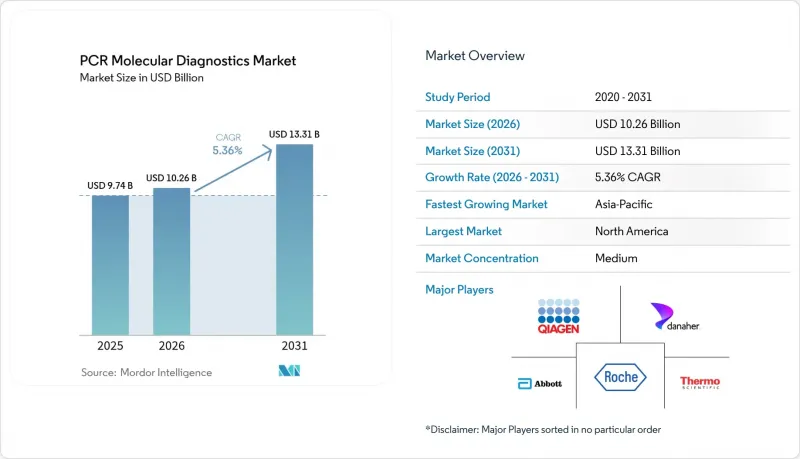
본 보고서는 제품 유형(장비, 시약 및 소모품, 소프트웨어), 용도(감염병 검사, 종양학 검사, 기타 용도), 최종 사용자(병원, 진단·검사 기관 등), 지역(북미, 유럽, 아시아태평양, 중동 및 아프리카, 남미)별로 분류되어 있습니다. 시장 전망은 금액(달러) 기준으로 제시되어 있습니다.
전 세계 PCR 분자진단 시장 동향 및 인사이트
감염병 및 암 발병률 증가
세계 질병 부담 증가는 PCR 분자진단 시장 전체에서 분자 검사 수요를 뒷받침하고 있습니다. 미국 암 학회(American Cancer Society)는 2025년에 미국에서 204만 1,910건의 신규 암 진단과 61만 8,000명의 사망이 예상된다고 예측하고 있으며, 조기 발견 전략의 중요성이 더욱 커지고 있습니다. 동시에, 인간 메타뉴모바이러스와 관련된 소아 입원 환자 수는 미국 및 중국에서 2023년 대비 17% 증가하여, 호흡기 바이러스에 대한 신속한 감별 진단의 필요성이 부각되고 있습니다. PCR은 아토몰 수준의 민감도를 갖추고 있어, 임상의는 이를 활용하여 항바이러스제 투여를 적절히 지도하고, 환자를 보다 정확하게 격리하며, 치료 후 미세 잔존 병변을 모니터링할 수 있게 됩니다. 신규 암 사례의 40%는 조기 발견을 통해 예방할 수 있는 것으로 여겨지기 때문에 보험사 및 정책 입안자들은 분자진단을 ‘선택적 검사’가 아닌 ‘비용 절감으로 이어지는 수단’으로 인식하는 경향이 강해지고 있습니다. 그 결과, PCR 분자진단 시장에서 중앙 집중형 및 환자 인근 검사실 모두에서 검사 처리 능력의 지속적인 성장이 예상됩니다.
PCR 화학 및 기기 분야의 기술 혁신
고속 사이클용 효소, 마이크로플루이딕스 기술, 그리고 디지털화가 PCR 분자진단 시장의 성능 기준을 새롭게 정의하고 있습니다. ‘익스트림 PCR’ 프로토콜을 통해 완전한 열 사이클이 15초로 단축되어, 장비 설치 면적을 늘리지 않고도 시간당 검체 처리 능력이 향상되고 있습니다. 디지털 PCR은 반응액을 수천 개의 나노 액적(nanodrops)으로 분할하여, 과거에는 차세대 염기서열 분석(NGS)을 통해서만 가능했던 0.01%의 변이 검출률을 실현하고 있습니다. AI는 품질 관리에 필수적인 요소로 자리 잡고 있습니다. Seegene사는 Microsoft사와 공동으로 ‘디지털화 개발 시스템’을 개발 중이며, 이를 통해 프라이머 설계 자동화 및 신호 이상을 실시간으로 감지할 수 있게 됩니다. 이러한 발전들이 결합되어 감도가 향상되고, 처리 시간이 단축되며, 작업자에 따른 편차가 감소함에 따라, PCR 분자진단 시장에서의 종양 모니터링, 이식 후 경과 관찰, 그리고 폐수를 기반으로 한 역학 조사의 적용 범위가 확대되고 있습니다.
높은 설비 투자 및 소모품 비용
최첨단 디지털 PCR 장비는 대당 25만 달러를 초과하는 경우도 있어, 빠듯한 자본 예산으로 운영되는 지방 병원에게는 장벽이 되고 있습니다. 시약에 대한 지속적인 지출도 부담을 가중시키고 있는데, 이는 검사 전체 비용의 55-65%를 화학 시약이 차지하는 경우가 많기 때문입니다. 액체 생검 패널 비용은 건당 500-3,000달러로, 고소득 국가 이외 시장에서는 암의 정기적인 경과 관찰이 제한되고 있습니다. 생산 규모 확대와 개방형 채널 방식의 화학 반응법 덕분에 가격은 서서히 하락하고 있지만, 당분간은 첨단 검사가 주요 의료 센터에 집중되는 양극화된 진단 생태계가 현실로 자리 잡고 있습니다. 그로 인해 소규모 검사실은 검체 분석을 외부에 위탁할 수밖에 없으며, 그 결과 검사 결과 반환까지 시간이 길어지면서 PCR 분자진단 시장의 일부에서 검사 건수 증가세가 둔화되고 있습니다.
부문 분석
시약 및 소모품은 2025년 매출의 54.72%를 차지하며 가장 큰 비중을 차지했습니다. 이는 검사를 수행할 때마다 새로운 프라이머, 프로브, 완충액이 필요하기 때문이며, PCR 분자진단 시장 내에서 예측 가능한 정기 수익형 비즈니스 모델을 창출하고 있습니다. 디지털 PCR 장비는 현재 도입 대수로는 소수이지만, 절대 정량이 가능하고 분석 감도가 비약적으로 향상됨에 따라 가장 빠른 보급 속도를 기록했습니다. 예를 들어, Bio-Rad사의 액적 분획법은 0.01%까지의 희귀 대립유전자를 일상적으로 검출할 수 있어, 표준 채혈을 통해 순환 종양 DNA를 검출할 수 있게 해줍니다. 표준 서모사이클러는 도입 비용이 저렴하여 여전히 많은 지방 병원에서 널리 사용되고 있지만, 한편 실시간 시스템은 디지털 시스템과 같은 자본 집약성을 수반하지 않으면서 정량 분석을 제공함으로써 중위권 시장을 점유하고 있습니다.
검사실이 고처리량 시스템에서 생성되는 방대한 데이터로 어려움을 겪는 가운데, 소프트웨어와 분석 서비스가 새로운 수익원으로 부상하고 있습니다. 로슈(Roche)사의 ‘LightCycler PRO’는 자동 보정과 로봇 기술을 통합하여 무인 가동 시간을 연장하고 있습니다. 또한 QIAGEN은 2024년 하반기에 호흡기 증후군 진단 메뉴에 대한 CE 마크를 획득한 후, 2028년까지 100종 이상의 새로운 ‘QIAcuity’ 분석법을 제공할 계획입니다. 이러한 동향은 PCR 분자진단 시장에서 공학 및 생물정보학의 발전이 각 세대 기기의 가치 제안을 어떻게 지속적으로 확대하고 있는지를 여실히 보여주고 있습니다.
지역별 분석
2025년, 북미는 전 세계 매출의 41.62%를 차지했습니다. 연방 정부의 자금 지원이 이러한 선도적 위치를 뒷받침하고 있으며, 미국 국방부 보건 프로그램의 2025 회계연도 예산에서는 정밀의료 및 유전체 감시 프로젝트에 막대한 지출이 배정되었습니다. 대규모 병원 네트워크에서는 일상 검사를 위한 고처리량 공동 실험실용 서모사이클러와 수술실용 이동형 유닛이라는 두 가지 플랫폼을 병용하는 경우가 많으며, 이로 인해 PCR 분자진단 시장 전체에 다층적인 수요가 발생하고 있습니다. FDA의 규제 강화는 실험실 통합을 촉진하는 한편 표준화도 촉진할 것으로 예상되며, 이는 승인된 키트의 미국 내 수출 경쟁력을 높일 가능성이 있습니다.
아시아태평양은 2031년까지 연평균 성장률(CAGR) 6.27%를 나타낼 것으로 예측되며, 이는 세계에서 가장 빠른 속도입니다. 중국, 인도, 한국 정부는 정밀의료 예산 확대를 계획하고 있는 반면, 민간 검사 기관들은 종양학 패널 수요에 부응하기 위해 경쟁하고 있습니다. 일본은 이 지역에서 암 특화 검사 도입을 현재 주도하고 있으며, 2023년에는 해당 틈새 시장에서 약 41%의 점유율을 차지하고 있습니다. 동남아시아의 공중보건 당국은 중앙 검사실의 부족을 보완하기 위해 뎅기열 및 호흡기 감염병 유행에 대응하여 현장 진단(PoC) PCR 검사를 도입하고 있습니다. 이러한 다각적인 성장 요인으로 인해, 이 지역은 PCR 분자진단 시장에서 가장 역동적인 성장 영역으로서의 입지를 확고히 하고 있습니다.
유럽은 국민건강보험 제도와 산학 협력을 통한 강력한 연구개발 컨소시엄을 바탕으로 견실한 시장 점유율을 유지하고 있습니다. ‘체외진단용 의료기기 규정(In Vitro Diagnostic Regulation)’의 시행으로 제조업체와 인증 기관 간의 협력 시점이 앞당겨지면서, 승인까지의 기간은 길어지고 있지만 의료기기의 품질과 시판 후 조사 수준은 향상되고 있습니다. 대조적으로, 라틴아메리카, 중동 및 아프리카는 아직 발전 단계에 있지만 큰 가능성을 지닌 지역이며, 분산형 플랫폼이 인프라 부족을 보완하고 있습니다. 외딴 지역의 진료소에 GeneXpert 장비를 도입하는 시범 사업은 결핵의 실시간 확정 진단이 치료 시작 및 항생제 적정 사용에 미치는 영향을 입증하고 있으며, 이러한 지역들을 점차 전 세계 PCR 분자진단 시장의 밸류체인에 임베디드시키고 있습니다.
기타 혜택:
- 엑셀 형식 시장 예측(ME) 시트
- 3개월간 애널리스트 지원
자주 묻는 질문
목차
제1장 서론
제2장 조사 방법
제3장 주요 요약
제4장 시장 구도
제5장 시장 규모와 성장 예측
제6장 경쟁 구도
제7장 시장 기회와 향후 전망
JHS 26.08.28According to Mordor Intelligence, the PCR molecular diagnostics market size was valued at USD 9.74 billion in 2025 and estimated to grow from USD 10.26 billion in 2026 to reach USD 13.31 billion by 2031, at a CAGR of 5.36% during the forecast period (2026-2031).
This report is Segmented by Product Type (Instrument, Reagents and Consumables and Software), Application (Infectious Disease Testing, Oncology Testing, Other Applications), End User (Hospitals, Diagnostic & Reference Laboratories, and More), and Geography (North America, Europe, Asia-Pacific, Middle East and Africa, and South America). The Market Forecasts are Provided in Terms of Value (USD).
Global PCR Molecular Diagnostics Market Trends and Insights
Rising Infectious-Disease and Cancer Incidence
Escalating global disease burdens anchor demand for molecular assays across the PCR molecular diagnostics market. The American Cancer Society anticipates 2,041,910 new cancer diagnoses and 618,000 deaths in the United States during 2025, heightening the urgency for early detection strategies. Concurrently, paediatric hospitalisations linked to human metapneumovirus rose 17% versus 2023 across the United States and China, underscoring the need for rapid respiratory-virus differentiation. PCR offers attomolar sensitivity, enabling clinicians to guide antivirals, isolate patients more precisely and monitor minimal residual disease after therapy. Because 40% of new cancer cases are considered preventable through earlier detection, payers and policymakers increasingly treat molecular diagnostics as cost-saving rather than discretionary. The result is sustained throughput growth across centralised and near-patient laboratories within the PCR molecular diagnostics market.
Technological Innovation in PCR Chemistry & Instrumentation
Rapid-cycle enzymes, microfluidics and digitisation are rewriting performance benchmarks within the PCR molecular diagnostics market. Extreme-PCR protocols now compress complete thermocycles into 15 seconds, raising hourly sample capacity without raising instrument footprints. Digital PCR partitions reaction volumes into thousands of nanodroplets, reaching 0.01% variant calls that were once the sole province of next-generation sequencing. AI is becoming integral to quality control; Seegene is co-developing a Digitalized Development System with Microsoft that automates primer design and detects signal anomalies in real time. These advances collectively elevate sensitivity, shorten turn-around-time and lower operator variability, thereby expanding oncology monitoring, transplant surveillance and wastewater-based epidemiology within the PCR molecular diagnostics market.
High Capital and Consumable Costs
Cutting-edge digital PCR instruments can exceed USD 250,000 per unit, a barrier for district hospitals that operate under tight capital budgets. Ongoing reagent outlays compound the burden because chemistry often represents 55-65% of lifetime testing expenses. Liquid-biopsy panels cost USD 500-3,000 each, limiting routine oncology follow-up outside high-income markets. Although manufacturing scale and open-channel chemistries are nudging prices downward, the near-term reality is a two-tier diagnostic ecosystem where sophisticated assays cluster in major medical centres. Smaller laboratories therefore outsource samples, extending turn-around-times and tempering volume growth in parts of the PCR molecular diagnostics market.
Other drivers and restraints analyzed in the detailed report include:
- Adoption of Syndromic and Multiplex Panels
- Decentralised and Point-of-Care Molecular Testing
- Regulatory Complexity and Reimbursement Uncertainty
For complete list of drivers and restraints, kindly check the Table Of Contents.
Segment Analysis
Reagents and consumables produced the largest slice of 2025 revenue at 54.72% because every test run mandates fresh primers, probes and buffers, creating a predictable annuity business model inside the PCR molecular diagnostics market. Digital PCR instruments, though currently a minority in installed base, logged the quickest adoption pace due to absolute quantification and orders-of-magnitude gains in analytical sensitivity. For example, Bio-Rad's droplet partitioning routinely detects rare alleles down to 0.01%, enabling detection of circulating tumour DNA in a standard blood draw. Standard thermocyclers still populate many regional hospitals thanks to lower acquisition costs, whereas real-time systems occupy a middle tier by offering quantitation without the capital intensity of digital.
Software and analytical services are emerging revenue streams as laboratories wrestle with data lakes generated by high-throughput systems. Roche's LightCycler PRO integrates automatic calibration and robotics to lift walk-away time, and QIAGEN plans more than 100 new QIAcuity assays by 2028 after obtaining CE mark for its syndromic respiratory menu in late 2024. These developments highlight how engineering and bioinformatics advances continue to extend the value proposition of each instrument generation within the PCR molecular diagnostics market.
Complete Report Scope:
- By Product
- Instrument
- Standard PCR Systems
- Real-time PCR Systems
- Digital PCR Systems
- Reagents & Consumables
- Software & Services
- Instrument
- By Application
- Infectious Disease Testing
- Oncology Testing
- Other Applications
- By End User
- Hospitals
- Diagnostic & Reference Laboratories
- Academic & Research Institutes
- Other End Users
- Geography
- North America
- United States
- Canada
- Mexico
- Europe
- Germany
- United Kingdom
- France
- Italy
- Spain
- Rest of Europe
- Asia-Pacific
- China
- Japan
- India
- South Korea
- Australia
- Rest of Asia-Pacific
- Middle-East and Africa
- GCC
- South Africa
- Rest of Middle East and Africa
- South America
- Brazil
- Argentina
- Rest of South America
- North America
Geography Analysis
North America generated 41.62% of global revenue in 2025. Federal funding streams reinforce this leadership position; the U.S. Defense Health Program's FY 2025 budget allocates substantial outlays for precision-medicine and genomic-surveillance projects. Large hospital networks frequently run dual platforms-high-throughput core-lab thermocyclers for routine testing and mobile units for operating rooms-creating layered demand across the PCR molecular diagnostics market size. FDA regulatory tightening is expected to spur lab consolidation but also encourage standardisation, possibly elevating U.S. export competitiveness for cleared kits.
Asia-Pacific is forecast to record a 6.27% CAGR through 2031, the fastest worldwide. Governments in China, India and South Korea earmark expanding precision-medicine budgets, while private laboratories race to meet oncology-panel demand. Japan currently leads regional adoption in oncology-focused testing, holding roughly 41% share of that application niche during 2023. Public-health authorities in Southeast Asia embrace point-of-care PCR for dengue and respiratory outbreaks to compensate for central-lab shortages. This multifaceted growth portfolio positions the region as the most dynamic frontier for the PCR molecular diagnostics market.
Europe maintains robust share on the back of universal-health-coverage frameworks and strong academic-industry R&D consortia. Implementation of the In Vitro Diagnostic Regulation is prompting earlier engagement between manufacturers and notified bodies, lengthening approval timelines yet raising device quality and post-market surveillance. In contrast, Latin America, Middle East and Africa constitute nascent but high-potential territories where decentralised platforms circumvent infrastructural deficits. Pilots deploying GeneXpert units in remote clinics illustrate the impact of real-time tuberculosis confirmation on treatment initiation and antibiotic stewardship, gradually stitching these regions into the global PCR molecular diagnostics market value chain.
- Roche
- Thermo Fisher Scientific
- Danaher
- QIAGEN
- Abbott Laboratories
- Bio-Rad Laboratories
- Agilent Technologies
- Beckton Dickinson
- Takara Bio
- Promega
- LGC Ltd. (Biosearch Technologies)
- PerkinElmer Inc. (Revvity)
- Standard BioTools Inc. (Fluidigm)
- Seegene
- Analytik Jena GmbH
- BGI Genomics Co. Ltd.
- Sysmex Inostics GmbH
- QuantuMDx Group
- DiaSorin
- Hologic
- Luminex
Additional Benefits:
- The market estimate (ME) sheet in Excel format
- 3 months of analyst support
TABLE OF CONTENTS
1 Introduction
- 1.1 Study Assumptions & Market Definition
- 1.2 Scope of the Study
2 Research Methodology
3 Executive Summary
4 Market Landscape
- 4.1 Market Overview
- 4.2 Market Drivers
- 4.2.1 Growing Global Incidence of Infectious Diseases and Cancer
- 4.2.2 Continuous Technological Innovations in PCR Instrumentation & Chemistry
- 4.2.3 Increasing Adoption of Syndromic and Multiplex PCR Panels for Rapid Diagnosis
- 4.2.4 Expansion of Decentralised & Point-of-Care Molecular Testing Platforms
- 4.2.5 Government Screening Programs & Public-Health Funding for Molecular Diagnostics
- 4.2.6 Rising Demand for Precision Medicine & Companion Diagnostics in Oncology
- 4.3 Market Restraints
- 4.3.1 High Capital Investment and Consumable Costs of Advanced PCR Systems
- 4.3.2 Complex Regulatory Approval Pathways and Reimbursement Uncertainties
- 4.3.3 Limited Availability of Skilled Molecular Laboratory Workforce
- 4.3.4 Growing Competition from Isothermal Amplification and CRISPR-based Diagnostics
- 4.4 Regulatory Outlook
- 4.5 Porter's Five Forces Analysis
- 4.5.1 Threat of New Entrants
- 4.5.2 Bargaining Power of Buyers
- 4.5.3 Bargaining Power of Suppliers
- 4.5.4 Threat of Substitutes
- 4.5.5 Intensity of Competitive Rivalry
5 Market Size & Growth Forecasts (Value, USD)
- 5.1 By Product
- 5.1.1 Instrument
- 5.1.1.1 Standard PCR Systems
- 5.1.1.2 Real-time PCR Systems
- 5.1.1.3 Digital PCR Systems
- 5.1.2 Reagents & Consumables
- 5.1.3 Software & Services
- 5.1.1 Instrument
- 5.2 By Application
- 5.2.1 Infectious Disease Testing
- 5.2.2 Oncology Testing
- 5.2.3 Other Applications
- 5.3 By End User
- 5.3.1 Hospitals
- 5.3.2 Diagnostic & Reference Laboratories
- 5.3.3 Academic & Research Institutes
- 5.3.4 Other End Users
- 5.4 Geography
- 5.4.1 North America
- 5.4.1.1 United States
- 5.4.1.2 Canada
- 5.4.1.3 Mexico
- 5.4.2 Europe
- 5.4.2.1 Germany
- 5.4.2.2 United Kingdom
- 5.4.2.3 France
- 5.4.2.4 Italy
- 5.4.2.5 Spain
- 5.4.2.6 Rest of Europe
- 5.4.3 Asia-Pacific
- 5.4.3.1 China
- 5.4.3.2 Japan
- 5.4.3.3 India
- 5.4.3.4 South Korea
- 5.4.3.5 Australia
- 5.4.3.6 Rest of Asia-Pacific
- 5.4.4 Middle-East and Africa
- 5.4.4.1 GCC
- 5.4.4.2 South Africa
- 5.4.4.3 Rest of Middle East and Africa
- 5.4.5 South America
- 5.4.5.1 Brazil
- 5.4.5.2 Argentina
- 5.4.5.3 Rest of South America
- 5.4.1 North America
6 Competitive Landscape
- 6.1 Market Concentration
- 6.2 Strategic Moves
- 6.3 Market Share Analysis
- 6.4 Company Profiles (includes Global level Overview, Market level overview, Core Business Segments, Financials, Headcount, Key Information, Market Rank, Market Share, Products and Services, and analysis of Recent Developments)
- 6.4.1 F. Hoffmann-La Roche Ltd.
- 6.4.2 Thermo Fisher Scientific Inc.
- 6.4.3 Danaher
- 6.4.4 QIAGEN N.V.
- 6.4.5 Abbott Laboratories
- 6.4.6 Bio-Rad Laboratories Inc.
- 6.4.7 Agilent Technologies Inc.
- 6.4.8 Becton Dickinson and Company
- 6.4.9 Takara Bio Inc.
- 6.4.10 Promega Corporation
- 6.4.11 LGC Ltd. (Biosearch Technologies)
- 6.4.12 PerkinElmer Inc. (Revvity)
- 6.4.13 Standard BioTools Inc. (Fluidigm)
- 6.4.14 Seegene Inc.
- 6.4.15 Analytik Jena GmbH
- 6.4.16 BGI Genomics Co. Ltd.
- 6.4.17 Sysmex Inostics GmbH
- 6.4.18 QuantuMDx Group Ltd.
- 6.4.19 DiaSorin S.p.A.
- 6.4.20 Hologic Inc.
- 6.4.21 Luminex Corporation
7 Market Opportunities & Future Outlook
- 7.1 White-Space & Unmet-Need Assessment


