

|
시장보고서
상품코드
2116269
NGS 샘플 조제 시장 : 점유율 분석, 업계 동향과 통계, 성장 예측(2026-2031년)Global NGS Sample Preparation - Market Share Analysis, Industry Trends & Statistics, Growth Forecasts (2026 - 2031) |
||||||
 Mordor Intelligence
Mordor Intelligence에 의하면, NGS 샘플 조제 시장 규모는 2025년 27억 달러에서 2026년에는 30억 8,000만 달러로 확대되어 2026년부터 2031년까지 CAGR 14.08%로 성장을 지속하여, 2031년까지 59억 5,000만 달러에 이를 것으로 예측됩니다.
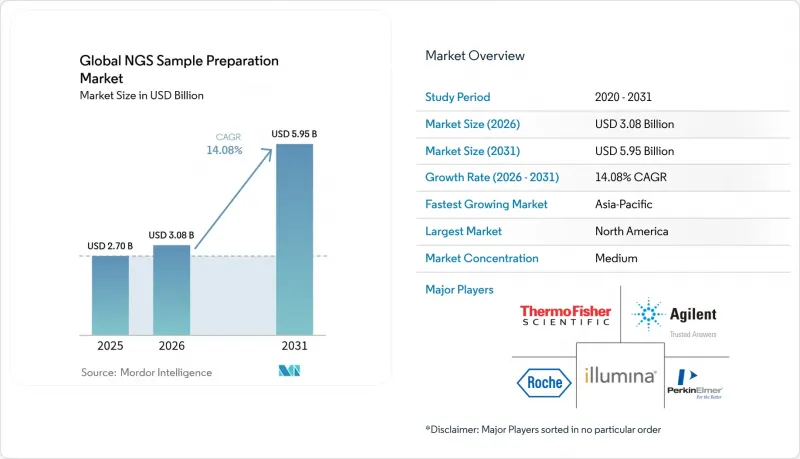
본 보고서는 제품별(시약 및 소모품, 자동화 워크스테이션 등), 워크플로우 단계별(핵산 추출·정제 등), 용도별(진단, 신약 개발 등), 최종 사용자별(병원·검사 기관 등), 지역별(북미, 유럽 등)로 분류되어 있습니다. 시장 예측은 금액(달러) 기준으로 제시되어 있습니다.
전 세계 NGS 샘플 조제 시장 동향 및 인사이트
감염병 및 신종 병원체의 확산 확대
현재 사하라 이남 아프리카 국가 중 절반 이상이 국내에서 NGS 감시 플랫폼을 운영하고 있으며, COVID-19 대응 과정에서 구축된 병원체 추적 역량이 가속화되고 있습니다. ‘아시아 병원체 유전체 이니셔티브(Asia Pathogen Genomics Initiative)’와 같은 지역 컨소시엄은 지속적인 공급 병목 현상을 완화하기 위해 자원을 집약하고 있습니다. 검증된 메타유전체 검사법은 24시간 이내에 호흡기 바이러스에 대해 93.6%의 민감도를 달성하고 있습니다. 나노포어 시퀀싱과 항생제 내성 판정을 결합함으로써 표현형 데이터와 90%를 초과하는 일치율을 얻었으며, 다양한 검체 매트릭스에 대응하도록 설계된 샘플 조제 기술의 개선이 더욱 강화되고 있습니다. 따라서 검사 기관에서는 적은 양으로도 병원체가 풍부한 검체에 대응하고, 처리 시간을 단축할 수 있는 키트를 우선적으로 채택하고 있습니다.
염기당 시퀀싱 비용의 감소와 개방형 플랫폼의 화학 기술
다중 공급업체에 의한 공급망이 성숙해짐에 따라, 플로우셀, 효소, 터미네이터의 부품 가격은 계속 하락하고 있으며, 신규 진출기업도 10만 달러 미만으로 벤치탑형 시퀀서를 상용화할 수 있게 되었습니다. 일루미나(Illumina)사가 2025년에 상용 출시를 예정하고 있는 ‘온-플로우셀 라이브러리 화학(On-Flowcell Library Chemistry)’은 별도의 라이브러리 준비 공정을 불필요하게 하여 1회 실행당 총 비용을 절감합니다. CapTrap-seq와 같은 플랫폼 독립형 키트를 통해 연구소는 업스트림 공정을 재검증할 필요 없이 장비를 유연하게 전환할 수 있습니다. 이러한 발전에 따라 설비 투자 판단 기준은 하드웨어 업데이트 주기에서 화학 방법 및 워크플로우 최적화로 전환되고 있으며, 시약 간의 경쟁은 더욱 치열해지고 있습니다.
중규모 연구소의 자본 집약적 자동화와 소모품 비용
MGISP-960과 같은 장비에는 6자리 수의 투자와 안정적인 처리 능력이 요구됩니다. 매월 1,000개 미만의 시료를 처리하는 연구실에서는 시료당 비용 절감을 실현하기 어렵습니다. 소모품은 전처리 비용 전체의 최대 70%를 차지하는 경우가 있어, 중규모 시설은 시퀀싱을 외부에 위탁할 수밖에 없습니다. Biomatrica사의 상온 안정화 화학 시약은 콜드체인 없이도 DNA의 무결성을 유지할 수 있게 하여 부분적인 해결책을 제공하는 동시에 물류 비용 절감에도 기여하고 있습니다. 샘플 조제 서비스 제공업체들은 역량 격차를 메우는 한편, 설비 투자의 직접적인 확대를 늦추고 있습니다.
부문 분석
2025년, NGS 샘플 조제 시장에서 시약 및 소모품은 64.12%의 점유율을 차지하며 지속적인 수익원으로서의 특성을 부각시켰습니다. 자동화 워크스테이션은 절대적인 매출액은 낮지만, 인력 부족으로 인해 수동 워크플로우의 비용이 증가하고 있어 연평균 18.28%의 성장이 예상됩니다. NEBNext Ultra II 효소 단편화 키트는 높은 라이브러리 복잡도를 유지하면서 수작업 시간을 15분으로 단축하여, 화학 기술의 발전이 자동화를 어떻게 보완하는지를 보여주고 있습니다. 이 부문에서 시약 사용량을 모니터링하고 피펫팅 오류를 방지하는 고부가가치 장치는월500개 이상의 샘플을 처리하는 실험실에서 프리미엄 가격 책정과 18개월 미만의 투자 회수 기간을 실현하고 있습니다.
실험실에서는 시약 잔량을 예측하는 소프트웨어 대시보드와 자동화 하드웨어를 세트로 도입하는 경향이 강해지고 있으며, 이를 통해 적시(JIT) 납품에 맞춘 조달이 가능해졌습니다. DISPENDIX사의 i.DOT 핸들러는 라이브러리 준비 공정의 80%를 자동화하고 시각적인 품질 관리 체크포인트를 제공함으로써 재실행률을 낮춥니다. 처리 능력이 향상됨에 따라 이러한 통합 플랫폼은 시약 소비를 최적화하고 벤더 락인 전략을 강화하고 있습니다.
종양학이 주도하는 진단 분야는 주요 암 아형에서 유전체 프로파일링이 표준 치료법이 됨에 따라 2025년 매출의 53.62%를 차지했습니다. NIPT는 보험 적용 범위 확대와 부계 하플로유형 검사 확충에 힘입어 2031년까지 연평균 성장률(CAGR) 17.62%를 나타낼 것으로 예측됩니다. 현재 정밀 종양학 패널은 초기 단계 종양의 미세 잔류 병변을 검출하여 보조 요법 선택을 안내하는 동시에, 검체 전처리에 대한 민감도 요건을 높이고 있습니다. 라보코프(LabCorp)가 울티마 제노믹스(Ultima Genomics)와 제휴하여 전장 유전체 기반의 잔류 병변 검사를 시행하고 있는 것은 임상 실험실이 극히 낮은 돌연변이 대립유전자 빈도에 대응하기 위해 워크플로우를 정교화하고 있음을 보여줍니다.
신약 개발 그룹은 종양 미세환경을 규명하기 위해 단일 세포 시퀀싱을 채택하고 있는 반면, 농업 연구자들은 작물의 형질을 개선하기 위해 표적형 제노타이핑 바이 시퀀싱을 도입하여 인간 건강 분야 이외의 수익원 다각화를 도모하고 있습니다. 이러한 다양한 활용 사례가 NGS의 샘플 조제 시장을 뒷받침하고 있습니다. 키트 제조업체는 순환 DNA, FFPE 조직, 또는 식물 재료에 맞추어 화학 반응을 조정하여 워크플로우의 적응성을 확보하고 있습니다.
지역별 분석
북미는 도입 위험을 줄여주는 견고한 의료비 상환 제도와 명확한 규제 경로에 힘입어 2025년 매출의 39.10%를 차지했습니다. 일루미나, 서모피셔 사이언티픽, 엘리먼트 바이오사이언스는 해당 지역에서 제조 및 지원 체계를 유지하며 고객의 검증 주기를 원활하게 하고 있습니다. 캐나다 지역 병원의 액체 생검 프로그램은 임상 현장에서의 보급을 보여주고 있는 반면, 멕시코는 미국 공급업체와의 지리적 근접성을 활용하여 참조 실험실의 처리 능력을 확대되고 있습니다.
유럽은 독일, 영국, 프랑스, 이탈리아, 스페인에 걸친 조율된 연구 자금과 성숙한 인프라의 혜택을 받고 있습니다. 조화로운 IVDR 규정 덕분에 국경을 초월한 키트 배포가 가능해졌지만, 추가 문서 작성에는 비용 부담이 따르기 때문에 소규모 검사 기관은 컨소시엄을 통한 공동 구매 모델을 통해 이를 상쇄하고 있습니다. 신흥 동유럽 시장은 확립된 유전체 연구센터와의 공동 프로젝트를 통해 기술 이전을 확보하고 있으며, NGS 샘플 조제 시장 규모에 대한 해당 지역의 기여도를 확대되고 있습니다.
아시아태평양은 각국 정부가 유전체학을 공중보건 정책에 포함시키고 있기 때문에 연평균 성장률(CAGR) 14.22%로 가장 빠르게 성장하고 있는 지역입니다. 인도의 ‘IndiGen’ 이니셔티브는 1,000명의 유전체 시퀀싱을 실시하여 현지 바이오뱅크 역량 구축을 비약적으로 촉진했습니다. 중국의 MGI Tech는 국내에서 자동 워크스테이션의 규모를 확대하는 동시에 동남아시아로 수출하고 있으며, 한편 일본은 3차 의료기관에서 신속 시퀀싱의 선구자 역할을 하고 있습니다. 그러나 콜드체인 물류와 다양한 규제 기준은 여전히 장벽으로 남아 있으며, 각 공급업체들은 상온 안정화 장치 제공 및 현지 규정 준수 지원 사무소 설치를 통해 이러한 과제를 해결하고 있습니다.
기타 혜택:
- 엑셀 형식 시장 예측(ME) 시트
- 3개월간의 애널리스트 지원
자주 묻는 질문
목차
제1장 서론
제2장 조사 방법
제3장 주요 요약
제4장 시장 구도
제5장 시장 규모 및 성장 예측(금액, 백만 달러)
제6장 경쟁 구도
제7장 시장 기회와 향후 전망
JHS 26.08.28According to Mordor Intelligence, the next-generation sequencing sample preparation market size is expected to grow from USD 2.7 billion in 2025 to USD 3.08 billion in 2026 and is forecast to reach USD 5.95 billion by 2031 at 14.08% CAGR over 2026-2031.
This report is Segmented by Product (Reagents & Consumables, Automation Workstations, and More), Workflow Phase (Nucleic-Acid Extraction & Purification, and More), Application (Diagnostics, Drug Discovery, and More), End-User (Hospitals & Reference Labs, and More), and Geography (North America, Europe, and More). The Market Forecasts are Provided in Terms of Value (USD).
Global NGS Sample Preparation Market Trends and Insights
Rising Prevalence of Infectious and Emerging Pathogens
Over half of Sub-Saharan African nations now run in-country NGS surveillance platforms, accelerating pathogen tracking capacity built during the COVID-19 response. Regional consortia, such as the Asia Pathogen Genomics Initiative, aggregate resources to mitigate persistent supply bottlenecks. Validated metagenomic assays reach 93.6% sensitivity for respiratory viruses in under 24 hours. Coupling nanopore sequencing with antimicrobial-resistance calling delivers >90% concordance with phenotypic data, reinforcing sample-prep upgrades designed for diverse specimen matrices. Laboratories, therefore, prioritize kits compatible with low-input, pathogen-rich samples and shortened turnaround.
Falling Sequencing-Per-Base Costs and Open-Platform Chemistry
Component prices for flow cells, enzymes, and terminators continue to decline as multi-vendor supply chains mature, allowing new entrants to commercialize benchtop sequencers for below USD 100,000. Illumina's on-flow-cell library chemistry, scheduled for commercial release in 2025, removes separate library prep steps and lowers overall per-run costs. Platform-agnostic kits such as CapTrap-seq give laboratories flexibility to switch instruments without revalidating upstream preparation. These developments shift capital budget decisions from hardware replacement cycles to chemistry and workflow optimization, reinforcing price competition across reagents.
Capital-Intensive Automation and Consumable Costs for Mid-Size Laboratories
Units such as the MGISP-960 demand six-figure investments and steady throughput; labs processing under 1,000 samples each month struggle to realize per-sample savings. Consumables can comprise up to 70% of total preparation cost, pressuring mid-volume facilities to outsource sequencing. Ambient-temperature stabilization chemistries from Biomatrica now maintain DNA integrity without a cold chain, offering a partial remedy and trimming logistics spend. Sample-prep-as-a-service providers bridge capability gaps, yet slow direct capital equipment growth.
Other drivers and restraints analyzed in the detailed report include:
- Automation Reducing Hands-On Time in High-Throughput Laboratories
- Clinical Adoption of Rapid On-Board Sample-to-Answer Systems
- Fragmented Regulatory Guidance for Laboratory Developed Tests Across Regions
For complete list of drivers and restraints, kindly check the Table Of Contents.
Segment Analysis
Reagents and consumables held 64.12% of the next-generation sequencing sample preparation market share in 2025, underscoring their recurring revenue profile. Automation workstations, though lower in absolute revenue, are expected to grow 18.28% annually as staffing shortages raise the cost of manual workflows. The NEBNext Ultra II enzymatic fragmentation kit cuts hands-on time to 15 minutes while maintaining high library complexity, exemplifying how chemistry advances complement automation. Within this segment, value-added devices that monitor reagent use and prevent pipetting errors secure premium pricing and pay-back periods of under 18 months for labs exceeding 500 monthly samples.
Laboratories increasingly bundle automation hardware with software dashboards that predict reagent depletion, aligning purchasing with just-in-time delivery. DISPENDIX's I.DOT handler automates 80% of library prep steps and provides visual QC checkpoints, lowering re-run rates. As throughput rises, these integrated platforms optimize reagent consumption and strengthen vendor lock-in strategies.
Diagnostics, led by oncology, generated 53.62% of 2025 revenue as genomic profiling became the standard of care across major cancer subtypes. NIPT is forecast to log a 17.62% CAGR through 2031, fueled by broader payer coverage and expanding paternal haplotype assays. Precision-oncology panels now detect minimal residual disease in early-stage tumors, guiding adjuvant therapy choices and heightening sensitivity requirements for sample prep. Labcorp's alliance with Ultima Genomics on whole-genome-based residual-disease testing illustrates how clinical labs refine workflows for ultralow variant allele frequencies.
Drug discovery groups adopt single-cell sequencing to decipher tumor microenvironments, while agricultural researchers deploy targeted genotyping-by-sequencing to improve crop traits, diversifying revenue beyond human health. These varied use cases sustain the next-generation sequencing sample preparation market as kit manufacturers tailor chemistries for circulating DNA, FFPE tissue, or plant material, ensuring workflow adaptability.
Complete Report Scope:
- By Product Class
- Reagents & Consumables
- Automation Workstations
- Other Consumables
- By Workflow Phase
- Nucleic-acid Extraction & Purification
- Library Construction
- Target Enrichment / Amplicon Generation
- Quality Control & Quantification
- By Application
- Diagnostics
- Drug Discovery / Functional Genomics
- Agriculture & Animal Research
- Other Research Applications
- By End-User
- Hospitals & Reference Labs
- Pharmaceutical & Biotechnology Companies
- Academic & Research Institutes
- Contract Research Organizations
- Others
- By Geography
- North America
- United States
- Canada
- Mexico
- Europe
- Germany
- United Kingdom
- France
- Italy
- Spain
- Rest of Europe
- Asia Pacific
- China
- Japan
- India
- South Korea
- Australia
- Rest of Asia Pacific
- Middle East & Africa
- GCC
- South Africa
- Rest of Middle East & Africa
- South America
- Brazil
- Argentina
- Rest of South America
- North America
Geography Analysis
North America held 39.10% of 2025 revenue, anchored by robust healthcare reimbursement structures and clear regulatory pathways that reduce adoption risk. Illumina, Thermo Fisher Scientific, and Element Biosciences maintain regional manufacturing and support footprints, easing customer validation cycles. Canada's community-hospital liquid-biopsy programs illustrate clinical uptake, while Mexico leverages proximity to U.S. suppliers to scale reference-lab capacity.
Europe benefits from coordinated research funding and infrastructural maturity across Germany, the United Kingdom, France, Italy, and Spain. Harmonized IVDR rules enable cross-border kit deployment, although additional documentation imposes cost overheads that smaller labs offset via consortium purchasing models. Emerging Eastern European markets gain technology transfer through joint projects with established genomic centers, broadening regional contribution to the next-generation sequencing sample preparation market size.
Asia Pacific is the fastest-growing region at a 14.22% CAGR as governments embed genomics in public-health agendas. India's IndiGen initiative, which sequenced 1,000 genomes, jump-started local bio-banking capacity. China's MGI Tech scales automated workstations domestically and exports to Southeast Asia, while Japan pioneers rapid sequencing in tertiary hospitals. Nonetheless, cold-chain logistics and varied regulatory standards remain hurdles that vendors address via ambient-temperature stabilizers and local compliance support offices.
- Illumina
- Thermo Fisher Scientific
- QIAGEN
- Agilent Technologies
- Roche
- PerkinElmer
- Danaher Corp (Beckman Coulter)
- BGI
- Eurofins
- Bio-Rad Laboratories
- Oxford Nanopore Technologies
- Pacific Biosciences
- Macrogen
- Integrated DNA Technologies
- Genomatix
- Tecan Group
- Hamilton Company
- New England Biolabs
- Swift Biosciences
- Helix OpCo
Additional Benefits:
- The market estimate (ME) sheet in Excel format
- 3 months of analyst support
TABLE OF CONTENTS
1 Introduction
- 1.1 Study Assumptions & Market Definition
- 1.2 Scope of the Study
2 Research Methodology
3 Executive Summary
4 Market Landscape
- 4.1 Market Overview
- 4.2 Market Drivers
- 4.2.1 Rising Prevalence Of Infectious And Emerging Pathogens
- 4.2.2 Falling Sequencing-Per-Base Costs And Open-Platform Chemistry
- 4.2.3 Automation Reducing Hands-On Time In High-Throughput Laboratories
- 4.2.4 Clinical Adoption Of Rapid On-Board Sample-To-Answer Systems
- 4.2.5 Venture Funding For Sample-Prep-As-A-Service Startups
- 4.2.6 Expansion Of Precision Oncology And Companion Diagnostics Applications
- 4.3 Market Restraints
- 4.3.1 Capital-Intensive Automation And Consumable Costs For Mid-Size Laboratories
- 4.3.2 High Variability In Upstream Sample Quality Impacting Library Yield
- 4.3.3 Fragmented Regulatory Guidance For Laboratory Developed Tests Across Regions
- 4.3.4 Cold-Chain Constraints For Reagent Logistics In Emerging Markets
- 4.4 Supply Chain Analysis
- 4.5 Regulatory Landscape
- 4.6 Technological Outlook
- 4.7 Porter's Five Forces Analysis
- 4.7.1 Threat of New Entrants
- 4.7.2 Bargaining Power of Buyers
- 4.7.3 Bargaining Power of Suppliers
- 4.7.4 Threat of Substitutes
- 4.7.5 Intensity of Competitive Rivalry
5 Market Size & Growth Forecasts (Value, USD Mn)
- 5.1 By Product Class
- 5.1.1 Reagents & Consumables
- 5.1.2 Automation Workstations
- 5.1.3 Other Consumables
- 5.2 By Workflow Phase
- 5.2.1 Nucleic-acid Extraction & Purification
- 5.2.2 Library Construction
- 5.2.3 Target Enrichment / Amplicon Generation
- 5.2.4 Quality Control & Quantification
- 5.3 By Application
- 5.3.1 Diagnostics
- 5.3.2 Drug Discovery / Functional Genomics
- 5.3.3 Agriculture & Animal Research
- 5.3.4 Other Research Applications
- 5.4 By End-User
- 5.4.1 Hospitals & Reference Labs
- 5.4.2 Pharmaceutical & Biotechnology Companies
- 5.4.3 Academic & Research Institutes
- 5.4.4 Contract Research Organizations
- 5.4.5 Others
- 5.5 By Geography
- 5.5.1 North America
- 5.5.1.1 United States
- 5.5.1.2 Canada
- 5.5.1.3 Mexico
- 5.5.2 Europe
- 5.5.2.1 Germany
- 5.5.2.2 United Kingdom
- 5.5.2.3 France
- 5.5.2.4 Italy
- 5.5.2.5 Spain
- 5.5.2.6 Rest of Europe
- 5.5.3 Asia Pacific
- 5.5.3.1 China
- 5.5.3.2 Japan
- 5.5.3.3 India
- 5.5.3.4 South Korea
- 5.5.3.5 Australia
- 5.5.3.6 Rest of Asia Pacific
- 5.5.4 Middle East & Africa
- 5.5.4.1 GCC
- 5.5.4.2 South Africa
- 5.5.4.3 Rest of Middle East & Africa
- 5.5.5 South America
- 5.5.5.1 Brazil
- 5.5.5.2 Argentina
- 5.5.5.3 Rest of South America
- 5.5.1 North America
6 Competitive Landscape
- 6.1 Market Concentration
- 6.2 Market Share Analysis
- 6.3 Company Profiles (includes Global level Overview, Market level overview, Core Segments, Financials as available, Strategic Information, Market Rank/Share for key companies, Products & Services, and Recent Developments)
- 6.3.1 Illumina Inc.
- 6.3.2 Thermo Fisher Scientific
- 6.3.3 Qiagen N.V.
- 6.3.4 Agilent Technologies
- 6.3.5 F. Hoffmann-La Roche Ltd
- 6.3.6 PerkinElmer Inc.
- 6.3.7 Danaher Corp (Beckman Coulter)
- 6.3.8 BGI Genomics
- 6.3.9 Eurofins Scientific
- 6.3.10 Bio-Rad Laboratories
- 6.3.11 Oxford Nanopore Technologies
- 6.3.12 Pacific Biosciences
- 6.3.13 Macrogen Inc.
- 6.3.14 Integrated DNA Technologies
- 6.3.15 Genomatix
- 6.3.16 Tecan Group
- 6.3.17 Hamilton Company
- 6.3.18 New England Biolabs
- 6.3.19 Swift Biosciences
- 6.3.20 Helix OpCo LLC
7 Market Opportunities & Future Outlook
- 7.1 White-space & Unmet-need Assessment


