

|
시장보고서
상품코드
2116273
재택 의료장비 : 시장 점유율 분석, 업계 동향 및 통계, 성장 예측(2026-2031년)Home Medical Equipment - Market Share Analysis, Industry Trends & Statistics, Growth Forecasts (2026 - 2031) |
||||||
 Mordor Intelligence
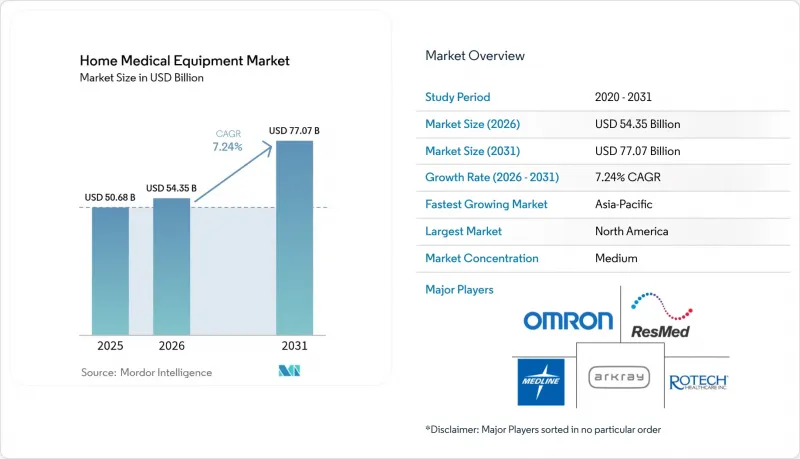
Mordor Intelligence에 의하면, 2026년 재택 의료장비 시장 규모는 543억 5,000만 달러로 추정되고 2025년 506억 8,000만 달러에서 확대해, 2031년에는 770억 7,000만 달러에 이를 것으로 예측됩니다.
2026-2031년 동안의 연평균 성장률(CAGR)은 7.24%를 나타낼 전망입니다.
본 보고서는 기능별(치료용 기기, 기타), 치료 분야별(호흡기 관리, 당뇨병 관리, 기타), 연결 방식별(커넥티드/스마트 기기, 기존 기기), 유통 채널별(소매 의료용품점, 기타), 최종 사용자별(만성 질환 재택 관리, 기타),지역별(북미, 기타)로 분류되어 있습니다. 시장 전망은 금액(달러) 기준으로 제시되어 있습니다.
세계의 재택 의료장비 시장 동향 및 인사이트
만성 질환(호흡기 질환, 당뇨병, 심혈관 질환)의 부담 증가
당뇨병, COPD, 심혈관 질환의 전 세계 유병률은 재택 의료장비 시장에서 치료 우선순위를 재편하고 있습니다. 출고 시 교정이 완료된 센서 및 자동 인슐린 투여 알고리즘을 허용하는 FDA의 승인을 바탕으로, 연속 혈당 모니터링 시스템은 현재 치료 부문 매출의 40%를 차지하고 있습니다. 보험사들이 고액의 급성 발작을 예방하기 위해 자가 관리를 장려함에 따라, 휴대용 산소 농축기와 재택 투석 장치도 유사한 성장 궤도를 따르고 있습니다. 의료 제공업체들은 기기에서 생성된 데이터를 원격 의료 워크플로우에 점점 더 통합하여, 장기적인 치료 연계를 강화하고 치료 순응도를 높이고 있습니다.
이동 지원 및 모니터링 지원이 필요한 전 세계 고령 인구 급증
2030년까지 65세 이상 성인은 미국 인구의 21%를 차지할 것으로 예상되며, 그 대다수는 자택에서 노후를 보내기를 원합니다. 이러한 인구 통계학적 변화로 인해 휠체어, 환자 리프트, 낙상 방지 센서, 비침습적 생체 신호 모니터의 잠재 고객 기반이 대폭 확대될 것입니다. 경량 복합재 프레임, 파워 어시스트 모터, 레이더식 재실 감지 기능을 통해 간병인의 부담이 경감되어, 급성기 이후의 상황에만 국한되지 않고 이용 범위가 확대되고 있습니다. 장기 요양 서비스 제공업체들은 이러한 지속적인 수요를 흡수하기 위해 재택 서비스 제공을 확대하고 있으며, 이는 재택 의료장비 시장의 성장 전망을 뒷받침하고 있습니다.
가정용 기기에 대한 엄격한 규제 및 품질 규정 준수
2024년 1월, FDA는 품질 경영 시스템 규정을 최종 확정하여 미국 요건을 ISO 13485 : 2016에 부합하도록 했습니다. 제조업체는 2026년 2월 2일 시행 시작 전까지 설계, 공급업체, 시판 후 모니터링 프로세스를 갱신했습니다. 동시에, EU의 배터리 규정 2023/1542에 따라 휴대용 기기의 전원에 대해 ‘제조부터 폐기까지’의 의무가 추가되어, 주입 펌프나 혈당 측정기에도 마찬가지로 영향을 미치고 있습니다. 규정 준수 비용과 문서 작성 부담은 중소기업에 특히 큰 부담이 되고 있으며, 이로 인해 재택 의료장비 시장의 단기적인 성장 속도가 둔화되고 있습니다.
부문별 분석
2025년, 치료용 기기는 매출에서 45.55%의 비중을 유지했습니다. 이는 호흡 치료 기기, 투석 시스템, 주입 펌프가 만성 질환 관리에 있어 필수적인 역할을 하고 있음을 반영합니다. 한편, 이동 지원 및 환자 지원 기기는 2031년 연평균 성장률(CAGR)이 8.55%로 가장 빠르게 성장하는 부문이며, 재택 고령화에 대응하는 서비스에 대한 수요가 증가하고 있음을 반영하고 있습니다. AI가 탑재된 인공호흡기, 원격 측정 모듈을 갖춘 복막투석 사이클러, 센서가 장착된 병원용 침대는 치료 순응도를 높이고 의료진의 모니터링 효율을 높여줍니다. 이동 지원 솔루션 분야의 재택 의료장비 시장 규모는 보험 환급 제도의 개선과 인체공학적 진보에 힘입어 2026년부터 2031년 사이에 62억 5,000만 달러 증가할 전망입니다.
레이더식 모니터와 같은 자율형 생체 신호 측정 기술은 기능 범주 간의 지속적인 융합을 여실히 보여주고 있습니다. 이러한 비접촉식 시스템은 전자 건강 기록과 원활하게 연동되어, 기존의 순간 측정형 기기보다 더 빠르게 건강 상태의 악화를 감지합니다. 기기 중립성(여러 데이터 플랫폼과 연동할 수 있는 능력)은 의료 시스템 및 대규모 재택 간호 사업자에게 주요 구매 기준으로 부상하고 있으며, 재택 의료장비 시장에서 상호 운용성의 전략적 중요성을 더욱 강화하고 있습니다.
당뇨병 관리는 공장에서 교정된 연속 혈당 모니터와 하이브리드형 폐쇄 루프 인슐린 펌프의 광범위한 도입에 힘입어, 치료 부문 매출의 39.35%를 차지하고 있습니다. 당뇨병 관리용 재택 의료장비 시장 규모는 새로운 바이오센서 기술과 장시간 착용 가능한 접착제의 등장을 배경으로 2031년까지 294억 달러를 넘어설 것으로 예측됩니다. 신경 재활은 절대값으로는 작지만 9.15%라는 가장 높은 예측 연평균 성장률(CAGR)을 기록하고 있습니다. 로봇 외골격, 웨어러블 모션 캡처 슬리브, 인터랙티브 VR 치료 세트는 정량화 가능한 기능 개선을 가져와 산재 보험 및 신경 전문 클리닉에서의 보험 적용을 가속화하고 있습니다.
호흡기 및 순환기 부문의 응용은 COPD 유병률과 심부전으로 인한 입원 증가에 힘입어 매출 점유율에서 두 자릿수를 유지하고 있습니다. 의료기기 제조업체들이 부품의 소형화와 무선 진단 기능 통합을 추진하는 가운데, 통합형 상처 관리 키트와 재택 혈액투석 플랫폼은 꾸준히 보급되고 있으며, 이를 통해 재택 의료장비 시장 전체에서 서비스 중단을 방지하고 치료의 확실성을 높이고 있습니다.
지역별 분석
북미는 2025년에도 37.75%의 점유율을 유지했습니다. 이는 메디케어의 내구 의료기기 급여 제도, 민간 보험사와의 급여 균등화법, 커넥티드 기기의 활발한 조기 도입에 힘입은 결과입니다. 이 지역의 AI 탑재 환자 모니터링용 재택 의료장비 시장 규모는 2026년에 43억 달러를 넘어설 전망이며, 임상 인력 부족이 심화되는 가운데 두 자릿수 성장세를 유지하고 있습니다. ‘병원과 같은 가정(Hospital-at-Home)’의 적용 면제 등 전략적인 정책 이니셔티브를 통해 입원과 동등한 보험 급여가 주거 환경까지 확대되면서, 시장 보급이 더욱 촉진되고 있습니다.
아시아태평양은 2031년 연평균 성장률(CAGR)이 10.25%로 가장 빠르게 성장하고 있는 지역입니다. 중국의 ‘건강 중국 2030’ 로드맵, 일본의 ‘지역 밀착형 통합 케어 시스템’, 인도의 ‘생산 연계형 인센티브 제도’가 맞물려 현지 제조거점의 심화와 의료기기 접근성을 높이고 있습니다. 중산층의 발전과 모바일 광대역의 높은 보급률이 맞물려, 소비자 직접 판매(DTC)의 확대와 지역별 클라우드 기반 원격 의료 서비스의 규모 확대가 가속화되고 있습니다. 그 결과, 재택 의료장비 시장에서 점유율 증가가 가장 두드러지는 분야는 네트워크 연결형 혈당 측정기와 좁은 주거 공간에 대응한 전동 휠체어입니다.
유럽에서는 의료기기 도입 절차를 공식적으로 정한 국민건강보험 제도와 지역 간호 프로그램을 활용하여 여전히 상당한 수량을 유지하고 있습니다. EU의 배터리 규제에서는 휴대용 기기의 배터리에 대해 탄소 발자국 공개 및 교체 의무가 도입되어, 제조업체는 유지보수성을 간소화하고 EU의 순환 경제 목표에 부합하는 모듈식 설계로 유도되고 있습니다. 북유럽 국가들은 강력한 사회보험 제도의 지원으로 1인당 지출액이 가장 높은 반면, 남유럽 국가들은 낮은 기준선에서 빠른 속도로 성장하고 있으며, 이러한 요인들이 결합되어 유럽 전역의 재택 의료장비 시장의 안정성을 강화하고 있습니다.
중동 및 아프리카와 남미는 시장 점유율은 작지만, 보건부가 1차 진료 네트워크에 투자하고 민간 보험사가 질환별 재택 간호 패키지를 출시함에 따라 성장세가 가속화되고 있습니다. GCC는 해당 지역의 호흡기 질환 유병률이 높은 점을 배경으로, 장기 사용용 인공호흡기 조달을 우선시하고 있습니다. 한편, 브라질의 보완 의료 분야에서는 환자와의 직접 임대 계약이 체결되고 있습니다. 환율 변동과 보험 환급 제도의 세분화는 여전히 역풍으로 작용하고 있지만, 인프라 구축이 진행됨에 따라 재택 의료장비 시장의 장기적인 보급률 향상이 예상됩니다.
기타 혜택
- 엑셀 형식 시장 예측(ME) 시트
- 3개월간의 애널리스트 지원
자주 묻는 질문
목차
제1장 서론
제2장 조사 방법
제3장 개요
제4장 시장 구도
제5장 시장 규모 및 성장 예측
제6장 경쟁 구도
제7장 시장 기회 및 향후 전망
KTH 26.08.31According to Mordor Intelligence, home medical equipment market size in 2026 is estimated at USD 54.35 billion, growing from 2025 value of USD 50.68 billion with 2031 projections showing USD 77.07 billion, growing at 7.24% CAGR over 2026-2031.
This report is Segmented by Functionality (Therapeutic Equipment, and More), Therapeutic Area (Respiratory Care, Diabetes Care, and More), Connectivity (Smart Devices and Conventional Devices), Distribution Channel (Retail Medical Stores, and More), End-User (Chronic-Disease Home-Care, and More), and Geography (North America, and More). The Market Forecasts are Provided in Terms of Value (USD).
Global Home Medical Equipment Market Trends and Insights
Rising Chronic Disease Burden Accelerates Home Monitoring Adoption
Global prevalence of diabetes, COPD, and cardiovascular disorders is reshaping therapeutic priorities in the home medical equipment market. Continuous glucose monitoring systems now anchor 40% of therapeutic-area revenue, propelled by FDA clearances that allow factory-calibrated sensors and automated insulin-delivery algorithms. Portable oxygen concentrators and home dialysis units follow similar growth trajectories as payers incentivize self-management to prevent costly acute episodes. Healthcare providers increasingly integrate device-generated data into telehealth workflows, enhancing longitudinal care coordination and reinforcing adherence.
Aging Population Drives Demand for Mobility and Monitoring Solutions
Adults aged 65+ will represent 21% of the U.S. population by 2030, and most prefer to age in place. That demographic shift materially enlarges the addressable base for wheelchairs, patient lifts, fall-prevention sensors, and non-invasive vital sign monitors. Lightweight composite frames, power-assist motors, and radar-based occupancy detection reduce caregiver burden and broaden use beyond post-acute scenarios. Long-term services providers expand home-based offerings to capture this persistent demand pool, reinforcing the growth outlook for the home medical equipment market.
Regulatory Complexity Creates Market Entry Barriers
In January 2024 the FDA finalized its Quality Management System Regulation, aligning U.S. requirements with ISO 13485:2016. Manufacturers must update design, supplier, and post-market surveillance processes before enforcement begins February 2, 2026. Simultaneously, the EU Battery Regulation 2023/1542 adds cradle-to-grave obligations for portable-device power sources, impacting infusion pumps and glucose meters alike. Compliance costs and documentation workload weigh heaviest on small firms, trimming near-term expansion pacing within the home medical equipment market.
Other drivers and restraints analyzed in the detailed report include:
- Home-Care Shift Transforms Healthcare Delivery Models
- Technological Advances Enable Remote Patient Monitoring Revolution
- Supply Chain Vulnerabilities Threaten Production Continuity
For complete list of drivers and restraints, kindly check the Table Of Contents.
Segment Analysis
Therapeutic equipment retained a 45.55% revenue contribution in 2025, reflecting the indispensable role of respiratory therapy devices, dialysis systems, and infusion pumps in chronic-disease management. Conversely, mobility assist and patient support equipment is the fastest-expanding cohort at 8.55% CAGR through 2031, mirroring rising demand for aging-in-place services. AI-driven respirators, peritoneal dialysis cyclers outfitted with telemetric modules, and sensor-enabled hospital beds enhance adherence and streamline clinician oversight. The home medical equipment market size for mobility solutions is on track to add USD 6.25 billion between 2026 and 2031, buoyed by reimbursement enhancements and ergonomic advances.
Autonomous vital-sign technologies such as radar-based monitors illustrate ongoing convergence across functionality categories. These contactless systems integrate seamlessly with electronic health records, flagging deterioration events sooner than conventional point-in-time devices. Device neutrality-ability to pair with multiple data platforms-emerges as a principal buying criterion among health systems and large home-care agencies, reinforcing the strategic importance of interoperability within the home medical equipment market.
Diabetes care holds 39.35% of therapeutic-area revenue, supported by widespread deployment of factory-calibrated continuous glucose monitors and hybrid closed-loop insulin pumps. The home medical equipment market size for diabetes management is projected to surpass USD 29.4 billion by 2031 on the back of newer biosensor chemistries and extended-wear adhesives. Neuro-rehabilitation, although smaller in absolute terms, posts the highest forecast CAGR at 9.15%. Robotic exoskeletons, wearable motion-capture sleeves, and interactive VR therapy suites deliver quantifiable functional gains, hastening coverage among workers' compensation plans and neuro-specialty clinics.
Respiratory and cardiovascular applications maintain double-digit revenue shares, driven by COPD prevalence and heart failure hospitalizations. Integrated wound-care kits and home hemodialysis platforms display steady uptake as device makers miniaturize components and embed wireless diagnostics, preventing service interruptions and elevating treatment fidelity across the home medical equipment market.
Complete Report Scope:
- By Functionality
- Therapeutic Equipment
- Respiratory Therapy Equipment
- Dialysis Equipment
- Intravenous / Infusion Pumps
- Negative-Pressure Wound-Therapy Systems
- Patient Monitoring Equipment
- Blood Glucose Monitors
- Blood-Pressure Monitors
- Multi-parameter & Wearables
- Mobility Assist & Patient Support
- Wheelchairs (Manual, Powered)
- Mobility Scooters
- Patient Lifts
- Medical Furniture
- Bathroom Safety Products
- Therapeutic Equipment
- By Therapeutic Area
- Respiratory Care
- Diabetes Care
- Cardiovascular Care
- Renal Care
- Wound & Skin Management
- Neuro-rehabilitation
- By Connectivity
- Connected / Smart Devices
- Conventional Devices
- By Distribution Channel
- Retail Medical Stores
- Online Retailers
- Hospital & Clinic Pharmacies
- Other Channels
- By End-User
- Chronic-Disease Home-Care
- Elderly & Assisted-Living
- Post-operative Care
- Pediatric Home-Care
- Palliative & Hospice
- Geography
- North America
- United States
- Canada
- Mexico
- Europe
- Germany
- United Kingdom
- France
- Italy
- Spain
- Rest of Europe
- Asia-Pacific
- China
- Japan
- India
- South Korea
- Australia
- Rest of Asia-Pacific
- Middle East and Africa
- GCC
- South Africa
- Rest of Middle East and Africa
- South America
- Brazil
- Argentina
- Rest of South America
- North America
Geography Analysis
North America retained 37.75% share in 2025, underpinned by Medicare's Durable Medical Equipment benefit set, private payer parity laws, and prolific early adoption of connected devices. The region's home medical equipment market size for AI-enabled patient monitoring exceeded USD 4.3 billion in 2026 and is pacing double-digit growth as clinical staffing gaps widen. Strategic policy initiatives like Hospital-at-Home waivers extend inpatient-equivalent reimbursement into residential settings, catalyzing further uptake.
Asia-Pacific is the fastest-growing geography with a 10.25% CAGR through 2031. China's Healthy China 2030 roadmap, Japan's Community-Based Integrated Care System, and India's Production-Linked Incentive scheme collectively expand local manufacturing depth and equipment accessibility. A rising middle class, coupled with high mobile broadband penetration, accelerates direct-to-consumer acquisition and regional cloud-hosted telehealth scale-up. The resulting home medical equipment market share uplift is most pronounced in connected glucometers and motorized wheelchairs adapted for smaller dwelling sizes.
Europe maintains substantive volume, leveraging universal coverage and community nursing programs that formalize device deployment protocols. The EU Battery Regulation introduces carbon footprint disclosure and mandatory replaceability for portable device batteries, nudging manufacturers toward modular designs that simplify serviceability and align with the bloc's circular-economy goals. Nordic countries showcase the highest per-capita expenditure owing to strong social-insurance backing, while Southern Europe advances at an accelerated clip from a lower baseline, collectively reinforcing continent-wide stability in the home medical equipment market.
The Middle East & Africa and South America contribute smaller slices but report quickening momentum as health ministries invest in primary-care networks and private insurers launch disease-specific home-care bundles. GCC nations prioritize long-term ventilator procurement amid local respiratory disease prevalence, whereas Brazil's supplementary-health segment contracts direct-to-patient equipment leases. Currency volatility and fragmented reimbursement remain headwinds yet expected infrastructure upgrades promote longer-term penetration gains for the home medical equipment market.
- Abbott Laboratories
- Medline Industries
- GE Healthcare
- Medtronic
- Arkray
- Invacare
- OMRON
- ResMed Corporation
- Smiths Group
- Rotech Healthcare
- Home Medical Products
- Beckton Dickinson
- Stryker
- Koninklijke Philips
- Cardinal Health
- Baxter
- Drive DeVilbiss Healthcare
- Sunrise Medical
- Pride Mobility Products
- B. Braun
Additional Benefits:
- The market estimate (ME) sheet in Excel format
- 3 months of analyst support
TABLE OF CONTENTS
1 Introduction
- 1.1 Study Assumptions & Market Definition
- 1.2 Scope of the Study
2 Research Methodology
3 Executive Summary
4 Market Landscape
- 4.1 Market Overview
- 4.2 Market Drivers
- 4.2.1 Rising Chronic Disease Burden (Respiratory, Diabetes, Cardiovascular)
- 4.2.2 Rapidly Expanding Global Geriatric Population Requiring Mobility & Monitoring Support
- 4.2.3 Healthcare Cost-Containment Shift from In-patient to Home-care Settings
- 4.2.4 Technological Advances in Portable & Connected Therapeutic Devices
- 4.2.5 Broadening Reimbursement Coverage for Home Therapies Across Major Economies
- 4.2.6 Growth of E-commerce & Rental Models for Durable Medical Equipment
- 4.3 Market Restraints
- 4.3.1 Stringent Regulatory & Quality Compliance for Home-use Devices
- 4.3.2 Supply-Chain Volatility Affecting Semiconductor & Sensor Availability
- 4.3.3 Safety-Related Recalls Undermining End-User Confidence
- 4.3.4 High Up-front Costs & Limited Insurance Coverage in Emerging Markets
- 4.4 Technological Outlook
- 4.5 Porter's Five Forces
- 4.5.1 Threat of New Entrants
- 4.5.2 Bargaining Power of Buyers
- 4.5.3 Bargaining Power of Suppliers
- 4.5.4 Threat of Substitutes
- 4.5.5 Intensity of Competitive Rivalry
5 Market Size & Growth Forecasts (Value, USD)
- 5.1 By Functionality
- 5.1.1 Therapeutic Equipment
- 5.1.1.1 Respiratory Therapy Equipment
- 5.1.1.2 Dialysis Equipment
- 5.1.1.3 Intravenous / Infusion Pumps
- 5.1.1.4 Negative-Pressure Wound-Therapy Systems
- 5.1.2 Patient Monitoring Equipment
- 5.1.2.1 Blood Glucose Monitors
- 5.1.2.2 Blood-Pressure Monitors
- 5.1.2.3 Multi-parameter & Wearables
- 5.1.3 Mobility Assist & Patient Support
- 5.1.3.1 Wheelchairs (Manual, Powered)
- 5.1.3.2 Mobility Scooters
- 5.1.3.3 Patient Lifts
- 5.1.3.4 Medical Furniture
- 5.1.3.5 Bathroom Safety Products
- 5.1.1 Therapeutic Equipment
- 5.2 By Therapeutic Area
- 5.2.1 Respiratory Care
- 5.2.2 Diabetes Care
- 5.2.3 Cardiovascular Care
- 5.2.4 Renal Care
- 5.2.5 Wound & Skin Management
- 5.2.6 Neuro-rehabilitation
- 5.3 By Connectivity
- 5.3.1 Connected / Smart Devices
- 5.3.2 Conventional Devices
- 5.4 By Distribution Channel
- 5.4.1 Retail Medical Stores
- 5.4.2 Online Retailers
- 5.4.3 Hospital & Clinic Pharmacies
- 5.4.4 Other Channels
- 5.5 By End-User
- 5.5.1 Chronic-Disease Home-Care
- 5.5.2 Elderly & Assisted-Living
- 5.5.3 Post-operative Care
- 5.5.4 Pediatric Home-Care
- 5.5.5 Palliative & Hospice
- 5.6 Geography
- 5.6.1 North America
- 5.6.1.1 United States
- 5.6.1.2 Canada
- 5.6.1.3 Mexico
- 5.6.2 Europe
- 5.6.2.1 Germany
- 5.6.2.2 United Kingdom
- 5.6.2.3 France
- 5.6.2.4 Italy
- 5.6.2.5 Spain
- 5.6.2.6 Rest of Europe
- 5.6.3 Asia-Pacific
- 5.6.3.1 China
- 5.6.3.2 Japan
- 5.6.3.3 India
- 5.6.3.4 South Korea
- 5.6.3.5 Australia
- 5.6.3.6 Rest of Asia-Pacific
- 5.6.4 Middle East and Africa
- 5.6.4.1 GCC
- 5.6.4.2 South Africa
- 5.6.4.3 Rest of Middle East and Africa
- 5.6.5 South America
- 5.6.5.1 Brazil
- 5.6.5.2 Argentina
- 5.6.5.3 Rest of South America
- 5.6.1 North America
6 Competitive Landscape
- 6.1 Market Concentration
- 6.2 Market Share Analysis
- 6.3 Company Profiles (includes Global level Overview, Market level overview, Core Business Segments, Financials, Headcount, Key Information, Market Rank, Market Share, Products and Services, and analysis of Recent Developments)
- 6.3.1 Abbott Laboratories
- 6.3.2 Medline Industries, Inc.
- 6.3.3 GE Healthcare
- 6.3.4 Medtronic plc
- 6.3.5 ARKRAY Inc.
- 6.3.6 Invacare Corporation
- 6.3.7 Omron Healthcare Inc.
- 6.3.8 ResMed Corporation
- 6.3.9 Smiths Group plc
- 6.3.10 Rotech Healthcare Inc.
- 6.3.11 Home Medical Products Inc.
- 6.3.12 Becton, Dickinson & Co.
- 6.3.13 Stryker Corporation
- 6.3.14 Koninklijke Philips N.V.
- 6.3.15 Cardinal Health Inc.
- 6.3.16 Baxter International Inc.
- 6.3.17 Drive DeVilbiss Healthcare
- 6.3.18 Sunrise Medical LLC
- 6.3.19 Pride Mobility Products
- 6.3.20 Braun Melsungen AG
7 Market Opportunities & Future Outlook
- 7.1 White-space & Unmet-Need Assessment


