|
시장보고서
상품코드
2116274
부비동염 치료 시장 : 점유율 분석, 업계 동향과 통계, 성장 예측(2026-2031년)Sinusitis Treatment - Market Share Analysis, Industry Trends & Statistics, Growth Forecasts (2026 - 2031) |
||||||
 Mordor Intelligence
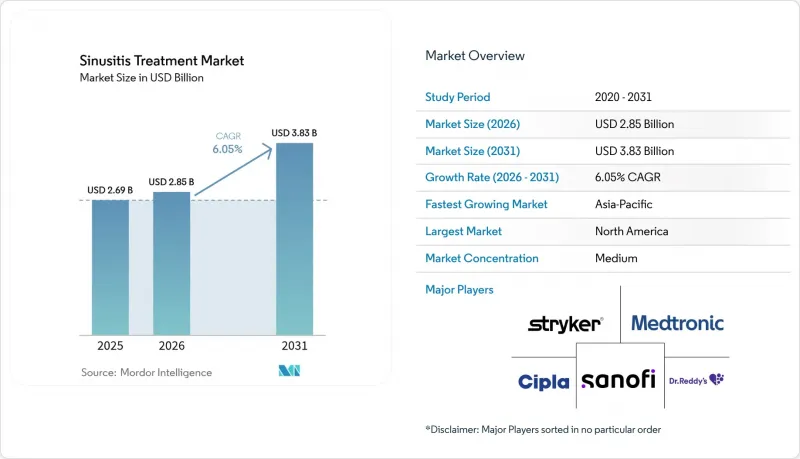
Mordor Intelligence에 의하면, 부비동염 치료 시장 규모는 2025년 26억 9,000만 달러에서 2026년에는 28억 5,000만 달러로 확대되어 2026년부터 2031년까지 CAGR 6.05%로 성장을 지속하여, 2031년에는 38억 3,000만 달러에 이를 것으로 예측됩니다.
본 보고서는 질환별(급성 부비동염, 아급성 부비동염, 만성 부비동염), 치료법별(진통제, 항히스타민제, 코르티코스테로이드, 항생제, 기타를 포함한 약물 분류별 및 최소 침습 수술), 지역별(북미, 유럽, 아시아태평양, 중동 및 아프리카, 남미)로 분류되어 있습니다. 시장 전망은 금액(미 달러) 기준으로 제시되어 있습니다.
전 세계 부비동염 치료 시장 동향 및 인사이트
만성 및 급성 비부비동염 유병률 증가
현재 만성 비부비동염은 전 세계 인구의 최대 12%에 영향을 미치고 있으며, 이로 인해 외래 환자 수와 수술 의뢰 건수가 증가하고 있습니다. COVID-19와 관련된 미생물 군집의 변화로 인해 지속적인 염증 증상을 보이는 환자군이 나타나고 있으며, 합병증을 동반한 부비동염으로 인한 입원 건수가 증가하고 있습니다. 미국에서는 환자 1인당 연간 평균 20.6 영업일의 생산성 손실이 발생하고 있으며, 연간 80억 달러의 의료비가 소요되고 있습니다. 도시 지역의 대기 오염 물질과 알레르겐은 점막 염증을 악화시켜, 부비동염 치료 시장의 모든 세분 시장에서 지속적인 치료법에 대한 수요를 확대시키고 있습니다. 고령화와 평균 수명의 연장은 향후 몇 년 동안 생물학적 제제, 영상 유도 수술 및 프로바이오틱스 제제에 대한 수요를 확고히할 것입니다.
저침습적 풍선 부비동 성형술에 대한 선호도 증가
풍선 부비동 성형술의 수술 건수는 증가 추세를 보이고 있으며, 조직 보존술이 기존의 기능적 부비동 성형술(FESS)을 대체하고 있는 것으로 나타났습니다. 현재의 증거에 따르면, 수술 후 합병증이 적고 임상적 성공률이 91%에 달하여, 많은 환자에게 풍선 확장술이 1차 선택 수술법으로 자리매김하고 있습니다. 외래 진료실에서의 시술은 입원 기간을 단축시키며, 가치 기반 의료와도 부합합니다. 스트라이커(Stryker)사의 분석에 따르면, 기존의 FESS와 비교하여 환자 1인당 2,200달러의 비용 절감이 예상되며, 이는 보험사에게 설득력 있는 근거가 됩니다. 영상 유도 내비게이션은 특히 복잡한 전두동 심부의 해부학적 구조에서 정확도를 한층 더 높여주며, 한편 일회용 마이크로 데브리더는 감염 위험과 재처리 비용을 줄여줍니다. 이러한 장점들이 결합되어 부비동염 치료 시장의 시술 건수 증가를 이끌고 있습니다.
저비용 제네릭 의약품 및 OTC 충혈 완화제 시장 침투 확대
제네릭 의약품의 출시로 아제라스틴·플루티카손 복합 스프레이의 평균 판매 가격이 하락하고 있으며, 미국에서는 특허 만료 후 12개월 이내에 소매 가격이 45% 이상 하락했습니다. OTC 비강 스프레이는 증상 지속 기간을 6.5일로 단축한다는 점에서 처방약과 동등한 효능을 보여주고 있어, 소매 채널에서의 경쟁을 심화시키고 있습니다. Sinupret과 같은 허브 기반 대체 의약품을 통해 항생제 투여를 지연시키는 전략이 가능해졌으며, 무작위 대조 시험 환경에서 항균제 사용량을 43.7% 감축했습니다. 신흥국에서는 처방전 총수의 70% 이상을 제네릭 의약품이 차지하고 있으며, 이로 인해 브랜드 의약품의 이익률이 압박을 받고 있어 혁신 기업들은 우수한 치료 성과를 입증해야 하는 상황에 처해 있습니다. 이러한 가격 하락으로 인해 부비동염 치료 시장의 일부 부문에서 매출 성장세가 일시적으로 정체되고 있습니다.
부문 분석
만성 부비동염은 재발하기 쉬운 특성과 더 높은 의료 자원 이용률로 인해 2025년에는 부비동염 치료 시장 점유율의 57.02%를 차지했습니다. 이 부문은 생물학적 제제에 대한 지출과 재수술(FESS) 건수를 흡수하며 견실한 수익원을 뒷받침하고 있습니다. 급성 부비동염은 규모는 작지만, 1차 의료에서의 진단 기술 향상과 항생제 투여 프로토콜의 정교화를 반영하여 연평균 성장률(CAGR) 7.31%로 확대될 것으로 예측됩니다. 아급성 부비동염은 ‘과도기’ 단계의 병태로, 적절히 치료되지 않을 경우 만성 부비동염으로 진행되는 경우가 많습니다.
만성 질환의 이질성은 계속해서 정밀 의학을 주도하고 있습니다. 호산구형 아형은 IL-4/IL-13 차단 요법에 강하게 반응하는 반면, 아시아인 집단에서 많이 나타나는 비호산구형 표현형에는 별도의 치료 경로가 필요합니다. 수술 중 조직 내 호산구 증가 점수 평가는 현재 수술 후 약물 치료의 지침이 되고 있으며, 재수술 위험을 낮추고 있습니다. 바이오마커와 차세대 생물학적 제제의 병행 개발은 만성 질환 관리와 관련된 부비동염 치료 시장 규모의 장기적인 성장을 보장하고 있습니다.
지역별 분석
북미는 생물학적 제제의 조기 도입과 최소 침습 수술에 대한 보험사의 지원 덕분에 2025년 부비동염 치료 시장에서 39.62%의 점유율을 유지했습니다. 2024년 9월 듀필루맙(사춘기 환자용)의 승인 및 2025년 6월 SONU Band(소아용)의 허가는 혁신에 우호적인 규제 환경을 뒷받침하고 있습니다. 풍선 부비동 성형술은 기존의 FESS에 비해 1건당 평균 2,200달러의 비용 절감을 실현하고 있어, 이에 따라 지불 기관의 지지가 더욱 강화되고 있습니다. 캐나다의 엄격한 약제경제학적 평가 결과, 오말리주맙은 적격 환자에게 비용 대비 효과가 높은 생물학적 제제로 권장되고 있습니다. 멕시코에서는 중산층의 부상과 의료 관광의 확대로 인해 수술 및 의약품의 보급이 진행되고 있으며, 부비동염 치료 시장 전체에서 북미의 영향력이 확대되고 있습니다.
아시아태평양은 인프라 투자와 첨단 치료법에 대한 인식 제고를 원동력으로, 8.02%라는 지역별 최고 수준의 연평균 성장률(CAGR)을 기록하고 있습니다. 중국에서는 영상 유도 하 FESS에 대한 수요가 높으며, 출혈로 인한 재입원을 100% 방지할 수 있을 뿐만 아니라, 기존 수술에 비해 질조정생존년(QALY)당 총비용이 낮은 것으로 나타났습니다. 2024년 12월, 중국 최초의 국산 생물학적 제제인 스타포키바트가 승인된 것은 접근성을 개선하고 수입 제제에 대한 의존도를 낮추는 전략적 이정표가 될 것입니다. 인력 부족은 여전히 걸림돌로 작용하고 있지만, 원격 지도와 로봇 기술을 통해 기술 격차가 부분적으로 보완되면서 부비동염 치료 시장은 급속한 성장 궤도를 유지하고 있습니다.
유럽에서는 엄격한 비용 억제 조치 하에서도 꾸준한 성장이 관찰되고 있습니다. ‘비부비동염에 관한 유럽 입장문’은 근거 기반 활용을 촉진하는 통일된 진단·치료 기준을 제시하고 있습니다. 주요 시장인 독일, 영국, 프랑스가 생물학적 제제의 도입을 주도하는 한편, 남유럽 국가들에서는 의료 기술 평가에서 긍정적인 결과를 바탕으로 도입이 가속화되고 있습니다. 디지털 헬스 도구는 원격 경과 관찰 및 전문의 진료를 지원하여 지방 지역의 의료 접근성을 확대하는 동시에, 유럽 전역의 부비동염 치료 시장 성장을 안정적으로 뒷받침하고 있습니다.
기타 혜택:
- 엑셀 형식 시장 예측(ME) 시트
- 3개월간의 애널리스트 지원
자주 묻는 질문
목차
제1장 서론
제2장 조사 방법
제3장 주요 요약
제4장 시장 구도
제5장 시장 규모와 성장 예측
제6장 경쟁 구도
제7장 시장 기회와 향후 전망
JHS 26.08.28According to Mordor Intelligence, the sinusitis treatment market size is expected to grow from USD 2.69 billion in 2025 to USD 2.85 billion in 2026 and is forecast to reach USD 3.83 billion by 2031 at 6.05% CAGR over 2026-2031.
This report is Segmented by Disease (Acute Sinusitis, Sub-Acute Sinusitis, Chronic Sinusitis), Modality (Drug Class Including Analgesics, Antihistamines, Corticosteroids, Antibiotics, Others, and Minimally-Invasive Surgery), and Geography (North America, Europe, Asia-Pacific, Middle East and Africa, South America). The Market Forecasts are Provided in Terms of Value (USD).
Global Sinusitis Treatment Market Trends and Insights
Rising Prevalence of Chronic & Acute Rhinosinusitis
Chronic rhinosinusitis now affects up to 12% of the global population, translating to heavier outpatient loads and higher surgical referrals. COVID-related microbial shifts introduced a cohort with persistent inflammatory symptoms, raising hospital admissions for complicated sinusitis. In the United States, productivity losses average 20.6 workdays per patient per year and drive USD 8 billion in annual medical spending. Urban air pollutants and allergens intensify mucosal inflammation, magnifying demand for durable treatments across every sinusitis treatment market segment. Aging populations and longer life expectancy further solidify a multi-year volume base for biologics, image-guided surgery, and probiotic solutions.
Growing Preference for Minimally-Invasive Balloon Sinuplasty
Balloon sinuplasty has been increasing, showing how tissue-preserving techniques are displacing conventional FESS. Current evidence reports 91% clinical success with fewer postoperative complications, positioning balloon dilation as the first-line surgical option for many patients. Office-based execution cuts hospital stay and dovetails with value-based care; Stryker's analysis shows USD 2,200 per-patient savings compared with traditional FESS, a compelling argument for payers. Image-guided navigation further improves precision, especially inside complex frontal recess anatomy, while disposable microdebriders reduce infection risk and reprocessing costs. These advantages collectively pull incremental procedure volume into the sinusitis treatment market.
Escalating Penetration of Low-Cost Generics & OTC Decongestants
Generic launches reduce average selling price of azelastine-fluticasone sprays, with U.S. retail erosion exceeding 45% within 12 months of patent expiry. OTC nasal sprays now match prescription efficacy in shortening symptom duration to 6.5 days, adding retail-channel competition. Herbal alternatives such as Sinupret allow delayed antibiotic strategies that trim antimicrobial use by 43.7% in randomized settings. In emerging economies, generics account for over 70% of total scripts, compressing branded margins and pressuring innovators to demonstrate superior outcomes. This price deflation temporarily caps revenue expansion within certain segments of the sinusitis treatment market.
Other drivers and restraints analyzed in the detailed report include:
- Expanding Access to Combination Drug Regimens
- Rapid Uptake of Biologics for CRSwNP
- Rising Antibiotic-Resistance Pressures Curbing Empirical Scripts
For complete list of drivers and restraints, kindly check the Table Of Contents.
Segment Analysis
Chronic sinusitis controlled 57.02% of sinusitis treatment market share in 2025 thanks to its recurrent profile and higher resource utilization. The segment absorbs biologic spending and revision FESS volumes, underpinning robust revenue streams. Acute sinusitis, while smaller, is projected to expand at a 7.31% CAGR, reflecting better primary-care diagnostics and refined antibiotic protocols. Sub-acute sinusitis serves as the bridge phenotype, often migrating into chronic classification when inadequately resolved.
Chronic disease heterogeneity continues to steer precision medicine. Eosinophilic variants respond strongly to IL-4/IL-13 blockade, whereas non-eosinophilic phenotypes common in Asian populations need alternative pathways. Tissue eosinophilia scoring during surgery now guides postoperative pharmacotherapy, cutting revision risk. Parallel development of biomarkers and next-generation biologics secures long-term growth for the sinusitis treatment market size linked to chronic disease management.
Complete Report Scope:
- By Disease
- Acute Sinusitis
- Sub-acute Sinusitis
- Chronic Sinusitis
- By Modality
- Drug Class
- Analgesics
- Antihistamines
- Corticosteroids
- Antibiotics
- Others
- Minimally-invasive Surgery (Balloon Sinuplasty, FESS)
- Drug Class
- By Geography
- North America
- United States
- Canada
- Mexico
- Europe
- Germany
- United Kingdom
- France
- Italy
- Spain
- Rest of Europe
- Asia-Pacific
- China
- Japan
- India
- Australia
- South Korea
- Rest of Asia-Pacific
- Middle East and Africa
- GCC
- South Africa
- Rest of Middle East and Africa
- South America
- Brazil
- Argentina
- Rest of South America
- North America
Geography Analysis
North America retained 39.62% of the sinusitis treatment market in 2025 due to early biologic adoption and payer support for minimally-invasive surgery. The September 2024 adolescent dupilumab approval and the June 2025 SONU Band pediatric clearance underscore an innovation-friendly regulatory climate. Balloon sinuplasty delivers USD 2,200 average savings per case compared with traditional FESS, further cementing payer backing. Canada's rigorous pharmacoeconomic evaluations favor omalizumab as the cost-effective biologic for eligible patients. Mexico's rising middle class and medical tourism growth broaden procedure and drug uptake, extending North American influence across the sinusitis treatment market.
Asia-Pacific registers the fastest regional CAGR at 8.02%, powered by infrastructure investment and greater awareness of advanced therapies. China demonstrates strong demand for image-guided FESS, showing 100% avoidance of rehospitalization for bleeding and lower overall cost per quality-adjusted life year versus conventional surgery. The December 2024 approval of stapokibart, China's first indigenous biologic, marks a strategic milestone that improves access and lowers dependence on imported agents. Workforce shortages remain a drag, yet tele-mentoring and robotics partially offset skill gaps, keeping the sinusitis treatment market on a steep trajectory.
Europe shows steady expansion under tight cost-containment regimes. The European Position Paper on Rhinosinusitis supplies unified diagnostic and therapeutic criteria that drive evidence-based utilization. Major markets-Germany, United Kingdom, France-lead biologic uptake, while southern nations accelerate adoption after positive health-technology assessments. Digital health tools support remote follow-up and specialist consultations, widening reach in rural settings and stabilizing growth for the sinusitis treatment market across the continent.
- Acclarent Inc (J&J)
- AstraZeneca
- Aurobindo Pharma
- Bayer
- Cipla
- Dr Reddy's Laboratories
- Entellus Medical
- GlaxoSmithKline
- Medtronic
- NeilMed Pharmaceuticals
- Novartis
- Olympus
- OptiNose Inc
- Pfizer
- Regeneron Pharmaceuticals
- Sanofi
- SinuSys
- Smiths Group
- Stryker
- Teva Pharmaceutical Industries
Additional Benefits:
- The market estimate (ME) sheet in Excel format
- 3 months of analyst support
TABLE OF CONTENTS
1 Introduction
- 1.1 Study Assumptions & Market Definition
- 1.2 Scope of the Study
2 Research Methodology
3 Executive Summary
4 Market Landscape
- 4.1 Market Overview
- 4.2 Market Drivers
- 4.2.1 Rising Prevalence of Chronic & Acute Rhinosinusitis
- 4.2.2 Growing Preference for Minimally-Invasive Balloon Sinuplasty
- 4.2.3 Expanding Access to Combination Drug Regimens (Antibiotics + Corticosteroids)
- 4.2.4 Rapid Uptake of Biologics for CRSwNP (E.G., Dupilumab, Omalizumab)
- 4.2.5 AI-Guided Endoscopic Navigation & Robotic FESS Platforms
- 4.2.6 Microbiome-Modulating Probiotics & Post-Biotics Emerging as Adjunct Therapy
- 4.3 Market Restraints
- 4.3.1 Escalating Penetration of Low-Cost Generics & OTC Decongestants
- 4.3.2 Rising Antibiotic-Resistance Pressures Curbing Empirical Scripts
- 4.3.3 Post-COVID Shifts in Sinonasal Microbiome Dampening Elective Procedure Demand
- 4.3.4 Shortage of Trained Otolaryngologists in High-Growth Emerging Regions
- 4.4 Value Chain Analysis
- 4.5 Regulatory Landscape
- 4.6 Technological Outlook
- 4.7 Porter's Five Forces Analysis
- 4.7.1 Threat of New Entrants
- 4.7.2 Bargaining Power of Buyers
- 4.7.3 Bargaining Power of Suppliers
- 4.7.4 Threat of Substitutes
- 4.7.5 Intensity of Competitive Rivalry
5 Market Size & Growth Forecasts (Value)
- 5.1 By Disease
- 5.1.1 Acute Sinusitis
- 5.1.2 Sub-acute Sinusitis
- 5.1.3 Chronic Sinusitis
- 5.2 By Modality
- 5.2.1 Drug Class
- 5.2.1.1 Analgesics
- 5.2.1.2 Antihistamines
- 5.2.1.3 Corticosteroids
- 5.2.1.4 Antibiotics
- 5.2.1.5 Others
- 5.2.2 Minimally-invasive Surgery (Balloon Sinuplasty, FESS)
- 5.2.1 Drug Class
- 5.3 By Geography
- 5.3.1 North America
- 5.3.1.1 United States
- 5.3.1.2 Canada
- 5.3.1.3 Mexico
- 5.3.2 Europe
- 5.3.2.1 Germany
- 5.3.2.2 United Kingdom
- 5.3.2.3 France
- 5.3.2.4 Italy
- 5.3.2.5 Spain
- 5.3.2.6 Rest of Europe
- 5.3.3 Asia-Pacific
- 5.3.3.1 China
- 5.3.3.2 Japan
- 5.3.3.3 India
- 5.3.3.4 Australia
- 5.3.3.5 South Korea
- 5.3.3.6 Rest of Asia-Pacific
- 5.3.4 Middle East and Africa
- 5.3.4.1 GCC
- 5.3.4.2 South Africa
- 5.3.4.3 Rest of Middle East and Africa
- 5.3.5 South America
- 5.3.5.1 Brazil
- 5.3.5.2 Argentina
- 5.3.5.3 Rest of South America
- 5.3.1 North America
6 Competitive Landscape
- 6.1 Market Concentration
- 6.2 Market Share Analysis
- 6.3 Company Profiles (includes Global level Overview, Market level overview, Core Segments, Financials as available, Strategic Information, Market Rank/Share for key companies, Products & Services, and Recent Developments)
- 6.3.1 Acclarent Inc (J&J)
- 6.3.2 AstraZeneca plc
- 6.3.3 Aurobindo Pharma
- 6.3.4 Bayer AG
- 6.3.5 Cipla Ltd
- 6.3.6 Dr Reddy's Laboratories
- 6.3.7 Entellus Medical
- 6.3.8 GlaxoSmithKline plc
- 6.3.9 Medtronic plc
- 6.3.10 NeilMed Pharmaceuticals
- 6.3.11 Novartis AG
- 6.3.12 Olympus Corporation
- 6.3.13 OptiNose Inc
- 6.3.14 Pfizer Inc
- 6.3.15 Regeneron Pharmaceuticals
- 6.3.16 Sanofi SA
- 6.3.17 SinuSys Corporation
- 6.3.18 Smith & Nephew plc
- 6.3.19 Stryker Corporation
- 6.3.20 Teva Pharmaceutical
7 Market Opportunities & Future Outlook
- 7.1 White-space & Unmet-need Assessment