|
시장보고서
상품코드
2116290
미국의 상업용 빌딩 자동화 : 시장 점유율 분석, 업계 동향 및 통계, 성장 예측(2026-2031년)United States Commercial Building Automation - Market Share Analysis, Industry Trends & Statistics, Growth Forecasts (2026 - 2031) |
||||||
 Mordor Intelligence
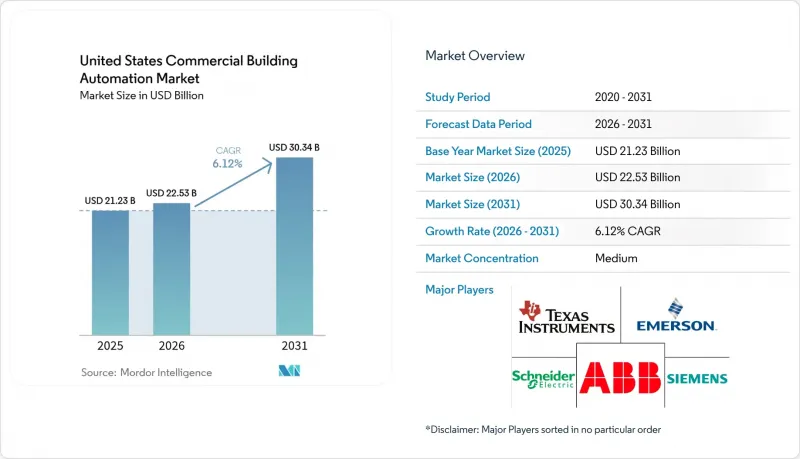
Mordor Intelligence에 의하면, 미국의 상업용 빌딩 자동화 시장 규모는 2025년 212억 3,000만 달러로 평가되었습니다. 2026년에는 225억 3,000만 달러로 확대되어 2026-2031년에 걸쳐 CAGR 6.12%로 성장을 지속하여, 2031년에는 303억 4,000만 달러에 이를 것으로 예측됩니다.
본 보고서는 제품 유형(HVAC 제어 시스템, 보안·출입 제어 시스템, 기타),건축 유형(사무실, 공공시설, 소매, 호텔·리조트, 기타), 구성 요소(컨트롤러·필드 디바이스, 센서, 기타), 통신 프로토콜(BACnet, Modbus, KNX, 기타)별로 분류되어 있습니다. 시장 전망은 금액(미 달러) 기준으로 제시되어 있습니다.
미국의 상업용 빌딩 자동화 시장 동향 및 인사이트
연방 및 주 정부의 넷 제로·전기화 관련 의무화
연방 성능 기준에 따라 2만 5,000제곱피트를 초과하는 건물은 2030년까지 에너지 사용량을 30% 감축해야 하며, 이에 대응하기 위해 소유주는 규정 준수를 충족할 수 있는 완전한 기능을 갖춘 자동화 시스템 도입을 서두르고 있습니다. 캘리포니아주의 ‘타이틀 24’와 뉴욕주의 ‘로컬 로 97’은 더 엄격한 탄소 배출 상한선을 규정하고 있으며, 이미 벌칙이 시행되고 있어 정부, 교육, 의료 부문에서 급속한 설비 갱신이 진행되고 있습니다. 수동으로 일정을 설정하는 방식으로는 20-40%의 감축 기준을 달성할 수 없기 때문에 네트워크화된 공조(HVAC), 조명, 콘센트 부하 제어는 신규 임대 계약의 표준 사양으로 자리 잡고 있습니다. 각 벤더사는 현재 센서 데이터를 감사 대응이 가능한 보고서로 변환하는 규정 준수 대시보드를 패키지화하고 있으며, 이에 따라 조달 결정은 비용 중심에서 규제 대응 중심으로 전환되고 있습니다. 이러한 파급 효과로 인해 입찰 프로젝트는 얼리 어답터에 그치지 않고, 벌금을 피하고 연방 정부 임차인을 유치하려는 일반 소유주층으로 확대되고 있습니다.
기업의 ESG 주도 하에 증가하는 실시간 에너지 데이터 수요
SEC의 새로운 기후 변화 공시 규정에 따라 포춘 500대 기업은 15분 단위의 스코프 2 배출량 데이터 공시가 의무화되어, 서브미터링 및 클라우드 분석에 대한 수요가 급증하고 있습니다. 다중 임차인 타워에는 임차인 단위의 계량기가 설치되어 있어, 소유주는 비용을 정확하게 배분할 수 있을 뿐만 아니라 ESG 대시보드를 프리미엄 편의 시설로 제공할 수 있게 되었습니다. 공개 템플릿에 데이터를 자동으로 입력하는 SaaS(Software-as-a-Service) 플랫폼은 수작업 보고의 부담을 줄이는 동시에 더 높은 구독 요금을 실현하고 있습니다. 실시간 투명성은 임대 계약 협상에도 변화를 가져오고 있습니다. 임차인들은 현재 지속가능성 목표 달성 현황을 검증할 수 있는 건물을 강력히 요구하고 있습니다. 이에 대응하여 자동화 솔루션 공급업체들은 ESG 소프트웨어 벤더와 제휴하여 데이터 파이프라인을 통합함으로써 규정 준수를 효율화하는 동시에 새로운 지속적인 수익원을 개발하고 있습니다.
사이버 보안에 대한 책임과 네트워크 연결형 빌딩 자동화 시스템(BAS)의 보험 면책 조항
NAIC에 따르면, 현재 상업용 부동산 보험 계약의 40%가 IoT 관련 손해를 면책 대상으로 하고 있어, 소유주는 100만 달러를 초과하는 잠재적인 정보 유출 비용에 노출되어 있습니다. 이미 엄격한 데이터 규제의 적용을 받고 있는 의료 및 금융 시설에서는 운영 기술(OT)을 공용 인터넷에 공개하는 것을 주저하고 있습니다. 전문 사이버 보험의 보험료는 연간 1제곱피트당 0.50-1달러로, 투자 회수 기간이 길어질 뿐만 아니라 프로젝트 지연까지 초래하고 있습니다. BACnet Secure Connect나 NIST 프로파일과 같은 표준은 여전히 초안 단계에 머물러 있어, 향후 규정 준수 관련 비용에 대한 불확실성이 남아 있습니다. 벤더 측은 제로 트러스트 아키텍처나 관리형 보안 서비스로 대응하고 있지만, 구매자들의 신중한 태도는 지속되고 있습니다.
부문별 분석
HVAC 제어 시스템은 자동 환기 및 온도 제어 사용을 의무화하는 주(州)의 성능 기준에 힘입어 2025년 매출의 40.92%를 차지했습니다. 그러나 소유주들이 사일로화된 하위 시스템으로는 달성할 수 없는 시설 전체의 30-50% 효율 향상을 추구하는 가운데, 통합형 빌딩 관리 플랫폼은 연평균 성장률(CAGR) 7.22%로 성장을 가속화하고 있습니다. 이러한 진화에 따라, 예측 기간 동안 이 플랫폼은 미국의 상업용 빌딩 자동화 시장에서 더 큰 점유율을 확보할 것으로 보입니다.
또한, 플랫폼 도입은 HVAC, 조명, 보안, 전력을 아우르는 통합된 ESG 보고에 대한 지향점도 반영하고 있습니다. 각 벤더들은 현재 데이터 스트림을 집계하여 ‘싱글 페인 오브 글라스(Single Pane of Glass)’ 뷰로 표시하는 클라우드 대시보드를 제공함으로써, 규정 준수 및 유지보수 워크플로우를 간소화하고 있습니다. BACnet 및 무선 프로토콜과의 상호 운용성을 통해 미래 가치가 높아지고 있으며, 견고한 자산 성과를 중시하는 투자자들에게 통합 플랫폼은 매력적인 선택지가 되고 있습니다.
2025년, 사무실 부동산은 기업의 ESG 공시 의무와 하이브리드 근무에 관한 분석 수요의 혜택을 받아 미국의 상업용 빌딩 자동화 시장 규모에서 35.01%의 점유율을 유지했습니다. 한편, 도시 계획가들이 소매, 주거, 업무 공간 등의 기능을 결합하는 경향이 강해지는 가운데, 정교한 구역 제어가 요구되는 복합 시설은 연평균 성장률(CAGR) 7.01%로 확대될 것으로 예측됩니다.
복합 용도 자산의 다양한 입주 패턴에는 HVAC 일정을 1시간 단위로 조정할 수 있는 유연한 자동화가 필수적입니다. 부동산 소유주는 이러한 적응성을 변화하는 임차인 구성에 대한 헤지로 간주하는 반면, 지자체는 구역 지정상의 우대 조치를 통해 통합형 개발을 장려하고 있습니다. 오피스 소유주들은 A등급 평가를 유지하기 위해 첨단 BAS(빌딩 자동화 시스템) 도입을 지속하고 있지만, 체험 중심의 복합 용도 프로젝트와의 경쟁으로 인해 기술 경쟁은 격화되고 있습니다.
기타 혜택
- 엑셀 형식 시장 예측(ME) 시트
- 3개월간의 애널리스트 지원
자주 묻는 질문
목차
제1장 서론
제2장 조사 방법
제3장 개요
제4장 시장 구도
제5장 시장 규모 및 성장 예측
제6장 경쟁 구도
제7장 시장 기회 및 향후 전망
KTH 26.08.31According to Mordor Intelligence, the United States commercial building automation market size is expected to grow from USD 21.23 billion in 2025 to USD 22.53 billion in 2026 and is forecast to reach USD 30.34 billion by 2031 at 6.12% CAGR over 2026-2031.
This report is Segmented by Product Type (HVAC Control Systems, Security and Access Control Systems, and More), Building Type (Office, Institutional, Retail, Hospitality, and More), Component (Controllers and Field Devices, Sensors, and More), Communication Protocol (BACnet, Modbus, KNX, and More). The Market Forecasts are Provided in Terms of Value (USD).
United States Commercial Building Automation Market Trends and Insights
Federal and State Net-Zero Electrification Mandates
Federal performance standards compel buildings larger than 25,000 square feet to cut energy use 30% by 2030, pushing owners toward full-featured automation for compliance. California Title 24 and New York Local Law 97 add stricter carbon caps with penalties already in force, prompting rapid upgrades across government, education, and healthcare portfolios. Manual scheduling cannot reach 20-40% reduction thresholds, so connected HVAC, lighting, and plug-load controls have become default specifications in new leases. Vendors now bundle compliance dashboards that translate sensor data into audit-ready reports, shifting procurement decisions from cost-centric to mandate-driven. The ripple effect has expanded bid pipelines beyond early adopters to mainstream owners aiming to avoid fines and attract federal tenants.
Corporate ESG-Driven Demand for Real-Time Energy Data
New SEC climate disclosure rules require Fortune 500 firms to publish 15-minute Scope 2 emissions data, spurring a surge in sub-metering and cloud analytics. Multi-tenant towers are wiring tenant-level meters so landlords can allocate costs accurately and supply ESG dashboards as a premium amenity. SaaS platforms that auto-populate disclosure templates command higher subscription fees while reducing manual reporting labor. Real-time transparency is also reshaping lease negotiations; tenants now insist on buildings capable of validating sustainability targets. In response, automation suppliers have partnered with ESG software vendors to integrate data pipelines that streamline compliance and unlock new recurring-revenue streams.
Cyber-Security Liabilities and Insurance Exclusions for Connected BAS
40% of commercial property policies now exclude IoT-related losses, exposing owners to more than USD 1 million in potential breach costs, according to NAIC. Health-care and financial campuses, already subject to stringent data regulations, hesitate to expose operational technology to the public internet. Specialty cyber cover costs USD 0.50-1.00 per square foot annually, extending paybacks and delaying projects. Standards such as BACnet Secure Connect and NIST profiles remain in draft, leaving uncertainty over future compliance spending. Vendors answer with zero-trust architectures and managed security services, yet buyer caution persists.
Other drivers and restraints analyzed in the detailed report include:
- Inflation Reduction Act Tax Incentives for High-Efficiency HVAC and Controls
- Hybrid-Work Shift Requiring Flexible Space-Utilization Analytics
- Fragmented Legacy Infrastructure and High Integration Costs
For complete list of drivers and restraints, kindly check the Table Of Contents.
Segment Analysis
HVAC control systems accounted for 40.92% of 2025 revenue, driven by state performance standards that mandate the use of automated ventilation and temperature control. Yet, integrated building-management platforms are accelerating at a 7.22% CAGR, as owners pursue 30-50% whole-facility efficiency gains that are unattainable through siloed subsystems. This evolution positions platforms to capture a larger slice of the United States commercial building automation market over the forecast horizon.
Platform adoption also reflects a preference for unified ESG reporting that spans HVAC, lighting, security, and power. Vendors now offer cloud dashboards that aggregate data streams into single-pane-of-glass views, simplifying compliance and maintenance workflows. Interoperability with BACnet and wireless protocols ensures future-proofing, making integrated platforms attractive to investors valuing resilient asset performance.
Office properties retained 35.01% share of the United States commercial building automation market size in 2025, benefiting from corporate ESG disclosure obligations and hybrid-work analytics needs. Mixed-use complexes, however, are forecast to rise at 7.01% CAGR as urban planners combine retail, residential, and workspace functions that demand sophisticated zonal control.
Diverse occupancy patterns in mixed-use assets necessitate flexible automation that can adjust HVAC schedules by the hour. Landlords view such adaptability as a hedge against evolving tenant mixes, while municipalities encourage integrated developments through zoning incentives. Office owners continue to deploy advanced BAS to retain Class A designation, but competition from experience-driven mixed-use projects intensifies the technology race.
Complete Report Scope:
- By Product Type
- HVAC Control Systems
- Security and Access Control Systems
- Energy Management and Power-Monitoring Systems
- Lighting and Shading Control Systems
- Fire and Life-Safety Systems
- Integrated Building-Management Platforms
- By Building Type
- Office
- Institutional (Education and Healthcare)
- Retail
- Hospitality
- Industrial and Warehouse
- Mixed-Use and Other Commercial
- By Component
- Controllers and Field Devices
- Sensors
- Software and Analytics Platforms
- Services (Consulting, Integration and Maintenance)
- By Communication Protocol / Network
- BACnet
- Modbus
- KNX
- LonWorks
- Zigbee and Other Wireless Protocols
- EnOcean and Energy-Harvesting Protocols
- Proprietary Protocols
List of Companies Covered in this Report:
- ABB Ltd.
- Advantech Co., Ltd.
- Autani, LLC
- Carrier Global Corporation
- Crestron Electronics, Inc.
- Delta Electronics, Inc.
- Distech Controls Inc.
- Emerson Electric Co.
- Honeywell International Inc.
- Johnson Controls International plc
- Lutron Electronics Co., Inc.
- Mitsubishi Electric Corporation
- Omron Corporation
- Phoenix Contact GmbH and Co. KG
- Robert Bosch GmbH
- Schneider Electric SE
- Siemens AG
- Texas Instruments Incorporated
- Trane Technologies plc
- Tridium, Inc.
- BuildingIQ, Inc.
- Resideo Technologies, Inc.
Additional Benefits:
- The market estimate (ME) sheet in Excel format
- 3 months of analyst support
TABLE OF CONTENTS
1 INTRODUCTION
- 1.1 Study Assumptions and Market Definition
- 1.2 Scope of the Study
2 RESEARCH METHODOLOGY
3 EXECUTIVE SUMMARY
4 MARKET LANDSCAPE
- 4.1 Market Overview
- 4.2 Market Drivers
- 4.2.1 Federal and state net-zero / electrification mandates
- 4.2.2 Corporate ESG-driven demand for real-time energy data
- 4.2.3 Inflation Reduction Act tax incentives for high-efficiency HVAC and controls
- 4.2.4 Hybrid-work shift requiring flexible space-utilization analytics
- 4.2.5 Falling cost and interoperability of open-source IoT sensors / edge controllers
- 4.2.6 Utility-sponsored demand-response monetisation for automated load-shedding
- 4.3 Market Restraints
- 4.3.1 Cyber-security liabilities and insurance exclusions for connected BAS
- 4.3.2 Fragmented legacy infrastructure -> high integration cost
- 4.3.3 Skilled-labour shortages in BAS commissioning and analytics
- 4.3.4 Unclear ROI for small-/mid-size commercial properties
- 4.4 Industry Value Chain Analysis
- 4.5 Regulatory Landscape
- 4.6 Technological Outlook
- 4.7 Porter's Five Forces Analysis
- 4.7.1 Bargaining Power of Suppliers
- 4.7.2 Bargaining Power of Buyers
- 4.7.3 Threat of New Entrants
- 4.7.4 Threat of Substitutes
- 4.7.5 Intensity of Competitive Rivalry
- 4.8 Impact of Macroeconomic Factors
5 MARKET SIZE AND GROWTH FORECASTS (VALUE)
- 5.1 By Product Type
- 5.1.1 HVAC Control Systems
- 5.1.2 Security and Access Control Systems
- 5.1.3 Energy Management and Power-Monitoring Systems
- 5.1.4 Lighting and Shading Control Systems
- 5.1.5 Fire and Life-Safety Systems
- 5.1.6 Integrated Building-Management Platforms
- 5.2 By Building Type
- 5.2.1 Office
- 5.2.2 Institutional (Education and Healthcare)
- 5.2.3 Retail
- 5.2.4 Hospitality
- 5.2.5 Industrial and Warehouse
- 5.2.6 Mixed-Use and Other Commercial
- 5.3 By Component
- 5.3.1 Controllers and Field Devices
- 5.3.2 Sensors
- 5.3.3 Software and Analytics Platforms
- 5.3.4 Services (Consulting, Integration and Maintenance)
- 5.4 By Communication Protocol / Network
- 5.4.1 BACnet
- 5.4.2 Modbus
- 5.4.3 KNX
- 5.4.4 LonWorks
- 5.4.5 Zigbee and Other Wireless Protocols
- 5.4.6 EnOcean and Energy-Harvesting Protocols
- 5.4.7 Proprietary Protocols
6 COMPETITIVE LANDSCAPE
- 6.1 Market Concentration
- 6.2 Strategic Moves
- 6.3 Market Share Analysis
- 6.4 Company Profiles (includes Global level Overview, Market level overview, Core Segments, Financials as available, Strategic Information, Market Rank/Share for key companies, Products and Services, and Recent Developments)
- 6.4.1 ABB Ltd.
- 6.4.2 Advantech Co., Ltd.
- 6.4.3 Autani, LLC
- 6.4.4 Carrier Global Corporation
- 6.4.5 Crestron Electronics, Inc.
- 6.4.6 Delta Electronics, Inc.
- 6.4.7 Distech Controls Inc.
- 6.4.8 Emerson Electric Co.
- 6.4.9 Honeywell International Inc.
- 6.4.10 Johnson Controls International plc
- 6.4.11 Lutron Electronics Co., Inc.
- 6.4.12 Mitsubishi Electric Corporation
- 6.4.13 Omron Corporation
- 6.4.14 Phoenix Contact GmbH and Co. KG
- 6.4.15 Robert Bosch GmbH
- 6.4.16 Schneider Electric SE
- 6.4.17 Siemens AG
- 6.4.18 Texas Instruments Incorporated
- 6.4.19 Trane Technologies plc
- 6.4.20 Tridium, Inc.
- 6.4.21 BuildingIQ, Inc.
- 6.4.22 Resideo Technologies, Inc.
7 MARKET OPPORTUNITIES AND FUTURE OUTLOOK
- 7.1 White-space and Unmet-Need Assessment