

|
시장보고서
상품코드
2116299
의료용 산소 가스 실린더 : 시장 점유율 분석, 업계 동향 및 통계, 성장 예측(2026-2031년)Medical Oxygen Gas Cylinders - Market Share Analysis, Industry Trends & Statistics, Growth Forecasts (2026 - 2031) |
||||||
 Mordor Intelligence
Mordor Intelligence에 의하면, 2026년 의료용 산소 가스 실린더 시장 규모는 49억 3,000만 달러로 추정되고 2025년 46억 8,000만 달러에서 확대해, 2031년에는 63억 9,000만 달러에 이를 것으로 예측됩니다.
2026년부터 2031년까지 연평균 성장률(CAGR) 5.34%로 성장할 것으로 전망됩니다.
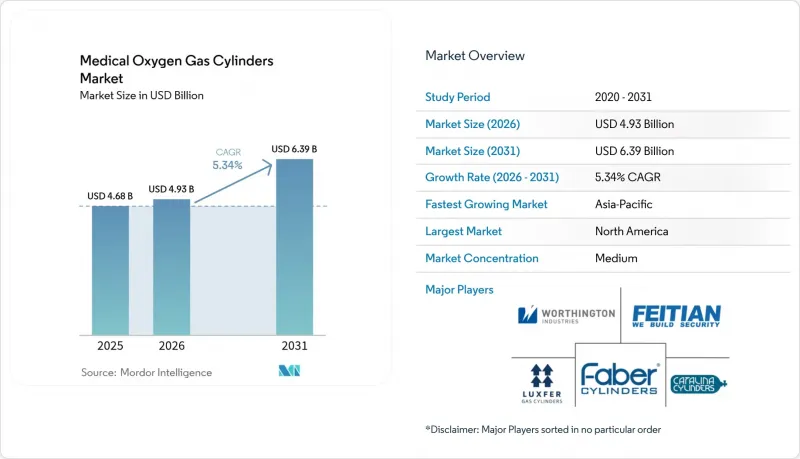
본 보고서는 제품 유형(휴대용 및 대형), 재질(알루미늄, 강철, 탄소섬유 복합재), 제품 크기(10리터 미만, 10-50리터, 50리터 이상), 최종 사용자(병원, 재택치료 등),지역(북미, 유럽, 아시아태평양 등)별로 세분화되어 있습니다. 시장 전망은 금액(달러) 기준으로 제시되어 있습니다.
세계의 의료용 산소 가스 실린더 시장 동향 및 인사이트
만성 호흡기 질환 유병률 증가
만성 폐쇄성 폐질환(COPD)은 40세 이상 성인의 12.64%에게 영향을 미치고 있으며, 2024년에는 2억 1,339만 명의 유병자 수에 달했습니다. COPD로 인한 사망의 약 85%는 산소 접근성이 여전히 제한적인 저·중소득 국가에서 발생하고 있습니다. 질병이 진행됨에 따라 산소 공급에 대한 의존도가 높아집니다. 특발성 폐섬유증 환자의 68%는 결국 산소 요법이 필요합니다. 흡연과 대기 중 미세먼지(미세입자)가 복합적으로 작용하여 COPD로 인한 장애 조정 생명년(DALY)의 대부분을 차지하고 있습니다. WHO의 ‘만성 호흡기 질환 대응 세계 연합’은 현재 연간 약 400만 명의 예방 가능한 사망을 줄이는 것을 목표로 하고 있으며, 이는 환자의 생존에 있어 산소 탱크가 얼마나 중요한지를 다시금 부각시키고 있습니다.
장기 산소 요법이 필요한 고령자 증가
미국에는 65세 이상 주민이 5,780만 명으로, 이는 전체 인구의 17.3%에 해당합니다. 이 비율은 2040년까지 22%로 상승할 것으로 예측됩니다. 이 연령대의 약 10%는 만성 폐쇄성 폐질환(COPD)을, 15%는 관상동맥 질환을 앓고 있으며, 두 질환 모두 증상이 악화될 경우 산소 지원이 필요합니다. 이미 약 150만 명의 미국 성인이 삶의 질을 유지하기 위해 가정에서 산소 공급을 이용하고 있습니다. 경량 산소 탱크는 특히 허약한 고령자에게 자립적인 생활을 가능하게 하는 이동성 요구를 충족시킵니다. 메디케어가 산소 요법에 대해 환자 1인당 월평균 65달러를 지출하고 있어 안정적인 수요를 뒷받침하고 있습니다.
엄격한 규제 및 품질 보증 요건
2025년 12월에 발효된 FDA의 최종 규정에 따라 의료용 가스에 관한 현행 우수 제조 기준(GMP), 표시 및 시판 후 안전성이 강화됩니다. 실린더에는 산소 전용 색상 코드가 기재된 360° 전면 라벨 부착이 의무화되었습니다. 2026년 2월 품질 경영 시스템 규정이 시행됨에 따라 ISO 13485 : 2016 준수가 의무화됩니다. 복합재 실린더는 기존 소재 제품의 인증 유효 기간이 10년인 데 비해 5년마다 재인증을 받아야 하므로 수명 주기 비용이 증가합니다. 중소기업의 경우 규정 준수 부담이 커져 업계 재편이 가속화될 가능성이 있습니다.
부문별 분석
휴대용 실린더는 의료용 산소 가스 실린더 시장의 60.98%를 차지하고 있으며, 2031년까지 연평균 성장률(CAGR) 8.17%로 성장할 전망입니다. ‘가정 내 고령화’를 중시하는 치료법에 대한 관심이 높아짐에 따라, 이동의 용이성과 자가 투여의 편의성이 구매 결정의 최우선 사항이 되고 있습니다. 반면, 수술실이나 중환자실에서는 연속 공급의 신뢰성이 여전히 필수적이기 때문에 병원에서는 고정식 실린더 재고를 유지하고 있습니다. INTELLI-OX+와 같은 스마트 밸브를 통해 간병인은 잔량을 파악할 수 있어, 실수로 산소가 고갈될 위험을 줄일 수 있습니다. 메디케어의 월 65달러 환급 덕분에, 만성 질환 환자를 관리하는 의료 제공업체에게는 산소 실린더 대여가 여전히 수익성 있는 사업으로 남아 있습니다. 휴대용 부문의 성장세는 외래 진료에서의 만성 질환 관리로 크게 전환되고 있음을 여실히 보여줍니다.
고정형 하위 부문에서는 수술실, 정신과 병동, 응급실에서 예비 산소에 대한 수요가 여전히 지속되고 있습니다. 구급차 서비스에는 휴대용 실린더가 탑재되어 있지만, 신속한 보충을 위해서는 병원의 중앙 공급에 의존하고 있습니다. 규제 기준의 발전에 따라 공급업체들은 안전 기능을 지속적으로 개선하고 있으며, 밸브의 견고성, 압력 안정성, 원격 측정 통합 측면에서 차별화를 꾀하고 있습니다. 따라서 의료용 산소 가스 실린더 시장은 휴대성의 혁신과 대용량 공급에 대한 의료 기관의 의무 사이에서 균형을 맞추고 있습니다.
알루미늄은 성숙한 밸류체인과 낮은 구매 비용 덕분에 의료용 산소 가스 실린더 시장 규모의 46.11% 점유율을 유지하고 있습니다. 의료 시스템에서는 직원의 물건 들기로 인한 부상을 줄이고 환자의 치료 순응도를 높이기 위해 경량화가 중시되고 있기 때문에 탄소섬유 복합재료는 11.64%라는 가장 높은 연평균 성장률(CAGR)을 기록하고 있습니다. 워싱턴 엔터프라이즈의 헥사곤 라가스코 인수는 복합재료 기술의 전략적 중요성을 부각시키고 있습니다. 강철 실린더는 군사 용도나 고압 산소 요법 등 특수한 고압 요구 사항을 지속적으로 충족하고 있습니다. 복합재료 실린더는 5년마다 재인증을 받아야 하므로 검사 비용이 발생하지만, 마모가 적어 수명이 연장됩니다. 이는 경량화라는 이점을 얻기 위해 많은 병원 관리자들이 수용하는 타협점입니다. 따라서 소재 선택은 가격, 내구성, 취급 용이성이라는 세 가지 요소의 균형을 반영한 결과입니다.
아시아태평양에서는 신축 병원에 최신 설비가 지정되면서 복합재의 채택이 가속화되고 있습니다. 한편, 대량의 실린더 재고가 필요한 비용 중심의 시설에서는 여전히 알루미늄이 선호되고 있습니다. 각 공급업체는 다양한 제품 라인을 활용하여 양극단 수요에 대응하고 있으며, 규모의 경제에 따라 단가가 하락함에 따라 시장 점유율이 점차 복합 소재로 이동할 것으로 전망하고 있습니다. 그 결과, 의료용 산소 가스 실린더 시장에서는 급격한 변화보다는 꾸준한 소재 대체가 진행되고 있습니다.
지역별 분석
북미는 2025년에 매출 점유율 36.21%를 기록했습니다. 메디케어(Medicare)가 보조 산소에 대해월65달러의 정액 환급을 제공함으로써 실린더에 대한 지속적인 발주를 뒷받침하고 있습니다. 미국의 65세 이상 인구는 5,780만 명에 달하며, 이는 구조적인 수요를 뒷받침하고 있습니다. 2025년 12월에 발효되는 FDA 규정은 전 세계적인 실무 기준을 정의함과 동시에 새로운 라벨 형식을 의무화하고 있어, 이로 인해 구매 결정이 규정을 준수하는 공급업체로 유도될 것입니다. 견고한 디지털 인프라와 혁신적인 의료기기에 대한 높은 보상금 덕분에, 이 지역에서는 첨단 원격 측정 기술의 도입이 가장 빠르게 진행되고 있습니다.
아시아태평양은 9.76%라는 가장 높은 연평균 성장률(CAGR)을 기록하고 있습니다. 정부 자금으로 지원되는 산소 공급 프로그램은 영구적인 PSA 플랜트 건설이 진행되는 동안 즉각적인 공급 능력 확보를 위해 실린더에 자금을 투입하고 있습니다. 세계 옥시젠 얼라이언스(Global Oxygen Alliance)의 340억 달러 규모 계획에서는 실린더 조달에 막대한 자금이 배정되어 있습니다. 인구가 많은 경제권에서 대기 오염으로 인한 만성폐쇄성폐질환(COPD)의 높은 유병률은 수요를 더욱 증폭시키고 있습니다. 지역 제조업체들은 해외 공급업체로부터의 물류 기간을 단축하기 위해 알루미늄 압출기 및 복합재 권선 라인의 생산 능력을 확대되고 있습니다. 다자간 협력을 통해 품질 기준이 강화되어, 산소 실린더가 ISO 및 CGA 규격을 준수하도록 보장되고 있습니다. 이러한 변화는 인증 획득에 조기에 투자한 기업들에게 유리하게 작용합니다.
유럽에서는 국민건강보험 제도가 장기 산소 요법 비용을 보상하고 있어 꾸준한 성장이 나타나고 있습니다. 고령화 추세는 미국의 양상과 유사하여 재택 간호 확대를 뒷받침하고 있습니다. ISO 13485 준수를 통한 북미와의 규제 조화는 대서양을 가로지르는 공급 계약을 원활하게 하고 있습니다. 중동, 아프리카 및 남미에서는 지역별 산소통 충전 허브를 구축하는 유니타이드(Unitaid)의 사하라 이남 아프리카 이니셔티브와 같은 개발 프로그램의 혜택을 받고 있습니다. 파트너스 인 헬스(Partners In Health)의 레소토 모델은 산악 지대에서도 산소통 공급 네트워크가 신속하게 작동할 수 있음을 입증하고 있습니다. 이러한 요인들이 결합되어 신흥 지역의 의료용 산소통 시장 범위가 확대되고 있습니다.
기타 혜택 :
- 엑셀 형식 시장 예측(ME) 시트
- 3개월간의 애널리스트 지원
자주 묻는 질문
목차
제1장 서론
제2장 조사 방법
제3장 개요
제4장 시장 구도
제5장 시장 규모 및 성장 예측
제6장 경쟁 구도
제7장 시장 기회 및 향후 전망
KTH 26.08.31According to Mordor Intelligence, the medical oxygen gas cylinders market size in 2026 is estimated at USD 4.93 billion, growing from 2025 value of USD 4.68 billion with 2031 projections showing USD 6.39 billion, growing at 5.34% CAGR over 2026-2031.
This report is Segmented by Product Type (Portable and Heavy), Material (Aluminum, Steel, and Carbon-Fiber Composite), Product Size (Less Than 10 Liter, 10 - 50 Liter, and More Than 50 Liter), End User (Hospitals, Home Healthcare, and More), and Geography (North America, Europe, Asia-Pacific, and More). The Market Forecasts are Provided in Terms of Value (USD).
Global Medical Oxygen Gas Cylinders Market Trends and Insights
Rising Prevalence of Chronic Respiratory Diseases
Chronic obstructive pulmonary disease affects 12.64% of adults aged 40 and older, translating into 213.39 million prevalent cases in 2024. Roughly 85% of COPD deaths occur in low- and middle-income countries where oxygen access remains limited. Reliance on supplemental oxygen intensifies as disease progresses; 68% of idiopathic pulmonary fibrosis patients eventually require oxygen therapy. Smoking and ambient particulate matter together account for the majority of COPD disability-adjusted life years. WHO's Global Alliance against Chronic Respiratory Diseases now targets nearly 4 million preventable deaths annually, reinforcing the centrality of cylinders to patient survival.
Growing Geriatric Population Requiring Long-Term Oxygen Therapy
The United States counts 57.8 million residents 65 years and older, equal to 17.3% of the population, and the share is projected to rise to 22% by 2040. Roughly 10% of this age group lives with COPD and 15% with coronary heart disease-both conditions demanding oxygen support during flare-ups. Around 1.5 million US adults already use supplemental oxygen at home to maintain quality of life. Lighter cylinders meet mobility preferences that enable independent living, especially for frail seniors. Medicare's average outlay of USD 65 per patient each month for oxygen therapy underpins stable demand.
Stringent Regulatory & Quality-Assurance Requirements
The FDA's final rule effective December 2025 tightens current good manufacturing practice, labeling, and post-marketing safety for medical gases. Cylinders now require 360° wraparound labels with color codes specific to oxygen. Alignment with ISO 13485:2016 becomes mandatory as the Quality Management System Regulation takes effect in February 2026. Composite cylinders must be requalified every five years versus ten years for traditional materials, inflating lifecycle costs. Smaller firms face higher compliance hurdles, potentially accelerating consolidation.
Other drivers and restraints analyzed in the detailed report include:
- Technological Shift Toward Lightweight Composite & High-Pressure Cylinders
- Government-Funded Oxygen Security Programs in LMICs
- Uptake of Oxygen Concentrators & Onsite PSA Plants
For complete list of drivers and restraints, kindly check the Table Of Contents.
Segment Analysis
Portable cylinders dominate 60.98% of the medical oxygen gas cylinders market and will expand at 8.17% CAGR to 2031. Growing preference for aging-in-place therapies puts mobility and self-administration at the forefront of purchase decisions. Hospitals still hold stock of stationary cylinders for operating suites and critical care wards because continuous flow reliability remains non-negotiable. Smart valves such as INTELLI-OX+ enable caregivers to track remaining supply and lower accidental runout risk. Medicare's USD 65 monthly reimbursement keeps cylinder rental viable for providers managing chronic patients. The portable segment's momentum underlines a larger shift toward outpatient chronic disease management.
In stationary sub-segments, demand persists for backup oxygen in operating rooms, psychiatric units, and emergency departments. Ambulance services carry portable cylinders but rely on centralized hospital supplies for rapid replenishment. Suppliers continue to refine safety features as regulatory standards evolve, creating differentiation on valve integrity, pressure consistency, and telemetry integration. The medical oxygen gas cylinders market therefore balances innovation in portability with institutional obligations for bulk capacity.
Aluminum retains 46.11% share of the medical oxygen gas cylinders market size thanks to its mature supply chain and lower purchase cost. Carbon-fiber composites post the highest 11.64% CAGR as healthcare systems value weight savings that ease lifting injuries among staff and encourage patient adherence. Worthington Enterprises' Hexagon Ragasco deal highlights the strategic importance of composite capabilities. Steel continues to serve specialist high-pressure needs in military and hyperbaric applications. Composite cylinders must undergo five-year requalification, adding inspection cost yet extending service life through lower wear, a trade-off many hospital administrators accept for weight savings. Material choices therefore reflect a three-way balance among price, durability, and ease of handling.
Composite adoption gains traction in Asia-Pacific where new hospital builds specify modern equipment. Aluminum remains preferred in cost-sensitive facilities needing large cylinder inventories. Suppliers leverage diversified product lines to serve both ends of the spectrum, anticipating gradual share migration to composite as economies of scale reduce unit cost. The medical oxygen gas cylinders market consequently shows progressive but not disruptive material substitution.
Complete Report Scope:
- By Product Type
- Portable / Lightweight
- Stationary / Heavy
- By Material
- Aluminum
- Steel
- Carbon-fiber composite (Type III/IV)
- By Product Size
- < 10 L
- 10 - 50 L
- > 50 L
- By End User
- Hospitals & Clinics
- Home Healthcare
- Emergency Medical Services / Ambulance
- Others
- Geography
- North America
- United States
- Canada
- Mexico
- Europe
- Germany
- United Kingdom
- France
- Italy
- Spain
- Rest of Europe
- Asia-Pacific
- China
- Japan
- India
- South Korea
- Australia
- Rest of Asia-Pacific
- Middle East and Africa
- GCC
- South Africa
- Rest of Middle East and Africa
- South America
- Brazil
- Argentina
- Rest of South America
- North America
Geography Analysis
North America records 36.21% revenue share in 2025. Medicare's consistent USD 65 monthly reimbursement for supplemental oxygen supports recurring cylinder orders. The US population aged 65+ hits 57.8 million, feeding structural demand. FDA regulations effective December 2025 define global practice benchmarks and require new label formats that redirect purchase decisions toward compliant suppliers. Advanced telemetry adoption proceeds fastest in this region given strong digital infrastructure and higher reimbursement for innovative devices.
Asia-Pacific registers the highest 9.76% CAGR. Government-funded oxygen programs channel capital into cylinders as immediate capacity while permanent PSA plants are under construction. The Global Oxygen Alliance's USD 34 billion plan earmarks large tranches for cylinder procurement. High COPD prevalence due to air pollution in populous economies amplifies need. Regional manufacturers ramp up aluminum extruders and composite winding lines to shorten logistics from foreign suppliers. Multilateral initiatives lift quality standards, ensuring cylinders meet ISO and CGA codes, a shift that favors firms investing early in certification.
Europe delivers steady growth as universal health systems reimburse long-term oxygen therapy. Aging demographics mirror US patterns and spur home care expansions. Regulatory parity with North America through ISO 13485 alignment eases cross-Atlantic supply agreements. Middle East & Africa and South America benefit from development programs such as Unitaid's sub-Saharan Africa initiative that builds regional cylinder filling hubs. Partners In Health's Lesotho model proves cylinder networks can serve mountainous terrain quickly. Collectively, these factors broaden the footprint of the medical oxygen gas cylinders market across emerging geographies.
- Luxfer Gas Cylinders
- Catalina Cylinders
- Worthington Industries
- Faber Industrie S.p.A.
- Tianjin Feitian Gas Cylinder
- Invacare
- Precision Medical
- CAIRE Inc. (Chart Industries)
- Norris Cylinder Company
- Thunderbird Cylinders
- B.N.O.S Meditech Ltd
- ProRack Gas Control Products
- Desco Medical
- O2 CONCEPTS
- Royax s.r.o.
- Hebei Baigong High-Pressure Cylinder
- Cyl-Tec Inc.
- FIBA Technologies
- Linde plc (Healthcare Gases)
- Air Liquide
Additional Benefits:
- The market estimate (ME) sheet in Excel format
- 3 months of analyst support
TABLE OF CONTENTS
1 Introduction
- 1.1 Study Assumptions & Market Definition
- 1.2 Scope of the Study
2 Research Methodology
3 Executive Summary
4 Market Landscape
- 4.1 Market Overview
- 4.2 Market Drivers
- 4.2.1 Rising Prevalence Of Chronic Respiratory Diseases
- 4.2.2 Growing Geriatric Population Requiring Long-Term Oxygen Therapy
- 4.2.3 Technological Shift Toward Lightweight Composite & High-Pressure Cylinders
- 4.2.4 Government-Funded Oxygen Security Programs In LMICs
- 4.2.5 Iot-Enabled Telemetry Improving Refill Logistics & Reducing Leakage
- 4.3 Market Restraints
- 4.3.1 Stringent Regulatory & Quality-Assurance Requirements
- 4.3.2 Uptake Of Oxygen Concentrators & Onsite PSA Plants
- 4.3.3 Volatile Aluminum & Carbon-Fiber Supply Chains Raising Cylinder Costs
- 4.4 Porter's Five Forces
- 4.4.1 Threat of New Entrants
- 4.4.2 Bargaining Power of Buyers
- 4.4.3 Bargaining Power of Suppliers
- 4.4.4 Threat of Substitutes
- 4.4.5 Intensity of Competitive Rivalry
5 Market Size & Growth Forecasts (Value, USD)
- 5.1 By Product Type
- 5.1.1 Portable / Lightweight
- 5.1.2 Stationary / Heavy
- 5.2 By Material
- 5.2.1 Aluminum
- 5.2.2 Steel
- 5.2.3 Carbon-fiber composite (Type III/IV)
- 5.3 By Product Size
- 5.3.1 < 10 L
- 5.3.2 10 - 50 L
- 5.3.3 > 50 L
- 5.4 By End User
- 5.4.1 Hospitals & Clinics
- 5.4.2 Home Healthcare
- 5.4.3 Emergency Medical Services / Ambulance
- 5.4.4 Others
- 5.5 Geography
- 5.5.1 North America
- 5.5.1.1 United States
- 5.5.1.2 Canada
- 5.5.1.3 Mexico
- 5.5.2 Europe
- 5.5.2.1 Germany
- 5.5.2.2 United Kingdom
- 5.5.2.3 France
- 5.5.2.4 Italy
- 5.5.2.5 Spain
- 5.5.2.6 Rest of Europe
- 5.5.3 Asia-Pacific
- 5.5.3.1 China
- 5.5.3.2 Japan
- 5.5.3.3 India
- 5.5.3.4 South Korea
- 5.5.3.5 Australia
- 5.5.3.6 Rest of Asia-Pacific
- 5.5.4 Middle East and Africa
- 5.5.4.1 GCC
- 5.5.4.2 South Africa
- 5.5.4.3 Rest of Middle East and Africa
- 5.5.5 South America
- 5.5.5.1 Brazil
- 5.5.5.2 Argentina
- 5.5.5.3 Rest of South America
- 5.5.1 North America
6 Competitive Landscape
- 6.1 Market Concentration
- 6.2 Market Share Analysis
- 6.3 Company Profiles (includes Global level Overview, Market level overview, Core Segments, Financials as available, Strategic Information, Market Rank/Share for key companies, Products & Services, and Recent Developments)
- 6.3.1 Luxfer Gas Cylinders
- 6.3.2 Catalina Cylinders
- 6.3.3 Worthington Industries
- 6.3.4 Faber Industrie S.p.A.
- 6.3.5 Tianjin Feitian Gas Cylinder
- 6.3.6 Invacare Corporation
- 6.3.7 Precision Medical Inc.
- 6.3.8 CAIRE Inc. (Chart Industries)
- 6.3.9 Norris Cylinder Company
- 6.3.10 Thunderbird Cylinders
- 6.3.11 B.N.O.S Meditech Ltd
- 6.3.12 ProRack Gas Control Products
- 6.3.13 Desco Medical India
- 6.3.14 O2 Concepts LLC
- 6.3.15 Royax s.r.o.
- 6.3.16 Hebei Baigong High-Pressure Cylinder
- 6.3.17 Cyl-Tec Inc.
- 6.3.18 FIBA Technologies
- 6.3.19 Linde plc (Healthcare Gases)
- 6.3.20 Air Liquide Healthcare
7 Market Opportunities & Future Outlook
- 7.1 White-space & Unmet-need Assessment


