|
시장보고서
상품코드
2116307
정맥주사 철분제 시장 : 점유율 분석, 업계 동향과 통계, 성장 예측(2026-2031년)Intravenous Iron Drugs - Market Share Analysis, Industry Trends & Statistics, Growth Forecasts (2026 - 2031) |
||||||
 Mordor Intelligence
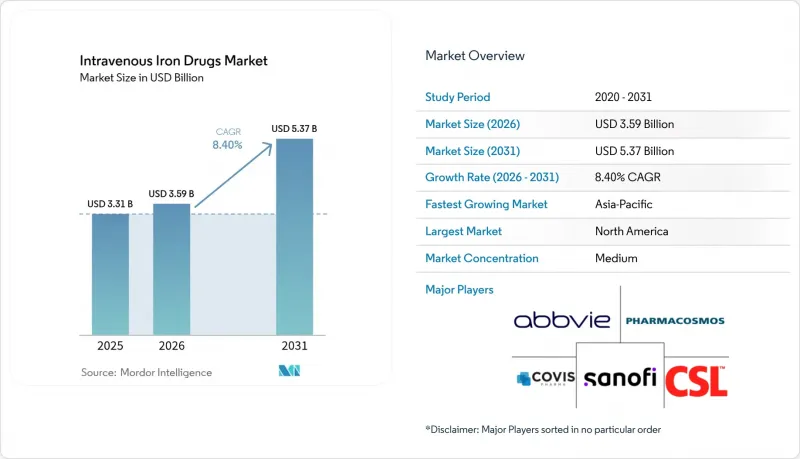
Mordor Intelligence에 의하면, 정맥주사 철분제 시장 규모는 2025년 33억 1,000만 달러에서 2026년에는 35억 9,000만 달러로 확대되어 2026년부터 2031년까지 CAGR 8.40%로 성장을 지속하여, 2031년에는 53억 7,000만 달러에 이를 것으로 예측됩니다.
본 보고서는 제품 유형(카르복시말토스 철분제 등), 적응증(만성 신장 질환, 염증성 장 질환 등), 최종 사용자(병원 등), 유통 채널(직접 입찰 등), 지역(북미, 유럽, 아시아태평양, 중동 및 아프리카, 남미)별로 분류되어 있습니다. 시장 전망은 금액(달러) 기준으로 제시되어 있습니다.
전 세계 정맥주사 철분제 시장 동향 및 인사이트
CKD, IBD, 종양학, 심부전(HF) 환자 집단에서 전 세계 철 결핍성 빈혈의 부담 증가
임상 감사에 따르면, 심부전(HF) 환자의 37-61%에서 철분 결핍이 확인되었으며, 메타 분석 결과, 정맥주사 철분제가 위약에 비해 심혈관 사망을 13% 감소시키는 것으로 확인되었습니다. 신장 질환 진료 지침에 따르면 투석 환자의 92%에게 정기적인 철분 보충이 의무화되어 있으며, 한편 만성 신장 질환(CKD) 유병률 증가가 기초 수요를 뒷받침하고 있습니다. 중국에서는 1990년 이후 식이성 철 결핍률이 40.86% 감소했음에도 불구하고, 여전히 7,960만 명의 성인이 철 결핍 상태에 있는 것으로 보고되고 있습니다. 암에 따른 기능성 철 결핍은 염증으로 인해 장내 흡수가 저해되기 때문에 수요 증가의 또 다른 요인이 됩니다. 이러한 질환군을 종합해 보면, 신장내과, 순환기내과, 종양내과 각 진료과에서 장기적인 수요 증가가 보장됩니다.
경구 흡수율이 낮거나 복약 순응도가 낮은 문제를 극복하기 위해, 정맥주사 철분제에 대한 임상적 선호도가 높아지고 있습니다.
2024년에 발표된 합의 성명에 따르면, 박출률 저하형 심부전 환자에서 경구용 철염만으로는 페리틴 수치 정상화나 6분 보행 거리 개선을 종종 달성하지 못하는 것으로 나타났습니다. IRONMAN 연구에서는 트랜스페린 포화도가 20% 미만인 환자에서 가장 큰 효과가 확인되었습니다. 일본의 실세계 데이터(632,200건)에 따르면, 투여 12주 시점에서 카르복시말토스 철분제는 헤모글로빈 수치가 3.20 g/dL 상승한 반면, 경구용 철분제는 1.70 g/dL 상승에 그쳤습니다. 위장 장애로 인한 높은 중단률이 처방 의사들을 비경구 요법으로 더욱 기울게 하여, 만성 질환 환자 집단 전체 수요를 확고히 하고 있습니다.
안전성에 대한 우려(과민증, 저인산혈증)가 고용량 제제의 보급을 저해하고 있습니다.
카르복시말토스 철은 FGF-23 수치를 상승시켜 투여 시작 후 5주 이내에 70% 이상의 환자에서 저인산혈증을 유발하며, 이는 심기능 장애나 골절의 위험을 초래합니다. 네덜란드의 코호트 데이터(2,468건)에 따르면, 65%의 사례에서 보충 투여량이 불충분하여 지속적인 빈혈이 관찰되었으며, 이는 임상의가 부작용을 완화하기 위해 투여량을 과소하게 설정하는 경우가 있음을 시사합니다. FDA 지침에 따르면, 이 계열의 모든 약물에 대해 정맥 주사 종료 후 30분간의 경과 관찰이 의무화되어 있어 진료소의 업무 흐름을 지연시키고 있습니다. 이러한 안전상의 우려들이 겹치면서 일부 처방 의사는 저용량 또는 대체 제제를 선택하게 되었고, 최고 농도의 SKU의 단기적인 보급에 제동이 걸리고 있습니다.
부문 분석
카르복시말토스 철분제는 2025년 매출의 44.78%를 차지하며, CKD(만성 신장 질환) 및 HF(심부전) 프로토콜에 대한 광범위한 근거를 바탕으로 정맥주사 철분제 시장에서 가장 큰 점유율을 확보했습니다. 한편, 이소말토시드 철분제의 정맥주사 철분제 시장 규모는 처방 의사들이 그 낮은 저인산혈증 위험 프로파일을 높이 평가하고 있어, 2031년까지 연평균 성장률(CAGR) 10.14%를 나타낼 것으로 예측됩니다. PHOSPHARE-IBD 임상시험의 추산에 따르면, 델리소말토스는 5년 동안 정맥 주사 횟수를 1.64회 줄여 환자 1인당 9,707 노르웨이 크로네의 비용 절감으로 이어질 것으로 보입니다.
안전을 중시하는 약물 선정 경향은 지속되고 있습니다. 자당은 투석 번들에서 확고한 사용 실적을 보유하고 있는 반면, 글루콘산철(III)나트륨은 과민증과 같은 특수한 증례에 대응하고 있습니다. 페르모시톨의 제네릭 의약품 진입은 이 약물군 전체에 가격 측면에서 영향을 미치며, 보험 적용 의약품 목록의 변경을 초래하고 있습니다. 전반적으로 단순한 브랜드 역사보다는 안전성, 투여 편의성, 비용과 같은 차별화 요소가 경쟁의 축을 형성하고 있습니다.
2025년에는 만성 신장 질환(CKD)이 매출의 51.62%를 차지하며, 이는 혈액 투석 프로토콜에서 필수적인 철분 보충 수요에 힘입은 것입니다. 그러나 정맥주사 철분제 시장은 향후 심부전(HF)으로 점점 더 무게중심을 옮겨갈 것입니다. 이 적응증의 연평균 성장률(CAGR) 10.02%는 복합 심혈관 종결점이 18% 감소했음을 보여준 획기적인 임상시험을 반영하고 있습니다. 유럽의 보험 환급 제도 개정에 따라 외래 심부전 환자에 대한 정맥 주사 투여가 적용 대상이 되면서 대상 환자층이 확대되고 있습니다.
종양학, 염증성 장질환(IBD), 산부인과 각 부문에서는 경구 요법에 반응하지 않는 기능성 철분 결핍이 인식됨에 따라 판매량이 증가하고 있습니다. 체중 감량 수술 시 트랜스페린 포화도에 대한 정밀 선별 검사 또한 수요를 더욱 끌어올리고 있습니다. 적응증 구성은 계속해서 다양화되고 있으며, 기존의 신장학 분야에 그치지 않고 성장이 보다 고르게 분산되고 있습니다.
지역별 분석
2025년, 북미는 전 세계 매출의 42.05%를 차지하며, 이는 지침에 따른 채택 확대와 비경구 철분제의 광범위한 보험 적용에 힘입은 결과입니다. 인디펜던스 블루 크로스(Independence Blue Cross)의 ‘스텝 에디트(Step Edit)’ 규정은 비용 감시를 강화하는 한 예이지만, CMS(미국 의료보험센터)에 의한 보험 급여액 인상으로 인해 투석 채널의 판매량은 확보되고 있습니다. 성숙한 인프라가 안정적인 수요를 뒷받침하고 있지만, 대상인 만성 신장 질환(CKD) 환자군이 거의 완전한 보급률에 가까워짐에 따라 판매량 증가세는 정체되는 경향을 보이고 있습니다.
아시아태평양은 2031년까지 연평균 성장률(CAGR) 9.42%로 가장 높은 성장률을 나타낼 것으로 예상되며, 그 원동력은 중국의 수량 연동형 조달 제도입니다. 이에 따라 가격은 42% 인하된 반면, 사용량은 49% 증가했습니다. CSL Vifor-Fresenius와 같은 합작 기업은 2,000개 이상의 3급 병원을 대상으로 하고 있으며, 인도의 ‘Anemia Mukt Bharat’ 프로그램은 진단 격차 해소를 목표로 하고 있습니다. 가격 부담 가능성은 여전히 제한 요인으로 작용하고 있지만, 경제 성장과 보험 적용 범위 확대가 이용 증가를 뒷받침하고 있습니다.
유럽에서는 확립된 신장 질환 치료 프로토콜과 심부전(HF) 지침의 일관성이 효과를 거두고 있습니다. 그러나 제네릭 의약품의 높은 보급률과 의료 기술 평가(HTA)에 따른 엄격한 심사가 가격 상승을 억제하고 있습니다. 공정한 경쟁에 대한 규제 당국의 면밀한 감시(EU의 비방적 표현에 대한 조사에서 드러난 바와 같이) 덕분에 다양한 분자공급이 확보되고 있습니다. 중동 및 아프리카 및 남미에서는 민간 보험사나 공공 의료 기금이 빈혈의 신속한 개선을 통한 생산성 향상을 인식함에 따라, 도입은 초기 단계이지만 가속화되고 있습니다.
기타 혜택:
- 엑셀 형식 시장 예측(ME) 시트
- 3개월간의 애널리스트 지원
자주 묻는 질문
목차
제1장 서론
제2장 조사 방법
제3장 주요 요약
제4장 시장 구도
제5장 시장 규모와 성장 예측
제6장 경쟁 구도
제7장 시장 기회와 향후 전망
JHS 26.08.28According to Mordor Intelligence, the intravenous iron drugs market size is expected to grow from USD 3.31 billion in 2025 to USD 3.59 billion in 2026 and is forecast to reach USD 5.37 billion by 2031 at 8.40% CAGR over 2026-2031.
This report is Segmented by Product Type (Ferric Carboxymaltose, and More), Indication (Chronic Kidney Disease, Inflammatory Bowel Disease, and More), End-User (Hospitals, and More), Distribution Channel (Direct Tenders, and More), and Geography (North America, Europe, Asia-Pacific, Middle East & Africa, South America). The Market Forecasts are Provided in Terms of Value (USD).
Global Intravenous Iron Drugs Market Trends and Insights
Escalating Global Iron-Deficiency Anemia Burden Across CKD, IBD, Oncology & HF Populations
Clinical audits show iron deficiency in 37-61% of HF patients, and meta-analysis confirms that IV iron lowers cardiovascular mortality by 13% compared with placebo. Renal guidelines mandate regular iron supplementation for 92% of dialysis recipients, while CKD prevalence growth sustains baseline demand. China still reports 79.6 million iron-deficient adults even after a 40.86% fall in dietary deficiency rates since 1990. Functional deficiency in cancer adds incremental volume because inflammation blocks gut absorption. Collectively, these disease pools secure long-run volume growth across nephrology, cardiology and oncology clinics.
Growing Clinical Preference for Intravenous Iron to Overcome Poor Oral Absorption & Adherence
Consensus statements published in 2024 indicate that oral ferrous salts often fail to normalize ferritin or improve 6-minute-walk distance in HF with reduced ejection fraction. The IRONMAN trial showed the greatest benefit among patients with transferrin saturation below 20%. Real-world Japanese data in 632,200 cases reported a 3.20 g/dL hemoglobin rise with ferric carboxymaltose versus 1.70 g/dL for oral iron at week 12. High discontinuation rates tied to gastrointestinal intolerance further tilt prescribers toward parenteral therapy, cementing demand across chronic disease cohorts.
Safety Concerns (Hypersensitivity, Hypophosphatemia) Limiting Uptake of High-Dose Formulations
Ferric carboxymaltose triggers hypophosphatemia in more than 70% of recipients within five weeks by elevating FGF-23, risking cardiac dysfunction and fractures. Dutch cohort data in 2,468 courses documented insufficient replacement dosing and persistent anemia in 65% of cases, hinting that clinicians sometimes under-dose to mitigate adverse events. FDA guidance requires 30-minute post-infusion observation across the class, slowing clinic workflow. Collectively, these safety flags push some prescribers toward lower-dose or alternative complexes, capping near-term adoption of the highest-strength SKUs.
Other drivers and restraints analyzed in the detailed report include:
- Rapid Expansion of Outpatient Infusion Centers and Dialysis Networks Worldwide
- Updated International Guidelines Endorsing IV Iron as First-Line Therapy in CKD And Heart Failure
- Intensifying Generic Competition Driving Price Erosion in Mature Molecules
For complete list of drivers and restraints, kindly check the Table Of Contents.
Segment Analysis
Ferric carboxymaltose held 44.78% of 2025 sales, securing the largest intravenous iron drugs market share on the back of extensive evidence across CKD and HF protocols. However, the intravenous iron drugs market size for iron isomaltoside is forecast to post a 10.14% CAGR to 2031 as prescribers value its lower hypophosphatemia risk profile. The PHOSPHARE-IBD study estimated that derisomaltose cuts infusion visits by 1.64 over a five-year horizon, translating into NOK 9,707 cost savings per patient.
Momentum toward safety-led selection continues. Sucrose enjoys embedded use in dialysis bundles, whereas sodium ferric gluconate fills niche hypersensitivity cases. Ferumoxytol's generic entry exerts pricing leverage across the class, triggering formulary shifts. Overall, differentiated safety, dosing convenience and cost shape the competitive axis more than simple brand tenure.
CKD accounted for 51.62% of revenue in 2025, underpinned by obligatory iron needs within hemodialysis protocols. Yet the intravenous iron drugs market will increasingly pivot toward HF, where the indication's 10.02% CAGR reflects landmark trials showing 18% reductions in composite cardiovascular endpoints. Reimbursement updates in Europe now cover outpatient HF infusions, widening addressability.
Oncology, IBD and obstetric segments deliver incremental volume through recognition of functional iron deficiency unresponsive to oral therapy. Precision screening of transferrin saturation in bariatric surgery further elevates demand. The indication mix continues to diversify, distributing growth more evenly beyond traditional nephrology silos.
Complete Report Scope:
- By Product Type
- Ferric Carboxymaltose
- Iron Sucrose
- Intravenous Ferumoxytol
- Sodium Ferric Gluconate Complex
- Iron Isomaltoside 1000
- Other Product Type
- By Indication
- Chronic Kidney Disease (Dialysis & Non-Dialysis)
- Inflammatory Bowel Disease
- Cancer- & Chemotherapy-Induced Anemia
- Obstetrics & Gynecology (Pregnancy-Related Anemia)
- Heart Failure with Iron Deficiency
- Bariatric & Gastrointestinal Surgery
- Other Indications
- By End-User
- Hospitals (In-patient)
- Out-patient Infusion & Oncology Centers
- Dialysis Centers
- Other End-Users
- By Distribution Channel
- Direct Tenders / Institutional Sales
- Hospital Pharmacies
- Online & Specialty Pharmacies
- Captive Dialysis Service Providers
- Geography
- North America
- United States
- Canada
- Mexico
- Europe
- Germany
- United Kingdom
- France
- Italy
- Spain
- Rest of Europe
- Asia-Pacific
- China
- Japan
- India
- Australia
- South Korea
- Rest of Asia-Pacific
- Middle East & Africa
- GCC
- South Africa
- Rest of Middle East & Africa
- South America
- Brazil
- Argentina
- Rest of South America
- North America
Geography Analysis
North America contributed 42.05% of global turnover in 2025, sustained by guideline-driven uptake and broad reimbursement of parenteral iron. Independence Blue Cross's step-edit rules exemplify mounting cost oversight, yet CMS's reimbursement increase secures dialysis channel volume. Mature infrastructure supports stable demand, though unit growth is flattening as eligible CKD cohorts approach full penetration.
Asia-Pacific is forecast to record the fastest 9.42% CAGR through 2031, led by China's volume-linked procurement that cut prices 42% while lifting usage 49%. Joint ventures such as CSL Vifor-Fresenius target more than 2,000 tier-3 hospitals, and India's Anemia Mukt Bharat program seeks to narrow diagnostic gaps. Affordability remains a ceiling, yet economic expansion and insurance coverage gains support rising uptake.
Europe benefits from entrenched nephrology protocols and HF guideline alignment. However, high generic penetration and HTA scrutiny constrain price growth. Regulatory attention to fair competition-illustrated by the EU probe into disparagement claims-ensures diversified molecule availability. Middle East & Africa and South America show nascent but accelerating adoption as private insurers and public health funds recognize the productivity gains of rapid anemia correction.
- CSL Behring
- Daiichi Sankyo
- Sanofi
- Pharmacosmos
- Shield Therapeutics plc
- Covis Pharma
- Akebia Therapeutics Inc. (Keryx/AMAG)
- Rockwell Medical
- Pfizer
- Zydus Lifesciences Ltd.
- Fresenius
- Dr. Reddy's Laboratories
- Emcure Pharmaceuticals
- Teva Pharmaceutical Industries
- Nichi-Iko Pharmaceutical Co. Ltd.
- Lupin
- FDC Ltd.
- Hikma Pharmaceuticals
Additional Benefits:
- The market estimate (ME) sheet in Excel format
- 3 months of analyst support
TABLE OF CONTENTS
1 Introduction
- 1.1 Study Assumptions & Market Definition
- 1.2 Scope of the Study
2 Research Methodology
3 Executive Summary
4 Market Landscape
- 4.1 Market Overview
- 4.2 Market Drivers
- 4.2.1 Escalating Global Iron-Deficiency Anemia Burden Across CKD, IBD, Oncology & HF Populations
- 4.2.2 Growing Clinical Preference for Intravenous Iron to Overcome Poor Oral Absorption & Adherence
- 4.2.3 Rapid Expansion of Out-patient Infusion Centers and Dialysis Networks Worldwide
- 4.2.4 Updated International Guidelines Endorsing IV Iron as First-Line Therapy in CKD and Heart Failure
- 4.2.5 Introduction of High-Dose, Rapid-Infusion Complexes Reducing Treatment Visits & Costs
- 4.2.6 Rising Healthcare Expenditure in Emerging Markets Improving Access to Parenteral Therapies
- 4.3 Market Restraints
- 4.3.1 Safety Concerns (Hypersensitivity, Hypophosphatemia) Limiting Uptake of High-Dose Formulations
- 4.3.2 Intensifying Generic Competition Driving Price Erosion in Mature Molecules
- 4.3.3 Reimbursement Uncertainties for Non-Dialysis Indications in Major Markets
- 4.3.4 Cold-Chain & Infusion Infrastructure Gaps in Low-Resource Regions
- 4.4 Regulatory Outlook
- 4.5 Porter's Five Forces Analysis
- 4.5.1 Bargaining Power of Buyers/Consumers
- 4.5.2 Bargaining Power of Suppliers
- 4.5.3 Threat of New Entrants
- 4.5.4 Threat of Substitute Products
- 4.5.5 Intensity of Competitive Rivalry
5 Market Size & Growth Forecasts (Value, USD)
- 5.1 By Product Type
- 5.1.1 Ferric Carboxymaltose
- 5.1.2 Iron Sucrose
- 5.1.3 Intravenous Ferumoxytol
- 5.1.4 Sodium Ferric Gluconate Complex
- 5.1.5 Iron Isomaltoside 1000
- 5.1.6 Other Product Type
- 5.2 By Indication
- 5.2.1 Chronic Kidney Disease (Dialysis & Non-Dialysis)
- 5.2.2 Inflammatory Bowel Disease
- 5.2.3 Cancer- & Chemotherapy-Induced Anemia
- 5.2.4 Obstetrics & Gynecology (Pregnancy-Related Anemia)
- 5.2.5 Heart Failure with Iron Deficiency
- 5.2.6 Bariatric & Gastrointestinal Surgery
- 5.2.7 Other Indications
- 5.3 By End-User
- 5.3.1 Hospitals (In-patient)
- 5.3.2 Out-patient Infusion & Oncology Centers
- 5.3.3 Dialysis Centers
- 5.3.4 Other End-Users
- 5.4 By Distribution Channel
- 5.4.1 Direct Tenders / Institutional Sales
- 5.4.2 Hospital Pharmacies
- 5.4.3 Online & Specialty Pharmacies
- 5.4.4 Captive Dialysis Service Providers
- 5.5 Geography
- 5.5.1 North America
- 5.5.1.1 United States
- 5.5.1.2 Canada
- 5.5.1.3 Mexico
- 5.5.2 Europe
- 5.5.2.1 Germany
- 5.5.2.2 United Kingdom
- 5.5.2.3 France
- 5.5.2.4 Italy
- 5.5.2.5 Spain
- 5.5.2.6 Rest of Europe
- 5.5.3 Asia-Pacific
- 5.5.3.1 China
- 5.5.3.2 Japan
- 5.5.3.3 India
- 5.5.3.4 Australia
- 5.5.3.5 South Korea
- 5.5.3.6 Rest of Asia-Pacific
- 5.5.4 Middle East & Africa
- 5.5.4.1 GCC
- 5.5.4.2 South Africa
- 5.5.4.3 Rest of Middle East & Africa
- 5.5.5 South America
- 5.5.5.1 Brazil
- 5.5.5.2 Argentina
- 5.5.5.3 Rest of South America
- 5.5.1 North America
6 Competitive Landscape
- 6.1 Market Concentration
- 6.2 Market Share Analysis
- 6.3 Company Profiles (includes Global level Overview, Market level overview, Core Business Segments, Financials, Headcount, Key Information, Market Rank, Market Share, Products and Services, and analysis of Recent Developments)
- 6.3.1 CSL Limited (Vifor Pharma Management Ltd.)
- 6.3.2 Daiichi Sankyo Company, Ltd.
- 6.3.3 Sanofi S.A.
- 6.3.4 Pharmacosmos A/S
- 6.3.5 Shield Therapeutics plc
- 6.3.6 Covis Pharma GmbH (AMAG Pharmaceuticals, Inc)
- 6.3.7 Akebia Therapeutics Inc. (Keryx/AMAG)
- 6.3.8 Rockwell Medical Inc.
- 6.3.9 Pfizer Inc.
- 6.3.10 Zydus Lifesciences Ltd.
- 6.3.11 Fresenius Kabi AG
- 6.3.12 Dr. Reddy's Laboratories Ltd.
- 6.3.13 Emcure Pharmaceuticals Ltd.
- 6.3.14 Teva Pharmaceutical Industries Ltd.
- 6.3.15 Nichi-Iko Pharmaceutical Co. Ltd.
- 6.3.16 Lupin Ltd.
- 6.3.17 FDC Ltd.
- 6.3.18 Hikma Pharmaceuticals plc
7 Market Opportunities & Future Outlook
- 7.1 White-Space & Unmet-Need Assessment