

|
시장보고서
상품코드
2116313
유럽의 가정용 냉장고 시장 : 점유율 분석, 업계 동향과 통계, 성장 예측(2026-2031년)Europe Household Refrigerator - Market Share Analysis, Industry Trends & Statistics, Growth Forecasts (2026 - 2031) |
||||||
 Mordor Intelligence
Mordor Intelligence에 의하면, 유럽 가정용 냉장고 시장 규모는 2025년 133억 6,000만 달러에서 2026년에는 137억 4,000만 달러로 확대되어 2026년부터 2031년까지 CAGR 2.88%로 성장을 지속하여, 2031년에는 158억 4,000만 달러에 이를 것으로 예측됩니다.
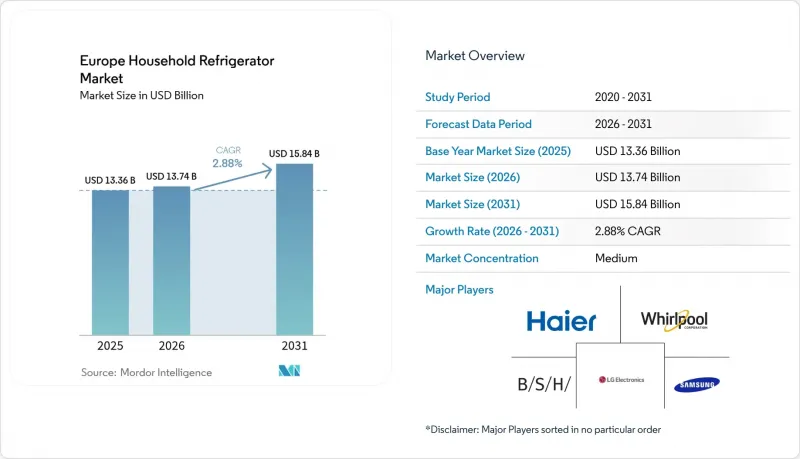
본 보고서는 제품별(싱글도어 냉장고, 더블도어 냉장고 등)로 분류되어 있습니다. 구조(빌트인형 및 독립형), 용량(15입방피트 미만 및 15입방피트 이상과), 유통 채널(다브랜드 매장, 전문 매장 등), 지역(영국, 독일 등)별로 분류되어 있습니다. 시장 예측은 금액(달러) 기준으로 제시되어 있습니다.
유럽 가정용 냉장고 시장 동향 및 인사이트
EU의 에너지 효율 규제 및 인센티브
유럽연합 집행위원회의 새로운 ‘지속 가능한 제품을 위한 에코디자인 규정’은 가전 제조업체에 추가적인 추진력을 제공합니다. 2025년부터 2030년까지의 의제에서 가전제품이 최우선 과제로 지정됨에 따라, 제조업체들은 현재 수명이 더 길고 수리가 용이하며 탄소 발자국을 명확히 표시한 라벨이 부착된 제품을 생산해야 합니다. ‘지속 가능한 제품을 위한 에코디자인 규정’은 가정용 냉장고의 모든 제품 라인에 대해 내구성, 수리 가능성 및 탄소 배출량 공개를 의무화함으로써 교체 주기를 가속화하고 있습니다. 명확한 A-G 에너지 효율 등급으로의 전환을 통해 라벨 표기의 혼란이 해소되는 한편, 디지털 제품 여권을 통해 당국은 등록된 모델을 추적하고 규정을 준수하지 않는 재고를 단계적으로 제거할 수 있게 됩니다. 소비자의 절감액은 2022년에 900억 유로에 달했으며, 2030년까지 1,500억 유로에 이를 것으로 예측되어, 이는 유럽 가정용 냉장고 시장에서 정책 주도형 성장 궤도를 확고히 하고 있습니다.
스마트 가전의 급속한 보급과 IoT 상호 운용성
2024년 4월에 발효된 ‘에너지 효율이 높은 가전제품에 관한 EU 행동 강령’은 프로토콜을 통일하여 냉장고가 수요 측 유연성 프로그램에 원활하게 참여할 수 있도록 합니다. 아르셀릭(Arcelik), 다이킨(Daikin), 일렉트로룩스(Electrolux) 각사의 노력으로 1년 이내에 기준을 준수한 모델이 출시될 것으로 확실시되고 있습니다. LG가 네덜란드 플랫폼 ‘Athom’의 지분 80%를 인수함에 따라, ‘Homey Pro’의 5만 대 기기로 구성된 생태계가 LG의 백색가전 포트폴리오에 통합되었으며, 커넥티드 기능이 프리미엄 가격 책정을 정당화한다는 사실이 입증되었습니다. 학술적 실증 실험에 따르면, 가정용 에너지 관리를 통해 가정의 전력 소비를 57% 줄일 수 있는 것으로 나타났으며, 커넥티비티가 측정 가능한 절약으로 이어지고 있습니다.
변동이 심한 철강 및 압축기 투입 비용
유럽의 제조업체들은 130개의 공장을 운영하며 철강 및 압축기 가격의 큰 변동을 흡수하고 있지만, 에너지 비용이 미국의 2-3배에 달하는 상황에서 이익률은 압박을 받고 있습니다. 새로운 F-가스 규제로 인해 GWP 값이 높은 냉매의 비용이 더욱 치솟고 있어, 천연 유래 대체 냉매로의 신속한 전환이 시급합니다. BSH가 2023년에 8억 5,000만 유로를 연구개발비로 투자한 것은 설계 효율 향상을 통해 비용 급등에 대응하기 위해 필요한 설비 투자 규모를 여실히 보여줍니다.
부문 분석
2025년 출하 대수의 33.60%를 차지한 것은 양문형으로, 그 친근함과 중가대 포지셔닝이 호재로 작용하고 있습니다. 프렌치 도어형은 여전히 소수이지만, 2026년부터 2031년까지 연평균 성장률(CAGR) 5.35%로 급성장하여 유럽 가정용 냉장고 시장 전체의 성장 속도를 능가할 전망입니다. 그러나 도시 지역의 부유층이 증가함에 따라 더 넓은 선반 공간과 눈에 띄지 않는 채소용 서랍에 대한 수요가 높아지고 있으며, 이는 프렌치 도어형 냉장고의 보급을 촉진하고 있습니다. 캐비닛 용량이 확대됨에 따라 제조업체들은 멀티존 냉각 기능, 터치스크린, EU의 스마트 가전 상호운용성 표준을 준수하는 카메라를 통한 재고 추적 기능을 결합할 수 있게 됩니다. 성장의 원동력은 교체 수요에 있습니다. 노후된 양문형 모델을 사용하는 가구는 운영 비용과 최신 A등급 인증을 받은 프렌치 도어형 제품을 통해 실현 가능한 에너지 절약 효과를 저울질하고 있습니다. BSH는 매출의 5.5%를 연구 개발(R&D)에 할당하여, 예측 유지보수를 위한 ‘Home Connect’ 플랫폼을 통합한 프리미엄 모델에 자금을 투자하고 있습니다. 이를 통해 브랜드에 대한 애착이 높아지고, 중국으로부터의 가격 압박 속에서도 이익률을 유지할 수 있게 되었으며, 프렌치 도어의 혁신이 유럽 가정용 냉장고 시장에 있어 지극히 중요한 이유를 여실히 보여주고 있습니다.
2025년 출하 대수의 67.40%를 독립형 모델이 차지하며, 이사가 용이한 점을 중시하는 임대 거주자나 가성비를 중시하는 소비자로부터 지지를 받고 있습니다. 한편, 인구 밀도가 높은 유럽 도시에서는 리모델링 시 캐비닛과의 매끄러운 일체감이 중요시되기 때문에 빌트인형 가전은 연평균 성장률(CAGR) 5.70%로 성장할 전망입니다. 에너지 라벨 제도 개혁도 빌트인형 제품의 보급을 더욱 촉진하고 있습니다. 소유자는 제품을 장기간 사용할 것으로 예상하며, 높은 초기 비용이 긴 수명에 의해 상쇄되기 때문입니다. 제조업체들은 이에 대응하여 용량을 희생하지 않고도 캐비닛의 깊이를 확보할 수 있는 신축식 설치 키트와 더 슬림한 압축기 하우징을 개발하고 있습니다. ‘에코디자인 규정’에 포함된 EU의 내구성 기준은 빌트인 제품의 품질 요건과 부합하며, 15년 이상 고장률 감소와 서비스 요청 건수 감소를 보장합니다. 주방이 개방형 사교 공간으로 진화함에 따라, 빌트인 방식은 미적 요구를 충족시키는 동시에 각 브랜드가 유럽 가정용 냉장고 시장에서 고수익률의 업그레이드 수요를 확보하는 데 기여하고 있습니다.
기타 혜택:
- 엑셀 형식 시장 예측(ME) 시트
- 3개월간의 애널리스트 지원
자주 묻는 질문
목차
제1장 서론
제2장 조사 방법
제3장 주요 요약
제4장 시장 구도
제5장 시장 규모와 성장 예측
제6장 경쟁 구도
제7장 시장 기회와 향후 전망
JHS 26.08.28According to Mordor Intelligence, the Europe household refrigerator market size is expected to grow from USD 13.36 billion in 2025 to USD 13.74 billion in 2026 and is forecast to reach USD 15.84 billion by 2031 at 2.88% CAGR over 2026-2031.
This report is Segmented by Product (Single-Door Refrigerator, Double-Door Refrigerator, and More). Structure (Built-In and Freestanding), Capacity (Less Than 15 Cu. Feet and More Than 15 Cu. Feet), Distribution Channel (Multi-Brand Stores, Exclusive Brand Outlets, and More), and Geography (United Kingdom, Germany, and More). The Market Forecasts are Provided in Terms of Value (USD).
Europe Household Refrigerator Market Trends and Insights
EU Energy-Efficiency Regulations and Incentives
The European Commission's new Ecodesign for Sustainable Products Regulation is giving appliance makers an extra push. Under its 2025-2030 agenda, household devices take top billing, and manufacturers must now build products that last longer, can be repaired more easily, and carry clear labels showing their carbon footprint. The Ecodesign for Sustainable Products Regulation accelerates replacement cycles by requiring durability, repairability, and carbon disclosure across household refrigeration lines. Moving to a clear A-G energy scale eliminates label confusion while digital product passports allow authorities to trace registered models, phasing out non-compliant stock. Consumer savings reached EUR 90 billion in 2022 and are projected at EUR 150 billion by 2030, anchoring a policy-led runway for the European household refrigerator market.
Rapid Smart-Appliance Penetration and IoT Interoperability
The EU Code of Conduct for energy-smart appliances, launched in April 2024, harmonizes protocols so refrigerators seamlessly join demand-side flexibility programs. Commitments from Arcelik, Daikin, and Electrolux ensure compliant models within a year. LG's 80% stake in Dutch platform Athom attaches Homey Pro's 50,000-device ecosystem to its white-goods portfolio, affirming that connected features now justify premium pricing. Academic trials show home-energy management can cut household consumption by 57%, translating connectivity into measurable savings.
Volatile Steel and Compressor Input Costs
European manufacturers operate 130 plants that absorb wide swings in steel and compressor pricing, eroding margins just as energy costs run 2-3 times US levels. The new F-gas regime further inflates high-GWP refrigerant costs, forcing swift conversion to natural alternatives. BSH's EUR 850 million R&D outlay in 2023 underscores the capex required to counter cost spikes via design efficiency.
Other drivers and restraints analyzed in the detailed report include:
- High Replacement Demand from Ageing Installed Base
- Expansion of Organised Retail and Last-Mile Cold-Chain Logistics
- Intensifying Price Competition from Chinese OEM Imports
For complete list of drivers and restraints, kindly check the Table Of Contents.
Segment Analysis
Double-door formats anchored 33.60% of 2025 shipments, thriving on familiarity and mid-price positioning. French-door units, though still a minority, will sprint at 5.35% CAGR between 2026-2031, outpacing the European household refrigerator market's overall rhythm. Yet rising urban affluence calls for wider shelf space and discreet vegetable drawers, propelling French-door adoption. The broader cabinet allows manufacturers to bundle multi-zone cooling, touchscreens, and camera-based inventory tracking that meet EU smart-appliance interoperability codes.Growth feeds off replacement demand: households with ageing double-door models weigh operating costs against the energy savings achievable with fresh A-class French-door offerings. BSH dedicates 5.5% of turnover to R&D, channelling funds into premium models that integrate Home Connect platforms for predictive maintenance. This reinforces brand stickiness and cushions margins amid Chinese pricing pressure, underlining why French-door innovation is pivotal for the European household refrigerator market.
Freestanding designs accounted for 67.40% of 2025 shipments, favored by renters and value-seekers who prize easy relocation. Built-in appliances, however, are poised for a 5.70% CAGR as renovation cycles in dense European cities emphasize seamless cabinetry. Energy-label reforms further encourage integrated units because owners anticipate keeping them for longer, diluting the upfront cost premium across an extended lifespan.Manufacturers respond with telescopic installation kits and slimmer compressor housings that reclaim cabinet depth without reducing capacity. The EU's durability criteria, embedded in the Ecodesign regulation, align with built-in quality, ensuring lower failure rates and fewer service calls over 15-plus years. As kitchens evolve into open-plan social spaces, built-in formats satisfy aesthetic demands while helping brands capture high-margin upgrades in the Europe household refrigerator market.
Complete Report Scope:
- By Product
- Single-Door Refrigerator
- Double-Door Refrigerator
- Top Freezer
- Bottom Freezer
- Side-By-Side Door Refrigerator
- French-Door Refrigerator
- Other Refrigerators
- By Structure
- Built-In
- Freestanding
- By Capacity
- Less Than 15 cu. Feet
- More Than 15 cu. Feet
- By Distribution Channel
- Multi-Brand Stores
- Exclusive Brand Outlets
- Online
- Other Distribution Channels
- By Geography
- United Kingdom
- Germany
- France
- Spain
- Italy
- BENELUX (Belgium, Netherlands, Luxembourg)
- NORDICS (Denmark, Finland, Iceland, Norway, Sweden)
- Rest of Europe
List of Companies Covered in this Report:
- BSH Hausgerate GmbH (Bosch-Siemens)
- Whirlpool Corp.
- Samsung Electronics Co. Ltd.
- LG Electronics Inc.
- Haier Smart Home Co. Ltd.
- Liebherr-Hausgerate GmbH
- Electrolux AB
- Midea Group
- Gorenje (Hisense)
- Miele & Cie. KG
- Arcelik A.S. (Beko, Grundig)
- Vestel Ticaret A.S.
- Smeg SpA
- CDA Group Ltd.
- Amica SA
- Candy Hoover Group
- Sharp Consumer Electronics
- Severin Elektrogerate
- Atlant Inc.
- Panasonic Corporation
- Teka Group
- Winia Electronics
Additional Benefits:
- The market estimate (ME) sheet in Excel format
- 3 months of analyst support
TABLE OF CONTENTS
1 Introduction
- 1.1 Study Assumptions & Market Definition
- 1.2 Scope of the Study
2 Research Methodology
3 Executive Summary
4 Market Landscape
- 4.1 Market Overview
- 4.2 Market Drivers
- 4.2.1 EU Energy-Efficiency Regulations and Incentives
- 4.2.2 Rapid Smart-Appliance Penetration and IoT Interoperability
- 4.2.3 High Replacement Demand from Ageing Installed Base
- 4.2.4 Expansion of Organised Retail and Last-Mile Cold-Chain Logistics
- 4.2.5 VPP-Ready Refrigerators Enabling Demand-Response Revenues
- 4.2.6 Circular-Economy Subsidies for Refurbishment and Repair Schemes
- 4.3 Market Restraints
- 4.3.1 Volatile Steel and Compressor Input Costs
- 4.3.2 Intensifying Price Competition from Chinese OEM Imports
- 4.3.3 Consumer Confusion over New EU Energy Labels
- 4.3.4 Delivery Delays from Alternative dispute resolution (ADR) Rules on Refrigerant/Battery Shipping
- 4.4 Industry Value Chain Analysis
- 4.5 Porter's Five Forces Analysis
- 4.5.1 Threat of New Entrants
- 4.5.2 Bargaining Power of Suppliers
- 4.5.3 Bargaining Power of Buyers
- 4.5.4 Threat of Substitutes
- 4.5.5 Competitive Rivalry
- 4.6 Insights Into the Latest Trends and Innovations in the Market
- 4.7 Insights on Recent Developments (New Product Launches, Strategic Initiatives, Investments, Partnerships, JVs, Expansion, M&As, etc.) in the Market
5 Market Size & Growth Forecasts (Value)
- 5.1 By Product
- 5.1.1 Single-Door Refrigerator
- 5.1.2 Double-Door Refrigerator
- 5.1.2.1 Top Freezer
- 5.1.2.2 Bottom Freezer
- 5.1.3 Side-By-Side Door Refrigerator
- 5.1.4 French-Door Refrigerator
- 5.1.5 Other Refrigerators
- 5.2 By Structure
- 5.2.1 Built-In
- 5.2.2 Freestanding
- 5.3 By Capacity
- 5.3.1 Less Than 15 cu. Feet
- 5.3.2 More Than 15 cu. Feet
- 5.4 By Distribution Channel
- 5.4.1 Multi-Brand Stores
- 5.4.2 Exclusive Brand Outlets
- 5.4.3 Online
- 5.4.4 Other Distribution Channels
- 5.5 By Geography
- 5.5.1 United Kingdom
- 5.5.2 Germany
- 5.5.3 France
- 5.5.4 Spain
- 5.5.5 Italy
- 5.5.6 BENELUX (Belgium, Netherlands, Luxembourg)
- 5.5.7 NORDICS (Denmark, Finland, Iceland, Norway, Sweden)
- 5.5.8 Rest of Europe
6 Competitive Landscape
- 6.1 Market Concentration
- 6.2 Strategic Moves
- 6.3 Market Share Analysis
- 6.4 Company Profiles (includes Global Level Overview, Market Level Overview, Core Segments, Financials as Available, Strategic Information, Market Rank/Share for Key Companies, Products & Services, and Recent Developments)
- 6.4.1 BSH Hausgerate GmbH (Bosch-Siemens)
- 6.4.2 Whirlpool Corp.
- 6.4.3 Samsung Electronics Co. Ltd.
- 6.4.4 LG Electronics Inc.
- 6.4.5 Haier Smart Home Co. Ltd.
- 6.4.6 Liebherr-Hausgerate GmbH
- 6.4.7 Electrolux AB
- 6.4.8 Midea Group
- 6.4.9 Gorenje (Hisense)
- 6.4.10 Miele & Cie. KG
- 6.4.11 Arcelik A.S. (Beko, Grundig)
- 6.4.12 Vestel Ticaret A.S.
- 6.4.13 Smeg SpA
- 6.4.14 CDA Group Ltd.
- 6.4.15 Amica SA
- 6.4.16 Candy Hoover Group
- 6.4.17 Sharp Consumer Electronics
- 6.4.18 Severin Elektrogerate
- 6.4.19 Atlant Inc.
- 6.4.20 Panasonic Corporation
- 6.4.21 Teka Group
- 6.4.22 Winia Electronics
7 Market Opportunities & Future Outlook
- 7.1 Adoption of Smart Technology and IoT-Enabled Refrigerators


