|
시장보고서
상품코드
2116317
정형외과 내비게이션 시스템 : 시장 점유율 분석, 업계 동향 및 통계, 성장 예측(2026-2031년)Orthopedic Navigation Systems - Market Share Analysis, Industry Trends & Statistics, Growth Forecasts (2026 - 2031) |
||||||
 Mordor Intelligence
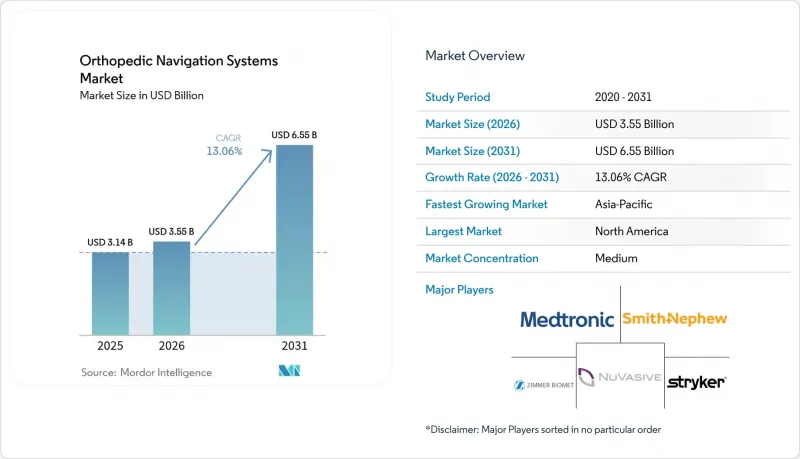
Mordor Intelligence에 의하면, 2026년 정형외과 내비게이션 시스템 시장 규모는 35억 5,000만 달러로 추정되고 2025년 31억 4,000만 달러에서 성장하여 2031년에는 65억 5,000만 달러에 이를 것으로 예측됩니다.
2026년부터 2031년까지의 연평균 성장률(CAGR)은 13.06%가 될 것으로 전망됩니다.
본 보고서는 기술별(전자기식 위치 측정 장치, 광학식 트래킹 등), 용도별(무릎 관절 수술, 척추 수술 등), 최종 사용자별(병원, 외래수술센터(ASC) 등), 지역별(북미, 유럽, 아시아태평양 등)로 분류되어 있습니다. 시장 규모 및 전망은 금액(달러) 기준으로 제시되어 있습니다.
세계의 정형외과 내비게이션 시스템 시장 동향 및 인사이트
저침습 정형외과 수술의 보급 확대
외과의사들은 조직 손상을 최소화하면서 서브mm 단위의 임플란트 정밀도가 요구되는 작은 절개를 점점 더 선호하고 있습니다. 내비게이션은 3차원 공간에서 기구를 유도하여 지원을 제공하며, 인공 슬관절 전치환술에서 ±2° 이내의 93% 정렬 정밀도를 실현합니다. 입원 기간 단축과 재활 조기화로 인해 지불 주체의 비용 부담이 경감되어 경제적 이점이 발생합니다. 투시 기능을 통합한 시스템은 기존 방식에 비해 방사선 피폭량을 91.8% 추가로 감소시킵니다.
로봇 보조 수술 플랫폼 도입 대수 확대
이미 로봇 기술을 도입한 병원에서는 기존 암에 내비게이션 소프트웨어를 통합하여 종합적인 생태계를 구축하고 있습니다. 스트라이커(Striker)사가 곧 출시할 ‘Mako 4’는 적용 범위를 고관절 및 무릎 관절에서 척추 및 어깨 관절로 확대하고, Q Guidance 모듈을 통합하여 영상과 로봇의 원활한 동기화를 실현합니다. 동료 심사를 거친 연구에 따르면, 로봇 내비게이션은 경력이 짧은 외과의사의 고관절 치환술 학습 곡선을 완만하게 하여, 더 빨리 베테랑 수준의 정확도를 달성할 수 있게 해준다는 것이 입증되었습니다.
내비게이션 플랫폼의 높은 초기 투자 비용 및 1건당 비용
시스템 가격은 47만 5,000달러에서 100만 달러 이상으로 폭이 넓으며, 일회용 소모품은 1건당 442-1,500달러의 추가 비용이 듭니다. 보험 환급액이 부족하여 의료기관이 자비로 업그레이드를 해야 하는 경우도 적지 않습니다. 일부 데이터에 따르면, 내비게이션 시스템을 통해 시설당 17건의 척추 재수술을 방지할 수 있다면 비용 대비 효과가 균형을 이룬다고 합니다. 저비용 핸드헬드형 모델이 등장하면서 중규모 병원이나 외래수술센터(ASC)에 대한 경제적 장벽이 점차 완화되고 있습니다.
부문별 분석
2025년, 정형외과 내비게이션 시스템 시장에서 광학식 시스템이 42.02%의 점유율을 차지했습니다. 이는 대량으로 시행되는 인공 슬관절 치환술에서 서브mm급 정밀도를 실현하는 충분히 검증된 카메라 어레이가 채택되었기 때문입니다. 증강현실(AR) 및 혼합 현실(MR) 솔루션은 현재 이 부문에서 가장 높은 연평균 성장률(CAGR) 17.85%로 성장을 지속하고 있습니다. 이는 외과의사의 시야 내에 홀로그램 가이드를 표시하여 고정형 카메라에서 흔히 발생하는 시야 제약을 해소하는 헤드 마운트 디스플레이의 보급에 힘입은 결과입니다. 척추 수술의 경우, 금속 제구로 인해 광학 마커가 가려질 수 있으므로 전자기 트래커가 점차 보급되고 있습니다. 한편, 즉각적인 영상 진단이 필요한 외상 수술실에서는 형광 투시에 기반한 안내 방식이 여전히 주류를 이루고 있습니다. 또한, 정밀한 명암 대비가 요구되는 연조직 위주의 종양 절제술에서는 MRI 전용 플랫폼이 틈새 시장을 차지하고 있습니다.
기존 기업들이 센서, GPU, 클라우드 분석을 단일 패키지로 통합함에 따라 경쟁은 치열해지고 있습니다. 스미스 앤 네퓨(Smith & Nephew)의 ‘TESSA Spatial Surgery System’은 NVIDIA 칩에서 실시간으로 작동하며, 외부 카메라를 사용하지 않고 전방십자인대(ACL) 재건 수술을 안내함으로써, 소형 하이브리드 기기로의 전환을 보여주고 있습니다. 독자적인 AI 모듈을 통해 수술 중 스캔 이미지에서 뼈를 자동으로 분할하고, 기구의 경로를 미세 조정함으로써 수작업 공정을 줄일 수 있게 되었습니다. 광학 기술의 신뢰성은 이미 입증되었으므로, 각 기업은 설치 공간 축소, 케이블 감소, AR 통합을 통해 차별화를 꾀하고 있습니다. 가격대가 낮아짐에 따라 정형외과 내비게이션 시스템 시장에서는 단일 모달리티가 우위를 점하기보다는 기술의 중복 현상이 나타날 것으로 보입니다.
지역별 분석
2025년 매출액 중 북미가 40.74%를 차지했습니다. 이는 조기 도입이 진행되고 있다는 점, 복잡한 관절 수술에 대한 내비게이션 비용을 보상하는 명확한 CPT 코드가 존재한다는 점, 그리고 연중무휴 24시간 현장 지원을 제공할 수 있는 공급업체가 있다는 점을 반영합니다. 고관절 및 무릎 관절 치환술이 ASC(외래수술센터(ASC))로 이동함에 따라, 병원 수준의 정확도를 재현하는 소형 플랫폼에 대한 수요가 증가하고 있습니다. ASC가 관절 수술에 내비게이션 프로토콜을 도입한 경우, 병원 외래 진료 부서와 비교해 26%의 비용 절감이 확인되었습니다. 캐나다도 유사한 추세를 보이고 있으며, 데이터로 검증된 치료 성과를 장려하는 주 정부의 보조금 프로그램이 도입되었습니다. 한편, 멕시코는 국경을 넘는 의료기기 거래와 민간 병원의 성장으로 혜택을 보고 있습니다.
유럽은 그 다음으로 큰 시장을 형성하고 있으며, 독일, 영국, 프랑스에서는 정렬 정밀도가 고가의 임플란트 내구성을 좌우하는 경우 내비게이션을 권장하는 엄격한 근거 기반 지침이 채택되어 있습니다. 환급 제도가 다양하기 때문에 도입 현황에는 편차가 있습니다. 독일의 공적 보험은 내비게이션용 일회용 제품을 보장하고 있지만, 남부 시장에서는 민간 보험사나 본인 부담 모델에 의존하고 있습니다. 베를린 샤리테나 옥스퍼드 대학 병원 등 학술 거점에서는 이 기술을 뒷받침하는 탄탄한 등록 자료를 공개하고 있으며, 이는 유럽 대륙 전체의 기준에 영향을 미치고 있습니다. 신흥 중동부 유럽 국가들에서는 현재 EU 부흥 기금을 활용하여 정형외과 부문의 현대화를 추진하고 있으며, 내비게이션 기술을 고액의 재수술을 억제하는 수단으로 간주하고 있습니다.
아시아태평양은 가장 빠르게 성장하는 지역으로, 인구 고령화와 소득 수준 상승이 맞물려 2031년까지 연평균 성장률(CAGR) 9.24%를 나타낼 것으로 전망됩니다. 인도의 인공 관절 치환용 임플란트 시장은 연평균 성장률(CAGR) 약 25%로 확대되고 있지만, 관절 치환술에 대한 인식이 제한적이어서 당분간 수술 건수는 정체될 전망입니다. 중국의 보급률은 여전히 낮은 수준이며, 내비게이션이나 로봇 기술을 활용하는 고관절 외과 의사는 8.31%에 불과하지만, 첨단 의료를 목표로 하는 국가의 5개년 계획에 따라 이용률이 향상될 것으로 예측됩니다. 일본과 한국에서는 이미 성숙한 보험 환급 제도가 운영되고 있는 반면, 호주의 전국 관절 등록부는 내비게이션과 재수술 위험 감소 간의 연관성을 입증하여 도입을 뒷받침하고 있습니다. 동남아시아 시장에서는 첨단 수술을 원하는 의료 관광객이 유입되고 있으며, 민간 병원들은 경쟁상의 차별화 요소로 내비게이션에 대한 투자를 확대되고 있습니다.
기타 혜택 :
- 엑셀 형식 시장 예측(ME) 시트
- 3개월간의 애널리스트 지원
자주 묻는 질문
목차
제1장 서론
제2장 조사 방법
제3장 개요
제4장 시장 구도
제5장 시장 규모 및 성장 예측
제6장 경쟁 구도
제7장 시장 기회 및 향후 전망
KTH 26.08.31According to Mordor Intelligence, the orthopedic navigation systems market size in 2026 is estimated at USD 3.55 billion, growing from 2025 value of USD 3.14 billion with 2031 projections showing USD 6.55 billion, growing at 13.06% CAGR over 2026-2031.
This report is Segmented by Technology (Electromagnetic Localizers, Optical Tracking, and More), by Application (Knee Surgery, Spine Surgery, and More), by End User (Hospitals, Ambulatory Surgical Centers, and More), and by Geography (North America, Europe, Asia-Pacific, and More). The Market Sizes and Forecasts are Provided in Terms of Value (USD).
Global Orthopedic Navigation Systems Market Trends and Insights
Rising Adoption of Minimally Invasive Orthopedic Procedures
Surgeons increasingly favor smaller incisions that minimize tissue trauma yet still demand sub-millimeter implant accuracy. Navigation assists by guiding instruments in three-dimensional space, enabling 93% alignment within +-2° during total knee arthroplasty.Economic benefits accrue when shorter inpatient stays and quicker rehabilitation reduce payer spend. Fluoroscopy-integrated systems further cut radiation exposure by 91.8% compared with conventional methods.
Expanding Installed Base of Robotic-Assisted Surgery Platforms
Hospitals that already rely on robotics are layering navigation software on existing arms to form comprehensive ecosystems. Stryker's forthcoming Mako 4 release extends its footprint from hips and knees to spine and shoulders, embedding the Q Guidance module for seamless imaging-robot synchronization. Peer-reviewed research shows robotic navigation flattens the learning curve in hip arthroplasty for early-career surgeons, achieving veteran-level accuracy sooner.
High Capital & Per-Procedure Costs of Navigation Platforms
Systems list from USD 475,000 to more than USD 1 million, while disposables can add USD 442-1,500 each case. Reimbursement gaps often push facilities to self-fund upgrades. Some evidence shows neutrality is achieved when navigation averts 17 spine revisions per center. Lower-cost handheld models are gradually easing the financial barrier for mid-size hospitals and ASCs.
Other drivers and restraints analyzed in the detailed report include:
- Advances in Real-Time Imaging & Sensor Fusion for Intra-Op Guidance
- Growing Burden of Musculoskeletal Disorders in Ageing Populations
- Steep Learning Curve & Workflow Disruption for Surgical Teams
For complete list of drivers and restraints, kindly check the Table Of Contents.
Segment Analysis
Optical systems controlled 42.02% of the orthopedic navigation systems market in 2025, thanks to well-validated camera arrays that deliver sub-millimeter accuracy during high-volume knee replacements. Augmented- and mixed-reality solutions now post the segment's fastest 17.85% CAGR, propelled by head-mounted displays that place holographic guides inside the surgeon's field of view and remove line-of-sight constraints common to fixed cameras. Electromagnetic trackers are gaining ground for spine work where metallic instruments obscure optical markers, whereas fluoroscopy-based guidance remains a staple in trauma rooms needing instant imaging. MRI-specific platforms hold a niche for soft-tissue-driven tumor resections that depend on detailed contrast.
Competition is intensifying as incumbents meld sensors, GPUs, and cloud analytics into single packages. Smith+Nephew's TESSA Spatial Surgery System runs in real-time on NVIDIA chips to guide ACL reconstruction without external cameras, illustrating the shift toward compact hybrid devices. Proprietary AI modules now auto-segment bone on intra-op scans and fine-tune instrument paths, trimming manual steps. With optical reliability already proven, companies seek differentiation by shrinking footprints, cutting cables, and integrating AR. As price points drop, the orthopedic navigation systems market will likely see technology overlap rather than a single-modality winner.
Complete Report Scope:
- By Technology
- Electromagnetic Localizers
- Optical Tracking
- Fluoroscopy-based
- MRI-based
- Augmented / Mixed Reality Systems
- Other Emerging Technologies
- By Application
- Knee Surgery
- Spine Surgery
- Hip Surgery
- Shoulder & Upper-Extremity
- Trauma & Sports Injury
- Other Applications
- By End User
- Hospitals
- Ambulatory Surgical Centers (ASCs)
- Others
- By Geography
- North America
- United States
- Canada
- Mexico
- Europe
- Germany
- United Kingdom
- France
- Italy
- Spain
- Rest of Europe
- Asia Pacific
- China
- Japan
- India
- South Korea
- Australia
- Rest of Asia Pacific
- Middle East and Africa
- GCC
- South Africa
- Rest of Middle East and Africa
- South America
- Brazil
- Argentina
- Rest of South America
- North America
Geography Analysis
North America accounted for 40.74% of sales in 2025, reflecting early adoption, clear CPT codes that reimburse navigation in complex joints, and the presence of vendors able to provide 24/7 field support. Migration of hip and knee replacements to ASCs intensifies demand for compact platforms that replicate hospital-level precision. A 26% cost reduction versus hospital outpatient departments has been documented when ASCs deploy navigated protocols for joint work. Canada mirrors this path with provincial funding programs that incentivize data-verified outcomes, while Mexico gains from cross-border device trade and private hospital growth.
Europe forms the next largest block, with Germany, the United Kingdom, and France adopting stringent evidence-based guidelines favoring navigation when alignment accuracy predicts longevity of high-priced implants. Diverse reimbursement regimes mean uptake varies, statutory payers in Germany cover navigation disposables, whereas southern markets rely on private insurers or self-pay models. Academic hubs such as Charite in Berlin and Oxford University Hospitals publish robust registries that validate technology, influencing continental standards. Emerging Central-Eastern nations now modernize orthopedic departments with EU recovery funds and see navigation as a path to curb expensive revisions.
Asia Pacific is the fastest-growing region, posting a 9.24% CAGR to 2031 as demographic aging meets rising income levels. India's arthroplasty implant sector is expanding near 25% CAGR, yet limited awareness of joint-replacement options caps immediate volumes. China's penetration remains low, with only 8.31% of hip surgeons using navigation or robotics, but state 5-year plans targeting advanced healthcare are expected to lift utilization. Japan and South Korea already operate mature reimbursement schemes, while Australia's national joint registry proves the link between navigation and lower revision risk, reinforcing adoption. Southeast Asian markets draw medical tourists seeking high-tech surgery, nudging private hospitals to invest in navigation as a competitive differentiator.
- Stryker
- Zimmer Biomet
- Smiths Group
- Medtronic
- Brain Lab
- NuVasive
- B. Braun
- Arthrex
- Siemens Healthineers
- MicroPort MedTech
- Exactech
- OrthAlign
- 7D Surgical
- Intellijoint Surgical
- Corin Group
- DePuy Synthes
- Joimax
- Globus Medical
- Karl Storz
- Scopis (Stryker)
Additional Benefits:
- The market estimate (ME) sheet in Excel format
- 3 months of analyst support
TABLE OF CONTENTS
1 Introduction
- 1.1 Study Assumptions & Market Definition
- 1.2 Scope of the Study
2 Research Methodology
3 Executive Summary
4 Market Landscape
- 4.1 Market Overview
- 4.2 Market Drivers
- 4.2.1 Rising Adoption of Minimally Invasive Orthopedic Procedures
- 4.2.2 Expanding Installed Base of Robotic-Assisted Surgery Platforms
- 4.2.3 Advances In Real-Time Imaging & Sensor Fusion for Intra-Op Guidance
- 4.2.4 Growing Burden of Musculoskeletal Disorders in Ageing Populations
- 4.2.5 Hand-Held & Pin-Less Low-Cost Devices Targeting ASC Settings
- 4.2.6 FDA Real-World Evidence (RWE) Programs Accelerating Post-Market Data Use
- 4.3 Market Restraints
- 4.3.1 High Capital & Per-Procedure Costs of Navigation Platforms
- 4.3.2 Steep Learning Curve & Workflow Disruption for Surgical Teams
- 4.3.3 Stringent Multi-Region Regulatory Approval & Device-Recall Risk
- 4.3.4 Competitive Cannibalization by Fully Integrated Orthopedic Robots
- 4.4 Supply-Chain Analysis
- 4.5 Regulatory Landscape
- 4.6 Technological Outlook
- 4.7 Porter's Five Forces
- 4.7.1 Bargaining Power of Suppliers
- 4.7.2 Bargaining Power of Buyers
- 4.7.3 Threat of New Entrants
- 4.7.4 Threat of Substitutes
- 4.7.5 Intensity of Competitive Rivalry
5 Market Size & Growth Forecasts (Value)
- 5.1 By Technology
- 5.1.1 Electromagnetic Localizers
- 5.1.2 Optical Tracking
- 5.1.3 Fluoroscopy-based
- 5.1.4 MRI-based
- 5.1.5 Augmented / Mixed Reality Systems
- 5.1.6 Other Emerging Technologies
- 5.2 By Application
- 5.2.1 Knee Surgery
- 5.2.2 Spine Surgery
- 5.2.3 Hip Surgery
- 5.2.4 Shoulder & Upper-Extremity
- 5.2.5 Trauma & Sports Injury
- 5.2.6 Other Applications
- 5.3 By End User
- 5.3.1 Hospitals
- 5.3.2 Ambulatory Surgical Centers (ASCs)
- 5.3.3 Others
- 5.4 By Geography
- 5.4.1 North America
- 5.4.1.1 United States
- 5.4.1.2 Canada
- 5.4.1.3 Mexico
- 5.4.2 Europe
- 5.4.2.1 Germany
- 5.4.2.2 United Kingdom
- 5.4.2.3 France
- 5.4.2.4 Italy
- 5.4.2.5 Spain
- 5.4.2.6 Rest of Europe
- 5.4.3 Asia Pacific
- 5.4.3.1 China
- 5.4.3.2 Japan
- 5.4.3.3 India
- 5.4.3.4 South Korea
- 5.4.3.5 Australia
- 5.4.3.6 Rest of Asia Pacific
- 5.4.4 Middle East and Africa
- 5.4.4.1 GCC
- 5.4.4.2 South Africa
- 5.4.4.3 Rest of Middle East and Africa
- 5.4.5 South America
- 5.4.5.1 Brazil
- 5.4.5.2 Argentina
- 5.4.5.3 Rest of South America
- 5.4.1 North America
6 Competitive Landscape
- 6.1 Market Concentration
- 6.2 Market Share Analysis
- 6.3 Company Profiles (includes Global level Overview, Market level overview, Core Segments, Financials as available, Strategic Information, Market Rank/Share for key companies, Products & Services, and Recent Developments)
- 6.3.1 Stryker
- 6.3.2 Zimmer Biomet
- 6.3.3 Smith & Nephew
- 6.3.4 Medtronic plc
- 6.3.5 Brainlab
- 6.3.6 NuVasive
- 6.3.7 B. Braun SE
- 6.3.8 Arthrex
- 6.3.9 Siemens Healthineers
- 6.3.10 MicroPort MedTech
- 6.3.11 Exactech
- 6.3.12 OrthAlign
- 6.3.13 7D Surgical
- 6.3.14 Intellijoint Surgical
- 6.3.15 Corin Group
- 6.3.16 DePuy Synthes
- 6.3.17 Joimax
- 6.3.18 Globus Medical
- 6.3.19 Karl Storz
- 6.3.20 Scopis (Stryker)
7 Market Opportunities & Future Outlook
- 7.1 White-space & Unmet-Need Assessment