|
시장보고서
상품코드
2116332
피브레이트 계열 약물 : 시장 점유율 분석, 업계 동향 및 통계, 성장 예측(2026-2031년)Fibrate Drugs - Market Share Analysis, Industry Trends & Statistics, Growth Forecasts (2026 - 2031) |
||||||
 Mordor Intelligence
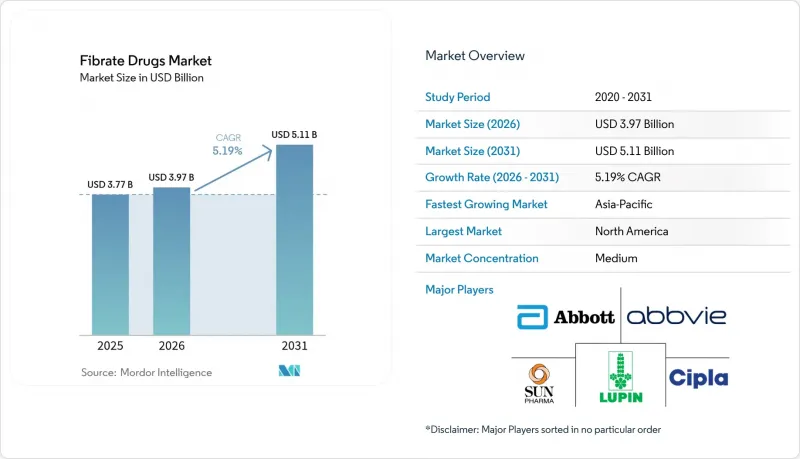
Mordor Intelligence에 의하면, 피브레이트 계열 약물 시장 규모는 2025년에 37억 7,000만 달러로 평가되었습니다. 2026년 39억 7,000만 달러에서 2031년까지 51억 1,000만 달러에 이를 것으로 예상되며, 예측 기간(2026-2031년) CAGR은 5.19%를 나타낼 전망입니다.
본 보고서는 약물별(클로피브레이트, 젬피브로딜, 페노피브레이트, 베자피브레이트, 시프로피브레이트 등),제품 유형별(브랜드 의약품 및 제네릭 의약품), 유통 채널별(병원 약국, 소매 약국, 온라인 약국), 지역별(북미, 유럽, 아시아태평양, 중동 및 아프리카, 남미)로 분류되어 있습니다. 시장 예측은 금액(미 달러) 기준으로 제시되어 있습니다.
세계의 피브레이트 계열 약물 시장 동향 및 인사이트
심혈관 질환 유병률 증가
세계적으로 심혈관 질환 유병률이 상승하고 있어, 트리글리세라이드 저하제에 대한 수요가 지속적으로 증가하고 있습니다. 중국의 40세 미만 성인 중 트리글리세라이드 수치가 최상위 사분위군에 속하는 사람들의 심혈관 위험이 2.26배 높은 것으로 나타나, 트리글리세라이드 수치 상승이 젊은 층의 심혈관 사건에 미치는 영향이 부각되고 있습니다. 미국심장협회(AHA)의 2024년판 최신 보고서에 따르면, 당뇨병 및 고혈압의 지속적인 증가가 예측되고 있으며, 이에 따라 피브레이트 계열 약물의 처방 대상이 되는 환자층이 확대될 것으로 전망됩니다. 고트리글리세라이드혈증으로 인한 급성 췌장염은 이미 전 세계 증례의 5분의 1을 차지하고 있으며, 그 부담은 아시아에서 가장 높습니다. 이러한 추세가 맞물리면서 피브레이트 계열 약물 시장은 표준 지질 관리 알고리즘 내에서 확고한 위치를 유지하고 있습니다.
지질강하제 연구 개발에 대한 막대한 투자
지질 과학 분야로의 자본 유입은 피브레이트 요법을 보완하는 혁신을 촉진하고 있습니다. 획기적인 RNA 치료제인 프로자실란과 오레자르센은 2024년 ACC(미국심장학회) 발표에서 기존 기준을 크게 상회하는 트리글리세라이드 저하 효과를 보여주었습니다. 이와는 별도로, 크로다(Kuroda)사가 지질 시스템 생산 능력 확대를 위해 추진 중인 1억 3,300만 달러 규모의 프로젝트(미국 연방 정부의 7,500만 달러 지원을 받고 있음)는 지질 관련 기술에 대한 공급망의 신뢰를 보여줍니다. 이러한 투자는 피브레이트 계열 약물과 스타틴, 또는 신규 생물학적 제제를 조합한 복합 제품 파이프라인을 육성하고 있습니다.
스타틴 및 PCSK9 억제제에 대한 보험 지급 기관의 선호도
보험 급여 기관은 스타틴을 우선시하고, PCSK9 억제제도 점점 더 중요하게 여기는 추세이며, 중증 고트리글리세라이드혈증이 지속되는 경우를 제외하고는 피브레이트 계열 약물이 2차 선택 약물로 밀려나고 있습니다. 청구 데이터에 따르면, 가격 인하에도 불구하고 PCSK9 억제제 처방전의 30.95%가 거부되고 있어, 약제 목록 선정에 대한 압박이 두드러지게 나타나고 있습니다. 인크리실란의 비용-효과 모델에 따르면, 중국에서 스타틴 요법과 동등한 수준에 도달하려면 88%의 가격 인하가 필요하다고 합니다(frontiersin.org). 이러한 추세로 인해, 지급 기관이 단계적 치료 프로토콜을 철저히 적용하고 있는 지역에서는 피브레이트 처방량이 감소하고 있습니다.
부문별 분석
피브레이트 계열 약물 시장은 여전히 페노피브레이트가 주도하고 있으며, 2025년에는 전 세계 매출의 61.90%를 차지했습니다. 이는 모든 치료 분야에서 피브레이트 계열 약물이 차지하는 최대 시장 점유율에 필적하는 수준입니다. 이러한 확고한 입지는 임상 현장에서의 폭넓은 인지도, 1일 1회 투여, 그리고 트리글리세라이드 저하 효과에 대한 확실한 근거를 반영하고 있습니다. 현재 성장의 핵심은 적응증 확대에 있습니다. LENS 데이터에 따르면 당뇨병성 망막병증의 진행이 27% 감소한 것으로 나타났으며, 이로 인해 안과 분야에서 대상 환자층이 확대되고 있습니다. 한편, 베자피브레이트는 특히 대사증후군 환자군에서 균형 잡힌 안전성 및 유효성 프로파일이 임상의들로부터 높은 평가를 받고 있으며, 연평균 성장률(CAGR) 7.12%라는 가장 빠른 확산세를 보이고 있습니다. 젬피브로질은 스타틴과의 상호작용이 완화된 분야에서 틈새 시장 역할을 유지하고 있는 반면, 시프로피브라트와 클로피브라트는 과거의 안전성 우려로 인해 판매량이 감소하고 있습니다.
실제 임상 현장에서의 안전성 모니터링에 대한 지속적인 투자가 각 약물의 경쟁적 위치를 형성하고 있습니다. FDA의 이상반응 모니터링에서는 로스바스타틴·페노피브레이트 복합제에 대해 68건의 신호가 지적되었으며, 그중 28건은 현재 첨부문서에 기재되어 있지 않은 것으로, 경계가 필요함이 부각되고 있습니다. 이러한 면밀한 검토는 근병증 위험이 낮다는 베자피브레이트의 평판을 뒷받침하고 있습니다. RNA 기반 길항제는 현시점에서 피브레이트의 직접적인 대체제가 될 수는 없지만, 트리글리세라이드 대사 경로의 임상적 중요성을 부각시키고 있으며, 다각적인 지질 관리 요법에서 피브레이트 계열 약제 시장의 중요성이 유지되고 있습니다.
지역별 분석
북미는 지속성 고중성지방혈증에 대한 피브레이트 사용을 권장하는 종합적인 보험 급여 제도 및 임상 지침에 힘입어 2025년 전 세계 매출의 38.20%를 차지했습니다. 복합제제에 대한 접근성이 확대됨에 따라 처방 건수는 더욱 증가하고 있습니다. 그러나 청구 건수의 3분의 1 가까이가 PCSK9 억제제에 대한 보험 적용 거부를 받고 있다는 사실은 피브레이트가 비용 대비 효과적인 방식으로 메워야 할 공백을 드러내고 있습니다. 환경 규제로 인해 미국 제조업체들은 규정 준수 비용 증가를 겪고 있지만, 확립된 품질 관리 시스템 덕분에 심각한 혼란은 완화되고 있습니다. 캐나다의 공공 의약품 프로그램과 멕시코에서 확대되고 있는 민간 보험 부문은 모두 접근성을 확대하고 있어, 해당 지역의 판매 모멘텀을 유지하고 있습니다.
아시아태평양은 미치료 환자 수 증가, 비만율 상승, 그리고 대사계 의약품 제조업체에 대한 정부의 장려책에 힘입어 8.76%라는 가장 높은 연평균 성장률(CAGR)을 기록하고 있습니다. 인도의 ‘생산 연계형 인센티브(PLI)’ 제도는 2026년 도입을 목표로 하고 있으며, 수출 전망을 밝게 할 뿐만 아니라 지역 제약사들에게 피브레이트 계열 약물 시장 규모를 확대시키고 있습니다. 중국의 ‘국가 전략적 의약품 가격 협상’은 가격 상한선을 낮춤으로써 대량 도입을 유지하고 있습니다. 일본과 한국에서는 트리글리세라이드에 특화된 지표를 중시하며, 조기 전문의 진료를 촉진하고 있습니다. 호주는 병행수입 정책을 활용하여 의약품 목록의 비용 경쟁력을 유지하고, 환자의 접근성을 확대되고 있습니다.
유럽에서는 지불 주체의 면밀한 검토로 단가가 억제되고 있는 반면, 심혈관계에 대한 부가적인 효과가 인정되는 의약품에 대해서는 실세계 데이터를 바탕으로 한 평가가 이루어지는 등 균형 잡힌 전망이 유지되고 있습니다. 중동부 유럽 회원국에서는 제네릭 의약품 도입이 적극적으로 추진되는 반면, 서유럽에서는 직접 비교 데이터로 뒷받침되는 브랜드 의약품의 혁신에 중점을 두고 있습니다. 중동 및 아프리카에서는 경제 다각화 계획에 따라 헬스케어 예산이 증가하고 있지만, 질환 유병률에 비하면 도입률은 여전히 낮은 수준입니다. 남미에서는 거시경제의 변동으로 인해 일관된 조달이 저해되고 있지만, 브라질에서의 심장병 위험 선별 검사 확대가 완만한 성장을 뒷받침하고 있습니다. 이러한 동향들이 맞물려 피브레이트 계열 약물 시장은 광범위한 경제권에 분산되어 있어, 특정 지역의 충격으로부터 매출을 보호하고 있습니다.
기타 혜택 :
- 엑셀 형식 시장 예측(ME) 시트
- 3개월간의 애널리스트 지원
자주 묻는 질문
목차
제1장 서론
제2장 조사 방법
제3장 개요
제4장 시장 구도
제5장 시장 규모 및 성장 예측
제6장 경쟁 구도
제7장 시장 기회 및 향후 전망
KTH 26.08.31According to Mordor Intelligence, the fibrate drugs market size was valued at USD 3.77 billion in 2025 and estimated to grow from USD 3.97 billion in 2026 to reach USD 5.11 billion by 2031, at a CAGR of 5.19% during the forecast period (2026-2031).
This report is Segmented by Drug (Clofibrate, Gemfibrozil, Fenofibrate, Bezafibrate, Ciprofibrate, and More), Product Type (Branded and Generics), Distribution Channel (Hospital Pharmacy and Retail Pharmacy, and Online Pharmacy), and Geography (North America, Europe, Asia-Pacific, The Middle East and Africa, and South America). The Market Forecasts are Provided in Terms of Value (USD).
Global Fibrate Drugs Market Trends and Insights
Increasing Prevalence of Cardiovascular Diseases
Cardiovascular morbidity is climbing worldwide, pushing continuous demand for triglyceride-lowering agents. Chinese adults under 40 exhibited a 2.26-fold higher cardiovascular risk in the top triglyceride quartile, underscoring the contribution of elevated TG to early-age events. The American Heart Association's 2024 update projects sustained expansion of diabetes and hypertension, enlarging the clinical pool for fibrate prescriptions. Hypertriglyceridemia-induced acute pancreatitis already causes one-fifth of global cases, with the burden highest in Asia. Together, these patterns keep the fibrate drugs market firmly positioned within standard lipid-management algorithms.
High Investment in R&D of Lipid-Lowering Drugs
Capital inflows into lipid science spur innovation that often complements fibrate therapy. Breakthrough RNA therapeutics plozasiran and olezarsen lowered triglycerides far beyond conventional benchmarks in 2024 ACC presentations. Separately, Croda's USD 133 million project to expand lipid-systems capacity-bolstered by USD 75 million in U.S. federal backing-signals supply-chain confidence in lipid-based technologies. Such investment nurtures combination-product pipelines pairing fibrates with statins or novel biologics.
Payer Preference for Statins & PCSK9 Inhibitors
Reimbursement bodies prioritise statins and, increasingly, PCSK9 inhibitors, relegating fibrates to second line unless severe hypertriglyceridemia persists. Claims data reveal 30.95% PCSK9 prescriptions were denied despite price cuts, exposing formulary pressure. Cost-effectiveness models for inclisiran call for an 88% price haircut in China before parity with statin therapy frontiersin.org. Such dynamics reduce fibrate volume where payers enforce step-therapy protocols.
Other drivers and restraints analyzed in the detailed report include:
- Rising Incidence of Metabolic Syndrome & Hypertriglyceridemia
- Expanding Generic Manufacturing Capacity in Emerging Markets
- Environmental Curbs on Fluorinated Intermediates Supply Chain
For complete list of drivers and restraints, kindly check the Table Of Contents.
Segment Analysis
The fibrate drugs market remains led by fenofibrate, which captured 61.90% of global revenue in 2025, a level equal to the largest fibrate drugs market share across any therapeutic class. This anchor position reflects broad clinical familiarity, once-daily dosing, and robust evidence for triglyceride lowering. Growth now centres on repurposing; LENS data show a 27% decline in diabetic-retinopathy progression, enlarging the addressable base within ophthalmology. Bezafibrate, meanwhile, enjoys the quickest uptake, advancing at a 7.12% CAGR as clinicians value its balanced safety-efficacy profile, especially in metabolic-syndrome cohorts. Gemfibrozil retains a niche role where statin interactions are mitigated, while ciprofibrate and clofibrate shrink in volume following legacy safety concerns.
Continued investment in real-world safety monitoring shapes competitive positioning. FDA adverse-event surveillance flagged 68 signals for rosuvastatin-fenofibrate combinations, 28 of which are absent from current labels, underscoring vigilance needs. That scrutiny benefits bezafibrate's reputation for lower myopathy risk. RNA-based antagonists, though not yet direct fibrate replacements, spotlight the triglyceride pathway's clinical weight, keeping the fibrate drugs market essential within multimodal lipid control regimens.
Complete Report Scope:
- By Drug
- Clofibrate
- Gemfibrozil
- Fenofibrate
- Bezafibrate
- Ciprofibrate
- Other Drugs
- By Product Type
- Branded
- Generic
- By Distribution Channel
- Hospital & Retail Pharmacy
- Online Pharmacy
- Geography
- North America
- United States
- Canada
- Mexico
- Europe
- Germany
- United Kingdom
- France
- Italy
- Spain
- Rest of Europe
- Asia-Pacific
- China
- Japan
- India
- South Korea
- Australia
- Rest of Asia-Pacific
- Middle East and Africa
- GCC
- South Africa
- Rest of Middle East and Africa
- South America
- Brazil
- Argentina
- Rest of South America
- North America
Geography Analysis
North America generated 38.20% of 2025 global revenue, anchored by comprehensive reimbursement and clinical guidelines that endorse fibrates for persistent hypertriglyceridemia. Wider access to combination pills further elevates prescribing. Yet, PCSK9 coverage denials affecting nearly one-third of claims expose gaps that fibrates cost-effectively fill. Environmental restrictions raise compliance costs for U.S. producers, but established quality systems mitigate severe disruption. Canada's public-drug programs and Mexico's growing private insurance segments both widen access, sustaining regional sales momentum.
Asia-Pacific records the fastest 8.76% CAGR, driven by sizable untreated populations, rising obesity rates, and state incentives for metabolic-drug makers. India's Production Linked Incentive scheme aims at 2026 roll-out, brightening export prospects and enhancing fibrate drugs market size for regional producers. China's Strategic National Drug negotiations push price ceilings downward, preserving high volume uptake. Japan and South Korea emphasise triglyceride-specific indices, promoting earlier specialist referral. Australia leverages parallel-import policy to keep formularies cost-competitive, widening patient access.
Europe maintains a balanced outlook with payer scrutiny capping unit pricing but real-world evidence rewarding drugs that show additive cardiovascular benefit. Central and Eastern member states adopt generics aggressively, while Western Europe leans on branded innovations backed by head-to-head data. In the Middle East and Africa, economic diversification plans are raising healthcare budgets, yet uptake remains modest relative to disease prevalence. South America's macroeconomic fluctuations hobble consistent procurement, though Brazil's cardiac risk-screening expansions support gradual growth. Collectively, these patterns distribute the fibrate drugs market across a broad economic spectrum, insulating revenue from single-region shocks.
- Abbott Laboratories
- Abbvie
- Ajanta Pharma USA
- Amneal Pharmaceuticals
- Aurobindo Pharma
- Cipla
- Dr. Reddy's Laboratories
- Hikma Pharmaceuticals
- IOL Chemicals & Pharmaceuticals
- Kowa Pharmaceutical Co.
- Lupin
- Macleods Pharmaceuticals
- Merck
- Viatris
- Novartis
- Pfizer
- Sanofi
- Sun Pharmaceuticals Industries
- Teva Pharmaceutical Industries
- Unnati Pharmaceuticals
Additional Benefits:
- The market estimate (ME) sheet in Excel format
- 3 months of analyst support
TABLE OF CONTENTS
1 Introduction
- 1.1 Study Assumptions & Market Definition
- 1.2 Scope of the Study
2 Research Methodology
3 Executive Summary
4 Market Landscape
- 4.1 Market Overview
- 4.2 Market Drivers
- 4.2.1 Increasing Prevalence Of Cardiovascular Diseases
- 4.2.2 High Investment In R&D Of Lipid-Lowering Drugs
- 4.2.3 Rising Incidence Of Metabolic Syndrome & Hypertriglyceridemia
- 4.2.4 Expanding Generic Manufacturing Capacity In Emerging Markets
- 4.2.5 Therapeutic Repurposing For Diabetic Retinopathy & CKD
- 4.2.6 Precision-Medicine Tools Enabling Targeted Fibrate Therapy
- 4.3 Market Restraints
- 4.3.1 Frequent Product Recalls & Discontinuations
- 4.3.2 Stringent Regulatory Framework
- 4.3.3 Payer Preference For Statins & PCSK9 Inhibitors
- 4.3.4 Environmental Curbs On Fluorinated Intermediates Supply Chain
- 4.4 Porter's Five Forces Analysis
- 4.4.1 Threat of New Entrants
- 4.4.2 Bargaining Power of Buyers
- 4.4.3 Bargaining Power of Suppliers
- 4.4.4 Threat of Substitutes
- 4.4.5 Intensity of Competitive Rivalry
5 Market Size & Growth Forecasts (Value, USD)
- 5.1 By Drug
- 5.1.1 Clofibrate
- 5.1.2 Gemfibrozil
- 5.1.3 Fenofibrate
- 5.1.4 Bezafibrate
- 5.1.5 Ciprofibrate
- 5.1.6 Other Drugs
- 5.2 By Product Type
- 5.2.1 Branded
- 5.2.2 Generic
- 5.3 By Distribution Channel
- 5.3.1 Hospital & Retail Pharmacy
- 5.3.2 Online Pharmacy
- 5.4 Geography
- 5.4.1 North America
- 5.4.1.1 United States
- 5.4.1.2 Canada
- 5.4.1.3 Mexico
- 5.4.2 Europe
- 5.4.2.1 Germany
- 5.4.2.2 United Kingdom
- 5.4.2.3 France
- 5.4.2.4 Italy
- 5.4.2.5 Spain
- 5.4.2.6 Rest of Europe
- 5.4.3 Asia-Pacific
- 5.4.3.1 China
- 5.4.3.2 Japan
- 5.4.3.3 India
- 5.4.3.4 South Korea
- 5.4.3.5 Australia
- 5.4.3.6 Rest of Asia-Pacific
- 5.4.4 Middle East and Africa
- 5.4.4.1 GCC
- 5.4.4.2 South Africa
- 5.4.4.3 Rest of Middle East and Africa
- 5.4.5 South America
- 5.4.5.1 Brazil
- 5.4.5.2 Argentina
- 5.4.5.3 Rest of South America
- 5.4.1 North America
6 Competitive Landscape
- 6.1 Market Concentration
- 6.2 Market Share Analysis
- 6.3 Company Profiles (includes Global level Overview, Market level overview, Core Segments, Financials as available, Strategic Information, Market Rank/Share for key companies, Products & Services, and Recent Developments)
- 6.3.1 Abbott Laboratories
- 6.3.2 AbbVie Inc
- 6.3.3 Ajanta Pharma USA
- 6.3.4 Amneal Pharmaceuticals
- 6.3.5 Aurobindo Pharma USA
- 6.3.6 Cipla Ltd
- 6.3.7 Dr. Reddy's Laboratories
- 6.3.8 Hikma Pharmaceuticals
- 6.3.9 IOL Chemicals & Pharmaceuticals
- 6.3.10 Kowa Pharmaceutical Co.
- 6.3.11 Lupin Ltd
- 6.3.12 Macleods Pharmaceuticals
- 6.3.13 Merck & Co.
- 6.3.14 Viatris Inc
- 6.3.15 Novartis AG
- 6.3.16 Pfizer Inc
- 6.3.17 Sanofi S.A
- 6.3.18 Sun Pharmaceutical Industries
- 6.3.19 Teva Pharmaceutical Industries
- 6.3.20 Unnati Pharmaceuticals
7 Market Opportunities & Future Outlook
- 7.1 White-space & Unmet-need Assessment