|
시장보고서
상품코드
2116337
프로필렌 글리콜 시장 : 점유율 분석, 업계 동향과 통계, 성장 예측(2026-2031년)Propylene Glycol - Market Share Analysis, Industry Trends & Statistics, Growth Forecasts (2026 - 2031) |
||||||
 Mordor Intelligence
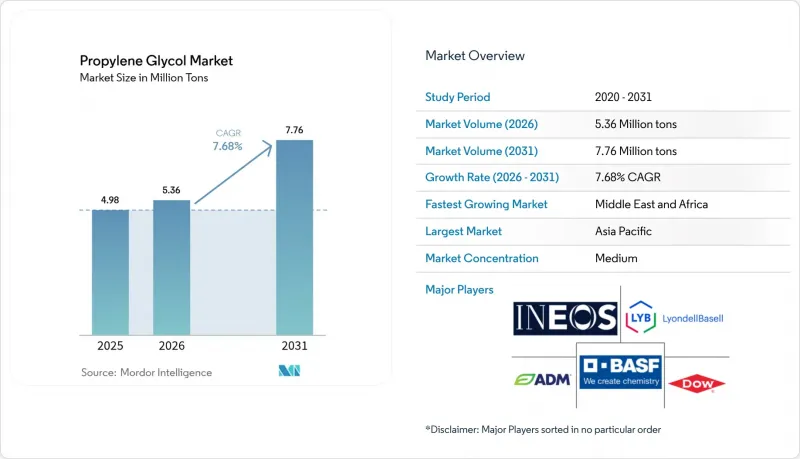
Mordor Intelligence에 의하면, 프로필렌 글리콜 시장 규모는 2025년 498만 톤에서 2026년에는 536만 톤으로 확대되어 2026년부터 2031년까지 CAGR 7.68%로 성장을 지속하여, 2031년에는 776만 톤에 이를 것으로 예측됩니다.
본 보고서는 용도별(향료, 부동액·제설제, 불포화 폴리에스터 수지, 화학 중간체, 기타), 최종 사용자 산업별(운송, 건축 및 건설, 식품 및 음료 등), 지역별(아시아태평양, 북미, 유럽, 남미, 중동 및 아프리카)로 분류되어 있습니다. 시장 예측은 수량(톤) 기준으로 제시되어 있습니다.
세계 프로필렌 글리콜 시장 동향 및 인사이트
식품 및 음료 배합 업체들 수요 급증
미국 식품의약국(FDA)의 21 CFR 184.1666에 따른 규제 승인 및 유럽식품안전청(EFSA)의 E1520 등록으로 인해, 제형 제조업체는 표시상의 제약 없이 프로필렌 글리콜을 사용할 수 있게 되었으며, 이에 따라, 프로필렌 글리콜은 주류 및 저가 제형에서 널리 수용되는 몇 안 되는 합성 보습제 중 하나가 되었습니다. 주류 제조업체는 이 분자를 이용하여 향료 농축액을 운반하고 저당 제품의 식감을 유지하고 있으며, 한편 제빵 업체는 상온 유통 시 수분 유지와 유통 기한 연장에 활용하고 있습니다. 2024년 9월, 미국 환경보호청(EPA)의 ‘더 안전한 화학 성분 목록’에 새로운 PG 유도체가 추가된 것은 규제 당국이 PG의 화학적 특성을 용인하고 있음을 뒷받침하며, 습도가 높은 아시아 시장에서는 유제품 가공업체들이 부패 방지를 위해 PG 기반의 텍스처 조절제를 지정하고 있습니다. 고급 유기농 브랜드에서는 여전히 글리세린이 선호되고 있지만, 대중 시장용 제품에서는 ? 스낵 및 과자류 제품 라인에서 PG의 보급률이 높게 유지되고 있으며, 그 결과 전체 성장률이 1.2% 포인트 상승하는 뚜렷한 효과를 가져오고 있습니다.
자동차용 냉각수 및 제설액 소비량 증가
전기자동차 배터리 팩에는 셀 온도를 15°C에서 35°C 사이로 유지하는 열 관리용 유체가 필요합니다. 이 사양에서는 독성이 낮고 저온에서 유동성이 뛰어나기 때문에 에틸렌글리콜보다 프로필렌 글리콜이 선호됩니다. 각 배터리식 전기차는 수명 기간 동안 PG 기반 냉각수를 소비하기 때문에 수요 증가폭이 매우 큽니다. 항공 안전 기준 또한 성장의 기반이 되고 있습니다. 유형 I 항공기용 제빙제 배합은 응고점 강하 작용 때문에 PG에 의존하고 있으며, 2030년까지 전 세계 출발 편수는 매년 증가할 것으로 예측됩니다. 북미와 북유럽의 한랭지 시장이 냉각수 소비량의 큰 비중을 차지하고 있지만, 중국과 한국에서 국가 차원의 탄소 중립 의무화로 인해 상용차의 전동화가 가속화되면서 아시아태평양의 점유율도 상승하고 있습니다.
원유 가격 변동에 따른 프로필렌 옥사이드 가격 변동
프로필렌 옥사이드(PO) 가격은 제품별 수익 및 크래커 가동률이 원유 가격과 연동되어 변동하기 때문에 1년 중에도 큰 변동이 나타납니다. 브렌트 원유 가격이 일정 임계치 이하로 떨어지면 나프타 크래커 가동이 중단되어 하류 수요가 약화되는 한편, 프로필렌 공급 부족으로 인해 PO 가격이 상승합니다. 반대로 원유 가격이 급등하면 크래킹이 촉진되어 프로필렌 시장에 공급이 넘쳐나며, PO의 마진이 압박받게 됩니다. 이러한 불안정성으로 인해 구매자는 많은 재고를 보유할 수밖에 없게 되고, 생산자의 전망도 불투명해집니다.
부문 분석
2025년, 불포화 폴리에스테르 수지는 프로필렌 글리콜 시장 규모의 32.02%를 차지했습니다. 이는 풍력 터빈 블레이드와 내식성 인프라가 대량의 수지를 흡수했기 때문입니다. 자동차의 전기화와 항공 안전 규제로 인해 부동액 및 제빙제 수요가 증가하는 한편, 탄산프로필렌 및 디프로필렌 글리콜과 같은 화학 중간체는 폴리우레탄 및 계면활성제 생산을 뒷받침하고 있습니다. 퍼스널케어용 중간체는 에스테르와 에테르가 씻어내지 않는 유형의 화장품에 널리 사용되고 있어 연평균 성장률(CAGR) 8.03%로 가장 빠르게 성장하고 있습니다.
특히 퍼스널케어 분야에서는 ISCC PLUS 인증을 획득한 바이오·서큘러 등급 제품에 대해, 비싼 가격을 지불하더라도 채택하는 제형 개발자가 증가하고 있습니다. 반면, 비용을 중시하는 UPR 컴파운더는 그린 빌딩 인증이 요구되는 경우에만 이를 채택하고 있습니다. 반도체용 포토레지스트 스트리퍼에는 프로필렌 글리콜 모노메틸에테르가 사용됩니다. 이는 틈새 시장 제품이지만, 전자 등급의 순도를 갖추고 있어 고가에 거래되고 있습니다. 특수 용도와 범용 용도를 아우르는 수요의 다양화로 인해 생산자는 경기 변동에 따른 리스크를 헤지할 수 있지만, 그 성공 여부는 용매 순도 향상을 위한 투자와 다양한 등급의 제품 포트폴리오에 대응할 수 있는 신속한 물류 체계에 달려 있습니다.
지역별 분석
2025년, 아시아태평양은 전 세계 프로필렌 글리콜 시장 물량의 46.11%를 차지했습니다. 이는 중국의 프로판 탈수소화 및 PO(프로필렌옥사이드) 통합 생산 라인, 그리고 태국의 수출 지향형 공장이 주도한 결과입니다. 최근 확장된 태국의 맵타풋 공장은 현재 ISCC PLUS 인증을 획득한 등급의 제품을 일본과 한국으로 출하하고 있습니다. 인도에서는 마나리 페트로케미칼(Manali Petrochemicals)사가 가동 허가를 취득하는 대로 국내 생산 능력을 대폭 확대될 전망이며, 높은 이익률을 보이는 식품 및 의약품 사용자를 타겟으로 하고 있습니다. 그러나 현물 가격을 압박하고 있는 중국의 낮은 설비 가동률로 인해, 해당 지역의 단기적인 이익률은 여전히 어려운 상황입니다.
중동 및 아프리카은 정유시설의 오프가스를 프로필렌 유도체로 전환하는 사우디아라비아의 프로젝트에 힘입어, 2026년부터 2031년까지 8.66%라는 가장 높은 성장률을 나타낼 것으로 예측됩니다. 낮은 에탄 비용은 지역 생산자들에게 에너지 면에서의 우위를 가져다주어 유럽 및 인도로의 수출을 뒷받침하고 있지만, 최근 원자재 가격 조정으로 인해 마진은 압박을 받고 있습니다.
북미는 수요의 상당 부분을 차지하고 있으며, 그 주요 견인차는 미국의 자동차, 제약, 음료 부문입니다. 텍사스주 채널뷰에 신설될 프로필렌 메타세시스 설비는 원료의 유연성을 보장하는 한편, EPA의 NESHAP 규제로 인해 배기가스 대책을 위한 자금이 부족한 중소 기업들 간의 통합이 불가피할 수 있습니다.
유럽은 세계 생산량의 상당 부분을 차지하고 있습니다. EU의 탄소 국경 조정 조치와 2030년 재활용 함유율 목표에 따라 바이오 PG의 도입이 가속화되고 있으며, 독일 및 태국산 ISCC PLUS 인증 등급이 프리미엄 시장을 채우고 있습니다. 독일에서 시범 운영된 전기 가열식 크래커는 미래의 탈탄소화된 프로필렌의 가능성을 시사하고 있지만, 그 경제성은 탄소 가격이 일정 임계치에 도달하느냐에 달려 있습니다.
남미의 점유율은 비교적 작으며, 브라질의 음료 및 퍼스널케어 제조업체들이 주도하고 있습니다. 현지 PO(프로필렌) 생산 설비가 제한적이어서 수입에 의존할 수밖에 없지만, 수입품에는 관세가 부과되어 성장이 억제되고 있습니다. 그럼에도 불구하고, 사탕수수 유래 에탄올이나 바이오디젤 유래 글리세롤은 장기적인 바이오 원료로서의 가능성을 지니고 있습니다.
기타 혜택:
- 엑셀 형식 시장 예측(ME) 시트
- 3개월간의 애널리스트 지원
자주 묻는 질문
목차
제1장 서론
제2장 조사 방법
제3장 주요 요약
제4장 시장 구도
제5장 시장 규모와 성장 예측
제6장 경쟁 구도
제7장 시장 기회와 향후 전망
JHS 26.08.28According to Mordor Intelligence, the propylene glycol market size is expected to grow from 4.98 million tons in 2025 to 5.36 million tons in 2026 and is forecast to reach 7.76 million tons by 2031 at 7.68% CAGR over 2026-2031.
This report is Segmented by Application (Flavoring Agent, Antifreeze and Deicer Agent, Unsaturated Polyester Resins, Chemical Intermediates, and Other Applications), End-User Industry (Transportation, Building and Construction, Food and Beverages, and More), and Geography (Asia-Pacific, North America, Europe, South America, and Middle-East and Africa). Market Forecasts are Provided in Terms of Volume (Tons).
Global Propylene Glycol Market Trends and Insights
Surging Demand from Food and Beverage Formulators
Regulatory recognition by the U.S. Food and Drug Administration under 21 CFR 184.1666 and the European Food Safety Authority's E1520 listing allows formulators to use propylene glycol without labeling hurdles, making it one of the few synthetic humectants accepted in mainstream and value formulations. Beverage-alcohol producers rely on the molecule to carry flavor concentrates and preserve mouthfeel in reduced-sugar products, while bakery manufacturers use it to retain moisture and lengthen shelf life in ambient distribution. The September 2024 addition of new PG derivatives to the Environmental Protection Agency Safer Chemical Ingredients List confirmed regulators' comfort with PG chemistry, and dairy processors across humid Asian markets now specify PG-based texture modifiers to prevent spoilage. Although premium organic brands still favor glycerin, mass-market products maintain high PG penetration in wet-snack and confectionery lines, resulting in a measurable 1.2 percentage-point lift to overall growth.
Growing Automotive Coolant and De-Icing Fluid Consumption
Electric-vehicle battery packs require thermal-management fluids that maintain cell temperatures between 15 °C and 35 °C, a specification that favors propylene glycol over ethylene glycol due to its lower toxicity and excellent low-temperature fluidity. Each battery electric vehicle consumes PG-based coolant during its lifetime, and incremental demand is substantial. Aviation safety norms also underpin growth, as Type I aircraft de-icing formulations depend on PG for freeze-point depression, and worldwide departures are projected to increase annually through 2030. Cold-climate markets in North America and Northern Europe account for a significant share of coolant volumes, but the Asia-Pacific region's share is rising as national carbon-neutrality mandates in China and South Korea accelerate commercial-fleet electrification.
Propylene-Oxide Price Volatility Linked to Crude Swings
Propylene oxide prices can fluctuate significantly within a single year because co-product credits and cracker run rates move in tandem with crude oil prices. When Brent drops beneath a certain threshold, naphtha crackers idle and propylene scarcity lifts PO prices, just as downstream demand weakens. Conversely, crude rallies encourage cracking, flooding the propylene pool, and compressing PO margins. Such instability forces buyers to hold larger inventories and erodes producer visibility.
Other drivers and restraints analyzed in the detailed report include:
- Unsaturated Polyester Resin Growth in Composites and Construction
- Bio-Based PG Capacity Build-Out in Asia Accelerates Adoption
- Regulatory Scrutiny Over Residual Impurities in High-Dose Uses
For complete list of drivers and restraints, kindly check the Table Of Contents.
Segment Analysis
Unsaturated polyester resins accounted for 32.02% of the propylene glycol market size in 2025, as wind-turbine blades and corrosion-resistant infrastructure absorbed large volumes of resin. Vehicle electrification and aviation safety rules demand antifreeze and de-icing agents, while chemical intermediates such as propylene carbonate and dipropylene glycol underpin the production of polyurethane and surfactants. Personal-care intermediates grow at the fastest rate, with an 8.03% CAGR, as esters and ethers penetrate leave-on cosmetics.
More formulators now pay premiums for ISCC PLUS-certified bio-circular grades, especially in the personal care sector, whereas cost-sensitive UPR compounders adopt them only when green-building certifications are required. Semiconductor photoresist strippers rely on propylene glycol monomethyl ether, a niche product that commands a premium price due to its electronics-grade purity. The diversification of demand across specialty and commodity uses enables producers to hedge cyclical exposure; however, success hinges on solvent-purity investments and quick-change logistics for multi-grade portfolios.
Complete Report Scope:
- By Application
- Flavoring Agent
- Antifreeze and Deicer Agent
- Unsaturated Polyester Resins
- Chemical Intermediates
- Other Applications (Antioxidants, Household Care, etc.)
- By End-user Industry
- Transportation
- Building and Construction
- Food and Beverages
- Personal Care
- Pharmaceuticals
- Other End-user Industries (Electronics, Paints and Coatings, etc.)
- By Geography
- Asia-Pacific
- China
- India
- Japan
- South Korea
- ASEAN Countries
- Rest of Asia-Pacific
- North America
- United States
- Canada
- Mexico
- Europe
- Germany
- United Kingdom
- Italy
- France
- Spain
- Russia
- Rest of Europe
- South America
- Brazil
- Argentina
- Rest of South America
- Middle-East and Africa
- Saudi Arabia
- South Africa
- Rest of Middle-East and Africa
- Asia-Pacific
Geography Analysis
Asia-Pacific controlled 46.11% of the global propylene glycol market volume in 2025, driven by integrated propane dehydrogenation and PO chains in China, as well as export-oriented plants in Thailand. The Map Ta Phut site in Thailand, which has recently expanded, now ships ISCC PLUS-certified grades to Japan and South Korea. India is set to significantly increase its domestic capacity once Manali Petrochemicals gains operating consent, targeting high-margin food and pharmaceutical users. Yet the region's near-term margins remain pressured by under-utilized Chinese assets that weigh on spot prices.
The Middle-East and Africa are expected to record the fastest growth rate of 8.66% from 2026 to 2031, driven by Saudi Arabian projects that monetize refinery off-gases into propylene derivatives. Low ethane costs give regional producers an energy advantage that supports exports to Europe and India, although recent feedstock price adjustments have compressed margins.
North America represents a notable portion of demand, primarily driven by the United States' automotive, pharmaceutical, and beverage sectors. New propylene metathesis capacity at Channelview, Texas, promises feedstock flexibility, while EPA NESHAP rules could force consolidation among smaller players that lack capital for emission controls.
Europe accounts for a significant share of the global volume. The bloc's carbon-border measures and 2030 recycled-content targets accelerate bio-PG uptake, with ISCC PLUS-certified grades from Germany and Thailand filling premium channels. Electrically heated crackers, pilot-tested in Germany, hint at a future decarbonized propylene; however, their economics depend on carbon prices reaching certain thresholds.
South America holds a smaller share, led by Brazil's beverage and personal-care manufacturers. Limited local PO assets compel imports, which face duties and restrain growth, even though sugarcane ethanol and biodiesel glycerol present long-term bio-feedstock opportunities.
- ADEKA Corporation
- ADM
- AGC Chemicals
- BASF
- Cargill, Incorporated.
- Chaoyang Chemicals Inc.
- Dow
- Eastman Chemical Company
- Global Bio-chem Technology Group Co. Ltd
- Golden Dyechem
- Huntsman International LLC
- Indorama Ventures Public Company Limited.
- INEOS
- KLK Temix
- Lonza
- LyondellBasell Industries Holdings B.V.
- Manali Petrochemicals Limited
- Repsol
- Shell plc
- SKC Chemicals
- Sumitomo Chemical Co., Ltd.
Additional Benefits:
- The market estimate (ME) sheet in Excel format
- 3 months of analyst support
TABLE OF CONTENTS
1 Introduction
- 1.1 Study Assumptions and Market Definition
- 1.2 Scope of the Study
2 Research Methodology
3 Executive Summary
4 Market Landscape
- 4.1 Market Overview
- 4.2 Market Drivers
- 4.2.1 Surging demand from food and beverage formulators (GRAS status)
- 4.2.2 Growing automotive coolant and de-icing fluid consumption
- 4.2.3 Unsaturated polyester resin growth in composites and construction
- 4.2.4 Bio-based PG capacity build-out in Asia accelerates adoption
- 4.2.5 Direct propylene-oxide-to-PG catalytic routes cut unit costs
- 4.3 Market Restraints
- 4.3.1 Propylene-oxide price volatility linked to crude swings
- 4.3.2 Regulatory scrutiny over residual impurities in high-dose uses
- 4.3.3 Looming oversupply from rapid Chinese capacity additions
- 4.4 Value Chain Analysis
- 4.5 Porter's Five Forces
- 4.5.1 Bargaining Power of Suppliers
- 4.5.2 Bargaining Power of Buyers
- 4.5.3 Threat of New Entrants
- 4.5.4 Threat of Substitutes
- 4.5.5 Degree of Competition
5 Market Size and Growth Forecasts (Volume)
- 5.1 By Application
- 5.1.1 Flavoring Agent
- 5.1.2 Antifreeze and Deicer Agent
- 5.1.3 Unsaturated Polyester Resins
- 5.1.4 Chemical Intermediates
- 5.1.5 Other Applications (Antioxidants, Household Care, etc.)
- 5.2 By End-user Industry
- 5.2.1 Transportation
- 5.2.2 Building and Construction
- 5.2.3 Food and Beverages
- 5.2.4 Personal Care
- 5.2.5 Pharmaceuticals
- 5.2.6 Other End-user Industries (Electronics, Paints and Coatings, etc.)
- 5.3 By Geography
- 5.3.1 Asia-Pacific
- 5.3.1.1 China
- 5.3.1.2 India
- 5.3.1.3 Japan
- 5.3.1.4 South Korea
- 5.3.1.5 ASEAN Countries
- 5.3.1.6 Rest of Asia-Pacific
- 5.3.2 North America
- 5.3.2.1 United States
- 5.3.2.2 Canada
- 5.3.2.3 Mexico
- 5.3.3 Europe
- 5.3.3.1 Germany
- 5.3.3.2 United Kingdom
- 5.3.3.3 Italy
- 5.3.3.4 France
- 5.3.3.5 Spain
- 5.3.3.6 Russia
- 5.3.3.7 Rest of Europe
- 5.3.4 South America
- 5.3.4.1 Brazil
- 5.3.4.2 Argentina
- 5.3.4.3 Rest of South America
- 5.3.5 Middle-East and Africa
- 5.3.5.1 Saudi Arabia
- 5.3.5.2 South Africa
- 5.3.5.3 Rest of Middle-East and Africa
- 5.3.1 Asia-Pacific
6 Competitive Landscape
- 6.1 Market Concentration
- 6.2 Strategic Moves
- 6.3 Market Share(%)/Ranking Analysis
- 6.4 Company Profiles (includes Global-level Overview, Market-level Overview, Core Segments, Financials, Strategic Info, Rank/Share, Products and Services, Recent Developments)
- 6.4.1 ADEKA Corporation
- 6.4.2 ADM
- 6.4.3 AGC Chemicals
- 6.4.4 BASF
- 6.4.5 Cargill, Incorporated.
- 6.4.6 Chaoyang Chemicals Inc.
- 6.4.7 Dow
- 6.4.8 Eastman Chemical Company
- 6.4.9 Global Bio-chem Technology Group Co. Ltd
- 6.4.10 Golden Dyechem
- 6.4.11 Huntsman International LLC
- 6.4.12 Indorama Ventures Public Company Limited.
- 6.4.13 INEOS
- 6.4.14 KLK Temix
- 6.4.15 Lonza
- 6.4.16 LyondellBasell Industries Holdings B.V.
- 6.4.17 Manali Petrochemicals Limited
- 6.4.18 Repsol
- 6.4.19 Shell plc
- 6.4.20 SKC Chemicals
- 6.4.21 Sumitomo Chemical Co., Ltd.
7 Market Opportunities and Future Outlook
- 7.1 White-space and Unmet-need Assessment