

|
시장보고서
상품코드
2116339
헌팅턴병 치료 시장 : 점유율 분석, 업계 동향과 통계, 성장 예측(2026-2031년)Huntington´s Disease Treatment - Market Share Analysis, Industry Trends & Statistics, Growth Forecasts (2026 - 2031) |
||||||
 Mordor Intelligence
Mordor Intelligence에 의하면, 헌팅턴병 치료 시장 규모는 2025년에 8억 2,000만 달러로 평가되었고 2026년 8억 9,000만 달러에서 2031년까지 13억 1,000만 달러에 이를 것으로 예측되며, 예측 기간(2026-2031년) CAGR은 8.12%를 나타낼 전망입니다.
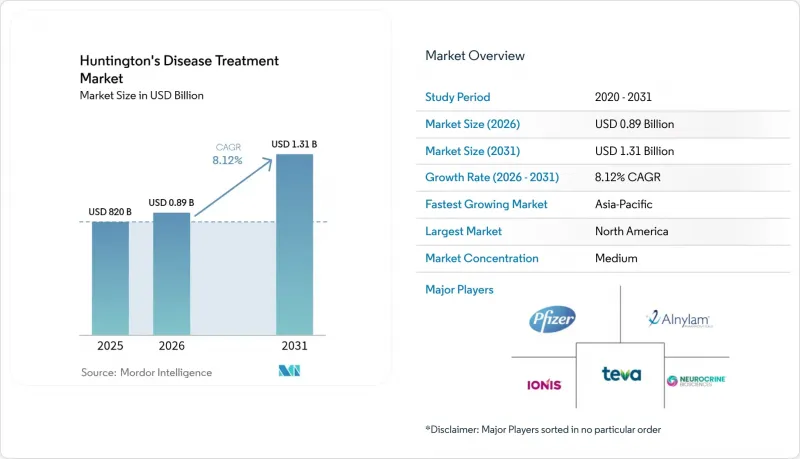
본 보고서는 유형별(증상 완화 치료 및 질병 진행 억제 치료), 투여 경로별(경구, 정맥 내 투여 등), 유통 채널별(병원 약국, 소매 약국 등), 질병 단계별(초기 단계, 중기 단계 등), 지역별(북미, 유럽, 아시아태평양 등)로 구분되어 있습니다. 시장 예측은 금액(달러) 기준으로 제시되어 있습니다.
전 세계 헌팅턴병 치료제 시장 동향 및 인사이트
HTT 감소를 목표로 하는 임상 파이프라인의 획기적인 진전
현재 여러 플랫폼에서 변이형 헌팅턴 단백질의 유의미한 감소가 확인되고 있습니다. WVE-003은 야생형 단백질을 보존하면서 뇌척수액 내 변이형 헌팅턴 단백질을 46% 감소시켜, 이전의 안전성 관련 우려를 해소했습니다. 경구용 제제인 PTC 518은 혈중 농도를 최대 43% 감소시켰으며, 12개월 시점에서 총 운동 점수(TMS)의 진행을 70% 이상 늦췄습니다. 노바티스가 PTC 518을 29억 달러에 인수함에 따라 투자자들의 신뢰가 높아졌으며, 이 치료법의 상업적 잠재력이 확고해졌습니다. 미국 FDA가 헌팅턴 단백질 감소를 대체 평가 지표로 인정할 의향을 밝힘에 따라 개발 일정이 단축되고, 단일 플랫폼에 의존하는 위험이 경감되어 헌팅턴병 치료 시장의 성장 궤도가 가속화되고 있습니다.
1일 1회 투여 방식의 VMAT2, 아시아에서 출시
테바(Teva)사와 장쑤 Nhwa사의 제휴를 통해 AUSTEDO가 중국 최초의 중수소화 의약품으로 승인되어, 무도병 치료에 대한 접근성이 확대됨과 동시에 향후 질병 수정제 시장 진입을 위한 발판이 마련되었습니다. INGREZZA는 2024년에 23억 달러의 매출을 기록했으며, 분제 제형 덕분에 연하 장애가 있는 환자들도 약을 복용하기 쉬워졌습니다. 유병률 격차(아시아 10만 명당 0.40, 유럽 10만 명당 5.70)로 인해 대중을 대상으로 한 캠페인보다는 의사 교육을 중시하는 접근 방식이 필요합니다. 따라서 아시아에서의 전략적 출시는 헌팅턴병 치료 시장의 입지를 유럽 및 미국의 주요 시장을 넘어 확장하게 될 것입니다.
유전자 치료 및 세포 치료의 극도로 높은 비용
환자 1인당 100만 달러를 초과하는 정가는 공평한 접근성을 위협하고 있습니다. 1만 종의 희귀질환 중 FDA 승인을 받은 치료법이 있는 경우는 5% 미만에 불과하며, 이는 보험 급여의 장벽을 여실히 드러내고 있습니다. 보험사들은 가치 기반 모델이나 재보험 도입을 검토하고 있지만, 도입 현황이 제각각이어서 많은 시장에서 여전히 이용이 어렵고, 이는 헌팅턴병 치료 시장의 조기 보급을 지연시키고 있습니다.
부문 분석
2025년 시점에서 대증요법 약물은 헌팅턴병 치료 시장 점유율의 61.92%를 차지했으나, 질병 수정 약물은 2031년까지 연평균 성장률(CAGR) 15.84%라는 빠른 속도로 확대되고 있습니다. 이러한 전환에 따라 경구용 저분자 화합물, 안티센스 올리고뉴클레오티드, RNA 간섭 벡터 및 AAV 유전자 치료가 융합되면서 헌팅턴병 치료 시장은 확대되고 있습니다. INGREZZA의 2024년 매출 23억 달러는 무도증 억제에 대한 견고한 수요를 뒷받침하는 한편, AMT-130이 외부 대조군에 비해 질병 진행을 80% 늦춘 것은 유전자 치료가 가져다주는 획기적인 가능성을 보여줍니다. 베타 차단제의 적응증 외 사용을 통해 발병 전 보균자의 운동 증상 위험이 34% 감소하는 것으로 나타나, 대증 요법과 병태 수정 요법의 패러다임을 연결하는 가교 역할을 했습니다. 병용 요법이 정착됨에 따라, 개발 기업은 투여 순서의 최적화, 안전성 모니터링, 그리고 보험사 대상 증거 패키지의 정비가 필요하게 됩니다.
통합 치료 모델에서는 머지않아 1일 1회 투여하는 VMAT2 억제제와 정기적인 헌팅턴 단백질 감소 주사를 병용하여, 급성기 증상 완화와 장기적인 신경 보호를 동시에 달성할 수 있게 될 가능성이 있습니다. 헌팅턴병 치료 시장에서 질병 수식 약물 시장 규모는 2031년까지 5억 9,000만 달러에 달할 것으로 예측되며, 이는 매출 증가분의 45.00% 가까이를 차지할 것으로 보입니다. 이 치료법의 보급은 야생형 헌팅턴 단백질을 보존하고 외래 진료에서 투여가 가능하도록 하는 선택적 감소 접근법에 달려 있습니다. 바이오마커 기반의 승인에 관한 규제 유연성은 DNA 복구 경로나 체세포의 CAG 확장을 표적으로 하는 차세대 후보 약물 시장 진입 장벽을 더욱 낮출 것입니다.
2025년에는 경구 제제가 헌팅턴병 치료 시장 규모의 54.05%를 차지하며, 이는 높은 복약 순응도와 1차 진료에서의 처방 경향과 일치합니다. 정맥 내 투여 부문의 연평균 성장률(CAGR) 11.73%는 일회성 유전자 치료와 중추 신경계로의 정확한 분포가 요구되는 반복적인 안티센스 주입에 의해 촉진되고 있습니다. 척수강 내 투여는 여전히 틈새 시장이지만, 전신 노출 없이 뇌척수액에 접근해야 하는 대립 유전자 선택적 올리고뉴클레오티드의 경우 필수적입니다.
약물 전달 기술 분야에서는 현재, 프리필드 주사기나 동결건조 분말 키트 등 환자가 사용하기 편리한 포장 형태에 초점이 맞추어져 있습니다. 병원에서는 실시간 신경 모니터링 기능을 갖춘 정맥 주사실에 대한 투자가 진행되고 있으며, 전문 약국에서는 콜드체인 관리와 장기적인 사후 관리를 담당하고 있습니다. 시판 후 데이터를 통해 내구성과 안전성이 확인됨에 따라, 2031년까지 헌팅턴병 치료 시장에서 정맥 내 투여의 점유율은 29.40%에 근접할 것으로 예측됩니다. 피하 투여에서 정맥 내 투여로의 전환에 관한 연구를 통해 비용 대비 효과의 한계가 더욱 명확해질 것입니다.
지역별 분석
북미는 2025년에 전 세계 매출의 38.20%를 차지하며, 이는 신속 승인 절차에서 FDA의 주도적인 역할, 전문 클리닉의 집중, 그리고 VMAT2 억제제에 대한 보험사의 적극적인 채택에 힘입은 것입니다. 그러나 흑인 집단에서의 진단 지연은 절대적인 성장 잠재력을 억제하는 구조적 불평등을 여실히 드러내고 있습니다. 캐나다와 멕시코는 미국의 의료 센터와 협력하여 유전자 치료 임상시험에 대한 접근성을 확대하고 있으며, 국경을 초월한 의뢰 경로를 촉진함으로써 헌팅턴병 치료 시장을 꾸준히 확장하고 있습니다.
유럽에서는 규제 조화를 활용하여 질병 수정 약물의 승인 절차를 가속화하고 있으며, EMA는 2025년 하반기 출시를 목표로 프리도피딘의 심사를 진행하고 있습니다. 다국적 컨소시엄이 개발한 ‘Huntington Support App’은 진료소 분포의 불균형을 보완하는 비용 대비 효과가 높은 디지털 지원의 모범 사례가 되고 있습니다. 독일, 영국, 프랑스가 임상시험 후원을 주도하는 한편, 동유럽의 신경학 인프라 현대화는 두 자릿수 성장을 약속하고 있습니다. 다양한 보험 급여 제도에 따라 성과 연계형 시범 계약이 촉진되고 있으며, 그 유효성이 확인되면 다른 지역으로도 확대될 가능성이 있습니다.
아시아태평양은 2031년까지 연평균 성장률(CAGR)이 14.55%로 가장 빠르게 성장하는 지역이며, 중국의 첫 중수소화 의약품 승인 및 일본의 정교한 희귀질환 등록제가 성장의 견인차 역할을 하고 있습니다. 한국에서는 전문 학회가 현지 임상의의 연수를 추진하고 있으며, 호주 규제 당국의 병행 심사 제도가 국제적인 임상시험을 가속화하고 있습니다. 유병률이 낮기 때문에 세심한 관여가 요구됩니다. 의사 주도의 환자 매핑, 우수 센터(Center of Excellence) 인증, 원격 모니터링 등이 인프라가 미비한 지역의 격차를 메우고 있습니다. 이러한 노력들이 어우러져 신흥 경제국 전체에서 헌팅턴병 치료 시장의 입지를 강화하고 있습니다. 라틴아메리카, 중동 및 아프리카는 여전히 발전 단계에 있지만, 진단율 향상과 환자 지원 단체 주도의 정책 논의가 나타나고 있으며, 비용 장벽이 해소된다면 점차 보급이 확대될 것으로 예측됩니다.
기타 혜택:
- 엑셀 형식 시장 예측(ME) 시트
- 3개월간의 애널리스트 지원
자주 묻는 질문
목차
제1장 서론
제2장 조사 방법
제3장 주요 요약
제4장 시장 구도
제5장 시장 규모와 성장 예측
제6장 경쟁 구도
제7장 시장 기회와 향후 전망
JHS 26.08.28According to Mordor Intelligence, the huntington's disease treatment market size was valued at USD 820 million in 2025 and estimated to grow from USD 890 million in 2026 to reach USD 1.31 billion by 2031, at a CAGR of 8.12% during the forecast period (2026-2031).
This report is Segmented by Type (Symptomatic Treatment and Disease-Modifying Therapies), Route of Administration (Oral, Intravenous, and More), Distribution Channel (Hospital Pharmacies, Retail Pharmacies, and More), Stage of Disease (Early-Stage, Mid-Stage, and More), and Geography (North America, Europe, Asia-Pacific, and More). The Market Forecasts are Provided in Terms of Value (USD).
Global Huntington's Disease Treatment Market Trends and Insights
HTT-lowering clinical pipeline breakthroughs
Multiple platforms now show meaningful mutant huntingtin reductions. WVE-003 produced a 46% cerebrospinal-fluid decrease while sparing wild-type protein, addressing earlier safety concerns. Oral PTC 518 delivered up to 43% blood reductions and slowed Total Motor Score progression by more than 70% at 12 months. Investor confidence surged when Novartis paid USD 2.9 billion for PTC 518, crystallising the therapy's perceived commercial potential. The US FDA's readiness to accept huntingtin lowering as a surrogate endpoint compresses timelines and mitigates single-platform risk, accelerating the Huntington's disease treatment market trajectory.
Once-daily VMAT2 launches in Asia
Teva's alliance with Jiangsu Nhwa earned the first deuterated-drug approval in China for AUSTEDO, broadening access to chorea management and creating a springboard for future disease-modifying entries. INGREZZA generated USD 2.3 billion in 2024, with sprinkle formulations easing administration for dysphagic patients. Prevalence disparity-0.40 per 100,000 in Asia versus 5.70 per 100,000 in Europe-necessitates physician-education heavy models rather than mass-market campaigns. Strategic Asian launches therefore extend the Huntington's disease treatment market footprint beyond Western strongholds.
Ultra-high cost of gene and cell therapies
List prices eclipsing USD 1 million per patient threaten equitable access. Less than 5% of 10,000 rare diseases have FDA-cleared therapies, underscoring reimbursement hurdles. Payors explore value-based models and reinsurance, yet fragmented adoption keeps many markets out of reach and slows early uptake within the Huntington's disease treatment market.
Other drivers and restraints analyzed in the detailed report include:
- Fast-track and orphan designations in US / EU
- Rising incidence in ageing cohorts
- Limited specialist centres outside US/EU
For complete list of drivers and restraints, kindly check the Table Of Contents.
Segment Analysis
Symptomatic drugs retained 61.92% of the Huntington's disease treatment market share in 2025, yet disease-modifying agents are scaling faster at a 15.84% CAGR through 2031. This pivot enlarges the Huntington's disease treatment market as oral small molecules, antisense oligonucleotides, RNA interference constructs, and AAV gene therapies converge. INGREZZA's USD 2.3 billion 2024 revenue underscores robust demand for chorea control, while AMT-130's 80% slowing of disease progression versus external controls illustrates gene therapy's disruptive promise. Beta-blocker repurposing introduced 34% motor-symptom risk reduction in pre-manifest carriers, bridging symptomatic and modifying paradigms. As combination regimens coalesce, developers will need to optimise sequencing, safety monitoring, and payor evidence packages.
Integrated care models may soon pair once-daily VMAT2 inhibitors with periodic huntingtin-lowering infusions to synchronise acute symptom relief and long-range neuroprotection. The Huntington's disease treatment market size for disease-modifying products is projected to reach USD 590 million by 2031, accounting for nearly 45.00% of incremental revenue growth. Uptake hinges on selective lowering approaches that spare wild-type huntingtin and offer outpatient dosing. Regulatory flexibility around biomarker-driven approvals further lowers market-entry barriers for next-wave candidates targeting DNA-repair pathways and somatic CAG expansion.
Oral formulations secured 54.05% of the Huntington's disease treatment market size in 2025, aligned with strong adherence and primary-care prescription patterns. Intravenous segment growth at 11.73% CAGR is catalysed by one-time gene therapies and recurrent antisense infusions demanding precise central-nervous-system distribution. Intrathecal delivery remains niche yet essential for allele-selective oligonucleotides that require cerebrospinal-fluid access without systemic exposure.
Drug-delivery engineering now focuses on patient-friendly packaging such as pre-filled syringes and lyophilised powder kits. Hospitals invest in infusion suites with real-time neuro-monitoring, while specialty pharmacies manage cold chain and long-term follow-up. As post-marketing data confirm durability and safety, intravenous share is forecast to approach 29.40% of the Huntington's disease treatment market by 2031. Subcutaneous-to-intravenous switching studies will further refine cost-effectiveness boundaries.
Complete Report Scope:
- By Treatment Type
- Symptomatic Treatments
- VMAT2 Inhibitors
- Antidopaminergics (Antipsychotics)
- Antidepressants & Anxiolytics
- Anticonvulsants / Others
- Disease-Modifying Therapies
- Gene Silencing / ASO
- Gene Therapy (AAV, LNP etc.)
- Stem-Cell Therapy
- Small-Molecule HTT Modifiers
- Symptomatic Treatments
- By Route of Administration
- Oral
- Intravenous
- Intrathecal
- Subcutaneous
- By Distribution Channel
- Hospital Pharmacies
- Retail Pharmacies
- Specialty & Online Pharmacies
- By Stage of Disease
- Pre-symptomatic / Prodromal
- Early-Stage
- Mid-Stage
- Late-Stage
- Geography
- North America
- United States
- Canada
- Mexico
- Europe
- Germany
- United Kingdom
- France
- Italy
- Spain
- Rest of Europe
- Asia-Pacific
- China
- Japan
- India
- South Korea
- Australia
- Rest of Asia-Pacific
- Middle East and Africa
- GCC
- South Africa
- Rest of Middle East and Africa
- South America
- Brazil
- Argentina
- Rest of South America
- North America
Geography Analysis
North America generated 38.20% of global revenue in 2025, underpinned by FDA leadership on expedited pathways, concentrated specialist clinics, and strong payer adoption of VMAT2 inhibitors. Nevertheless, diagnosis delays in Black populations highlight systemic inequities that temper absolute growth potential. Canada and Mexico collaborate with US centres to widen access to gene therapy trials, fostering cross-border referral channels that steadily enlarge the Huntington's disease treatment market.
Europe leverages regulatory harmonisation to fast-track disease-modifying dossiers, with the EMA reviewing pridopidine for potential H2 2025 launch. Multi-country consortia developed the Huntington Support App, exemplifying cost-efficient digital outreach that offsets uneven clinic density. Germany, United Kingdom, and France lead on trial sponsorship, while Eastern Europe's modernising neurologic infrastructure promises double-digit gains. Diverse reimbursement systems foster pilot outcomes-based contracts that could migrate to other regions once validated.
Asia-Pacific is the fastest-growing cluster at 14.55% CAGR through 2031, spearheaded by China's first deuterated-drug approval and Japan's sophisticated rare-disease registries Teva. South Korea's dedicated society advances local clinician training, and Australia's regulatory parallel-processing accelerates international studies. Lower prevalence forces high-touch engagement: physician-led patient mapping, centre-of-excellence accreditation, and remote monitoring fill gaps where infrastructure lags. These initiatives collectively elevate the Huntington's disease treatment market presence across emerging economies. Latin America, the Middle East, and Africa remain nascent yet display improving diagnostic rates and advocacy-driven policy discussions that foreshadow gradual uptake once cost barriers recede.
- Pfizer
- Teva Pharmaceutical Industries
- Neurocrine Biosciences
- Alnylam Pharmaceuticals
- Ionis Pharmaceuticals
- Roche / Genentech
- Novartis
- uniQure
- Sangamo Therapeutics
- PTC Therapeutics
- Prilenia Therapeutics
- Wave Life Sciences
- Sage Therapeutics
- Biogen
- Lundbeck
- Azevan Pharmaceuticals
- Voyager Therapeutics
- IntraBio
- Kyowa Kirin
- Vaxxinity
Additional Benefits:
- The market estimate (ME) sheet in Excel format
- 3 months of analyst support
TABLE OF CONTENTS
1 Introduction
- 1.1 Study Assumptions & Market Definition
- 1.2 Scope of the Study
2 Research Methodology
3 Executive Summary
4 Market Landscape
- 4.1 Market Overview
- 4.2 Market Drivers
- 4.2.1 Rising Incidence In Ageing-Cohort Populations
- 4.2.2 Accelerating HTT-Lowering Clinical Pipeline Breakthroughs
- 4.2.3 Commercial Launch Of Once-Daily VMAT2 Inhibitors In Asia
- 4.2.4 Fast-Track & Orphan Designations In US / EU
- 4.2.5 AI-Enabled Biomarker Discovery Improving Trial Success
- 4.2.6 ?eta-Blocker Repurposing Showing Disease-Modifying Signal
- 4.3 Market Restraints
- 4.3.1 Ultra-High Cost Of Gene & Cell Therapies
- 4.3.2 Limited Specialist Centres Outside North America & EU
- 4.3.3 Sub-Optimal Adherence To Symptomatic Poly-Pharmacy
- 4.3.4 Data-Safety Concerns For CRISPR In Neuronal Tissue
- 4.4 Porter's Five Forces
- 4.4.1 Threat of New Entrants
- 4.4.2 Bargaining Power of Buyers
- 4.4.3 Bargaining Power of Suppliers
- 4.4.4 Threat of Substitutes
- 4.4.5 Intensity of Competitive Rivalry
5 Market Size & Growth Forecasts (Value, USD)
- 5.1 By Treatment Type
- 5.1.1 Symptomatic Treatments
- 5.1.1.1 VMAT2 Inhibitors
- 5.1.1.2 Antidopaminergics (Antipsychotics)
- 5.1.1.3 Antidepressants & Anxiolytics
- 5.1.1.4 Anticonvulsants / Others
- 5.1.2 Disease-Modifying Therapies
- 5.1.2.1 Gene Silencing / ASO
- 5.1.2.2 Gene Therapy (AAV, LNP etc.)
- 5.1.2.3 Stem-Cell Therapy
- 5.1.2.4 Small-Molecule HTT Modifiers
- 5.1.1 Symptomatic Treatments
- 5.2 By Route of Administration
- 5.2.1 Oral
- 5.2.2 Intravenous
- 5.2.3 Intrathecal
- 5.2.4 Subcutaneous
- 5.3 By Distribution Channel
- 5.3.1 Hospital Pharmacies
- 5.3.2 Retail Pharmacies
- 5.3.3 Specialty & Online Pharmacies
- 5.4 By Stage of Disease
- 5.4.1 Pre-symptomatic / Prodromal
- 5.4.2 Early-Stage
- 5.4.3 Mid-Stage
- 5.4.4 Late-Stage
- 5.5 Geography
- 5.5.1 North America
- 5.5.1.1 United States
- 5.5.1.2 Canada
- 5.5.1.3 Mexico
- 5.5.2 Europe
- 5.5.2.1 Germany
- 5.5.2.2 United Kingdom
- 5.5.2.3 France
- 5.5.2.4 Italy
- 5.5.2.5 Spain
- 5.5.2.6 Rest of Europe
- 5.5.3 Asia-Pacific
- 5.5.3.1 China
- 5.5.3.2 Japan
- 5.5.3.3 India
- 5.5.3.4 South Korea
- 5.5.3.5 Australia
- 5.5.3.6 Rest of Asia-Pacific
- 5.5.4 Middle East and Africa
- 5.5.4.1 GCC
- 5.5.4.2 South Africa
- 5.5.4.3 Rest of Middle East and Africa
- 5.5.5 South America
- 5.5.5.1 Brazil
- 5.5.5.2 Argentina
- 5.5.5.3 Rest of South America
- 5.5.1 North America
6 Competitive Landscape
- 6.1 Market Concentration
- 6.2 Market Share Analysis
- 6.3 Company Profiles (includes Global level Overview, Market level overview, Core Segments, Financials as available, Strategic Information, Market Rank/Share for key companies, Products & Services, and Recent Developments)
- 6.3.1 Pfizer Inc
- 6.3.2 Teva Pharmaceutical Industries
- 6.3.3 Neurocrine Biosciences
- 6.3.4 Alnylam Pharmaceuticals
- 6.3.5 Ionis Pharmaceuticals
- 6.3.6 Roche / Genentech
- 6.3.7 Novartis AG
- 6.3.8 uniQure
- 6.3.9 Sangamo Therapeutics
- 6.3.10 PTC Therapeutics
- 6.3.11 Prilenia Therapeutics
- 6.3.12 Wave Life Sciences
- 6.3.13 Sage Therapeutics
- 6.3.14 Biogen Inc.
- 6.3.15 Lundbeck
- 6.3.16 Azevan Pharmaceuticals
- 6.3.17 Voyager Therapeutics
- 6.3.18 IntraBio
- 6.3.19 Kyowa Kirin
- 6.3.20 Vaxxinity
7 Market Opportunities & Future Outlook
- 7.1 White-space & Unmet-need Assessment


