

|
시장보고서
상품코드
2116341
에어택시 : 시장 점유율 분석, 업계 동향 및 통계, 성장 예측(2026-2031년)Air Taxi - Market Share Analysis, Industry Trends & Statistics, Growth Forecasts (2026 - 2031) |
||||||
 Mordor Intelligence
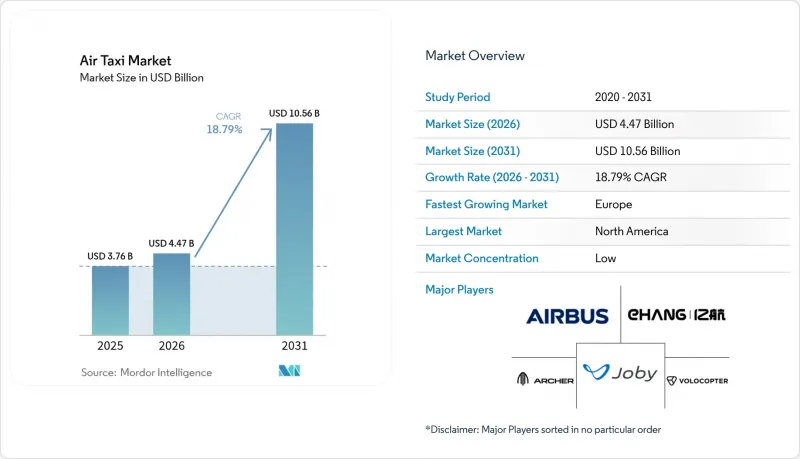
Mordor Intelligence에 의하면, 에어택시 시장 규모는 2025년 37억 6,000만 달러로 평가되었습니다. 2026년에는 44억 7,000만 달러로 확대되어 2026년부터 2031년에 걸쳐 CAGR 18.79%로 성장을 지속하여, 2031년에는 105억 6,000만 달러에 이를 것으로 예측됩니다.
본 보고서는 운용 모드(유인 및 자율형), 추진 방식(전기, 하이브리드 등), 승객 정원(1-2석 등), 항속 거리(시내, 단거리 도시 간, 지역 내, 장거리),용도(공항 셔틀 등), 리프트 기술(멀티콥터, 틸트로터 등), 지역(북미, 유럽 등)별로 분류되어 있습니다. 시장 예측은 금액(미 달러) 기준으로 제시되어 있습니다.
세계의 에어택시 시장 동향 및 인사이트
배터리 밀도의 비약적인 향상으로 실용적인 항속 거리 확대
현재 리튬 이온 배터리 팩은 250-300 Wh/kg의 에너지 밀도밖에 없어, 많은 도시 간 이동의 항속 거리는 약 30 km로 제한되어 있습니다. CATL의 500 Wh/kg ‘Qilin’ 셀과 새롭게 등장하고 있는 리튬-황계 배터리 기술 덕분에 2027년까지 실용적 항속 거리가 2배로 늘어날 것으로 기대됩니다. 이에 따라 좌석 킬로미터당 에너지 비용이 절감되어 지역 간 도시 노선이 개척될 전망입니다. Joby사의 S4 기체에 채택된 구조용 배터리 모듈을 통해 구조 중량을 15-20% 줄일 수 있는 한편, 고체 배터리 프로토타입은 FAA의 열폭주 기준을 충족하여 인증 절차가 가속화되고 있습니다.
버티포트에서의 민관 파트너십이 인프라 구축을 가속화
세계적으로 1,500곳 이상의 버티포트가 계획 단계에 있지만, 맨해튼의 EB 105A 시범 부지는 공동 출자 모델을 통해 건설 기간을 3-5년으로 단축할 수 있음을 입증하고 있습니다. 두바이와 오사카의 유사한 프레임워크는 이 모델의 재현 가능성을 시사하며, 에어택시 시장이 이착륙 패드나 충전기공급 부족으로 제약을 받지 않을 것임을 보장합니다. 인프라가 확대됨에 따라 새로운 노선이 개척되고 이동 시간이 단축될 것입니다. 혁신을 촉진하고 규제 절차를 효율화하기 위해서는 민관 협력이 필수적입니다.
새로운 비행 제어 소프트웨어 인증의 병목 현상
각 eVTOL에는 DO-178C 레벨 A 프로세스를 준수해야 하는 안전상 극히 중요한 1만 줄 이상의 코드가 탑재되어 있습니다. 자격을 갖춘 소프트웨어 평가자가 부족하기 때문에 FAA와 EASA는 외부 컨설턴트에 의존할 수밖에 없으며, 이로 인해 승인 주기가 2-3년 연장되기도 합니다. 예상되는 비용 초과로 인해 수익화 이전에 2억-3억 달러의 현금이 소진될 가능성이 있으며, 이는 자본력이 부족한 신규 진출기업의 파산 위험을 높입니다.
부문별 분석
2025년에는 조종사가 탑승하는 비행이 부문 수익의 60.72%를 차지했으며, 정평이 나 있는 회전익기 훈련 체계를 활용하고 있습니다. 한편, 자율 시스템은 연평균 성장률(CAGR) 24.10%로 성장을 지속하고 있습니다. 이는 비용 구조상 연간 15만 달러 이상의 조종사 인건비를 절감할 수 있을 뿐만 아니라, 승무원의 휴식으로 인한 병목 현상 없이 24시간 운항이 가능하기 때문입니다. 미국에서의 회랑 시험 및 중국의 EHang에 의한 도입은 원격 감시의 개념을 뒷받침하는 것이며, 규제 당국이 요구하는 안전 데이터를 점차 축적하고 있습니다. 자율 비행에 대한 신뢰가 높아짐에 따라, 물류, 긴급 대응, 통근 수요를 목표로 하는 2020년대 후반 도입을 위한 에어택시 시장 규모는 확대되고 있습니다.
혼합 교통 환경에서도 소프트웨어 후보의 견고성이 입증됨에 따라 확장성이 향상됩니다. 자율 비행 기술이 성숙해지면 운항 사업자는 인간 조종사를 기단 관리 업무에 재배치할 수 있게 되어, 항공기 가동률 향상과 승무원 확보로 인한 운항 중단 위험을 줄이는 데 기여할 것입니다. 이에 따라 훈련비와 보험료도 절감될 전망이지만, 규제 당국이 완전한 핸즈프리 운항을 승인할 때까지는 조기 도입 사업자들이 안전 확보를 위해 기내에 안전 조종사를 계속 탑승시켜야할 것입니다.
배터리식 전기 플랫폼은 셀 비용의 하락과 구동계 유지보수의 간편함에 힘입어 2025년 출하 대수의 54.88%를 차지했습니다. 그러나 Joby사의 523마일 시범 비행에 힘입어 수소 연료전지 항공기는 연평균 성장률(CAGR) 20.85%로 성장하고 있으며, 수백 킬로미터 구간을 운항해야 하는 지역 항공사들의 관심을 끌고 있습니다. 배터리 교체 및 350kW 급속 충전 사양 덕분에 전기 모델은 도시 지역 운항에서 경쟁력을 유지하고 있는 반면, 하이브리드 방식은 항속 거리에 대한 우려를 해소하고자 하는 운항 사업자들에게 가교 역할을 하고 있습니다.
인프라가 속도를 좌우합니다. 배터리 충전기는 전기차 정비망에 편승하여 설치되는 반면, 수소에는 새로운 저장 및 공급 시설이 필요합니다. BP나 쉘과 같은 대형 석유 회사들은 대형 트럭 네트워크와의 시너지 효과를 기대하고 있으며, 이를 통해 수소는 2030년 이후 에어택시 시장에서 15-20%의 점유율을 확보할 수 있는 현실적인 길이 열리고 있습니다.
지역별 분석
FAA(연방항공청)가 동력 상승기의 틀을 확정하고, 대도시권의 버티포트(수직 이착륙장) 시범 사업이 환경 심사의 장벽을 넘어선 결과, 2025년 수익의 45.10%를 북미가 차지했습니다. 미국 항공사가 주요 고객으로 기능하며 예측 가능한 수요 곡선을 형성하고 있으며, 투자자들은 이를 프로젝트 파이낸싱 체계 구축에 활용하고 있습니다. 캐나다와 멕시코는 국경을 넘는 관광 노선과 지원적인 시험 비행 노선을 통해 추가적인 성장에 기여하고 있습니다.
아시아태평양은 연평균 성장률(CAGR) 25.20%로 급성장하고 있습니다. 중국의 저고도 경제 구상에 따라 EHang과 AutoFlight는 시범 프로그램의 범위를 넘어 상용 기단을 확대하는 것이 승인되었으며, 한편 일본의 오사카 엑스포에서는 2025년에 일상적인 여객 서비스 시연이 예정되어 있습니다. 인도의 지방 도시 네트워크는 항공 교통 밀도가 비교적 낮은 가운데 새로운 비행 노선을 개척하고 있으며, 혼잡한 공역으로 전환되기 전에 스타트업 기업들에게 유리한 시험장을 제공합니다.
유럽은 3위를 차지하고 있지만, EASA(유럽항공안전청)의 SC-VTOL 규정을 통해 규제 측면에서 영향력을 행사하며, 세계 안전 기준 수립에 기여하고 있습니다. 독일에는 Volocopter나 Lilium과 같은 주요 기업들이 거점을 두고 있으나, 후자의 파산은 자본 집약형 비즈니스가 안고 있는 과제를 여실히 드러내고 있습니다. EU의 ‘커넥팅 유럽 시설(CEF)’은 버티포트(수직 이착륙장)에 대한 보조금으로 12억 9,000만 달러를 배정하여, EU 전역의 인프라 구축 기반을 강화하고 있습니다.
기타 혜택 :
- 엑셀 형식 시장 예측(ME) 시트
- 3개월간의 애널리스트 지원
자주 묻는 질문
목차
제1장 서론
제2장 조사 방법
제3장 개요
제4장 시장 구도
제5장 시장 규모 및 성장 예측
제6장 경쟁 구도
제7장 시장 기회 및 향후 전망
KTH 26.08.31According to Mordor Intelligence, the air taxi market size is expected to grow from USD 3.76 billion in 2025 to USD 4.47 billion in 2026 and is forecast to reach USD 10.56 billion by 2031 at 18.79% CAGR over 2026-2031.
This report is Segmented by Mode of Operation (Piloted and Autonomous), Propulsion Type (Electric, Hybrid, and More), Passenger Capacity (1 To 2 Seats, and More), Range (Intracity, Short Intercity, Regional, and Extended), End-Use (Airport Shuttle, and More), Lift Technology (Multicopter, Tilt-Rotor, and More), and Geography (North America, Europe, and More). The Market Forecasts are Provided in Terms of Value (USD).
Global Air Taxi Market Trends and Insights
Battery-density breakthroughs extend practical range
Present lithium-ion packs deliver 250-300 Wh/kg, capping many urban trips at roughly 30 km. CATL's 500 Wh/kg Qilin cell and emerging lithium-sulfur chemistries promise to double usable range by 2027, trimming energy cost per seat-kilometer and opening regional city pairs. Structural battery modules in Joby's S4 airframe remove 15-20% structural weight, while solid-state prototypes meet FAA thermal-runaway criteria and unlock accelerated certification.
Vertiport public-private partnerships accelerate infrastructure rollout
More than 1,500 vertiports sit in global pipelines, but Manhattan's EB 105A pilot site proves that co-funded models can cut build times to three to five years. Similar frameworks in Dubai and Osaka hint at replicability, ensuring the air taxi market is not supply-constrained by pads and chargers. As infrastructure expands, it will unlock new routes and reduce travel times. Collaboration between the private and public sectors is essential to foster innovation and streamline regulatory processes.
Certification bottlenecks for novel flight-control software
Each eVTOL hosts over 10,000 lines of safety-critical code that must comply with DO-178C Level A processes. Scarcity of qualified software assessors forces FAA and EASA to rely on external consultants, sometimes extending approval cycles by two to three years. Predictive cost overruns can consume USD 200-300 million of pre-revenue cash, elevating bankruptcy risk for under-capitalized entrants.
Other drivers and restraints analyzed in the detailed report include:
- Airline and airport integration for premium first-/last-mile service
- Noise-abatement eVTOL designs gain fast-track certification
- Limited high-power grid capacity at vertiport sites
For complete list of drivers and restraints, kindly check the Table Of Contents.
Segment Analysis
Piloted flights generated 60.72% of segment revenue in 2025, leveraging well-known rotorcraft training pipelines. Autonomous systems, however, are tracking a 24.10% CAGR because they strip USD 150,000-plus in annual pilot wages from the cost stack and support round-the-clock operations without crew-rest bottlenecks. The US corridor trials and China's EHang deployments validate remote oversight concepts, gradually building the safety data regulators require. Rising confidence in autonomy widens the air taxi market size for late-decade deployments aimed at logistics, emergency response, and commuter pools.
Scalability improves as software candidates prove robust across mixed traffic. When autonomy matures, operators could redeploy human pilots into fleet-services roles, boosting aircraft utilization and reducing cancellation risks tied to crew availability. Training and insurance costs should compress in lock-step, though early adopters will maintain a safety pilot on board until regulators sign off on full hands-free operations.
Battery-electric platforms captured 54.88% of 2025 shipments, buoyed by falling cell costs and simple drivetrain maintenance. Yet hydrogen fuel-cell aircraft, spurred by Joby's 523-mile demo flight, are advancing at 20.85% CAGR, attracting interest from regional carriers that need multi-hundred-kilometer legs. Battery swaps and 350-kW fast-charge specs keep electric models competitive on urban missions, while hybrid architectures provide a bridge for operators hedging range anxiety.
Infrastructure dictates pace: Battery chargers piggyback on EV build-outs, whereas hydrogen demands new storage and dispensing. Oil majors like BP and Shell see synergies with heavy-truck networks, giving hydrogen a realistic path to a 15-20% air taxi market share post-2030.
Complete Report Scope:
- By Mode of Operation
- Piloted
- Autonomous
- By Propulsion Type
- Electric
- Hybrid
- Turboshaft
- Hydrogen Fuel Cell
- By Passenger Capacity
- 1 to 2 Seats
- 3 to 4 Seats
- 5 to 6 Seats
- More than 6 Seats
- By Range
- Intracity (Less than 50 km)
- Short Intercity (50 to 150 km)
- Regional (150 to 300 km)
- Extended (More than 300 km)
- By End-Use
- Airport Shuttle
- On-Demand Air Taxi
- Corporate Shuttle
- Emergency Medical Services
- Tourism and Sightseeing
- By Lift Technology
- Multicopter
- Tilt-Rotor
- Lift + Cruise
- Ducted Fan Jet
- By Geography
- North America
- United States
- Canada
- Mexico
- Europe
- United Kingdom
- France
- Germany
- Russia
- Rest of Europe
- Asia-Pacific
- China
- India
- Japan
- South Korea
- Rest of Asia-Pacific
- South America
- Brazil
- Rest of South America
- Middle East and Africa
- Middle East
- Saudi Arabia
- United Arab Emirates
- Rest of Middle East
- Africa
- South Africa
- Rest of Africa
- Middle East
- North America
Geography Analysis
North America generated 45.10% of 2025 revenue after the FAA finalized powered-lift frameworks and metropolitan vertiport pilots moved past environmental-review hurdles. The US airlines act as anchor customers, creating predictable demand curves that investors leverage for project-finance structures. Canada and Mexico contribute incremental growth through cross-border tourism routes and supportive test corridors.
Asia-Pacific is accelerating at a 25.20% CAGR. China's low-altitude economy blueprint green-lights EHang and AutoFlight to scale commercial fleets beyond pilot programs, while Japan's Osaka Expo is set to showcase daily passenger services in 2025. India's tier-2 city network opens new miles under mild air traffic density, offering startup-friendly test beds before shifting into crowded skies.
Europe ranks third but wields regulatory influence via EASA's SC-VTOL code, shaping safety baselines worldwide. Germany hosts flagship players Volocopter and Lilium, although the latter's insolvency underscores capital-intensity challenges. The EU's Connecting Europe Facility earmarks USD 1.29 billion for vertiport grants, raising baseline infrastructure readiness across the bloc.
- Airbus SE
- Archer Aviation Inc.
- AutoFlight China
- BETA Technologies, Inc.
- Eve Holding, Inc.
- Guangzhou EHang Intelligent Technology Co. Ltd.
- Honeywell International Inc.
- Supernal, LLC
- Jaunt Air Mobility LLC
- Joby Aero, Inc.
- Wisk Aero LLC
- PIPISTREL D.O.O. (Textron Inc.)
- The Boeing Company
- Vertical Aerospace Group Ltd.
- Volocopter GmbH (Diamond Aircraft Industries GmbH)
- XTI Aerospace, Inc.
Additional Benefits:
- The market estimate (ME) sheet in Excel format
- 3 months of analyst support
TABLE OF CONTENTS
1 INTRODUCTION
- 1.1 Study Assumptions and Market Definition
- 1.2 Scope of the Study
2 RESEARCH METHODOLOGY
3 EXECUTIVE SUMMARY
4 MARKET LANDSCAPE
- 4.1 Market Overview
- 4.2 Market Drivers
- 4.2.1 Battery-density breakthroughs extend practical range
- 4.2.2 Vertiport public-private partnerships accelerate infrastructure rollout
- 4.2.3 Airline and airport integration for premium first-mile/last-mile service
- 4.2.4 Noise-abatement eVTOL designs gain fast-track certification
- 4.2.5 Post-COVID decentralized work patterns spur regional mobility demand
- 4.2.6 Corporate ESG mandates prioritize zero-emission mobility solutions
- 4.3 Market Restraints
- 4.3.1 Certification bottlenecks for novel flight-control software
- 4.3.2 Limited high-power grid capacity at candidate vertiport sites
- 4.3.3 Scarcity of aviation-grade lithium and rare-earth materials
- 4.3.4 Public safety perception after any high-profile incident
- 4.4 Value Chain Analysis
- 4.5 Regulatory Landscape
- 4.6 Technological Outlook
- 4.7 Porter's Five Forces Analysis
- 4.7.1 Bargaining Power of Suppliers
- 4.7.2 Bargaining Power of Buyers
- 4.7.3 Threat of New Entrants
- 4.7.4 Threat of Substitute Products
- 4.7.5 Intensity of Competitive Rivalry
5 MARKET SIZE AND GROWTH FORECASTS (VALUE)
- 5.1 By Mode of Operation
- 5.1.1 Piloted
- 5.1.2 Autonomous
- 5.2 By Propulsion Type
- 5.2.1 Electric
- 5.2.2 Hybrid
- 5.2.3 Turboshaft
- 5.2.4 Hydrogen Fuel Cell
- 5.3 By Passenger Capacity
- 5.3.1 1 to 2 Seats
- 5.3.2 3 to 4 Seats
- 5.3.3 5 to 6 Seats
- 5.3.4 More than 6 Seats
- 5.4 By Range
- 5.4.1 Intracity (Less than 50 km)
- 5.4.2 Short Intercity (50 to 150 km)
- 5.4.3 Regional (150 to 300 km)
- 5.4.4 Extended (More than 300 km)
- 5.5 By End-Use
- 5.5.1 Airport Shuttle
- 5.5.2 On-Demand Air Taxi
- 5.5.3 Corporate Shuttle
- 5.5.4 Emergency Medical Services
- 5.5.5 Tourism and Sightseeing
- 5.6 By Lift Technology
- 5.6.1 Multicopter
- 5.6.2 Tilt-Rotor
- 5.6.3 Lift + Cruise
- 5.6.4 Ducted Fan Jet
- 5.7 By Geography
- 5.7.1 North America
- 5.7.1.1 United States
- 5.7.1.2 Canada
- 5.7.1.3 Mexico
- 5.7.2 Europe
- 5.7.2.1 United Kingdom
- 5.7.2.2 France
- 5.7.2.3 Germany
- 5.7.2.4 Russia
- 5.7.2.5 Rest of Europe
- 5.7.3 Asia-Pacific
- 5.7.3.1 China
- 5.7.3.2 India
- 5.7.3.3 Japan
- 5.7.3.4 South Korea
- 5.7.3.5 Rest of Asia-Pacific
- 5.7.4 South America
- 5.7.4.1 Brazil
- 5.7.4.2 Rest of South America
- 5.7.5 Middle East and Africa
- 5.7.5.1 Middle East
- 5.7.5.1.1 Saudi Arabia
- 5.7.5.1.2 United Arab Emirates
- 5.7.5.1.3 Rest of Middle East
- 5.7.5.2 Africa
- 5.7.5.2.1 South Africa
- 5.7.5.2.2 Rest of Africa
- 5.7.5.1 Middle East
- 5.7.1 North America
6 COMPETITIVE LANDSCAPE
- 6.1 Market Concentration
- 6.2 Strategic Moves
- 6.3 Market Share Analysis
- 6.4 Company Profiles (includes Global level Overview, Market level overview, Core Segments, Financials as available, Strategic Information, Market Rank/Share for key companies, Products and Services, and Recent Developments)
- 6.4.1 Airbus SE
- 6.4.2 Archer Aviation Inc.
- 6.4.3 AutoFlight China
- 6.4.4 BETA Technologies, Inc.
- 6.4.5 Eve Holding, Inc.
- 6.4.6 Guangzhou EHang Intelligent Technology Co. Ltd.
- 6.4.7 Honeywell International Inc.
- 6.4.8 Supernal, LLC
- 6.4.9 Jaunt Air Mobility LLC
- 6.4.10 Joby Aero, Inc.
- 6.4.11 Wisk Aero LLC
- 6.4.12 PIPISTREL D.O.O. (Textron Inc.)
- 6.4.13 The Boeing Company
- 6.4.14 Vertical Aerospace Group Ltd.
- 6.4.15 Volocopter GmbH (Diamond Aircraft Industries GmbH)
- 6.4.16 XTI Aerospace, Inc.
7 MARKET OPPORTUNITIES AND FUTURE OUTLOOK
- 7.1 White-space and Unmet-Need Assessment


