|
시장보고서
상품코드
2116349
심장 안전 서비스 : 시장 점유율 분석, 업계 동향 및 통계, 성장 예측(2026-2031년)Cardiac Safety Service - Market Share Analysis, Industry Trends & Statistics, Growth Forecasts (2026 - 2031) |
||||||
 Mordor Intelligence
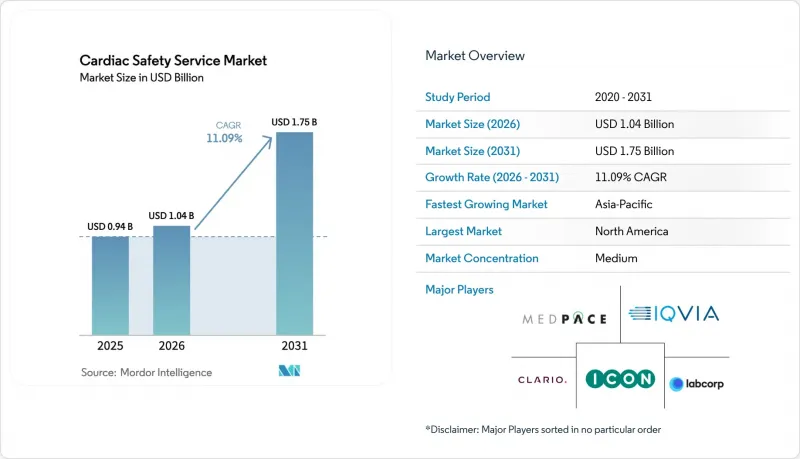
Mordor Intelligence에 의하면, 심장 안전 서비스 시장 규모는 2025년 9억 4,000만 달러로 평가되었습니다. 2026년 10억 4,000만 달러에서 2031년까지 17억 5,000만 달러로 확대되고 2026년부터 2031년까지 연평균 복합 성장률(CAGR)은 11.09%를 나타낼 전망입니다.
본 보고서는 서비스 유형별(심층 QT/QTc 검사 서비스, 심전도 및 홀터 모니터링 분석, 혈압 및 원격 측정 분석 등),서비스 제공 모델(사내 실시 등), 임상시험 단계(1상 등), 최종 사용자(제약사 등), 지역(북미 등)별로 분류되어 있습니다. 시장 예측은 금액(달러) 기준으로 제시되어 있습니다.
세계의 심장 안전 서비스 시장 동향 및 인사이트
분산형 및 하이브리드형 임상시험의 도입 확대
분산형 심장 안전성 워크플로는 심혈관계 연구에서 차지하는 비중이 2023년 12%에서 2025년 28%로 성장했습니다. 원격 홀터 패치는 암호화된 심전도 데이터를 클라우드 서버로 전송하고, 몇 시간 이내에 QTc 드리프트를 감지함으로써 FDA의 2024년 디지털 헬스 지침 요건을 충족합니다. 하이브리드형 접근 방식은 재택 원격 모니터링과 시설 내 심초음파 검사를 결합하여 영상 진단의 정확도를 유지하면서 환자의 교통비를 40% 절감하고 있습니다. Clario와 같은 벤더들은 2025년에 종양학 프로토콜 전반에 걸쳐 1만 5,000대의 웨어러블 기기를 도입하고, 머신러닝 알고리즘을 활용하여 부정맥 경보를 자동으로 상위 단계로 에스컬레이션했습니다. 일원화된 재검토를 통해 지역별 심장 전문의 부족 문제를 완화하고, 데이터 품질을 저하시키지 않으면서 다국간 피험자 등록을 가능하게 하고 있습니다.
암 임상시험에서 심혈관계 이상반응 발생률 증가
2024년 암 임상시험에서 발생한 중대한 이상반응 중 심혈관계 독성이 2위를 차지했습니다. 티로신 키나제 억제제나 면역관문억제제는 QT 간격을 연장하거나 심근염을 유발할 수 있으므로, FDA는 안전성에 관한 공지를 발령했으며, 현재는 초기 단계의 암 임상시험 프로토콜에서 심전도(ECG) 모니터링 강화를 의무화하고 있습니다. 2025년에 개정된 유럽심장학회(ESC) 지침에서는 심전도 모니터링을 바이오마커 및 영상 진단과 병행할 것을 권장하고 있으며, 환자 1인당 비용은 35% 증가하지만 후기 단계에서의 중도 탈락률은 감소합니다. 실시간 원격 측정 기술은 용량 증량 코호트 시험 중에 무증상 부정맥을 감지할 수 있으며, 이는 찰스 리버(Charles River)사가 최근 종양학 분야에서 계약을 수주한 데 있어 차별화 요소 중 하나입니다. 그 결과 발생한 수요의 급증으로 인해 심장 안전 서비스 시장은 기존의 저분자 화합물 프로그램의 범위를 넘어 확장되고 있습니다.
QT/QTc 평가 기준에 대한 전 세계적 조화 부족
각 지역의 규제 당국은 서로 다른 QTc 보정식이나 위험 임계값을 적용하고 있어, 이로 인해 스폰서는 중복된 분석을 수행할 수밖에 없으며, 승인이 최대 3개월까지 지연될 가능성이 있습니다. 중국에서는 여전히 바제트 보정이 선호되는 반면, FDA와 EMA는 프리델리시아 보정을 우선시하고 있으며, 일본에서는 일본인 피험자를 대상으로 한 민족 특이성 연구가 요구되어 프로그램당 150만-200만 달러의 추가 비용이 발생하고 있습니다. 관할 구역에 따라 컷오프 값이 다른 점(어떤 지역에서는 480밀리초, 다른 지역에서는 500밀리초 등)은 데이터 안전성 위원회에 불확실성을 초래하여 용량 증량 결정을 복잡하게 만들고 있습니다. ICH 작업반은 2025년에 통일된 보정 지침 초안 작성을 시작했으나, 최종안이 2028년 이전에 마련될 가능성은 낮은 것으로 보입니다. 그때까지 심장 안전 서비스 시장은 임상시험 예산을 압박하고 일정을 장기화시키는 중복된 통계 비용을 계속해서 부담하게 될 것입니다.
부문별 분석
실시간 데이터 분석 및 보고 부문은 연평균 성장률(CAGR) 14.24%를 기록하며 심장 안전 서비스 시장 내에서 가장 높은 성장률을 보였습니다. 이는 후원사가 용량 증량 결정을 위해 부정맥 경보를 당일 내에 수신하기를 기대하게 되었기 때문입니다. ECG 및 홀터 모니터링은 2025년에도 매출에서 37.42%의 점유율을 유지했습니다. 이는 주요 임상시험 프로토콜에서 12-리드 홀터 모니터링이 여전히 필수로 규정되어 있기 때문입니다. Thorough-QT 시험 서비스는 약 22%를 차지했으나, 노출-반응 모델링을 통해 전용 교차 시험을 대체하는 것을 허용하는 E14/S7B 부록의 영향으로 성장세가 둔화되고 있습니다. 종양학 프로그램에서 VEGF 억제제의 위험 프로파일링을 위해 혈역학 데이터와 심전도를 결합하는 추세가 확대됨에 따라, 혈압 원격 측정 서비스는 10.8%의 성장을 기록했습니다. 심혈관 영상은 약 15%를 차지했으며, 심혈관 종양학 지침에서 좌심실 박출률의 정기적인 검사를 요구하고 있기 때문에 꾸준히 성장하고 있습니다.
각 스폰서사는 투여량을 현장에서 조정하는 적응형 임상시험 설계에서 실시간 분석이 핵심이라고 보고 있으며, 이는 사후 일괄 처리로는 대응할 수 없는 부분입니다. Clario사는 자사의 머신러닝을 활용한 트리아지를 통해 심장 전문의의 심사 시간을 35% 단축할 수 있었습니다고 보고했으며, 이는 심장 안전 서비스 시장에서 알고리즘을 활용한 워크플로가 지지를 받는 이유를 뒷받침합니다. 이온 채널 특성이 불분명한 화합물의 경우, 크로스오버형 철저 QT 시험이 여전히 필수적이지만, 120만 달러에 달하는 비용 부담으로 인해 많은 생명공학 기업들이 대신 통합형 1상 모니터링을 채택하고 있습니다. 하이브리드형 기기는 혈압 커프와 심전도 패치를 하나의 송신기에 통합하여 조달 비용을 20% 절감하고, 피험자의 순응도 향상에도 기여하고 있습니다. 영상 진단의 성장은 시설 방문 요건으로 인해 제약을 받고 있지만, 2024년 FDA가 발표한 심장 종양학에 관한 초안으로 인해 고위험 약물에 대한 기준선 및 치료 중 스캔이 보장되어 심장 안전 서비스 시장의 검사 건수가 유지되고 있습니다.
2025년에는 외부 위탁 제공업체가 매출의 72.53%를 차지했으나, 주요 제약사들이 방화벽 내부에 구독형 소프트웨어를 도입함에 따라 2026년부터 2031년까지 사내 부서는 12.52% 확대될 전망입니다. 사내화(in-house)를 통해 원시 데이터인 심전도 파일이 보호되고, GDPR(EU 개인정보보호규정) 및 PIPL 준수가 용이해지며, 광범위한 포트폴리오 전반에 걸쳐 단위 비용이 절감됨에 따라 심장 안전 서비스 시장의 전환이 가속화되고 있습니다. 일라이 릴리(Eli Lilly)의 사내 코아랩(CoaLab)은 현재 20건의 병행 임상시험에서 발생한 데이터를 처리하고 있으며, 연간 800만 달러의 비용 절감을 실현하고 있습니다. 이 모델은 다른 다국적 기업들도 따를 가능성이 높습니다.
심장학 전문 인력이나 하드웨어 구입 자금이 부족한 소규모 생명공학 기업에서는 아웃소싱이 여전히 주류를 이루고 있습니다. 여러 국가에 걸친 3상 임상시험에서는 24시간 다국어 지원을 제공하는 벤더에 대한 의존도가 높으며, 이러한 규모의 대응은 최대 규모의 계약연구기관(CRO)만이 제공할 수 있습니다. 소규모 CRO는 경쟁력을 유지하기 위해 제휴를 맺고 있습니다. PSI와 리치먼드 파마콜로지는 2025년에 제휴를 맺고, 심혈관 전문의 네트워크를 공유하여 사업 범위를 확대했습니다. 규제 당국은 스폰서가 운영하는 실험실을 엄격하게 심사하고 있습니다. 2024년 FDA 감사 결과 중 12건에서 품질 관리(QC) 미비 사항이 지적되었으며, 이는 소규모 기업에게 감시 업무의 외부 위탁이 여전히 중요한 이유를 다시 한번 보여줍니다. 심장 안전 서비스 시장이 비용, 속도, 규정 준수의 균형을 모색하는 가운데, 스폰서의 데이터 수집과 독립적인 재판독을 결합한 하이브리드 모델이 표준이 될 가능성이 있습니다.
지역별 분석
북미는 FDA의 E14/S7B 부칙 시행이 ‘인간 최초’ 임상시험을 견인함에 따라 2025년 매출의 39.14%를 차지했으나, 스폰서가 초기 단계 연구를 비용 효율이 높은 지역으로 분산함에 따라 성장률은 10.45%로 둔화되고 있습니다. 유럽에서는 규정(EU) 536/2014의 채택으로 국경을 초월한 심전도(ECG) 교환이 효율화되었으나, GDPR(EU 개인정보보호규정) 개정에 따라 출시 시 행정 절차가 길어지면서 그 확대에 제동이 걸리고 있습니다. 아시아태평양은 가장 빠르게 성장하고 있으며, 연평균 성장률(CAGR) 13.63%가 예상됩니다. 이는 프리데리시아 보정과 부합하는 중국의 2024년 심장 안전성 지침과, ISO 13485를 준수하는 코라보에 대한 인도의 투자가 뒷받침되고 있습니다.
중동 및 아프리카는 걸프협력회의(GCC) 회원국들이 석유 의존에서 벗어나기 위해 규정을 준수하는 연구센터에 5억 달러를 투자함에 따라 성장할 전망입니다. 남미는 8%의 점유율을 차지하고 있으며, 브라질 규제 당국이 QT 규정을 ICH 기준에 부합하도록 조정한 데 따라 11.7%의 성장이 예상됩니다. 또한 아르헨티나의 경제 안정화로 인해 부에노스아이레스가 임상시험 거점으로 재부상하고 있습니다. 유럽, 중국, 인도의 데이터 주권 관련 법률로 인해 원격 측정 워크플로가 단절되고, 중복된 인프라 도입이 불가피해지고 있습니다. 이로 인해 환자 1인당 비용이 증가하며, 심장 안전 서비스 시장 내 지출 배분이 재편되고 있습니다.
아시아태평양에는 미치료 환자가 다수 존재하기 때문에 2상 및 3상 임상시험은 유럽 및 미국 지역에 비해 6-9개월 빨리 완료될 수 있으며, 우시 클리니컬은 이 장점을 다국적 후원 기업들에게 강조하고 있습니다. 북미는 여전히 규제 측면의 지표 역할을 하고 있으며, 2024년 FDA가 발표한 AI 바이오마커 관련 지침안은 전 세계 도입 추세를 형성하고 있어, 비용에 대한 우려에도 불구하고 많은 파일럿 연구가 미국 내에서 계속 진행되고 있습니다. 유럽의 점유율은 브렉시트로 인한 규제 분단의 영향을 받고 있으며, EMA와 영국 규제 당국에 이중 신청이 의무화됨에 따라 행정 부담이 증가하여 일부 1상 임상시험의 실시가 네덜란드나 벨기에로 이동하고 있습니다. 사하라 이남 아프리카의 잠재력은 통신 대역폭 부족과 심혈관 전문의 부족으로 인해 제약을 받고 있지만, 유럽의 검사 기관과의 원격 판독 파트너십을 통해 점차 새로운 피험자 모집 경로가 열리고 있습니다.
기타 혜택 :
- 엑셀 형식 시장 예측(ME) 시트
- 3개월간의 애널리스트 지원
자주 묻는 질문
목차
제1장 서론
제2장 조사 방법
제3장 개요
제4장 시장 구도
제5장 시장 규모 및 성장 예측
제6장 경쟁 구도
제7장 시장 기회 및 향후 전망
KTH 26.08.31According to Mordor Intelligence, the cardiac safety service market size is projected to expand from USD 0.94 billion in 2025 and USD 1.04 billion in 2026 to USD 1.75 billion by 2031, registering a CAGR of 11.09% between 2026 to 2031.
This report is Segmented by Service Type (Thorough QT/QTc Study Services, ECG & Holter Monitoring Analysis, Blood Pressure & Telemetry Analysis, and More), Service Delivery Model (In-House, and More), Clinical Trial Phase (Phase I, and More), End User (Pharmaceutical Companies, and More), and Geography (North America, and More). Market Forecasts are Provided in Terms of Value (USD).
Global Cardiac Safety Service Market Trends and Insights
Expanding Adoption of Decentralized & Hybrid Trials
Decentralized cardiac safety workflows grew from 12% of cardiovascular studies in 2023 to 28% in 2025. Remote Holter patches transmit encrypted ECG streams to cloud servers that flag QTc drift within hours, satisfying the FDA's 2024 digital-health guidance. Hybrid approaches blend at-home telemetry with site-based echocardiography, lowering patient travel costs by 40% while preserving imaging rigor. Vendors such as Clario fielded 15,000 wearable devices across oncology protocols in 2025, using machine-learning algorithms to escalate arrhythmia alerts automatically. Centralized over-reads mitigate regional cardiologist shortages, enabling multicountry enrollment without sacrificing data quality.
Rising Incidence of Cardiovascular Adverse Events in Oncology Trials
Cardiovascular toxicities ranked second among serious adverse events in cancer trials during 2024. Tyrosine-kinase inhibitors and immune checkpoint agents prolong QT or provoke myocarditis, prompting FDA safety communications that now require intensified ECG surveillance in early-phase oncology protocols. Updated 2025 European Society of Cardiology guidelines recommend pairing ECG monitoring with biomarkers and imaging, raising per-patient costs by 35% but cutting late-stage attrition. Real-time telemetry detects silent arrhythmias during dose escalation cohorts, a differentiator cited by Charles River in recent oncology contract wins. The resulting demand surge broadens the cardiac safety service market beyond traditional small-molecule programs.
Limited Global Harmonization of QT/QTc Assessment Standards
Regional regulators apply different QTc correction formulas and risk thresholds, forcing sponsors to run duplicate analyses that can delay approvals by up to three months. China still favors Bazett correction while the FDA and EMA prefer Fridericia, and Japan demands ethnic-sensitivity studies in Japanese volunteers, adding USD 1.5-2 million per program. Divergent cut-off values-480 ms in some jurisdictions versus 500 ms elsewhere-create uncertainty for data-safety boards and complicate dose-escalation decisions. The ICH working group began drafting unified correction guidance in 2025, yet final text is unlikely before 2028. Until then the cardiac safety service market will continue to bear redundant statistical costs that erode trial budgets and elongate timelines.
Other drivers and restraints analyzed in the detailed report include:
- Stricter ICH E14/S7B 2022 Addendum Implementation
- Growth of Real-Time Cloud-ECG Analytics Platforms
- High Cost & Complexity of Comprehensive Cardiac Safety Studies
For complete list of drivers and restraints, kindly check the Table Of Contents.
Segment Analysis
The real-time data analytics and reporting segment grew to 14.24% CAGR, the fastest within the cardiac safety service market, as sponsors now expect same-day arrhythmia alerts for dose-escalation decisions. ECG and Holter monitoring maintained a 37.42% revenue lead in 2025 because 12-lead Holters remain mandatory in pivotal protocols. Thorough-QT study services contributed about 22% but lag due to the E14/S7B addendum that lets exposure-response modeling replace dedicated crossover trials. Blood-pressure telemetry posted 10.8% growth as oncology programs pair hemodynamic data with ECG to profile VEGF inhibitor risk. Cardiovascular imaging accounted for roughly 15% and climbs steadily because cardio-oncology guidelines call for serial left-ventricular ejection fraction checks.
Sponsors view real-time analytics as central to adaptive trial designs that modify dosing on the fly, something retrospective batches cannot support. Clario reports its machine-learning triage trims cardiologist review time 35%, underscoring why the cardiac safety service market favors algorithm-enabled workflows. Crossover thorough-QT remains vital for compounds with unknown ion-channel profiles, yet its USD 1.2 million price tag pushes many biotechnology firms toward integrated Phase I monitoring instead. Hybrid devices now combine blood-pressure cuffs and ECG patches in one transmitter, cutting procurement spend 20% and easing subject compliance. Imaging growth is tempered by the site-visit requirement, but the FDA's cardio-oncology draft in 2024 guarantees baseline and on-treatment scans for high-risk drugs, sustaining volume within the cardiac safety service market
Outsourced providers controlled 72.53% revenue in 2025, yet in-house units are set to expand 12.52% over 2026-2031 as large pharmaceutical companies install subscription software behind their firewalls. Internalization protects raw ECG files, eases GDPR and PIPL compliance, and lowers unit costs across long portfolios, fueling a shift within the cardiac safety service market. Eli Lilly's internal core lab now processes data from 20 concurrent studies and saves USD 8 million annually, a model other multinationals will likely mirror.
Outsourcing remains dominant for small biotechnology firms that lack cardiology staff or capital to buy hardware. Multicountry Phase III trials depend on vendors with 24-hour multilingual support, a scale only the largest contract research organizations provide. Smaller CROs form alliances to stay relevant; PSI and Richmond Pharmacology teamed up in 2025 to share cardiologist networks and broaden reach. Regulators scrutinize sponsor-run labs closely: twelve FDA inspection findings in 2024 cited inadequate QC, reminding smaller companies why outsourced oversight still matters. Hybrid models blending sponsor data capture with independent over-reads may become the norm as the cardiac safety service market balances cost, speed, and compliance.
Complete Report Scope:
- By Service Type
- Thorough QT/QTc Study Services
- ECG & Holter Monitoring Analysis
- Blood Pressure & Telemetry Analysis
- Cardiovascular Imaging (Echocardiography, MUGA)
- Real-Time Data Analytics & Reporting
- By Service Delivery Model
- In-house (Sponsor-run)
- Outsourced (CRO & Specialist Vendors)
- By Clinical Trial Phase
- Phase I
- Phase II
- Phase III
- Phase IV / Post-marketing
- By End User
- Pharmaceutical Companies
- Biotechnology Firms
- Medical Device Manufacturers
- Contract Research Organisations (CROs)
- By Geography
- North America
- United States
- Canada
- Mexico
- Europe
- Germany
- France
- United Kingdom
- Italy
- Spain
- Rest of Europe
- Asia-Pacific
- China
- Japan
- India
- South Korea
- Australia
- Rest of Asia-Pacific
- Middle East & Africa
- GCC
- South Africa
- Rest of Middle East & Africa
- South America
- Brazil
- Argentina
- Rest of South America
- North America
Geography Analysis
North America commanded 39.14% of 2025 revenue because FDA enforcement of the E14/S7B addendum anchors first-in-human activity, yet its growth moderates to 10.45% as sponsors diversify early-phase work into cost-efficient regions. Europe after adoption of Regulation (EU) 536/2014 streamlined cross-border ECG exchange, though GDPR amendments extend start-up paperwork and temper its expansion.EU. Asia-Pacific is the fastest mover, projected at 13.63% CAGR, propelled by China's 2024 cardiac safety guidance that aligns with Fridericia correction and India's investment in ISO 13485 core labs.
Middle East and Africa will grow as Gulf Cooperation Council nations invest USD 500 million in compliant research centers, aiming to diversify beyond oil. South America held 8% and expands 11.7% after Brazil's regulator aligned QT rules with ICH standards, while Argentina's economic stabilization revives Buenos Aires as a trial hub. Data-sovereignty laws in Europe, China, and India fragment telemetry workflows, forcing redundant infrastructure that raises per-patient costs and redistributes spend within the cardiac safety service market.
Asia-Pacific's large treatment-naive population lets Phase II and III trials finish six to nine months faster than in Western regions, a benefit WuXi Clinical highlights to multinational sponsors. North America remains the regulatory bellwether; FDA draft guidance on AI biomarkers issued in 2024 has shaped global adoption curves, keeping many pilot studies domestic despite cost concerns. European share is influenced by Brexit fragmentation that forces dual submissions to EMA and the UK regulator, adding administrative load and tilting some Phase I volumes toward the Netherlands and Belgium. Sub-Saharan Africa's potential is constrained by bandwidth and cardiologist shortages, yet tele-reading partnerships with European labs gradually open new recruitment corridors.
- Banook Group
- Celerion
- Certara
- Charles River
- Clario (ERT & Bioclinica)
- Clinilabs Drug Development Corp
- Frontage Laboratories
- ICON
- In Vitro Technologies (CardioQuick)
- IQVIA
- Koninklijke Philips
- LabCorp
- MedPace
- Ncardia
- Parexel International
- PSI CRO
- Richmond Pharmacology
- SGS Life Sciences
- Thermo Fisher Scientific
- Worldwide Clinical Trials
- WuXi Clinical
Additional Benefits:
- The market estimate (ME) sheet in Excel format
- 3 months of analyst support
TABLE OF CONTENTS
1 Introduction
- 1.1 Study Assumptions & Market Definition
- 1.2 Scope of the Study
2 Research Methodology
3 Executive Summary
4 Market Landscape
- 4.1 Market Overview
- 4.2 Market Drivers
- 4.2.1 Expanding Adoption of Decentralized & Hybrid Trials
- 4.2.2 Rising Incidence of Cardiovascular Adverse Events in Oncology Trials
- 4.2.3 Stricter ICH E14/S7B 2022 Addendum Implementation
- 4.2.4 Growth of Real-Time Cloud-ECG Analytics Platforms
- 4.2.5 AI-Enabled Arrhythmia Prediction Reducing Late-Stage Failures
- 4.2.6 Integration Of In-Silico Proarrhythmia Models into Safety Workflows
- 4.3 Market Restraints
- 4.3.1 Limited Global Harmonization Of QT/QTc Assessment Standards
- 4.3.2 High Capital Cost For 12-Lead Telemetry Infrastructure
- 4.3.3 Data-Privacy Restrictions on Cross-Border ECG Transfer
- 4.3.4 Scarcity of Certified Cardiac Safety Cardiologists in Emerging Markets
- 4.4 Supply-Chain Analysis
- 4.5 Regulatory Landscape
- 4.6 Technological Outlook
- 4.7 Porter's Five Forces Analysis
- 4.7.1 Threat of New Entrants
- 4.7.2 Threat of Substitutes
- 4.7.3 Bargaining Power of Suppliers
- 4.7.4 Bargaining Power of Buyers
- 4.7.5 Intensity of Competitive Rivalry
5 Market Size & Growth Forecasts (Value in USD)
- 5.1 By Service Type
- 5.1.1 Thorough QT/QTc Study Services
- 5.1.2 ECG & Holter Monitoring Analysis
- 5.1.3 Blood Pressure & Telemetry Analysis
- 5.1.4 Cardiovascular Imaging (Echocardiography, MUGA)
- 5.1.5 Real-Time Data Analytics & Reporting
- 5.2 By Service Delivery Model
- 5.2.1 In-house (Sponsor-run)
- 5.2.2 Outsourced (CRO & Specialist Vendors)
- 5.3 By Clinical Trial Phase
- 5.3.1 Phase I
- 5.3.2 Phase II
- 5.3.3 Phase III
- 5.3.4 Phase IV / Post-marketing
- 5.4 By End User
- 5.4.1 Pharmaceutical Companies
- 5.4.2 Biotechnology Firms
- 5.4.3 Medical Device Manufacturers
- 5.4.4 Contract Research Organisations (CROs)
- 5.5 By Geography
- 5.5.1 North America
- 5.5.1.1 United States
- 5.5.1.2 Canada
- 5.5.1.3 Mexico
- 5.5.2 Europe
- 5.5.2.1 Germany
- 5.5.2.2 France
- 5.5.2.3 United Kingdom
- 5.5.2.4 Italy
- 5.5.2.5 Spain
- 5.5.2.6 Rest of Europe
- 5.5.3 Asia-Pacific
- 5.5.3.1 China
- 5.5.3.2 Japan
- 5.5.3.3 India
- 5.5.3.4 South Korea
- 5.5.3.5 Australia
- 5.5.3.6 Rest of Asia-Pacific
- 5.5.4 Middle East & Africa
- 5.5.4.1 GCC
- 5.5.4.2 South Africa
- 5.5.4.3 Rest of Middle East & Africa
- 5.5.5 South America
- 5.5.5.1 Brazil
- 5.5.5.2 Argentina
- 5.5.5.3 Rest of South America
- 5.5.1 North America
6 Competitive Landscape
- 6.1 Market Concentration
- 6.2 Market Share Analysis
- 6.3 Company Profiles (includes Global level Overview, Market level overview, Core Segments, Financials as available, Strategic Information, Market Rank/Share for key companies, Products and Services, and Recent Developments)
- 6.3.1 Banook Group
- 6.3.2 Celerion
- 6.3.3 Certara
- 6.3.4 Charles River Laboratories
- 6.3.5 Clario (ERT & Bioclinica)
- 6.3.6 Clinilabs Drug Development Corp
- 6.3.7 Frontage Laboratories
- 6.3.8 ICON plc
- 6.3.9 In Vitro Technologies (CardioQuick)
- 6.3.10 IQVIA
- 6.3.11 Koninklijke Philips N.V
- 6.3.12 Labcorp Drug Development (Covance)
- 6.3.13 Medpace
- 6.3.14 Ncardia
- 6.3.15 Parexel
- 6.3.16 PSI CRO
- 6.3.17 Richmond Pharmacology
- 6.3.18 SGS Life Sciences
- 6.3.19 Thermo Fisher Scientific
- 6.3.20 Worldwide Clinical Trials
- 6.3.21 WuXi Clinical
7 Market Opportunities & Future Outlook
- 7.1 White-space & Unmet-Need Assessment