
|
시장보고서
상품코드
2116419
발덴스트롬 거대글로불린혈증 치료 : 시장 점유율 분석, 업계 동향 및 통계, 성장 예측(2026-2031년)Waldenstrom´s Macroglobulinemia (WM) Treatment - Market Share Analysis, Industry Trends & Statistics, Growth Forecasts (2026 - 2031) |
||||||
 Mordor Intelligence
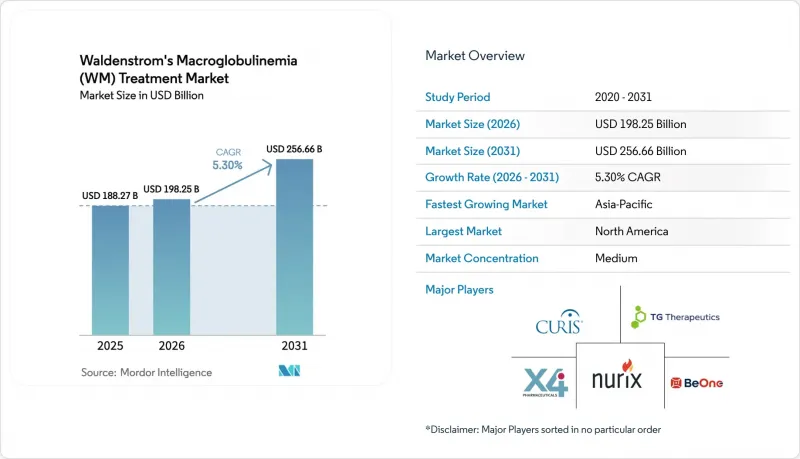
Mordor Intelligence에 의하면, 발덴스트롬 거대글로불린혈증 치료 시장 규모는 2025년 1,882억 7,000만 달러로 평가되었습니다. 2026년 1,982억 5,000만 달러에서 2031년까지 2,566억 6,000만 달러로 확대되고 2026년부터 2031년까지 연평균 성장률(CAGR)은 5.30%를 나타낼 전망입니다.
본 보고서는 치료 분류(BTK 억제제, 프로테아좀 억제제 등), 치료 단계(1차 치료, 2차 치료, 3차 치료 등), 의료 기관(대학 부속 암 센터, 지역 병원, 전문 클리닉) 및 지역(북미, 유럽, 아시아태평양 등)별로 분류되어 있습니다. 시장 전망은 금액(달러) 기준으로 제시되어 있습니다.
세계의 발덴스트롬 거대글로불린혈증 치료 시장 동향 및 인사이트
차세대 유전체 검사를 통한 진단 건수 증가
MYD88 L265P 및 CXCR4 돌연변이를 검출하는 차세대 시퀀싱 패널 덕분에, 진단까지 걸리는 기간의 중앙값은 2020년 14.3개월에서 2025년 6.8개월로 단축되었습니다. 이러한 발전으로 치료 대상 환자층이 확대되었으며, 고위험 환자에 대한 조기 개입이 가능해졌습니다. 2024년 3월, 메디케어의 적용 범위가 파운데이션 메디신(Foundation Medicine)사의 ‘FoundationOne Heme’ 검사로 확대되었습니다. 이 검사는 406개의 유전자를 시퀀싱하는 것으로, 정가 5,800달러에 대한 대폭적인 비용 지원 덕분에 지역 의료 현장에서의 도입이 확대되고 검사 실무의 표준화가 촉진되었습니다. 2024년 9월에 출시된 일루미나(Illumina)의 ‘TruSight Oncology 500’ 분석법은 7일 이내의 결과 보고 기간을 실현하여 기존 방법에 비해 의사결정을 신속화하고, BTK 억제제의 적시 투여를 가능하게 했습니다. 또한, 유럽의약품청(EMA)의 2024년 지침에 따라 BTK 억제제를 처방하기 전에 MYD88 돌연변이 검사를 실시해야 할 의무가 부과되어, 이는 유럽 전역의 규제 요건이 되었습니다. 이러한 발전에 따라 발덴스트렘 거대글로불린혈증 시장의 진단 체계가 재정의되었으며, 모든 치료 현장에서 분자 검사에 기반한 치료 선택의 도입이 강화되었습니다.
BTK 억제제의 FDA/EMA 승인 및 적응증 확대
2024년 1월, FDA는 기존 치료를 받은 발덴스트롬 거대글로불린혈증에 대한 자누부르티닙의 신속 승인을 부여하여, 일상적인 임상 현장에서 우수한 내약성이 입증된 이 선택적 BTK 억제제에 대한 접근성을 확대했습니다. 마찬가지로, EMA는 2024년 5월 조건부 시판 허가를 발급하여 EU 27개 회원국 전역에서 보험 적용이 가능하도록 함과 동시에, 병원 약제 목록을 통해 환자의 접근성을 개선했습니다. 2025년 10월, 아카라부티닙은 94%의 전체 반응률을 보인 ELEVATE-WM 임상시험 데이터를 바탕으로 1차 치료제로서의 사용에 대해 FDA로부터 우선 심사 지정을 받아, 이를 통해 초기 치료 선택의 폭이 넓어졌습니다. 일본의 PMDA는 2024년 12월 자누브루티닙을 승인하고, 국민건강보험 제도에서 본인 부담금을 10만 엔으로 상한을 설정함으로써, 치료가 필요할 가능성이 높은 고령 환자의 경제적 부담이 경감되었습니다. 이러한 승인 및 적응증 확대를 통해 미국, 유럽연합(EU), 일본 내 발덴스트룀 거대글로불린혈증 시장에서 단기적으로 판매량이 크게 증가할 것으로 전망됩니다.
고액의 연간 치료비와 제한된 보험 환급
연간 정가가 17만 9,000달러에 달하는 자누브루티닙은 미국의 지불 주체 측 예산에 큰 부담을 주고 있으며, 그 결과 치료 시작을 지연시킬 가능성이 있는 이용 관리 조치가 취해지고 있습니다. 2024년 11월, NICE는 증분 비용 대비 효과 비율이 8만 7,000파운드(약 11만 달러)로 영국의 3만 파운드 기준치를 초과한다는 이유로, 자누브루티닙에 대한 NHS의 일반 자금 지원을 기각했습니다. 마찬가지로, 2024년 3월에는 CADTH가 장기적인 경제 모델의 불확실성을 이유로 WM의 1차 치료제로서의 이부르티닙에 대한 공적 환급을 권고하지 않았으며, 이에 따라 캐나다의 공적 의료 프로그램에서 해당 약물의 채택이 제한되었습니다.
부문별 분석
2025년, BTK 억제제는 치료제 부문 매출의 68.56%라는 압도적인 점유율을 차지했습니다. 이는 처방 의사들의 강한 신뢰와, 발덴스트렘 거대글로불린혈증 치료 시장에서 적격 환자를 위한 1차 치료제로서의 위상을 반영한 것입니다. 임상시험 데이터는 자누브루티닙이 이부루티닙에 비해 우월함을 분명히 보여주었습니다. 자누브루티닙은 이브루티닙의 20.3개월에 비해 42.7개월이라는 더 긴 무재발 생존 기간 중앙값을 보여주었으며, 선정된 BTK 억제제 요법의 지속성과 연속성이 강조되었습니다. 또한, 자누부르티닙은 이부르티닙에 비해 3등급 이상의 이상반응이 적어, 심장 관련 위험이 치료 결정에 영향을 미치는 경우 이는 매우 중요한 고려 사항이 됩니다. 이러한 임상 결과는 발덴스트룀 거대글로불린혈증의 1차 치료 및 조기 재발 치료에서 BTK 억제제가 수행하는 핵심적인 역할을 뒷받침합니다. 동시에, 비공유 결합형 약물 및 분해제 파이프라인이 지속적으로 확대됨에 따라, 내성 기전에 대한 대응이 계속해서 주목을 받고 있습니다. 1차 치료에서 아카라부티닙의 승인 절차가 진전됨에 따라, 임상 프로파일에 따라 차별화된 여러 BTK 치료 옵션이 공존하게 되고, 임상 지침의 발전에 따라 환자 개개인에 맞춘 보다 정교한 치료 결정이 가능해질 것이라는 기대를 더욱 뒷받침하고 있습니다.
프로테아좀 억제제는 2031년까지 연평균 성장률(CAGR)이 5.87%로 가장 빠른 성장이 예상됩니다. 이러한 성장은 보르테조밉을 기반으로 한 치료 요법의 채택 확대에 의해 주도되고 있으며, 특히 BTK 치료 중 심방세동을 발병한 환자에서 두드러집니다. 이러한 안전성 우려는 지역 의료 현장과 학술 의료 현장 모두에서 치료 순서 결정에 큰 영향을 미치고 있습니다.
지역별 분석
2025년에는 확고한 처방 의사 기반과 보험 체계를 갖춘 북미가 고비용 항암제 대응에 있어 계속해서 주도적인 위치를 유지했습니다. 한편, 아시아태평양에서는 발덴스트롬 거대글로불린혈증 치료 시장에서 BTK 억제제의 보험 적용 범위 확대에 힘입어 2031년까지 급속한 성장이 예상됩니다. 중국과 일본에서 시장 접근성 개선으로 인해 이미 치료 시작률은 상승하고 있으며, 호주에서는 보조금 제도의 도입으로 인해 그동안 치료 도입의 장벽이 되었던 본인 부담금이 경감되고 있습니다. 유럽은 시장 규모가 크지만, 성장 속도는 비교적 완만합니다. NICE(영국 국립의료기술평가기구)의 2024년 자누부르티닙에 대한 견해 등의 결정이 치료 선택에 영향을 미치고 있으며, 그 결과 조기 접근을 제공하는 관할 구역과의 조화가 지연되고 있습니다.
아시아태평양의 성장 궤도는 대규모이며 고령화가 진행 중인 인구에 의해 더욱 뒷받침되고 있어, 이에 따라 적격 환자 수는 향후 증가할 것으로 예측됩니다. 이러한 인구 통계학적 동향은 주요 국가에서의 보험 급여 제도 확충이 발덴스트룀 거대글로불린혈증 치료 시장에 미치는 영향을 더욱 강화하고 있습니다. 임상팀의 일상적인 평가에 분자진단이 도입됨에 따라, 증상 확인부터 치료 시작까지의 기간이 단축되고 있습니다. 이러한 발전으로 인해 치료 초기 단계부터 표적 치료의 혜택을 받는 환자 비율이 증가하고 있습니다. 일본과 호주에서는 합리적인 본인 부담금 제도와 국가 의약품 목록을 통해 치료의 지속성이 보장되고 있으며, 이는 장기적인 관리가 필요한 질환에 있어 매우 중요합니다. 반면, 중동, 아프리카 및 남미에서는 전문의 부족이나 자금 조달의 어려움과 같은 과제에 여전히 직면해 있어, 최근의 정책적 노력에도 불구하고 시장 점유율은 비교적 낮은 수준을 유지하고 있습니다.
기타 혜택 :
- 엑셀 형식 시장 전망(ME) 시트
- 3개월간의 애널리스트 지원
자주 묻는 질문
목차
제1장 서론
제2장 조사 방법
제3장 개요
제4장 시장 구도
제5장 시장 규모 및 성장 예측
제6장 경쟁 구도
제7장 시장 기회 및 향후 전망
KTH 26.08.31According to Mordor Intelligence, the waldenstrom's macroglobulinemia treatment market size is projected to expand from USD 188.27 billion in 2025 and USD 198.25 billion in 2026 to USD 256.66 billion by 2031, registering a CAGR of 5.30% between 2026 to 2031.
This report is Segmented by Treatment Class (BTK Inhibitors, Proteasome Inhibitors, and More), Line of Therapy (First-Line, Second-Line, Third-Line & More), Healthcare Setting (Academic Cancer Centres, Community/Regional Hospitals, Speciality Clinics), and Geography (North America, Europe, Asia-Pacific, and More). The Market Forecasts are Provided in Terms of Value (USD).
Global Waldenstrom's Macroglobulinemia (WM) Treatment Market Trends and Insights
Growing Diagnosed Prevalence Via Next-Gen Genomic Testing
Next-generation sequencing panels that detect MYD88 L265P and CXCR4 mutations reduced the median time-to-diagnosis from 14.3 months in 2020 to 6.8 months in 2025. This advancement expanded the patient population eligible for treatment and enabled earlier intervention for high-risk individuals. In March 2024, Medicare coverage was extended to Foundation Medicine's FoundationOne Heme test. This test sequences 406 genes and, with significant payment support towards its USD 5,800 list price, has driven increased adoption in community settings, promoting standardized testing practices. Launched in September 2024, Illumina's TruSight Oncology 500 assay offers a 7-day turnaround time, expediting decision-making compared to traditional methods and facilitating the timely initiation of BTK inhibitors. Additionally, the European Medicines Agency's 2024 directive mandated MYD88 mutation testing before prescribing BTK inhibitors, making it a regulatory requirement across the region. These advancements have redefined the diagnostic framework for the Waldenstrom's Macroglobulinemia market and strengthened the adoption of molecularly guided therapy selection across treatment settings.
FDA/EMA Approvals & Label Expansions of BTK Inhibitors
In January 2024, the FDA granted accelerated approval to zanubrutinib for previously treated WM, expanding access to this selective BTK inhibitor, recognized for its favorable tolerability in routine clinical practice. Similarly, the EMA issued a conditional marketing authorization in May 2024, enabling reimbursement across 27 EU member states and improving patient access within hospital formularies. In October 2025, Acalabrutinib received FDA priority review for frontline use, supported by ELEVATE-WM data demonstrating a 94% overall response rate, thereby enhancing competitive options for initial therapy selection. Japan's PMDA approved zanubrutinib in December 2024, with the national insurance framework capping co-pays at JPY 100,000, reducing financial barriers for older patients who are more likely to require treatment. These approvals and label expansions are expected to drive significant near-term volume growth in the Waldenstrom's Macroglobulinemia market across the United States, the European Union, and Japan.
High Annual Therapy Cost & Restricted Reimbursement
With an annual list price of USD 179,000, zanubrutinib imposes significant pressure on payer budgets in the United States, resulting in utilization management measures that can delay treatment initiation. In November 2024, NICE declined routine NHS funding for zanubrutinib, citing an incremental cost-effectiveness ratio of GBP 87,000 (approximately USD 110,000), which exceeds the UK's GBP 30,000 threshold. Similarly, in March 2024, CADTH recommended against public reimbursement for ibrutinib as a frontline treatment for WM due to uncertainties in the long-term economic model, limiting its adoption in Canada's public programs.
Other drivers and restraints analyzed in the detailed report include:
- Ageing Population Enlarging Treatment-Eligible Cohort
- Non-Covalent BTK Degraders Addressing Resistance Gaps
- Limited WM Expertise in Low-Resource Regions
For complete list of drivers and restraints, kindly check the Table Of Contents.
Segment Analysis
In 2025, BTK inhibitors captured a dominant 68.56% share of the treatment-class revenue, reflecting strong prescriber confidence and their position as the preferred option for eligible patients in the Waldenstrom's Macroglobulinemia market. Data from clinical trials highlighted the advantages of zanubrutinib over ibrutinib, with zanubrutinib demonstrating a longer median progression-free survival of 42.7 months compared to 20.3 months for ibrutinib, emphasizing the durability and continuity of selected BTK regimens. Additionally, zanubrutinib was associated with fewer Grade 3 or higher adverse events than ibrutinib, a critical consideration when cardiac risks influence treatment decisions. These clinical outcomes reinforce the central role of BTK inhibitors in first-line and early-relapse treatments for Waldenstrom's Macroglobulinemia. At the same time, the expanding pipeline of non-covalent agents and degraders continues to drive attention toward addressing resistance mechanisms. The regulatory progress of acalabrutinib in frontline WM further supports the expectation that multiple BTK options, differentiated by clinical profiles, will coexist, enabling more refined patient-level decisions as clinical guidelines evolve.
Proteasome inhibitors are projected to grow the fastest, with a compound annual growth rate (CAGR) of 5.87% through 2031. This growth is driven by the increasing adoption of bortezomib-based regimens, particularly among patients who develop atrial fibrillation on BTK therapy, a safety concern that significantly impacts treatment sequencing in both community and academic settings.
Complete Report Scope:
- By Treatment Class
- BTK Inhibitors
- Proteasome Inhibitors
- BCL-2 Inhibitors
- PI3K/mTOR Inhibitors
- Plasmapheresis
- Chemotherapy & Others
- By Line of Therapy
- First-Line
- Second-Line
- Third-Line & Beyond
- By Healthcare Setting
- Academic Cancer Centres
- Community/Regional Hospitals
- Speciality Clinics
- By Geography
- North America
- United States
- Canada
- Mexico
- Europe
- Germany
- United Kingdom
- France
- Italy
- Spain
- Rest of Europe
- Asia-Pacific
- China
- India
- Japan
- Australia
- South Korea
- Rest of Asia-Pacific
- Middle East and Africa
- GCC
- South Africa
- Rest of Middle East and Africa
- South America
- Brazil
- Argentina
- Rest of South America
- North America
Geography Analysis
In 2025, North America, with its established prescriber base and payer structures, is expected to maintain its leadership in accommodating high-cost oncology drugs. Meanwhile, the Asia-Pacific region is projected to experience rapid growth through 2031, driven by expanding reimbursement schemes for BTK inhibitors in the Waldenstrom's Macroglobulinemia market. Improved market access in China and Japan is already increasing initiation rates, while Australian subsidies have reduced out-of-pocket expenses that previously hindered uptake. Europe, while holding a significant market volume, is advancing at a slower pace. Decisions such as NICE's 2024 stance on zanubrutinib are shaping treatment choices, resulting in slower alignment with jurisdictions offering early access.
Asia-Pacific's growth trajectory is further supported by its large and aging population, which is expected to increase the number of eligible patients over time. This demographic trend amplifies the impact of enhanced reimbursements in major countries on the Waldenstrom's Macroglobulinemia market. The adoption of molecular diagnostics in routine evaluations by clinical teams is narrowing the gap between symptom identification and treatment initiation. This development is increasing the proportion of patients benefiting from targeted therapies earlier in their treatment journey. In Japan and Australia, affordable co-pay structures and national formularies are ensuring the continuation of therapy, which is critical for diseases requiring long-term management. In contrast, the Middle East and Africa, along with South America, continue to face challenges such as limited expert availability and funding, which are keeping their market shares relatively small despite recent policy initiatives.
- Abbvie
- ADC Therapeutics SA.
- Ascentage Pharma
- AstraZeneca
- BeOne Medicines GmbH
- Cellectar Biosciences, Inc.
- Curis Inc.
- Roche
- InnoCare
- Johnson & Johnson
- Nurix Therapeutics, Inc.
- Takeda Pharmaceuticals
- TG Therapeutics
- X4 Pharmaceuticals Inc.
Additional Benefits:
- The market estimate (ME) sheet in Excel format
- 3 months of analyst support
TABLE OF CONTENTS
1 Introduction
- 1.1 Study Assumptions & Market Definition
- 1.2 Scope of the Study
2 Research Methodology
3 Executive Summary
4 Market Landscape
- 4.1 Market Overview
- 4.2 Market Drivers
- 4.2.1 Growing Diagnosed Prevalence Via Next-Gen Genomic Testing
- 4.2.2 FDA/EMA Approvals & Label Expansions of BTK Inhibitors
- 4.2.3 Ageing Population Enlarging Treatment-Eligible Cohort
- 4.2.4 Non-Covalent BTK Degraders Addressing Resistance Gaps
- 4.2.5 Liquid-Biopsy MRD Tools Triggering Earlier Intervention
- 4.2.6 Advocacy-Funded Trial Acceleration in Rare Haematologics
- 4.3 Market Restraints
- 4.3.1 High Annual Therapy Cost & Restricted Reimbursement
- 4.3.2 Limited WM Expertise in Low-Resource Regions
- 4.3.3 Cardiotoxicity Concerns Curbing Combo-Regimen Uptake
- 4.3.4 Radio-Isotope Supply Bottlenecks For I-131 Therapies
- 4.4 Supply-Chain Analysis
- 4.5 Regulatory Landscape
- 4.6 Technological Outlook
- 4.7 Porter's Five Forces Analysis
- 4.7.1 Threat of New Entrants
- 4.7.2 Bargaining Power of Buyers
- 4.7.3 Bargaining Power of Suppliers
- 4.7.4 Threat of Substitutes
- 4.7.5 Intensity of Competitive Rivalry
5 Market Size & Growth Forecasts (Value, USD)
- 5.1 By Treatment Class
- 5.1.1 BTK Inhibitors
- 5.1.2 Proteasome Inhibitors
- 5.1.3 BCL-2 Inhibitors
- 5.1.4 PI3K/mTOR Inhibitors
- 5.1.5 Plasmapheresis
- 5.1.6 Chemotherapy & Others
- 5.2 By Line of Therapy
- 5.2.1 First-Line
- 5.2.2 Second-Line
- 5.2.3 Third-Line & Beyond
- 5.3 By Healthcare Setting
- 5.3.1 Academic Cancer Centres
- 5.3.2 Community/Regional Hospitals
- 5.3.3 Speciality Clinics
- 5.4 By Geography
- 5.4.1 North America
- 5.4.1.1 United States
- 5.4.1.2 Canada
- 5.4.1.3 Mexico
- 5.4.2 Europe
- 5.4.2.1 Germany
- 5.4.2.2 United Kingdom
- 5.4.2.3 France
- 5.4.2.4 Italy
- 5.4.2.5 Spain
- 5.4.2.6 Rest of Europe
- 5.4.3 Asia-Pacific
- 5.4.3.1 China
- 5.4.3.2 India
- 5.4.3.3 Japan
- 5.4.3.4 Australia
- 5.4.3.5 South Korea
- 5.4.3.6 Rest of Asia-Pacific
- 5.4.4 Middle East and Africa
- 5.4.4.1 GCC
- 5.4.4.2 South Africa
- 5.4.4.3 Rest of Middle East and Africa
- 5.4.5 South America
- 5.4.5.1 Brazil
- 5.4.5.2 Argentina
- 5.4.5.3 Rest of South America
- 5.4.1 North America
6 Competitive Landscape
- 6.1 Market Concentration
- 6.2 Market Share Analysis
- 6.3 Company Profiles (includes Global level Overview, Market-level Overview, Core Segments, Financials, Strategic Information, Market Rank/Share, Products & Services, Recent Developments)
- 6.3.1 AbbVie Inc.
- 6.3.2 ADC Therapeutics SA.
- 6.3.3 Ascentage Pharma
- 6.3.4 AstraZeneca plc
- 6.3.5 BeOne Medicines GmbH
- 6.3.6 Cellectar Biosciences, Inc.
- 6.3.7 Curis Inc.
- 6.3.8 F. Hoffmann-La Roche Ltd
- 6.3.9 InnoCare
- 6.3.10 Johnson & Johnson Services, Inc.
- 6.3.11 Nurix Therapeutics, Inc.
- 6.3.12 Takeda Pharmaceutical Company Limited.
- 6.3.13 TG Therapeutics, Inc.
- 6.3.14 X4 Pharmaceuticals Inc.
7 Market Opportunities & Future Outlook
- 7.1 White-space & Unmet-Need Assessment