|
시장보고서
상품코드
2116439
산화 스트레스 어세이 시장 : 점유율 분석, 업계 동향과 통계, 성장 예측(2026-2031년)Oxidative Stress Assay - Market Share Analysis, Industry Trends & Statistics, Growth Forecasts (2026 - 2031) |
||||||
 Mordor Intelligence
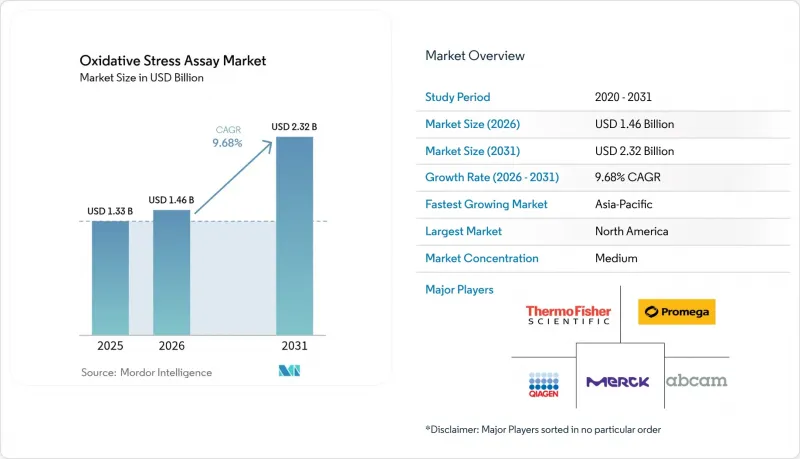
Mordor Intelligence에 의하면, 산화 스트레스 어세이 시장 규모는 2025년에 13억 3,000만 달러로 평가되었고 2026년 14억 6,000만 달러에서 2031년까지 23억 2,000만 달러에 이를 것으로 추정되고 있어 예측 기간(2026-2031년) CAGR은 9.68%를 나타낼 전망입니다.
본 보고서는 제품별(기기 및 소모품), 검사 유형별(간접 분석, 항산화 능력 분석 등), 기술별(ELISA, 유세포분석법 등), 질환별(심혈관 질환, COPD 등),최종 사용자별(위탁 연구 기관 등), 검체별(세포 유래 검체 등), 지역별로 분류되어 있습니다. 시장 예측은 금액(달러) 기준으로 제시되어 있습니다.
전 세계 산화 스트레스 어세이 시장 동향 및 인사이트
바이오의약품 및 생명공학 제조 분야의 급속한 성장
바이오의약품 생산 능력 확대에 따라, 공정 규모 확대 과정에서 실시간 품질 지표로 기능하는 산화 스트레스 어세이에 대한 수요가 증가하고 있습니다. 써모피셔 사이언티픽(Thermo Fisher Scientific)은 경구용 고형 제형 시설에 2,200만 달러를 투자하여, 단백질 안정성을 위협하는 산화 스트레스의 징후를 모니터링하기 위해 예측 AI를 도입했습니다. 현재 연속 제조 워크플로우에서는 수율에 영향을 미치기 전에 대사 변화를 감지할 수 있는 인라인 분석법이 필수적입니다. 바이오래드(Bio-Rad)의 스틸라 테크놀로지스(Stilla Technologies) 인수로 산화 바이오마커 검출에 디지털 PCR의 민감도가 도입되었으며, 차세대 생산이 통합된 분석 생태계에 의존하고 있음을 입증했습니다. 이러한 전환을 통해 산화 스트레스 측정은 시판되는 생물학적 제제 제조에서 순도 및 효능과 어깨를 나란히 하는 표준 매개변수로 자리매김하고 있습니다.
ROS 바이오마커의 고처리량 스크리닝 확대
고속 스크리닝(HTS) 시스템을 통해 과학자들은 수천 가지의 산화 스트레스 조건을 동시에 평가할 수 있게 되어, 항산화제 및 감작 물질의 발견에 소요되는 기간이 단축됩니다. Abcam사의 FirePlex 멀티플렉스 플랫폼은 검증된 항체 쌍과 자동화를 결합하여 순차적 시험으로 인한 병목 현상을 해소하고, 기존 키트에 비해 정량 감도를 10배 향상시켰습니다. HTS와 딥러닝 알고리즘을 융합함으로써 위양성률을 더욱 낮출 수 있을 뿐만 아니라, CRISPR 기반 기능 스크리닝을 통해 산화-환원 균형을 매개하는 유전자를 특정할 수 있습니다. 비용 절감으로 이어지는 소형화를 통해 시약비를 비례적으로 늘리지 않고도 라이브러리를 확장할 수 있어, 신약 개발 파이프라인의 초기 단계를 가속화할 수 있습니다.
검출 장비의 고액 초기 투자
최고 수준의 오비트랩형 질량 분석기는 대당 100만 달러를 초과하며, 많은 학술 연구 기관에서는 예산이 기술 혁신의 속도를 따라가지 못해 구매를 미루고 있습니다. 7년 이내에 급속히 구식이 되어 버리기 때문에 반복적인 투자가 불가피하며, 자원이 제한된 지역에서의 보급이 저해되고 있습니다. 리스나 샘플 단위 과금 모델이 등장하고 있지만, 북미 이외 지역에서의 채택률은 여전히 낮은 수준에 머물러 있습니다.
부문 분석
2025년, 산화 스트레스 어세이 시장의 매출의 55.62%를 장비가 차지하며, 고도의 스크리닝을 수행하는 연구실의 기반으로서 계속해서 자리매김하고 있습니다. 한 번의 측정으로 5배 더 많은 화합물을 프로파일링할 수 있는 신형 오비트랩 분석 장치는 광범위한 대사 산물의 종합적인 분석이 필요한 제약 화학자들에게 이 부문의 매력을 높이고 있습니다. 한편, 키트 기반 워크플로가 최고 수준의 연구센터를 넘어 확대됨에 따라 소모품은 2031년까지 13.12%라는 가장 높은 연평균 성장률(CAGR)을 나타낼 전망입니다. 즉시 사용 가능한 적색 형광 프로브와 표준화된 기준 시약은 소규모 연구소의 프로토콜을 간소화하여 산화 스트레스 어세이 시장의 확대에 기여하고 있습니다. 또한, 분석 소요 시간 단축이 요구되는 가운데, 정기적인 구매 주기 역시 소모품 수요를 뒷받침하고 있습니다.
자가형광을 최소화한 2세대 프로브는 유세포 분석기 및 현미경과의 호환성을 넓혀 키트 채택을 촉진하고 있습니다. 동시에, 장비 제조업체들은 AI 분석 기능을 기기의 펌웨어에 직접 통합하여, 다단계 분석을 한 번의 클릭으로 생성되는 보고서로 집약하고 있습니다. 이러한 융합으로 인해 하드웨어와 소모품 사이의 기존 경계가 모호해졌으며, 데이터의 연속성을 보장하는 엔드투엔드 플랫폼을 제공할 수 있는 제조업체들은 시장 평균을 상회하는 성장을 유지하고 있습니다.
ROS(활성산소종) 기반 분석법은 2025년에 산화 스트레스 어세이 시장 점유율의 29.10%를 차지하며, 질병 진행을 좌우하는 산화 버스트에 대한 실시간 인사이트력을 의약품 개발자들이 우선시함에 따라 연평균 성장률(CAGR) 11.82%로 성장할 전망입니다. 광유전학적 H₂O₂ 센서는 세포 내 수준의 분해능을 실현하고 나노몰 수준의 플럭스를 포착할 수 있으므로, 연구자들은 암 및 신경퇴행성 질환 연구에서 국소적인 스트레스와 신호 전달 경로의 활성화 간의 상관관계를 규명할 수 있게 됩니다. 지질 과산화 등의 하류 생성물을 측정하는 간접 분석법은 시료가 고정된 경우나, 집단 연구에 수명이 긴 바이오마커가 필요한 경우에는 여전히 유용합니다.
한 장의 플레이트 위에서 ROS, 항산화 능력, 단백질 산화의 종말점을 결합한 멀티플렉스 대시보드가 현재 일반화되어 있어, 실험 횟수를 줄이고 귀중한 1세대 세포를 절약하고 있습니다. 이러한 통합적인 검사는 검증 기간을 단축하며, 2031년까지 산화 스트레스 어세이 시장 규모 확대 전망을 뒷받침하고 있습니다.
지역별 분석
북미는 FDA의 명확한 바이오마커 인증 절차와 AI를 활용한 분석법을 연구실에서 임상 현장으로 신속하게 도입할 수 있는 탄탄한 바이오의약품 인프라 덕분에 2025년에도 매출 점유율 36.41%를 유지했습니다. 미국에 기반을 둔 벤처 캐피탈의 지원과 장비 공급업체의 존재가 프로토타입의 신속한 도입을 촉진하고 있습니다. BioAge Labs가 노바티스와 제휴하여 장수 표적을 탐색하고 있는 것과 같은 전략적 제휴는 지역 내 기업들이 산화 스트레스 데이터를 어떻게 활용하여 새로운 치료의 지평을 열어가고 있는지를 보여줍니다.
유럽은 이에 근소한 차이로 뒤를 잇고 있으며, 실험실에 검증된 체외(in vitro) 산화 스트레스 플랫폼의 도입을 촉구하는 엄격한 3R 지침에 힘입고 있습니다. 학술 기관들은 끊임없이 새로운 분석법을 개발하고 있는 반면, 시약 제조업체들은 유럽의약품청(EMA)의 요건을 충족하는 표준화된 기준 물질을 제공하는 데 주력하고 있습니다. 민관 공동 프로젝트는 기술의 실용화를 가속화하며, 지속 가능한 연구 체계에 산화 스트레스 검사를 정착시키고 있습니다.
아시아태평양은 2031년까지 11.05%라는 가장 높은 연평균 성장률(CAGR)을 기록하고 있습니다. 중국의 연구 기관들은 전기화학식 바이오센서 개발을 추진하고 있으며, 일본에서는 영양 보조제에 관한 규제를 엄격한 산화 종점 검증과 조화시킴으로써 상업적 수요를 확대되고 있습니다. 생명공학 교육에 대한 정부 투자로 인해 분석가의 기술 격차는 점차 줄어들고 있습니다. 다국적 공급업체들은 유통 거점과 현지화된 기술 지원을 확대하고 있으며, 이는 해당 지역의 성장 모멘텀에 대한 신뢰를 반영합니다.
기타 혜택:
- 엑셀 형식 시장 예측(ME) 시트
- 3개월간의 애널리스트 지원
자주 묻는 질문
목차
제1장 서론
제2장 조사 방법
제3장 주요 요약
제4장 시장 구도
제5장 시장 규모와 성장 예측
제6장 경쟁 구도
제7장 시장 기회와 향후 전망
JHSAccording to Mordor Intelligence, the oxidative stress assays market size was valued at USD 1.33 billion in 2025 and estimated to grow from USD 1.46 billion in 2026 to reach USD 2.32 billion by 2031, at a CAGR of 9.68% during the forecast period (2026-2031).
This report is Segmented by Product (Instruments and Consumables), Test Type (Indirect Assays, Antioxidant Capacity Assays, and More), Technology (ELISA, Flow Cytometry, and More), Disease Type (Cardiovascular Diseases, COPD, and More), End User (Contract Research Organizations and More), Sample Type (Cell-Based Samples and More), and Geography. The Market Forecasts are Provided in Terms of Value (USD).
Global Oxidative Stress Assay Market Trends and Insights
Rapid Growth in Biopharma and Biotech Manufacturing
Expanding biopharma capacity is amplifying demand for oxidative stress assays that serve as real-time quality indicators during process scale-up. Thermo Fisher Scientific invested USD 22 million in oral solid dose facilities and embedded predictive AI to monitor oxidative stress signatures that threaten protein stability. Continuous manufacturing workflows now depend on inline assays able to flag metabolic shifts before they affect yield. Bio-Rad's purchase of Stilla Technologies brought digital PCR sensitivity to oxidative biomarker detection, confirming that next-generation production relies on integrated analytical ecosystems. This transition positions oxidative stress measurement as a standard parameter alongside purity and potency in commercial biologics runs.
Expansion of High-Throughput Screening for ROS Biomarkers
High-throughput screening (HTS) systems let scientists assess thousands of oxidative stress conditions in parallel, cutting discovery timelines for antioxidants and sensitizers. Abcam's FirePlex multiplex platform couples validated antibody pairs with automation, removing the bottleneck of sequential testing and increasing quantitative sensitivity tenfold over earlier kits. Merging HTS with deep-learning algorithms further lowers false positive rates while CRISPR-based functional screening pinpoints genes that mediate redox balance. Cost-reducing miniaturization means libraries can expand without proportional reagent spend, accelerating early-stage drug pipelines.
High Capital Cost of Detection Instruments
Top-tier orbitrap mass spectrometers exceed USD 1 million per unit, and many academic labs defer purchases because budgets trail the pace of innovation. Rapid obsolescence within seven years forces repeat investment, limiting diffusion into resource-constrained geographies. Leasing and pay-per-sample models are emerging but adoption remains low outside North America.
Other drivers and restraints analyzed in the detailed report include:
- Regulatory Push for In-Vitro Toxicology Alternatives
- Mainstream Adoption of Label-Free Live-Cell Imaging Assays
- Lack of Trained Personnel in Multi-Modal Data Interpretation
For complete list of drivers and restraints, kindly check the Table Of Contents.
Segment Analysis
Instruments generated 55.62% of oxidative stress assays market revenue in 2025 and remain the backbone of advanced screening labs. Novel orbitrap analyzers that profile five times more compounds per run strengthen the segment's appeal among pharmaceutical chemists who require deep metabolite coverage. Consumables, however, will register the fastest 13.12% CAGR to 2031 as kit-based workflows scale beyond top-tier centers. Ready-to-use red-fluorescent probes and standardized reference reagents simplify protocols for smaller labs, widening the oxidative stress assays market. Demand for consumables also benefits from recurring purchasing cycles that accompany ever-shorter assay turnaround expectations.
Second-generation probes with minimized autofluorescence broaden compatibility across flow cytometers and microscopes, boosting kit adoption. At the same time, instrument makers embed AI analytics directly on device firmware, condensing multi-step analysis into a single-click report. This convergence blurs the traditional boundary between hardware and consumables and sustains above-market growth for manufacturers able to provide end-to-end platforms that ensure data continuity.
ROS-based assays accounted for 29.10% of oxidative stress assays market share in 2025 and will grow at 11.82% CAGR as drug developers prioritize real-time insights into oxidative bursts that shape disease progression. Optogenetic H2O2 sensors achieve sub-cellular resolution and capture nanomolar fluxes, enabling researchers to correlate localized stress with pathway activation in cancer and neurodegeneration studies. Indirect assays that measure downstream products such as lipid peroxidation remain valuable when samples are fixed or when long-lived biomarkers are required for population studies.
Multiplex dashboards that combine ROS, antioxidant capacity, and protein oxidation endpoints on a single plate are now common, reducing experiment count and conserving precious primary cells. Such integrated testing shortens validation timelines and supports the oxidative stress assays market size expansion forecast to 2031.
Complete Report Scope:
- By Product
- Instruments
- Consumables
- By Test Type
- Indirect Assays
- Antioxidant Capacity Assays
- Enzyme-based Assays
- Reactive Oxygen Species (ROS)-based Assays
- By Technology
- Enzyme-linked Immunosorbent Assay (ELISA)
- Flow Cytometry
- Chromatography
- Microscopy
- Label-free Impedance & Real-Time Cell Analysis
- By Disease Type
- Cardiovascular Diseases
- Chronic Obstructive Pulmonary Disease (COPD)
- Cancer
- Neuro-degenerative Disorders
- By End User
- Pharmaceutical & Biotechnology Companies
- Academic & Research Institutes
- Contract Research Organizations
- By Sample Type
- Cell-based Samples
- Tissue Homogenates
- Blood / Plasma
- Urine & Other Biofluids
- By Geography
- North America
- United States
- Canada
- Mexico
- Europe
- Germany
- United Kingdom
- France
- Italy
- Spain
- Rest of Europe
- Asia-Pacific
- China
- Japan
- India
- Australia
- South Korea
- Rest of Asia-Pacific
- Middle East and Africa
- GCC
- South Africa
- Rest of Middle East and Africa
- South America
- Brazil
- Argentina
- Rest of South America
- North America
Geography Analysis
North America maintained 36.41% revenue share in 2025 thanks to clear FDA biomarker qualification pathways and a dense biopharma infrastructure that rapidly pilots AI-driven assays from bench to clinic. Venture capital backing and equipment vendors headquartered in the United States foster rapid prototype adoption. Strategic collaborations, such as BioAge Labs partnering with Novartis to explore longevity targets, showcase how regional players leverage oxidative stress data to open new therapeutic frontiers.
Europe follows closely, propelled by stringent 3Rs directives that push laboratories toward validated in-vitro oxidative platforms. Academic centers supply a steady pipeline of assay innovations, while reagent companies emphasize standardized reference materials that meet European Medicines Agency expectations. Joint public-private projects accelerate technology translation and embed oxidative testing in sustainable research frameworks.
Asia Pacific records the fastest 11.05% CAGR through 2031. Chinese institutes advance electrochemical biosensors, and Japan aligns nutraceutical regulations with rigorous oxidative endpoint validation, broadening commercial demand. Government investment in biotechnology education is narrowing the analyst skills gap. Multinational suppliers expand distribution hubs and localized technical support, reflecting confidence in regional growth momentum.
- Thermo Fisher Scientific
- Abcam
- Merck
- QIAGEN
- Promega
- Cell Biolabs
- Cayman Chemical
- Enzo Life Sciences
- AMSBIO
- ImmunoChemistry Technologies
- Biovision
- Creative Diagnostics
- R&D Systems (Bio-Techne)
- Ethos Biosciences
- Signosis Inc.
- Agilent Technologies
- BioAssay Systems
- AssayGenie
- Bio-Rad Laboratories
Additional Benefits:
- The market estimate (ME) sheet in Excel format
- 3 months of analyst support
TABLE OF CONTENTS
1 Introduction
- 1.1 Study Assumptions and Market Definition
- 1.2 Scope of the Study
2 Research Methodology
3 Executive Summary
4 Market Landscape
- 4.1 Market Overview
- 4.2 Market Drivers
- 4.2.1 Rapid Growth In Biopharma & Biotech Manufacturing
- 4.2.2 Expansion Of High-Throughput Screening (HTS) For ROS Biomarkers
- 4.2.3 Regulatory Push For In-Vitro Toxicology Alternatives
- 4.2.4 Mainstream Adoption Of Label-Free Live-Cell Imaging Assays
- 4.2.5 Novel Red-Fluorescent Probes For Real-Time Mitochondrial ROS
- 4.2.6 Integration Of AI-Driven Assay Analytics
- 4.3 Market Restraints
- 4.3.1 High Capital Cost Of Detection Instruments
- 4.3.2 Lack Of Trained Personnel In Multi-Modal Data Interpretation
- 4.3.3 Photobleaching & Probe-Derived Artifacts
- 4.3.4 Limited Standardization Of ROS Reference Materials
- 4.4 Value / Supply-Chain Analysis
- 4.5 Regulatory Landscape
- 4.6 Technology Outlook
- 4.7 Porter's Five Forces Analysis
- 4.7.1 Bargaining Power of Suppliers
- 4.7.2 Bargaining Power of Buyers
- 4.7.3 Threat of New Entrants
- 4.7.4 Threat of Substitutes
- 4.7.5 Intensity of Competitive Rivalry
5 Market Size and Growth Forecasts (Value-USD)
- 5.1 By Product
- 5.1.1 Instruments
- 5.1.2 Consumables
- 5.2 By Test Type
- 5.2.1 Indirect Assays
- 5.2.2 Antioxidant Capacity Assays
- 5.2.3 Enzyme-based Assays
- 5.2.4 Reactive Oxygen Species (ROS)-based Assays
- 5.3 By Technology
- 5.3.1 Enzyme-linked Immunosorbent Assay (ELISA)
- 5.3.2 Flow Cytometry
- 5.3.3 Chromatography
- 5.3.4 Microscopy
- 5.3.5 Label-free Impedance & Real-Time Cell Analysis
- 5.4 By Disease Type
- 5.4.1 Cardiovascular Diseases
- 5.4.2 Chronic Obstructive Pulmonary Disease (COPD)
- 5.4.3 Cancer
- 5.4.4 Neuro-degenerative Disorders
- 5.5 By End User
- 5.5.1 Pharmaceutical & Biotechnology Companies
- 5.5.2 Academic & Research Institutes
- 5.5.3 Contract Research Organizations
- 5.6 By Sample Type
- 5.6.1 Cell-based Samples
- 5.6.2 Tissue Homogenates
- 5.6.3 Blood / Plasma
- 5.6.4 Urine & Other Biofluids
- 5.7 By Geography
- 5.7.1 North America
- 5.7.1.1 United States
- 5.7.1.2 Canada
- 5.7.1.3 Mexico
- 5.7.2 Europe
- 5.7.2.1 Germany
- 5.7.2.2 United Kingdom
- 5.7.2.3 France
- 5.7.2.4 Italy
- 5.7.2.5 Spain
- 5.7.2.6 Rest of Europe
- 5.7.3 Asia-Pacific
- 5.7.3.1 China
- 5.7.3.2 Japan
- 5.7.3.3 India
- 5.7.3.4 Australia
- 5.7.3.5 South Korea
- 5.7.3.6 Rest of Asia-Pacific
- 5.7.4 Middle East and Africa
- 5.7.4.1 GCC
- 5.7.4.2 South Africa
- 5.7.4.3 Rest of Middle East and Africa
- 5.7.5 South America
- 5.7.5.1 Brazil
- 5.7.5.2 Argentina
- 5.7.5.3 Rest of South America
- 5.7.1 North America
6 Competitive Landscape
- 6.1 Market Concentration
- 6.2 Market Share Analysis
- 6.3 Company profiles (includes Global level Overview, Market level overview, Core Segments, Financials as available, Strategic Information, Market Rank/Share for key companies, Products and Services, and Recent Developments)
- 6.3.1 Thermo Fisher Scientific
- 6.3.2 Abcam plc
- 6.3.3 Merck KGaA (Sigma-Aldrich)
- 6.3.4 Qiagen N.V.
- 6.3.5 Promega Corporation
- 6.3.6 Cell Biolabs Inc.
- 6.3.7 Cayman Chemical
- 6.3.8 Enzo Life Sciences
- 6.3.9 AMSBIO
- 6.3.10 ImmunoChemistry Technologies
- 6.3.11 BioVision Inc.
- 6.3.12 Creative Diagnostics
- 6.3.13 R&D Systems (Bio-Techne)
- 6.3.14 Ethos Biosciences
- 6.3.15 Signosis Inc.
- 6.3.16 Agilent Technologies
- 6.3.17 BioAssay Systems
- 6.3.18 AssayGenie
- 6.3.19 Bio-Rad Laboratories
7 Market Opportunities and Future Outlook
- 7.1 White-Space and Unmet-Need Assessment