|
시장보고서
상품코드
2116452
혈액 처리 기기 및 소모품 : 시장 점유율 분석, 업계 동향 및 통계, 성장 예측(2026-2031년)Blood Processing Devices And Consumables - Market Share Analysis, Industry Trends & Statistics, Growth Forecasts (2026 - 2031) |
||||||
 Mordor Intelligence
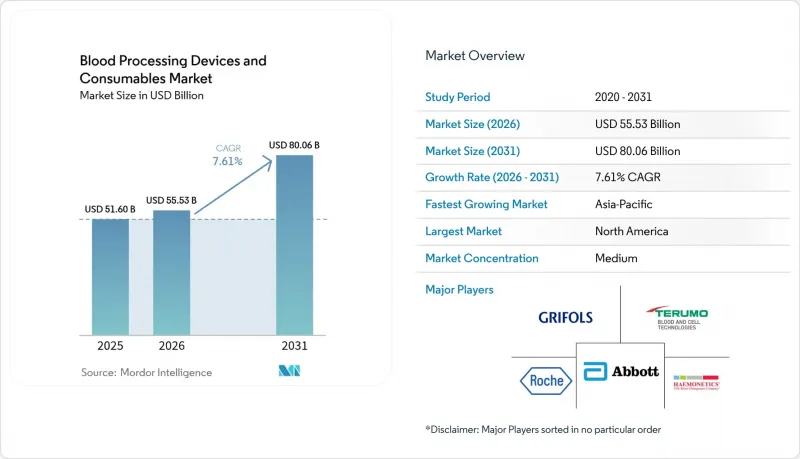
Mordor Intelligence에 의하면, 혈액 처리 기기 및 소모품 시장 규모는 2025년 516억 달러로 평가되었습니다. 2026년에는 555억 3,000만 달러로 확대되어 2026년부터 2031년에 걸쳐 CAGR 7.61%로 성장을 지속하여, 2031년에는 800억 6,000만 달러에 이를 것으로 예측됩니다.
본 보고서는 제품별(혈액 처리 장치·혈액 처리용 혈액처리소모품), 기술별(원심 분리, 막 여과 등), 최종 사용자별(병원 및 진료소, 진단실험실 등), 지역별(북미, 유럽, 아시아태평양, 중동 및 아프리카, 남미)로 분류되어 있습니다. 시장 예측은 금액(달러) 기준으로 제시되어 있습니다.
세계의 혈액 처리 기기 및 소모품 시장 동향 및 인사이트
전 세계 수혈 수요 증가
세계 수혈 수요는 여전히 헌혈량을 상회하고 있으며, 미국 적십자사는 외과 수술 및 외상 사례가 증가하고 있음에도 불구하고 공급량이 25% 감소했다고 보고했습니다. 세계보건기구(WHO)는 많은 저소득 지역에서 자발적인 무상 헌혈을 통한 공급량이 여전히 필요량의 절반도 채 되지 않는다는 사실을 확인하여 만성적인 부족 현상을 부각시키고 있습니다. 따라서 고수율의 성분 분리 장치와 자동화된 콜드체인 물류가 필수적입니다. 대만의 교육 병원은 업계 최고 수준의 재고 관리를 실천하고 있으며, 실시간 모니터링을 통해 폐기율을 0.08%까지 줄였습니다. 대학병원에서는 트리아지 업무의 자동화를 통해 2024년에 처리한 검체 수가 전년 대비 7% 증가했으며, 같은 해 323건의 대량 수혈 프로토콜이 발동되었습니다. 이러한 사례는 처리 능력 향상이 1회의 헌혈에서 이용 가능한 성분을 최대한 끌어낼 수 있는 첨단 장비와 혈액처리소모품에 달려 있음을 보여줍니다.
고령 인구 증가
유엔의 예측에 따르면, 개발도상국 전체에서 인구의 급속한 고령화가 진행되고 있으며, 과거의 헌혈자들이 수혈자로 전환되고 있습니다. 2023년 미국의 의료비는 7.5% 증가하여 4조 9,000억 달러에 달했는데, 그 주된 요인은 고령 환자와 관련된 메디케어 지출이었습니다. 혈액 센터에서는 젊은 층의 헌혈자 수 감소를 완화하기 위해, 고령자의 헌혈 적격 기준을 안전하게 확대하는 헌혈자 관리 시스템의 시범 운영이 진행되고 있습니다. WHO의 ‘환자 혈액 관리 지침’은 고령자의 빈혈 치료에 있어 자원 효율이 높은 성분 처리를 채택할 것을 권장하고 있으며, 이에 따라 폐기물을 최소화하면서 소량의 혈액을 처리할 수 있는 소형 세포 처리 장치의 도입이 촉진되고 있습니다. 고령 인구가 증가하는 가운데, 각 시설은 더욱 엄격해진 혈액 안전 감시 기준에 대응하면서 처리 능력을 확대해 나가야 합니다.
엄격한 규제 및 품질 준수 요건
FDA가 갱신한 헌혈자 적격성에 관한 지침안에서는 문서화 요건이 확대되어 검증 주기 및 내부 감사의 업무 부담이 증가하고 있습니다. WHO의 기술 지침에 따르면, 모든 혈액 시설은 헌혈자 모집부터 수혈에 이르기까지 품질 관리 시스템을 구축해야 할 의무가 있으며, 소규모 센터는 바코드가 부착된 혈액백, 감사용 소프트웨어, 직원 자격 취득에 대한 투자를 할 수밖에 없습니다. 안전 확보에는 필수적이지만, 이러한 규제는 운영 비용을 상승시키고 학습 곡선을 가파르게 만들어 신규 진입을 저해하는 요인이 되고 있습니다.
부문별 분석
2025년, 혈액 처리 기기 및 소모품 시장 매출액 중 장비가 54.62%를 차지하며, 이는 모든 수혈 서비스에서 필수적인 존재임을 반영했습니다. 멀티백 자동 분리 장치 및 스마트 냉동고에 대한 FDA의 승인은 급속한 기술 혁신을 뒷받침하고 있습니다. 병원에서는 수작업 공정을 대폭 줄이기 위해 냉각, 혼합, 바코드 추적 기능을 통합한 모듈식 시스템이 선호되고 있습니다. 각 벤더사는 가동 중지 시간을 줄이고 자산 수명을 연장하는 예측 유지보수 알고리즘을 탑재하고 있습니다. 운영 리스 모델이 등장함에 따라, 설비 투자(CAPEX)를 운영 비용(OPEX)으로 전환함으로써 중규모 시설에서의 활용 기회가 확대되고 있습니다.
혈액처리소모품은 현재 규모는 작지만 2031년까지 연평균 성장률(CAGR)이 9.31%에 달하고, 가장 큰 성장 동력이 되고 있으며, 혈액 처리 기기 및 소모품 시장의 장기적인 성장 궤도에서 매우 중요한 역할을 하고 있습니다. 일회용 아페레시스 키트, 병원체 불활성화 슬리브, 백혈구 제거 필터는 모든 시술마다 주문되므로 지속적인 수익원을 창출하고 있습니다. 아시아태평양에서는 병원 설비 갱신 및 지방 의료 지원 프로그램이 기초 수요를 끌어올리고 있는 반면, 성숙 시장에서는 RFID 및 항균 코팅이 적용된 프리미엄 혈액처리소모품으로의 전환이 진행되고 있습니다. 그 결과, 현지 생산 거점을 갖춘 일회용 제품 제조업체는 리드 타임을 단축하고 환율 리스크를 완화할 수 있게 됩니다.
지역별 분석
북미는 성숙한 인프라, 엄격하고 투명한 규제, 그리고 4조 9,000억 달러에 달하는 의료비 지출을 배경으로 2025년 매출의 38.10%를 차지했습니다. 대규모 통합 의료 제공 네트워크에서는 진화하는 AABB 기준에 대응하기 위해 원심분리기, 가온기, 적합성 분석 장비를 지속적으로 갱신하고 있습니다. 2025년 말까지 가동을 시작할 예정인 일리노이주와 텍사스주에 위치한 애보트사의 5억 달러 규모의 제조 거점 확장으로 인해, 수혈 진단 키트의 국내 공급이 확대될 전망입니다. FDA의 지침안은 예측 가능한 승인 주기를 촉진하고 있으며, 이를 통해 각 공급업체들은 지역 기준 검사실에서 차세대 AI 알고리즘의 시범 운영을 진행하도록 장려받고 있습니다.
아시아태평양은 병원 건설 확대, 의료 관광, 중산층의 보험 가입 증가에 힘입어 2031년까지 연평균 성장률(CAGR)이 8.41%로 가장 빠르게 성장하는 지역입니다. 중국에서는 600개 혈액 센터를 대상으로 한 국가 품질 재인증 프로그램에 따라 원심분리기 및 아페레시스 장치의 교체가 가속화되고 있습니다. 테르모가 항저우에 건설한 1,500만 달러 규모의 생산 공장에서는 각 성의 조달 방침에 맞추어 ‘Reveos’ 시스템의 현지 사양 모델을 조립할 예정입니다. 인도와 태국에서는 민관 파트너십을 통해 지역별 혈장 분획 허브에 대한 공동 투자가 이루어지고 있으며, 고처리량 분리 장치 및 멸균 튜브 용접기의 도입이 의무화되어 있습니다.
유럽에서는 병원들이 비용 관리를 엄격히 강화하는 한편, 새로운 EN 규격을 충족하기 위해 병원체 저감 처리가 완료된 성분혈을 추구하고 있어 꾸준한 교체 수요가 나타나고 있습니다. 독일과 프랑스의 일괄 구매 연합은 가동률 보장이 포함된 다년 서비스 패키지를 제공하는 공급업체를 우선적으로 선정하고 있습니다. EU 통합 예산에 연계된 동유럽 현대화 기금을 통해 중규모 도시에서의 자동 성분혈 추출 장치 첫 도입에 대한 자금 지원이 이루어지고 있어, 도입 기반이 확대되고 있습니다.
중동 및 아프리카·남미에서는 인프라 격차가 여전히 남아 있지만, 수요가 점진적으로 증가할 것으로 전망됩니다. 걸프 국가들은 3차 의료 거점을 지원하기 위해 최첨단 로봇 기술에 투자하고 있는 반면, 사하라 이남 아프리카에서는 기부금에 의한 메가 센터에 의존하고 있으며, 이곳에는 내구성이 뛰어난 원심분리기와 태양광 발전에 의한 축전 시스템이 도입되고 있습니다. 라틴아메리카의 민간 병원 체인은 의료 관광 계약을 수주하기 위해 적합성 분석 장비를 업그레이드하고 있습니다. 이 지역 전반에 걸쳐 유연한 자금 조달 및 현장 교육을 제공하는 공급업체가 경쟁 우위를 높이고 있습니다.
기타 혜택 :
- 엑셀 형식 시장 예측(ME) 시트
- 3개월간의 애널리스트 지원
자주 묻는 질문
목차
제1장 서론
제2장 조사 방법
제3장 주요 요약
제4장 시장 구도
제5장 시장 규모 및 성장 예측
제6장 경쟁 구도
제7장 시장 기회 및 향후 전망
KTH 26.09.04According to Mordor Intelligence, the blood processing devices and consumables market size is expected to grow from USD 51.60 billion in 2025 to USD 55.53 billion in 2026 and is forecast to reach USD 80.06 billion by 2031 at 7.61% CAGR over 2026-2031.
This report is Segmented by Product (Blood Processing Devices and Blood Processing Consumables), Technology (Centrifugation, Membrane Filtration, and More), End User (Hospitals and Clinics, Diagnostic Laboratories, and More), Geography (North America, Europe, Asia-Pacific, The Middle East and Africa, and South America). The Market Forecasts are Provided in Terms of Value (USD).
Global Blood Processing Devices And Consumables Market Trends and Insights
Rising Global Blood Transfusion Demand
Worldwide transfusion requirements continue to outstrip donations, with the American Red Cross citing a 25% decline in supply even as surgical and trauma cases rise. The World Health Organization confirms that voluntary unpaid donations still contribute less than half of needed units in many low-income regions, underscoring chronic shortfalls. High-yield component separators and automated cold-chain logistics are therefore essential. Taiwan's teaching hospitals demonstrate best-in-class inventory control, trimming wastage to 0.08% through real-time monitoring. University Hospitals processed 7% more samples in 2024 after automating triage workflows, activating 323 Massive Transfusion Protocols in the same year. These examples illustrate how capacity gains hinge on sophisticated devices and consumables that maximize usable components from every donation.
Growing Geriatric Population Base
United Nations projections show rapidly aging populations across developing economies, converting erstwhile donors into recipients. U.S. healthcare spending rose 7.5% to USD 4.9 trillion in 2023, mainly through Medicare outlays linked to older patients. Blood centers are piloting donor-management systems that safely extend eligibility for seniors to mitigate shrinking youth donor pools. The WHO's patient blood-management guidelines urge adoption of resource-efficient component processing for anemia in the elderly, spurring uptake of compact cell processors that can run small volumes with minimal wastage. As geriatrics grow, facilities must scale processing while navigating stricter hemovigilance standards.
Stringent Regulatory and Quality-Compliance Requirements
The FDA's updated donor-eligibility draft guidance expands documentation demands, extending validation cycles and internal audit workloads. WHO technical directives stipulate that every blood establishment must embed quality systems covering donor recruitment through transfusion, forcing smaller centers to invest in bar-coded bags, audit software, and staff certification. While necessary for safety, these rules elevate operating costs and create steep learning curves, discouraging new entrants.
Other drivers and restraints analyzed in the detailed report include:
- Expansion of Regenerative Medicine and Cell Therapies
- Government Programs to Enhance Blood Safety
- High Capital and Maintenance Costs of Equipment
For complete list of drivers and restraints, kindly check the Table Of Contents.
Segment Analysis
Devices contributed 54.62% of blood processing devices and consumables market revenue in 2025, reflecting their indispensability in every transfusion service. FDA clearances for multi-bag automated separators and smart freezers confirm fast innovation. Hospitals prefer modular systems that integrate chilling, mixing, and barcode tracking to slash manual steps. Vendors are embedding predictive-maintenance algorithms that reduce downtime and extend asset life. Operating-lease models are emerging, shifting capex to opex and broadening access in mid-tier facilities.
Consumables, although smaller today, are the chief growth engine at 9.31% CAGR to 2031, making them critical to the long-term trajectory of the blood processing devices and consumables market. Single-use apheresis kits, pathogen-inactivation sleeves, and leukofilters are ordered with every procedure, producing recurring revenue streams. In Asia-Pacific, hospital upgrades and rural outreach programs are boosting baseline demand, while mature markets pivot to premium consumables with RFID and antimicrobial coatings. As a result, disposables producers with localized manufacturing footprints can shorten lead times and cushion currency risks.
Complete Report Scope:
- By Product
- Blood Processing Devices
- Blood Bank Freezers
- Blood Grouping Analyzers
- Blood Warmers
- Blood Cell Processors
- Other Blood Processing Devices
- Blood Processing Consumables
- Blood Bags
- Disposable Apheresis Kits
- Blood Lancets
- Vials & Collection Tubes
- Blood Administration Sets
- Other Consumables
- Blood Processing Devices
- By Technology
- Centrifugation
- Membrane Filtration
- Automated Robotic Processing
- AI-Enabled Cross-Matching Platforms
- By End User
- Hospitals and Clinics
- Diagnostic Laboratories
- Blood Banks & Transfusion Centers
- Other End Users
- Geography
- North America
- United States
- Canada
- Mexico
- Europe
- Germany
- United Kingdom
- France
- Italy
- Spain
- Rest of Europe
- Asia-Pacific
- China
- Japan
- India
- Australia
- South Korea
- Rest of Asia-Pacific
- Middle East & Africa
- GCC
- South Africa
- Rest of Middle East & Africa
- South America
- Brazil
- Argentina
- Rest of South America
- North America
Geography Analysis
North America commanded 38.10% of 2025 revenue, leveraging mature infrastructure, stringent but transparent regulation, and USD 4.9 trillion in healthcare spending. Large integrated delivery networks continuously refresh centrifuges, warmers, and compatibility analyzers to meet evolving AABB standards. Abbott's USD 500 million manufacturing expansion in Illinois and Texas, scheduled to go live by end-2025, will amplify domestic supply of transfusion-diagnostic kits. FDA guidance pipelines foster predictable approval cycles that encourage vendors to pilot next-gen AI algorithms in regional reference labs.
Asia-Pacific is the fastest-growing territory at an 8.41% CAGR through 2031, fueled by hospital build-outs, medical tourism, and middle-class insurance uptake. China's national quality re-certification program for 600 blood centers is accelerating centrifuge and apheresis upgrades. Terumo's USD 15 million production plant in Hangzhou will assemble local versions of its Reveos system, aligning with provincial procurement preferences. In India and Thailand, public-private partnerships are co-financing regional plasma-fractionation hubs, mandating high-throughput separators and sterile-tube welders.
Europe shows steady replacement demand as hospitals tighten cost controls yet pursue pathogen-reduced components to meet new EN standards. Bulk-buying alliances in Germany and France favor suppliers offering multi-year service bundles with uptime guarantees. Eastern European modernization funds tied to EU cohesion budgets are financing first-time adoption of automated component extractors in mid-size cities, broadening the installed base.
Middle East & Africa and South America provide incremental upside though infrastructure gaps persist. Gulf states invest in cutting-edge robotics to support tertiary-care hubs, while Sub-Saharan Africa leans on donor-funded mega-centers outfitted with rugged centrifuges and solar-powered storage. Latin America's private hospital chains are upgrading compatibility analyzers to win medical-tourism contracts. Across these regions, vendors that offer flexible financing and on-site training gain competitive traction.
- Abbott Laboratories
- Roche
- Terumo Corporation (Terumo BCT)
- Grifols
- Haemonetics
- Danaher
- Beckton Dickinson
- Fresenius
- Asahi Kasei
- Baxter
- Bio-Rad Laboratories
- bioMerieux
- Immucor
- MacoPharma
- Siemens Healthineers
- Thermo Fisher Scientific
- B. Braun
- 3M
- Cardinal Health
- Barkey
- Avantor Inc.
Additional Benefits:
- The market estimate (ME) sheet in Excel format
- 3 months of analyst support
TABLE OF CONTENTS
1 Introduction
- 1.1 Study Assumptions & Market Definition
- 1.2 Scope of the Study
2 Research Methodology
3 Executive Summary
4 Market Landscape
- 4.1 Market Overview
- 4.2 Market Drivers
- 4.2.1 Rising Global Blood Transfusion Demand
- 4.2.2 Growing Geriatric Population Base
- 4.2.3 Expansion of Regenerative Medicine And Cell Therapies
- 4.2.4 Government Programs to Enhance Blood Safety Infrastructure
- 4.2.5 Technological Advancements in Apheresis And Automation
- 4.2.6 Increasing Point-of-Care and Mobile Blood Processing Adoption
- 4.3 Market Restraints
- 4.3.1 Stringent Regulatory and Quality Compliance Requirements
- 4.3.2 High Capital And Maintenance Costs of Equipment
- 4.3.3 Limited Reimbursement for Advanced Procedures
- 4.3.4 Shortage of Skilled Technicians in Low-Resource Settings
- 4.4 Value / Supply-Chain Analysis
- 4.5 Regulatory Landscape
- 4.6 Porter's Five Forces Analysis
- 4.6.1 Threat Of New Entrants
- 4.6.2 Bargaining Power Of Buyers
- 4.6.3 Bargaining Power Of Suppliers
- 4.6.4 Threat Of Substitutes
- 4.6.5 Competitive Rivalry
5 Market Size & Growth Forecasts (Value, USD)
- 5.1 By Product
- 5.1.1 Blood Processing Devices
- 5.1.1.1 Blood Bank Freezers
- 5.1.1.2 Blood Grouping Analyzers
- 5.1.1.3 Blood Warmers
- 5.1.1.4 Blood Cell Processors
- 5.1.1.5 Other Blood Processing Devices
- 5.1.2 Blood Processing Consumables
- 5.1.2.1 Blood Bags
- 5.1.2.2 Disposable Apheresis Kits
- 5.1.2.3 Blood Lancets
- 5.1.2.4 Vials & Collection Tubes
- 5.1.2.5 Blood Administration Sets
- 5.1.2.6 Other Consumables
- 5.1.1 Blood Processing Devices
- 5.2 By Technology
- 5.2.1 Centrifugation
- 5.2.2 Membrane Filtration
- 5.2.3 Automated Robotic Processing
- 5.2.4 AI-Enabled Cross-Matching Platforms
- 5.3 By End User
- 5.3.1 Hospitals and Clinics
- 5.3.2 Diagnostic Laboratories
- 5.3.3 Blood Banks & Transfusion Centers
- 5.3.4 Other End Users
- 5.4 Geography
- 5.4.1 North America
- 5.4.1.1 United States
- 5.4.1.2 Canada
- 5.4.1.3 Mexico
- 5.4.2 Europe
- 5.4.2.1 Germany
- 5.4.2.2 United Kingdom
- 5.4.2.3 France
- 5.4.2.4 Italy
- 5.4.2.5 Spain
- 5.4.2.6 Rest of Europe
- 5.4.3 Asia-Pacific
- 5.4.3.1 China
- 5.4.3.2 Japan
- 5.4.3.3 India
- 5.4.3.4 Australia
- 5.4.3.5 South Korea
- 5.4.3.6 Rest of Asia-Pacific
- 5.4.4 Middle East & Africa
- 5.4.4.1 GCC
- 5.4.4.2 South Africa
- 5.4.4.3 Rest of Middle East & Africa
- 5.4.5 South America
- 5.4.5.1 Brazil
- 5.4.5.2 Argentina
- 5.4.5.3 Rest of South America
- 5.4.1 North America
6 Competitive Landscape
- 6.1 Market Concentration
- 6.2 Market Share Analysis
- 6.3 Company Profiles (includes Global level Overview, Market level overview, Core Business Segments, Financials, Headcount, Key Information, Market Rank, Market Share, Products and Services, and analysis of Recent Developments)
- 6.3.1 Abbott Laboratories
- 6.3.2 F. Hoffmann-La Roche AG
- 6.3.3 Terumo Corporation (Terumo BCT)
- 6.3.4 Grifols S.A.
- 6.3.5 Haemonetics Corporation
- 6.3.6 Danaher Corporation (Beckman Coulter)
- 6.3.7 Becton, Dickinson And Company
- 6.3.8 Fresenius Kabi AG
- 6.3.9 Asahi Kasei Corporation
- 6.3.10 Baxter International Inc.
- 6.3.11 Bio-Rad Laboratories Inc.
- 6.3.12 bioMrieux SA
- 6.3.13 Immucor Inc.
- 6.3.14 Macopharma SA
- 6.3.15 Siemens Healthineers AG
- 6.3.16 Thermo Fisher Scientific Inc.
- 6.3.17 B. Braun Melsungen AG
- 6.3.18 3M Company
- 6.3.19 Cardinal Health Inc.
- 6.3.20 Barkey GmbH & Co. KG
- 6.3.21 Avantor Inc.
7 Market Opportunities & Future Outlook
- 7.1 White-Space & Unmet-Need Assessment