
|
시장보고서
상품코드
2116453
췌장 외분비 부전(EPI) : 시장 점유율 분석, 업계 동향 및 통계, 성장 예측(2026-2031년)Exocrine Pancreatic Insufficiency (EPI) - Market Share Analysis, Industry Trends & Statistics, Growth Forecasts (2026 - 2031) |
||||||
 Mordor Intelligence
Mordor Intelligence에 의하면, 췌장 외분비 부전(EPI) 시장 규모는 2025년에 30억 2,000만 달러로 평가되었습니다. 2026년 31억 8,000만 달러에서 2031년까지 41억 5,000만 달러에 이를 것으로 예상되며, 예측 기간(2026-2031년) CAGR은 5.45%를 나타낼 전망입니다.
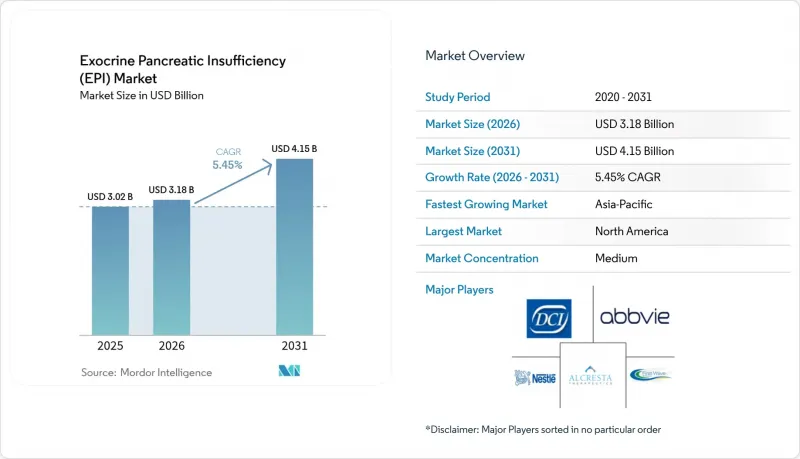
본 보고서는 치료법(PERT, 영양 요법), 질환의 원인(낭포성 섬유증, 만성 췌장염, 췌장암 등), 유통 채널(병원 약국 등), 지역(북미, 유럽, 아시아태평양, 중동 및 아프리카, 남미)별로 분류되어 있습니다. 시장 전망은 금액(달러) 기준으로 제시되어 있습니다.
세계의 췌장 외분비 부전(EPI) 시장 동향 및 인사이트
만성 췌장염 및 췌장암과 관련된 EPI 유병률 상승
만성 췌장염과 췌장암은 합쳐서 효소 보충 요법의 최대 위험군을 형성하고 있습니다. 종단적 데이터에 따르면, 만성 췌장염 환자의 80-90%가 췌장 외분비 부전(EPI)으로 진행되며, 췌장암 환자의 최대 80%가 결국 소화 기능 부전 증상을 보인다는 것이 밝혀졌습니다. 높은 유병률에도 불구하고, 실제 임상 환경에서의 연구에 따르면 증상이 있는 암 환자 중 지침에서 권장하는 효소 보충 요법(PERT)을 받고 있는 비율은 고작 21%에 불과하여, 치료상의 큰 격차가 드러나고 있습니다. 암 치료 지침이 화학요법과 병행하는 조기 효소 요법을 중시함에 따라, 이러한 격차는 점차 줄어들고 있습니다. 공중보건 캠페인의 강화와 영상 진단 기술의 발전으로 잠재적 사례가 드러나면서, 과거에는 급성기의 대증 요법에 그쳤던 것이 환자의 전체 생존 기간에 걸친 만성적 지지 요법 모델로 변화하고 있습니다. 그 결과, 수요 추세는 처방량이 많고 장기간에 걸친 처방으로 이동하고 있어, 제약 회사 입장에서는 지속적인 수익 전망을 세우기 쉬워지고 있습니다.
낭포성 섬유증 생존율 향상으로 인한 평생 환자 수 증가
수십년전만 해도 낭포성 섬유증은 주로 소아기의 치명적인 질환이었지만, 오늘날에는 CFTR 조절제 치료 덕분에 선진국 시장에서 생존 기간의 중앙값이 45년을 넘고 있습니다. 낭포성 섬유증 환자의 최대 85%는 영아기에 췌장 기능 부전을 보이기 때문에 진단 후 즉시 PERT를 시작합니다. 이 환자들이 성인기나 고령층으로 접어들면서 평생 처방량이 증가하여, 효소 제제 공급업체에게는 예측 가능하고 연금과 같은 안정적인 수요가 확립됩니다. 성인 중심 치료로 인해, 복약 부담 경감, 맛 가리기, 다양한 식습관에서의 복약 순응도를 단순화하는 디지털 투여량 계산 도구와 같은 제품 차별화가 더욱 확대되고 있습니다. 치료의 지속적 특성으로 인해, 하루 캡슐 수를 줄여 삶의 질을 향상시키고 간접적으로 영양 상태를 뒷받침하는 장기 작용형 재조합 제제의 가치 제안을 더욱 강화하고 있습니다.
돼지 유래 췌장 효소 공급의 간헐적인 부족
2024년부터 2025년에 걸쳐 영국 지역 약국의 96%가 ‘크레온(Creon)’ 조달 어려움을 보고했으며, 이러한 공급 부족은 2026년까지 지속될 전망입니다. 근본적인 원인으로는 인증된 도축장 수가 제한적이라는 점, 로트 출하 시험 지연, 그리고 팬데믹으로 인한 운송 병목 현상 등이 꼽힙니다. 재고 부족이 심각해지는 가운데, 국가 규제 당국은 ‘심각한 품귀 프로토콜’을 발동하여 약사가 용량 단위로 대체 처방을 할 수 있도록 허용했으나, 많은 환자들이 캡슐 사용량을 제한하거나 식단을 변경하는 등 영양실조의 위험에 노출되어 있습니다. 이러한 품귀 현상은 단일 동물 유래 원료에 의존하는 공급망의 취약성을 여실히 드러내는 동시에, 돼지 유래 원료의 제약을 피할 수 있는 재조합 또는 미생물 유래 대체품에 대한 이해관계자들의 관심을 높이고 있습니다.
부문별 분석
췌장 외분비 부전(EPI)을 위한 췌장 효소 보충 요법 시장에서 2025년에는 매출 점유율의 80.92%를 차지했습니다. 돼지 유래 판크레리파제에 대한 의존이 여전히 일반적인 이유는 이 제제가 임상의들이 신뢰하는 비율로 리파제,아밀라제, 프로테아제 등 3가지 효소를 배합하고 있기 때문입니다. 그러나 재조합 및 미생물 유래 제제는 현재 판매량 점유율이 5% 미만임에도 불구하고, 공급 불안 및 식이 제한 문제에 대응하고 있다는 점에서 연평균 성장률(CAGR) 8.55%로 성장을 지속하고 있습니다. 아돌리파제와 같은 후기 임상시험 단계의 후보 약물이 제3상 시험 데이터를 축적함에 따라, 합성 효소의 췌장 외분비 부전(EPI) 시장 점유율은 2031년까지 10.25%를 약간 상회할 것으로 예측됩니다.
기존 PERT 제조업체들은 위산에 견디는 서방형 마이크로과립을 채택하고 있는 반면, 혁신적인 기업들은 경장 영양 펌프와 호환되는 고정화 효소 카트리지 개발을 추진하고 있습니다. 차별화는 부가 서비스, 모바일 복약 순응도 플랫폼, 원격 영양 상담, 환자 지원 프로그램까지 확대되고 있으며, 제네릭 의약품에 의한 시장 잠식이 다가오는 상황에서도 처방 의사의 지지를 확보하고 있습니다. 이러한 시너지 효과를 내는 발전은 알레르기 상태, 문화적 선호도, 원산지에 대한 윤리관을 바탕으로 각각 특정 환자층을 대상으로 하는 돼지 유래 및 재조합 유래 제품이 공존하는 미래 시장 구조를 시사하고 있습니다.
지역별 분석
북미는 2025년에도 매출 점유율 41.22%를 유지했으며, 이는 승인된 PERT 브랜드에 대한 보편적인 보험 적용과 고용량 요법에 정통한 성숙한 처방 의사층을 반영합니다. 크레온(Creon)만 해도 민간 보험, 메디케어, 파트 D 플랜에서 93%의 우선 처방약 목록 등재를 자랑하고 있습니다. 그럼에도 불구하고, 돼지 유래 선공급 제한으로 인한 간헐적인 품절은 지불 기관의 면밀한 조사를 초래하고 있으며, 의료 서비스 제공업체들에게 향후 재조합형 대체품의 검토를 촉구하고 있습니다. BLA(생물학적 제제 승인 신청) 절차에 따라 수립된 FDA 지침에 따라 바이오시밀러 효소에 대한 요건이 명확해짐에 따라 경쟁이 심화될 것으로 예상되며, 2028년 이후 제네릭 의약품 신청이 가속화될 가능성이 있습니다.
유럽에서는 임상적 측면에서 높은 수준의 지식이 축적되어 있지만, 재고 부족 문제가 심각하게 대두되고 있습니다. 유럽의약품청(EMA)은 제품의 입수 가능성을 다각화하기 위해 2024년 6월 ‘Micrazym’의 승인을 신속히 처리했습니다. 그럼에도 불구하고 2025년 조사에 따르면, 장기화되는 공급 부족 속에서 영국 환자들이 투여량 제한을 강요받고 있는 것으로 밝혀졌습니다. 이에 대응하여 각국의 의료 제도에서는 공급업체에 수개월 분량의 안전 재고를 확보하도록 의무화하는 비상 시 계약을 수립하고 있으며, 재조합 효소 제제의 파이프라인이 성숙해질 때까지 공급 안정성을 강화하고 있습니다. 식사 사진을 바탕으로 투여량을 맞춤 설정하는 ‘MyCyFAPP’ 앱으로 대표되는 복약 순응도를 지원하는 디지털 도구의 병행 개발도 유럽의 낭포성 섬유증 진료과 사이에서 빠르게 확산되고 있습니다.
아시아태평양은 가장 성장세가 두드러지는 지역으로, 진단 체계의 정비, 인구 고령화, 만성 질환 부담 증가를 배경으로 2031년까지 연평균 성장률(CAGR)이 6.29%를 나타낼 것으로 예측됩니다. 중국의 역학 데이터에 따르면, 35-49세 성인에서 췌장암 발생률이 불균형적으로 증가하고 있으며, 이러한 추세가 효소 제제 수요를 직접적으로 끌어올리고 있습니다. 규제에 대한 근본적인 재검토도 마찬가지로 주목받고 있습니다. 인도에서는 2024년 ‘국가 필수 의약품 목록’ 개정을 통해 팽크레리파제가 명시적으로 지정되어, 공립병원에서의 조달이 효율화되었습니다. 그러나 보험 환급 제도의 불균일성과 수입 브랜드에 대한 의존으로 인해 치료 접근성에는 여전히 격차가 존재합니다. 이에 따라 다국적 기업들은 지역 수탁 제조업체와 제휴하여 현지에서의 충전 및 마무리 생산 능력을 구축하는 한편, 관세 인하 및 정치적 신뢰 관계 강화를 도모하고 있습니다.
기타 혜택 :
- 엑셀 형식 시장 예측(ME) 시트
- 3개월간의 애널리스트 지원
자주 묻는 질문
목차
제1장 서론
제2장 조사 방법
제3장 주요 요약
제4장 시장 구도
제5장 시장 규모 및 성장 예측
제6장 경쟁 구도
제7장 시장 기회 및 향후 전망
KTH 26.09.04According to Mordor Intelligence, the exocrine pancreatic insufficiency market size was valued at USD 3.02 billion in 2025 and estimated to grow from USD 3.18 billion in 2026 to reach USD 4.15 billion by 2031, at a CAGR of 5.45% during the forecast period (2026-2031).
This report is Segmented by Therapy (Pancreatic Enzyme Replacement Therapy, Nutritional Therapy), Disease Etiology (Cystic Fibrosis, Chronic Pancreatitis, Pancreatic Cancer, and More), Distribution Channel (Hospital Pharmacies, and More), and Geography (North America, Europe, Asia-Pacific, Middle East & Africa, South America). The Market Forecasts are Provided in Terms of Value (USD).
Global Exocrine Pancreatic Insufficiency (EPI) Market Trends and Insights
Rising Prevalence of EPI Linked to Chronic Pancreatitis & Pancreatic Cancer
Chronic pancreatitis and pancreatic cancer together shape the largest at-risk cohort for enzyme replacement therapy. Longitudinal data show that 80-90% of chronic pancreatitis cases progress to exocrine pancreatic insufficiency, and up to 80% of pancreatic cancer patients ultimately manifest digestive insufficiency symptoms. Despite the high incidence, real-world studies indicate that only 21% of symptomatic cancer patients receive guideline-recommended PERT, highlighting a sizable treatment gap. The disconnect is gradually closing as oncology guidelines emphasize early enzyme therapy alongside chemotherapeutic regimens. Heightened public health campaigns and improved imaging modalities are unveiling latent cases, transforming what was once acute palliation into a chronic supportive-care model that extends throughout a patient's survival journey. Consequently, demand patterns are shifting toward high-volume, long-duration prescriptions that favor sustained revenue visibility for manufacturers.
Increasing Cystic-Fibrosis Survival Rates Expanding Lifetime Patient Pool
Decades ago, cystic fibrosis was primarily a pediatric fatality; today, median survival in developed markets exceeds 45 years, courtesy of CFTR modulator therapies. Up to 85% of cystic-fibrosis patients exhibit pancreatic insufficiency at infancy and therefore initiate PERT soon after diagnosis. As these patients transition into adulthood and elderly age bands, lifetime prescription volumes multiply, embedding predictable, annuity-like demand for enzyme suppliers. Adult-centered care further magnifies product differentiation around pill burden, flavor masking, and digital dosing calculators that simplify adherence across diverse meal patterns. The sustained nature of therapy also strengthens the value proposition for long-acting recombinant options that reduce daily capsule counts, thereby improving quality of life and indirectly supporting nutritional status.
Intermittent Shortages of Porcine Pancreatin Supply
In 2024-2025, 96% of U.K. community pharmacies reported difficulty sourcing Creon, a shortage expected to linger through 2026. Root causes include a limited number of qualified slaughterhouses, batch-release testing delays, and pandemic-driven transportation bottlenecks. As inventory gaps widened, national regulators invoked Serious Shortage Protocols permitting pharmacists to make dose-for-dose substitutions, yet many patients rationed capsules or altered diets, risking malnutrition. The scarcity underscores the fragility of a supply chain reliant on a single animal source and catalyzes stakeholder interest in recombinant or microbial substitutes that circumvent porcine raw-material constraints.
Other drivers and restraints analyzed in the detailed report include:
- Patent Expiries Spurring Affordable Generics
- Supply-Chain Innovation in Microbial/Recombinant Enzymes
- Low Clinician Confidence; Sub-Therapeutic PERT Dosing
For complete list of drivers and restraints, kindly check the Table Of Contents.
Segment Analysis
The exocrine pancreatic insufficiency market size for pancreatic enzyme replacement therapy held an 80.92% revenue share in 2025. Reliance on porcine-derived pancrelipase remains the norm because the formulation delivers the triad of lipase, amylase, and protease in ratios clinicians trust. Yet recombinant and microbial formulations, though representing under 5% of volume today, are clocking an 8.55% CAGR as they respond to supply insecurities and dietary constraints. The exocrine pancreatic insufficiency market share of synthetic enzymes is forecast to inch past 10.25% by 2031 as late-stage candidates like adrulipase accumulate phase III data.
Manufacturers of conventional PERT are deploying controlled-release micro-granules that withstand gastric acidity, while innovators explore immobilized enzyme cartridges compatible with enteral feeding pumps. Differentiation extends to ancillary services, mobile adherence platforms, tele-nutrition counseling, and patient-assistance programs-that lock in prescriber loyalty even as generic erosion looms. These converging developments suggest a future landscape where porcine and recombinant options coexist, each targeting specific patient segments based on allergy status, cultural preferences, and source-of-origin ethics.
Complete Report Scope:
- By Therapy
- Pancreatic Enzyme Replacement Therapy (PERT)
- Porcine-derived formulations
- Microbial/Recombinant formulations
- Nutritional Therapy
- Macronutrient-specific supplements
- Pro- & Synbiotics
- Pancreatic Enzyme Replacement Therapy (PERT)
- By Disease Etiology
- Cystic Fibrosis
- Chronic Pancreatitis
- Pancreatic Cancer
- Post-surgical & Other Causes
- By Distribution Channel
- Hospital Pharmacies
- Retail Pharmacies
- Online Pharmacies
- By Geography
- North America
- United States
- Canada
- Mexico
- Europe
- Germany
- United Kingdom
- France
- Italy
- Spain
- Rest of Europe
- Asia-Pacific
- China
- Japan
- India
- Australia
- South Korea
- Rest of Asia-Pacific
- Middle East & Africa
- GCC
- South Africa
- Rest of Middle East & Africa
- South America
- Brazil
- Argentina
- Rest of South America
- North America
Geography Analysis
North America retained a 41.22% revenue share in 2025, reflecting universal insurance coverage for approved PERT brands and a mature prescriber base familiar with high-dose regimens. Creon alone enjoys 93% preferred formulary placement across commercial and Medicare Part D plans. Nevertheless, episodic backorders linked to limited porcine gland supply have triggered payer scrutiny, nudging providers to consider future recombinant alternatives. Competitive dynamics may intensify as FDA guidances framed under the BLA pathway clarify requirements for biosimilar enzymes, accelerating generic filings post-2028.
Europe exhibits high clinical sophistication but is grappling with acutely constrained inventories. The European Medicines Agency expedited approval of Micrazym in June 2024 to diversify product availability. Despite this, 2025 surveys revealed U.K. patients resorting to dose rationing amid prolonged shortages. In response, national health systems are drafting contingency contracts that oblige suppliers to hold multi-month safety stocks, bolstering resilience until recombinant pipelines mature. Parallel developments in digital adherence tools exemplified by the MyCyFAPP app that customizes dosing based on meal photographs are quickly gaining traction among European cystic-fibrosis clinics.
Asia-Pacific is the fastest-growing region, charting a 6.29% CAGR through 2031 on the back of improved diagnostic reach, population aging, and rising chronic-disease burdens. Chinese epidemiological data reveal a disproportionate uptick in pancreatic cancer incidence among adults aged 35-49, a trend that directly feeds enzyme demand. Regulatory overhaul is equally salient: India's 2024 revision of its National Essential Medicines List now explicitly names pancrelipase, streamlining public-hospital procurement. However, fragmented reimbursement and a reliance on imported brands keep treatment access uneven. Multinational firms are therefore partnering with regional contract manufacturers to establish local fill-and-finish capacity, simultaneously lowering tariffs and strengthening political goodwill.
- Abbvie
- Viatris (Zenpep)
- Nestle Health Science
- Digestive Care Inc.
- Nordmark Pharma
- Alcresta Therapeutics
- First Wave BioPharma
- Perseo Pharma
- Synspira Therapeutics
- Codexis
- Vivus LLC
- Anthera Pharmaceuticals
- Adare Pharma Solutions
- Mayoly Spindler
- Dr. Falk Pharma
- Kreon Pharma
- Zymtech
- Laboratoires Mayoly-Spindler
- AzurRx Biopharma
Additional Benefits:
- The market estimate (ME) sheet in Excel format
- 3 months of analyst support
TABLE OF CONTENTS
1 Introduction
- 1.1 Study Assumptions & Market Definition
- 1.2 Scope of the Study
2 Research Methodology
3 Executive Summary
4 Market Landscape
- 4.1 Market Overview
- 4.2 Market Drivers
- 4.2.1 Rising Prevalence of EPI Linked to Chronic Pancreatitis & Pancreatic Cancer
- 4.2.2 Increasing Cystic-Fibrosis Survival Rates Expanding Lifetime Patient Pool
- 4.2.3 Patent Expiries Spurring Affordable Generics
- 4.2.4 Supply-Chain Innovation in Microbial/Recombinant Enzymes
- 4.2.5 Digital Dosing Apps Improving Adherence & Outcomes
- 4.2.6 Strategic Guideline Updates Mandating Early PERT Initiation
- 4.3 Market Restraints
- 4.3.1 Intermittent Shortages of Porcine Pancreatin Supply
- 4.3.2 Low Clinician Confidence; Sub-Therapeutic PERT Dosing
- 4.3.3 Regional Reimbursement Gaps for Long-Term PERT
- 4.3.4 Stringent cGMP & Viral Safety Requirements Inflating COGS
- 4.4 Porter's Five Forces Analysis
- 4.4.1 Threat of New Entrants
- 4.4.2 Bargaining Power of Buyers
- 4.4.3 Bargaining Power of Suppliers
- 4.4.4 Threat of Substitutes
- 4.4.5 Intensity of Competitive Rivalry
5 Market Size & Growth Forecasts (Value in USD)
- 5.1 By Therapy
- 5.1.1 Pancreatic Enzyme Replacement Therapy (PERT)
- 5.1.1.1 Porcine-derived formulations
- 5.1.1.2 Microbial/Recombinant formulations
- 5.1.2 Nutritional Therapy
- 5.1.2.1 Macronutrient-specific supplements
- 5.1.2.2 Pro- & Synbiotics
- 5.1.1 Pancreatic Enzyme Replacement Therapy (PERT)
- 5.2 By Disease Etiology
- 5.2.1 Cystic Fibrosis
- 5.2.2 Chronic Pancreatitis
- 5.2.3 Pancreatic Cancer
- 5.2.4 Post-surgical & Other Causes
- 5.3 By Distribution Channel
- 5.3.1 Hospital Pharmacies
- 5.3.2 Retail Pharmacies
- 5.3.3 Online Pharmacies
- 5.4 By Geography
- 5.4.1 North America
- 5.4.1.1 United States
- 5.4.1.2 Canada
- 5.4.1.3 Mexico
- 5.4.2 Europe
- 5.4.2.1 Germany
- 5.4.2.2 United Kingdom
- 5.4.2.3 France
- 5.4.2.4 Italy
- 5.4.2.5 Spain
- 5.4.2.6 Rest of Europe
- 5.4.3 Asia-Pacific
- 5.4.3.1 China
- 5.4.3.2 Japan
- 5.4.3.3 India
- 5.4.3.4 Australia
- 5.4.3.5 South Korea
- 5.4.3.6 Rest of Asia-Pacific
- 5.4.4 Middle East & Africa
- 5.4.4.1 GCC
- 5.4.4.2 South Africa
- 5.4.4.3 Rest of Middle East & Africa
- 5.4.5 South America
- 5.4.5.1 Brazil
- 5.4.5.2 Argentina
- 5.4.5.3 Rest of South America
- 5.4.1 North America
6 Competitive Landscape
- 6.1 Market Concentration
- 6.2 Market Share Analysis
- 6.3 Company Profiles (includes Global-level Overview, Market-level Overview, Core Segments, Financials, Strategic Info, Market Rank/Share, Products & Services, Recent Developments)
- 6.3.1 AbbVie Inc.
- 6.3.2 Viatris (Zenpep)
- 6.3.3 Nestle Health Science
- 6.3.4 Digestive Care Inc.
- 6.3.5 Nordmark Pharma
- 6.3.6 Alcresta Therapeutics
- 6.3.7 First Wave BioPharma
- 6.3.8 Perseo Pharma
- 6.3.9 Synspira Therapeutics
- 6.3.10 Codexis Inc.
- 6.3.11 Vivus LLC
- 6.3.12 Anthera Pharmaceuticals
- 6.3.13 Adare Pharma Solutions
- 6.3.14 Mayoly Spindler
- 6.3.15 Dr. Falk Pharma
- 6.3.16 Kreon Pharma
- 6.3.17 Zymtech
- 6.3.18 Laboratoires Mayoly-Spindler
- 6.3.19 AzurRx Biopharma
7 Market Opportunities & Future Outlook
- 7.1 White-space & Unmet-Need Assessment