|
시장보고서
상품코드
2116455
신경학 임상시험 : 시장 점유율 분석, 업계 동향 및 통계, 성장 예측(2026-2031년)Neurology Clinical Trials - Market Share Analysis, Industry Trends & Statistics, Growth Forecasts (2026 - 2031) |
||||||
 Mordor Intelligence
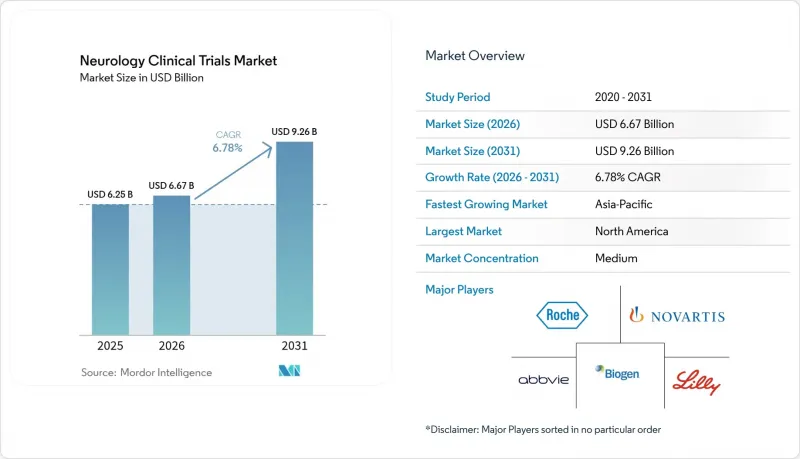
Mordor Intelligence에 의하면, 신경학 임상시험 시장 규모는 2025년 62억 5,000만 달러로 평가되었습니다. 2026년에는 66억 7,000만 달러로 확대되어 2026년부터 2031년에 걸쳐 CAGR 6.78%로 성장을 지속하여, 2031년에는 92억 6,000만 달러에 이를 것으로 예측됩니다.
본 보고서는 단계(1상, 2상 등), 연구 구성(중재적, 관찰적, 확장 접근), 적응증(간질, 뇌졸중, 알츠하이머병, 파킨슨병, 다발성 경화증, 편두통 등),지역(북미, 유럽, 아시아태평양, 중동 및 아프리카, 남미)별로 분류되어 있습니다. 시장 예측은 금액(달러) 기준으로 제시되어 있습니다.
세계의 신경학 임상시험 시장 동향 및 인사이트
전 세계적으로 증가하는 신경 질환의 부담
현재 전 세계적으로 10억 명 이상이 신경 질환을 앓고 있어, 질환 수정 요법에 대한 시급한 수요가 발생하고 있으며, 이것이 임상시험 건수 증가를 뒷받침하고 있습니다. 알츠하이머병만 해도 5,500만 명이 앓고 있으며, 2050년까지 그 수는 2배로 늘어날 것으로 예측됩니다. 이에 따라 FDA의 아두카누맙·레카네맙 승인을 계기로, 아밀로이드·타우를 표적으로 하는 약물로 개발 파이프라인이 전환되고 있습니다. 파킨슨병 유병자 수는 1,000만 명을 넘어섰으며, 교토대학이 iPS 세포 유래 도파민 작동성 전구세포를 이용한 재생의학 임상시험에서는 6명의 환자 중 4명에서 운동 기능 점수의 개선이 확인되었습니다. 뇌졸중 발생률은 계속 증가하고 있으며, 중국의 티로피반 관련 연구에서는 10개 뇌졸중 센터에서 아스피린에 비해 조기 신경학적 악화를 68% 감소시키는 것으로 나타났습니다. 따라서 인구 고령화는 임상시험 대상 환자층을 확대시키고 있으며, 신경내과 분야 임상시험 시장의 향후 수년에 걸친 성장세를 공고히 하고 있습니다.
중추신경계(CNS) 의약품 개발에 대한 투자 확대
2025년, 제약 기업과 벤처 투자자들은 보다 명확한 규제 경로와 혁신적인 기술 플랫폼에 매료되어 중추신경계(CNS) 프로그램에 사상 최대 규모의 자금을 투입했습니다. 애브비는 정신 질환 치료용 비환각성 신경 가소성 유도제를 개발하기 위해 길가메쉬 파마슈티컬스와 20억 달러 규모의 제휴를 시작했습니다. 바이엘은 파킨슨병 치료용 유전자 치료제 AB-1005에 대해 1b상 임상시험에서 양호한 안전성 데이터를 확보함에 따라, 4개국에서 2상 임상시험으로 진행했습니다. 에자이(Eisai)는 신경학 분야의 스타트업 기업을 대상으로 연간 벤처 투자 한도를 40억 엔으로 인상했습니다. Nexus NeuroTech Ventures와 같은 새로운 전문 펀드가 등장하여 BCI(뇌-컴퓨터 인터페이스), 유전자 편집, 신경면역학 프로젝트를 육성하고 있습니다. 자본 유입으로 인해 개념 증명(PoC)까지의 기간이 단축되었으며, 치료법 선택지도 다양해지고 있습니다.
신경내과 분야 후기 임상시험의 높은 비용과 복잡성
대규모 표본 크기, 장기간에 걸친 추적 조사, 그리고 복잡한 결과 평가로 인해 환자 1인당 비용이 증가하고 있습니다. HERCULES 임상시험에서는 31개국에서 재발이 없는 이차 진행성 다발성 경화증 환자 1,131명이 등록되어, 진행성 질환 적응증에서 필요한 물류 규모를 여실히 보여주었습니다. 사노피의 플렉사리맙 병행 3상 임상시험 역시 재발형 및 진행형 코호트 모두에서 새로운 작용기전을 검증할 때 발생하는 재정적 부담을 더욱 부각시키고 있습니다. 세포 요법을 이용한 간질 연구의 경우, 뇌신경외과 센터와 수년에 걸친 모니터링이 필요하기 때문에 비용이 더욱 증가합니다. 이러한 자금적 장벽은 중소기업의 진입을 저해하고, 주요 임상시험의 지리적 다양성을 제한할 가능성이 있습니다.
부문별 분석
2025년에는 3상 임상시험이 신경내과 임상시험 시장 점유율의 52.02%를 차지하여, 대규모 확인 임상시험의 수익 비중이 높음을 반영했습니다. 그러나 유전자, 세포, BCI(뇌-컴퓨터 인터페이스) 프로그램이 급증하는 가운데, 1상 임상시험은 2031년까지 연평균 성장률(CAGR) 17.35%를 나타낼 것으로 예측됩니다. UniQure사의 AMT-162 SOD1-ALS 유전자 치료는 1년 이내에 2차 투여 코호트로 전환되어 초기 단계에서의 신속한 진전을 입증하고 있습니다. 마찬가지로, Precision사의 Layer 7 안전성 시험은 침습적인 신경기술에 필수적인 초기 단계의 집중적인 평가를 구현하고 있습니다. 이러한 1상 임상시험 활동의 급증은 2027년 이후의 후기 단계 임상시험 건수를 보완할 견고한 파이프라인의 존재를 시사합니다.
그럼에도 불구하고, 보험사의 승인이나 치료 지침 등재에는 여전히 후기 단계 연구가 매우 중요합니다. 트레빌티닙을 사용한 HERCULES 임상시험의 성공을 통해 질환 진행이 31% 지연됨이 입증되었으며, 규제 당국에 대한 신청 및 상업화로의 길이 열렸습니다. 시판 후 4상 임상시험은 비용은 적지만, UCSF의 오클레리주맙 림프절 작용기전 연구에서 드러난 바와 같이, 적응증 확대에 필수적인 실세계 데이터를 제공합니다.
지역별 분석
북미는 여전히 고도로 복잡한 신경과학 연구의 중심지로 자리 잡고 있습니다. BCI(뇌-컴퓨터 인터페이스), 디지털 치료제, 체액 바이오마커에 대한 FDA의 ‘획기적 치료제 지정(Breakthrough Designation)’은 규제상의 불확실성을 완화하고 다국적 후원사들을 유치하고 있습니다. 애브비(AbbVie)의 20억 달러 규모 뉴로플라스젠(Neuroplastigen) 제휴와 NIH(미국 국립보건원)의 연간 1,000만 달러 규모 BRAIN 이니셔티브 침습적 기기 프로그램은 자금력의 두께를 더욱 강화하고 있습니다. IQVIA나 Syneos와 같이 광범위한 네트워크를 보유한 CRO는 전문적인 뇌외과 수술 및 원격 모니터링 물류 서비스를 제공하며, 해당 지역에서의 우위를 유지하고 있습니다.
아시아태평양의 성장세는 폭넓은 정책적 지원과 비용 효율적인 인프라에서 비롯됩니다. 상하이 StairMed의 침습적 BCI 임상시험을 통해 중국은 최첨단 신경 임플란트를 시행하는 몇 안 되는 국가 중 하나가 되었습니다. 중국 내 10개 기관에서 실시된 티로피반을 이용한 뇌졸중 연구는 1,000명 이상의 환자를 대상으로 한 급성기 임상시험을 관리할 수 있는 능력을 입증했습니다. 일본에서 iPS 세포를 이용한 파킨슨병 치료의 성공은 재생의학 파이프라인에 탄력을 주고 있습니다. 중산층의 신경 질환 부담이 증가하고 있는 점과 맞물려, 이러한 요인들로 인해 스폰서의 활동 범위는 동쪽으로 이동하고 있습니다.
유럽에서는 광범위한 네트워크를 활용하여 다국간 임상시험을 효율적으로 수행하고 있습니다. 독일의 EPIsoDE가 진행하는 실로시빈 연구, 영국의 시간 간섭법을 활용한 알츠하이머병 자극 요법 프로젝트, 그리고 EU 전역에서 진행되고 있는 롱코비드 신경 자가항체 임상시험은 치료법 탐구의 폭이 얼마나 넓은지를 보여줍니다. EMA 지침에 기반한 통합된 윤리 심사로 준비 기간이 단축되는 한편, ‘호라이즌 유럽’의 보조금이 학계와 산업계 컨소시엄의 비용을 보전하고 있습니다.
기타 혜택 :
- 엑셀 형식 시장 예측(ME) 시트
- 3개월간의 애널리스트 지원
자주 묻는 질문
목차
제1장 서론
제2장 조사 방법
제3장 주요 요약
제4장 시장 구도
제5장 시장 규모 및 성장 예측
제6장 경쟁 구도
제7장 시장 기회 및 향후 전망
KTH 26.09.04According to Mordor Intelligence, the neurology clinical trials market size is expected to grow from USD 6.25 billion in 2025 to USD 6.67 billion in 2026 and is forecast to reach USD 9.26 billion by 2031 at 6.78% CAGR over 2026-2031.
This report is Segmented by Phase (Phase I, Phase II, and More), Study Design (Interventional, Observational, Expanded Access), Indication (Epilepsy, Stroke, Alzheimer's Disease, Parkinson's Disease, Multiple Sclerosis, Migraine, and More), and Geography (North America, Europe, Asia-Pacific, The Middle East and Africa, and South America). The Market Forecasts are Provided in Terms of Value (USD).
Global Neurology Clinical Trials Market Trends and Insights
Increasing Global Burden of Neurological Disorders
Neurological conditions now affect more than 1 billion people worldwide, creating urgent demand for disease-modifying therapies that fuels clinical trial volume. Alzheimer's disease alone impacts 55 million individuals and is projected to double by 2050, prompting a pipeline shift toward amyloid- and tau-targeting agents following FDA approvals of aducanumab and lecanemab. Parkinson's disease prevalence surpassed 10 million, and regenerative trials such as Kyoto University's iPS-cell dopaminergic progenitors showed motor-score improvements in 4 of 6 patients. Stroke incidence continues rising, with the Chinese tirofiban study reducing early neurological deterioration by 68% versus aspirin across 10 stroke centers. Population aging therefore extends trial addressable pools and secures multi-year growth momentum for the neurology clinical trials market.
Growing Investment in Central Nervous System Drug Development
Pharmaceutical and venture investors committed record sums to CNS programs in 2025, attracted by clearer regulatory routes and transformative technology platforms. AbbVie launched a USD 2 billion alliance with Gilgamesh Pharmaceuticals to create non-hallucinogenic neuroplastogens for psychiatric disorders. Bayer advanced AB-1005 gene therapy for Parkinson's into Phase II across four countries after favorable Phase Ib safety readouts. Eisai raised its annual venture allocation to JPY 4 billion, earmarking neurology start-ups. New specialist funds such as Nexus NeuroTech Ventures emerged to incubate BCI, gene-editing and neuro-immunology projects. Capital influx accelerates proof-of-concept timelines and diversifies modality choices.
High Cost and Complexity of Late-Phase Neuroscience Trials
Large sample sizes, lengthy follow-up and intricate outcome assessments inflate per-patient costs. The HERCULES study enrolled 1,131 non-relapsing secondary progressive multiple sclerosis patients across 31 countries, illustrating the logistic scale required for progressive indications. Sanofi's parallel Phase III trials for frexalimab further spotlight the financial load of testing novel mechanisms in both relapsing and progressive cohorts. Cell-therapy epilepsy studies demand neurosurgical centers and multi-year monitoring, compounding expenditure. These capital hurdles can deter smaller firms and limit geographic diversity of pivotal trials.
Other drivers and restraints analyzed in the detailed report include:
- Favorable Regulatory Initiatives for Neurotherapeutics
- Technological Advancements in Trial Design and Digital Health
- Stringent Ethical and Regulatory Requirements for CNS Studies
For complete list of drivers and restraints, kindly check the Table Of Contents.
Segment Analysis
Phase III held the dominant 52.02% neurology clinical trials market share in 2025, reflecting the high revenue weight of large confirmatory studies. Yet Phase I exhibits an 17.35% CAGR to 2031 as gene, cell and BCI programs proliferate. UniQure's AMT-162 SOD1-ALS gene therapy moved into its second dosing cohort within one year, underscoring brisk early-phase throughput. Similarly, Precision's Layer 7 safety trial exemplifies the front-loaded evaluation necessary for invasive neurotech. This burst of Phase I activity signals a robust pipeline that will replenish late-phase volumes after 2027.
Later-stage studies nonetheless remain pivotal for payer acceptance and guideline inclusion. The HERCULES success with tolebrutinib showed a 31% delay in disability progression, setting the stage for regulatory filing and commercial rollout. Post-marketing Phase IV studies-though smaller in spend-provide real-world evidence vital for label expansions, as illustrated by UCSF's ocrelizumab lymph-node mechanism study.
Complete Report Scope:
- By Phase
- Phase I
- Phase II
- Phase III
- Phase IV
- By Study Design
- Interventional
- Observational
- Expanded Access
- By Indication
- Epilepsy
- Stroke
- Alzheimer's Disease
- Parkinson's Disease
- Multiple Sclerosis
- Migraine
- Amyotrophic Lateral Sclerosis
- Other Indications
- Geography
- North America
- United States
- Canada
- Mexico
- Europe
- Germany
- United Kingdom
- France
- Italy
- Spain
- Rest of Europe
- Asia-Pacific
- China
- Japan
- India
- Australia
- South Korea
- Rest of Asia-Pacific
- Middle East & Africa
- GCC
- South Africa
- Rest of Middle East & Africa
- South America
- Brazil
- Argentina
- Rest of South America
- North America
Geography Analysis
North America remains the gravitational center of high-complexity neuroscience research. FDA breakthrough designations for BCIs, digital therapeutics and fluid biomarkers lower regulatory opacity and entice multinational sponsors. AbbVie's USD 2 billion neuroplastogen alliance and NIH's USD 10 million annual BRAIN Initiative invasive-device program reinforce capital depth. Extensively networked CROs such as IQVIA and Syneos supply specialized neurosurgical and remote-monitoring logistics, sustaining regional dominance.
Asia-Pacific's momentum derives from broad policy backing and cost-efficient infrastructure. Shanghai StairMed's invasive BCI trial places China among the few nations executing cutting-edge neuroimplants. The 10-center Chinese tirofiban stroke study proved capability to manage >1,000-patient acute trials. Japan's iPS Parkinson's therapy successes ignite regenerative-medicine pipelines. Coupled with rising middle-class neurological disease burden, these factors shift sponsor footprints eastward.
Europe leverages pan-regional networks to run multi-country trials efficiently. Germany's EPIsoDE psilocybin investigation, the UK's temporal-interference Alzheimer's stimulation project and EU-wide Long-COVID neuro-autoantibody trials illustrate breadth of therapeutic exploration. Harmonized ethics review under EMA guidelines shortens setup times, while Horizon Europe grants offset costs for academia-industry consortia.
- Abbvie
- AstraZeneca
- Biogen
- Eli Lilly and Company
- Eisai
- Novartis
- Sanofi
- Merck
- Roche
- Takeda Pharmaceuticals
- Teva Pharmaceutical Industries
- Supernus (Adamas)
- Athira Pharma
- Annovis Bio
- Zydus Group
- Neurocrine Biosciences
- Voyager Therapeutics
- IQVIA
- Parexel International (MA) Corporation
- Charles River
- Syneos Health
- MedPace
Additional Benefits:
- The market estimate (ME) sheet in Excel format
- 3 months of analyst support
TABLE OF CONTENTS
1 Introduction
- 1.1 Study Assumptions & Market Definition
- 1.2 Scope Of The Study
2 Research Methodology
3 Executive Summary
4 Market Landscape
- 4.1 Market Overview
- 4.2 Market Drivers
- 4.2.1 Increasing Global Burden of Neurological Disorders
- 4.2.2 Growing Investment in Central Nervous System Drug Development
- 4.2.3 Favorable Regulatory Initiatives for Neurotherapeutics
- 4.2.4 Technological Advancements in Trial Design and Digital Health
- 4.2.5 Expansion of Contract Research Organization Capabilities
- 4.2.6 Rising Adoption of Precision Medicine and Biomarkers in Neurology
- 4.3 Market Restraints
- 4.3.1 High Cost and Complexity of Late-Phase Neuroscience Trials
- 4.3.2 Stringent Ethical And Regulatory Requirements for CNS Studies
- 4.3.3 Recruitment Challenges due to Narrow Patient Eligibility
- 4.3.4 Limited Predictive Preclinical Models for Neurological Diseases
- 4.4 Regulatory Landscape
- 4.5 Porter's Five Forces Analysis
- 4.5.1 Threat Of New Entrants
- 4.5.2 Bargaining Power Of Buyers
- 4.5.3 Bargaining Power Of Suppliers
- 4.5.4 Threat Of Substitutes
- 4.5.5 Competitive Rivalry
5 Market Size & Growth Forecasts (Value, USD)
- 5.1 By Phase
- 5.1.1 Phase I
- 5.1.2 Phase II
- 5.1.3 Phase III
- 5.1.4 Phase IV
- 5.2 By Study Design
- 5.2.1 Interventional
- 5.2.2 Observational
- 5.2.3 Expanded Access
- 5.3 By Indication
- 5.3.1 Epilepsy
- 5.3.2 Stroke
- 5.3.3 Alzheimer's Disease
- 5.3.4 Parkinson's Disease
- 5.3.5 Multiple Sclerosis
- 5.3.6 Migraine
- 5.3.7 Amyotrophic Lateral Sclerosis
- 5.3.8 Other Indications
- 5.4 Geography
- 5.4.1 North America
- 5.4.1.1 United States
- 5.4.1.2 Canada
- 5.4.1.3 Mexico
- 5.4.2 Europe
- 5.4.2.1 Germany
- 5.4.2.2 United Kingdom
- 5.4.2.3 France
- 5.4.2.4 Italy
- 5.4.2.5 Spain
- 5.4.2.6 Rest of Europe
- 5.4.3 Asia-Pacific
- 5.4.3.1 China
- 5.4.3.2 Japan
- 5.4.3.3 India
- 5.4.3.4 Australia
- 5.4.3.5 South Korea
- 5.4.3.6 Rest of Asia-Pacific
- 5.4.4 Middle East & Africa
- 5.4.4.1 GCC
- 5.4.4.2 South Africa
- 5.4.4.3 Rest of Middle East & Africa
- 5.4.5 South America
- 5.4.5.1 Brazil
- 5.4.5.2 Argentina
- 5.4.5.3 Rest of South America
- 5.4.1 North America
6 Competitive Landscape
- 6.1 Market Concentration
- 6.2 Market Share Analysis
- 6.3 Company Profiles (Includes Global Level Overview, Market Level Overview, Core Segments, Financials As Available, Strategic Information, Market Rank/Share, Products & Services, Recent Developments)
- 6.3.1 Abbvie, Inc.
- 6.3.2 Astrazeneca
- 6.3.3 Biogen
- 6.3.4 Eli Lilly & Co.
- 6.3.5 Eisai Co., Ltd.
- 6.3.6 Novartis AG
- 6.3.7 Sanofi
- 6.3.8 Merck & Co.
- 6.3.9 F. Hoffmann-La Roche Ltd.
- 6.3.10 Takeda Pharmaceutical Company Limited
- 6.3.11 Teva Pharmaceutical Industries Ltd.
- 6.3.12 Supernus (Adamas)
- 6.3.13 Athira Pharma
- 6.3.14 Annovis Bio
- 6.3.15 Zydus Group
- 6.3.16 Neurocrine Biosciences
- 6.3.17 Voyager Therapeutics
- 6.3.18 IQVIA Inc.
- 6.3.19 Parexel International (MA) Corporation
- 6.3.20 Charles River Laboratories
- 6.3.21 Syneos Health
- 6.3.22 Medpace, Inc.
7 Market Opportunities & Future Outlook
- 7.1 White-Space & Unmet-Need Assessment