
|
시장보고서
상품코드
2116458
외상 후 스트레스 장애 시장 : 점유율 분석, 업계 동향과 통계, 성장 예측(2026-2031년)Post Traumatic Stress Disorder - Market Share Analysis, Industry Trends & Statistics, Growth Forecasts (2026 - 2031) |
||||||
 Mordor Intelligence
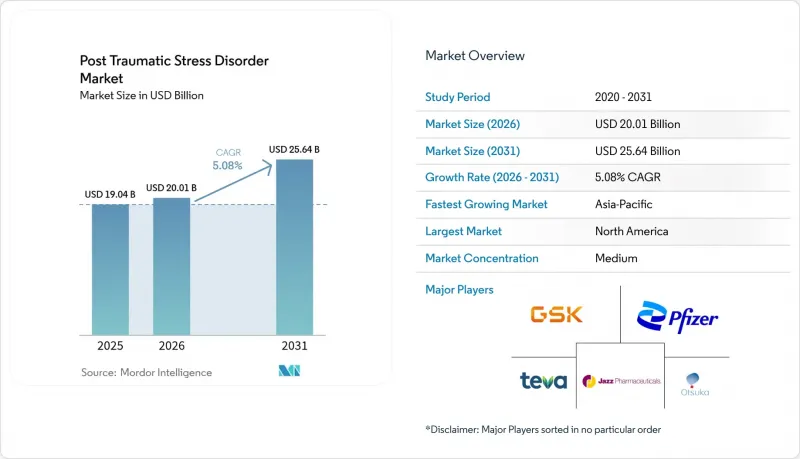
Mordor Intelligence에 의하면, 외상 후 스트레스 장애(PTSD) 시장 규모는 2025년에 190억 4,000만 달러로 평가되었고 2026년 200억 1,000만 달러에서 2031년까지 256억 4,000만 달러에 이를 것으로 예측되며, 예측 기간(2026-2031년) CAGR은 5.08%를 나타낼 전망입니다.
본 보고서는 약물 분류별(SSRI, SNRI, 비정형 항정신병제 등), 환자층(성인, 소아·청소년), 치료법(약물 요법, 심리 요법 등), 유통 채널(병원 약국 등), 지역(북미, 유럽 등)별로 분류되어 있습니다. 시장 전망은 금액(달러) 기준으로 제시되어 있습니다.
전 세계 외상 후 스트레스 장애(PTSD) 시장 동향 및 인사이트
전 세계 PTSD 유병률 및 진단률 증가
선별 프로토콜의 개선으로 인해, 지금까지 진단이 미흡했던 여성 재향 군인 및 민간인 트라우마 경험자 중에서 상당수의 환자 집단이 드러나고 있습니다. 오디샤주의 열차 사고는 대규모 트라우마 사건이 어떻게 체계적인 PTSD 평가를 유발하는지를 보여주고 있으며, 생존자의 유병률은 19%에서 59.4%에 이릅니다. 텍사스주 등 일부 주에서는 기존 의료 예산 삭감에 따라 재향군인을 대상으로 한 환각제 치료 프로그램의 시범 운영을 시작했으며, 이로 인해 치료 대상이 되는 인구는 더욱 확대되고 있습니다. 그 결과 처방 건수가 증가하고 있으며, PTSD 시장은 꾸준한 성장 궤도를 유지하고 있을 뿐만 아니라, 개발 기업들에게 치료 저항성 하위 집단에 대한 대응을 촉구하고 있습니다.
신약의 후기 임상시험 가속화
파이프라인의 충실도는 지난 20년 동안 최고 수준에 이르렀으며, 오츠카 제약과 룬드베크사는 2건의 긍정적인 3상 임상시험에서 브렉스피프라졸-셀트랄린이 위약 대비 CAPS-5 점수의 평균 개선치가 5.59포인트였습니다고 보고했습니다. 컴퍼스 패스웨이즈(Compass Pathways)는 심리적 지원을 병행한 25mg 시로시빈 단회 투여를 통해 임상적으로 지속적인 효과가 얻어졌음을 입증했습니다. FDA가 320명의 환자를 대상으로 한 대마초 관련 연구를 승인한 것은 다양한 치료법에 대한 규제 당국의 수용 태도가 확대되고 있음을 보여줍니다.
환각성 화합물에 대한 안전성 및 남용 위험에 대한 우려
2024년 8월, FDA 자문위원회는 기능적 맹검 해제 및 치료사의 부정행위를 이유로 10대 1의 투표로 MDMA를 부결했습니다. 스케줄 I로 지정됨에 따라 더 엄격한 REMS(위험 평가 및 완화 전략)가 의무화되어, PTSD(외상 후 스트레스 장애) 시장에서 비용 상승과 유통 경로의 제한을 초래하고 있습니다. 전문 치료사의 교육 및 통제된 환경이 여전히 전제조건으로 요구되고 있어, 임상적 수요는 높지만 단기적인 보급은 억제되고 있습니다.
부문 분석
SSRI는 처방 의사들 사이에서 폭넓은 인지도와 양호한 안전성 실적을 바탕으로 2025년 PTSD 시장에서 38.96%의 점유율을 유지했습니다. 그러나 MDMA의 실패를 교훈으로 삼은 적응형 임상시험 설계와 최적화된 안전성 프로토콜에 힘입어, 환각제를 병용하는 치료법은 연평균 성장률(CAGR) 8.42%를 나타낼 것으로 전망됩니다. 이미 확립된 SNRI는 치료 저항성 사례에 대한 치료를 계속하고 있으며, 브렉스피프라졸과 같은 비정형 항정신병 약물은 병용 약물로 보급되고 있습니다.
중국에서 승인된 에스케타민을 포함한 NMDA 수용체 조절제의 부상은 글루타메이트 경로로 전환되고 있음을 여실히 보여줍니다. 알파-1 아드레날린 수용체 길항제 및 AI를 통해 확인된 용도 변경 약물도 위험 감소가 가속화됨에 따라 임상시험 단계에 접어들고 있습니다. 약리학과 디지털 지원을 통합할 수 있는 개발 기업은 PTSD 시장에서 매우 큰 가치를 확보하게 될 것입니다.
2025년에는 재향군인과 1차 대응자 수요로 인해 성인이 PTSD 시장 규모의 81.22%를 차지할 것으로 전망됩니다. 재향군인부의 환각 요법에 대한 지원은 성인 환자 기반의 기반을 더욱 공고히 하고 있습니다. 그럼에도 불구하고 소아 환자층은 규모는 작지만, Tonix사의 OASIS 임상시험과 같은 조기 중개 연구가 주목을 받으면서 연평균 성장률(CAGR) 7.21%로 성장을 주도하고 있습니다.
청소년층의 참여와 보호자의 감독을 목적으로 하는 디지털 플랫폼은 대면 치료가 부족한 지역으로의 접근성을 확대하며, 원격의료 보험 급여 제도 개혁과도 부합합니다. 윤리적 장벽과 피험자 수의 부족으로 인해 단기적인 보급에는 여전히 제약이 있지만, 수요에 부응하는 제품이 등장함에 따라 PTSD 시장에서 소아 환자의 채택률은 궁극적으로 향상될 것입니다.
지역별 분석
북미는 탄탄한 임상시험 인프라, 최대 규모의 재향 군인 인구, 그리고 의약품 및 의료기기용 소프트웨어 모두에 대한 선진적인 보험 환급 제도의 뒷받침을 받아 2025년에는 매출 점유율 36.10%로 PTSD 시장을 주도했습니다. 2025년 2월로 예정된 브렉피프라졸·셀트랄린의 FDA 승인 목표일과 디지털 PTSD 도구에 대한 CMS의 보험 급여 코드 제정으로 인해, 이 지역은 계속해서 주요 혁신의 거점으로서의 지위를 유지할 전망입니다.
아시아태평양은 가장 빠르게 성장하는 지역으로, 2031년까지 연평균 성장률(CAGR) 6.88%를 기록할 전망입니다. 일본의 스마트폰 기반 인지 치료 승인 및 중국의 에스케타민 승인은 새로운 치료법에 대해 점점 더 수용적인 규제 환경이 조성되고 있음을 보여줍니다. 정신 건강에 대한 편견 해소 및 원격 의료 인프라에 대한 투자를 추진하는 정부 프로그램 덕분에, 인구가 많은 신흥 경제국에서 환자에 대한 접근성이 확대되면서 PTSD 시장은 더욱 성장할 것입니다.
유럽에서는 꾸준하면서도 변화하는 수요가 관찰되고 있으며, 호주의 MDMA 및 실로시빈 도입에 따라 정책 입안자들은 환각제 도입을 위한 프레임워크를 마련하고 있습니다. EU 전역의 규제 조화를 위한 노력은 엄격한 증거 기준을 유지하면서 승인 절차의 효율화를 목표로 하고 있습니다. 지역별로 상이한 규제가 여전히 시장 진입 장벽으로 작용하고 있지만, 디지털 치료법의 보급이 확대되고 제네릭 SSRI에 대한 수요가 견조함에 따라 유럽 전역에서 PTSD 시장은 견조한 모습을 유지하고 있습니다.
기타 혜택:
- 엑셀 형식 시장 예측(ME) 시트
- 3개월간의 애널리스트 지원
자주 묻는 질문
목차
제1장 서론
제2장 조사 방법
제3장 주요 요약
제4장 시장 구도
제5장 시장 규모와 성장 예측
제6장 경쟁 구도
제7장 시장 기회와 향후 전망
JHS 26.08.28According to Mordor Intelligence, the post traumatic stress disorder market size was valued at USD 19.04 billion in 2025 and estimated to grow from USD 20.01 billion in 2026 to reach USD 25.64 billion by 2031, at a CAGR of 5.08% during the forecast period (2026-2031).
This report is Segmented by Drug Class (SSRIs, Snris, Atypical Antipsychotics, and More), Patient Type (Adults, Children & Adolescents), Therapy Modality (Pharmacotherapy, Psychotherapy, and More), Distribution Channel (Hospital Pharmacies, and More), and Geography (North America, Europe and More). The Market Forecasts are Provided in Terms of Value (USD).
Global Post Traumatic Stress Disorder Market Trends and Insights
Growing Global PTSD Prevalence and Diagnosis Rates
Improved screening protocols are unveiling sizeable patient cohorts among women veterans and civilian trauma survivors who were historically under-diagnosed. The Odisha train disaster illustrated how mass trauma events trigger systematic PTSD assessments, with prevalence among survivors ranging from 19% to 59.4%.States such as Texas now pilot psychedelic therapy programs for veterans after budget cuts to conventional care, further enlarging the treated population. The resulting rise in prescriptions keeps the post traumatic stress disorder market on a steady growth trajectory and pushes developers to address therapy-resistant subgroups.
Accelerating Late-Stage Clinical Trials for Novel Agents
Pipeline density is the highest in two decades, with Otsuka and Lundbeck reporting a mean CAPS-5 improvement of 5.59 points for brexpiprazole-sertraline vs. placebo in two positive Phase 3 studies. Compass Pathways achieved clinically sustained benefits from a single 25 mg psilocybin dose backed by psychological support. The FDA's clearance for a 320-patient cannabis study underscores the wider regulatory appetite for diversified modalities.
Safety & Abuse-Liability Concerns Around Psychedelic Compounds
FDA advisers voted 10-1 against MDMA in August 2024, citing functional unblinding and therapist misconduct. Schedule I status triggers stricter REMS, elevating cost and limiting distribution channels in the post traumatic stress disorder market. Specialized therapist training and controlled settings remain prerequisites, restraining near-term adoption despite strong clinical demand.
Other drivers and restraints analyzed in the detailed report include:
- Expedited FDA Breakthrough & Fast-Track Designations for Psychedelic-Assisted Therapies
- AI-Driven Drug-Repurposing Platforms Uncovering PTSD Indications
- High Placebo Responses in PTSD Trials Complicate Regulatory Approvals
For complete list of drivers and restraints, kindly check the Table Of Contents.
Segment Analysis
SSRIs retained a 38.96% slice of the post traumatic stress disorder market in 2025 due to broad familiarity among prescribers and favorable safety records. Yet psychedelic-assisted approaches exhibit an 8.42% CAGR outlook, encouraged by adaptive trial designs and optimized safety protocols after the MDMA setback. Established SNRIs continue to serve treatment-resistant cases, and atypical antipsychotics such as brexpiprazole gain traction as combination agents.
The rise of NMDA receptor modulators, including esketamine approved in China, spotlights a shift toward glutamatergic pathways. Alpha-1 adrenergic antagonists and AI-identified repurposed drugs are also entering trials, enabled by faster de-risking. Developers able to integrate pharmacology with digital support will capture outsized value in the post traumatic stress disorder market.
Adults contributed 81.22% of post traumatic stress disorder market size in 2025 thanks to veteran and first-responder demand. Department of Veterans Affairs backing for psychedelic services further entrenches adult volume. Nonetheless, the pediatric cohort, while smaller, leads growth at 7.21% CAGR as early-intervention studies such as Tonix's OASIS trial gain traction.
Digital platforms designed for youth engagement and caregiver oversight extend reach where in-person therapy is scarce, aligning with tele-health reimbursement reforms. Ethical barriers and smaller trial pools still temper near-term penetration, but tailored products will eventually lift pediatric uptake within the post traumatic stress disorder market.
Complete Report Scope:
- By Drug Class
- Selective Serotonin Re-uptake Inhibitors (SSRIs)
- Serotonin-Norepinephrine Re-uptake Inhibitors (SNRIs)
- Atypical Antipsychotics
- Alpha-1 Adrenergic Antagonists
- NMDA Receptor Modulators
- Psychedelic-assisted Therapies (MDMA, Psilocybin, LSD)
- Other Classes (Beta-blockers, Benzodiazepines, Anticonvulsants)
- By Patient Type
- Adults
- Children & Adolescents
- By Therapy Modality
- Pharmacotherapy
- Psychotherapy
- Digital Therapeutics
- Combination Therapy
- By Distribution Channel
- Hospital Pharmacies
- Retail & Specialty Pharmacies
- Digital / Tele-prescription Platforms
- By Geography
- North America
- United States
- Canada
- Mexico
- Europe
- Germany
- United Kingdom
- France
- Italy
- Spain
- Rest of Europe
- Asia-Pacific
- China
- Japan
- India
- Australia
- South Korea
- Rest of Asia-Pacific
- Middle East and Africa
- GCC
- South Africa
- Rest of Middle East and Africa
- South America
- Brazil
- Argentina
- Rest of South America
- North America
Geography Analysis
North America led the post traumatic stress disorder market with a 36.10% revenue share in 2025, supported by extensive clinical trial infrastructure, the largest veteran population, and progressive reimbursement for both drugs and software-as-medical-devices. The February 2025 FDA target date for brexpiprazole-sertraline approval and CMS reimbursement codes for digital PTSD tools position the region to remain the primary innovation hub.
Asia-Pacific is the fastest-growing territory, set to register a 6.88% CAGR to 2031. Japan's clearance of smartphone-delivered cognitive therapy and China's esketamine nod illustrate a regulatory climate increasingly receptive to novel modalities. Government programs that address mental-health stigma and invest in tele-health infrastructure will amplify patient reach in populous emerging economies, further expanding the post traumatic stress disorder market.
Europe shows steady but evolving demand, with policymakers crafting frameworks for psychedelic adoption after Australia's MDMA and psilocybin rollout. Pan-EU harmonization efforts aim to streamline approvals while maintaining stringent evidence thresholds. Fragmented local regulations still challenge market entry, but rising digital-therapy adoption and robust generic SSRI uptake keep the post traumatic stress disorder market resilient across the continent.
- Pfizer
- GlaxoSmithKline
- Otsuka
- Lundbeck
- Jazz Pharmaceuticals
- Teva Pharmaceutical Industries
- Viatris
- Tonix Pharmaceuticals
- Compass Pathways
- Multidisciplinary Association for Psychedelic Studies (MAPS PBC)
- Mydecine Innovations Group
- Alto Neuroscience
- BioXcel Therapeutics
- Transcend Therapeutics
- Lupin
- Merck
- Johnson & Johnson
- Aurobindo Pharma
- Clearmind Medicine
Additional Benefits:
- The market estimate (ME) sheet in Excel format
- 3 months of analyst support
TABLE OF CONTENTS
1 Introduction
- 1.1 Study Assumptions and Market Definition
- 1.2 Scope of the Study
2 Research Methodology
3 Executive Summary
4 Market Landscape
- 4.1 Market Overview
- 4.2 Market Drivers
- 4.2.1 Growing Global PTSD Prevalence And Diagnosis Rates
- 4.2.2 Accelerating Late-Stage Clinical Trials For Novel Agents
- 4.2.3 Expedited FDA Breakthrough Therapy & Fast-Track Designations For Psychedelic-Assisted Therapies
- 4.2.4 AI-Driven Drug-Repurposing Platforms Uncovering PTSD Indications For Existing CNS Drugs
- 4.2.5 Government And Payer Uptake Of Digital Therapeutics For Post-Deployment Mental Health
- 4.2.6 Expansion Of Tele-Psychiatry Increasing Prescription Reach In Underserved Regions
- 4.3 Market Restraints
- 4.3.1 Safety & Abuse-Liability Concerns Around Psychedelic Compounds
- 4.3.2 High Placebo Responses In PTSD Trials Complicate Regulatory Approvals
- 4.3.3 Limited Biomarker-Based Patient Stratification Reducing Drug Efficacy Signals
- 4.3.4 Stigmatization And Under-Reporting Of Symptoms Curbing Treatment Uptake
- 4.4 Value / Supply-Chain Analysis
- 4.5 Regulatory Landscape
- 4.6 Technology Outlook
- 4.7 Porter's Five Forces Analysis
- 4.7.1 Bargaining Power of Suppliers
- 4.7.2 Bargaining Power of Buyers
- 4.7.3 Threat of New Entrants
- 4.7.4 Threat of Substitutes
- 4.7.5 Intensity of Competitive Rivalry
5 Market Size and Growth Forecasts (Value-USD)
- 5.1 By Drug Class
- 5.1.1 Selective Serotonin Re-uptake Inhibitors (SSRIs)
- 5.1.2 Serotonin-Norepinephrine Re-uptake Inhibitors (SNRIs)
- 5.1.3 Atypical Antipsychotics
- 5.1.4 Alpha-1 Adrenergic Antagonists
- 5.1.5 NMDA Receptor Modulators
- 5.1.6 Psychedelic-assisted Therapies (MDMA, Psilocybin, LSD)
- 5.1.7 Other Classes (Beta-blockers, Benzodiazepines, Anticonvulsants)
- 5.2 By Patient Type
- 5.2.1 Adults
- 5.2.2 Children & Adolescents
- 5.3 By Therapy Modality
- 5.3.1 Pharmacotherapy
- 5.3.2 Psychotherapy
- 5.3.3 Digital Therapeutics
- 5.3.4 Combination Therapy
- 5.4 By Distribution Channel
- 5.4.1 Hospital Pharmacies
- 5.4.2 Retail & Specialty Pharmacies
- 5.4.3 Digital / Tele-prescription Platforms
- 5.5 By Geography
- 5.5.1 North America
- 5.5.1.1 United States
- 5.5.1.2 Canada
- 5.5.1.3 Mexico
- 5.5.2 Europe
- 5.5.2.1 Germany
- 5.5.2.2 United Kingdom
- 5.5.2.3 France
- 5.5.2.4 Italy
- 5.5.2.5 Spain
- 5.5.2.6 Rest of Europe
- 5.5.3 Asia-Pacific
- 5.5.3.1 China
- 5.5.3.2 Japan
- 5.5.3.3 India
- 5.5.3.4 Australia
- 5.5.3.5 South Korea
- 5.5.3.6 Rest of Asia-Pacific
- 5.5.4 Middle East and Africa
- 5.5.4.1 GCC
- 5.5.4.2 South Africa
- 5.5.4.3 Rest of Middle East and Africa
- 5.5.5 South America
- 5.5.5.1 Brazil
- 5.5.5.2 Argentina
- 5.5.5.3 Rest of South America
- 5.5.1 North America
6 Competitive Landscape
- 6.1 Market Concentration
- 6.2 Market Share Analysis
- 6.3 Company profiles (includes Global level Overview, Market level overview, Core Segments, Financials as available, Strategic Information, Market Rank/Share for key companies, Products and Services, and Recent Developments)
- 6.3.1 Pfizer
- 6.3.2 GlaxoSmithKline
- 6.3.3 Otsuka Pharmaceutical
- 6.3.4 Lundbeck
- 6.3.5 Jazz Pharmaceuticals
- 6.3.6 Teva Pharmaceutical
- 6.3.7 Viatris
- 6.3.8 Tonix Pharmaceuticals
- 6.3.9 Compass Pathways
- 6.3.10 Multidisciplinary Association for Psychedelic Studies (MAPS PBC)
- 6.3.11 Mydecine Innovations Group
- 6.3.12 Alto Neuroscience
- 6.3.13 BioXcel Therapeutics
- 6.3.14 Transcend Therapeutics
- 6.3.15 Lupin
- 6.3.16 Merck KGaA
- 6.3.17 Johnson & Johnson (Janssen)
- 6.3.18 Aurobindo Pharma
- 6.3.19 Clearmind Medicine
7 Market Opportunities and Future Outlook
- 7.1 White-Space and Unmet-Need Assessment