

|
시장보고서
상품코드
2116459
축성 척추 관절염(axSpA) 시장 : 점유율 분석, 업계 동향과 통계, 성장 예측(2026-2031년)Global Axial Spondyloarthritis (axSpA) - Market Share Analysis, Industry Trends & Statistics, Growth Forecasts (2026 - 2031) |
||||||
 Mordor Intelligence
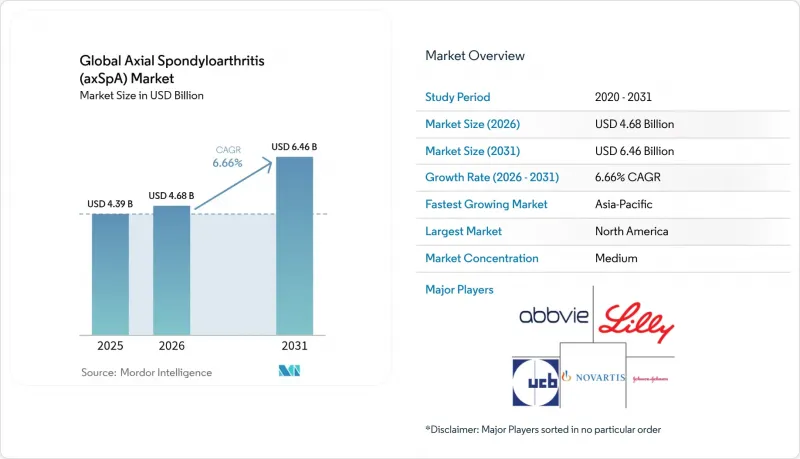
Mordor Intelligence에 의하면, 축성 척추 관절염 시장 규모는 2025년에 43억 9,000만 달러로 평가되었고 2026년 46억 8,000만 달러에서 2031년까지 64억 6,000만 달러에 이를 것으로 추정되고 있어 예측 기간(2026-2031년) CAGR은 6.66%를 나타낼 전망입니다.
본 보고서는 질환 유형(강직성 척추염 및 비방사선 소견성 축성 척추 관절염),약제 분류별(NSAIDs, 글루코코르티코이드 등), 투여 경로별(경구, 피하 투여 등), 유통 채널별(병원 약국 등), 지역별(북미, 유럽, 아시아태평양 등)로 분류되어 있습니다. 시장 예측은 금액(미 달러) 기준으로 제시되어 있습니다.
전 세계 축성 척추 관절염(axSpA) 시장 동향 및 인사이트
MRI 권장 프로그램에 따른 진단율 상승
ASAS 분류의 개정과 보험 제도의 통합으로 인해, 요통의 조기 평가에 MRI를 의무화하고 있는 의료 기관에서 진단까지의 지연 기간이 8년 이상에서 약 3년으로 단축되었습니다. 강화된 딕슨 시퀀싱는 현재 96%의 진단 정확도를 달성하고 있으며, 이로 인해 치료 대상이 되는 환자층이 확대되어 축성 척추 관절염 시장의 성장을 뒷받침하고 있습니다. 조기 발견은 구조적 손상을 예방하고 장기적인 노동 생산성을 뒷받침하는 것으로 이어지며, 보험사 측의 비용 절감 근거를 더욱 공고히 하고 있습니다.
치료 지침에서 IL-17 및 JAK 억제제의 급속한 도입
2022년 ASAS/EULAR 지침에서는 NSAIDs 및 적어도 1종의 TNF 억제제가 효과를 보이지 않는 경우, IL-17 및 JAK 억제제의 사용이 권장되었습니다. 2024년에 승인된 비메키주맙은 ASAS40 달성률이 44%를 넘어 효능의 새로운 기준을 세웠을 뿐만 아니라, 최초의 이중 사이토카인 억제 치료 옵션을 제공했습니다. 우파다시티닙을 비롯한 JAK 억제제는 심혈관계에 대한 경고가 있음에도 불구하고 경구 치료 옵션을 확대하고 있으며, 2차 치료가 표준화됨에 따라 축성 척추 관절염 시장을 확대되고 있습니다.
신규 생물학적 제제의 치료비는 여전히 고가
비메키즈마브의 1회 투여당 8,281달러라는 가격은 바이오시밀러와의 경쟁이 있음에도 불구하고 여전히 경제적 장벽이 존재함을 보여줍니다. 연간 총 치료비는 1만 달러 전후로 유지되고 있어, 지불 주체의 예산을 압박하고 저소득 지역에서의 보급을 제한하고 있습니다. 추가적인 모니터링, 투여에 따른 관리 비용, 그리고 이상반응 관리가 경제적 부담을 가중시켜 축성 척추 관절염 시장의 잠재력을 충분히 발휘하지 못하는 요인이 되고 있습니다.
부문 분석
2025년에는 강직성 척추염이 매출의 66.92%를 차지하며 1위를 차지했으나, 2031년까지 비방사선 소견형은 연평균 성장률(CAGR) 7.69%로 증가할 전망입니다. MRI의 조기 도입으로 구조적 손상이 발생하기 전에 염증성 병변을 검출할 수 있게 되어, 축성 척추 관절염 시장에서 비방사선 소견형 환자 기반이 확대되고 있습니다. 임상시험에서는 두 표현형 모두에서 유사한 생물학적 제제의 반응률이 보고되어, 질병 경과의 초기 단계에서 적극적인 치료의 유효성이 입증되었습니다. 지역 간 차이는 현저하여, 아시아 코호트에서 비방사선 소견의 유병률은 불과 14.4%로, 서유럽 환자 집단의 절반 수준에 그치고 있습니다. 이는 유전적 요인과 의료 접근성의 차이를 반영합니다. 통일된 용어 체계와 ASAS 기준에 따라 인지도가 지속적으로 높아지고 있으며, 진단에 따른 환자 수가 두 자릿수 성장세를 이어가면서 모든 약물 분류별로 축성 척추 관절염 시장의 기회가 확대되고 있습니다.
연구 관심은 비가역적인 유합이 발생하기 전에 치료를 목표로 하고, X선 소견으로의 전환을 예측하는 바이오마커에 집중되고 있습니다. 상업적 성장의 여지는 질병 진행 단계를 구별하고 프리미엄 가격 책정을 정당화할 수 있는 동반 진단에 있습니다. 환자 단체의 인식 제고 캠페인은 인지도 확대를 더욱 가속화하고 있으며, 원격 류마티스학은 도시와 농촌 간의 격차를 줄일 가능성이 있어, 축성 척추 관절염 시장의 장기적인 부문 확장을 뒷받침하는 구조적 호재를 강화하고 있습니다.
DMARD는 2025년에 전 세계 매출의 49.02%를 차지하며, 바이오의약품 및 표적 합성 의약품의 출시에 힘입어 연평균 성장률(CAGR) 7.11%로 성장할 전망입니다. 비메키주맙에 의한 이중 IL-17 억제는 이 부문을 강화하고 있으며, ASAS40에서 우수한 치료 성과를 가져오고 있습니다. JAK 억제제는 치료의 유연성을 높이지만, 모니터링의 필요성은 여전히 남아 있습니다. 실제 임상 데이터를 통해 지불 기관의 신뢰가 높아지고 보험 적용 범위가 확대됨에 따라, 축성 척추 관절염 시장에서 DMARD 시장 규모는 꾸준히 확대될 것으로 예측됩니다.
NSAIDs와 글루코코르티코이드는 증상 악화 억제에서 여전히 필수적이지만, 주로 소화기계 및 골밀도와 관련된 위험 프로파일로 인해 성장이 정체되어 있습니다. NLRX1 작용제나 마이크로바이옴 조절제 등 신규 진입 약물은 작용기전의 다양화를 가져와 파이프라인의 지속적인 보충을 보장할 것으로 기대됩니다. 관찰 레지스트리는 특히 새로운 분자의 장기적인 안전성 프로파일이 명확하고 효과가 지속된다는 것이 입증될 경우, 가이드라인 내에서의 위치에 영향을 미칠 가능성이 높으며, 이를 통해 축성 척추 관절염 시장에서 DMARD의 우위가 유지될 것입니다.
지역별 분석
북미는 전 세계 매출의 39.78%를 차지하고 있으며, 바이오의약품의 높은 보급률, 고용주가 자금을 지원하는 전문 의료 혜택, 그리고 효율화된 FDA 승인 절차의 혜택을 받고 있습니다. MRI 보급률과 AI를 활용한 영상 판독 도구를 통해 평균 진단까지의 지연 기간이 2.7년으로 단축되어, 치료 대상 환자 수가 증가하고 있습니다. 바이오시밀러의 보급은 리베이트 제도를 재편하여, 지불 주체의 예산을 늘리지 않으면서도 신약의 진입 여지를 넓혀, 강직성 척추 관절염 시장 전체에서 매출의 주도적 위치를 유지하고 있습니다.
아시아태평양은 중국의 보험 적용 범위 확대와 병원 수용 능력 증강에 힘입어 2031년까지 연평균 성장률(CAGR) 7.19%라는 가장 높은 성장률을 기록하고 있습니다. 강직성 척추염의 유병률이 최대 0.42%에 달한다는 점은 상당한 수의 미진단 환자가 존재함을 시사합니다. 일본에서는 국민건강보험제도에 힘입어 생물학적 제제의 높은 이용률이 나타나는 반면, 인도에서는 여전히 전문의 부족 및 본인 부담금 상한선과 같은 과제에 직면해 있습니다. MRI 스캐너 증설 및 원격 류마티스 진료 서비스 도입을 목표로 하는 지역별 민관 협력 프로젝트를 통해 약물 사용량은 증가할 전망입니다. 요가와 태극권이 표준 치료에 문화적으로 통합되어 있다는 점은 축성 질환 관리에 있어 지역적 적응성을 뒷받침합니다.
유럽은 국민건강보험 제도가 잘 갖춰진 성숙한 시장이지만, 의료 접근성에는 여전히 편차가 있습니다. 중동부 유럽 국가들은 생물학적 제제의 채택률(27.9%)이 낮고, 진단까지의 소요 기간도 길어(4.2년) 성장이 둔화되고 있습니다. 그럼에도 불구하고 유럽 대륙은 바이오시밀러 정책의 선구자로서 경쟁력 있는 가격 책정을 촉진하고 있습니다. 중동 및 아프리카은 재정 능력 및 콜드체인 부족으로 인해 뒤처져 있지만, 대상층을 좁힌 기증자 프로그램과 도시 지역의 진료소 확충을 통해 수요가 서서히 증가하고 있습니다. 남미에서는 거시경제 변동과 보험 급여 지연으로 인해 성장세가 다소 억제되고 있지만, 한 자릿수 중반대의 성장이 예상됩니다.
기타 혜택:
- 엑셀 형식 시장 예측(ME) 시트
- 3개월간의 애널리스트 지원
자주 묻는 질문
목차
제1장 서론
제2장 조사 방법
제3장 주요 요약
제4장 시장 구도
제5장 시장 규모와 성장 예측
제6장 경쟁 구도
제7장 시장 기회와 향후 전망
JHS 26.08.28According to Mordor Intelligence, the axial spondyloarthritis market size was valued at USD 4.39 billion in 2025 and estimated to grow from USD 4.68 billion in 2026 to reach USD 6.46 billion by 2031, at a CAGR of 6.66% during the forecast period (2026-2031).
This report is Segmented by Disease Types (Ankylosing Spondylitis and Non-Radiographic Axial Spondyloarthritis), by Drug Class (NSAIDs, Glucocorticoids, and More), Route of Administration (Oral, Subcutaneous, and More), Distribution Channel (Hospital Pharmacies, and More), and Geography (North America, Europe, Asia-Pacific, and More). The Market Forecasts are Provided in Terms of Value (USD).
Global Axial Spondyloarthritis (axSpA) Market Trends and Insights
Rising diagnosis rates due to MRI advocacy programs
Updated ASAS classification and insurance alignment have cut diagnostic delay from more than eight years to roughly three in centers that mandate MRI for early back-pain evaluation. Enhanced Dixon sequencing now reaches 96% diagnostic accuracy, unlocking larger treatable populations and fueling the axial spondyloarthritis market. Early identification also prevents structural damage and supports long-term work productivity, strengthening payers' cost-saving arguments.
Rapid uptake of IL-17 & JAK inhibitors in treatment guidelines
The 2022 ASAS/EULAR recommendations promoted IL-17 and JAK inhibitors once NSAIDs and at least one TNF blocker fail. Bimekizumab, approved in 2024, delivered ASAS40 responses above 44%, setting a new efficacy bar and providing the first dual cytokine blockade option. Upadacitinib and other JAK agents broaden oral alternatives despite cardiovascular warnings, enlarging the axial spondyloarthritis market as second-line therapy is standardized.
Persistently high treatment costs of novel biologics
Bimekizumab's USD 8,281 per injection illustrates ongoing affordability barriers despite biosimilar rivalry. Total annual therapy outlays hover near USD 10,000, straining payer budgets and limiting uptake in lower-income settings. Added monitoring, administration overhead, and adverse-event management inflate economic burden and temper the axial spondyloarthritis market's fullest potential.
Other drivers and restraints analyzed in the detailed report include:
- Expansion of biosimilar TNF-a inhibitors improves affordability
- Growing employer-sponsored specialty pharmacy benefits
- Limited long-term safety data for JAK inhibitors
For complete list of drivers and restraints, kindly check the Table Of Contents.
Segment Analysis
Ankylosing spondylitis led revenue with 66.92% share in 2025, yet non-radiographic presentations are rising at a 7.69% CAGR to 2031. Early MRI adoption now picks up inflammatory lesions before structural damage, swelling the non-radiographic patient base inside the axial spondyloarthritis market. Clinical trials report similar biologic response rates for both phenotypes, validating aggressive treatment earlier in the disease course. Inter-regional contrasts are pronounced; Asian cohorts show just 14.4% non-radiographic incidence, half that of Western peers, reflecting divergent genetics and care accessibility. Harmonized nomenclature and ASAS criteria continue to raise awareness, sustaining double-digit gains for diagnostically driven volumes and enlarging axial spondyloarthritis market opportunity across all drug classes.
Elevated research interest centers on biomarkers that predict radiographic conversion, aiming to target therapy before irreversible fusion. Commercial upside lies in companion diagnostics that would differentiate aggressiveness, potentially justifying premium pricing. Education campaigns by patient groups further speed recognition, while tele-rheumatology may shrink urban-rural gaps, reinforcing structural tailwinds that support prolonged segment expansion within the axial spondyloarthritis market.
DMARDs represented 49.02% of global revenue in 2025 and are set for 7.11% CAGR, propelled by biologic and targeted synthetic launches. Dual IL-17 inhibition through bimekizumab augments this category, offering superior ASAS40 outcomes. JAK agents deepen flexibility, though monitoring demands persist. The axial spondyloarthritis market size for DMARDs is forecast to climb steadily as real-world data strengthen payer confidence and formulary positions broaden.
NSAIDs and glucocorticoids remain crucial for symptom flare control but face stagnant growth, mainly due to gastrointestinal and bone-density risk profiles. Novel entrants like NLRX1 agonists and microbiome modulators promise to diversify mechanisms, ensuring continuous pipeline replenishment. Observational registries will likely influence guideline placement, particularly if newer molecules prove durable with clean long-term safety signatures, thus safeguarding DMARD dominance inside the axial spondyloarthritis market.
Complete Report Scope:
- By Disease Type
- Ankylosing Spondylitis (Radiographic axSpA)
- Non-radiographic Axial Spondyloarthritis
- By Drug Class
- Non-steroidal Anti-inflammatory Drugs (NSAIDs)
- Glucocorticoids
- Disease-modifying Antirheumatic Drugs (DMARDs)
- Others
- By Route of Administration
- Oral
- Subcutaneous
- Intravenous
- By Distribution Channel
- Hospital Pharmacies
- Retail Pharmacies
- Online Pharmacies
- By Geography
- North America
- United States
- Canada
- Mexico
- Europe
- Germany
- United Kingdom
- France
- Italy
- Spain
- Rest of Europe
- Asia-Pacific
- China
- Japan
- India
- Australia
- South Korea
- Rest of Asia-Pacific
- Middle East and Africa
- GCC
- South Africa
- Rest of Middle East and Africa
- South America
- Brazil
- Argentina
- Rest of South America
- North America
Geography Analysis
North America anchors 39.78% of global revenue and benefits from high biologic penetration, employer-funded specialty benefits, and streamlined FDA approval pathways. MRI density and AI-enabled reading tools have trimmed average diagnostic latency to 2.7 years, amplifying treated prevalence. Biosimilar diffusion is reshaping rebates and opening space for novel agents without swelling payer budgets, sustaining revenue leadership across the axial spondyloarthritis market.
Asia-Pacific records the quickest 7.19% CAGR through 2031 as China broadens reimbursement and hospital capacity. Ankylosing spondylitis prevalence of up to 0.42% implies sizable underdiagnosis. Japan exhibits high biologic utilization tied to universal coverage, whereas India still struggles with specialist scarcity and out-of-pocket limits. Regional public-private projects to add MRI scanners and tele-rheumatology services will likely raise drug volumes. Cultural integration of yoga and Tai Chi into standard care underscores local adaptation in managing axial disease.
Europe remains a mature market with universal coverage, but access variability lingers. Central and Eastern states lag in biologic uptake (27.9%) and endure longer diagnostic delays (4.2 years), muting growth. The continent nevertheless pioneers biosimilar policy, fostering competitive pricing. Middle East & Africa trail, constrained by fiscal capacity and cold-chain gaps, yet targeted donor programs and urban clinic build-outs are stirring incremental demand. South America offers mid-single-digit expansion tempered by macroeconomic volatility and reimbursement lag.
- Abbvie
- Johnson & Johnson
- Novartis
- Pfizer
- Eli Lilly and Company
- Amgen
- UCB
- Kyowa Kirin
- Acelyrin
- Bristol-Myers Squibb
- Biogen
- Samsung Bioepis
- Celltrion Healthcare
- Gilead Sciences
- Fresenius
- Sun Pharmaceuticals Industries
- Lupin
- Dr. Reddy's Laboratories
- Sandoz Group
- Sanofi
- Roche
- Boehringer Ingelheim
- Takeda Pharmaceuticals
- Galapagos NV
Additional Benefits:
- The market estimate (ME) sheet in Excel format
- 3 months of analyst support
TABLE OF CONTENTS
1 Introduction
- 1.1 Study Assumptions & Market Definition
- 1.2 Scope of the Study
2 Research Methodology
3 Executive Summary
4 Market Landscape
- 4.1 Market Overview
- 4.2 Market Drivers
- 4.2.1 Rising Diagnosis Rates due to MRI Advocacy Programs
- 4.2.2 Rapid Uptake of IL-17 & JAK Inhibitors in Treatment Guidelines
- 4.2.3 Expansion of Biosimilar TNF-a Inhibitors Improves Affordability
- 4.2.4 Growing Employer-sponsored Specialty Pharmacy Benefits
- 4.2.5 AI-assisted MRI Algorithms Enabling Earlier Detection
- 4.2.6 Microbiome-targeted Adjuvant Therapies Showing Disease-modifying Potential
- 4.3 Market Restraints
- 4.3.1 Persistently High Treatment Costs of Novel Biologics
- 4.3.2 Limited Long-term Safety Data for JAK Inhibitors
- 4.3.3 Access Inequality in Low-income Regions for Imaging & Biologics
- 4.3.4 Cold-chain Logistics Bottlenecks for Biologic Distribution
- 4.4 Value / Supply-Chain Analysis
- 4.5 Regulatory Landscape
- 4.6 Technological Outlook
- 4.7 Porter's Five Forces Analysis
- 4.7.1 Threat of New Entrants
- 4.7.2 Bargaining Power of Buyers/Consumers
- 4.7.3 Bargaining Power of Suppliers
- 4.7.4 Threat of Substitute Products
- 4.7.5 Intensity of Competitive Rivalry
5 Market Size & Growth Forecasts (Value - USD million)
- 5.1 By Disease Type
- 5.1.1 Ankylosing Spondylitis (Radiographic axSpA)
- 5.1.2 Non-radiographic Axial Spondyloarthritis
- 5.2 By Drug Class
- 5.2.1 Non-steroidal Anti-inflammatory Drugs (NSAIDs)
- 5.2.2 Glucocorticoids
- 5.2.3 Disease-modifying Antirheumatic Drugs (DMARDs)
- 5.2.4 Others
- 5.3 By Route of Administration
- 5.3.1 Oral
- 5.3.2 Subcutaneous
- 5.3.3 Intravenous
- 5.4 By Distribution Channel
- 5.4.1 Hospital Pharmacies
- 5.4.2 Retail Pharmacies
- 5.4.3 Online Pharmacies
- 5.5 By Geography
- 5.5.1 North America
- 5.5.1.1 United States
- 5.5.1.2 Canada
- 5.5.1.3 Mexico
- 5.5.2 Europe
- 5.5.2.1 Germany
- 5.5.2.2 United Kingdom
- 5.5.2.3 France
- 5.5.2.4 Italy
- 5.5.2.5 Spain
- 5.5.2.6 Rest of Europe
- 5.5.3 Asia-Pacific
- 5.5.3.1 China
- 5.5.3.2 Japan
- 5.5.3.3 India
- 5.5.3.4 Australia
- 5.5.3.5 South Korea
- 5.5.3.6 Rest of Asia-Pacific
- 5.5.4 Middle East and Africa
- 5.5.4.1 GCC
- 5.5.4.2 South Africa
- 5.5.4.3 Rest of Middle East and Africa
- 5.5.5 South America
- 5.5.5.1 Brazil
- 5.5.5.2 Argentina
- 5.5.5.3 Rest of South America
- 5.5.1 North America
6 Competitive Landscape
- 6.1 Market Concentration
- 6.2 Market Share Analysis
- 6.3 Company Profiles
- 6.3.1 AbbVie
- 6.3.2 Johnson & Johnson (Janssen)
- 6.3.3 Novartis
- 6.3.4 Pfizer
- 6.3.5 Eli Lilly
- 6.3.6 Amgen
- 6.3.7 UCB
- 6.3.8 Kyowa Kirin
- 6.3.9 Acelyrin
- 6.3.10 Bristol Myers Squibb
- 6.3.11 Biogen
- 6.3.12 Samsung Bioepis
- 6.3.13 Celltrion Healthcare
- 6.3.14 Gilead Sciences
- 6.3.15 Fresenius Kabi
- 6.3.16 Sun Pharma
- 6.3.17 Lupin
- 6.3.18 Dr. Reddy's Laboratories
- 6.3.19 Sandoz
- 6.3.20 Sanofi
- 6.3.21 Roche
- 6.3.22 Boehringer Ingelheim
- 6.3.23 Takeda Pharmaceutical
- 6.3.24 Galapagos NV
7 Market Opportunities & Future Outlook
- 7.1 White-space & Unmet-need Assessment


