
|
시장보고서
상품코드
2116464
뇌졸중 치료제 시장 : 점유율 분석, 업계 동향과 통계, 성장 예측(2026-2031년)Stroke Therapeutics - Market Share Analysis, Industry Trends & Statistics, Growth Forecasts (2026 - 2031) |
||||||
 Mordor Intelligence
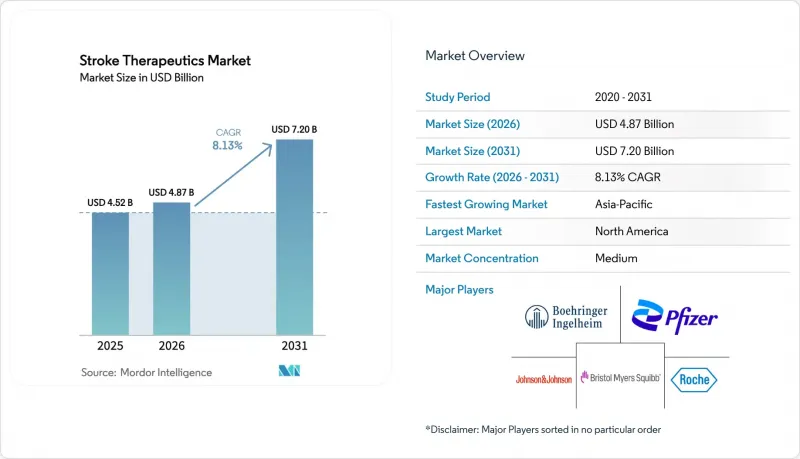
Mordor Intelligence에 의하면, 뇌졸중 치료제 시장 규모는 2026년에 48억 7,000만 달러에 이를 것으로 추정되고 있어 예측 기간(2026-2031년) CAGR 8.13%로 성장을 지속하여, 2031년까지 72억 달러에 이를 전망입니다.
본 보고서는 유형별(허혈성 뇌졸중 및 출혈성 뇌졸중), 약물 분류별(항혈전제 등), 투여 경로별(경구, 정맥 내 등), 유통 채널별(병원, 소매, 온라인 약국), 최종 사용자(병원 등), 지역별(북미, 유럽,아시아태평양, 중동 및 아프리카, 남미)별로 분류되어 있습니다. 시장 전망은 금액(달러) 기준으로 제시되어 있습니다.
전 세계 뇌졸중 치료제 시장 동향 및 인사이트
고령화에 따른 뇌졸중 유병률 상승
세계적으로 60세 이상 인구의 비율은 2015년부터 2050년 사이에 2배로 증가할 것이며, 뇌졸중 위험은 55세 이후 10년마다 2배씩 증가합니다. 미국에서만 연간 약 79만 5,000건의 뇌졸중이 발생하고 있으며, 그중 61만 건은 초발 뇌졸중입니다. 고혈압, 심방세동, 당뇨병과 같은 동반 질환으로 인해 예방적 항응고제 및 항고혈압제에 대한 수요가 증가하고 있습니다. 일본의 인구는 이미 고령화가 진행되고 있으며, 2024년에는 인구의 29%가 65세 이상이 될 전망인 만큼, 그 결과 2차 예방약의 처방량이 매우 많아지고 있습니다. 미국 식품의약국(FDA)의 패스트트랙 제도를 통해 고령자의 약동학적 변화를 고려한 고령자용 제제의 개발이 효율적으로 이루어지고 있습니다.
연구 개발 및 첨단 치료법에 대한 투자 확대
바이오의약품 파이프라인에는 100건 이상의 뇌졸중 관련 프로그램이 포함되어 있으며, 이들은 2024 회계연도에 미국 국립보건원(NIH)이 배정한 2억 1,800만 달러의 뇌졸중 연구 예산으로 지원받고 있습니다. 중점 분야는 NMDA 길항제에서 줄기세포 이식에 이르기까지 다양하며, 4.5시간이라는 제한된 혈전 용해 요법의 적응 시간을 연장하거나 회피하는 것을 목표로 하고 있습니다. PhRMA는 뇌졸중이 알츠하이머병 및 파킨슨병과 함께 신경 질환 분야의 최우선 과제 중 하나로 자리 잡고 있으며, 이는 세포 기반 재생의료 플랫폼으로의 자본 유입을 촉진하고 있다고 지적합니다. 후기 단계에서의 개발 중단률은 여전히 높은 편이지만, ‘퍼스트-인-클래스(first-in-class)’ 신경 보호제가 가져다주는 상업적 이점이 투자자들의 강한 관심을 지속적으로 불러일으키고 있습니다.
특허 만료로 인한 제네릭 의약품 시장 침투 가속화
클로피도그렐과 여러 직접 경구용 항응고제가 독점권을 상실하고 있어, 제네릭 의약품 출시 첫해에 80%가 넘는 가격 하락을 초래하고 있습니다. 제네릭 의약품은 접근성을 확대하는 한편 매출을 압박하고 있으며, 이에 따라 원개발사들은 새로운 작용기전이나 고정 용량 복합제의 도입을 추진하고 있습니다. 2024년에 예정된 아픽사반의 첫 제네릭 의약품 등장은 임박한 매출 급감을 상징하고 있습니다.
부문 분석
2025년, 허혈성 뇌졸중은 뇌졸중 치료제 시장의 62.45%를 차지하며, 이는 전 세계 뇌졸중 발병률에서 87%를 차지하는 비율을 반영합니다. 허혈성 뇌졸중 치료제 시장 규모는 알테플라제 요법의 보급과 혈전 제거술의 적응증 확대에 힘입어 성장하고 있습니다. 테네크테플라제의 도입은 편의성을 높이고 간호 업무의 부담을 경감시키고 있습니다. 2차 예방은 이중 항혈소판 요법 및 직접 경구용 항응고제(DOAC) 요법에 크게 의존하고 있으며, 이들이 지속적인 수익의 기반이 되고 있습니다.
출혈성 뇌졸중은 규모는 작지만 연평균 성장률(CAGR) 10.35%를 나타낼 것으로 예측되며, 이는 뇌졸중 치료제 시장 내에서 가장 높은 성장률입니다. 안덱사넷 알파(Andexanet-alpha)와 같은 새로운 역전제는 항응고제와 관련된 출혈을 해결하는 한편, 최소 침습적 제거 장치는 치료 성과를 향상시킵니다. 아시아 지역의 인구 고령화와 고혈압 유병률 증가에 따라, 출혈성 뇌졸중의 절대 환자 수가 수익성이 높은 지역적 비즈니스 기회를 뒷받침하고 있습니다.
항혈전제는 지침에 따라 평생 예방이 의무화됨에 따라 2025년 뇌졸중 치료제 시장 규모의 42.45%를 차지했습니다. 직접 작용형 경구용 항응고제(DOAC)는 투여량이 고정되어 있고 정기적인 모니터링이 필요하지 않기 때문에 와파린을 능가하는 성장을 이어가고 있습니다. 그러나 특허 만료가 임박함에 따라 제네릭 의약품이 등장하고, 뇌졸중 치료제 시장 전체에서 가치 재분배가 일어날 것으로 예측됩니다.
항고혈압제는 130/80 mmHg 미만이라는 AHA(미국심장협회)의 더욱 엄격한 목표치 도입을 반영하여 연평균 성장률(CAGR) 10.21%의 성장이 예상됩니다. 복합제는 복약 순응도를 향상시켜 높은 가격 책정을 뒷받침하고 있습니다. 지불 주체 입장에서는 지속적인 혈압 관리가 뇌졸중 위험 감소 효과가 입증되어, 약제 목록에 유리하게 등재되는 데 기여하고 있습니다.
지역별 분석
2025년에는 북미가 매출의 41.35%를 차지했습니다. 지역별 뇌졸중 네트워크, CMS(미국 의료보험 서비스 센터)의 가치 기반 구매 제도, 그리고 광범위한 보험 적용이 고가 의약품의 보급을 촉진하고 있습니다. 캐나다도 유사한 국민건강보험 제도를 채택하고 있지만, 주마다 서로 다른 처방약 목록이 마련되어 있습니다.
유럽은 유럽의약품청(EMA)의 중앙 승인 제도와 필수 뇌졸중 치료제에 대한 접근을 보장하는 각국의 국민건강보험제도에 힘입어 안정적인 점유율을 유지하고 있습니다. 유럽 뇌졸중 기구(ESO)가 모범 사례를 통일하는 한편, 각국은 비용 대비 효과에 관한 자료를 바탕으로 환급 제도를 미세 조정하고 있습니다.
아시아태평양은 연평균 성장률(CAGR) 9.54%로 가장 빠르게 성장하고 있습니다. 중국에서는 기본 의료보험에 제네릭 직접 경구용 항응고제가 추가되어 접근성이 확대되고 있습니다. 인도의 ‘암, 당뇨병, 심혈관 질환, 뇌졸중 예방 및 관리에 관한 국가 프로그램’은 지역별 허브 앤 스포크(hub-and-spoke)형 뇌졸중 유닛 운영에 자금을 지원하여 급성기 혈전 용해 요법에 대한 수요를 촉진하고 있습니다. 일본에서는 고령화의 진행과 관대한 보험 급여 제도로 인해 고가 치료법의 보급률이 높은 수준을 유지하고 있습니다.
기타 혜택:
- 엑셀 형식 시장 예측(ME) 시트
- 3개월간의 애널리스트 지원
자주 묻는 질문
목차
제1장 서론
제2장 조사 방법
제3장 주요 요약
제4장 시장 구도
제5장 시장 규모와 성장 예측
제6장 경쟁 구도
제7장 시장 기회와 향후 전망
JHS 26.08.28According to Mordor Intelligence, the stroke therapeutics market size is estimated to reach USD 4.87 billion in 2026, and is projected to climb to USD 7.20 billion by 2031, at a CAGR of 8.13% during the forecast period (2026-2031).
This report is Segmented by Type (Ischemic Stroke and Hemorrhagic Stroke), Drug Class (Antithrombotic Agents, and More), Route of Administration (Oral, Intravenous, and More), Distribution Channel (Hospital, Retail, and Online Pharmacies), End-User (Hospitals, and More), and Geography (North America, Europe, Asia-Pacific, MEA, and South America). Market Forecasts are Provided in Value (USD).
Global Stroke Therapeutics Market Trends and Insights
Rising Prevalence of Stroke in the Aging Population
Worldwide, the share of people aged >=60 years will double between 2015 and 2050, and stroke risk doubles every decade after 55. In the United States alone, about 795,000 strokes occur yearly, 610,000 of them first-ever events. Co-morbid hypertension, atrial fibrillation, and diabetes magnify demand for preventive anticoagulants and antihypertensives. Japan's population already skews old, with 29% of the population aged 65 or older in 2024, resulting in high prescription volumes for secondary prevention medicines. The U.S. FDA's fast-track mechanisms are streamlining the development of geriatric-appropriate formulations that recognize the altered pharmacokinetics in older adults.
Increasing Investments in R&D and Advanced Therapies
Biopharmaceutical pipelines list more than 100 active stroke programs, backed by NIH's USD 218 million stroke research allocation in FY 2024. Focus areas range from NMDA antagonists to stem-cell implants, aiming to lengthen or bypass the narrow 4.5-hour thrombolytic window. PhRMA notes that stroke joins Alzheimer's and Parkinson's as top neuro priorities, driving capital into cell-based regeneration platforms. Late-stage attrition remains high; however, the commercial upside of a first-in-class neuroprotectant continues to drive strong investor appetite.
Patent Expiries Accelerating Generic Erosion
Clopidogrel and multiple direct oral anticoagulants are losing exclusivity, triggering price drops of over 80% within the first year of generics. While generics widen access, they compress revenue, prompting originators to adopt novel mechanisms and fixed-dose combinations. Apixaban's initial generic entries in 2024 exemplify the looming revenue cliff.
Other drivers and restraints analyzed in the detailed report include:
- Favorable Reimbursement Policies for Thrombolytic Agents
- Emergence of Gene-Based Neuroprotective Platforms
- High Cost of Novel Biologics
For complete list of drivers and restraints, kindly check the Table Of Contents.
Segment Analysis
Ischemic stroke controlled 62.45% of the stroke therapeutics market in 2025, mirroring its 87% share of global stroke incidence. The stroke therapeutics market size for ischemic interventions is buoyed by widespread alteplase protocols and expanding thrombectomy eligibility. Tenecteplase adoption adds convenience, reducing nursing workload. Secondary prevention relies heavily on dual antiplatelet and direct oral anticoagulant regimens, anchoring recurring revenue.
Hemorrhagic stroke, though smaller, is projected to post a 10.35% CAGR, the fastest within the stroke therapeutics market. Novel reversal agents such as andexanet alfa address anticoagulant-related bleeds, while minimally invasive evacuation devices enhance outcomes. As Asian populations age and hypertension prevalence climbs, absolute hemorrhagic volumes support lucrative regional opportunities.
Antithrombotic agents represented 42.45% of the stroke therapeutics market size in 2025, driven by guideline-mandated lifelong prevention. Direct oral anticoagulants continue to outpace warfarin due to their fixed dosing and the elimination of routine monitoring. However, approaching patent cliffs bring generics that will redistribute value across the stroke therapeutics market.
Antihypertensives are on track for a 10.21% CAGR, reflecting tighter AHA target thresholds below 130/80 mmHg. Combination pills improve adherence and fuel premium pricing. For payers, sustained blood-pressure control offers proven stroke risk reduction, supporting favorable formulary placement.
Complete Report Scope:
- By Type
- Ischemic Stroke
- Hemorrhagic Stroke
- By Drug Class
- Antithrombotic Agents
- Neuroprotective Biologics
- Antihypertensive Agents
- Anti-Inflammatory & Antioxidants
- By Route of Administration
- Oral
- Intravenous
- Intra-arterial
- Subcutaneous / Intramuscular
- By Distribution Channel
- Hospital Pharmacies
- Retail Pharmacies
- Online Pharmacies
- By End-User
- Hospitals
- Specialty Clinics
- Ambulatory Surgical Centers
- Other End-Users
- Geography
- North America
- United States
- Canada
- Mexico
- Europe
- Germany
- United Kingdom
- France
- Italy
- Spain
- Rest Of Europe
- Asia-Pacific
- China
- Japan
- India
- South Korea
- Australia
- Rest Of Asia-Pacific
- Middle East And Africa
- GCC
- South Africa
- Rest Of Middle East And Africa
- South America
- Brazil
- Argentina
- Rest Of South America
- North America
Geography Analysis
North America accounted for 41.35% of the revenue in 2025. Regional stroke networks, CMS value-based purchasing, and broad insurance coverage facilitate the uptake of premium drugs. Canada follows similar universal-coverage pathways, albeit with province-specific formularies.
Europe contributes a consistent share, guided by EMA centralized approvals and national health systems that guarantee access to essential stroke drugs. The European Stroke Organisation harmonizes best practices, while individual countries fine-tune reimbursement according to cost-effectiveness dossiers.
The Asia-Pacific region is the fastest-growing, with a 9.54% CAGR. China's basic medical insurance now lists generic direct oral anticoagulants, widening access. India's National Programme for Prevention and Control of Cancer, Diabetes, Cardiovascular Diseases, and Stroke funds regional hub-and-spoke stroke units, fostering demand for acute thrombolytics. Japan maintains high penetration of premium therapies thanks to ageing demographics and generous reimbursement.
- Abbott Laboratories
- Amgen
- Athersys, Inc.
- Bayer
- Biogen
- Boehringer Ingelheim
- Bristol-Myers Squibb
- CSL Behring
- Daiichi Sankyo
- Roche
- Genentech
- Johnson & Johnson
- Merck
- Pfizer
- Portola Pharmaceuticals
- ReNeuron Group
- Sanofi
- Takeda Pharmaceuticals
Additional Benefits:
- The market estimate (ME) sheet in Excel format
- 3 months of analyst support
TABLE OF CONTENTS
1 Introduction
- 1.1 Study Assumptions & Market Definition
- 1.2 Scope of the Study
2 Research Methodology
3 Executive Summary
4 Market Landscape
- 4.1 Market Overview
- 4.2 Market Drivers
- 4.2.1 Rising Prevalence of Stroke in Aging Population
- 4.2.2 Increasing Investments in R&D and Advanced Therapies
- 4.2.3 Favorable Reimbursement Policies for Thrombolytic Agents
- 4.2.4 Emergence of Gene-Based Neuroprotective Platforms
- 4.2.5 AI-Enabled Hyper-Acute Stroke Triage Systems Boost Drug Utilization
- 4.2.6 Expansion of Mobile Stroke Units in Emerging Markets
- 4.3 Market Restraints
- 4.3.1 Patent Expiries Accelerating Generic Erosion
- 4.3.2 High Cost of Novel Biologics
- 4.3.3 Limited Cross-Border Cold Chain for Cell & Gene Therapies
- 4.3.4 Physician Skepticism Toward Dual Antiplatelet De-Escalation Protocols
- 4.4 Value / Supply-Chain Analysis
- 4.5 Regulatory Landscape
- 4.6 Technological Outlook
- 4.7 Porter's Five Forces Analysis
- 4.7.1 Threat of New Entrants
- 4.7.2 Bargaining Power of Buyers/Consumers
- 4.7.3 Bargaining Power of Suppliers
- 4.7.4 Threat of Substitute Products
- 4.7.5 Intensity of Competitive Rivalry
5 Market Size & Growth Forecasts (Value, USD)
- 5.1 By Type
- 5.1.1 Ischemic Stroke
- 5.1.2 Hemorrhagic Stroke
- 5.2 By Drug Class
- 5.2.1 Antithrombotic Agents
- 5.2.2 Neuroprotective Biologics
- 5.2.3 Antihypertensive Agents
- 5.2.4 Anti-Inflammatory & Antioxidants
- 5.3 By Route of Administration
- 5.3.1 Oral
- 5.3.2 Intravenous
- 5.3.3 Intra-arterial
- 5.3.4 Subcutaneous / Intramuscular
- 5.4 By Distribution Channel
- 5.4.1 Hospital Pharmacies
- 5.4.2 Retail Pharmacies
- 5.4.3 Online Pharmacies
- 5.5 By End-User
- 5.5.1 Hospitals
- 5.5.2 Specialty Clinics
- 5.5.3 Ambulatory Surgical Centers
- 5.5.4 Other End-Users
- 5.6 Geography
- 5.6.1 North America
- 5.6.1.1 United States
- 5.6.1.2 Canada
- 5.6.1.3 Mexico
- 5.6.2 Europe
- 5.6.2.1 Germany
- 5.6.2.2 United Kingdom
- 5.6.2.3 France
- 5.6.2.4 Italy
- 5.6.2.5 Spain
- 5.6.2.6 Rest Of Europe
- 5.6.3 Asia-Pacific
- 5.6.3.1 China
- 5.6.3.2 Japan
- 5.6.3.3 India
- 5.6.3.4 South Korea
- 5.6.3.5 Australia
- 5.6.3.6 Rest Of Asia-Pacific
- 5.6.4 Middle East And Africa
- 5.6.4.1 GCC
- 5.6.4.2 South Africa
- 5.6.4.3 Rest Of Middle East And Africa
- 5.6.5 South America
- 5.6.5.1 Brazil
- 5.6.5.2 Argentina
- 5.6.5.3 Rest Of South America
- 5.6.1 North America
6 Competitive Landscape
- 6.1 Market Concentration
- 6.2 Market Share Analysis
- 6.3 Company Profiles (Includes Global Level Overview, Market Level Overview, Core Segments, Financials As Available, Strategic Information, Market Rank/Share For Key Companies, Products & Services, And Recent Developments)
- 6.3.1 Abbott Laboratories
- 6.3.2 Amgen Inc.
- 6.3.3 Athersys, Inc.
- 6.3.4 Bayer AG
- 6.3.5 Biogen Inc.
- 6.3.6 Boehringer Ingelheim International GmbH
- 6.3.7 Bristol-Myers Squibb Company
- 6.3.8 CSL Behring
- 6.3.9 Daiichi Sankyo Company, Limited
- 6.3.10 F. Hoffmann-La Roche Ltd.
- 6.3.11 Genentech, Inc.
- 6.3.12 Johnson & Johnson
- 6.3.13 Merck & Co., Inc.
- 6.3.14 Pfizer Inc.
- 6.3.15 Portola Pharmaceuticals
- 6.3.16 ReNeuron Group plc
- 6.3.17 Sanofi S.A.
- 6.3.18 Takeda Pharmaceutical Company Limited
7 Market Opportunities & Future Outlook
- 7.1 White-Space & Unmet-Need Assessment