|
시장보고서
상품코드
2116471
DNA 복구 약물 : 시장 점유율 분석, 업계 동향 및 통계, 성장 예측(2026-2031년)DNA Repair Drugs - Market Share Analysis, Industry Trends & Statistics, Growth Forecasts (2026 - 2031) |
||||||
 Mordor Intelligence
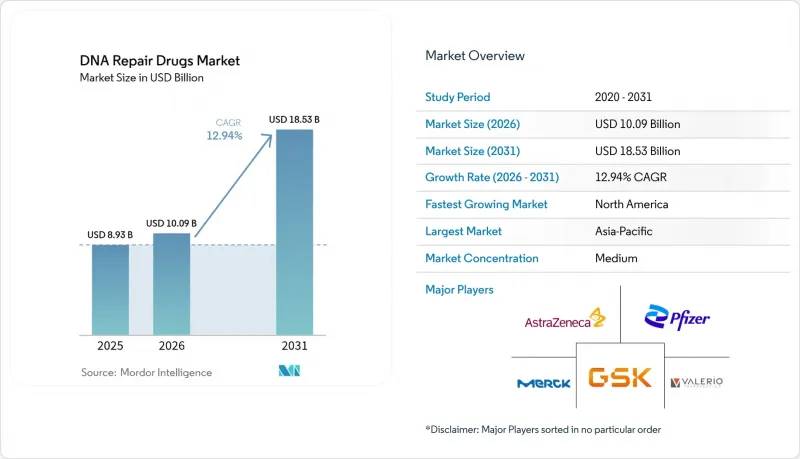
Mordor Intelligence에 의하면, DNA 복구 약물 시장 규모는 2025년 89억 3,000만 달러로 평가되었습니다. 2026년에는 100억 9,000만 달러로 확대되어 2026년부터 2031년에 걸쳐 CAGR 12.94%로 성장을 지속하여, 2031년에는 185억 3,000만 달러에 이를 것으로 예측됩니다.
본 보고서는 약물 유형(PARP 억제제 등), 적응증(난소암 등), 치료 단계(1차 치료 및 2차·그 이후 치료), 유통 채널(병원 약국, 전문 약국·소매 약국, 온라인 약국), 지역(북미, 유럽, 아시아태평양 등)별로 분류되어 있습니다. 시장 예측은 금액(미 달러) 기준으로 제시되어 있습니다.
세계의 DNA 복구 약물 시장 동향 및 인사이트
HR 결손 고형암 발생률 증가
HRD 검사의 보급으로 인해 DNA 복구 약물 시장의 치료 대상이 되는 환자층이 확대되고 있습니다. 고악성도 장액성 난소종양의 약 50% 및 전립선암의 최대 25%에서 치료 대상이 될 수 있는 DNA 복구 결함이 확인됩니다. 따라서 광범위한 NGS 패널이 일상 진료에 도입됨에 따라 새로운 환자층이 개척되고, 특히 보험 적용 체계가 잘 갖춰진 지역에서 처방량이 지속적으로 증가할 것입니다.
PARP 억제제의 적응증 확대 : 조기 치료 및 유지 요법으로의 확대
PRIMA 임상시험에서 나타난 바와 같이, 1차 치료 및 유지 요법에서의 사용은 후기 치료에서의 사용에 비해 치료 기간을 10-12개월 연장합니다. 이 임상시험에서 니라파리브는 HRD 양성 난소암에서 5년 무재발 생존율(PFS) 35%를 달성했습니다. 치료 기간의 연장은 누적 매출 증가로 이어져, 해당 약물군 시장 지위를 강화할 것입니다.
HRD/BRCA 검사의 높은 비용이 적격 환자군을 제한
종합적인 유전체 프로파일링 비용은 환자 1인당 3,500-5,800달러로, 이로 인해 미국에서는 가이드라인 대상 난소암 사례의 47%에 그치고 있어 검사 수검률이 제한되고 있습니다. 저·중소득 지역에서는 경제적 부담의 격차가 더욱 커, 표적 치료를 이용할 수 있는 환자의 실제 수는 더욱 줄어들고 있습니다.
부문별 분석
PARP 억제제는 난소암, 유방암, 전립선암 분야에서 확고한 상업적 기반을 바탕으로 2025년 DNA 복구 약물 시장의 49.02% 점유율을 유지했습니다. 이 계열의 DNA 복구 약물 시장 규모는 경쟁이 심화되고 있음에도 불구하고 꾸준히 확대될 것으로 예측됩니다. 이러한 성장세는 ATM 키나아제 억제제로 이동하고 있으며, 라르테르셀티브 및 기타 파이프라인 의약품이 후기 임상시험 단계에 진입함에 따라 연평균 성장률(CAGR) 18.92%를 나타낼 것으로 예측됩니다. 이 약물의 매력은 전립선암, 췌장암, 위암의 5-8%를 차지하는 ATM 결핍을 가진 종양에 대한 효능에 있습니다.
초기 데이터에 따르면, 기존 PARP 요법에 난치성을 보였던 종양에서도 객관적 반응이 확인되었으며, 이 부문은 내성 관리의 선택지로 입지를 다져가고 있습니다. 각 제약사는 ATM 억제제를 1차 치료 임상시험에 포함시키고 있어 시장 침투 가능성을 가속화하고 있습니다. 지속 투여형 경구 제제는 외래 암 치료로 향하는 의료 시스템의 동향과 더욱 부합하며, 전문 약국을 통한 유통 경로로의 침투를 뒷받침하고 있습니다. 전반적으로, 파이프라인의 충실도를 고려할 때, ATM 억제제는 1세대 제품의 특허 만료가 예정된 2030년까지 PARP 억제제가 현재 차지하고 있는 주도적 지위를 잠식할 가능성이 있는 것으로 보입니다.
난소암은 확립된 PARP 유지 요법 프로토콜과 HRD 유병률이 가장 높다는 점으로 인해 2025년 매출의 38.72%를 차지했습니다. 이 적응증과 관련된 DNA 복구 약물 시장 규모는 여전히 견조하지만, 선진국 시장에서의 보급률이 포화 상태에 가까워짐에 따라 성장은 둔화되고 있습니다. 대조적으로, 전립선암은 올라파립과 아비라테론의 병용 요법에 따른 전체 생존 기간의 현저한 개선(생존 중앙값이 42.1개월로 연장)으로 인해 17.86%의 연평균 성장률(CAGR)로 시장을 주도하고 있습니다.
전이성 거세 저항성 전립선암 외에도, 제약 기업들은 현재 호르몬 민감성 및 국소성 사례에 대한 병용 요법 임상시험을 진행 중이며, 이로 인해 적격 환자 수가 4배로 확대될 가능성이 있습니다. APODDC 가이드라인에 힘입어 차세대 염기서열 분석(NGS)의 도입이 확대됨에 따라 아시아태평양 전체에서 진단 포착률이 더욱 높아져 수요 증가를 뒷받침할 것입니다. 동시에, BRCA 변이가 없는 종양에서 합성 치사 파트너가 PARP 활성을 증폭시킴에 따라 췌장암 및 대장암 시장 기회도 확대되고 있습니다.
지역별 분석
북미는 HRD 검사에 대한 규제 당국의 조기 승인 및 보험 적용을 배경으로 2025년 매출의 47.35%를 차지했습니다. 통합형 의료 시스템이 운영하는 전문 약국은 유전체 검사에서 치료로의 원활한 전환을 촉진하며, 꾸준한 검사 건수 증가를 이끌고 있습니다. 또한, 이 지역에서는 ATR-PARP 및 PARP-체크포인트 억제제의 병용 요법을 검증하는 임상시험이 가장 집중적으로 수행되고 있어, 향후 승인 후 신속한 보급이 확실시되고 있습니다.
아시아태평양은 가장 빠르게 성장하는 지역으로, 정밀 종양학 노력을 통해 축적된 수요가 해소됨에 따라 2031년까지 연평균 16.35%의 성장률이 예상됩니다. 중국에서는 FLAMES 임상시험을 바탕으로 2025년에 세나파립의 난소암 1차 치료 유지요법 승인이 내려진 것이 규제 측면에서의 모멘텀이 가속화되고 있음을 보여줍니다. 일본과 한국에서는 다유전자 HRD 패널을 보험 적용 대상에 포함하도록 환급 규정이 개정되었으며, 검사 채택률은 60%를 초과하고 있습니다. 인도 및 동남아시아 시장에서는 시장 침투율이 여전히 낮은 편이지만, 현지 계약 연구 기관(CRO)이 해당 지역에 비용 효율적인 임상시험을 도입함에 따라 추세가 상승하고 있습니다.
유럽은 두 번째로 큰 시장 점유율을 차지하고 있으며, 연평균 성장률(CAGR) 12.21%로 꾸준히 확대되고 있습니다. 각국의 보험 급여 기관은 바이오마커 기반 프레임워크를 점점 더 의무화하고 있으며, 이는 신규 DDR 약물에 대한 유럽의약품청(EMA)의 긍정적인 위험-이익 평가와 일치합니다. 남미, 중동 및 아프리카는 기준치는 낮지만 각각 연평균 성장률(CAGR) 12.96% 및 14.66%로 성장을 지속하고 있습니다. 다국적 기업들은 경제적 장벽을 극복하기 위해 단계적 가격 책정 전략이나 민관 협력에 의한 진단 파트너십을 시범적으로 도입하고 있습니다. 브라질, 사우디아라비아, 아랍에미리트(UAE)의 3차 암 치료 센터 확대로 인해 임상시험 참여가 확대되고, 의료진의 DDR 기전에 대한 이해가 깊어질 것으로 기대됩니다.
기타 혜택 :
- 엑셀 형식 시장 예측(ME) 시트
- 3개월간의 애널리스트 지원
자주 묻는 질문
목차
제1장 서론
제2장 조사 방법
제3장 개요
제4장 시장 구도
제5장 시장 규모 및 성장 예측
제6장 경쟁 구도
제7장 시장 기회 및 향후 전망
KTH 26.08.31According to Mordor Intelligence, the DNA repair drugs market size is expected to grow from USD 8.93 billion in 2025 to USD 10.09 billion in 2026 and is forecast to reach USD 18.53 billion by 2031 at 12.94% CAGR over 2026-2031.
This report is Segmented by Drug Type (PARP Inhibitors and More), Indication (Ovarian Cancer, and More), Line of Therapy (First-Line and Second/Subsequent-Line), Distribution Channel (Hospital Pharmacies, Specialty & Retail Pharmacies, and Online Pharmacies), and Geography (North America, Europe, Asia-Pacific, and More). The Market Forecasts are Provided in Terms of Value (USD).
Global DNA Repair Drugs Market Trends and Insights
Rising Incidence of HR-Deficient Solid Tumors
Expanding HRD testing is enlarging the treatable population for the DNA repair drugs market. Around 50% of high-grade serous ovarian tumors and up to 25% of prostate cancers harbor actionable DNA repair defects. Integration of broad NGS panels into routine care, therefore, unlocks new patient pools and sustains prescription growth, especially where payer coverage is mature.
Label Expansion of PARP Inhibitors into Early-Line & Maintenance Settings
Front-line maintenance use is lengthening therapy duration by 10-12 months versus later-line use, as demonstrated in the PRIMA trial where niraparib yielded a 5-year progression-free survival (PFS) rate of 35% in HRD-positive ovarian cancer. Extended exposure drives higher cumulative sales and strengthens class incumbency.
High Cost of HRD / BRCA Testing Limiting Eligible Patient Pool
Comprehensive genomic profiling costs USD 3,500-5,800 per patient, limiting test uptake to 47% of guideline-eligible ovarian-cancer cases in the United States. The affordability gap is wider in low- and middle-income regions, shrinking the real-world funnel of patients who can access targeted therapies.
Other drivers and restraints analyzed in the detailed report include:
- Adoption of Synthetic-Lethality Combination Regimens
- Shift Toward Oral Oncolytics in Oncology Formularies
- Safety Signals-Myelosuppression & MDS/AML-Capping Duration of Therapy
For complete list of drivers and restraints, kindly check the Table Of Contents.
Segment Analysis
PARP inhibitors retained 49.02% of the DNA repair drugs market share in 2025, underpinned by mature commercial footprints across ovarian, breast, and prostate cancers. The DNA repair drugs market size for this class is projected to expand steadily, although competitive intensity is rising. Momentum is shifting toward ATM kinase inhibitors, forecast to clock a 18.92% CAGR as lartesertib and other pipeline agents enter late-phase trials. Their appeal lies in activity against tumors harboring ATM loss, which encompasses 5-8% of prostate, pancreatic, and gastric cancers.
Early data show objective responses in tumors previously refractory to PARP therapy, positioning the segment as a resistance-management option. Manufacturers are layering ATM inhibitors into frontline trials, accelerating potential uptake. Continuous-dosing oral formulations further align with the health-system trend toward ambulatory oncology, bolstering channel penetration through specialty pharmacies. Collectively, pipeline depth suggests ATM inhibitors may erode the incumbent lead of PARP agents by 2030, when first-generation products face patent expiry.
Ovarian cancer generated 38.72% of 2025 revenue because of entrenched PARP maintenance protocols and the highest prevalence of HRD. The DNA repair drugs market size attached to this indication remains robust, yet growth is moderating as penetration approaches saturation in developed markets. In contrast, prostate cancer is pacing the field with an 17.86% CAGR owing to compelling overall-survival gains with olaparib-abiraterone doublets that lifted median survival to 42.1 months.
Beyond metastatic castration-resistant prostate cancer, sponsors are now testing combinations in hormone-sensitive and localized settings, potentially quadrupling the eligible patient base. Heightened NGS adoption-spurred by APODDC guidelines-will further raise diagnostic capture rates across Asia Pacific, reinforcing demand growth. Simultaneously, pancreatic and colorectal cancers are moving up the opportunity curve as synthetic-lethal partners magnify PARP activity in tumors without BRCA mutations.
Complete Report Scope:
- By Drug Type
- PARP Inhibitors
- ATM Kinase Inhibitors
- ATR Inhibitors
- DNA-PK Inhibitors
- Other Drug Types
- By Indication
- Ovarian Cancer
- Breast Cancer
- Prostate Cancer
- Pancreatic Cancer
- Glioblastoma & CNS Tumors
- Other Indications
- By Line of Therapy
- First-Line Maintenance
- Second-/Subsequent-Line Treatment
- By Distribution Channel
- Hospital Pharmacies
- Specialty & Retail Pharmacies
- Online Pharmacies
- By Geography (Value)
- North America
- United States
- Canada
- Mexico
- Europe
- Germany
- United Kingdom
- France
- Italy
- Spain
- Rest of Europe
- Asia-Pacific
- China
- India
- Japan
- Australia
- South Korea
- Rest of Asia-Pacific
- Middle East & Africa
- GCC
- South Africa
- Rest of Middle East & Africa
- South America
- Brazil
- Argentina
- Rest of South America
- North America
Geography Analysis
North America generated 47.35% of 2025 revenue, anchored by early regulatory approvals and payer coverage for HRD testing. Integrated health-system ownership of specialty pharmacies promotes seamless genomic test-to-treatment conversion, propelling steady volume growth. The region also hosts the highest density of combination trials exploring ATR-PARP and PARP-checkpoint inhibitor regimens, ensuring rapid uptake of future approvals.
Asia Pacific is the fastest-growing territory, advancing at 16.35% through 2031 as precision-oncology initiatives unlock pent-up demand. China's 2025 approval of senaparib for first-line ovarian maintenance-based on the FLAMES Study-illustrates accelerating regulatory momentum. Japan and South Korea are updating reimbursement schedules to include multigene HRD panels, elevating test adoption rates above 60%. India and Southeast Asian markets remain underpenetrated but are trending upward as local contract research organizations bring cost-efficient trials to the region.
Europe holds the second-largest share and is expanding at a steady 12.21% CAGR. National reimbursement bodies increasingly mandate biomarker-driven frameworks, aligning with EMA favorable benefit-risk assessments for new DDR agents. South America and the Middle East and Africa are tracking 12.96% and 14.66% CAGRs, respectively, albeit from lower baselines. Multinational firms are piloting tiered-pricing strategies and public-private diagnostic partnerships to overcome affordability barriers. Expansion of tertiary oncology centers across Brazil, Saudi Arabia and the United Arab Emirates is expected to widen clinical trial participation, bolstering physician familiarity with DDR mechanisms.
- Abbvie
- Allarity Therapeutics Inc.
- Antengene Corporation Limited
- Artios Pharma Ltd.
- AstraZeneca
- Breakpoint Therapeutics GmbH
- FoRx Therapeutics AG
- GlaxoSmithKline
- Ideaya Biosciences
- Johnson & Johnson
- Merck
- Novartis
- Pfizer
- Rakovina Therapeutics Inc.
- Repare Therapeutics Inc.
- Tolmar, Inc
- Valerio Therapeutics
- Zai Lab Ltd.
Additional Benefits:
- The market estimate (ME) sheet in Excel format
- 3 months of analyst support
TABLE OF CONTENTS
1 Introduction
- 1.1 Study Assumptions & Market Definition
- 1.2 Scope of the Study
2 Research Methodology
3 Executive Summary
4 Market Landscape
- 4.1 Market Overview
- 4.2 Market Drivers
- 4.2.1 Rising Incidence of HR-Deficient Solid Tumours
- 4.2.2 Label Expansion of PARP Inhibitors into Early-Line & Maintenance Settings
- 4.2.3 Adoption of Synthetic-Lethality Combination Regimens
- 4.2.4 Shift Toward Oral Oncolytics in Oncology Formularies
- 4.2.5 Accelerated Regulatory Pathways Shortening Time-to-Market
- 4.2.6 Public Precision-Oncology Initiatives Driving Companion-Dx Uptake
- 4.3 Market Restraints
- 4.3.1 High Cost of HRD / BRCA Testing Limiting Eligible Patient Pool
- 4.3.2 Safety Signals-Myelosuppression & MDS/AML-Capping Duration of Therapy
- 4.3.3 Escalating Payer Scrutiny on Overall-Survival Benefit vs. Standard Chemotherapy
- 4.3.4 Patent Cliff 2028-30 for First-Wave PARP Inhibitors Dampening Revenue Visibility
- 4.4 Supply Chain Analysis
- 4.5 Regulatory Outlook
- 4.6 Porter's Five Forces Analysis
- 4.6.1 Threat of New Entrants
- 4.6.2 Bargaining Power of Buyers
- 4.6.3 Bargaining Power of Suppliers
- 4.6.4 Threat of Substitutes
- 4.6.5 Intensity of Competitive Rivalry
5 Market Size & Growth Forecasts (Value, USD)
- 5.1 By Drug Type
- 5.1.1 PARP Inhibitors
- 5.1.2 ATM Kinase Inhibitors
- 5.1.3 ATR Inhibitors
- 5.1.4 DNA-PK Inhibitors
- 5.1.5 Other Drug Types
- 5.2 By Indication
- 5.2.1 Ovarian Cancer
- 5.2.2 Breast Cancer
- 5.2.3 Prostate Cancer
- 5.2.4 Pancreatic Cancer
- 5.2.5 Glioblastoma & CNS Tumors
- 5.2.6 Other Indications
- 5.3 By Line of Therapy
- 5.3.1 First-Line Maintenance
- 5.3.2 Second-/Subsequent-Line Treatment
- 5.4 By Distribution Channel
- 5.4.1 Hospital Pharmacies
- 5.4.2 Specialty & Retail Pharmacies
- 5.4.3 Online Pharmacies
- 5.5 By Geography (Value)
- 5.5.1 North America
- 5.5.1.1 United States
- 5.5.1.2 Canada
- 5.5.1.3 Mexico
- 5.5.2 Europe
- 5.5.2.1 Germany
- 5.5.2.2 United Kingdom
- 5.5.2.3 France
- 5.5.2.4 Italy
- 5.5.2.5 Spain
- 5.5.2.6 Rest of Europe
- 5.5.3 Asia-Pacific
- 5.5.3.1 China
- 5.5.3.2 India
- 5.5.3.3 Japan
- 5.5.3.4 Australia
- 5.5.3.5 South Korea
- 5.5.3.6 Rest of Asia-Pacific
- 5.5.4 Middle East & Africa
- 5.5.4.1 GCC
- 5.5.4.2 South Africa
- 5.5.4.3 Rest of Middle East & Africa
- 5.5.5 South America
- 5.5.5.1 Brazil
- 5.5.5.2 Argentina
- 5.5.5.3 Rest of South America
- 5.5.1 North America
6 Competitive Landscape
- 6.1 Market Concentration
- 6.2 Competitive Benchmarking
- 6.3 Market Share Analysis
- 6.4 Company Profiles (includes Global level Overview, Market level overview, Core Segments, Financials as available, Strategic Information, Market Rank/Share for key companies, Products & Services, and Recent Developments)
- 6.4.1 AbbVie Inc.
- 6.4.2 Allarity Therapeutics Inc.
- 6.4.3 Antengene Corporation Limited
- 6.4.4 Artios Pharma Ltd.
- 6.4.5 AstraZeneca PLC
- 6.4.6 Breakpoint Therapeutics GmbH
- 6.4.7 FoRx Therapeutics AG
- 6.4.8 GlaxoSmithKline PLC
- 6.4.9 Ideaya Biosciences
- 6.4.10 Johnson & Johnson (Janssen)
- 6.4.11 Merck KGaA (EMD Serono)
- 6.4.12 Novartis AG
- 6.4.13 Pfizer Inc.
- 6.4.14 Rakovina Therapeutics Inc.
- 6.4.15 Repare Therapeutics Inc.
- 6.4.16 Tolmar, Inc
- 6.4.17 Valerio Therapeutics
- 6.4.18 Zai Lab Ltd.
7 Market Opportunities & Future Outlook
- 7.1 White-Space & Unmet-Need Assessment